

Occupancy Sensor Technology Innovation: Key Trends, Growth Drivers and Opportunities
Introduction to Occupancy Sensor Technology
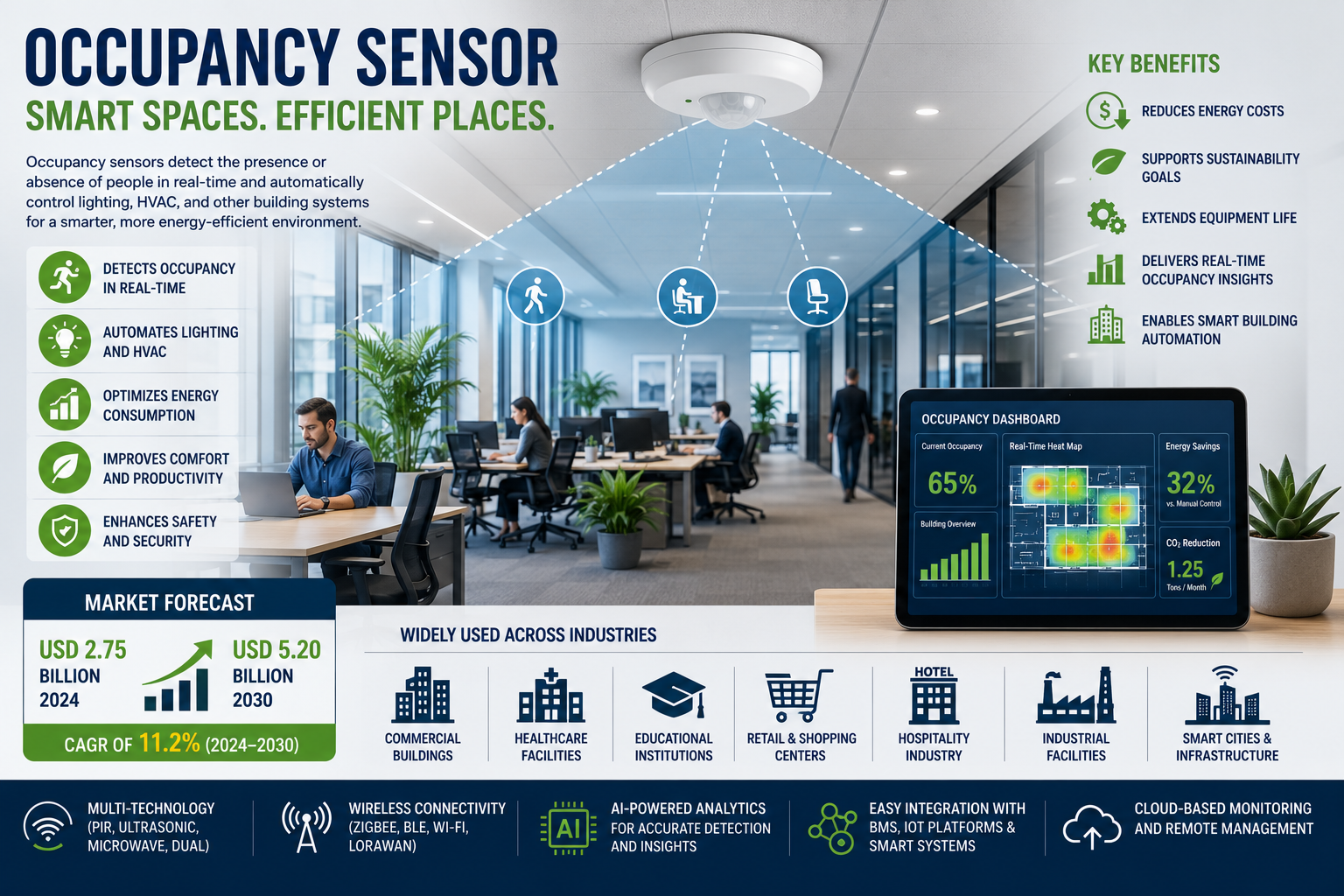
Occupancy sensor technology plays a vital role in intelligent building automation by detecting the presence of occupants and automatically controlling lighting, HVAC, security, and other building systems to improve energy efficiency, optimize space utilization, and enhance occupant comfort. Driven by the growth of smart buildings, IoT, and energy-efficient infrastructure, modern occupancy sensors leverage technologies such as Passive Infrared (PIR), Ultrasonic, Microwave, Dual-technology, image-based sensing, and AI-powered analytics for accurate and reliable detection. Integration with cloud platforms, wireless networks, and building management systems (BMS) enables real-time occupancy monitoring, resource optimization, and reduced operational costs. Additionally, stringent energy efficiency regulations and green building initiatives are accelerating the adoption of intelligent occupancy sensors across commercial, residential, healthcare, educational, and industrial facilities.
History of Occupancy Sensor Technology
Occupancy sensor technology has evolved from basic Passive Infrared (PIR) sensors used for automated lighting control to advanced intelligent systems that support smart building automation. Early PIR sensors improved energy efficiency but had limitations in detecting stationary occupants, leading to the development of ultrasonic, microwave, and dual-technology sensors for greater accuracy and reliability. Today, occupancy sensors integrate artificial intelligence (AI), machine learning, computer vision, IoT connectivity, and cloud-based building management systems to deliver real-time occupancy analytics, predictive energy management, automated environmental control, enhanced security, and data-driven facility management.
Benefits of Occupancy Sensor Technology
Occupancy sensor technology offers numerous operational, environmental, and financial benefits by automating building functions based on real-time occupancy information. Beyond reducing energy consumption, these systems improve occupant comfort, enhance workplace productivity, strengthen building security, and optimize facility management. Organizations implementing intelligent occupancy sensing solutions can significantly reduce operating expenses while supporting sustainability initiatives and regulatory compliance.
Key Benefits Include:
- Reduces energy consumption by automating lighting and HVAC systems.
- Improves occupant comfort through intelligent environmental control.
- Optimizes space utilization using real-time occupancy analytics.
- Lowers operational and maintenance costs across commercial facilities.
- Enhances building security through automated occupancy monitoring.
- Supports compliance with green building certifications and energy efficiency standards.
- Enables predictive facility management and data-driven decision-making.
- Increases sustainability by reducing carbon emissions and energy waste.
Current Market Size and Growth Trends of the Occupancy Sensor Industry
The occupancy sensor market is experiencing strong global growth, driven by rising demand for energy-efficient buildings, smart infrastructure, and intelligent building automation. Increasing electricity costs, government sustainability regulations, and smart city initiatives are accelerating the adoption of IoT-enabled occupancy sensors across residential, commercial, industrial, and public infrastructure projects. Integrated with lighting, HVAC, security, and building management systems, these sensors help optimize energy consumption and operational efficiency. Additionally, the expansion of hybrid workplaces, healthcare facilities, educational institutions, and commercial real estate is boosting demand for occupancy analytics to improve space utilization, reduce operating costs, and enhance occupant comfort.
According to MarketsandMarkets, the global occupancy sensor market is projected to grow from USD 2.75 billion in 2024 to USD 5.20 billion by 2030, registering a CAGR of 11.2% during the forecast period.
Download PDF Brochure: https://www.marketsandmarkets.com/pdfdownloadNew.asp?id=3859894
Several factors are driving this strong market expansion:
- Rapid adoption of smart buildings and intelligent infrastructure.
- Growing implementation of IoT-enabled building automation systems.
- Increasing demand for energy-efficient lighting and HVAC controls.
- Rising investments in smart cities and sustainable construction.
- Government regulations promoting green buildings and energy conservation.
- Expansion of commercial offices, healthcare facilities, educational institutions, and hospitality sectors.
- Continuous innovation in AI-powered occupancy analytics, wireless sensors, and cloud-connected building management platforms.
Key Drivers and Factors Influencing the Future of Occupancy Sensor Technology
- Smart building adoption is driving demand for occupancy sensors that integrate with lighting, HVAC, security, and Building Management Systems (BMS) to optimize energy use, automate environmental controls, and improve occupant comfort.
- The rapid expansion of IoT-enabled infrastructure allows occupancy sensors to deliver real-time occupancy data, enabling remote monitoring, predictive facility management, workspace optimization, and data-driven decision-making.
- Stringent energy efficiency regulations and green building certifications such as LEED, WELL Building Standard, and BREEAM are accelerating the deployment of occupancy-based lighting and HVAC control systems to reduce energy consumption and carbon emissions.
- The rise of hybrid workplaces is increasing the need for occupancy analytics to monitor desk utilization, meeting room usage, and employee movement, helping organizations optimize office layouts and reduce operational costs.
- Artificial intelligence (AI), machine learning, cloud computing, and edge processing are enhancing occupancy sensing with predictive analytics, behavioral insights, and autonomous building management that adapts to real-time occupancy patterns.
Emerging Trends in Occupancy Sensor Technology
- AI-powered occupancy analytics are enabling sensors to distinguish actual room usage from transient movement, improving energy management through predictive control of lighting, HVAC, and ventilation systems.
- Wireless occupancy sensors using technologies such as Zigbee, Bluetooth Low Energy (BLE), Wi-Fi, Thread, LoRaWAN, and EnOcean are simplifying installation, reducing infrastructure costs, and supporting building retrofits.
- Multi-technology sensing combines PIR, ultrasonic, microwave, image-based sensing, and environmental monitoring to deliver higher detection accuracy and minimize false activations.
- Edge computing and smart city integration are enhancing real-time data processing, cybersecurity, operational reliability, and occupancy-based management across municipal buildings, airports, healthcare facilities, campuses, and public infrastructure.
- Integration with digital twins is enabling facility managers to simulate building operations, optimize space utilization, improve energy performance, and enhance emergency planning using real-time occupancy data.
Opportunities and Challenges in the Occupancy Sensor Market
- Growing investments in smart buildings, sustainable infrastructure, and smart cities are creating significant opportunities for occupancy sensors to improve energy efficiency, automate public infrastructure, and support intelligent building management.
- Commercial real estate, hybrid workplaces, and healthcare facilities are driving adoption of occupancy sensors for space optimization, workplace analytics, patient room management, automated environmental controls, and reduced operating costs.
- High initial installation and integration costs remain a key challenge, particularly for advanced sensor networks and building automation systems, despite their long-term energy savings and operational benefits.
- Privacy and cybersecurity concerns surrounding image-based occupancy sensing and data collection require organizations to implement robust security measures and comply with data protection regulations.
- Interoperability across multi-vendor building systems continues to be a challenge, highlighting the need for standardized communication protocols and seamless integration with diverse building management platforms.
Innovations and Advancements in Occupancy Sensor Technology
- Artificial intelligence (AI) and machine learning are enabling predictive occupancy analytics, adaptive detection, and automated building optimization by analyzing occupancy patterns and environmental conditions in real time.
- Sensor fusion combines technologies such as PIR, ultrasonic, microwave, ambient light, temperature, CO2, and humidity sensors to improve detection accuracy, optimize HVAC performance, and create healthier indoor environments.
- Cloud-connected occupancy sensors provide centralized monitoring, real-time dashboards, predictive maintenance alerts, and enterprise-wide occupancy analytics for efficient multi-building management.
- Digital twin technology integrates real-time occupancy data with virtual building models to simulate occupancy scenarios, optimize energy usage, enhance emergency planning, and improve long-term facility performance.
- Emerging technologies including edge computing, 5G, cybersecurity, and intelligent automation are paving the way for autonomous buildings that continuously optimize energy efficiency, occupant comfort, and operational performance.
Future Applications and Industries That Will Benefit from Occupancy Sensor Technology
- Commercial buildings, residential properties, healthcare facilities, educational institutions, and industrial plants will be the primary adopters of occupancy sensors to automate lighting, HVAC, security, and space management while improving energy efficiency and occupant comfort.
- Smart homes, hybrid workplaces, and smart factories will increasingly leverage AI-enabled occupancy sensing and IIoT integration to optimize energy consumption, workspace utilization, worker safety, and operational productivity.
- Retail, hospitality, transportation hubs, data centers, government buildings, smart cities, banking, and warehousing will use occupancy analytics for customer flow management, intelligent automation, enhanced security, resource optimization, and sustainable operations.
- Integration with AI, edge computing, digital twins, and cloud platforms will enable predictive building management, real-time occupancy insights, automated decision-making, and improved facility performance.
- As intelligent infrastructure expands, occupancy sensors will become a core technology for autonomous buildings and smart cities, supporting sustainability goals, reducing carbon emissions, and delivering more efficient, adaptive, and occupant-centric environments.
Conclusion: The Promising Future of Occupancy Sensor Technology
Occupancy sensor technology has evolved into a critical enabler of intelligent building automation, helping organizations improve energy efficiency, optimize facility operations, and create safer, more comfortable indoor environments. The integration of artificial intelligence, Internet of Things (IoT), cloud computing, wireless communication, and advanced sensing technologies is transforming occupancy sensors into intelligent systems capable of delivering valuable operational insights and supporting data-driven facility management.
Download Sample Research Report for Occupancy Sensor Technology Innovation @ https://www.marketsandmarkets.com/Market-Reports/occupancy-sensor-market-3859894.html
80% of the Forbes Global 2000 B2B companies rely on MarketsandMarkets to identify growth opportunities in emerging technologies and use cases that will have a positive revenue impact.
- Food Packaging Market Size Set for Strong Growth Through 2030 Amid Rising Demand for Convenience Foods
- Crop Protection Chemical Market Size, Share & Growth Forecast (2025–2030)
- Mulch Films Market: Driving Sustainable Agriculture Through Innovation
- Agricultural Adjuvants Market Analysis, Trends, and Growth Outlook (2026–2031)
- Japan Enterprise Asset Management Market Growth: AI and Smart Infrastructure Drive Demand

