

EV Battery Breakthrough Signals a New Growth Cycle for the Market
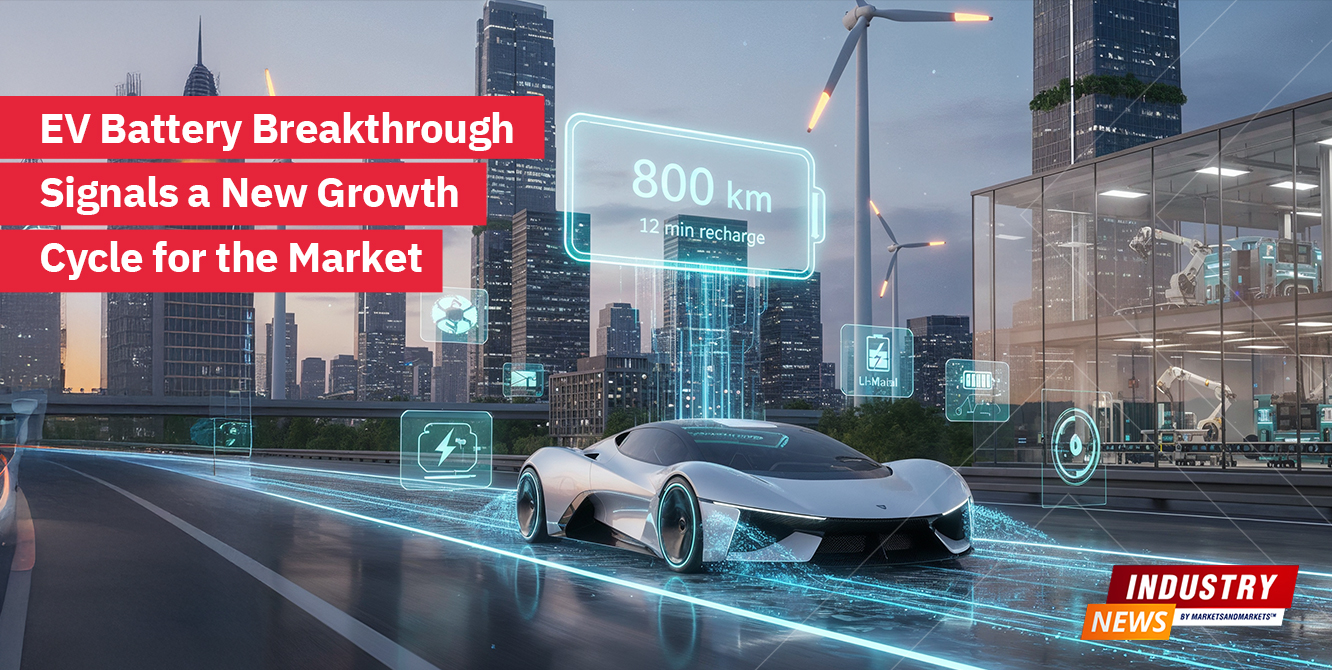
The EV landscape may be on the verge of a turning point. Imagine covering 800 kilometers on a single charge and then recharging your vehicle in just 12 minutes. What once seemed like a far-off future is now edging closer to reality.
Researchers at Korea Advanced Institute of Science & Technology (KAIST), in collaboration with LG Energy Solution, have unveiled a lithium-metal battery that directly addresses the industry’s long-standing challenge of dendrite formation. By deploying a novel electrolyte that ensures uniform lithium ion distribution, the team has engineered a system that combines ultra-fast charging with extended durability—lasting well beyond 300,000 kilometers of use. Tests show recharging from 5% to 70% in only 12 minutes, while maintaining performance stability across repeated cycles.
The implications are significant. This innovation directly confronts three of the most persistent barriers to EV adoption: limited range, long charging times, and battery longevity. If successfully scaled for mass production, “800 km in 12 minutes” could become the next defining promise of the EV industry, on par with “zero emissions.”
According to MarketsandMarkets™, the global EV Battery Market is projected to grow from USD 91.93 billion in 2024 to USD 251.33 billion by 2035, at a CAGR of 9.6%. Advancements such as lithium-metal and solid-state batteries are driving this next wave of disruption, moving beyond incremental improvements toward transformative performance gains. Players who can convert lab breakthroughs into scalable manufacturing will be best positioned to capture early leadership.
Asia-Pacific continues to be the epicenter of growth. With strong policy support, advanced supply chains, and large-scale production capacity, China, Japan, and South Korea are expected to lead commercialization efforts. For OEMs, cell manufacturers, and suppliers, aligning strategy with next-generation technologies is becoming a critical differentiator.
Challenges remain—including raw material sourcing, cost-efficient manufacturability, and safety validation—but the direction is unmistakable. This lithium-metal breakthrough signals not just a step forward in energy density, but a potential tipping point where technology, consumer demand, and market dynamics converge to accelerate global EV adoption.
For the EV Battery Market, this is more than innovation. It is the opening signal of a new growth cycle that could reshape competitiveness, redefine consumer expectations, and accelerate the shift to electric mobility.
MarketsandMarkets Industry News Desk
 Letter to Editor
GET AHEAD
Top Research Reports to Fuel Your Industry KnowledgeEditor's Pick

Healthcare
Cellevate’s Nanofiber Revolution 13× Higher Vaccine Yields, 85% Lower Costs.jpg)
Chemical and Materials
Semiconductor and IC Packaging Materials Gains Momentum as Amkor Invests $7B in Arizona
Information and Communication Technology
AI-Driven Data Center Expansion is Accelerating Innovation in Power Infrastructure WorldwidePODCASTS

Sustainable Digital Transformation & Industry 4.0
Sanjay Kaul, President-Asia Pacific & Japan, Cisco, and host Aashish Mehra, Chief Research Officer, MarketsandMarkets, in conversation on unraveling 'Sustainable Digital Transformation and Industry 4.0'
11 July 2023|S2E12|Listen Now

Generative AI
Prasad Joshi, Senior Vice President-Emerging Technology Solutions, Infosys, and host, Vinod Chikkareddy, CCO, MarketsandMarkets, in exploring the recent advances in AI and the generative AI space.
7 Nov 2023|S2E13|Listen Now


EV Battery Market to Reach $251.3 Billion by 2035, Driven by Next-Gen Technologies


From $91.9B to $251.3B: The Decade-Long Growth Path of the EV Battery Market
More than innovation, this is the opening signal of the EV industry’s next growth cycle.
Tracing the Journey of EV Battery Technology Through the Decades
The journey of electric vehicle batteries has been one of constant evolution. The earliest EVs in the late 19th century ran on bulky lead-acid batteries, offering limited range and speed. While they showed early promise, gasoline engines quickly overtook them due to superior energy density and convenience.



