
Electric Boats Market

Electric Boats Market by Boat Type (Cruising, Speedboat, Fishing, Passenger, Workboat, Patrol, and Combat), Power Source (Battery, Solar, and Hybrid), Boat Power (<5, 5–30, and >30 kW), Hull Type, Mode of Operation, Boat Size, and Region - Global Forecast to 2031




OVERVIEW
Source: Secondary Research, Interviews with Experts, MarketsandMarkets Analysis
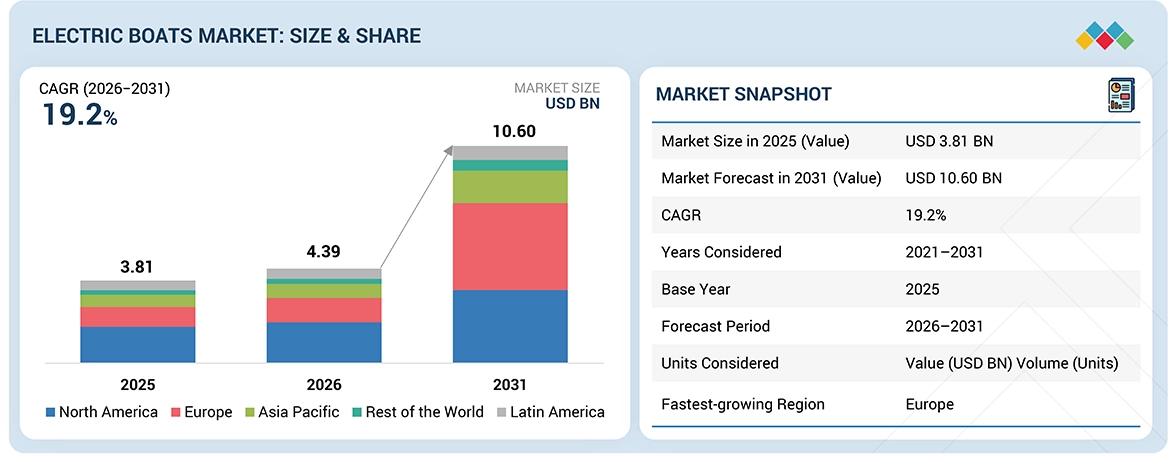
The electric boats market is projected to grow from USD 4.40 billion in 2026 to USD 10.60 billion in 2031, at a CAGR of 19.2%. The electric boats market is driven by the implementation of strict environmental laws that encourage zero-emission vessels, development in battery technology and electric engines, and a rising need for clean and noise-free water transport. Moreover, the development of marina charging infrastructure and surging use of electric boats in recreational activities and tourism also facilitate market expansion.
KEY TAKEAWAYS
-
By RegionEurope is expected to accounted for a 29.1% of market share in 2026. Driven by strict emission rules and government funding are pushing operators to adopt electric boats.
-
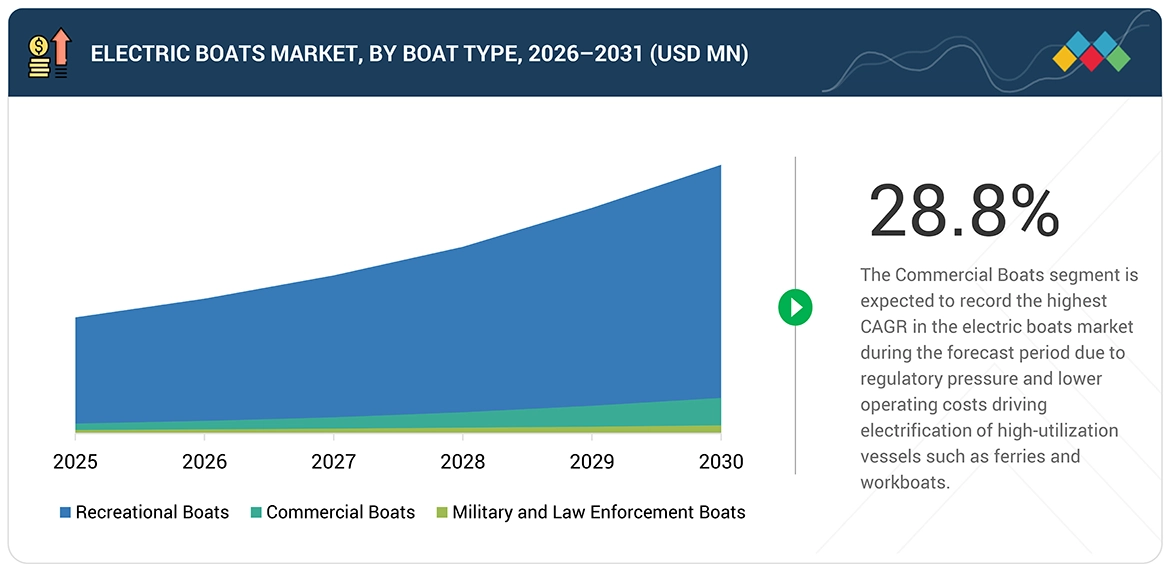
By Boat TypeBy end use, the commercial boats segment is expected to register the highest CAGR of 28.8% during the forecast period due to high fuel costs and fixed routes which make make electric boats more cost-effective for daily operations.
-
By Boat SizeBy boat size, the <20 feet segment is expected to dominate the market during the forecast period as smaller boats require less battery capacity, making electrification easier and more affordable.
-
By Hull TypeBy boat size, the mono hull segment is expected to dominate the market during the forecast period as existing monohull designs allow easier conversion to electric without major redesign.
-
By Power SourceBy boat size, the battery-powered Boats segment is expected to dominate the market during the forecast period as improvements in battery cost, safety and charging are making battery systems more practical.
-
By Boat PowerBy boat power, the >30 kW segment is expected to register the highest CAGR of 19.9% from 2026 to 2031 as growing demand for ferries and workboats is increasing the need for higher power electric systems.
-
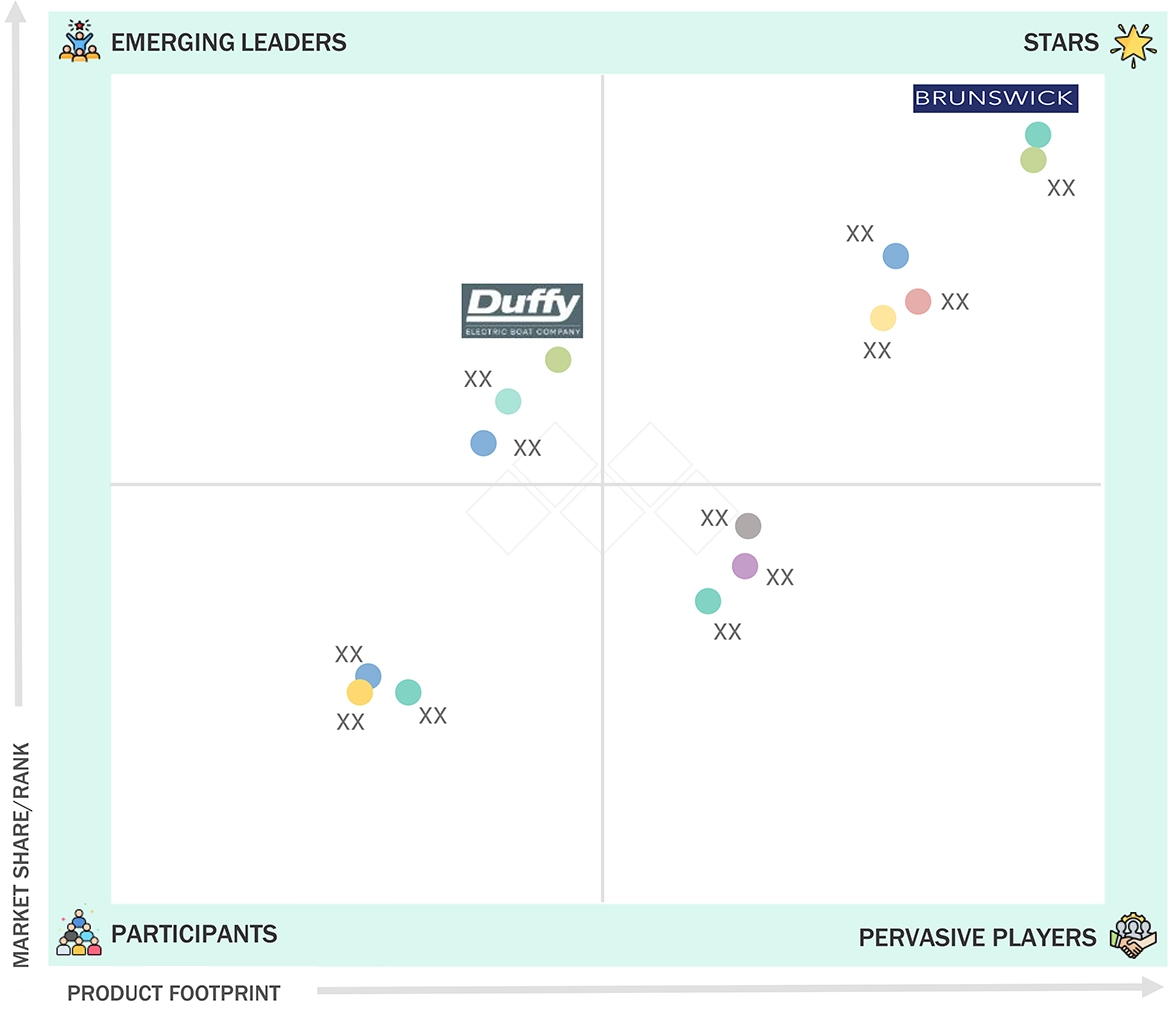
Competitive Landscape - Key CompaniesBrunswick Corporation, Groupe Beneteau , and Brunswick Corporation were identified as some of the star players in the electric boats market, given their strong market share and product footprint.
-
Competitive Landscape - Startups/SMEsAzimut Yachts, Callboats have distinguished themselves among startups and SMEs by securing strong footholds in specialized niche areas, underscoring their potential as emerging market leaders
The electric boats market is growing due to increasing use of electric propulsion in recreational, commercial, and patrol boats to reduce fuel use and operating costs. Improvements in battery capacity, development of hybrid systems, and integration of solar energy will facilitate the expansion of operational range and promote the adoption of electric propulsion on boats of all sizes. Adoption is also supported by rising demand for quieter operations and use in urban waterways and regulated areas.
TRENDS & DISRUPTIONS IMPACTING CUSTOMERS' CUSTOMERS
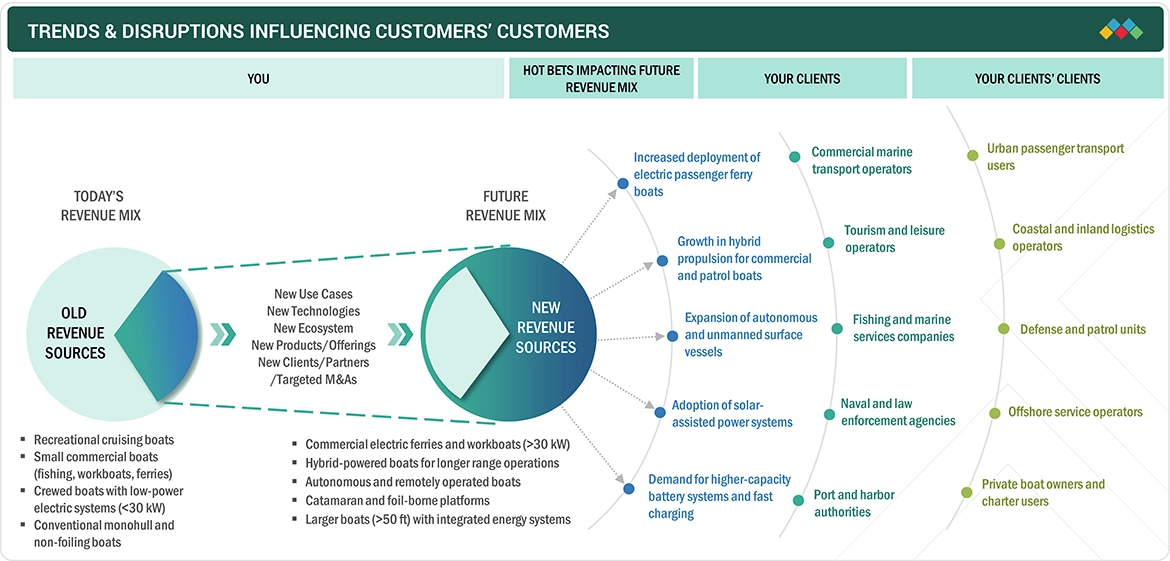
The impact on customers’ customers in the electric boats market comes from the growing use of electric propulsion across recreational, commercial, and patrol boats to reduce fuel use and operating costs. The industry has traditionally been dominated by recreational boat offerings, small commercial vessels, and low-powered electric boat components, but the market is now changing with rising interest in electric ferry boats, hybrid propulsion systems in commercial and patrol boats, unmanned surface vessels, solar hybrid propulsion systems, and high-capacity batteries that recharge rapidly. These innovations are impacting the dynamics of demand within marine transport operators, tourist attractions, fishing fleets, naval forces, and ports segments. As the marekt evolves, organizations must align their product lines, technology investments, partnerships, and acquisitions to capture emerging opportunities.
Source: Secondary Research, Interviews with Experts, MarketsandMarkets Analysis
MARKET DYNAMICS

Level
-
Rising focus of boat operators on reducing operating costs and fuel dependency

-
Improvements in battery capacity and hybrid/solar power systems


Level
-
Limited charging and shore power infrastructure

-
High upfront cost of high-power electric and hybrid boats


Level
-
Emergence of autonomous and remotely operated electric boats

-
Development of high-power electric and hybrid systems for larger commercial boats


Level
-
Constant improvements in conventional diesel and hybrid engines

-
High dependence on battery supply chains and raw materials

Source: Secondary Research, Interviews with Experts, MarketsandMarkets Analysis
Driver: Rising focus of boat operators on reducing operating costs and fuel dependency
The electric boats market growth is supported by the increasing focus of operators of recreational, commercial, and patrol boats on reducing fuel usage and operating costs.
Restraint: Limited charging and shore power infrastructure
Growth is limited by lack of charging and shore power infrastructure for commercial and larger boats across ports and inland waterways.
Opportunity: Emergence of autonomous and remotely operated electric boats
There is growing scope for autonomous and remotely operated electric boats in patrol, surveillance, and commercial operations presents growth opportunities, driven by elevating demand for unmanned maritime solutions that ensure operational efficiency, safety, and security, as well as reduce crew-related costs.
Challenge: Constant improvements in conventional diesel and hybrid engines
Conventional diesel and hybrid engines continue to be used, reducing the shift toward full electric boats, as as operators remain unsure about committing to full electrification given concerns around limited range, insufficient charging infrastructure, high upfront conversion costs, and the proven operational reliability that diesel and hybrid systems have long delivered across diverse maritime applications.
ELECTRIC BOATS MARKET: COMMERCIAL USE CASES ACROSS INDUSTRIES
| COMPANY | USE CASE DESCRIPTION | BENEFITS |
|---|---|---|
 |
Deployment of hybrid electric tugboats for harbor operations in Los Angeles and Long Beach to reduce emissions from high-power maneuvering activities | Reduces diesel consumption and emissions| Maintains high towing power | Lowers lifecycle operating costs | Enables partial zero-emission port operations |
 |
Development of electric hydrofoil ferry (Nova) for urban passenger transport in Stockholm to replace diesel ferries and improve efficiency | Cuts energy use by ~80% | Enables high-speed low-wake operations | Provides sustainable urban water transport with reduced environmental impact |
Logos and trademarks shown above are the property of their respective owners. Their use here is for informational and illustrative purposes only.
MARKET ECOSYSTEM
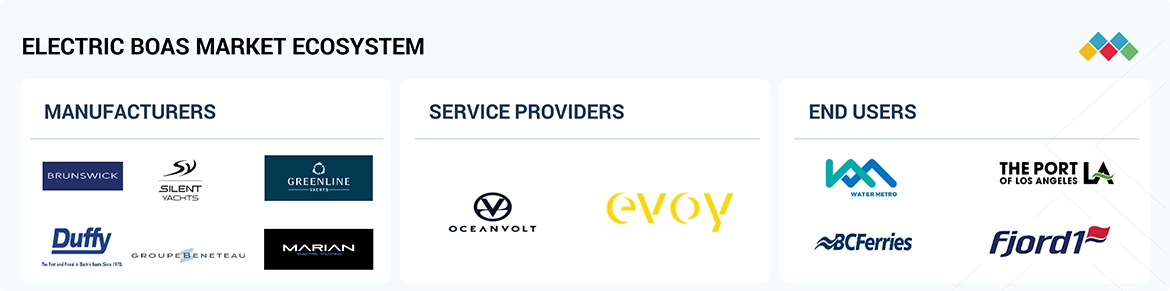
The electric boats market includes a mix of boat manufacturers and rental service providers. Key boat OEMs such as Brunswick, Groupe Beneteau, Frauscher, and Marian focus on designing and building electric boats with efficient battery systems and reliable propulsion. These companies work on improving performance, range, and ease of use. On the services side, rental providers such as Duffy Electric Boats and Ruban Bleu offer electric boats for leisure and tourism, helping increase customer access and awareness. The ecosystem also connects with battery suppliers, charging infrastructure providers, and marine component makers. Together, these players support the growth of electric boating by making boats more practical, reducing emissions, and improving overall user experience.
Logos and trademarks shown above are the property of their respective owners. Their use here is for informational and illustrative purposes only.
MARKET SEGMENTS
Source: Secondary Research, Interviews with Experts, MarketsandMarkets Analysis
Electric Boats Market, By Boat Type
The recreational boats segment is expected to dominate the market due to higher adoption of electric propulsion in small and mid-sized boats used for personal and leisure activities. These boats require lower power and shorter range making them more suitable for battery-powered systems. Demand is also supported by usage in lakes, coastal areas, and regulated zones where noise and emissions are restricted.
Electric Boats Market, By Boat Power
The >30 kW segment is expected to grow faster due to increasing use of electric and hybrid systems in larger boats such as ferries, work boats, and patrol vessels. These applications require higher power for longer operations and heavier loads. Growth is also supported by shift toward electrification in commercial and public transport use cases.
Electric Boats Market, By Boat Size
The >50 feet segment is expected to grow faster due to increasing use of electric and hybrid systems in larger boats such as ferries, yachts, and work boats. These vessels require higher power and longer operating range, making them suitable for advanced battery and hybrid setups. Growth is also supported by demand for commercial operations and long-distance cruising.
Electric Boats Market, By Mode by Operation
Crewed boats are expected to have the largest share because most passenger, recreational, and commercial boats still require onboard operators for safety, control, and regulatory compliance. Many use cases such as ferries, patrol boats, and leisure boats depend on human handling, which keeps demand for crewed systems higher than uncrewed options.
Electric Boats Market, By Hull Type
Monohull boats are expected to dominate because they are widely used across recreational, commercial and patrol applications due to their simple design and lower cost. They are easier to build, operate, and maintain compared to multi-hull boats, which supports higher adoption across most use cases.
Electric Boats Market, By Power Source
Battery-powered boats are expected to dominate because they are simpler to operate and are already widely used across small and medium boats. They have lower running and maintenance needs compared to hybrid or solar systems and are supported by improving battery performance and charging infrastructure.
REGION
Europe to be fastest-growing region in electric boats market during forecast period
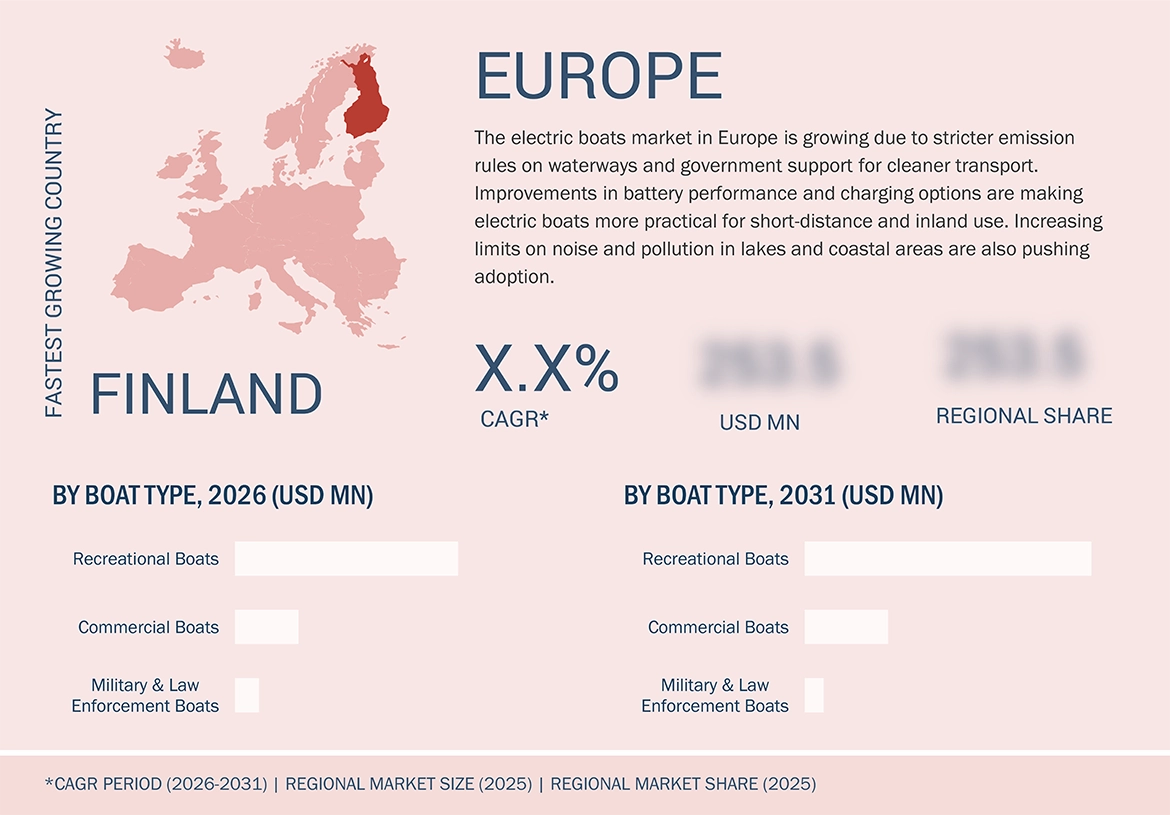
The European market is expected to grow at the fastest rate due to strict rules pertaining to emission and noise levels in waterways, which support the use of electric boats. The region also has higher use of electric ferries and recreational boats, along with better charging setup in ports and marinas. Early adoption across commercial and leisure segments also supports growth.
ELECTRIC BOATS MARKET: COMPANY EVALUATION MATRIX
In the electric boats market matrix, Brunswick Corporation (Star) has a strong position supported by its wide range of recreational and commercial boats and its presence across key marine markets. The company offers boats with electric and hybrid propulsion and has strong production and distribution capabilities, which support its position across different boat sizes and use cases. Salona Yachts (Emerging Leader) is building its position in the market through its focus on fully electric recreational boats, particularly in the small boat segment. The company operates with a direct-to-customer and dealer-based model and continues to expand its product offerings, supporting gradual growth as demand for low-speed, short-range electric boats increases.
Source: Secondary Research, Interviews with Experts, MarketsandMarkets Analysis
KEY MARKET PLAYERS
- Brunswick Corporation (US)
- Groupe Beneteau (France)
- AZIMUT | BENETTI GROUP (Italy)
- Arc Boat Company (US)
- Candela Technology AB (Sweden)
- BOOTE MARIAN GMBH (Austria)
- X SHORE (Sweden)
- Duffy Electric Boats (US)
- SAY Carbon Yachts (Germany)
- Ruban Bleu (France)
- Frauscher Bootswerft (Austria)
- Navalt (India)
- Ingenity Electric (US)
- Quadrofoil d.o.o (Slovenia)
- Greenline Yachts (Slovenia)
- Silent Yachts (Italy)
MARKET SCOPE
| REPORT METRIC | DETAILS |
|---|---|
| Market Size in 2025 | USD 3.81 Billion |
| Market Size in 2026 | USD 4.39 Billion |
| Market Forecast in 2031 | USD 10.60 Billion |
| CAGR | 19.2% |
| Years Considered | 2021–2031 |
| Base Year | 2025 |
| Forecast Period | 2026–2031 |
| Units Considered | USD Billion/No. of Units |
| Report Coverage | Revenue Forecast, Company Ranking, Competitive Landscape, Growth Factors, and Trends |
| Segments Covered |
|
| Regions Covered | North America, Asia Pacific, Europe, and Rest of the World |
WHAT IS IN IT FOR YOU: ELECTRIC BOATS MARKET REPORT CONTENT GUIDE
DELIVERED CUSTOMIZATIONS
We have successfully delivered the following deep-dive customizations:
| CLIENT REQUEST | CUSTOMIZATION DELIVERED | VALUE ADDS |
|---|---|---|
| Leading Manufacturer | Additional segment breakdown for countries | Additional country-level market sizing tables for segments/subsegments covered at the regional/global level to gain an understanding of market potential by each country |
| Emerging Leader | Additional company profiles | Competitive information on targeted players to gain granular insights on direct competition |
| Regional Market Leader | Additional country market estimates | Additional country-level deep dive for a more targeted understanding of the total addressable market |
RECENT DEVELOPMENTS
- April 2025 : Arc partnered with Portland shipyard Diversified Marine to retrofit a 26 ft tug with Arc’s electric powertrain as a prototype for zero-emission harbor operations at the Port of Los Angeles. The program will help validate performance, operability and scale-up requirements.
- May 2023 : Greenline Yachts appointed Derani Yachts as its official dealer and representative for Thailand, Malaysia, Singapore, and Indonesia to provide sales and aftersales support for Greenline’s hybrid yacht range. The announcement notes Derani’s regional experience and confirms the parties will promote and support Greenline models across those markets.
- June 2023 : Group Beneteau, in collaboration with Volvo, conducted a hands on hybrid-electric test at Volvo Penta’s Krossholmen facility collecting quantitative and qualitative data measuring user acceptance and priorities. Through this the partners identified requirements for charging HMI, boater education and commercialization.
Table of Contents
 Exclusive indicates content/data unique to MarketsandMarkets and not available with any competitors.
Methodology
The study involved four major activities to estimate the current size of the electric boat market. Exhaustive secondary research was conducted to gather information on the Electric boats market, its adjacent markets, and its parent market. The next step was to validate these findings, assumptions, and sizing with industry experts across the value chain through primary research. Demand-side analysis was conducted to estimate the overall market size. Thereafter, data triangulation procedures were employed to estimate the sizes of various segments and subsegments within the electric boats market.
Secondary Research
During the secondary research process, various sources were consulted to identify and collect information for this study. The secondary sources included government sources, such as SIPRI; corporate filings, including annual reports, press releases, and investor presentations; white papers, journals, and certified publications; and articles from recognized authors, directories, and databases.
Primary Research
Extensive primary research was conducted after acquiring information on the electric boat market through secondary research. Several primary interviews were conducted with market experts from the demand and supply sides across major countries of North America, Europe, Asia Pacific, and the Rest of the World (RoW). Primary data was collected through questionnaires, emails, and telephonic interviews.
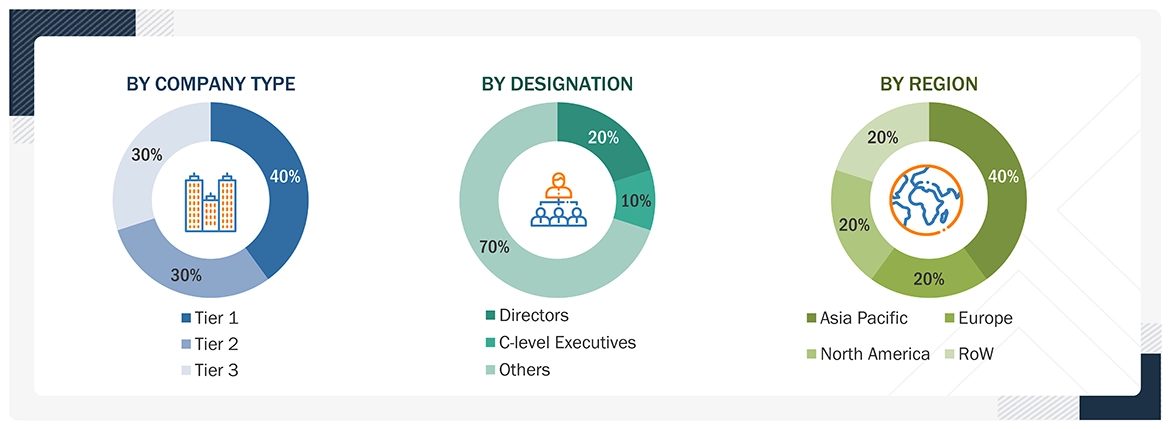
To know about the assumptions considered for the study, download the pdf brochure
Market Size Estimation
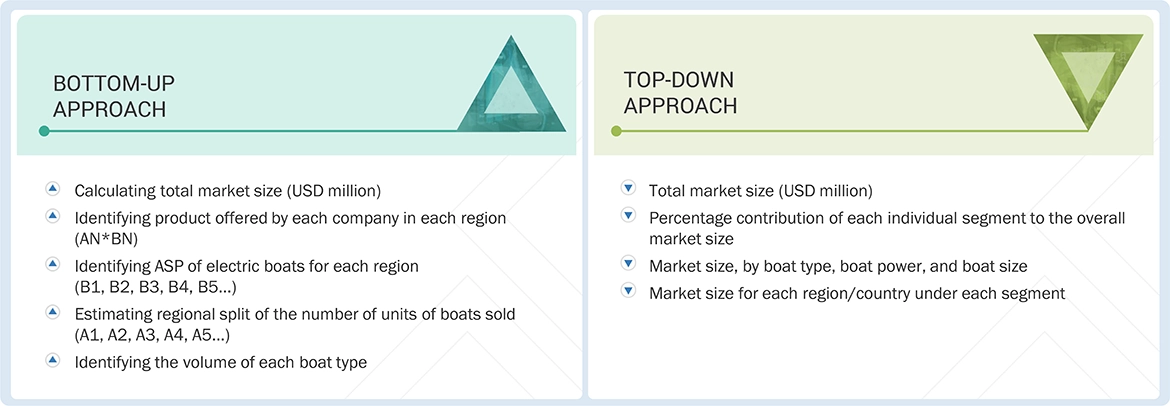
Top-down and bottom-up approaches were used to estimate and validate the size of the electric boat market. The research methodology used to estimate the size of the market included the following details:
- Key players in the electric boats market were identified through secondary research, and their market shares were determined through a combination of primary and secondary research. This included a study of the annual and financial reports of the top market players, as well as extensive interviews with leaders, including directors, engineers, marketing executives, and other key stakeholders of leading companies operating in the market.
- All percentage shares, splits, and breakdowns were determined using secondary sources and verified through primary sources.
- All possible parameters that affect the markets covered in this research study were accounted for, viewed in extensive detail, verified through primary research, and analyzed to obtain the final quantitative and qualitative data on the electric boats market. This data was consolidated, enhanced with detailed inputs, analyzed by MarketsandMarkets, and presented in this report.
Electric Boats Market : Top-Down and Bottom-Up Approach
Data Triangulation
After determining the overall market size, the total market was classified into several segments and subsegments. The data triangulation and market breakdown procedures explained below were implemented, wherever applicable, to complete the overall market engineering process and arrive at the estimated market numbers for the market segments and subsegments. The data was triangulated by examining various factors and trends on both the demand and supply sides. Additionally, the market size was validated using top-down and bottom-up approaches.
Market Definition
An electric boat is a vessel powered by electric propulsion systems, using onboard energy sources such as batteries, solar systems, or hybrid configurations combining electric and conventional power. These boats use electric motors for propulsion and may operate fully electric or in hybrid mode, depending on application and range requirements.
Within the market scope, electric boats include recreational, commercial, military and law enforcement vessels across different hull types and power capacities. The market covers battery-powered, solar-powered and hybrid-powered boats, including both crewed and uncrewed platforms, used in applications such as leisure boating, passenger transport, fishing, patrol and workboat operations.
Key Stakeholders
- Electric boat manufacturers
- Subcomponent manufacturers
- Technology support providers
- Research bodies
- System integrators
- Defense organizations
Report Objectives
- To define, describe, and forecast the electric boats market based on boat type, hull type, boat power, boat power source, boat size, and region, in terms of value and volume
- To forecast the size of various segments of the market across North America, Europe, Asia Pacific and RoW, in terms of value
- To identify and analyze the drivers, restraints, opportunities, and challenges influencing the growth of the market
- To identify industry trends, market trends, and technology trends currently prevailing in the electric boats market
- To provide an overview of the regulatory landscape with respect to electric boats across regions
- To analyze micromarkets with respect to individual growth trends, prospects, and their contribution to the overall market
- To analyze opportunities in the market for stakeholders by identifying key market trends
- To profile key market players and comprehensively analyze their market share and core competencies
- To evaluate the degree of competition in the market by analyzing recent developments, such as contracts, agreements, and acquisitions adopted by leading market players
- To identify detailed financial positions, key products, and unique selling points of leading companies in the market
- To provide a detailed competitive landscape of the market, along with market share analysis and revenue analysis of key players
Customization Options
MarketsandMarkets offers the following customizations for this market report:
- Additional country-level analysis of the electric boats market
- Profiling of other market players (up to 5)
Product Analysis
- Product matrix, which provides a detailed comparison of the product portfolios of each company in the electric boats market
Need a Tailored Report?
Customize this report to your needs
Get 10% FREE Customization
Customize This ReportPersonalize This Research
- Triangulate with your Own Data
- Get Data as per your Format and Definition
- Gain a Deeper Dive on a Specific Application, Geography, Customer or Competitor
- Any level of Personalization
Let Us Help You
- What are the Known and Unknown Adjacencies Impacting the Electric Boats Market
- What will your New Revenue Sources be?
- Who will be your Top Customer; what will make them switch?
- Defend your Market Share or Win Competitors
- Get a Scorecard for Target Partners

Custom Market Research Services
We Will Customise The Research For You, In Case The Report Listed Above Does Not Meet With Your Requirements
Get 10% Free Customisation



Growth opportunities and latent adjacency in Electric Boats Market