AI Assistant Market Size, Share & Growth Forecast to 2031

AI Assistant Market by Offering (Research, Sales, Presentation, Developer Assistants), Application (Meeting Transcription, Document Search, Email Sequencing, Scheduling, Code Completion, Design, Data Exploration, Spreadsheet AI) - Global Forecast to 2031




OVERVIEW
Source: Secondary Research, Interviews with Experts, MarketsandMarkets Analysis
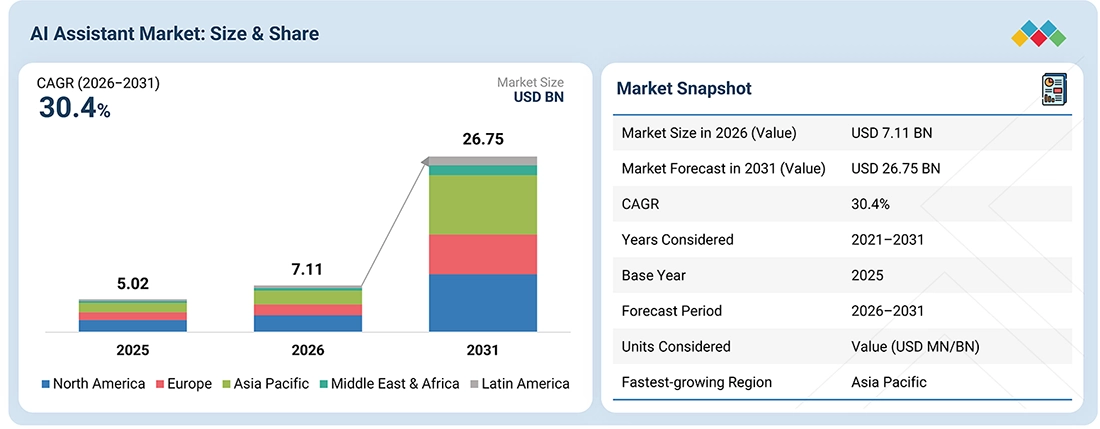
The AI assistant market is projected at USD 7.11 billion in 2026. It is expected to reach USD 26.75 billion by 2031 across major markets. This represents a 30.4% CAGR during the forecast period. Market expansion is supported by advances in reasoning, memory, and multimodal interaction capabilities. Organizations are integrating assistants across productivity, research, coding, collaboration, and customer workflows. Adoption is also strengthening for enterprise assistants grounded in proprietary organizational data. Enterprise integrations enable AI assistants to access business context and support more relevant, continuous workflows. Demand is growing for assistants that support multilingual, multimodal, and role-specific enterprise use cases. These capabilities improve productivity, information access, automation, and decision-making across increasingly complex digital environments.
AI Assistant Market Size and Forecast:
- 2026 Market Size: USD 7.11 Billion
- 2031 Forecasted Market Size: USD 26.75 Billion
- Growth Rate (2026-2031): CAGR of 30.4%
- Forecast period: 2020–2031
Key Market Trends and Insights
- Key Trends: Agentic AI, multimodal assistants, enterprise copilots, API integration, personalization, and workflow automation.
-
Fastest Growing Service Segment: Coding & Software Development (Agent Role) in the AI Assistant Market.
- Trending Opportunities: Low-code customization, multilingual support, API-based integration & proactive assistants.
- Driving Factors: Modular AI assistant deployment in SaaS platforms and real-time behavioral data enabling personalized user support.
KEY TAKEAWAYS
-
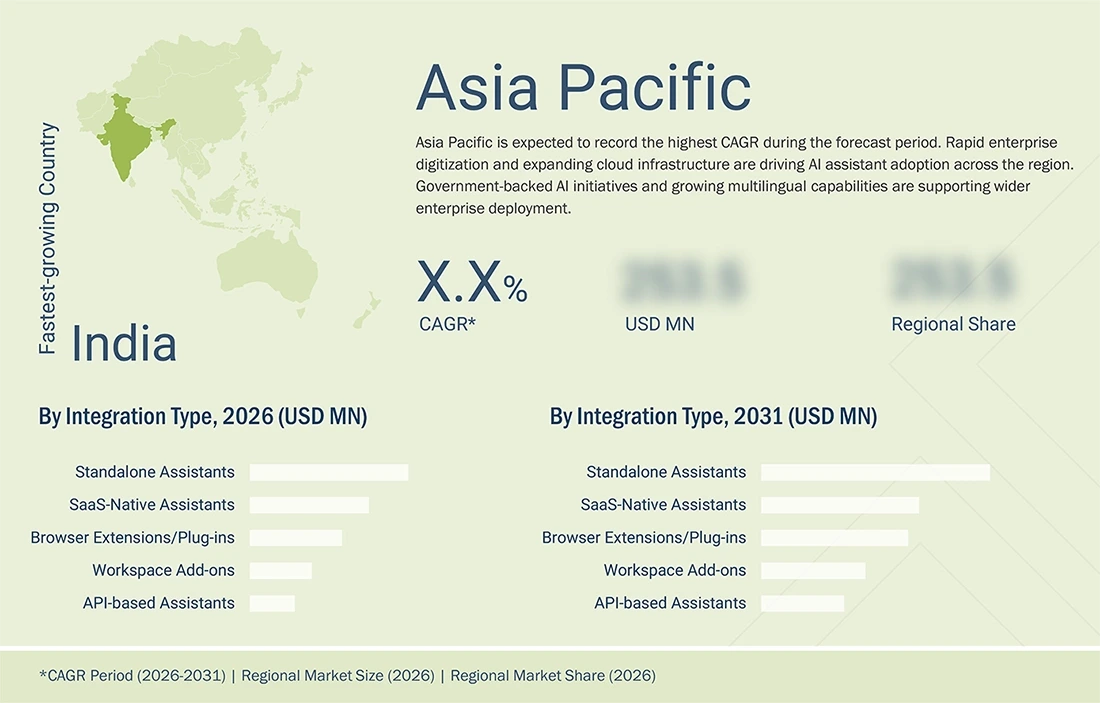
BY REGIONThe Asia Pacific region is poised to register the highest CAGR of 33.7% over the forecast period.
-
BY OFFERINGBy offering, the writing & content assistants segment is estimated to account for the largest share of 24.7% in 2026.
-
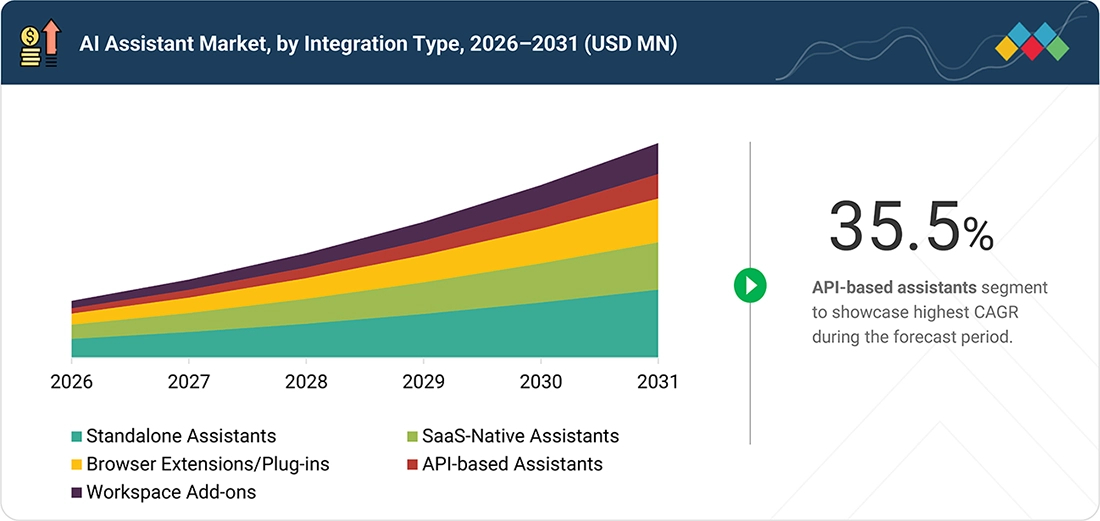
BY INTEGRATION TYPEBy integration type, the API-based assistants segment is slated to grow at the fastest rate between 2026 and 2031.
-
BY APPLICATIONBy application, the knowledge retrieval & document search segment is expected to register the fastest growth, at a CAGR of 35.8% over the forecast period.
-
BY END USERBy end user, the enterprises segment is expected to hold the largest share of 69.3% in 2026.
-
COMPETITIVE LANDSCAPE - KEY PLAYERSThe competitive landscape reflects continuous innovation across increasingly integrated AI assistant ecosystems and enterprise workflows. Microsoft (US), Google (US), OpenAI (US), Anthropic (US), Salesforce (US), SAP (Germany), Oracle (US), and Adobe (US) continue expanding advanced assistant capabilities. Their platforms increasingly support conversational interaction, contextual reasoning, enterprise search, workflow automation, and task execution. These capabilities strengthen productivity, knowledge access, collaboration, customer engagement, and decision support across business environments.
-
COMPETITIVE LANDSCAPE - STARTUPS/SMESGamma, Copysmith, Lumen5, Scribe, Regie.ai, Fathom, and Fireflies.ai, among others, have differentiated themselves among emerging AI assistant providers by developing focused capabilities in content generation, meeting assistance, sales engagement, workflow automation, research support, productivity enhancement, and conversational intelligence, highlighting their growing potential to address specialized user requirements and strengthen participation across the evolving AI assistant market.
The AI assistant market is advancing rapidly as organizations adopt more collaborative human-AI workflows. These approaches combine automated assistance with human judgment to strengthen oversight and accountability. At the same time, assistants are becoming gateways to enterprise knowledge and applications. Connected tools help users retrieve information, analyze context, and complete tasks across systems. More capable multimodal models are also broadening interactions across text, voice, images, and files. This flexibility allows assistants to support research, meetings, coding, analysis, and content creation. Moreover, enterprise agents are additionally extending assistance toward workflow execution and repetitive business processes. For instance, Microsoft notes agents can connect organizational knowledge while automating and executing business processes, similarly OpenAI enables company knowledge using connected sources while respecting existing user permissions.
TRENDS & DISRUPTIONS IMPACTING CUSTOMERS' CUSTOMERS
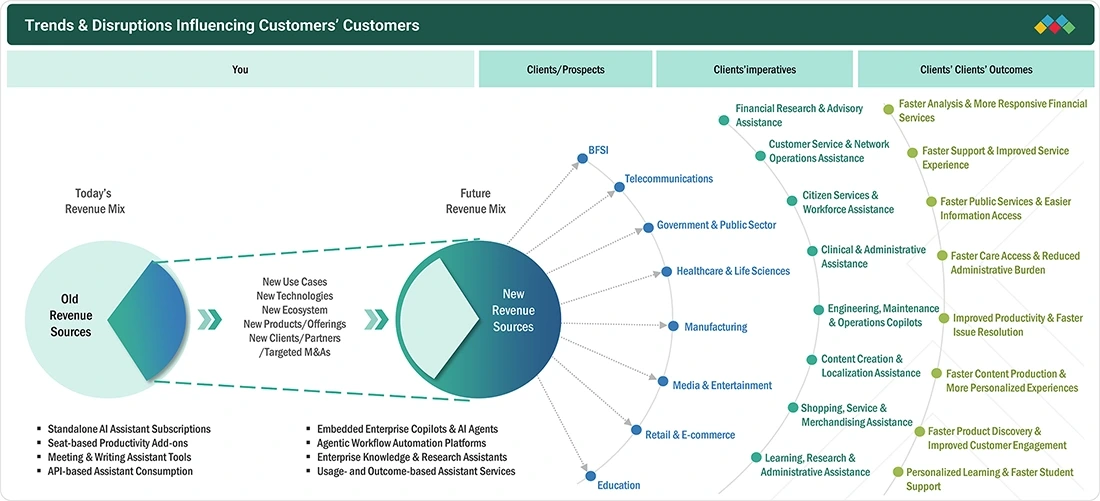
The AI assistant market is shifting from standalone chat tools toward integrated enterprise copilots. Organizations increasingly embed assistants within productivity suites, CRM platforms, development tools, and collaboration environments. Multimodal capabilities are expanding interactions across text, voice, images, files, and meetings. Enterprise knowledge connections help assistants deliver responses grounded in organizational data and business context. Agentic workflows are extending assistants from recommendations toward task execution and process coordination. BFSI, healthcare, government, retail, manufacturing, telecommunications, and professional services are accelerating enterprise adoption. Technology providers are embedding assistants directly into software platforms, workflows, and customer experiences. Secure connectors, permission controls, and governance frameworks support wider deployment across regulated enterprise environments. Organizations increasingly prioritize faster knowledge access, improved productivity, stronger engagement, and operational efficiency. Industry-specific assistants are also improving relevance across finance, healthcare, education, and service operations. These shifts are reshaping technology investments, operating models, partnerships, and enterprise software economics.
Source: Secondary Research, Interviews with Experts, MarketsandMarkets Analysis
MARKET DYNAMICS

Level
-
Modular deployment of AI assistants within SaaS platforms accelerating enterprise adoption

-
Real-time behavioral and contextual data enable highly personalized user support


Level
-
Fragmented digital ecosystems hinder unified AI assistant experiences across tools

-
Understanding unstructured data continues to limit assistant intelligence and adaptability


Level
-
Low-code customization and multilingual support unlock broader enterprise adoption

-
Proactive assistants that anticipate user needs unlock intelligent work orchestration


Level
-
Limits in generalization across roles and workflows restrict long-term scalability of AI assistants

-
Rapid evolution of AI capabilities may outpace employee adaptation and organizational readiness

Source: Secondary Research, Interviews with Experts, MarketsandMarkets Analysis
Driver: Modular deployment of AI assistants within SaaS platforms accelerating enterprise adoption
AI assistants offered as modular capabilities within SaaS platforms are rapidly accelerating enterprise adoption. Organizations activate targeted functions without replacing established collaboration, productivity, or business applications entirely. This lowers implementation friction and supports gradual experimentation across clearly defined employee workflows. Vendors also gain flexible monetization options through premium tiers, add-ons, and usage-based pricing models. Modular deployment aligns with enterprise preferences for composable, interoperable, and scalable software environments. Microsoft and Google increasingly embed assistants across productivity suites and connected workplace applications.
Restraint: Fragmented digital ecosystems hinder unified AI assistant experiences across tools
Fragmented enterprise technology environments still limit unified AI assistant experiences across business workflows. Employees frequently use separate tools for messaging, meetings, documents, CRM, and project management. Assistants operating across disconnected systems can easily lose context, permissions, and workflow continuity. This weakens cross-application reasoning and creates additional integration, governance, and security requirements for enterprises. OpenAI addresses these issues through connected applications, permission controls, and company knowledge capabilities. However, seamless context across heterogeneous enterprise systems remains technically demanding and operationally complex.
Opportunity: Low-code customization and multilingual support unlock broader enterprise adoption
Low-code customization and multilingual support create opportunities for broader global enterprise assistant adoption. Business users can configure agents, workflows, data sources, and actions without extensive engineering support. This speeds deployment across departments that need specialized prompts, permissions, and workflow behaviors quickly. Multilingual capabilities also expand accessibility across distributed teams operating in different regional markets. Google Agent Designer supports no-code and low-code creation of multi-step enterprise agents. Together, these capabilities improve flexibility, inclusivity, and scalability across diverse enterprise environments.
Challenge: Limits in generalization across roles and workflows restrict long-term scalability of AI assistants
AI assistants still struggle to generalize consistently across roles, workflows, and specialized domains. Performance can decline when assistants unexpectedly encounter unfamiliar terminology, processes, permissions, or organizational context. Enterprises therefore require configurable controls, connected data, testing, and human oversight mechanisms for reliability. Role-specific agents may outperform general assistants but significantly increase management complexity across organizations. OpenAI emphasizes permissions, approvals, and action constraints for agents operating across enterprise systems. Improving contextual transfer and cross-functional performance remains essential for scalable enterprise adoption.
AI ASSISTANT MARKET: COMMERCIAL USE CASES ACROSS INDUSTRIES
| COMPANY | USE CASE DESCRIPTION | BENEFITS |
|---|---|---|
 |
CBA deployed ChatGPT Enterprise across nearly 50,000 employees to strengthen enterprise AI adoption. Teams use assistants within everyday workflows while maintaining security, consistency, and controlled organizational access. The initiative supports customer service, fraud response, knowledge work, and improved employee productivity. | Nearly 50,000 employees gained access to enterprise AI across banking operations. | AI supports customer service and fraud-response workflows across high-impact customer interactions. | Enterprise-wide deployment strengthens workforce AI fluency and improves customer-focused operational outcomes. |
 |
TELUS deployed Gemini-powered agentic AI to automate customer service across telecommunications operations. AI analyzes customer interactions, identifies service needs, and supports proactive issue resolution workflows. The platform also improves frontline productivity while expanding automated assistance across customer service environments. | Customer issues are resolved 87% faster using agentic AI capabilities. | 30% of customer calls are resolved proactively using AI agents. | TELUS achieved USD 53.9 million in annual operational cost savings. |
 |
ENEOS Materials deployed ChatGPT Enterprise across the company to boost productivity and support knowledge-intensive manufacturing workflows. Teams use assistants for research, analysis, information aggregation, and specialized operational problem-solving activities. More than 1,000 custom GPTs support department-specific workflows across the organization. | After enterprise deployment, 90%+ of employees used ChatGPT at least weekly. | 80% of employees reported significant workflow improvements during the pilot phase. | HR data aggregation and analysis time declined by approximately 90%. |
Logos and trademarks shown above are the property of their respective owners. Their use here is for informational and illustrative purposes only.
MARKET ECOSYSTEM
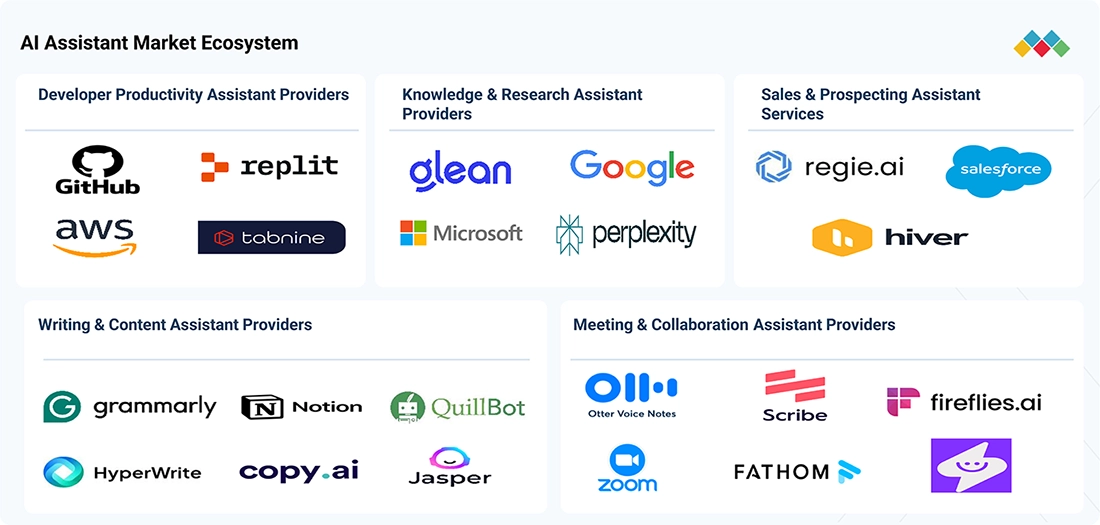
The AI assistant market ecosystem centers on several specialized productivity and knowledge categories. Developer productivity providers support coding, debugging, documentation, and software development workflows across engineering teams. Knowledge and research assistants help users retrieve information, summarize content, and generate contextual insights. Sales and prospecting assistants automate outreach, lead engagement, follow-ups, and customer relationship management activities. Writing and content assistants support drafting, rewriting, summarization, editing, and content creation across business functions. Meeting and collaboration assistants improve transcription, note-taking, action tracking, and post-meeting workflow coordination. Together, these segments combine broad productivity platforms with specialized vendors serving distinct enterprise requirements. This ecosystem enables organizations to improve efficiency, information access, collaboration, and task automation across workflows.
Logos and trademarks shown above are the property of their respective owners. Their use here is for informational and illustrative purposes only.
MARKET SEGMENTS
Source: Secondary Research, Interviews with Experts, MarketsandMarkets Analysis
AI Assistant Market, By Offering
Knowledge & research assistants are expected to record strong growth across enterprise knowledge environments. These assistants combine search, summarization, reasoning, and source synthesis across connected information repositories. Enterprises increasingly deploy them for research, policy review, competitive analysis, and knowledge discovery. OpenAI Deep Research can analyze trusted websites and connected applications for structured research workflows. Google Gemini Enterprise similarly provides permissions-aware search across organizational and third-party enterprise information sources. Growing demand for faster access to knowledge will support broader adoption across knowledge-intensive functions.
AI Assistant Market, By Integration Type
API-based assistants are gaining adoption because enterprises require flexible integration across existing applications. APIs let assistants connect to business systems, retrieve context, and execute defined workflow actions. This model supports customized assistants without replacing established enterprise software environments or processes. OpenAI supports connected applications and custom integrations that securely access organization-specific enterprise information. Google Gemini Enterprise connects third-party platforms, including SharePoint, Jira, Confluence, and ServiceNow environments. Growing interoperability needs will strengthen API-based deployments across complex enterprise technology ecosystems worldwide.
AI Assistant Market, By Application
Knowledge retrieval & document search is positioned for strong adoption across information-intensive enterprises. Organizations need faster access to documents, emails, policies, reports, and internal knowledge repositories. AI assistants increasingly provide permission-aware search and grounded answers across fragmented enterprise information sources. Gemini Enterprise enables multimodal search across connected organizational systems while enforcing user-level access controls. OpenAI Company Knowledge similarly provides organization-specific answers using authorized connected enterprise knowledge sources. These capabilities reduce search effort while improving information accessibility across distributed business workflows.
AI Assistant Market, By End User
The enterprises segment is expected to hold the largest share of the AI assistant market. Organizations increasingly deploy assistants across productivity, research, customer service, development, and collaboration workflows. Enterprise assistants connect internal data, applications, files, and communication platforms for contextual support. Microsoft 365 Copilot integrates AI assistance across Word, Excel, Outlook, and Teams environments. OpenAI Company Knowledge similarly connects authorized organizational sources while respecting existing access permissions. These capabilities improve productivity, knowledge access, decision support, and workflow automation across large organizations. Enterprise-grade security, governance, compliance, and administrative controls further support broader business adoption.
REGION
Asia Pacific to be fastest-growing region in global AI Assistant market during forecast period
The Asia Pacific region is expected to see the fastest growth in the AI assistant market. Enterprises are rapidly adopting copilots, agents, and productivity assistants across business functions. India, China, Japan, Singapore, and South Korea are significantly expanding enterprise AI deployments. Government strategies, digital infrastructure investments, and workforce upskilling programs are strengthening adoption across the region. Multilingual capabilities are also improving assistant relevance across linguistically diverse Asia Pacific markets. Rising cloud capacity is enabling scalable deployments across enterprises and public organizations. Microsoft reports strong agentic AI momentum across Asia Pacific enterprises and government ecosystems. These developments position Asia Pacific as a highly dynamic region for AI assistant adoption.
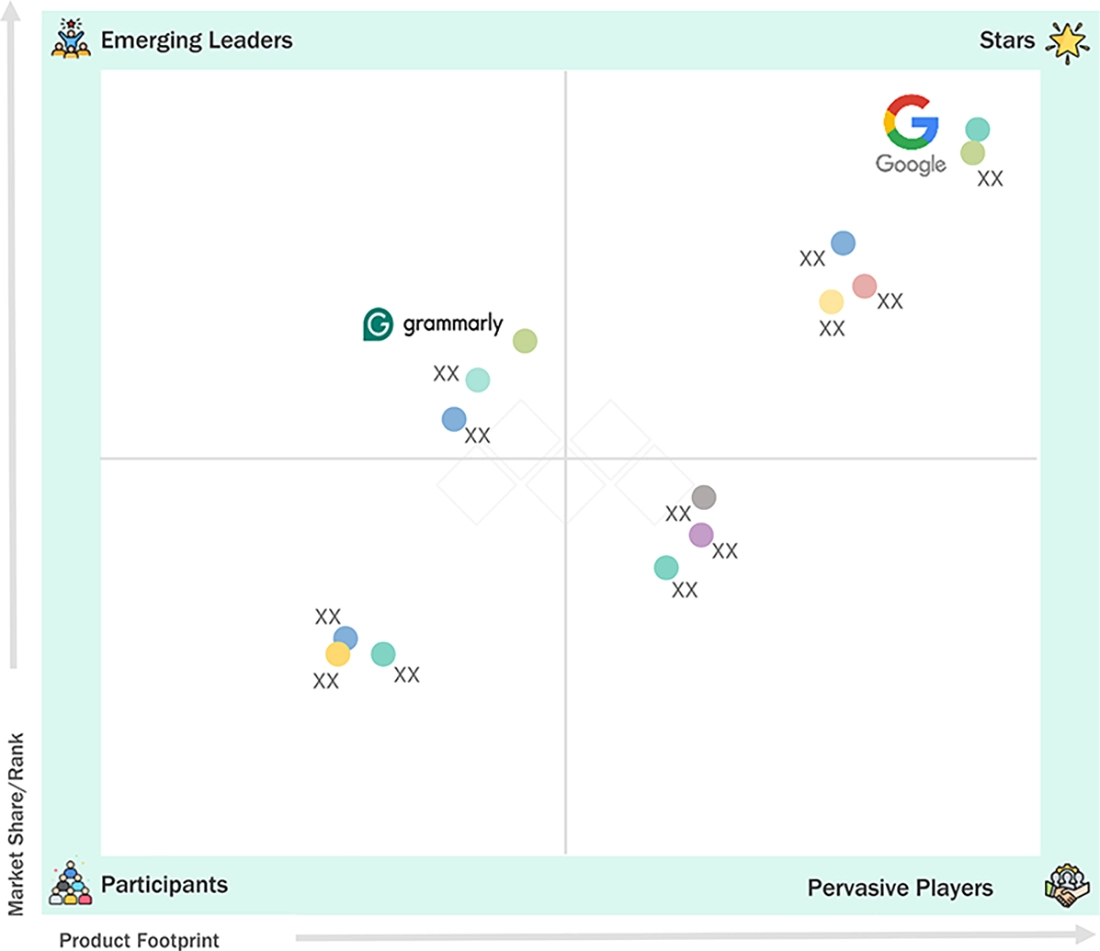
AI ASSISTANT MARKET: COMPANY EVALUATION MATRIX
Google is positioned in the Stars category because Gemini combines broad AI assistant capabilities with deep Workspace integration. Its ecosystem supports writing, research, meetings, analysis, enterprise search, and workflow automation. Gemini operates across Gmail, Docs, Sheets, Meet, and Drive, enabling scalable enterprise deployment. Grammarly is positioned in the Emerging Leader category through specialized writing and productivity assistance. Its platform supports drafting, rewriting, tone refinement, contextual guidance, and workplace communication workflows. These capabilities strengthen productivity, writing quality, and contextual assistance across enterprise environments.
Source: Secondary Research, Interviews with Experts, MarketsandMarkets Analysis
KEY MARKET PLAYERS
- Google (US)
- Microsoft (US)
- Salesforce (US)
- OpenAI (US)
- Adobe (US)
- Anthropic (US)
- Oracle (US)
- Amazon (US)
- Cisco (US)
- SAP (Germany)
- Dropbox (US)
- Zoom (US)
- Asana (US)
- Atlassian (Australia)
- Grammarly (US)
MARKET SCOPE
| REPORT METRIC | DETAILS |
|---|---|
| Market Size in 2025 (Value) | USD 5.02 Billion |
| Market Forecast in 2026 (Value) | USD 7.11 Billion |
| Market Forecast in 2031 (Value) | USD 26.75 Billion |
| Growth Rate | 30.4% |
| Years Considered | 2021–2031 |
| Base Year | 2025 |
| Forecast Period | 2026–2031 |
| Units Considered | Value (USD Billion) |
| Report Coverage | Revenue forecast, company ranking, competitive landscape, growth factors, and trends |
| Segments Covered |
|
| Regions Covered | North America, Europe, Asia Pacific, Middle East & Africa, Latin America |
WHAT IS IN IT FOR YOU: AI ASSISTANT MARKET REPORT CONTENT GUIDE
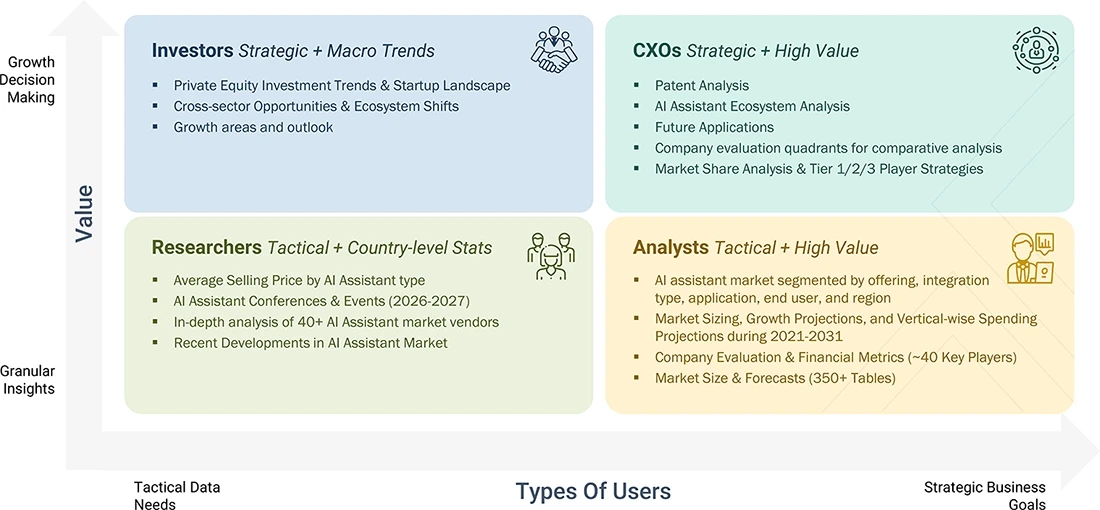
DELIVERED CUSTOMIZATIONS
We have successfully delivered the following deep-dive customizations:
| CLIENT REQUEST | CUSTOMIZATION DELIVERED | VALUE ADDS |
|---|---|---|
| Leading AI Assistant Provider (North America) |
|
|
| Leading AI Assistant Provider (Europe) |
|
|
RECENT DEVELOPMENTS
- September 2026 : OpenAI introduced GPT-6 Sol and Luna across ChatGPT Work, Codex, and APIs. The models improve reasoning, coding, multimodal understanding, and cost efficiency for professional use. Their broader availability strengthens enterprise productivity, development assistance, and knowledge-intensive workflows while supporting scalable AI assistant deployment across organizations.
- August 2026 : Anthropic expanded Claude access for scientists through dedicated team subscriptions and research programs. The initiative broadens Claude usage across analysis, scientific computing, and auditable research workflows. It strengthens Claude’s role as a specialized knowledge and research assistant for academic, nonprofit, and science-intensive professional environments.
- July 2026 : Google expanded Gemini Spark globally as a persistent AI agent for daily workflows. The assistant runs continuously and connects natively to Gmail, Docs, and Sheets. It extends Gemini beyond conversational assistance toward proactive task execution across connected productivity environments and broader personal assistant use cases.
- June 2026 : Salesforce launched Agentforce Help Agent to rapidly deploy customer-service AI assistants. The solution draws on Salesforce Knowledge and automates issue resolution across service channels. It strengthens enterprise adoption of specialized assistants by reducing setup complexity and supporting scalable customer-support automation across organizations.
- March 2026 : Zoom expanded AI Companion 3.0 with agentic workflows and custom AI agents. The platform can automate tasks across Zoom Workplace, Phone, and customer experience environments. These capabilities extend meeting assistance toward workflow execution, orchestration, and proactive productivity across connected collaboration and enterprise applications.
Table of Contents
 Exclusive indicates content/data unique to MarketsandMarkets and not available with any competitors.
Methodology
The research study on the AI assistant market relied heavily on secondary sources, including directories, journals, and paid databases. Primary sources included industry experts from core and related industries, preferred AI assistant providers, third-party service providers, consulting service providers, end users from various vertical industries, and other commercial enterprises. In-depth interviews with primary respondents, including key industry participants and subject matter experts, were conducted to gather and verify critical qualitative and quantitative information and assess the market’s prospects.
Secondary Research
In the secondary research process, various sources were referred to identify and collect information for the study. Secondary sources included annual reports, press releases, investor presentations, white papers, journals, certified publications, articles from recognized authors, and directories and databases. The data was also collected from other secondary sources, such as conferences and related magazines. Additionally, the AI assistant spending of various countries was extracted from respective sources. Secondary research was used to obtain key information about the industry’s supply chain to identify key players by solution, service, market classification, and segmentation according to the offerings of major players and industry trends related to the offering, integration type, application, end user, regions, and key developments from both market- and technology-oriented perspectives.
Primary Research
In the primary research process, various primary sources from both the supply and demand sides were interviewed to obtain qualitative and quantitative information on the market. The primary sources from the supply side included various industry experts, including Chief Experience Officers (CXOs); Vice Presidents (VPs); directors from business development, marketing, and AI assistant expertise; related key executives from AI assistant offering vendors, SIs, managed service providers, and industry associations; and key opinion leaders.
Primary interviews gathered insights, including market statistics, revenue data from solutions and services, market segmentation, market size estimates, market forecasts, and data triangulation. Primary research also helped understand various trends related to use cases, offerings, document types, verticals, and regions. Stakeholders from the demand side, such as Chief Information Officers (CIOs), Chief Technology Officers (CTOs), Chief Strategy Officers (CSOs), and end users in verticals using AI Assistant solutions, were interviewed to understand the buyer’s perspective on suppliers, products, and their current usage of AI assistant solutions, which would impact the overall AI assistant market.
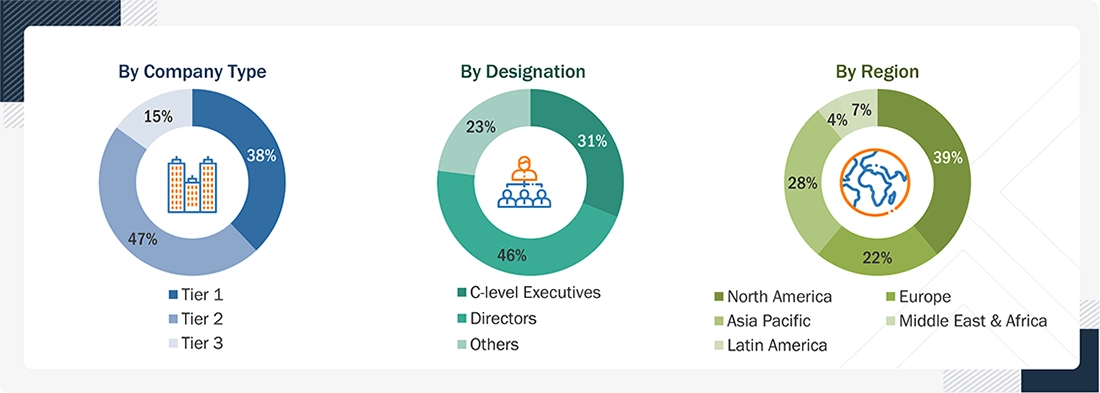
Note: Others include sales, marketing, and product managers; tier 1 companies’ revenues are more than USD 500 million, tier 2 companies’ revenues range between USD 500 and 100 million, and tier 3 companies’ revenues are equal to or less than USD 100 million.
Source: Industry Experts
To know about the assumptions considered for the study, download the pdf brochure
Market Size Estimation
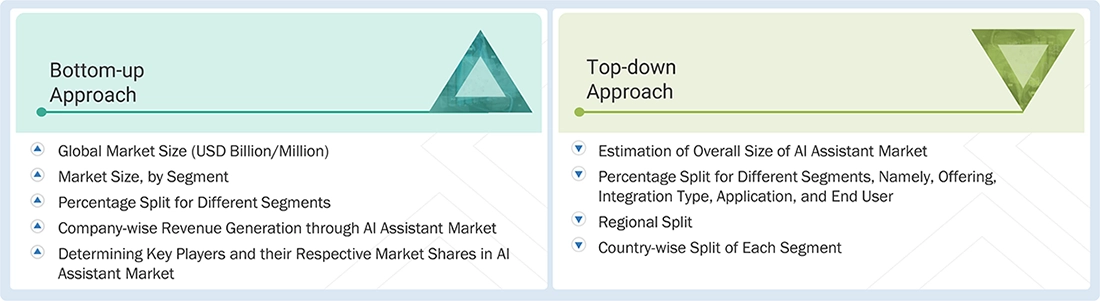
The top-down and bottom-up approaches were employed to estimate and forecast the AI assistant market, as well as its dependent submarkets. This multi-layered analysis was further reinforced through data triangulation, which incorporated primary and secondary research inputs. The market figures were also validated against the existing MarketsandMarkets repository for accuracy.
AI Assistant Market: Top-Down and Bottom-Up Approach
Data Triangulation
The market was divided into several segments and subsegments after determining the overall market size using the market size estimation processes described above. To complete the overall market engineering process and determine the exact statistics for each market segment and subsegment, data triangulation and market segmentation procedures were employed, wherever applicable. The overall market size was then used in the top-down approach to estimate the size of other individual markets by applying percentage splits to the market segmentation.
Market Definition
AI assistant refers to a set of artificial intelligence technologies that support users across digital tasks and workflows. These systems combine natural language interaction, contextual reasoning, memory, search, content generation, and task execution capabilities. AI assistants can support writing, research, coding, meetings, scheduling, customer interactions, data analysis, and knowledge retrieval. Enterprise assistants also connect with documents, emails, applications, calendars, repositories, and business systems for context-aware assistance. Microsoft defines Copilot as an AI assistant for work that combines language models with organizational data. OpenAI similarly positions ChatGPT Enterprise as an AI assistant supporting work while protecting organizational data and context. Together, these capabilities enable individuals and enterprises to improve productivity, automate repetitive activities, access information, and complete complex workflows more efficiently.
Key Stakeholders
- AI assistant software providers
- Third-party administrators
- Business analysts
- Cloud service providers
- Consulting service providers
- Enterprise end users
- Distributors and value-added resellers (VARs)
- Government agencies
- Independent software vendors (ISVs)
- Market research and consulting firms
- Support & maintenance service providers
- System integrators (SIs)/Migration service providers
- Technology providers
Report Objectives
- To define, describe, and forecast the AI assistant market by offering, integration type, application, end user, and region.
- To provide detailed information related to major factors (drivers, restraints, opportunities, and industry-specific challenges) influencing market growth
- To analyze opportunities in the market and provide details of the competitive landscape for stakeholders and market leaders
- To forecast the market size of segments with respect to five main regions: North America, Europe, Asia Pacific, the Middle East & Africa, and Latin America
- To analyze each submarket with respect to individual growth trends, prospects, and contributions to the overall AI assistant market
- To analyze competitive developments, such as partnerships, new product launches, mergers & acquisitions, in the AI assistant market
- To analyze the impact of macroeconomic factors on the AI assistant market across all regions
Available customizations:
Using the provided market data, MarketsandMarkets offers customizations tailored to the company’s specific needs. The following customization options are available for the report.
Product Analysis
- Product comparative analysis, which gives a detailed comparison of innovative products being offered by prominent vendors
Geographic Analysis
- Further breakdown of additional European countries by offering, integration type, application, and end user
- Further breakdown of additional Asia Pacific countries by offering, integration type, application, and end user
- Further breakdown of additional Middle Eastern & African countries by offering, integration type, application, and end user
- Further breakdown of additional Latin American countries by offering, integration type, application, and end user
Company Information
-
Detailed analysis and profiling of additional market players (up to five)
Key Questions Addressed by the Report
What are AI assistant?
AI assistant are intelligent, software-embedded tools that support knowledge workers, professionals, and teams in performing high-value, context-aware, task-specific activities across communication, productivity, research, collaboration, scheduling, analysis, and content creation.
What are the key benefits of using AI assistant?
AI assistant improve productivity by automating routine tasks, providing instant access to information, enhancing decision-making, and enabling personalized user interactions. They support employees with faster responses, content generation, data analysis, scheduling, and workflow management. By reducing manual effort and improving operational efficiency, AI assistants help organizations save time, lower costs, and deliver better customer experiences.
What industries benefit most from AI assistant?
AI assistant deliver measurable value across various enterprise sectors, especially those with high knowledge intensity and repetitive task loads. Professional services firms benefit by embedding AI in research, drafting, and client communication processes. BFSI institutions use AI assistants for real-time compliance support, document summarization, and intelligent knowledge retrieval, improving productivity and audit-readiness. Retail and e-commerce companies gain value from AI-driven content generation, campaign planning, and internal workflow automation. In healthcare and life sciences, AI assistants assist clinicians and researchers with notetaking, literature synthesis, and structured data entry, helping reduce administrative burden while improving documentation accuracy.
What trends are shaping the AI assistant market?
The AI assistant market is evolving rapidly and is driven by several transformative trends. Context-aware intelligence is gaining prominence. AI assistants are now tapping into user calendars, documents, emails, and chats to deliver hyper-relevant support in real time. The rise of role-specific assistants tailored for sales reps, software developers, HR teams, and analysts is replacing one-size-fits-all tools. Third, there's increasing focus on on-device or enterprise-grade privacy, using approaches like federated learning to ensure sensitive data stays within organizational boundaries. Vendors are embedding assistants directly into enterprise SaaS platforms, which improves adoption and stickiness.
How do organizations choose the right AI assistant?
Enterprises evaluate AI assistant solutions based on alignment with their workflow needs, user context, and security standards. Key factors include whether the assistant is embedded in employees' tools and whether it supports domain-specific tasks like research summarization, meeting transcription, or code generation. Organizations also assess context-awareness capabilities, ensuring the assistant can draw from calendars, documents, messages, and cloud storage to deliver relevant outputs. Enterprise buyers prioritize privacy controls, data residency compliance, and auditability, especially in regulated sectors. Flexibility is another deciding factor; solutions with low-code customization, modular deployment, and multilingual support are often preferred.


Personalize This Research
- Triangulate with your Own Data
- Get Data as per your Format and Definition
- Gain a Deeper Dive on a Specific Application, Geography, Customer or Competitor
- Any level of Personalization
Let Us Help You
- What are the Known and Unknown Adjacencies Impacting the AI Assistant Market
- What will your New Revenue Sources be?
- Who will be your Top Customer; what will make them switch?
- Defend your Market Share or Win Competitors
- Get a Scorecard for Target Partners

Custom Market Research Services
We Will Customise The Research For You, In Case The Report Listed Above Does Not Meet With Your Requirements
Get 10% Free CustomisationTESTIMONIALS
- Rest Of Latin America AI Assistant Market
- CANADA AI Assistant Market
- UK AI Assistant Market
- GERMANY AI Assistant Market
- FRANCE AI Assistant Market
- ITALY AI Assistant Market
- SPAIN AI Assistant Market
- NETHERLANDS AI Assistant Market
- CHINA AI Assistant Market
- INDIA AI Assistant Market
- JAPAN AI Assistant Market
- SOUTH KOREA AI Assistant Market
- SINGAPORE AI Assistant Market
- SAUDI ARABIA AI Assistant Market
- UAE AI Assistant Market
- QATAR AI Assistant Market
- TURKEY AI Assistant Market
- SOUTH AFRICA AI Assistant Market
- BRAZIL AI Assistant Market
- MEXICO AI Assistant Market
- ARGENTINA AI Assistant Market
- US AI Assistant Market
- Rest Of Europe AI Assistant Market
- Rest Of Asia Pacific AI Assistant Market






Growth opportunities and latent adjacency in AI Assistant Market