Air Quality Monitoring Systems Market

Air Quality Monitoring Systems Market by Product (indoor, outdoor, fixed, portable, wearable), Pollutant (SOX, NOX, VOC, PM 2.5, PM 10, biological), Sampling (manual, stack), End User (govt, petrochemical, residential, smart city) - Global Forecast to 2031



AIR QUALITY MONITORING SYSTEM MARKET SIZE, SHARE & GROWTH SNAPSHOT
Source: Secondary Research, Interviews with Experts, MarketsandMarkets Analysis
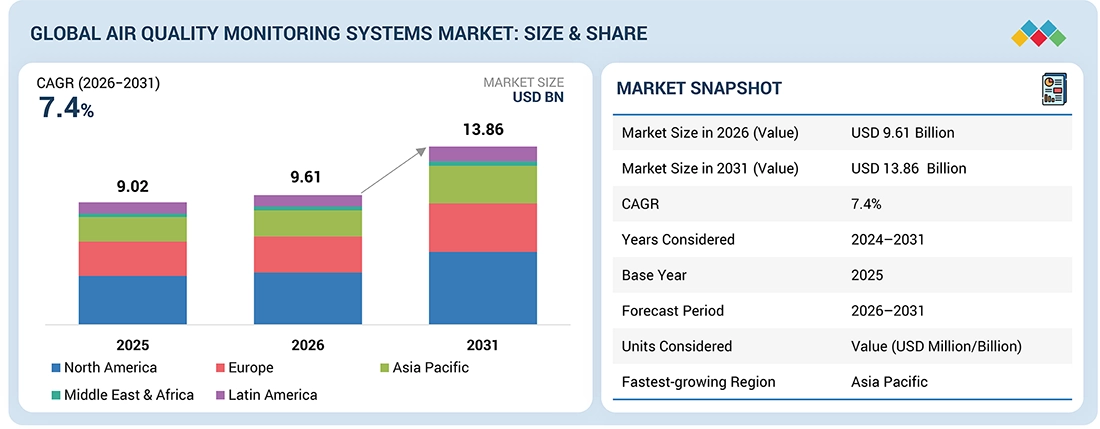
The global air quality monitoring systems market is projected to grow from USD 9.61 billion in 2026 to USD 13.86 billion by 2031, at a CAGR of 7.4% during the forecast period. The market was valued at USD 9.02 billion in 2025. The market growth is driven by an increase in investments owing to the global air pollution, regulations by the government concerning efficient monitoring and controlling of air pollution, increased funding from public and private sectors for efficient monitoring of air pollution, increase in awareness about environmental as well as health risks associated with air pollution, and increasing efforts by governments to develop eco-friendly industries.
KEY TAKEAWAYS
-
MARKET SNAPSHOT:
Base Year Market Size (2025): USD 9.02 Billion
Current Market Size (2026): USD 9.61 Billion
Forecast Market Size (2031): USD 13.86 Billion
CAGR (2026–2031): 7.4% -
SEGMENT LEADERSHIP:
Monitoring Type Leader: Active/continuous segment accounted for 50.2% of the market share in 2025.
Pollutant Type Leader: Chemical pollutants segment accounted for a major revenue share of 74.3% in 2025.
Product Leader: Outdoor monitors segment accounted for a share of 45.0% in 2025.
End User Leader: Government agencies & academic institutes segment accounted for a 31.5% share of the global air quality monitoring systems market in 2025. -
MARKET OUTLOOK & COMPETITIVE LANDSCAPE:
Thermo Fisher Scientific (US), Emerson Electric (US), Siemens AG (Germany), and Teledyne Technologies (US) were identified as key players in the global air quality monitoring systems market due to their strong product portfolios, extensive global distribution networks, and continuous investments in advanced environmental monitoring technologies. These companies are actively focusing on product innovations, strategic partnerships, smart city projects, and collaborations with government agencies and industrial facilities to strengthen their market presence while complying with international environmental monitoring and emission control standards.
Aeroqual (New Zealand), Forbes Marshall (India), Plume Labs (France), and Atmotech, Inc. (US) have established a strong presence in the global air quality monitoring systems market by focusing on low-cost sensors, portable monitoring devices, IoT-enabled solutions, and real-time air quality data platforms.
One of the major trends in the global air quality monitoring systems market is the increasing adoption of real-time and continuous air monitoring solutions across urban, industrial, and commercial environments. Governments and environmental agencies are increasingly deploying advanced monitoring systems to track air pollution levels and ensure compliance with environmental regulations. In addition, the growing integration of IoT, cloud computing, and wireless communication technologies in air quality monitoring devices is improving remote monitoring, data accessibility, and operational efficiency.
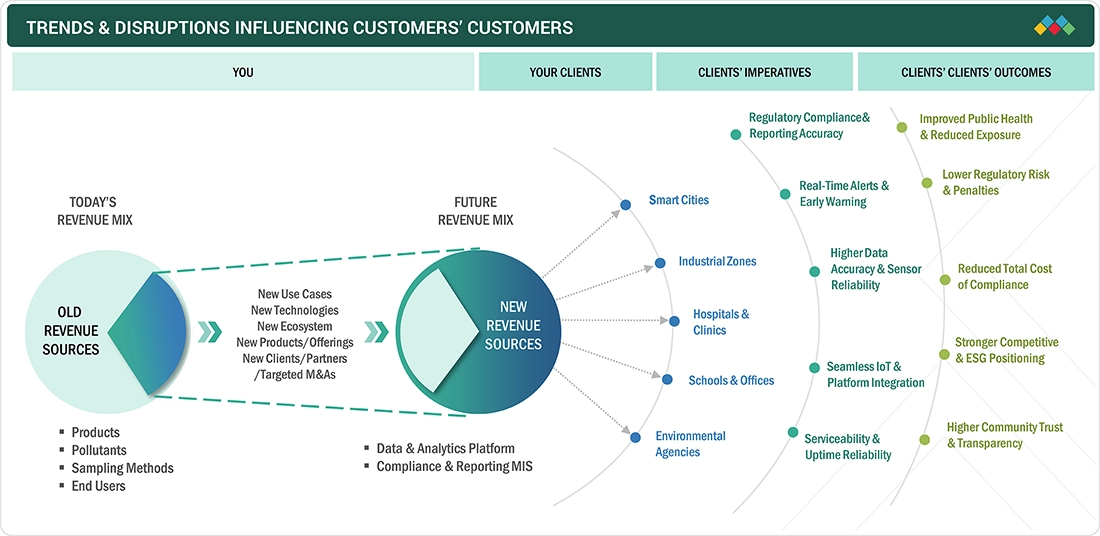
TRENDS & DISRUPTIONS IMPACTING CUSTOMERS' CUSTOMERS
Customers in the global air quality monitoring systems market, including government agencies, industrial facilities, environmental monitoring organizations, and research institutes, are experiencing significant disruption due to evolving environmental regulations, rapid technological advancements, and increasing demand for real-time pollution monitoring. End users are increasingly seeking connected, low-cost, and highly accurate monitoring solutions that deliver continuous air quality data with remote access and predictive analytics. This is driving organizations to replace conventional monitoring stations with IoT-enabled sensors, cloud-based platforms, and portable monitoring devices. Additionally, the growing adoption of smart city initiatives and stricter emission control policies are reshaping procurement patterns and increasing investment in large-scale monitoring networks. The entry of low-cost sensor manufacturers and software-based environmental monitoring providers is also intensifying market competition and disrupting traditional monitoring system suppliers. Furthermore, increasing regulatory scrutiny regarding data accuracy, calibration standards, and environmental compliance is impacting product development, certification processes, and operational requirements for monitoring solution providers across the market.
Source: Secondary Research, Interviews with Experts, MarketsandMarkets Analysis
MARKET DYNAMICS

Level
-
Government initiatives for AQM due to rising industrialization and urbanization

-
Favorable public-private initiatives for environmental conservation


Level
-
Lack of standardized regulations and monitoring frameworks

-
Premium product pricing


Level
-
Rising adoption of IoT-enabled and AI-based monitoring systems

-
Expansion of smart city projects


Level
-
Inadequate implementation of air pollution control reforms

-
Challenges associated with identifying emerging pollutants

Source: Secondary Research, Interviews with Experts, MarketsandMarkets Analysis
Driver: Government initiatives for AQM due to rising industrialization and urbanization
The global air quality monitoring systems market is being driven by growing government initiatives and stringent environmental regulations aimed at reducing pollution from rapid industrialization, urbanization, and rising vehicle emissions. Governments worldwide are implementing policies to improve air quality and protect public health, thereby increasing the adoption of continuous air monitoring systems across industrial, commercial, and urban environments. Initiatives such as India’s National Electric Mobility Mission Plan (NEMMP), the European Union Green Deal, US Tier 3 vehicle emission standards, Canada’s national pollution reduction regulations, the SSEA-AIR program in Asia, and the UK Clean Air Strategy are promoting emission control, sustainable transportation, and real-time environmental monitoring. In addition, the integration of air quality monitoring into smart city projects and urban infrastructure development is further supporting market growth by enabling data-driven environmental management and pollution control.
Restraint: Lack of standardized regulations and monitoring frameworks
Air quality regulations, pollutant thresholds, and monitoring protocols vary significantly across countries and regions. While developed countries have established comprehensive environmental regulations, several developing nations still lack strict enforcement policies and standardized air quality monitoring frameworks. This regulatory inconsistency creates challenges for manufacturers and service providers operating globally, as monitoring systems often require customization to meet different regional compliance standards. The absence of harmonized guidelines also affects data comparability and interoperability among monitoring networks.
Opportunity: Rising adoption of IoT-enabled and AI-based monitoring systems
The integration of Internet of Things (IoT), artificial intelligence (AI), cloud computing, and big data analytics into air quality monitoring systems is creating major opportunities for market expansion. Advanced monitoring platforms can provide real-time data collection, remote accessibility, predictive analytics, and automated pollution forecasting. AI-powered systems can analyze large environmental datasets to identify pollution trends, emission sources, and abnormal air quality events more efficiently than traditional systems. The increasing demand for portable, connected, and low-cost smart sensors in industrial, commercial, and residential applications is further driving technological innovation in the market.
Challenge: Challenges associated with identifying emerging pollutants
The global air quality monitoring systems market faces significant challenges in identifying and monitoring emerging pollutants, including volatile organic compounds (VOCs), ultrafine particles, PFAS, nanoparticles, and hazardous air toxics. Conventional monitoring systems are primarily designed to detect standard pollutants and often lack the sensitivity, selectivity, and low detection limits needed to accurately measure newly recognized contaminants, which are typically present at trace concentrations and exhibit complex chemical behavior. Addressing these pollutants requires advanced technologies such as AI-enabled analytics, mass spectrometry, and high-precision sensor systems, increasing operational complexity and overall monitoring costs. Additionally, the lack of globally standardized regulations and exposure limits for many emerging pollutants complicates data interpretation, compliance monitoring, and the implementation of pollution control strategies. Limited scientific understanding of the long-term environmental and health impacts of these contaminants, along with infrastructure and budget constraints in developing regions, further restrains the adoption of advanced air quality monitoring systems globally.
AIR QUALITY MONITORING SYSTEM MARKET: COMMERCIAL USE CASES ACROSS INDUSTRIES
| COMPANY | USE CASE DESCRIPTION | BENEFITS |
|---|---|---|
 |
Provides ambient air monitoring systems, gas analyzers, and particulate monitoring solutions for industrial facilities, environmental agencies, research institutions, and urban air quality monitoring networks | Supports continuous and accurate monitoring of air pollutants | Helps industries comply with environmental and emission regulations |
 |
Delivers indoor and outdoor air quality monitoring solutions, including air quality sensors, continuous emission monitoring systems, and smart building environmental monitoring platforms | Enhances energy-efficient building management and indoor air quality control | Supports industrial emission monitoring and compliance requirements |
 |
Offers environmental monitoring instruments and continuous emissions monitoring systems for industrial stack emissions, ambient air quality assessment, and environmental research applications | Enables precise detection and monitoring of trace gases and pollutants |Improves industrial pollution monitoring and reporting accuracy |
 |
Provides environmental sensing and monitoring technologies integrated with smart infrastructure and industrial monitoring applications to support air quality management and operational safety | Supports safer indoor and industrial environments | Enhances connected monitoring and operational efficiency |
Logos and trademarks shown above are the property of their respective owners. Their use here is for informational and illustrative purposes only.
MARKET ECOSYSTEM
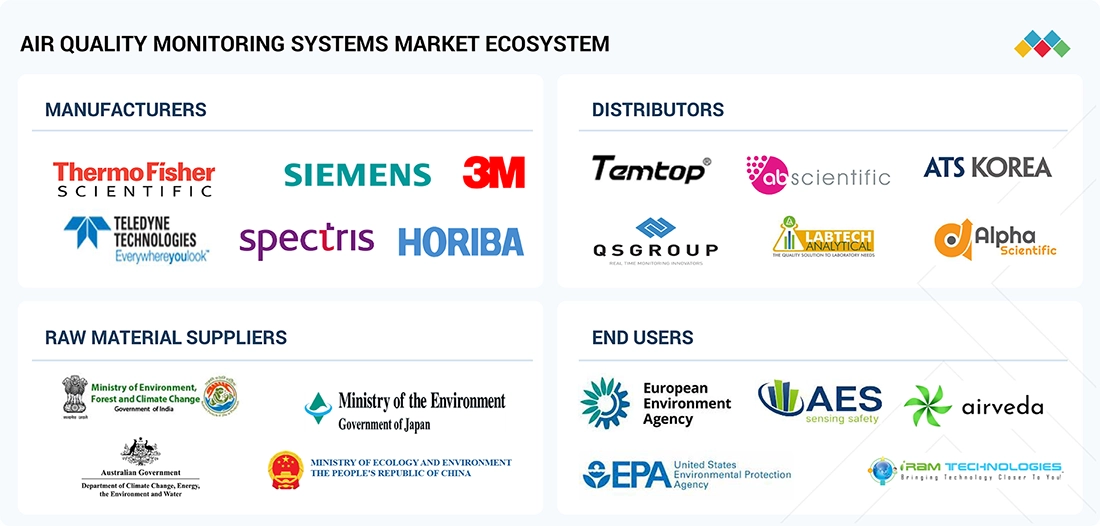
The market ecosystem for air quality monitoring systems comprises several key players: manufacturers, component suppliers, software companies, distributors, governmental authorities, environmental institutions, and end-users. The primary function of manufacturers is the development and promotion of air quality monitoring equipment, devices, and software platforms that enable the effective implementation of air quality monitoring programs. The component suppliers represent the second category of stakeholders who deliver components used in monitoring technologies, including gas sensors, particle sensors, data management technologies, and communication modules. Besides that, distributors and system integrators also serve an important role in extending the geographical market reach. End-users of the technology under study include government and environmental agencies, industries, research institutions, hospitals, commercial buildings, smart city authorities, and other interested parties. Software and cloud platform companies operate in the sphere of data collection, remote control, analysis, and reports related to the air quality. Moreover, research institutions, as well as other environmental institutions, play a vital role in improving the studied technologies and conducting environmental studies on air pollution. Regulatory bodies in various countries oversee emissions and monitor air quality.
Logos and trademarks shown above are the property of their respective owners. Their use here is for informational and illustrative purposes only.
MARKET SEGMENTS
Source: Secondary Research, Interviews with Experts, MarketsandMarkets Analysis
Air Quality Monitoring System Market, By Product
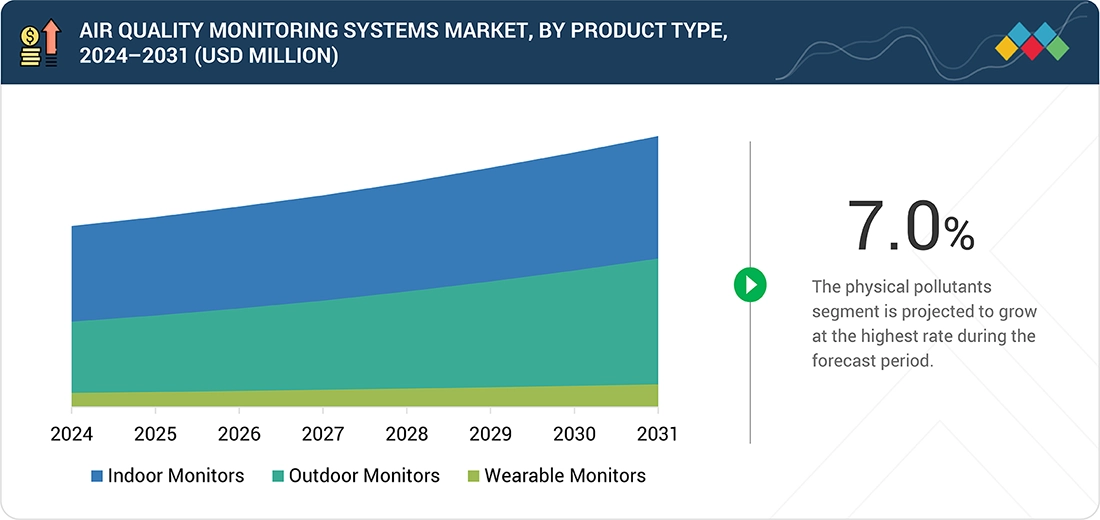
The indoor monitor segment dominated the market in terms of revenue share due to high awareness of the adverse effects of indoor air pollution on human health, driving growth in demand for maintaining healthy indoor air quality. An increase in indoor air pollutant generation from HVAC systems, cooking activities, building materials, and chemical use has been fueling the adoption of indoor air quality monitors. Further, the growing number of respiratory patients, allergics, and asthmatics, along with rising health awareness among consumers, is fueling demand for air quality monitors.
Air Quality Monitoring System Market, By Pollutant
The chemical pollutants market segment was the dominant segment within the total market for air quality monitoring systems, owing to high levels of toxic gas emissions from industrial, transportation, energy production, and urbanization activities worldwide. Some of the commonly observed air pollutants include nitrogen oxides (NOx), sulfur oxides (SOx), carbon oxides (COx), VOCs, and ozone. These air pollutants negatively affect the atmosphere and human health and well-being. In addition, stricter government policies to control emissions lead to greater adoption of continuous emission monitoring systems and ambient air quality monitoring stations in the air quality market segment. Additionally, rising public health concerns regarding air pollution, the development of smart cities, and advancements in sensor technology, Internet of Things-enabled air quality monitoring systems, and artificial intelligence contribute to the growth of the chemicals segment.
Air Quality Monitoring System Market, By Sampling Method
The stack monitoring segment is expected to witness significant growth in the global air quality monitoring systems market, driven by increasing demand for continuous industrial emissions monitoring and stringent environmental regulations across industries such as power generation, oil & gas, chemicals, cement, mining, and manufacturing. Stack monitoring systems are widely used to measure pollutants such as particulate matter (PM), sulfur oxides (SOx), nitrogen oxides (NOx), carbon monoxide (CO), volatile organic compounds (VOCs), and greenhouse gases emitted from industrial exhaust systems to ensure regulatory compliance and reduce environmental impact. The growth of this segment is further supported by rising government mandates for continuous emission monitoring systems (CEMS), increasing focus on carbon emission reduction and sustainability initiatives, and advancements in IoT-enabled sensors, AI-based analytics, cloud monitoring platforms, and automated reporting technologies that improve real-time monitoring accuracy and operational efficiency. Additionally, rapid industrialization and the expansion of environmental monitoring infrastructure in emerging economies are contributing to segment growth, although high installation costs, maintenance requirements, and a shortage of skilled personnel may limit adoption to some extent.
Air Quality Monitoring System Market, By End User
By end user, the government agencies and academic institutes segment is expected to grow at the fastest rate in the global air quality monitoring systems market during the forecast period. The growth of this segment is primarily driven by increasing government initiatives to strengthen environmental monitoring infrastructure, control air pollution, and improve public health outcomes. Governments across developed and emerging economies are implementing stringent environmental regulations and emission control policies that mandate continuous air quality monitoring across industrial, commercial, and urban environments. As a result, environmental protection agencies and regulatory authorities are increasingly investing in advanced air-quality monitoring stations, sensor networks, and real-time pollution surveillance systems to ensure regulatory compliance and support the implementation of environmental policies.
AIR QUALITY MONITORING SYSTEM MARKET: COMPANY EVALUATION MATRIX
Thermo Fisher Scientific is positioned in the “STAR” quadrant of the air quality monitoring systems market due to its strong analytical instrumentation portfolio, extensive global presence, and broad customer base across environmental monitoring, industrial, research, and government sectors. The company has established a strong market position through its advanced ambient air monitoring systems, gas analyzers, particulate monitoring instruments, and continuous emissions monitoring solutions within its Analytical Instruments segment. Thermo Fisher Scientific benefits from strong brand recognition, ongoing investments in research & development, and a diversified product portfolio that supports environmental compliance and pollution-monitoring applications across multiple industries. Its strong distribution network, technological capabilities, and focus on product innovation further strengthen its leadership position in the global air quality monitoring systems market. TSI is categorized as an “Emerging Player” in the air quality monitoring systems market due to its growing focus on environmental monitoring technologies and increasing adoption of its air quality measurement solutions across industrial, commercial, and research applications. The company has strengthened its market presence through its portable air quality monitors, particle counters, aerosol instruments, and indoor air quality monitoring solutions. TSI benefits from its expertise in precision measurement technologies and the increasing demand for real-time air quality monitoring systems. However, compared to larger multinational players, the company has a relatively limited global reach and narrower product diversification. Nevertheless, ongoing advancements in sensor technologies, increasing awareness regarding indoor air quality, and growing demand for portable monitoring solutions are expected to support TSI’s long-term growth in the global air quality monitoring systems market.
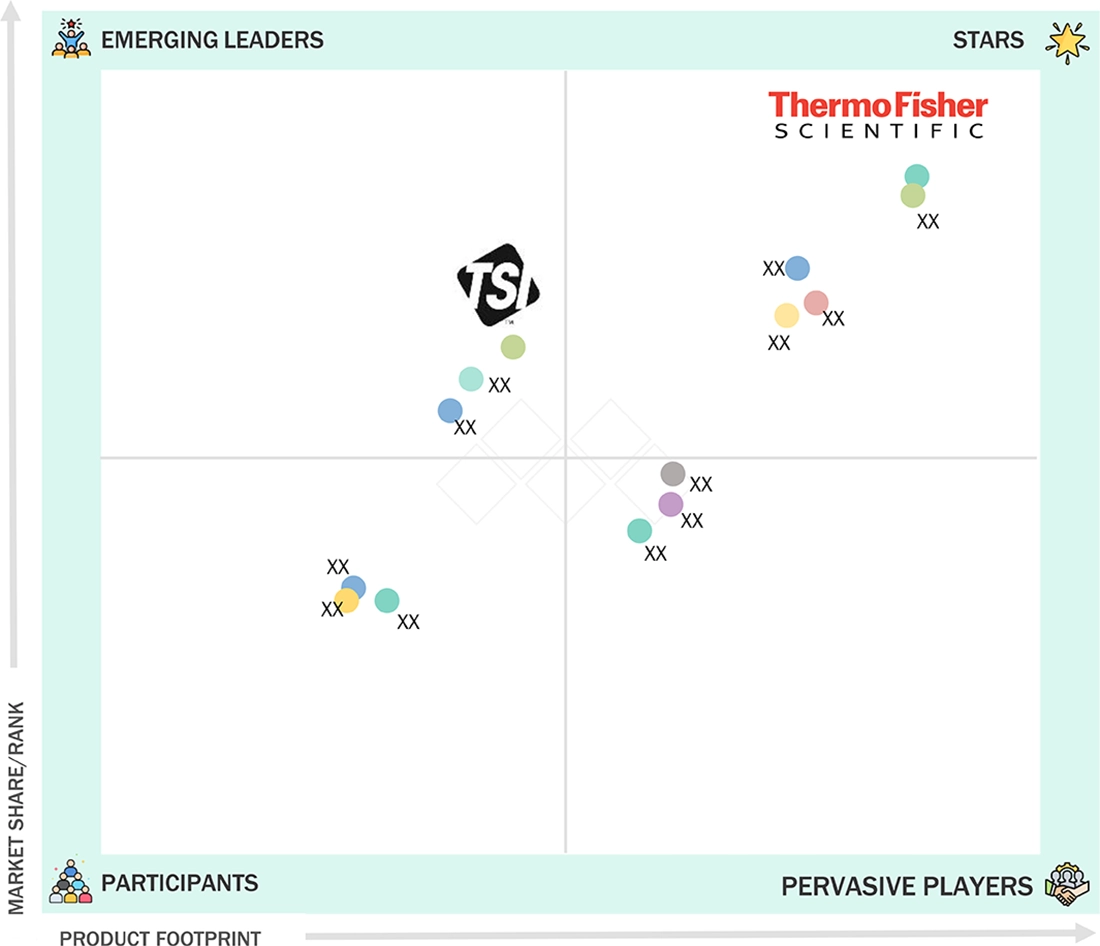
Source: Secondary Research, Interviews with Experts, MarketsandMarkets Analysis
KEY MARKET PLAYERS
MARKET SCOPE
| REPORT METRIC | DETAILS |
|---|---|
| Market Size in 2026 (Value) | USD 9.61 Billion |
| Market Size in 2031 (Value) | USD 13.86 Billion |
| Growth Rate | CAGR of 7.4% from 2026–2031 |
| Years Considered | 2024–2031 |
| Base Year | 2025 |
| Forecast Period | 2026–2031 |
| Units Considered | Value (USD Million/Billion) |
| Report Coverage | Revenue forecast, company ranking, competitive landscape, growth factors, and trends |
| Segments Covered |
|
| Regions Covered | North America, Europe, Asia Pacific, Latin America, Middle East & Africa |
DELIVERED CUSTOMIZATIONS
We have successfully delivered the following deep-dive customizations:
| CLIENT REQUEST | CUSTOMIZATION DELIVERED | VALUE ADDS |
|---|---|---|
| Environmental Monitoring Company |
|
|
| Air Quality Monitoring System Manufacturer |
|
|
| Government & Environmental Agency |
|
|
RECENT DEVELOPMENTS
- April 2026 : Teledyne Technologies acquired DD-Scientific Holdings Limited, a UK-based developer and manufacturer of high-performance electrochemical gas sensors. The acquired company’s portfolio includes trace-gas sensors specifically used for ambient air quality and emissions monitoring, adding gas-sensing capabilities to Teledyne’s environmental instrumentation business. The acquisition therefore has a direct connection to air quality monitoring systems and strengthens Teledyne’s portfolio for environmental gas measurement applications.
- April 2026: Thermo Fisher Scientific announced the discontinuation of selected particulate and gas analyzer product lines within its Environmental and Process Monitoring business, with last-time-buy orders available through June 30, 2026. The affected portfolio includes equipment used for particulate and gas analysis relevant to ambient air monitoring, making this a substantive portfolio development directly involving air-quality monitoring instrumentation.
- May 2024 : Thermo Fisher Scientific announced the launch of its “Make in India” Air Quality Monitoring System (AQMS) analyzers to support India’s clean air initiatives and strengthen local environmental monitoring capabilities. The company began manufacturing and validating AQMS analyzers at its Nashik, Maharashtra facility, while assembling Continuous Ambient Air Quality Monitoring Stations (CAAQMS) at its Pune facility.
- May 2024 : Thermo Fisher Scientific announced the launch of its “Make in India” Air Quality Monitoring System (AQMS) analyzers to support India’s clean air initiatives and strengthen local environmental monitoring capabilities. The company began manufacturing and validating AQMS analyzers at its Nashik, Maharashtra facility, while assembling Continuous Ambient Air Quality Monitoring Stations (CAAQMS) at its Pune facility.
- January 2024 : HORIBA launched the AP-380 series of analyzers to address diverse air quality monitoring requirements across environmental and industrial applications. The series includes five models for monitoring trace gases such as CO, SO2, O3, NOx, and hydrocarbons, featuring modular design, remote operation capabilities, and improved energy efficiency.
Table of Contents
 Exclusive indicates content/data unique to MarketsandMarkets and not available with any competitors.
Methodology
This study involved the extensive use of both primary and secondary sources. The research process involved the study of various factors affecting the industry to identify the segmentation types, industry trends, key players, competitive landscape, key market dynamics, and key player strategies.
Secondary Research
The secondary research process involved the widespread use of secondary sources, directories, databases (such as Bloomberg Businessweek, Factiva, and D&B Hoovers), white papers, annual reports, company house documents, investor presentations, and SEC filings of companies. Secondary research was used to identify and collect information useful for the extensive, technical, market-oriented, and commercial study of the air quality monitoring systems market. It was also used to obtain important information about the key players and market classification & segmentation according to industry trends to the bottom-most level, and key developments related to market and technology perspectives. A database of the key industry leaders was also prepared using secondary research.
Primary Research
In the primary research process, various sources from both the supply and demand sides were interviewed to obtain qualitative and quantitative information for this report. The primary sources from the supply side include industry experts such as CEOs, vice presidents, marketing and sales directors, technology & innovation directors, and related key executives from various key companies and organizations in the air quality monitoring systems market. The primary sources from the demand side include medical OEMs, analytical instrument OEMs, CDMOs, and service providers, among others. Primary research was conducted to validate the market segmentation, identify key players in the market, and gather insights on key industry trends & key market dynamics.
A breakdown of the primary respondents is provided below:
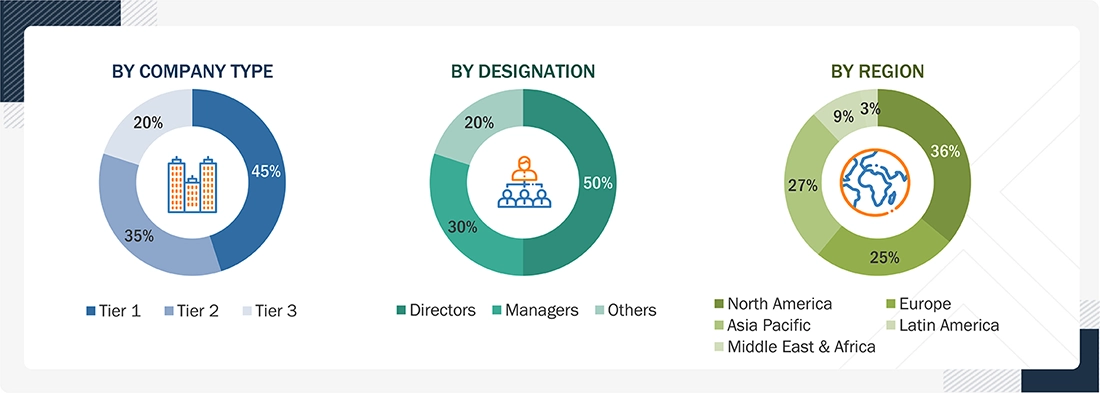
*Others include sales managers, marketing managers, business development managers, product managers, distributors, and suppliers.
Note: Companies are classified into tiers based on their total revenue. As of 2022, Tier 1 = >USD 10.00 billion, Tier 2 = USD 1.00 billion to USD 10.00 billion, and Tier 3 = <USD 1.00 billion.
To know about the assumptions considered for the study, download the pdf brochure
Market Size Estimation
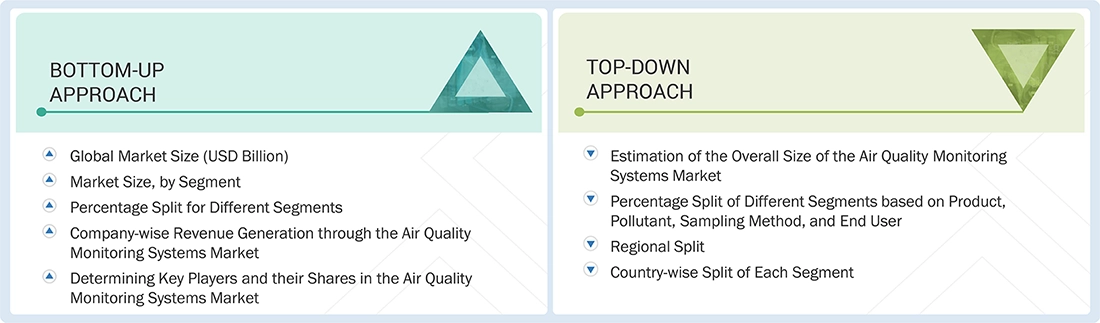
In this report, the global air quality monitoring systems market size was arrived at by using the revenue share analysis of leading players. For this purpose, key players in the market were identified, and their revenues from the air quality monitoring systems business were determined through various insights gathered during the primary and secondary research phases. Secondary research included the study of the annual and financial reports of the top market players. In contrast, primary research included extensive interviews with key opinion leaders, such as CEOs, directors, and key marketing executives.
To calculate the global market value, segmental revenues were calculated based on the revenue mapping of major solution/service providers. This process involved the following steps:
- Generating a list of major global players operating in the air quality monitoring systems market
- Mapping annual revenues generated by major global players from the air quality monitoring systems segment (or nearest reported business unit/product category)
- Revenue mapping of key players to cover a major share of the global market, as of 2025
- Extrapolating the global value of the air quality monitoring systems industry
Air Quality Monitoring Systems Market : Top-Down and Bottom-Up Approach
Data Triangulation
After arriving at the overall market size from the market size estimation process explained above, the global air quality monitoring systems market was split into segments and subsegments. Data triangulation and market breakdown procedures were employed to complete the overall market engineering process and arrive at the exact statistics for all segments and subsegments. The data was triangulated by studying various factors and trends from both the demand and supply sides. Additionally, the air quality monitoring systems market was validated using both top-down and bottom-up approaches.
Market Definition
Air quality monitoring is the process of measuring and analyzing the concentration of pollutants and contaminants present in the air, including particulate matter, harmful gases, and airborne microorganisms. Air quality monitoring systems are used to continuously assess ambient and indoor air conditions, track changes in pollution levels, and evaluate the impact of air pollution on human health, industrial safety, and the environment.
Key Stakeholders
- Manufacturers and distributors of air quality monitoring products
- Air quality monitoring software developers
- Research laboratories and academic institutes
- Air pollution monitoring committees
- Pharmaceutical and biotechnology companies
- Government and non-government agencies
- National and regional air pollution control boards and organizations
- Oil & gas production and distribution companies
- Gas operators, distributors, and regulators
- Power generation and power distribution units
- Municipalities and municipal corporations
- Food & beverage manufacturing companies
- Market research and consulting firms
Report Objectives
- To define, describe, and forecast the air quality monitoring systems market on the basis of product, sampling method, pollutant, end user, and region
- To provide detailed information regarding the major factors influencing the growth potential of the global air quality monitoring systems market (drivers, restraints, opportunities, challenges, and trends)
- To analyze the micro markets with respect to individual growth trends, prospects, and contributions to the global air quality monitoring systems market
- To analyze key growth opportunities in the global air quality monitoring systems market for key stakeholders and provide details of the competitive landscape for market leaders
- To forecast the size of market segments and/or subsegments with respect to major regions, namely, North America (US and Canada), Europe (Germany, France, the UK, Italy, Spain, and the RoE), Asia Pacific (Japan, China, India, Australia, South Korea, ASEAN region, and the RoAPAC), Latin America, and Middle East & Africa
- To profile the key players in the global air quality monitoring systems market and comprehensively analyze their market shares and core competencies
- To track and analyze the competitive developments undertaken in the global air quality monitoring systems market, such as product launches, agreements, expansions, and acquisitions.
Available customizations:
With the given market data, MarketsandMarkets offers customizations as per the company’s specific needs. The following customization options are available for the present global air quality monitoring systems market report:
Product Analysis
- Product matrix, which gives a detailed comparison of the product portfolios of the top fifteen companies
Regional Analysis
- Further breakdown of the Rest of Europe air quality monitoring systems market into Russia, Belgium, the Netherlands, Switzerland, Austria, Finland, Sweden, Poland, and Portugal, among other countries
- Further breakdown of the Rest of Asia Pacific air quality monitoring systems market into Singapore, Taiwan, New Zealand, the Philippines, Malaysia, and other APAC countries
- Further breakdown of the Rest of the Latin America air quality monitoring systems market into Argentina, Chile, Peru, and Colombia, among other countries
Company Information
- Detailed analysis and profiling of additional market players (up to 15)


Personalize This Research
- Triangulate with your Own Data
- Get Data as per your Format and Definition
- Gain a Deeper Dive on a Specific Application, Geography, Customer or Competitor
- Any level of Personalization
Let Us Help You
- What are the Known and Unknown Adjacencies Impacting the Air Quality Monitoring Systems Market
- What will your New Revenue Sources be?
- Who will be your Top Customer; what will make them switch?
- Defend your Market Share or Win Competitors
- Get a Scorecard for Target Partners

Custom Market Research Services
We Will Customise The Research For You, In Case The Report Listed Above Does Not Meet With Your Requirements
Get 10% Free CustomisationTESTIMONIALS

JAYANT RAJPUROHIT
Director of Market Insights, Data and Analytics
SFI Health,
Leading Pharmaceutical Companywww.sfihealth.com/

We at SFI Health approached MarketsandMarkets for an Opportunity Assessment on "Incidence and Prevalence of Focus Indications" as we wanted to know the most attractive HCPs like Physician, Functional MD, Naturopath and Pharmacist. The project was critical for us to ensure our focus on the right target which would enable sustainable growth and profitability for SFI Health. The business insights provided exceeded our expectations and we were extremely impressed. The team at MarketsandMarkets is highly professional and detail oriented and very well understood our business needs. MarketsandMarkets offers a unique combination of expertise and dedicated engagement model. We identified 2 new products to be launched in coming months, based on the research findings provided by MarketsandMarkets. We are happy with the services and would strongly recommend MarketsandMarkets to my peers in the industry.

BEATRIZ DE LA CALLE
Head of Commercial Analytics
Qualicaps,
Leading Pharmaceutical Companywww.qualicaps.com/

We partnered with MarketsandMarkets for an assessment study on hard empty capsules. The team was extremely professional in understanding our business requirements and we received timely responses to all our queries. The market intelligence and the recommendations has met our business requirements. We were extremely impressed to see the final study results; it really exceeded our expectations. The market intelligence offered by MarketsandMarkets, and clarity on next steps will help us achieve our business objective for the Year 2021. We are happy with the services and would strongly recommend MarketsandMarkets to my peers in the industry.

Bob Williams,
Senior Director Business Development & Innovation
Bracco Diagnostics Inc.,
Italian Multinational in life sciences sector and a World Leader in imaging diagnosticsimaging.bracco.com/us-en
We were pleased with targeted insights that MarketsandMarkets identified from a custom study on the 'Radiation Dose Management Solutions Market'. Your team identified and characterized the market participants as well as underlying trends accurately. This study was useful to Bracco in formulating business strategies for our dose monitoring product lines and we thank MarketsandMarkets for the job well done.
Cody Coonradt,
Market Development and Strategy Manager
3M Health Information Systems,
Leader in Health care Coding, Payment & Analytics Solutions.www.3m.com/3M/en_US/health-information-systems-us
The value for our organization comes from three things: depth of research, specificity of segments and being easy to work with. As important as the first two are, the third can't be underestimated. MarketsandMarkets, maybe more than any other research vendor, wants to know what is top of mind for our team and what big questions we are grappling to answer.
Their customer first approach and high value engagement model, have given us great analysis and excellent value for money
- France Air Quality Monitoring System Market
- Italy Air Quality Monitoring System Market
- Spain Air Quality Monitoring System Market
- Japan Air Quality Monitoring System Market
- China Air Quality Monitoring System Market
- India Air Quality Monitoring System Market
- Australia Air Quality Monitoring System Market
- South Korea Air Quality Monitoring System Market
- Brazil Air Quality Monitoring System Market
- Mexico Air Quality Monitoring System Market
- US Air Quality Monitoring System Market
- Canada Air Quality Monitoring System Market
- Germany Air Quality Monitoring System Market
- UK Air Quality Monitoring System Market
Growth opportunities and latent adjacency in Air Quality Monitoring Systems Market






Jennifer
Mar, 2022
Which factors are playing a key role in the global growth of Air Quality Monitoring System Market?.
Linda
Mar, 2022
Which are the main growth restraining factors for the Air Quality Monitoring System Market?.
Elizabeth
Mar, 2022
Can you elaborate more on the emerging trends in the Global Air Quality Monitoring System Market?.