



Vendor Neutral Archive (VNA) & PACS Market
Report Code
HIT 2128
Published in
Apr, 2026, By MarketsandMarkets™
Vendor Neutral Archive (VNA) & PACS Market by Product Type (Department, Multi-department, Multi-site), Modality (CT, MRI, X-ray, Ultrasound, Mammo), Application (Cardio, Onco, Neuro), End User (Hospital, ASC, Diagnostic Center) - Global Forecast to 2031

$5.60B
MARKET SIZE, 2026
$8.57B
MARKET SIZE, 2031

8.9%
CAGR (2026-2031)

2026-2031
FORECAST PERIOD
VENDOR NEUTRAL ARCHIVE (VNA) & PACS MARKET SIZE, SHARE & GROWTH SNAPSHOT
Source: Secondary Research, Interviews with Experts, MarketsandMarkets Analysis
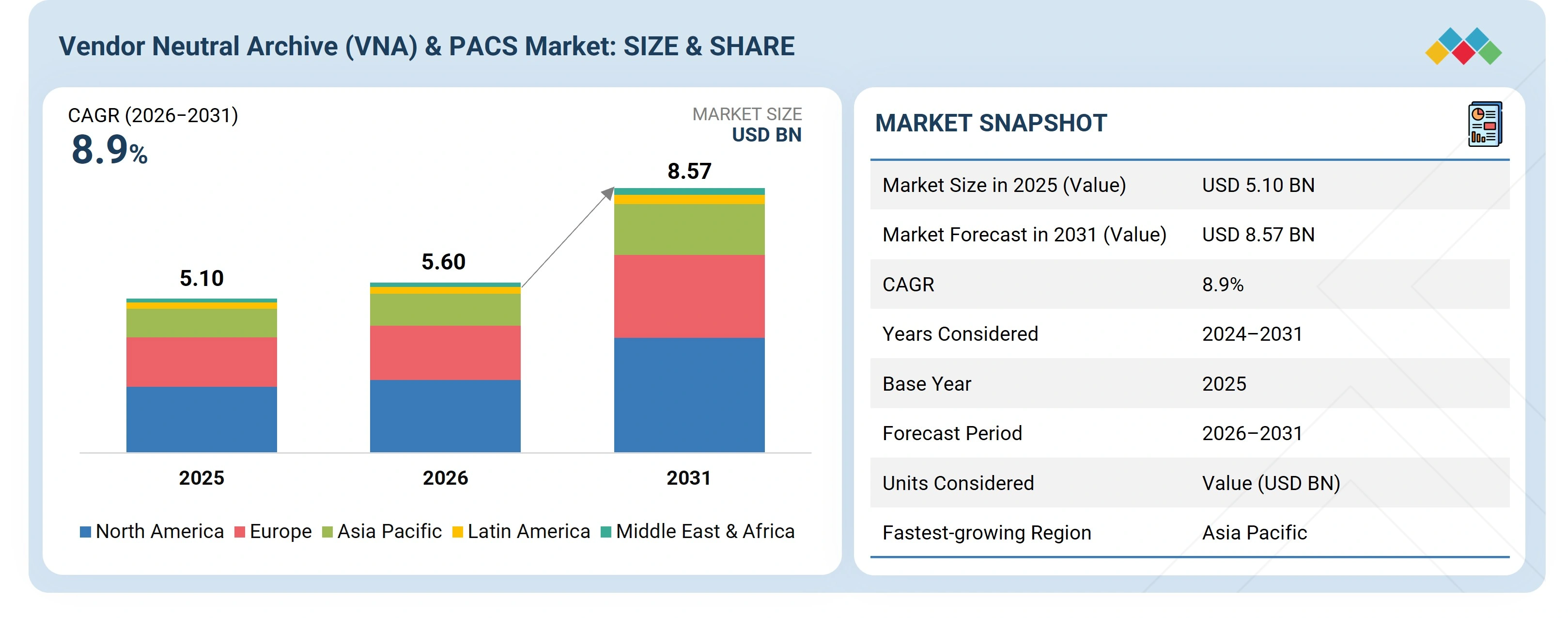
The global vendor neutral archive (VNA) & PACS market is projected to grow from USD 5.60 billion in 2026 to USD 8.57 billion by 2031, at a CAGR of 8.9% during the forecast period. The market was valued at USD 5.10 billion in 2025. This growth is driven by the rapid digital transformation of healthcare infrastructure and increasing adoption of cloud-based archiving and AI-enhanced diagnostic tools that support remote workflows and data-driven care.
KEY TAKEAWAYS
-
MARKET SNAPSHOT:
Base Year Market Size (2025): USD 5.10 Billion
Current Market Size (2026): USD 5.60 Billion
Forecast Market Size (2031): USD 8.57 Billion
CAGR (2026–2031): 8.9% -
SEGMENT LEADERSHIP:
Regional Leader: North America accounted for the largest share (42.9%) of the VNA & PACS market in 2025.
Modality Leader: X-ray accounted for the largest share (42.8%) of the VNA & PACS market in 2025.
Deployment Model Leader: Cloud-based deployment models are projected to register the highest CAGR (10.4%) from 2026 to 2031.
Product Leader: VNA accounted for the largest market share in 2025.
Vendor Leader: Independent vendors accounted for the largest share in 2025.
Application Leader: Cardiology accounted for the largest share in 2025.
End User Leader: Hospitals & clinics are projected to register the highest CAGR during the study period. -
MARKET OUTLOOK & COMPETITIVE LANDSCAPE:
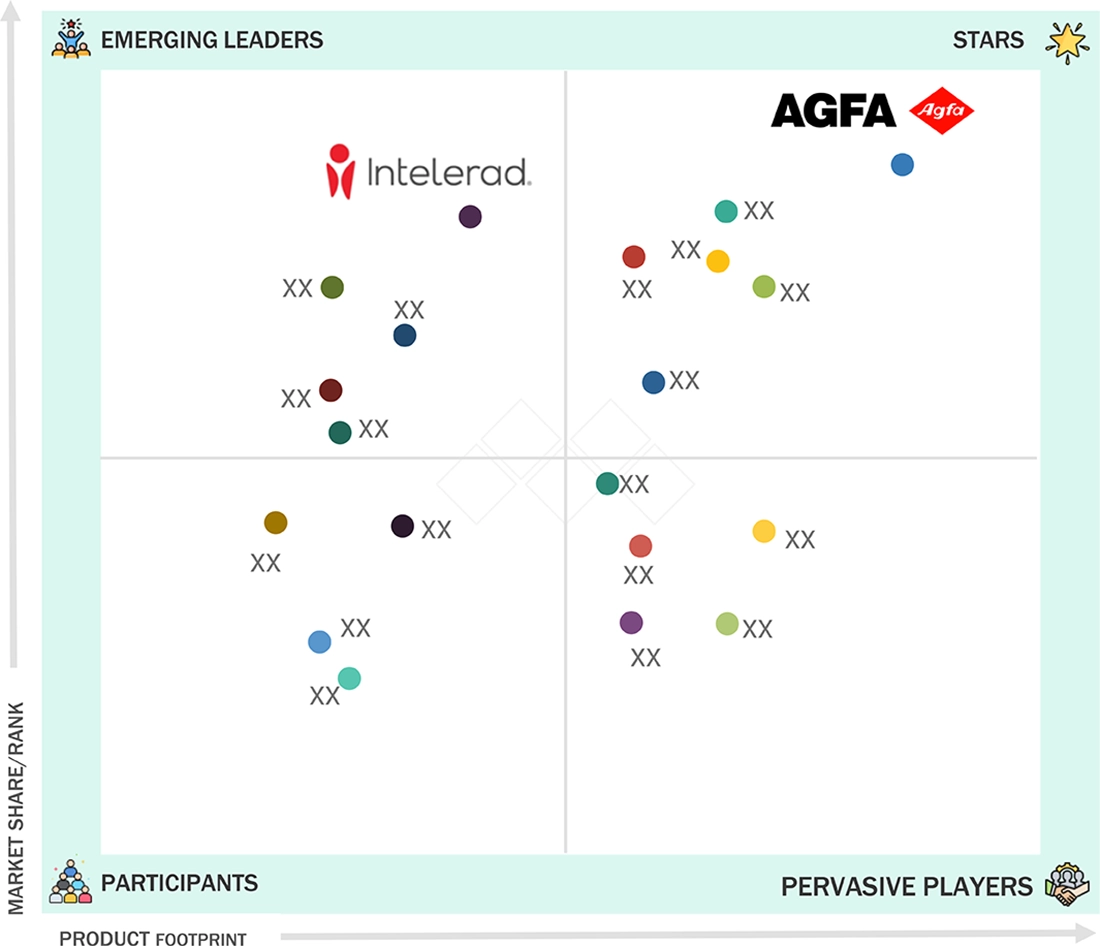
Agfa Healthcare (Star) leads with a strong market presence and comprehensive imaging portfolio, offering interoperable VNA and PACS solutions that support multi-department enterprise imaging across global healthcare networks.
Intelerad (Emerging Leader) is rapidly gaining traction with its cloud-native PACS and enterprise imaging platforms, delivering scalable and flexible solutions that appeal to mid-sized and large imaging providers. While Agfa dominates through a broad installed base and end-to-end imaging workflows, Intelerad shows strong momentum to advance toward the leaders' quadrant as cloud adoption and demand for integrated, AI-ready platforms continue to rise.
The growth in the medical imaging sector is predominantly fueled by the escalating volume of imaging data and a stronger regulatory push for EHR implementation. Additionally, the ongoing transition towards value-based care is prompting increased investments in scalable and interoperable imaging solutions. Key technological advancements, such as cloud-based storage, Al, and analytics integration, are significantly driving the adoption of VNA and PACS; these innovations facilitate improved clinical workflows, enhance data accessibility, and ultimately lead to better patient care outcomes.
TRENDS & DISRUPTIONS IMPACTING CUSTOMERS' CUSTOMERS
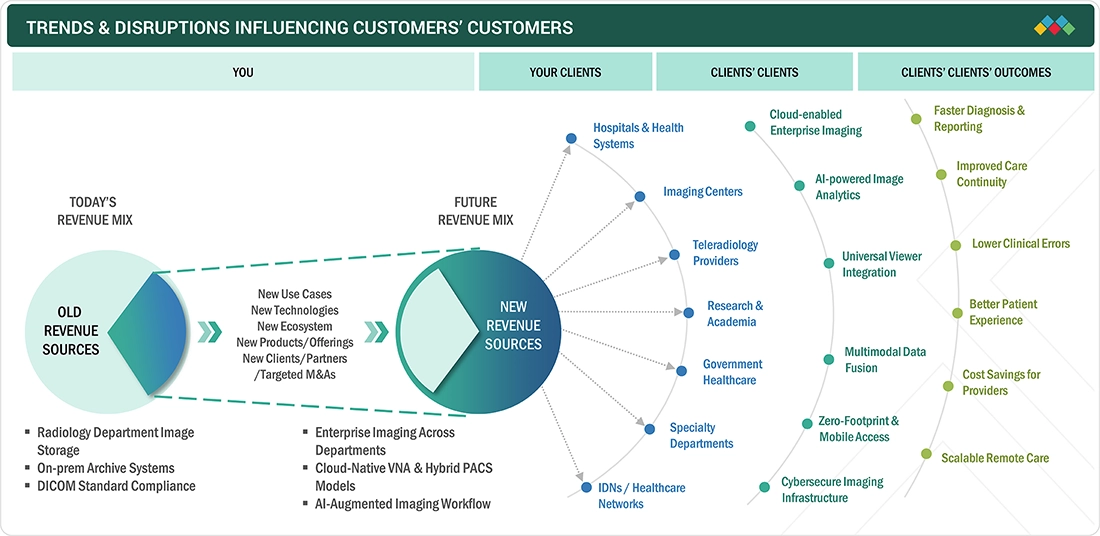
The VNA & PACS market is being significantly disrupted by the convergence of cloud technologies, AI-enabled imaging workflows, and enterprise-wide data interoperability. Traditional siloed PACS are rapidly being replaced by cloud-native VNAs that support both DICOM and non-DICOM formats, enabling unified access across departments and care settings. The growing demand for remote diagnostics, teleradiology, and mobile access is accelerating the need for zero-footprint universal viewers, while rising cybersecurity threats are driving adoption of more secure, scalable, and compliant storage architectures.
Source: Secondary Research, Interviews with Experts, MarketsandMarkets Analysis
MARKET DYNAMICS

Drivers
Impact
Level
Level
-
Heightened investments in medical imaging technologies

-
Growing demand for streamlined healthcare data management solutions


RESTRAINTS
Impact
Level
Level
-
High initial investment for implementing VNA and PACS solutions

-
Lack of standardized protocols and interoperability frameworks


OPPORTUNITIES
Impact
Level
Level
-
Favorable government initiatives for better penetration of AI in medical imaging

-
Increasing medical imaging procedures and large imaging data silos


CHALLENGES
Impact
Level
Level
-
Rising security concerns related to cloud-based image processing and analytics

-
Data security issues in healthcare settings

Source: Secondary Research, Interviews with Experts, MarketsandMarkets Analysis
Driver: Heightened investments in medical imaging technologies
Medical imaging employs various techniques, such as X-ray, Computed Tomography (CT), and Magnetic Resonance Imaging (MRI), to diagnose illnesses and provide insights into internal bodily conditions. Factors propelling investments in medical imaging technologies include governmental initiatives to modernize imaging facilities and research, the proliferation of diagnostic imaging centers, technological advancements in diagnostic imaging techniques, and patients’ growing preference for minimally invasive treatments
Restraint: High initial investment for implementing VNA and PACS solutions
The significant initial investment required for implementing VNA and PACS solutions poses a notable restraint on the market. Healthcare facilities considering the adoption of VNA and PACS technologies often face substantial upfront costs associated with infrastructure, software licenses, and training. These costs can present a considerable barrier to entry, particularly for smaller healthcare providers or facilities operating on a limited budget.
Opportunity: Favorable government initiatives for better penetration of AI in medical imaging
Innovative solutions, such as AI-based solutions, are used to interpret the massive volume of medical imaging and diagnosis data and transfer it into actionable, useful information that physicians, radiologists, and researchers can use to improve the quality of care. Realizing the benefits of AI-based solutions, government organizations in various countries are increasingly undertaking initiatives to increase the adoption of AI-based technologies in their respective healthcare systems
Challenge: Rising security concerns related to cloud-based image processing and analytics
In spite of the benefits offered by cloud computing, it is associated with several concerns related to integrity, availability, privacy, and confidentiality. Owing to the large number of issues related to cloud data storage, such as data breaches, data theft, and unavailability of cloud data, cloud service providers (CSPs) are required to ensure reliable data services to customers and their stored data. Although cloud computing has certain benefits, many users are still unwilling to store their confidential data in cloud data centers, such as personal health records, diagnostic imaging data, and government-sensitive files. Clients lose direct control over their data sources once the data is stored in a data center. CSPs are continuously striving to ensure data security by using mechanisms such as firewalls and virtualization. These mechanisms, however, cannot entirely provide complete data protection owing to network vulnerabilities and control issues CSPs face regarding cloud applications, hardware, and client data
VENDOR NEUTRAL ARCHIVE (VNA) & PACS MARKET: COMMERCIAL USE CASES ACROSS INDUSTRIES
| COMPANY | USE CASE DESCRIPTION | BENEFITS |
|---|---|---|
 |
Offers enterprise imaging solutions with embedded VNA and PACS for multi-department use. | Enhances interoperability and reduces data silos across radiology and cardiology systems. |
 |
Provides Synapse VNA for centralized archiving of imaging data from disparate systems. | Improves data accessibility and long-term storage efficiency, supporting clinical decisions. |
 |
Delivers enterprise imaging PACS integrated with VNA for hospitals and imaging centers. | Facilitates faster diagnosis and collaboration with unified access to image data. |
 |
Supplies scalable PACS and cloud-enabled VNAs for large healthcare networks. | Lowers IT overhead while enabling secure, remote access to imaging records. |
 |
Offers cloud-based VNA solutions with AI-driven image management. | Streamlines workflow and enhances diagnostic accuracy with intelligent data organization. |
Logos and trademarks shown above are the property of their respective owners. Their use here is for informational and illustrative purposes only.
MARKET ECOSYSTEM
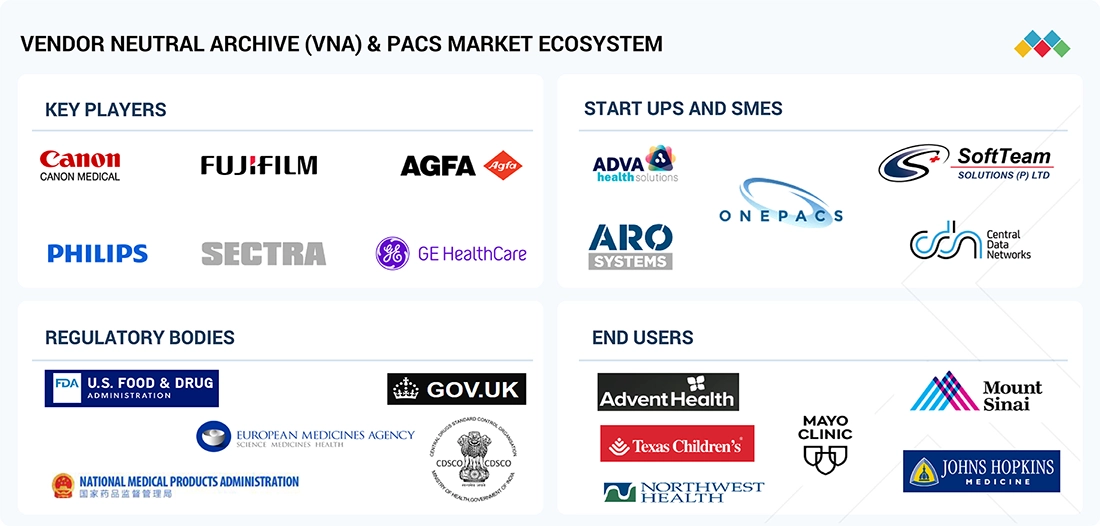
The VNA & PACS market ecosystem comprises a network of healthcare providers, imaging vendors, cloud service providers, and interoperability standards bodies working together to enable seamless storage, access, and exchange of medical images. Core participants include PACS/VNA software vendors, modality manufacturers (MRI, CT, etc.), cloud infrastructure providers, and cybersecurity firms. Supporting stakeholders like AI-powered imaging analytics companies, teleradiology platforms, and healthcare system integrators further enhances clinical workflows. This interconnected ecosystem is driven by a shared goal of achieving enterprise imaging, cross-vendor compatibility, and improved patient care across regions and healthcare settings.
Logos and trademarks shown above are the property of their respective owners. Their use here is for informational and illustrative purposes only.
MARKET SEGMENTS
Source: Secondary Research, Interviews with Experts, MarketsandMarkets Analysis
VNA & PACS Market, By Product Type
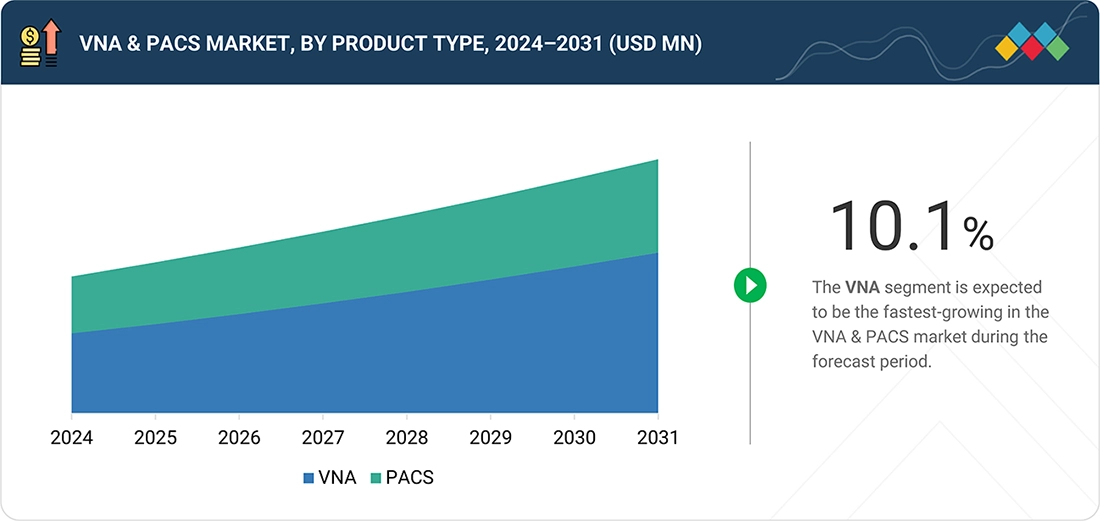
In 2025, the VNA segment held the largest share of the VNA & PACS market due to its capability to provide a centralized repository for storing medical images and related metadata in a standardized format, independent of specific imaging modalities or vendors. VNA enables efficient interoperability for data exchange across diverse systems and healthcare facilities, thereby enhancing collaboration and care coordination among providers. The VNA landscape can be delineated into three categories: departmental, multi-department, and multi-site VNA, each tailored to address the specific requirements of various levels within healthcare organizations. These solutions are essential for handling substantial volumes of imaging data, ensuring that medical images are readily accessible across multiple departments, locations, and systems; this access not only streamlines operational workflows but also optimizes patient care delivery. As the healthcare sector increasingly adopts value-based care models, the significance of comprehensive data management solutions, such as VNA, has escalated. Furthermore, VNA empowers healthcare organizations to leverage medical imaging data for initiatives related to population health management, predictive analytics, and personalized medicine. This strategic positioning has established VNA solutions as pivotal contributors to the evolving landscape of medical imaging and healthcare informatics.
VNA & PACS Market, By Deployment Model
The VNA & PACS market is segmented by deployment into cloud-based, on-premises, and hybrid deployment. The cloud-based segment is poised for robust growth throughout the forecast period, driven by a multitude of advantageous factors. Cloud-based VNA and PACS solutions eliminate the necessity for substantial investments in on- premises infrastructure, allowing healthcare organizations to leverage scalable storage and computing resources that can be dynamically configured according to fluctuating demand. This adaptability is particularly critical as healthcare entities grapple with the surging volumes of medical imaging data generated from diagnostic modalities such as X-rays, MRIs, and CT scans. Cloud service providers (CSPs) employ comprehensive security measures-including encryption, stringent access controls, and periodic security audits-to ensure the integrity and confidentiality of patient data. These protocols are essential for meeting regulatory compliance standards such as HIPAA and GDPR, mitigating the risks associated with potential data breaches, which are a major concern for healthcare organizations managing sensitive medical information. In addition, the cost-efficiency of cloud deployment models presents a compelling incentive for organizations aiming to curtail capital expenditures on physical infrastructure while capitalizing on the inherent flexibility of cloud storage solutions. The benefits of remote access and real-time monitoring afforded by cloud-based systems facilitate enhanced collaboration among healthcare professionals, enabling seamless access to imaging data across geographically dispersed locations while ensuring the health and security of the data remain intact.
VNA & PACS Market, By Modality
Based on modality, the VNA & PACS market is segmented into CT, mammography, MRI, ultrasound, X-rays, and PET. The CT segment held the largest market in 2025 due to the growing need for accurate and early diagnosis, advancements in technology, and the digitalization of healthcare. Additionally, CT scans play a crucial role in preventing unnecessary surgeries, improving cancer diagnosis and treatment, and enhancing patient care. Thus, the efficiency, versatility, and effectiveness of CT scans have made them indispensable in modern healthcare, driving their dominance in the VNA & PACS market as the preferred imaging modality for a diverse range of medical applications
VNA & PACS Market, By End User
Based on end-user, the VNA & PACS market is segmented into hospitals & clinics, diagnostic centers, ambulatory surgical centers, and other end users, including research and academic institutes. The hospitals & clinics segment dominates the end-user segment of the VNA & PACS market, as these healthcare facilities generate vast volumes of medical imaging data daily, necessitating robust solutions for managing, storing, and efficiently accessing this data. Moreover, these solutions provide a centralized repository for storing medical images and associated metadata in a standardized format, enabling seamless access and retrieval of patient information across different departments and facilities within hospitals and clinics. Owing to the increasing demand for personalized, data-driven care, the hospitals and clinics segment will remain at the forefront of innovation and investment in VNA and PACS solutions to meet the evolving needs of patients and healthcare professionals alike.
VNA & PACS Market, By Vendor type
Based on vendor type, the VNA & PACS market is segmented into independent vendors and third-party vendors. Third-party vendors are expected to be the fastest-growing during the forecast period due to their ability to provide flexible, interoperable solutions that integrate across multi-vendor imaging environments. Their offerings often include cost-effective cloud-based storage, enhanced data migration services, and scalable solutions that reduce IT complexity. Additionally, the increasing demand for cross-enterprise data sharing and the shift toward subscription-based models further fuel the growth of third-party VNA & PACS vendors.
VNA & PACS Market, By Application
Based on application, the VNA & PACS market is segmented into cardiology, orthopedic, oncology, neurology, obstetrics & gynecology, and other applications. The cardiology segment held the largest market share in 2025 due to the high volume of imaging procedures, such as echocardiograms, CT, and MRI scans, which require efficient storage and retrieval systems. The rising prevalence of cardiovascular diseases, growing adoption of advanced imaging technologies for early diagnosis, and increasing integration of AI-driven analytics in cardiac imaging are key drivers supporting the segment's dominance. Moreover, the demand for seamless cross-departmental access to imaging data to support timely interventions in critical care further propels market growth.
REGION
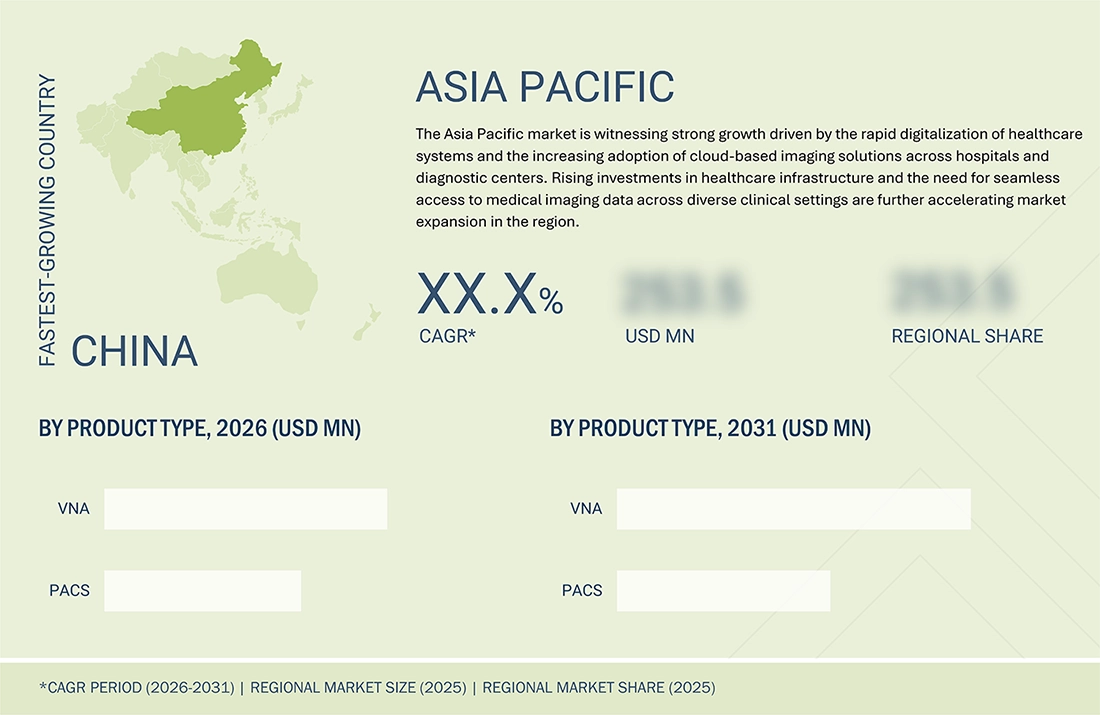
APAC is estimated to register the highest CAGR during the forecast period
The VNA & PACS market in APAC is projected to register the highest CAGR during the forecast period. The growth of this region is due to rising medical imaging investments and technological advancements in diagnostic imaging modalities. Moreover, advancements in technology and the growing prevalence of cloud computing are making VNA and PACS more accessible and affordable in APAC. As healthcare providers in this region continue to prioritize efficiency, accessibility, and quality of care, VNA and PACS solutions will play a pivotal role in driving healthcare transformation and improving patient outcomes across the region.
VENDOR NEUTRAL ARCHIVE (VNA) & PACS MARKET: COMPANY EVALUATION MATRIX
In the VNA & PACS market matrix, Agfa Healthcare (Star) leads with a strong market presence and comprehensive imaging portfolio, offering interoperable VNA and PACS solutions that support multi-department enterprise imaging across global healthcare networks. Intelerad (Emerging Leader) is rapidly gaining traction with its cloud-native PACS and enterprise imaging platforms, delivering scalable and flexible solutions that appeal to mid-sized and large imaging providers. While Agfa dominates through a broad installed base and end-to-end imaging workflows, Intelerad shows strong momentum to advance toward the leaders' quadrant as cloud adoption and demand for integrated, AI-ready platforms continue to rise.
Source: Secondary Research, Interviews with Experts, MarketsandMarkets Analysis
KEY MARKET PLAYERS
- Agfa-Gevaert Group. (Belgium)
- FUJIFILM Holdings Corporation (Japan)
- GE Healthcare (US)
- Merative (US)
- Sectra AB (Sweden)
- Koninklijke Philips N.V. (Netherland)
- Hyland Software, Inc. (US)
- CANON MEDICAL SYSTEMS CORPORATION (Japan)
- Siemens Healthineers AG (Germany)
- BridgeHead Software Ltd. (UK)
- Canopy Partners. (US)
- Novarad Corporation. (US)
- POSTDICOM (Netherlands)
- AdvaHealth Solutions Pte Ltd (Singapore)
- CrelioHealth (India)
- Esaote SPA (Italy)
- PaxeraHealth (US)
- VISUS Health IT GmbH (Germany)
MARKET SCOPE
| REPORT METRIC | DETAILS |
|---|---|
| Market Size in 2025 (Value) (Base Year) | USD 5.10 BN |
| Market Size in 2026 (Value) (Estimated Year) | USD 5.60 Billion |
| Market Forecast in 2031 (Value) (Forecast Year) | USD 8.57 Billion |
| CAGR | 8.9% |
| Years Considered | 2024–2031 |
| Base Year | 2025 |
| Forecast Period | 2026–2031 |
| Units Considered | USD Billion |
| Report Coverage | Revenue forecast, company ranking, competitive landscape, growth factors, and trends |
| Segments Covered |
|
| Regions Covered | North America, Asia Pacific, Europe, the Middle East & Africa, Latin America |
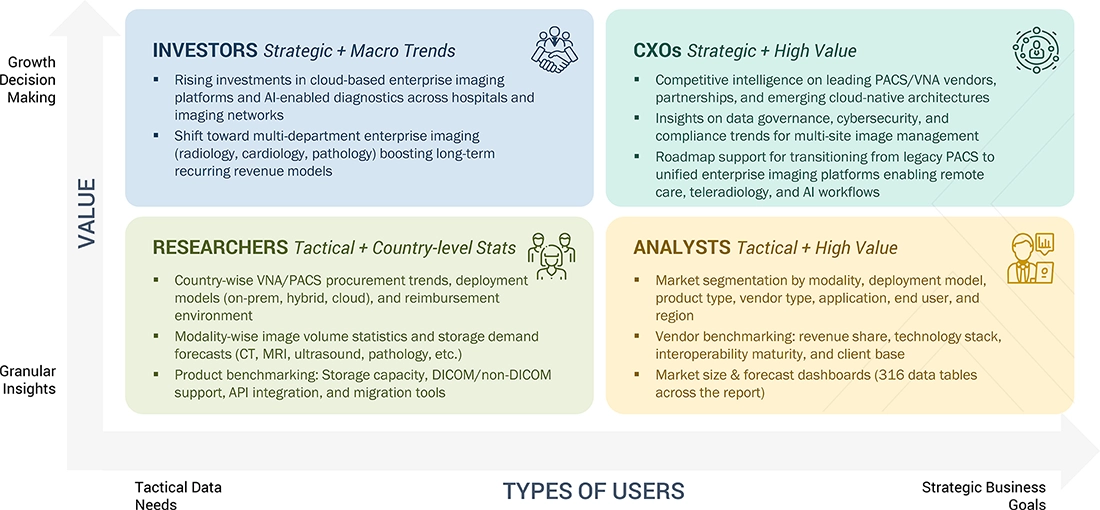
WHAT IS IN IT FOR YOU: VENDOR NEUTRAL ARCHIVE (VNA) & PACS MARKET REPORT CONTENT GUIDE
DELIVERED CUSTOMIZATIONS
We have successfully delivered the following deep-dive customizations:
| CLIENT REQUEST | CUSTOMIZATION DELIVERED | VALUE ADDS |
|---|---|---|
| Pricing and distribution channel of VNA & PACS market | Delivered detailed analysis of pricing models (subscription, perpetual license, tiered storage) and distribution channels (direct sales, system integrators, cloud marketplaces, and OEM partnerships) | Enabled the client to refine their go-to-market strategy and align pricing to competitive and buyer expectations |
RECENT DEVELOPMENTS
- April 2025 : Siemens Healthineers (Germany) and Tower Health (US) unveiled a 10-year value partnership to upgrade imaging systems and digital tools and enhance diagnostic capabilities.
- March 2025 : GE Healthcare (US) launched the Genesis Cloud Suite, an enterprise imaging SaaS portfolio offering edge, storage, VNA, and data migration solutions to improve workflow efficiency, precision, and IT resource optimization for healthcare providers.
- March 2025 : FUJIFILM Healthcare Americas (US) partnered with AWS (US) to enhance digital pathology and cloud integration to streamline data lifecycle management and optimize storage of large pathology files within Fujifilm's Synapse Pathology platform.
Table of Contents
 Exclusive indicates content/data unique to MarketsandMarkets and not available with any competitors.
TITLE
PAGE NO
1
INTRODUCTION
29
2
EXECUTIVE SUMMARY
34
3
PREMIUM INSIGHTS
39
4
MARKET OVERVIEW
AI-driven medical imaging poised for growth amid investment surges and data management innovations.
42
4.1
INTRODUCTION
4.2
MARKET DYNAMICS
4.2.1
DRIVERS
4.2.1.1
HEIGHTENED INVESTMENTS IN MEDICAL IMAGING TECHNOLOGIES
4.2.1.2
GROWING DEMAND FOR STREAMLINED HEALTHCARE DATA MANAGEMENT SOLUTIONS
4.2.1.3
INTEGRATION OF PACS/VNA WITH ELECTRONIC MEDICAL RECORDS (EMRS)
4.2.2
RESTRAINTS
4.2.2.1
HIGH INITIAL INVESTMENT
4.2.2.2
LACK OF STANDARDIZED PROTOCOLS AND INTEROPERABILITY FRAMEWORKS
4.2.3
OPPORTUNITIES
4.2.3.1
GOVERNMENT INITIATIVES TO INCREASE PENETRATION OF AI IN MEDICAL IMAGING
4.2.3.2
INCREASING MEDICAL IMAGING PROCEDURES AND LARGE IMAGING DATA SILOS
4.2.3.3
RAPID UPTAKE OF BIG DATA IN HEALTHCARE
4.2.4
CHALLENGES
4.2.4.1
RISING SECURITY CONCERNS RELATED TO CLOUD-BASED IMAGE PROCESSING AND ANALYTICS
4.2.4.2
DATA SECURITY ISSUES
4.3
UNMET NEEDS AND WHITE SPACES
4.4
INTERCONNECTED MARKETS AND CROSS-SECTOR OPPORTUNITIES
4.5
STRATEGIC MOVES BY TIER-1/2/3 PLAYERS
5
INDUSTRY TRENDS
Discover how competitive forces and pricing trends shape the future of healthcare IT.
52
5.1
PORTER’S FIVE FORCES ANALYSIS
5.1.1
INTENSITY OF COMPETITIVE RIVALRY
5.1.2
BARGAINING POWER OF SUPPLIERS
5.1.3
BARGAINING POWER OF BUYERS
5.1.4
THREAT OF NEW ENTRANTS
5.1.5
THREAT OF SUBSTITUTES
5.2
MACROECONOMICS INDICATORS
5.2.1
INTRODUCTION
5.2.2
GDP TRENDS AND FORECAST
5.2.3
TRENDS IN GLOBAL HEALTHCARE IT INDUSTRY
5.3
VALUE CHAIN ANALYSIS
5.4
ECOSYSTEM MAPPING
5.5
PRICING ANALYSIS
5.5.1
AVERAGE SELLING PRICE (ASP) TREND OF VNA AND PACS SOLUTIONS, BY PRODUCT TYPE
5.5.2
AVERAGE SELLING PRICE TREND, BY REGION
5.6
KEY CONFERENCES AND EVENTS, 2026–2027
5.7
TRENDS/DISRUPTIONS IMPACTING CUSTOMER BUSINESS
5.8
INVESTMENT AND FUNDING SCENARIO
5.9
CASE STUDY ANALYSIS
5.9.1
AMBRA HEALTH UTILIZED AWS CLOUD SERVICES TO PROPEL WORLDWIDE GROWTH OF ITS MEDICAL IMAGING PLATFORM
5.9.2
NHS TRUST ADOPTED INTEGRATION AND INSTANT DATA ACCESS OFFERED BY SYNAPPS VNA TO ESTABLISH UNIFIED PLATFORM FOR STORING AND MANAGING DICOM IMAGE DATA
5.10
IMPACT OF 2025 US TARIFF OVERVIEW
5.10.1
INTRODUCTION
5.10.2
KEY TARIFF RATES
5.10.3
PRICE IMPACT ANALYSIS
5.11
IMPACT ON COUNTRY/REGION
5.11.1
THE US
5.11.2
EUROPE
5.11.3
APAC
5.12
IMPACT ON END USE INDUSTRIES
5.13
CONCLUSION
6
TECHNOLOGICAL ADVANCEMENTS, AI-DRIVEN IMPACT, PATENTS, INNOVATIONS, AND FUTURE APPLICATIONS
AI-driven tech revolutionizes medical imaging with cloud innovations and strategic patent insights.
67
6.1
KEY EMERGING TECHNOLOGIES
6.1.1
DICOM (DIGITAL IMAGING AND COMMUNICATIONS IN MEDICINE)
6.1.2
ENTERPRISE IMAGING SOLUTIONS
6.1.3
CLOUD-BASED STORAGE AND SERVICES
6.2
COMPLEMENTARY TECHNOLOGIES
6.2.1
IMAGE EXCHANGE NETWORKS
6.2.2
DATA ANALYTICS AND BUSINESS INTELLIGENCE
6.3
ADJACENT TECHNOLOGIES
6.3.1
HEALTH INFORMATION EXCHANGE (HIE)
6.4
PATENT ANALYSIS
6.4.1
INSIGHTS: JURISDICTION AND TOP APPLICANT ANALYSIS
6.5
FUTURE APPLICATIONS
6.5.1
AI-ENABLED ENTERPRISE DIAGNOSTIC ORCHESTRATION
6.5.2
MULTI-SPECIALTY ENTERPRISE IMAGING REPOSITORY
6.5.3
IMAGING DATA LAKE FOR CLINICAL RESEARCH AND REAL-WORLD EVIDENCE
6.5.4
CLOUD-BASED REGIONAL IMAGE EXCHANGE AND VIRTUAL CARE NETWORKS
6.5.5
PERSONALIZED AND LONGITUDINAL IMAGING INTELLIGENCE
7
REGULATORY LANDSCAPE
Navigate complex global regulations with a detailed guide to regional compliance requirements and key agencies.
73
7.1
REGIONAL REGULATIONS AND COMPLIANCE
7.1.1
REGULATORY BODIES, GOVERNMENT AGENCIES, AND OTHER ORGANIZATIONS
7.1.2
REGULATIONS
7.1.2.1
US
7.1.2.2
EUROPE
7.1.2.3
CHINA
7.1.2.4
JAPAN
7.1.2.5
INDIA
7.1.3
INDUSTRY STANDARDS
8
CUSTOMER LANDSCAPE & BUYER BEHAVIOR
Unlock buyer insights by understanding stakeholder influence and unmet needs in the VNA & PACS market.
77
8.1
INTRODUCTION
8.2
DECISION-MAKING PROCESS
8.3
BUYER STAKEHOLDERS AND BUYING EVALUATION CRITERIA
8.3.1
KEY STAKEHOLDERS IN BUYING PROCESS
8.3.2
BUYING CRITERIA
8.4
ADOPTION BARRIERS & INTERNAL CHALLENGES
8.5
UNMET NEEDS FROM VARIOUS END-USE INDUSTRIES
8.5.1
UNMET NEEDS
8.5.2
END-USER EXPECTATIONS
8.6
MARKET PROFITABILITY
9
VENDOR NEUTRAL ARCHIVE (VNA) & PACS MARKET, BY PRODUCT TYPE
Market Size & Growth Rate Forecast Analysis to 2031 in USD Million | 11 Data Tables
83
9.1
INTRODUCTION
9.2
VNA
9.2.1
DEPARTMENT VNA
9.2.1.1
PHASED IMAGING MODERNIZATION DRIVING VNA ADOPTION AND INTEROPERABILITY GROWTH
9.2.2
MULTI-DEPARTMENT VNA
9.2.2.1
CROSS-DEPARTMENT IMAGING CONSOLIDATION DRIVING SCALABLE ENTERPRISE DATA PLATFORM ADOPTION
9.2.3
MULTI-SITE VNA
9.2.3.1
CLOUD-BASED MULTI-SITE IMAGING CONSOLIDATION ENABLING SCALABLE, CENTRALIZED CARE DELIVERY
9.3
PACS
9.3.1
DEPARTMENT PACS
9.3.1.1
RISING IMAGING VOLUMES AND WORKFORCE SHORTAGES DRIVING WORKFLOW-CENTRIC PACS ADOPTION
9.3.2
MULTI-DEPARTMENT PACS
9.3.2.1
SHARED IMAGING PLATFORMS REDUCING SILOS AND ENABLING CROSS-SPECIALTY COLLABORATION
9.3.3
MULTI-SITE PACS
9.3.3.1
CENTRALIZED CLOUD PACS ENABLING CROSS-SITE WORKLOAD BALANCING AND PRODUCTIVITY GAINS
10
VENDOR NEUTRAL ARCHIVE (VNA) & PACS MARKET, BY MODALITY
Market Size & Growth Rate Forecast Analysis to 2031 in USD Million | 7 Data Tables
97
10.1
INTRODUCTION
10.2
CT
10.2.1
RAPID RISE IN NEED FOR CT EXAMINATIONS TO SUPPORT MARKET GROWTH
10.3
MAMMOGRAPHY
10.3.1
RISE IN NUMBER OF MAMMOGRAPHY PROCEDURES TO DRIVE MARKET GROWTH
10.4
ULTRASOUND
10.4.1
RISING TECHNOLOGICAL ADVANCEMENT IN ULTRASOUND DEVICES TO SUPPORT MARKET GROWTH
10.5
MAGNETIC RESONANCE IMAGING (MRI)
10.5.1
MRI IS COST-EFFECTIVE AND EASILY AVAILABLE COMPARED TO PET
10.6
X-RAY
10.6.1
RAPID ADOPTION OF X-RAY IMAGING COMPARED TO OTHER MODALITIES TO BOOST MARKET
10.7
PET
10.7.1
INCREASING USE OF NUCLEAR MEDICINES TO SUPPORT POPULARITY OF PET
11
VENDOR NEUTRAL ARCHIVE (VNA) & PACS MARKET, BY DEPLOYMENT MODEL
Market Size & Growth Rate Forecast Analysis to 2031 in USD Million | 4 Data Tables
108
11.1
INTRODUCTION
11.2
ON-PREMISE MODEL
11.2.1
ON-PREMISE DEPLOYMENT MODEL PROVIDES HEALTHCARE ORGANIZATIONS WITH GREAT CONTROL AND SECURITY OVER SENSITIVE PATIENT DATA
11.3
CLOUD-BASED MODEL
11.3.1
TECHNOLOGICAL ADVANCEMENTS IN DIAGNOSTIC IMAGING MODALITIES TO DRIVE CLOUD-BASED MODEL’S POPULARITY
11.4
HYBRID MODEL
11.4.1
UNIFIED EFFICIENCY FOR OPTIMAL PERFORMANCE TO DRIVE HYBRID VNA AND PACS SOLUTIONS
12
VENDOR NEUTRAL ARCHIVE (VNA) & PACS MARKET, BY VENDOR TYPE
Market Size & Growth Rate Forecast Analysis to 2031 in USD Million | 3 Data Tables
114
12.1
INTRODUCTION
12.2
INDEPENDENT VENDOR
12.2.1
DOMINANCE OF INDEPENDENT VENDORS TO CAPTURE SIGNIFICANT MARKET SHARE
12.3
THIRD-PARTY VENDOR
12.3.1
NEED FOR INNOVATIVE SOLUTIONS TO FUEL SURGE IN THIRD-PARTY VENDORS’ PRESENCE IN MARKET
13
VENDOR NEUTRAL ARCHIVE (VNA) & PACS MARKET, BY APPLICATION
Market Size & Growth Rate Forecast Analysis to 2031 in USD Million | 7 Data Tables
119
13.1
INTRODUCTION
13.2
CARDIOLOGY
13.2.1
RISING CASES OF CARDIAC DISORDERS TO DRIVE MARKET
13.3
ORTHOPEDIC
13.3.1
GROWTH IN CASES OF ARTHRITIS TO SUPPORT MARKET GROWTH
13.4
ONCOLOGY
13.4.1
RISE IN NUMBER OF CANCER CASES TO DRIVE USE OF VNA AND PACS SOLUTIONS FOR ONCOLOGY
13.5
NEUROLOGY
13.5.1
INCREASING DEMAND FOR ADVANCED NEUROLOGICAL IMAGING TECHNOLOGIES TO SPUR GROWTH
13.6
OBSTETRICS & GYNECOLOGY
13.6.1
USE OF 3D AND 4D IMAGING FOR MONITORING FETUS GROWTH AND DIAGNOSING HIGH-RISK PREGNANCIES TO DRIVE APPLICATION OF VNA AND PACS SOLUTIONS
13.7
OTHER APPLICATIONS
14
VENDOR NEUTRAL ARCHIVE (VNA) & PACS MARKET, BY END USER
Market Size & Growth Rate Forecast Analysis to 2031 in USD Million | 5 Data Tables
130
14.1
INTRODUCTION
14.2
HOSPITALS & CLINICS
14.2.1
GROWING NEED TO IMPROVE PROFITABILITY OF HEALTHCARE SERVICES TO DRIVE USE OF HCIT IN HOSPITALS
14.3
DIAGNOSTIC CENTERS
14.3.1
POPULARITY OF DIAGNOSTIC CENTERS TO PROPEL USE OF VNA AND PACS SOLUTIONS
14.4
AMBULATORY SURGERY CENTERS
14.4.1
INCREASING NUMBER OF INTERVENTIONAL IMAGING PROCEDURES TO SUPPORT USE OF VNA AND PACS SOLUTIONS IN AMBULATORY SURGERY CENTERS
14.5
OTHER END USERS
15
VENDOR NEUTRAL ARCHIVE (VNA) & PACS MARKET, BY REGION
Comprehensive coverage of 9 Regions with country-level deep-dive of 12 Countries | 183 Data Tables.
138
15.1
INTRODUCTION
15.2
NORTH AMERICA
15.2.1
MACROECONOMIC OUTLOOK FOR NORTH AMERICA
15.2.2
US
15.2.2.1
REGULATORY INTEROPERABILITY MANDATES AND CLOUD-FIRST ENTERPRISE IMAGING STRATEGIES
15.2.3
CANADA
15.2.3.1
PAN-CANADIAN INTEROPERABILITY DRIVE OPENS ENTERPRISE IMAGING INVESTMENT PIPELINE
15.3
EUROPE
15.3.1
MACROECONOMIC OUTLOOK FOR EUROPE
15.3.2
GERMANY
15.3.2.1
HOSPITAL FUTURE ACT INVESTMENT CYCLE ACCELERATES PACS AND VNA MODERNIZATION
15.3.3
UK
15.3.3.1
NHS DIGITAL DIAGNOSTIC PROGRAMME AND AI MANDATE CATALYZE GBP 700M IMAGING IT OVERHAUL
15.3.4
FRANCE
15.3.4.1
SÉGUR DU NUMÉRIQUE IMAGING WAVE DRIVES RIS-PACS INTEROPERABILITY AT NATIONAL SCALE
15.3.5
ITALY
15.3.5.1
PNRR-FUNDED HOSPITAL MODERNIZATION DRIVES PACS REPLACEMENT AND DIGITAL IMAGING UPGRADES
15.3.6
SPAIN
15.3.6.1
NATIONAL HEALTH SYSTEM DIGITIZATION AND REGIONAL IMAGING NETWORK EXPANSION DRIVE MARKET GROWTH
15.3.7
REST OF EUROPE
15.4
ASIA PACIFIC
15.4.1
MACROECONOMIC OUTLOOK FOR ASIA PACIFIC
15.4.2
JAPAN
15.4.2.1
AGING SOCIETY AND SOCIETY 5.0 STRATEGY DRIVE NEXT-GENERATION PACS REPLACEMENT CYCLE
15.4.3
CHINA
15.4.3.1
HEALTHY CHINA 2030 AND 14TH FIVE-YEAR PLAN DRIVE NATIONAL EMR AND IMAGING INFORMATIZATION
15.4.4
INDIA
15.4.4.1
AYUSHMAN BHARAT DIGITAL MISSION CREATES NATIONAL IMAGING DATA INFRASTRUCTURE DEMAND
15.4.5
REST OF ASIA PACIFIC
15.5
LATIN AMERICA
15.5.1
MACROECONOMIC OUTLOOK FOR LATIN AMERICA
15.5.2
BRAZIL
15.5.2.1
SUS HOSPITAL MODERNIZATION AND PRIVATE SECTOR AI IMAGING ADOPTION DRIVE REGIONAL MARKET LEADERSHIP
15.5.3
MEXICO
15.5.3.1
PRIVATE HOSPITAL EXPANSION AND PUBLIC SECTOR TECHNOLOGY MODERNIZATION OPEN PACS GROWTH PATHWAY
15.5.4
REST OF LATIN AMERICA
15.6
MIDDLE EAST & AFRICA
15.6.1
MACROECONOMIC OUTLOOK FOR MIDDLE EAST & AFRICA
15.6.2
GCC COUNTRIES
15.6.2.1
VISION 2030 AND NATIONAL HEALTH DIGITIZATION INVESTMENTS ACCELERATE SMART HOSPITAL IMAGING DEPLOYMENTS
15.6.3
REST OF MIDDLE EAST & AFRICA
16
COMPETITIVE LANDSCAPE
Discover key strategies driving market dominance in VNA and PACS sectors through 2025.
231
16.1
OVERVIEW
16.2
KEY PLAYERS’ STRATEGIES/RIGHT TO WIN
16.2.1
OVERVIEW OF STRATEGIES ADOPTED BY KEY PLAYERS IN VENDOR NEUTRAL ARCHIVE (VNA) & PACS MARKET
16.3
REVENUE SHARE ANALYSIS
16.4
MARKET SHARE ANALYSIS, 2025
16.5
COMPANY EVALUATION MATRIX: KEY PLAYERS, 2025
16.5.1
STARS
16.5.2
EMERGING LEADERS
16.5.3
PERVASIVE PLAYERS
16.5.4
PARTICIPANTS
16.5.5
COMPANY FOOTPRINT: KEY PLAYERS, 2025
16.5.5.1
COMPANY FOOTPRINT
16.5.5.2
PRODUCT FOOTPRINT
16.5.5.3
DEPLOYMENT FOOTPRINT
16.5.5.4
END USER FOOTPRINT
16.5.5.5
REGIONAL FOOTPRINT
16.6
COMPANY EVALUATION MATRIX: STARTUPS/SMES, 2025
16.6.1
PROGRESSIVE COMPANIES
16.6.2
RESPONSIVE COMPANIES
16.6.3
DYNAMIC COMPANIES
16.6.4
STARTING BLOCKS
16.6.5
COMPETITIVE BENCHMARKING: STARTUPS/SMES, 2025
16.6.5.1
DETAILED LIST OF KEY STARTUPS/SMES
16.7
COMPANY VALUATION AND FINANCIAL METRICS
16.8
BRAND/SOFTWARE COMPARISON
16.9
COMPETITIVE SCENARIO
16.9.1
PRODUCT LAUNCHES & UPGRADES
16.9.2
DEALS
16.9.3
OTHER DEVELOPMENTS
17
COMPANY PROFILES
In-depth Company Profiles of Leading Market Players with detailed Business Overview, Product and Service Portfolio, Recent Developments, and Unique Analyst Perspective (MnM View)
251
17.1
KEY COMPANIES
17.1.1
AGFA-GEVAERT GROUP
17.1.1.1
BUSINESS OVERVIEW
17.1.1.2
SOLUTIONS OFFERED
17.1.1.3
RECENT DEVELOPMENTS
17.1.1.3.1
DEALS
17.1.1.4
MNM VIEW
17.1.1.4.1
RIGHT TO WIN
17.1.1.4.2
STRATEGIC CHOICES
17.1.1.4.3
WEAKNESSES & COMPETITIVE THREATS
17.1.2
FUJIFILM HOLDINGS CORPORATION
17.1.3
SECTRA AB
17.1.4
GE HEALTHCARE
17.1.5
MERATIVE
17.1.6
KONINKLIJKE PHILIPS N.V.
17.1.7
CANON MEDICAL SYSTEMS CORPORATION
17.1.8
PAXERAHEALTH
17.1.9
NOVARAD CORPORATION
17.1.10
HYLAND SOFTWARE, INC.
17.1.11
SIEMENS HEALTHCARE LIMITED
17.1.12
BRIDGEHEAD SOFTWARE LTD.
17.1.13
CANOPY PARTNERS
17.1.14
CRELIOHEALTH INC.
17.1.15
ASPYRA, LLC
17.1.16
POSTDICOM
17.1.17
MEDICASOFT
17.1.18
ESAOTE SPA
17.1.19
VISUS HEALTH IT GMBH
17.2
OTHER PLAYERS
17.2.1
ADVAHEALTH SOLUTIONS
17.2.2
SOFTTEAM SOLUTIONS PVT. LTD.
17.2.3
ARO SYSTEMS
17.2.4
CENTRAL DATA NETWORKS
17.2.5
ONEPACS
17.2.6
DEDALUS SPA.
18
RESEARCH METHODOLOGY
302
18.1
RESEARCH APPROACH
18.1.1
SECONDARY RESEARCH
18.1.1.1
KEY DATA FROM SECONDARY SOURCES
18.1.2
PRIMARY RESEARCH
18.1.2.1
PRIMARY SOURCES
18.1.2.2
KEY DATA FROM PRIMARY SOURCES
18.1.2.3
BREAKDOWN OF PRIMARY INTERVIEWS
18.1.2.4
INSIGHTS FROM PRIMARY EXPERTS
18.2
RESEARCH METHODOLOGY DESIGN
18.3
MARKET SIZE ESTIMATION
18.4
DATA TRIANGULATION
18.5
RESEARCH ASSUMPTIONS
18.6
RESEARCH LIMITATIONS
18.6.1
METHODOLOGY-RELATED
18.6.2
SCOPE-RELATED
18.7
RISK ASSESSMENT
19
APPENDIX
316
19.1
DISCUSSION GUIDE
19.2
KNOWLEDGESTORE: MARKETSANDMARKETS’ SUBSCRIPTION PORTAL
19.3
CUSTOMIZATION OPTIONS
19.4
RELATED REPORTS
19.5
AUTHOR DETAILS
LIST OF TABLES
TABLE 1
EXCHANGE RATES UTILIZED FOR CONVERSION TO USD
TABLE 2
IMPACT OF PORTER’S FIVE FORCES ON VENDOR NEUTRAL ARCHIVE (VNA) & PACS MARKET
TABLE 3
VENDOR NEUTRAL ARCHIVE (VNA) & PACS MARKET: ROLE IN ECOSYSTEM
TABLE 4
AVERAGE SELLING PRICE OF PACS SOLUTIONS, BY PRODUCT TYPE (USD)
TABLE 5
AVERAGE SELLING PRICE OF VNA SOLUTIONS, BY PRODUCT TYPE (USD)
TABLE 6
KEY CONFERENCES AND EVENTS, 2026–2027
TABLE 7
JURISDICTION ANALYSIS OF TOP APPLICANT COUNTRIES FOR AI IN TELEHEALTH & TELEMEDICINE
TABLE 8
LIST OF PATENTS/PATENT APPLICATIONS, 2015–2025
TABLE 9
NORTH AMERICA: REGULATORY BODIES, GOVERNMENT AGENCIES, AND OTHER ORGANIZATIONS
TABLE 10
EUROPE: REGULATORY BODIES, GOVERNMENT AGENCIES, AND OTHER ORGANIZATIONS
TABLE 11
ASIA PACIFIC: REGULATORY BODIES, GOVERNMENT AGENCIES, AND OTHER ORGANIZATIONS
TABLE 12
ROW: REGULATORY BODIES, GOVERNMENT AGENCIES, AND OTHER ORGANIZATIONS
TABLE 13
INFLUENCE OF STAKEHOLDERS ON BUYING PROCESS OF FOUR END USERS
TABLE 14
KEY BUYING CRITERIA FOR FOUR END USERS
TABLE 15
UNMET NEEDS IN VENDOR NEUTRAL ARCHIVE (VNA) & PACS MARKET
TABLE 16
END-USER EXPECTATIONS IN VENDOR NEUTRAL ARCHIVE (VNA) & PACS MARKET
TABLE 17
VENDOR NEUTRAL ARCHIVE (VNA) & PACS MARKET, BY PRODUCT TYPE, 2024–2031 (USD MILLION)
TABLE 18
VENDOR NEUTRAL ARCHIVE (VNA) MARKET, BY PRODUCT TYPE, 2024–2031 (USD MILLION)
TABLE 19
VENDOR NEUTRAL ARCHIVE (VNA) MARKET, BY COUNTRY/REGION, 2024–2031 (USD MILLION)
TABLE 20
DEPARTMENT VENDOR NEUTRAL ARCHIVE (VNA) MARKET, BY COUNTRY/REGION, 2024–2031 (USD MILLION)
TABLE 21
MULTI-DEPARTMENT VENDOR NEUTRAL ARCHIVE (VNA) MARKET, BY COUNTRY/REGION, 2024–2031 (USD MILLION)
TABLE 22
MULTI-SITE VENDOR NEUTRAL ARCHIVE (VNA) MARKET, BY COUNTRY/REGION, 2024–2031 (USD MILLION)
TABLE 23
PACS MARKET, BY PRODUCT TYPE, 2024–2031 (USD MILLION)
TABLE 24
PACS MARKET, BY COUNTRY/REGION, 2024–2031 (USD MILLION)
TABLE 25
DEPARTMENT PACS MARKET, BY COUNTRY/REGION, 2024–2031 (USD MILLION)
TABLE 26
MULTI-DEPARTMENT PACS MARKET, BY COUNTRY/REGION, 2024–2031 (USD MILLION)
TABLE 27
MULTI-SITE PACS MARKET, BY COUNTRY/REGION, 2024–2031 (USD MILLION)
TABLE 28
VENDOR NEUTRAL ARCHIVE (VNA) & PACS MARKET, BY MODALITY, 2024–2031 (USD MILLION)
TABLE 29
VENDOR NEUTRAL ARCHIVE (VNA) & PACS MARKET FOR CT, BY COUNTRY/REGION, 2024–2031 (USD MILLION)
TABLE 30
VENDOR NEUTRAL ARCHIVE (VNA) & PACS MARKET FOR MAMMOGRAPHY, BY COUNTRY/REGION, 2024–2031 (USD MILLION)
TABLE 31
VENDOR NEUTRAL ARCHIVE (VNA) & PACS MARKET FOR ULTRASOUND, BY COUNTRY/REGION, 2024–2031 (USD MILLION)
TABLE 32
VENDOR NEUTRAL ARCHIVE (VNA) & PACS MARKET FOR MAGNETIC RESONANCE IMAGING (MRI), BY COUNTRY/REGION, 2024–2031 (USD MILLION)
TABLE 33
VENDOR NEUTRAL ARCHIVE (VNA) & PACS MARKET FOR X-RAY, BY COUNTRY/REGION, 2024–2031 (USD MILLION)
TABLE 34
VENDOR NEUTRAL ARCHIVE (VNA) & PACS MARKET FOR PET, BY COUNTRY/REGION, 2024–2031 (USD MILLION)
TABLE 35
VENDOR NEUTRAL ARCHIVE (VNA) & PACS MARKET, BY DEPLOYMENT MODEL, 2024–2031 (USD MILLION)
TABLE 36
ON-PREMISE VENDOR NEUTRAL ARCHIVE (VNA) & PACS MARKET, BY COUNTRY/REGION, 2024–2031 (USD MILLION)
TABLE 37
CLOUD-BASED VENDOR NEUTRAL ARCHIVE (VNA) & PACS MARKET, BY COUNTRY/REGION, 2024–2031 (USD MILLION)
TABLE 38
HYBRID VENDOR NEUTRAL ARCHIVE (VNA) & PACS MARKET, BY COUNTRY/REGION, 2024–2031 (USD MILLION)
TABLE 39
VENDOR NEUTRAL ARCHIVE (VNA) & PACS MARKET, BY VENDOR TYPE, 2024–2031 (USD MILLION)
TABLE 40
INDEPENDENT VENDOR NEUTRAL ARCHIVE (VNA) & PACS MARKET, BY COUNTRY/REGION, 2024–2031 (USD MILLION)
TABLE 41
THIRD-PARTY VENDOR NEUTRAL ARCHIVE (VNA) & PACS MARKET, BY COUNTRY/REGION, 2024–2031 (USD MILLION)
TABLE 42
VENDOR NEUTRAL ARCHIVE (VNA) & PACS MARKET, BY APPLICATION, 2024–2031 (USD MILLION)
TABLE 43
VENDOR NEUTRAL ARCHIVE (VNA) & PACS MARKET FOR CARDIOLOGY APPLICATIONS, BY COUNTRY/REGION, 2024–2031 (USD MILLION)
TABLE 44
VENDOR NEUTRAL ARCHIVE (VNA) & PACS MARKET FOR ORTHOPEDIC APPLICATIONS, BY COUNTRY/REGION, 2024–2031 (USD MILLION)
TABLE 45
VENDOR NEUTRAL ARCHIVE (VNA) & PACS MARKET FOR ONCOLOGY APPLICATIONS, BY COUNTRY/REGION, 2024–2031 (USD MILLION)
TABLE 46
VENDOR NEUTRAL ARCHIVE (VNA) & PACS MARKET FOR NEUROLOGY APPLICATIONS, BY COUNTRY/REGION, 2024–2031 (USD MILLION)
TABLE 47
VENDOR NEUTRAL ARCHIVE (VNA) & PACS MARKET FOR OBSTETRICS AND GYNECOLOGY APPLICATIONS, BY COUNTRY/REGION, 2024–2031 (USD MILLION)
TABLE 48
VENDOR NEUTRAL ARCHIVE (VNA) & PACS MARKET FOR OTHER APPLICATIONS, BY COUNTRY/REGION, 2024–2031 (USD MILLION)
TABLE 49
VENDOR NEUTRAL ARCHIVE (VNA) & PACS MARKET, BY END USER, 2024–2031 (USD MILLION)
TABLE 50
VENDOR NEUTRAL ARCHIVE (VNA) & PACS MARKET FOR HOSPITALS & CLINICS, BY COUNTRY/REGION, 2024–2031 (USD MILLION)
TABLE 51
VENDOR NEUTRAL ARCHIVE (VNA) & PACS MARKET FOR DIAGNOSTIC CENTERS, BY COUNTRY/REGION, 2024–2031 (USD MILLION)
TABLE 52
VENDOR NEUTRAL ARCHIVE (VNA) & PACS MARKET FOR AMBULATORY SURGICAL CENTERS, BY COUNTRY/REGION, 2024–2031 (USD MILLION)
TABLE 53
VENDOR NEUTRAL ARCHIVE (VNA) & PACS MARKET FOR OTHER END USERS, BY COUNTRY/REGION, 2024–2031 (USD MILLION)
TABLE 54
VENDOR NEUTRAL ARCHIVE (VNA) & PACS MARKET, BY REGION, 2024–2031 (USD MILLION)
TABLE 55
NORTH AMERICA: VENDOR NEUTRAL ARCHIVE (VNA) & PACS MARKET, BY COUNTRY/REGION, 2024–2031 (USD MILLION)
TABLE 56
NORTH AMERICA: VENDOR NEUTRAL ARCHIVE (VNA) & PACS MARKET, BY PRODUCT TYPE, 2024–2031 (USD MILLION)
TABLE 57
NORTH AMERICA: VENDOR NEUTRAL ARCHIVE (VNA) MARKET, BY PRODUCT TYPE, 2024–2031 (USD MILLION)
TABLE 58
NORTH AMERICA: PACS MARKET, BY PRODUCT TYPE, 2024–2031 (USD MILLION)
TABLE 59
NORTH AMERICA: VENDOR NEUTRAL ARCHIVE (VNA) & PACS MARKET, BY MODALITY, 2024–2031 (USD MILLION)
TABLE 60
NORTH AMERICA: VENDOR NEUTRAL ARCHIVE (VNA) & PACS MARKET, BY DEPLOYMENT MODEL, 2024–2031 (USD MILLION)
TABLE 61
NORTH AMERICA: VENDOR NEUTRAL ARCHIVE (VNA) & PACS MARKET, BY VENDOR TYPE, 2024–2031 (USD MILLION)
TABLE 62
NORTH AMERICA: VENDOR NEUTRAL ARCHIVE (VNA) & PACS MARKET, BY APPLICATION, 2024–2031 (USD MILLION)
TABLE 63
NORTH AMERICA: VENDOR NEUTRAL ARCHIVE (VNA) & PACS MARKET, BY END USER, 2024–2031 (USD MILLION)
TABLE 64
US: KEY MACRO INDICATORS
TABLE 65
US: VENDOR NEUTRAL ARCHIVE (VNA) & PACS MARKET, BY PRODUCT TYPE, 2024–2031 (USD MILLION)
TABLE 66
US: VENDOR NEUTRAL ARCHIVE (VNA) MARKET, BY PRODUCT TYPE, 2024–2031 (USD MILLION)
TABLE 67
US: PACS MARKET, BY PRODUCT TYPE, 2024–2031 (USD MILLION)
TABLE 68
US: VENDOR NEUTRAL ARCHIVE (VNA) & PACS MARKET, BY MODALITY, 2024–2031 (USD MILLION)
TABLE 69
US: VENDOR NEUTRAL ARCHIVE (VNA) & PACS MARKET, BY DEPLOYMENT MODEL, 2024–2031 (USD MILLION)
TABLE 70
US: VENDOR NEUTRAL ARCHIVE (VNA) & PACS MARKET, BY VENDOR TYPE, 2024–2031 (USD MILLION)
TABLE 71
US: VENDOR NEUTRAL ARCHIVE (VNA) & PACS MARKET, BY APPLICATION, 2024–2031 (USD MILLION)
TABLE 72
US: VENDOR NEUTRAL ARCHIVE (VNA) & PACS MARKET, BY END USER, 2024–2031 (USD MILLION)
TABLE 73
CANADA: VENDOR NEUTRAL ARCHIVE (VNA) & PACS MARKET, BY PRODUCT TYPE, 2024–2031 (USD MILLION)
TABLE 74
CANADA: VENDOR NEUTRAL ARCHIVE (VNA) MARKET, BY PRODUCT TYPE, 2024–2031 (USD MILLION)
TABLE 75
CANADA: PACS MARKET, BY PRODUCT TYPE, 2024–2031 (USD MILLION)
TABLE 76
CANADA: VENDOR NEUTRAL ARCHIVE (VNA) & PACS MARKET, BY MODALITY, 2024–2031 (USD MILLION)
TABLE 77
CANADA: VENDOR NEUTRAL ARCHIVE (VNA) & PACS MARKET, BY DEPLOYMENT MODEL, 2024–2031 (USD MILLION)
TABLE 78
CANADA: VENDOR NEUTRAL ARCHIVE (VNA) & PACS MARKET, BY VENDOR TYPE, 2024–2031 (USD MILLION)
TABLE 79
CANADA: VENDOR NEUTRAL ARCHIVE (VNA) & PACS MARKET, BY APPLICATION, 2024–2031 (USD MILLION)
TABLE 80
CANADA: VENDOR NEUTRAL ARCHIVE (VNA) & PACS MARKET, BY END USER, 2024–2031 (USD MILLION)
TABLE 81
EUROPE: VENDOR NEUTRAL ARCHIVE (VNA) & PACS MARKET, BY COUNTRY/REGION, 2024–2031 (USD MILLION)
TABLE 82
EUROPE: VENDOR NEUTRAL ARCHIVE (VNA) & PACS MARKET, BY PRODUCT TYPE, 2024–2031 (USD MILLION)
TABLE 83
EUROPE: VENDOR NEUTRAL ARCHIVE (VNA) MARKET, BY PRODUCT TYPE, 2024–2031 (USD MILLION)
TABLE 84
EUROPE: PACS MARKET, BY PRODUCT TYPE, 2024–2031 (USD MILLION)
TABLE 85
EUROPE: VENDOR NEUTRAL ARCHIVE (VNA) & PACS MARKET, BY MODALITY, 2024–2031 (USD MILLION)
TABLE 86
EUROPE: VENDOR NEUTRAL ARCHIVE (VNA) & PACS MARKET, BY DEPLOYMENT MODEL, 2024–2031 (USD MILLION)
TABLE 87
EUROPE: VENDOR NEUTRAL ARCHIVE (VNA) & PACS MARKET, BY VENDOR TYPE, 2024–2031 (USD MILLION)
TABLE 88
EUROPE: VENDOR NEUTRAL ARCHIVE (VNA) & PACS MARKET, BY APPLICATION, 2024–2031 (USD MILLION)
TABLE 89
EUROPE: VENDOR NEUTRAL ARCHIVE (VNA) & PACS MARKET, BY END USER, 2024–2031 (USD MILLION)
TABLE 90
GERMANY: VENDOR NEUTRAL ARCHIVE (VNA) & PACS MARKET, BY PRODUCT TYPE, 2024–2031 (USD MILLION)
TABLE 91
GERMANY: VENDOR NEUTRAL ARCHIVE (VNA) MARKET, BY PRODUCT TYPE, 2024–2031 (USD MILLION)
TABLE 92
GERMANY: PACS MARKET, BY PRODUCT TYPE, 2024–2031 (USD MILLION)
TABLE 93
GERMANY: VENDOR NEUTRAL ARCHIVE (VNA) & PACS MARKET, BY MODALITY, 2024–2031 (USD MILLION)
TABLE 94
GERMANY: VENDOR NEUTRAL ARCHIVE (VNA) & PACS MARKET, BY DEPLOYMENT MODEL, 2024–2031 (USD MILLION)
TABLE 95
GERMANY: VENDOR NEUTRAL ARCHIVE (VNA) & PACS MARKET, BY VENDOR TYPE, 2024–2031 (USD MILLION)
TABLE 96
GERMANY: VENDOR NEUTRAL ARCHIVE (VNA) & PACS MARKET, BY APPLICATION, 2024–2031 (USD MILLION)
TABLE 97
GERMANY: VENDOR NEUTRAL ARCHIVE (VNA) & PACS MARKET, BY END USER, 2024–2031 (USD MILLION)
TABLE 98
UK: VENDOR NEUTRAL ARCHIVE (VNA) & PACS MARKET, BY PRODUCT TYPE, 2024–2031 (USD MILLION)
TABLE 99
UK: VENDOR NEUTRAL ARCHIVE (VNA) MARKET, BY PRODUCT TYPE, 2024–2031 (USD MILLION)
TABLE 100
UK: PACS MARKET, BY PRODUCT TYPE, 2024–2031 (USD MILLION)
TABLE 101
UK: VENDOR NEUTRAL ARCHIVE (VNA) & PACS MARKET, BY MODALITY, 2024–2031 (USD MILLION)
TABLE 102
UK: VENDOR NEUTRAL ARCHIVE (VNA) & PACS MARKET, BY DEPLOYMENT MODEL, 2024–2031 (USD MILLION)
TABLE 103
UK: VENDOR NEUTRAL ARCHIVE (VNA) & PACS MARKET, BY VENDOR TYPE, 2024–2031 (USD MILLION)
TABLE 104
UK: VENDOR NEUTRAL ARCHIVE (VNA) & PACS MARKET, BY APPLICATION, 2024–2031 (USD MILLION)
TABLE 105
UK: VENDOR NEUTRAL ARCHIVE (VNA) & PACS MARKET, BY END USER, 2024–2031 (USD MILLION)
TABLE 106
FRANCE: VENDOR NEUTRAL ARCHIVE (VNA) & PACS MARKET, BY PRODUCT TYPE, 2024–2031 (USD MILLION)
TABLE 107
FRANCE: VENDOR NEUTRAL ARCHIVE (VNA) MARKET, BY PRODUCT TYPE, 2024–2031 (USD MILLION)
TABLE 108
FRANCE: PACS MARKET, BY PRODUCT TYPE, 2024–2031 (USD MILLION)
TABLE 109
FRANCE: VENDOR NEUTRAL ARCHIVE (VNA) & PACS MARKET, BY MODALITY, 2024–2031 (USD MILLION)
TABLE 110
FRANCE: VENDOR NEUTRAL ARCHIVE (VNA) & PACS MARKET, BY DEPLOYMENT MODEL, 2024–2031 (USD MILLION)
TABLE 111
FRANCE: VENDOR NEUTRAL ARCHIVE (VNA) & PACS MARKET, BY VENDOR TYPE, 2024–2031 (USD MILLION)
TABLE 112
FRANCE: VENDOR NEUTRAL ARCHIVE (VNA) & PACS MARKET, BY APPLICATION, 2024–2031 (USD MILLION)
TABLE 113
FRANCE: VENDOR NEUTRAL ARCHIVE (VNA) & PACS MARKET, BY END USER, 2024–2031 (USD MILLION)
TABLE 114
ITALY: VENDOR NEUTRAL ARCHIVE (VNA) & PACS MARKET, BY PRODUCT TYPE, 2024–2031 (USD MILLION)
TABLE 115
ITALY: VENDOR NEUTRAL ARCHIVE (VNA) MARKET, BY PRODUCT TYPE, 2024–2031 (USD MILLION)
TABLE 116
ITALY: PACS MARKET, BY PRODUCT TYPE, 2024–2031 (USD MILLION)
TABLE 117
ITALY: VENDOR NEUTRAL ARCHIVE (VNA) & PACS MARKET, BY MODALITY, 2024–2031 (USD MILLION)
TABLE 118
ITALY: VENDOR NEUTRAL ARCHIVE (VNA) & PACS MARKET, BY DEPLOYMENT MODEL, 2024–2031 (USD MILLION)
TABLE 119
ITALY: VENDOR NEUTRAL ARCHIVE (VNA) & PACS MARKET, BY VENDOR TYPE, 2024–2031 (USD MILLION)
TABLE 120
ITALY: VENDOR NEUTRAL ARCHIVE (VNA) & PACS MARKET, BY APPLICATION, 2024–2031 (USD MILLION)
TABLE 121
ITALY: VENDOR NEUTRAL ARCHIVE (VNA) & PACS MARKET, BY END USER, 2024–2031 (USD MILLION)
TABLE 122
SPAIN: VENDOR NEUTRAL ARCHIVE (VNA) & PACS MARKET, BY PRODUCT TYPE, 2024–2031 (USD MILLION)
TABLE 123
SPAIN: VENDOR NEUTRAL ARCHIVE (VNA) MARKET, BY PRODUCT TYPE, 2024–2031 (USD MILLION)
TABLE 124
SPAIN: PACS MARKET, BY PRODUCT TYPE, 2024–2031 (USD MILLION)
TABLE 125
SPAIN: VENDOR NEUTRAL ARCHIVE (VNA) & PACS MARKET, BY MODALITY, 2024–2031 (USD MILLION)
TABLE 126
SPAIN: VENDOR NEUTRAL ARCHIVE (VNA) & PACS MARKET, BY DEPLOYMENT MODEL, 2024–2031 (USD MILLION)
TABLE 127
SPAIN: VENDOR NEUTRAL ARCHIVE (VNA) & PACS MARKET, BY VENDOR TYPE, 2024–2031 (USD MILLION)
TABLE 128
SPAIN: VENDOR NEUTRAL ARCHIVE (VNA) & PACS MARKET, BY APPLICATION, 2024–2031 (USD MILLION)
TABLE 129
SPAIN: VENDOR NEUTRAL ARCHIVE (VNA) & PACS MARKET, BY END USER, 2024–2031 (USD MILLION)
TABLE 130
REST OF EUROPE: VENDOR NEUTRAL ARCHIVE (VNA) & PACS MARKET, BY PRODUCT TYPE, 2024–2031 (USD MILLION)
TABLE 131
REST OF EUROPE: VENDOR NEUTRAL ARCHIVE (VNA) MARKET, BY PRODUCT TYPE, 2024–2031 (USD MILLION)
TABLE 132
REST OF EUROPE: PACS MARKET, BY PRODUCT TYPE, 2024–2031 (USD MILLION)
TABLE 133
REST OF EUROPE: VENDOR NEUTRAL ARCHIVE (VNA) & PACS MARKET, BY MODALITY, 2024–2031 (USD MILLION)
TABLE 134
REST OF EUROPE: VENDOR NEUTRAL ARCHIVE (VNA) & PACS MARKET, BY DEPLOYMENT MODEL, 2024–2031 (USD MILLION)
TABLE 135
REST OF EUROPE: VENDOR NEUTRAL ARCHIVE (VNA) & PACS MARKET, BY VENDOR TYPE, 2024–2031 (USD MILLION)
TABLE 136
REST OF EUROPE: VENDOR NEUTRAL ARCHIVE (VNA) & PACS MARKET, BY APPLICATION, 2024–2031 (USD MILLION)
TABLE 137
REST OF EUROPE: VENDOR NEUTRAL ARCHIVE (VNA) & PACS MARKET, BY END USER, 2024–2031 (USD MILLION)
TABLE 138
ASIA PACIFIC: VENDOR NEUTRAL ARCHIVE (VNA) & PACS MARKET, BY COUNTRY/REGION, 2024–2031 (USD MILLION)
TABLE 139
ASIA PACIFIC: VENDOR NEUTRAL ARCHIVE (VNA) & PACS MARKET, BY PRODUCT TYPE, 2024–2031 (USD MILLION)
TABLE 140
ASIA PACIFIC: VENDOR NEUTRAL ARCHIVE (VNA) MARKET, BY PRODUCT TYPE, 2024–2031 (USD MILLION)
TABLE 141
ASIA PACIFIC: PACS MARKET, BY PRODUCT TYPE, 2024–2031 (USD MILLION)
TABLE 142
ASIA PACIFIC: VENDOR NEUTRAL ARCHIVE (VNA) & PACS MARKET, BY MODALITY, 2024–2031 (USD MILLION)
TABLE 143
ASIA PACIFIC: VENDOR NEUTRAL ARCHIVE (VNA) & PACS MARKET, BY DEPLOYMENT MODEL, 2024–2031 (USD MILLION)
TABLE 144
ASIA PACIFIC: VENDOR NEUTRAL ARCHIVE (VNA) & PACS MARKET, BY VENDOR TYPE, 2024–2031 (USD MILLION)
TABLE 145
ASIA PACIFIC: VENDOR NEUTRAL ARCHIVE (VNA) & PACS MARKET, BY APPLICATION, 2024–2031 (USD MILLION)
TABLE 146
ASIA PACIFIC: VENDOR NEUTRAL ARCHIVE (VNA) & PACS MARKET, BY END USER, 2024–2031 (USD MILLION)
TABLE 147
JAPAN: VENDOR NEUTRAL ARCHIVE (VNA) & PACS MARKET, BY PRODUCT TYPE, 2024–2031 (USD MILLION)
TABLE 148
JAPAN: VENDOR NEUTRAL ARCHIVE (VNA) MARKET, BY PRODUCT TYPE, 2024–2031 (USD MILLION)
TABLE 149
JAPAN: PACS MARKET, BY PRODUCT TYPE, 2024–2031 (USD MILLION)
TABLE 150
JAPAN: VENDOR NEUTRAL ARCHIVE (VNA) & PACS MARKET, BY MODALITY, 2024–2031 (USD MILLION)
TABLE 151
JAPAN: VENDOR NEUTRAL ARCHIVE (VNA) & PACS MARKET, BY DEPLOYMENT MODEL, 2024–2031 (USD MILLION)
TABLE 152
JAPAN: VENDOR NEUTRAL ARCHIVE (VNA) & PACS MARKET, BY VENDOR TYPE, 2024–2031 (USD MILLION)
TABLE 153
JAPAN: VENDOR NEUTRAL ARCHIVE (VNA) & PACS MARKET, BY APPLICATION, 2024–2031 (USD MILLION)
TABLE 154
JAPAN: VENDOR NEUTRAL ARCHIVE (VNA) & PACS MARKET, BY END USER, 2024–2031 (USD MILLION)
TABLE 155
CHINA: VENDOR NEUTRAL ARCHIVE (VNA) & PACS MARKET, BY PRODUCT TYPE, 2024–2031 (USD MILLION)
TABLE 156
CHINA: VENDOR NEUTRAL ARCHIVE (VNA) MARKET, BY PRODUCT TYPE, 2024–2031 (USD MILLION)
TABLE 157
CHINA: PACS MARKET, BY PRODUCT TYPE, 2024–2031 (USD MILLION)
TABLE 158
CHINA: VENDOR NEUTRAL ARCHIVE (VNA) & PACS MARKET, BY MODALITY, 2024–2031 (USD MILLION)
TABLE 159
CHINA: VENDOR NEUTRAL ARCHIVE (VNA) & PACS MARKET, BY DEPLOYMENT MODEL, 2024–2031 (USD MILLION)
TABLE 160
CHINA: VENDOR NEUTRAL ARCHIVE (VNA) & PACS MARKET, BY VENDOR TYPE, 2024–2031 (USD MILLION)
TABLE 161
CHINA: VENDOR NEUTRAL ARCHIVE (VNA) & PACS MARKET, BY APPLICATION, 2024–2031 (USD MILLION)
TABLE 162
CHINA: VENDOR NEUTRAL ARCHIVE (VNA) & PACS MARKET, BY END USER, 2024–2031 (USD MILLION)
TABLE 163
INDIA: VENDOR NEUTRAL ARCHIVE (VNA) & PACS MARKET, BY PRODUCT TYPE, 2024–2031 (USD MILLION)
TABLE 164
INDIA: VENDOR NEUTRAL ARCHIVE (VNA) MARKET, BY PRODUCT TYPE, 2024–2031 (USD MILLION)
TABLE 165
INDIA: PACS MARKET, BY PRODUCT TYPE, 2024–2031 (USD MILLION)
TABLE 166
INDIA: VENDOR NEUTRAL ARCHIVE (VNA) & PACS MARKET, BY MODALITY, 2024–2031 (USD MILLION)
TABLE 167
INDIA: VENDOR NEUTRAL ARCHIVE (VNA) & PACS MARKET, BY DEPLOYMENT MODEL, 2024–2031 (USD MILLION)
TABLE 168
INDIA: VENDOR NEUTRAL ARCHIVE (VNA) & PACS MARKET, BY VENDOR TYPE, 2024–2031 (USD MILLION)
TABLE 169
INDIA: VENDOR NEUTRAL ARCHIVE (VNA) & PACS MARKET, BY APPLICATION, 2024–2031 (USD MILLION)
TABLE 170
INDIA: VENDOR NEUTRAL ARCHIVE (VNA) & PACS MARKET, BY END USER, 2024–2031 (USD MILLION)
TABLE 171
REST OF ASIA PACIFIC: VENDOR NEUTRAL ARCHIVE (VNA) & PACS MARKET, BY PRODUCT TYPE, 2024–2031 (USD MILLION)
TABLE 172
REST OF ASIA PACIFIC: VENDOR NEUTRAL ARCHIVE (VNA) MARKET, BY PRODUCT TYPE, 2024–2031 (USD MILLION)
TABLE 173
REST OF ASIA PACIFIC: PACS MARKET, BY PRODUCT TYPE, 2024–2031 (USD MILLION)
TABLE 174
REST OF ASIA PACIFIC: VENDOR NEUTRAL ARCHIVE (VNA) & PACS MARKET, BY MODALITY, 2024–2031 (USD MILLION)
TABLE 175
REST OF ASIA PACIFIC: VENDOR NEUTRAL ARCHIVE (VNA) & PACS MARKET, BY DEPLOYMENT MODEL, 2024–2031 (USD MILLION)
TABLE 176
REST OF ASIA PACIFIC: VENDOR NEUTRAL ARCHIVE (VNA) & PACS MARKET, BY VENDOR TYPE, 2024–2031 (USD MILLION)
TABLE 177
REST OF ASIA PACIFIC: VENDOR NEUTRAL ARCHIVE (VNA) & PACS MARKET, BY APPLICATION, 2024–2031 (USD MILLION)
TABLE 178
REST OF ASIA PACIFIC: VENDOR NEUTRAL ARCHIVE (VNA) & PACS MARKET, BY END USER, 2024–2031 (USD MILLION)
TABLE 179
LATIN AMERICA: VENDOR NEUTRAL ARCHIVE (VNA) & PACS MARKET, BY COUNTRY/REGION, 2024–2031 (USD MILLION)
TABLE 180
LATIN AMERICA: VENDOR NEUTRAL ARCHIVE (VNA) & PACS MARKET, BY PRODUCT TYPE, 2024–2031 (USD MILLION)
TABLE 181
LATIN AMERICA: VENDOR NEUTRAL ARCHIVE (VNA) MARKET, BY PRODUCT TYPE, 2024–2031 (USD MILLION)
TABLE 182
LATIN AMERICA: PACS MARKET, BY PRODUCT TYPE, 2024–2031 (USD MILLION)
TABLE 183
LATIN AMERICA: VENDOR NEUTRAL ARCHIVE (VNA) & PACS MARKET, BY MODALITY, 2024–2031 (USD MILLION)
TABLE 184
LATIN AMERICA: VENDOR NEUTRAL ARCHIVE (VNA) & PACS MARKET, BY DEPLOYMENT MODEL, 2024–2031 (USD MILLION)
TABLE 185
LATIN AMERICA: VENDOR NEUTRAL ARCHIVE (VNA) & PACS MARKET, BY VENDOR TYPE, 2024–2031 (USD MILLION)
TABLE 186
LATIN AMERICA: VENDOR NEUTRAL ARCHIVE (VNA) & PACS MARKET, BY APPLICATION, 2024–2031 (USD MILLION)
TABLE 187
LATIN AMERICA: VENDOR NEUTRAL ARCHIVE (VNA) & PACS MARKET, BY END USER, 2024–2031 (USD MILLION)
TABLE 188
BRAZIL: VENDOR NEUTRAL ARCHIVE (VNA) & PACS MARKET, BY PRODUCT TYPE, 2024–2031 (USD MILLION)
TABLE 189
BRAZIL: VENDOR NEUTRAL ARCHIVE (VNA) MARKET, BY PRODUCT TYPE, 2024–2031 (USD MILLION)
TABLE 190
BRAZIL: PACS MARKET, BY PRODUCT TYPE, 2024–2031 (USD MILLION)
TABLE 191
BRAZIL: VENDOR NEUTRAL ARCHIVE (VNA) & PACS MARKET, BY MODALITY, 2024–2031 (USD MILLION)
TABLE 192
BRAZIL: VENDOR NEUTRAL ARCHIVE (VNA) & PACS MARKET, BY DEPLOYMENT MODEL, 2024–2031 (USD MILLION)
TABLE 193
BRAZIL: VENDOR NEUTRAL ARCHIVE (VNA) & PACS MARKET, BY VENDOR TYPE, 2024–2031 (USD MILLION)
TABLE 194
BRAZIL: VENDOR NEUTRAL ARCHIVE (VNA) & PACS MARKET, BY APPLICATION, 2024–2031 (USD MILLION)
TABLE 195
BRAZIL: VENDOR NEUTRAL ARCHIVE (VNA) & PACS MARKET, BY END USER, 2024–2031 (USD MILLION)
TABLE 196
MEXICO: VENDOR NEUTRAL ARCHIVE (VNA) & PACS MARKET, BY PRODUCT TYPE, 2024–2031 (USD MILLION)
TABLE 197
MEXICO: VENDOR NEUTRAL ARCHIVE (VNA) MARKET, BY PRODUCT TYPE, 2024–2031 (USD MILLION)
TABLE 198
MEXICO: PACS MARKET, BY PRODUCT TYPE, 2024–2031 (USD MILLION)
TABLE 199
MEXICO: VENDOR NEUTRAL ARCHIVE (VNA) & PACS MARKET, BY MODALITY, 2024–2031 (USD MILLION)
TABLE 200
MEXICO: VENDOR NEUTRAL ARCHIVE (VNA) & PACS MARKET, BY DEPLOYMENT MODEL, 2024–2031 (USD MILLION)
TABLE 201
MEXICO: VENDOR NEUTRAL ARCHIVE (VNA) & PACS MARKET, BY VENDOR TYPE, 2024–2031 (USD MILLION)
TABLE 202
MEXICO: VENDOR NEUTRAL ARCHIVE (VNA) & PACS MARKET, BY APPLICATION, 2024–2031 (USD MILLION)
TABLE 203
MEXICO: VENDOR NEUTRAL ARCHIVE (VNA) & PACS MARKET, BY END USER, 2024–2031 (USD MILLION)
TABLE 204
REST OF LATIN AMERICA: VENDOR NEUTRAL ARCHIVE (VNA) & PACS MARKET, BY PRODUCT TYPE, 2024–2031 (USD MILLION)
TABLE 205
REST OF LATIN AMERICA: VENDOR NEUTRAL ARCHIVE (VNA) MARKET, BY PRODUCT TYPE, 2024–2031 (USD MILLION)
TABLE 206
REST OF LATIN AMERICA: PACS MARKET, BY PRODUCT TYPE, 2024–2031 (USD MILLION)
TABLE 207
REST OF LATIN AMERICA: VENDOR NEUTRAL ARCHIVE (VNA) & PACS MARKET, BY MODALITY, 2024–2031 (USD MILLION)
TABLE 208
REST OF LATIN AMERICA: VENDOR NEUTRAL ARCHIVE (VNA) & PACS MARKET, BY DEPLOYMENT MODEL, 2024–2031 (USD MILLION)
TABLE 209
REST OF LATIN AMERICA: VENDOR NEUTRAL ARCHIVE (VNA) & PACS MARKET, BY VENDOR TYPE, 2024–2031 (USD MILLION)
TABLE 210
REST OF LATIN AMERICA: VENDOR NEUTRAL ARCHIVE (VNA) & PACS MARKET, BY APPLICATION, 2024–2031 (USD MILLION)
TABLE 211
REST OF LATIN AMERICA: VENDOR NEUTRAL ARCHIVE (VNA) & PACS MARKET, BY END USER, 2024–2031 (USD MILLION)
TABLE 212
MIDDLE EAST & AFRICA: VENDOR NEUTRAL ARCHIVE (VNA) & PACS MARKET, BY COUNTRY/REGION, 2024–2031 (USD MILLION)
TABLE 213
MIDDLE EAST & AFRICA: VENDOR NEUTRAL ARCHIVE (VNA) & PACS MARKET, BY PRODUCT TYPE, 2024–2031 (USD MILLION)
TABLE 214
MIDDLE EAST & AFRICA: VENDOR NEUTRAL ARCHIVE (VNA) MARKET, BY PRODUCT TYPE, 2024–2031 (USD MILLION)
TABLE 215
MIDDLE EAST & AFRICA: PACS MARKET, BY PRODUCT TYPE, 2024–2031 (USD MILLION)
TABLE 216
MIDDLE EAST & AFRICA: VENDOR NEUTRAL ARCHIVE (VNA) & PACS MARKET, BY MODALITY, 2024–2031 (USD MILLION)
TABLE 217
MIDDLE EAST & AFRICA: VENDOR NEUTRAL ARCHIVE (VNA) & PACS MARKET, BY DEPLOYMENT MODEL, 2024–2031 (USD MILLION)
TABLE 218
MIDDLE EAST & AFRICA: VENDOR NEUTRAL ARCHIVE (VNA) & PACS MARKET, BY VENDOR TYPE, 2024–2031 (USD MILLION)
TABLE 219
MIDDLE EAST & AFRICA: VENDOR NEUTRAL ARCHIVE (VNA) & PACS MARKET, BY APPLICATION, 2024–2031 (USD MILLION)
TABLE 220
MIDDLE EAST & AFRICA: VENDOR NEUTRAL ARCHIVE (VNA) & PACS MARKET, BY END USER, 2024–2031 (USD MILLION)
TABLE 221
GCC COUNTRIES: VENDOR NEUTRAL ARCHIVE (VNA) & PACS MARKET, BY PRODUCT TYPE, 2024–2031 (USD MILLION)
TABLE 222
GCC COUNTRIES: VENDOR NEUTRAL ARCHIVE (VNA) MARKET, BY PRODUCT TYPE, 2024–2031 (USD MILLION)
TABLE 223
GCC COUNTRIES: PACS MARKET, BY PRODUCT TYPE, 2024–2031 (USD MILLION)
TABLE 224
GCC COUNTRIES: VENDOR NEUTRAL ARCHIVE (VNA) & PACS MARKET, BY MODALITY, 2024–2031 (USD MILLION)
TABLE 225
GCC COUNTRIES: VENDOR NEUTRAL ARCHIVE (VNA) & PACS MARKET, BY DEPLOYMENT MODEL, 2024–2031 (USD MILLION)
TABLE 226
GCC COUNTRIES: VENDOR NEUTRAL ARCHIVE (VNA) & PACS MARKET, BY VENDOR TYPE, 2024–2031 (USD MILLION)
TABLE 227
GCC COUNTRIES: VENDOR NEUTRAL ARCHIVE (VNA) & PACS MARKET, BY APPLICATION, 2024–2031 (USD MILLION)
TABLE 228
GCC COUNTRIES: VENDOR NEUTRAL ARCHIVE (VNA) & PACS MARKET, BY END USER, 2024–2031 (USD MILLION)
TABLE 229
REST OF MIDDLE EAST AND AFRICA: VENDOR NEUTRAL ARCHIVE (VNA) & PACS MARKET, BY PRODUCT TYPE, 2024–2031 (USD MILLION)
TABLE 230
REST OF MIDDLE EAST AND AFRICA: VENDOR NEUTRAL ARCHIVE (VNA) MARKET, BY PRODUCT TYPE, 2024–2031 (USD MILLION)
TABLE 231
REST OF MIDDLE EAST AND AFRICA: PACS MARKET, BY PRODUCT TYPE, 2024–2031 (USD MILLION)
TABLE 232
REST OF MIDDLE EAST AND AFRICA: VENDOR NEUTRAL ARCHIVE (VNA) & PACS MARKET, BY MODALITY, 2024–2031 (USD MILLION)
TABLE 233
REST OF MIDDLE EAST AND AFRICA: VENDOR NEUTRAL ARCHIVE (VNA) & PACS MARKET, BY DEPLOYMENT MODEL, 2024–2031 (USD MILLION)
TABLE 234
REST OF MIDDLE EAST AND AFRICA: VENDOR NEUTRAL ARCHIVE (VNA) & PACS MARKET, BY VENDOR TYPE, 2024–2031 (USD MILLION)
TABLE 235
REST OF MIDDLE EAST AND AFRICA: VENDOR NEUTRAL ARCHIVE (VNA) & PACS MARKET, BY APPLICATION, 2024–2031 (USD MILLION)
TABLE 236
REST OF MIDDLE EAST AND AFRICA: VENDOR NEUTRAL ARCHIVE (VNA) & PACS MARKET, BY END USER, 2024–2031 (USD MILLION)
TABLE 237
OVERVIEW OF STRATEGIES ADOPTED BY KEY PLAYERS IN VENDOR NEUTRAL ARCHIVE (VNA) & PACS MARKET, JANUARY 2023–APRIL 2026
TABLE 238
VENDOR NEUTRAL ARCHIVE (VNA) & PACS MARKET: DEGREE OF COMPETITION
TABLE 239
VENDOR NEUTRAL ARCHIVE (VNA) & PACS MARKET: PRODUCT FOOTPRINT, 2025
TABLE 240
VENDOR NEUTRAL ARCHIVE (VNA) & PACS MARKET: DEPLOYMENT FOOTPRINT, 2025
TABLE 241
VENDOR NEUTRAL ARCHIVE (VNA) & PACS MARKET: END USER FOOTPRINT, 2025
TABLE 242
VENDOR NEUTRAL ARCHIVE (VNA) & PACS MARKET: REGIONAL FOOTPRINT, 2025
TABLE 243
VENDOR NEUTRAL ARCHIVE (VNA) & PACS MARKET: DETAILED LIST OF KEY STARTUPS/SMES, 2025
TABLE 244
VENDOR NEUTRAL ARCHIVE (VNA) & PACS MARKET: COMPETITIVE BENCHMARKING OF STARTUPS/SMES, 2025
TABLE 245
VENDOR NEUTRAL ARCHIVE (VNA) & PACS MARKET: PRODUCT LAUNCHES & UPGRADES, JANUARY 2023–APRIL 2026
TABLE 246
VENDOR NEUTRAL ARCHIVE (VNA) & PACS MARKET: DEALS, JANUARY 2023–APRIL 2026
TABLE 247
VENDOR NEUTRAL ARCHIVE (VNA) & PACS MARKET: OTHER DEVELOPMENTS, JANUARY 2023–APRIL 2026
TABLE 248
AGFA-GEVAERT GROUP: BUSINESS OVERVIEW
TABLE 249
AGFA-GEVAERT GROUP: SOLUTIONS OFFERED
TABLE 250
AGFA-GEVAERT GROUP: DEALS
TABLE 251
FUJIFILM HOLDINGS CORPORATION: COMPANY OVERVIEW
TABLE 252
FUJIFILM HOLDINGS CORPORATION: SOLUTIONS OFFERED
TABLE 253
FUJIFILM HOLDINGS CORPORATION: DEALS
TABLE 254
FUJIFILM HOLDINGS CORPORATION: OTHER DEVELOPMENTS
TABLE 255
SECTRA AB: BUSINESS OVERVIEW
TABLE 256
SECTRA AB: SOLUTIONS OFFERED
TABLE 257
GE HEALTHCARE: BUSINESS OVERVIEW
TABLE 258
GE HEALTHCARE: SOLUTIONS OFFERED
TABLE 259
GE HEALTHCARE: PRODUCTS LAUNCHES
TABLE 260
GE HEALTHCARE: DEALS
TABLE 261
MERATIVE: BUSINESS OVERVIEW
TABLE 262
MERATIVE: SOLUTIONS OFFERED
TABLE 263
MERATIVE: DEALS
TABLE 264
KONINKLIJKE PHILIPS N.V.: BUSINESS OVERVIEW
TABLE 265
KONINKLIJKE PHILIPS N.V.: SOLUTIONS OFFERED
TABLE 266
KONINKLIJKE PHILIPS N.V.: PRODUCT LAUNCHES
TABLE 267
KONINKLIJKE PHILIPS N.V.: DEALS
TABLE 268
CANON MEDICAL SYSTEMS CORPORATION: COMPANY OVERVIEW
TABLE 269
CANON MEDICAL SYSTEMS CORPORATION: SOLUTIONS OFFERED
TABLE 270
CANON MEDICAL SYSTEMS CORPORATION: DEALS
TABLE 271
PAXERAHEALTH: BUSINESS OVERVIEW
TABLE 272
PAXERAHEALTH: SOLUTIONS OFFERED
TABLE 273
NOVARAD CORPORATION: BUSINESS OVERVIEW
TABLE 274
NOVARAD CORPORATION: SOLUTIONS OFFERED
TABLE 275
HYLAND SOFTWARE, INC.: BUSINESS OVERVIEW
TABLE 276
HYLAND SOFTWARE, INC.: SOLUTIONS OFFERED
TABLE 277
HYLAND SOFTWARE, INC.: DEALS
TABLE 278
SIEMENS HEALTHCARE LIMITED: BUSINESS OVERVIEW
TABLE 279
SIEMENS HEALTHCARE LIMITED: SOLUTIONS OFFERED
TABLE 280
SIEMENS HEALTHCARE LIMITED: DEALS
TABLE 281
BRIDGEHEAD SOFTWARE LTD.: BUSINESS OVERVIEW
TABLE 282
BRIDGEHEAD SOFTWARE LTD.: SOLUTIONS OFFERED
TABLE 283
CANOPY PARTNERS: BUSINESS OVERVIEW
TABLE 284
CANOPY PARTNERS: SOLUTIONS OFFERED
TABLE 285
CRELIOHEALTH INC.: BUSINESS OVERVIEW
TABLE 286
CRELIOHEALTH INC.: SOLUTIONS OFFERED
TABLE 287
ASPYRA, LLC: BUSINESS OVERVIEW
TABLE 288
ASPYRA, LLC: SOLUTIONS OFFERED
TABLE 289
POSTDICOM: BUSINESS OVERVIEW
TABLE 290
POSTDICOM: SOLUTIONS OFFERED
TABLE 291
MEDICASOFT: BUSINESS OVERVIEW
TABLE 292
MEDICASOFT: SOLUTIONS OFFERED
TABLE 293
ESAOTE SPA.: BUSINESS OVERVIEW
TABLE 294
ESAOTE SPA: SOLUTIONS OFFERED
TABLE 295
ESAOTE SPA: PRODUCT LAUNCHES
TABLE 296
VISUS HEALTH IT GMBH: BUSINESS OVERVIEW
TABLE 297
VISUS HEALTH IT GMBH: SOLUTIONS OFFERED
LIST OF FIGURES
FIGURE 1
STUDY YEARS CONSIDERED
FIGURE 2
MARKET SCENARIO
FIGURE 3
GLOBAL VENDOR NEUTRAL ARCHIVE (VNA) & PACS MARKET, 2024–2031 USD MILLION)
FIGURE 4
MAJOR STRATEGIES ADOPTED BY KEY PLAYERS IN VENDOR NEUTRAL ARCHIVE (VNA) & PACS MARKET
FIGURE 5
DISRUPTIONS INFLUENCING GROWTH OF VENDOR NEUTRAL ARCHIVE (VNA) & PACS MARKET
FIGURE 6
HIGH-GROWTH SEGMENTS IN VENDOR NEUTRAL ARCHIVE (VNA) & PACS MARKET
FIGURE 7
ASIA PACIFIC TO BE FASTEST-GROWING REGION DURING FORECAST PERIOD
FIGURE 8
EXPANSION OF ENTERPRISE IMAGING & MULTI-SITE HEALTHCARE NETWORKS FUELING DEMAND IN VENDOR NEUTRAL ARCHIVE (VNA) & PACS MARKET
FIGURE 9
HOSPITALS & END USERS AND US ACCOUNTED FOR LARGEST RESPECTIVE SHARES IN 2025
FIGURE 10
INDIA TO EXHIBIT FASTEST GROWTH DURING FORECAST PERIOD
FIGURE 11
VENDOR NEUTRAL ARCHIVE (VNA) & PACS MARKET: DRIVERS, RESTRAINTS, OPPORTUNITIES, AND CHALLENGES
FIGURE 12
VENDOR NEUTRAL ARCHIVE (VNA) & PACS MARKET: PORTER’S FIVE FORCES ANALYSIS
FIGURE 13
VENDOR NEUTRAL ARCHIVE (VNA) & PACS MARKET: VALUE CHAIN ANALYSIS
FIGURE 14
VENDOR NEUTRAL ARCHIVE (VNA) & PACS MARKET: ECOSYSTEM MAPPING
FIGURE 15
TRENDS/DISRUPTIONS IMPACTING CUSTOMERS’ BUSINESSES
FIGURE 16
VENDOR NEUTRAL ARCHIVE (VNA) & PACS MARKET: INVESTMENT AND FUNDING SCENARIO, 2022–2025 (USD MILLION)
FIGURE 17
JURISDICTION AND TOP APPLICANT ANALYSIS IN VENDOR NEUTRAL ARCHIVE (VNA) & PACS MARKET, JANUARY 2022–MAY 2025
FIGURE 18
TOP APPLICANTS AND OWNERS (COMPANIES/INSTITUTIONS) FOR VNA AND PACS, JANUARY 2015 TO MAY 2025
FIGURE 19
INFLUENCE OF STAKEHOLDERS ON BUYING PROCESS OF FOUR END USERS
FIGURE 20
KEY BUYING CRITERIA FOR FOUR END USERS
FIGURE 21
NORTH AMERICA: VENDOR NEUTRAL ARCHIVE (VNA) & PACS MARKET SNAPSHOT
FIGURE 22
UK: COUNT OF DIAGNOSTIC IMAGING ACTIVITY ON NHS PATIENTS, JANUARY 2022–JANUARY 2023 (MILLION)
FIGURE 23
ASIA PACIFIC: VENDOR NEUTRAL ARCHIVE (VNA) & PACS MARKET SNAPSHOT
FIGURE 24
REVENUE ANALYSIS OF KEY PLAYERS IN VENDOR NEUTRAL ARCHIVE (VNA) & PACS MARKET, 2021–2025 (USD MILLION)
FIGURE 25
VENDOR NEUTRAL ARCHIVE (VNA) & PACS MARKET: MARKET SHARE ANALYSIS (2025)
FIGURE 26
VENDOR NEUTRAL ARCHIVE (VNA) & PACS MARKET: COMPANY EVALUATION MATRIX (KEY PLAYERS), 2025
FIGURE 27
VENDOR NEUTRAL ARCHIVE (VNA) & PACS MARKET: COMPANY FOOTPRINT, 2025
FIGURE 28
VENDOR NEUTRAL ARCHIVE (VNA) & PACS MARKET: COMPANY EVALUATION MATRIX (STARTUPS/SMES), 2025
FIGURE 29
EV/EBITDA OF KEY VENDORS, 2026
FIGURE 30
YEAR-TO-DATE (YTD) PRICE TOTAL RETURN AND 5-YEAR STOCK BETA OF VNA AND PACS VENDORS, 2026
FIGURE 31
VENDOR NEUTRAL ARCHIVE (VNA) & PACS MARKET: BRAND/SOFTWARE COMPARATIVE ANALYSIS
FIGURE 32
AGFA-GEVAERT GROUP: COMPANY SNAPSHOT
FIGURE 33
FUJIFILM HOLDINGS CORPORATION: COMPANY SNAPSHOT
FIGURE 34
SECTRA AB: COMPANY SNAPSHOT
FIGURE 35
GE HEALTHCARE: COMPANY SNAPSHOT
FIGURE 36
KONINKLIJKE PHILIPS N.V.: COMPANY SNAPSHOT
FIGURE 37
CANON MEDICAL SYSTEMS CORPORATION: COMPANY SNAPSHOT
FIGURE 38
SIEMENS HEALTHCARE LIMITED: COMPANY SNAPSHOT
FIGURE 39
RESEARCH DESIGN
FIGURE 40
RESEARCH METHODOLOGY: HYPOTHESIS BUILDING
FIGURE 41
BOTTOM-UP APPROACH
FIGURE 42
TOP-DOWN APPROACH
FIGURE 43
CAGR PROJECTIONS FROM ANALYSIS OF MARKET DRIVERS, RESTRAINTS, OPPORTUNITIES, AND CHALLENGES
FIGURE 44
CAGR PROJECTIONS: SUPPLY-SIDE ANALYSIS
FIGURE 45
DATA TRIANGULATION
Methodology
The study involved five major activities to estimate the current size of the VNA & PACS market. Exhaustive secondary research was done to collect information on the market and its different subsegments. The next step was to validate these findings, assumptions, and sizing with industry experts across the value chain through primary research. Both top-down and bottom-up approaches were employed to estimate the complete market size. Thereafter, market breakdown and data triangulation procedures were used to estimate the market size of the segments and subsegments.
Secondary Research
In the secondary research process, various secondary sources such as annual reports, press releases & investor presentations of companies, white papers, certified publications, articles by recognized authors, gold-standard & silver-standard websites, regulatory bodies, and databases (such as D&B Hoovers, Bloomberg Business, and Factiva) were referred to identify and collect information for the study of the VNA PACS market. It was also used to obtain important information about the top players, market classification, and segmentation according to industry trends to the bottom-most level, geographic markets, and key developments related to the market. A database of the key industry leaders was also prepared using secondary research.
Primary Research
Extensive primary research was conducted after acquiring basic knowledge about the VNA & PACS market scenario through secondary research. Several primary interviews were conducted with market experts from both the demand side (Hospital directors, Hospital Vice Presidents, Department heads, and Critical care specialists ) and supply side (such as C-level and D-level executives, technology experts, product managers, marketing and sales managers, among others) across five major regions North America, Europe, the Asia Pacific, Latin America, Middle East, and Africa. This primary data was collected through questionnaires, e-mails, online surveys, personal interviews, and telephonic interviews.
BREAKDOWN OF PRIMARIES
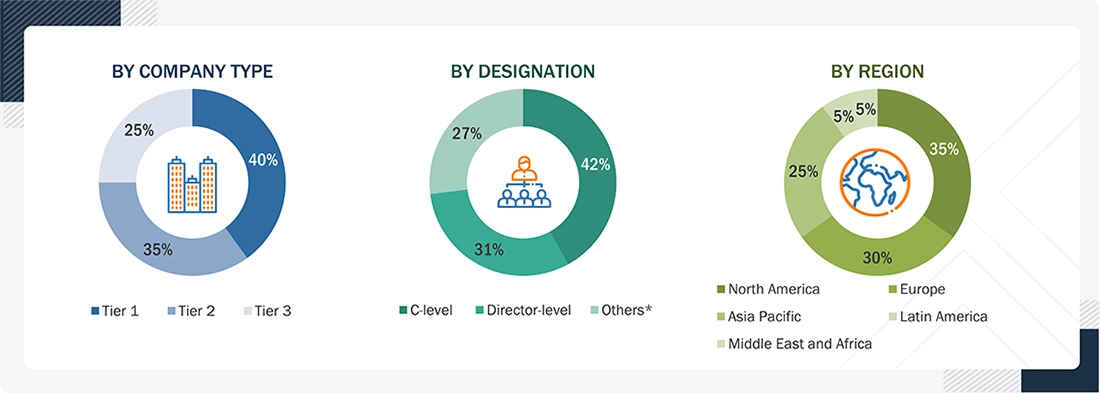
Note 2: Tiers of companies are defined based on their total revenues in 2025. Tier 1 = >USD 1 billion, Tier 2 = USD 500 million to USD 1 billion, and Tier 3 = <USD 500 million.
To know about the assumptions considered for the study, download the pdf brochure
Market Size Estimation
Both top-down and bottom-up approaches were used to estimate and validate the total size of the VNA & PACS market. These methods were also used extensively to estimate the size of various subsegments in the market.
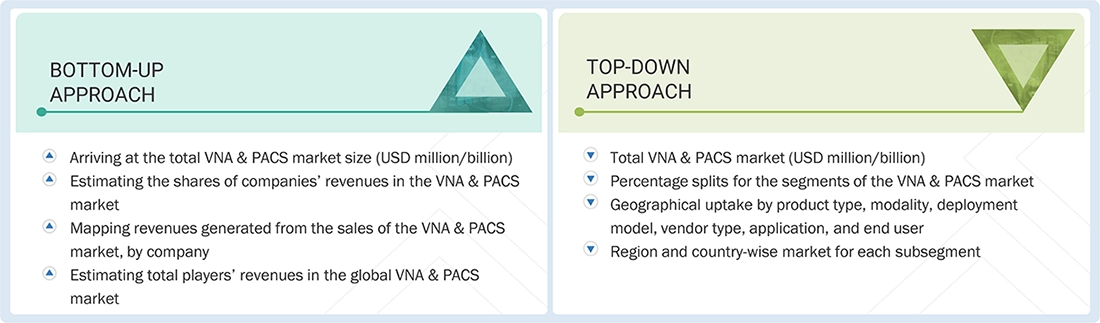
Data Triangulation
After arriving at the overall market size using the market size estimation processes, the market was split into several segments and subsegments. To complete the overall market engineering process and determine the exact statistics for each market segment and sub-segment, data triangulation and market breakdown procedures were employed where applicable. The data was triangulated by examining various factors and trends on both the demand and supply sides of the VNA & PACS market.
Market Definition
VNA and PACS are medical imaging technologies that offer cost-effective storage and easy access to images from various modalities. These solutions are essential elements of modern healthcare IT infrastructure, enabling the efficient and secure digitization, storage, retrieval, and sharing of medical imaging data.
Key Stakeholders
- VNA & PACS vendors
- Government bodies
- Healthcare service providers
- Clinical/Physician centers
- Healthcare professionals
- Health IT service providers
- Healthcare associations/institutes
- Ambulatory care centers
- Venture capitalists
- Distributors and resellers
- Maintenance and support service providers
- Integration service providers
- Healthcare players
Report Objectives
- To define, describe, and forecast the VNA & PACS market based on product type, modality, deployment, vendor type, application, end user, and region
- To provide detailed information regarding the factors influencing the growth of the market (drivers, restraints, opportunities, and challenges)
- To strategically analyze micromarkets¹ with respect to individual growth trends, prospects, and contributions to the market
- To analyze market opportunities for stakeholders and provide details of the competitive landscape for market leaders
- To forecast the size of market segments in North America, Europe, the Asia Pacific, Latin America, and the Middle East & Africa
- To profile key players and comprehensively analyze their product portfolios, market positions, and core competencies²
- To track and analyze competitive developments such as product launches and approvals; joint ventures, partnerships, & collaborations; acquisitions; and contracts in the VNA & PACS market.
Available customizations:
With the given market data, MarketsandMarkets offers customizations as per the company’s specific needs. The following customization options are available for the report:
- Product Analysis: Product matrix, which gives a detailed comparison of the product portfolios of each company.
- Geographic Analysis: Further breakdown of Latin America, Europe, and the Middle East & Africa VNA & PACS into specific countries
Fact checked
Personalize This Research
- Triangulate with your Own Data
- Get Data as per your Format and Definition
- Gain a Deeper Dive on a Specific Application, Geography, Customer or Competitor
- Any level of Personalization
Let Us Help You
- What are the Known and Unknown Adjacencies Impacting the Vendor Neutral Archive (VNA) & PACS Market
- What will your New Revenue Sources be?
- Who will be your Top Customer; what will make them switch?
- Defend your Market Share or Win Competitors
- Get a Scorecard for Target Partners

Custom Market Research Services
We Will Customise The Research For You, In Case The Report Listed Above Does Not Meet With Your Requirements
Get 10% Free CustomisationTESTIMONIALS

JAYANT RAJPUROHIT
Director of Market Insights, Data and Analytics
SFI Health,
Leading Pharmaceutical Companywww.sfihealth.com/

We at SFI Health approached MarketsandMarkets for an Opportunity Assessment on "Incidence and Prevalence of Focus Indications" as we wanted to know the most attractive HCPs like Physician, Functional MD, Naturopath and Pharmacist. The project was critical for us to ensure our focus on the right target which would enable sustainable growth and profitability for SFI Health. The business insights provided exceeded our expectations and we were extremely impressed. The team at MarketsandMarkets is highly professional and detail oriented and very well understood our business needs. MarketsandMarkets offers a unique combination of expertise and dedicated engagement model. We identified 2 new products to be launched in coming months, based on the research findings provided by MarketsandMarkets. We are happy with the services and would strongly recommend MarketsandMarkets to my peers in the industry.

BEATRIZ DE LA CALLE
Head of Commercial Analytics
Qualicaps,
Leading Pharmaceutical Companywww.qualicaps.com/

We partnered with MarketsandMarkets for an assessment study on hard empty capsules. The team was extremely professional in understanding our business requirements and we received timely responses to all our queries. The market intelligence and the recommendations has met our business requirements. We were extremely impressed to see the final study results; it really exceeded our expectations. The market intelligence offered by MarketsandMarkets, and clarity on next steps will help us achieve our business objective for the Year 2021. We are happy with the services and would strongly recommend MarketsandMarkets to my peers in the industry.

Bob Williams,
Senior Director Business Development & Innovation
Bracco Diagnostics Inc.,
Italian Multinational in life sciences sector and a World Leader in imaging diagnosticsimaging.bracco.com/us-en
We were pleased with targeted insights that MarketsandMarkets identified from a custom study on the 'Radiation Dose Management Solutions Market'. Your team identified and characterized the market participants as well as underlying trends accurately. This study was useful to Bracco in formulating business strategies for our dose monitoring product lines and we thank MarketsandMarkets for the job well done.
Cody Coonradt,
Market Development and Strategy Manager
3M Health Information Systems,
Leader in Health care Coding, Payment & Analytics Solutions.www.3m.com/3M/en_US/health-information-systems-us
The value for our organization comes from three things: depth of research, specificity of segments and being easy to work with. As important as the first two are, the third can't be underestimated. MarketsandMarkets, maybe more than any other research vendor, wants to know what is top of mind for our team and what big questions we are grappling to answer.
Their customer first approach and high value engagement model, have given us great analysis and excellent value for money
- US Vendor Neutral Archive (VNA) & PACS Market
- Canada Vendor Neutral Archive (VNA) & PACS Market
- UK Vendor Neutral Archive (VNA) & PACS Market
- Germany Vendor Neutral Archive (VNA) & PACS Market
- France Vendor Neutral Archive (VNA) & PACS Market
- Italy Vendor Neutral Archive (VNA) & PACS Market
- Spain Vendor Neutral Archive (VNA) & PACS Market
- China Vendor Neutral Archive (VNA) & PACS Market
- Japan Vendor Neutral Archive (VNA) & PACS Market
- India Vendor Neutral Archive (VNA) & PACS Market
- Brazil Vendor Neutral Archive (VNA) & PACS Market
- Mexico Vendor Neutral Archive (VNA) & PACS Market
Growth opportunities and latent adjacency in Vendor Neutral Archive (VNA) & PACS Market






Marcus
Apr, 2026
As a healthcare IT professional, how can VNA and PACS integration be optimized for better interoperability and imaging workflow efficiency?.
Carlos
Apr, 2026
How is VNA configuration and system integration improving data accessibility and imaging management across healthcare networks?.
Griffin
Apr, 2026
How can hospitals effectively integrate radiology and cardiology PACS systems for improved imaging workflow and interoperability?.
Blake
Apr, 2026
How are third-party VNA providers and AI integration improving medical imaging data management and accessibility?.
Jordan
Apr, 2026
How are cloud-based VNA systems improving workflow integration, data storage, and interoperability in healthcare imaging?.
Ethan
Apr, 2026
How are healthcare organizations differentiating between VNA and PACS, and what are the key benefits of each system in imaging workflows?.
Mason
Apr, 2026
From a hospital IT standpoint, what are the biggest barriers to adopting Vendor Neutral Archive (VNA) solutions alongside legacy PACS systems?.
Logan
Apr, 2026
How do you evaluate the ROI of implementing a VNA, especially for mid-sized healthcare providers with limited budgets?.
Carter
Apr, 2026
Do you see scalability challenges as imaging volumes grow with AI-driven diagnostics and multi-modality imaging?.
Avery
Apr, 2026
How confident can healthcare organizations be about data security and compliance when shifting to VNA, particularly in cloud deployments?.
Harper
Apr, 2026
What future opportunities do you see emerging in the VNA/PACS market as healthcare becomes more data-driven?.