Asia Pacific Augmented and Virtual Reality Market

Asia Pacific Augmented and Virtual Reality Market by Enterprise, Technology (Augmented Reality, Virtual Reality), Offering (Hardware, Software), Device Type (HMDs, HUDs, Gesture Tracking Devices), Application, and Country Forecast to 2032




OVERVIEW
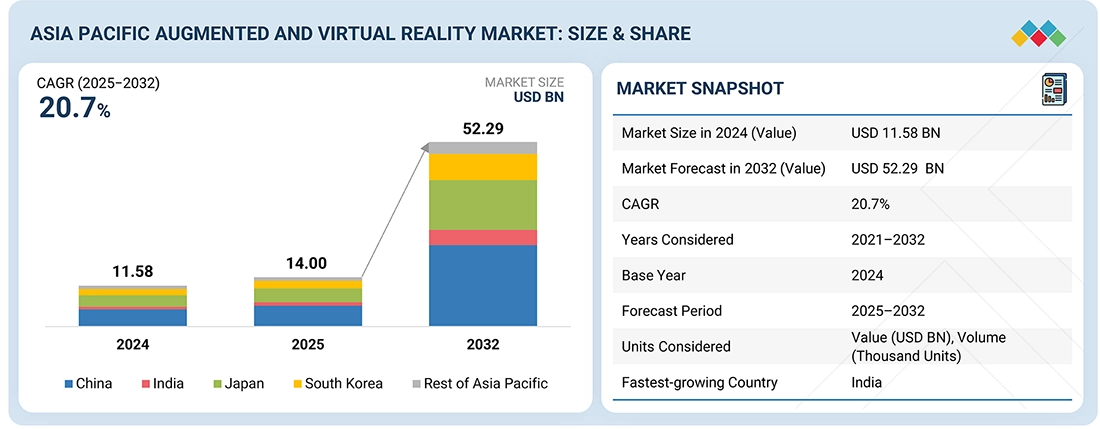
Source: Secondary Research, Interviews with Experts, MarketsandMarkets Analysis
The Asia Pacific augmented and virtual reality market is projected to grow from USD 14.00 billion in 2025 to USD 52.29 billion by 2032, registering a CAGR of 20.7% during the forecast period. The rapid adoption of augmented reality (AR) and virtual reality (VR) across gaming, entertainment, and immersive media is a key market driver. This expansion is supported by AR’s ability to enhance user interaction with digital content and by ongoing advancements in VR that improve performance, ergonomics, and user comfort.
Market Size & Forecast
• 2025 Market Size: USD 14.00 Billion
• 2032 Projected Market Size: USD 52.29 Billion
• CAGR (2025-2032): 20.7%
• Software Segment : Highest CAGR
• China: Largest Market Share
KEY TAKEAWAYS
-
By CountryChina accounted for the largest market share of 41.9% in 2024.
-
By TechnologyThe virtual reality segment captured 50.2% market share in 2024.
-
By OfferingThe software segment is projected to grow at a CAGR of 14.3% from 2025 to 2032.
-
By Device TypeAR head-mounted displays (HMDs) and VR gesture tracking devices are expected to witness the highest CAGRs during the forecast period.
-
By ApplicationThe enterprise and consumer applications are expected to lead the market during the forecast period.
-
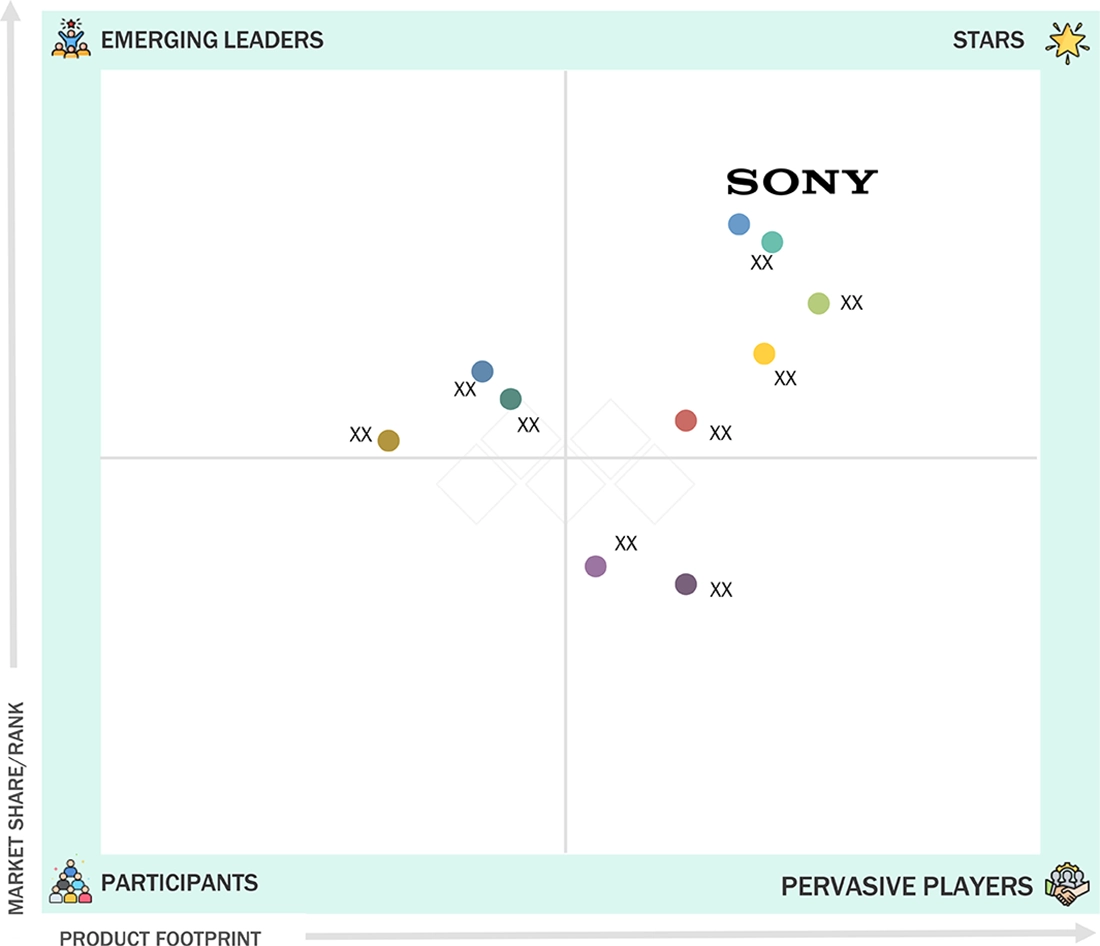
Competitive Landscape: Key PlayersSony Corporation (Japan) and ByteDance (China) are identified as the star players in the Asia Pacific augmented and virtual reality market, given their strong market share and product footprint.
-
Competitive Landscape: Startups/SMEsAutoVRse (India) is categorized among startups and SMEs by securing strong footholds in specialized niche areas, underscoring its potential as an emerging market leader.
The expansion of the Asia Pacific augmented and virtual reality market is fueled the rapid adoption of these technologies in gaming, entertainment, and immersive media.
TRENDS & DISRUPTIONS IMPACTING CUSTOMERS' CUSTOMERS
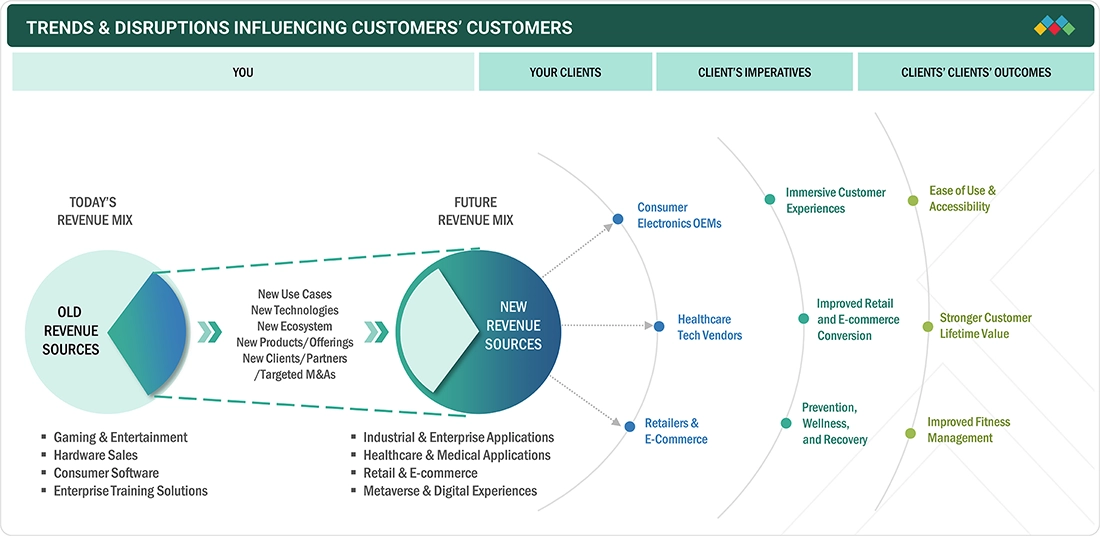
In the Asia Pacific, revenue in the AR and VR market is primarily driven by hardware components such as sensors, displays, semiconductor devices, cameras, and head-mounted systems, along with a rapidly expanding software ecosystem. While VR initially gained momentum through hardware adoption in gaming and entertainment, it has increasingly penetrated enterprise applications across industries. AR, on the other hand, has seen strong consumer and business interest, particularly in applications such as smart glasses, mobile AR, and near-eye displays for training, industrial operations, and remote assistance. Continuous innovation in AR-powered displays, microdisplays, and immersive visualization technologies is expected to create significant growth opportunities for AR and VR vendors in the Asia Pacfic over the next five years.
Source: Secondary Research, Interviews with Experts, MarketsandMarkets Analysis
MARKET DYNAMICS

Level
-
Rapid Digitalization Across Industries


Level
-
High Implementation and Hardware Costs


Level
-
Lack of Skilled Workforce and Standardization


Level
-
Expansion of Enterprise and Industrial Use Cases

Source: Secondary Research, Interviews with Experts, MarketsandMarkets Analysis
Rapid Digitalization Across Industries
Widespread digital transformation initiatives across manufacturing, healthcare, education, and retail are driving AR and VR adoption in the Asia Pacific region. Enterprises are using immersive technologies for training, remote assistance, and design visualization to improve efficiency and accuracy. Strong government support for smart manufacturing and digital economies further accelerates market growth.
High Implementation and Hardware Costs
The high cost of AR/VR hardware, software integration, and content development remains a key restraint, especially for small and mid-sized enterprises. Limited affordability of advanced headsets and infrastructure slows large-scale deployments. Ongoing maintenance and upgrade costs add to the total cost of ownership.
Lack of Skilled Workforce and Standardization
A shortage of skilled professionals capable of developing and managing AR/VR solutions poses a major challenge. Inconsistent standards across platforms and devices create interoperability issues for enterprises. These factors can delay adoption and increase complexity for end users.
Expansion of Enterprise and Industrial Use Cases
The growing adoption of AR/VR in Industry 4.0, smart factories, and remote collaboration presents significant growth opportunities. Use cases such as digital twins, predictive maintenance, and immersive training are gaining strong traction. Increasing integration with AI, IoT, and 5G is expected to unlock new, scalable enterprise applications.
ASIA PACIFIC AUGMENTED AND VIRTUAL REALITY MARKET: COMMERCIAL USE CASES ACROSS INDUSTRIES
| COMPANY | USE CASE DESCRIPTION | BENEFITS |
|---|---|---|
 |
Sony’s XR and spatial computing solutions (PlayStation VR2 and enterprise XR platforms) are used for immersive gaming, virtual content creation, industrial design simulation, and professional training applications. Sony also leverages advanced image sensors for AR/VR headsets to enable high-precision tracking, depth sensing, and realistic visual rendering. | Enhanced immersive experiences with high visual fidelity, improved training efficiency, realistic simulation environments, and strengthened positioning across entertainment, gaming, and enterprise XR ecosystems |
 |
ByteDance deploys AR and immersive technologies across platforms such as TikTok and Pico VR to support interactive content creation, social VR experiences, virtual events, and immersive digital advertising. AI-driven recommendation and computer vision models enable real-time effects, filters, and spatial interaction in short-form and immersive media formats. | Increased user engagement, higher content monetization, differentiated advertising formats, scalable immersive content ecosystems, and stronger creator-driven platform growth |
Logos and trademarks shown above are the property of their respective owners. Their use here is for informational and illustrative purposes only.
MARKET ECOSYSTEM
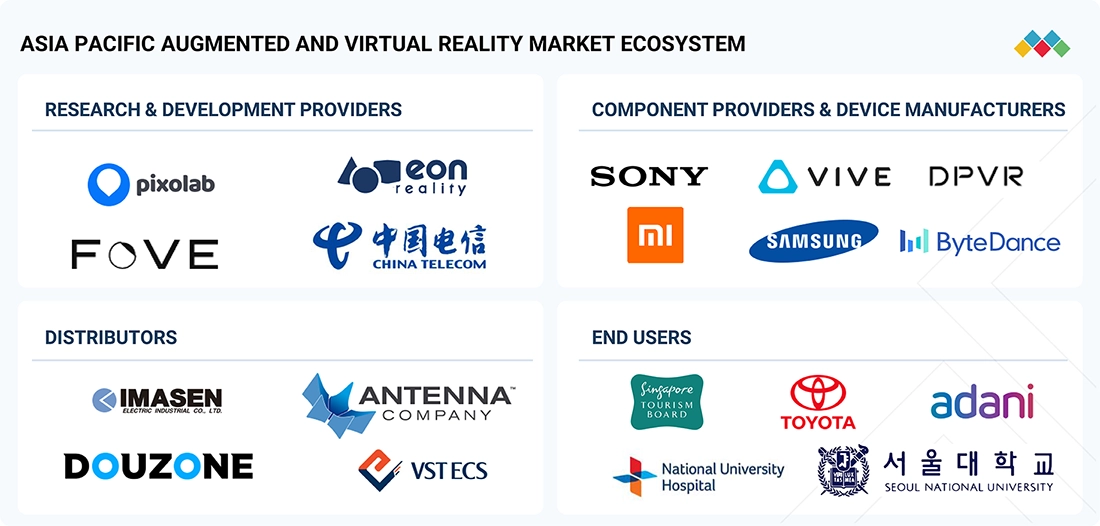
The ecosystem of the AR and VR market spans from research & development to end users. Academic and research institutions drive core innovation, while component providers enable software platforms and processing capabilities. Device manufacturers translate these technologies into commercial AR/VR hardware, supported by distributors that ensure large-scale market reach. End users across industries such as aerospace, automotive, tourism, and healthcare ultimately drive demand and real-world adoption of AR and VR solutions.
Logos and trademarks shown above are the property of their respective owners. Their use here is for informational and illustrative purposes only.
MARKET SEGMENTS
Source: Secondary Research, Interviews with Experts, MarketsandMarkets Analysis
By Country
China holds the largest share of the AR and VR market in the Asia Pacific region, driven by its robust technology ecosystem and strong government support for digital innovation. High investments in AR/VR startups, research, and development have accelerated the adoption of immersive technologies across industries such as gaming, manufacturing, healthcare, and education. The country’s vast consumer base and growing demand for entertainment and enterprise applications further contribute to market dominance. Integration of AR/VR with advanced technologies like AI, 5G, and IoT has enhanced the scalability and functionality of solutions in China. Additionally, favorable policies and strategic collaborations between local and global players continue to strengthen China’s leadership in the region’s AR/VR market.
By Application
The enterprise application segment is expected to dominate the AR market during the forecast period. This growth is driven by the rising demand to enhance workforce training, minimize operational errors, and improve efficiency across key industries such as manufacturing, healthcare, automotive, and logistics. The adoption of AR for training, maintenance, and workflow optimization closely aligns with Industry 4.0 and smart factory initiatives across countries in the region, enabling real-time guidance and improved process visibility for enterprises.
By Technology
Augmented reality is expected to register the highest growth in the Asia Pacific due to its broad applicability across both enterprise and consumer use cases. Increasing adoption of mobile AR, smart glasses, and spatial computing solutions is accelerating deployment across industries such as manufacturing, healthcare, retail, and logistics. Ongoing advancements in computer vision, AI, and expanding 5G connectivity across the regional market are further enhancing AR performance, scalability, and real-time capabilities.
By Offering
Software holds the largest share of the AR and VR market in the Asia Pacific due to the rising demand for content platforms, development tools, and enterprise application software. The increasing adoption of AR/VR across gaming, industrial training, simulation, and remote collaboration is generating strong recurring revenue from software licenses and subscription models. Widespread use of development engines and platforms such as Unity, Unreal Engine, and enterprise AR solutions further supports software dominance. Moreover, continuous software upgrades, customization requirements, and integration with AI and cloud services reinforce software’s leading position in the Asia Pacific market.
REGION
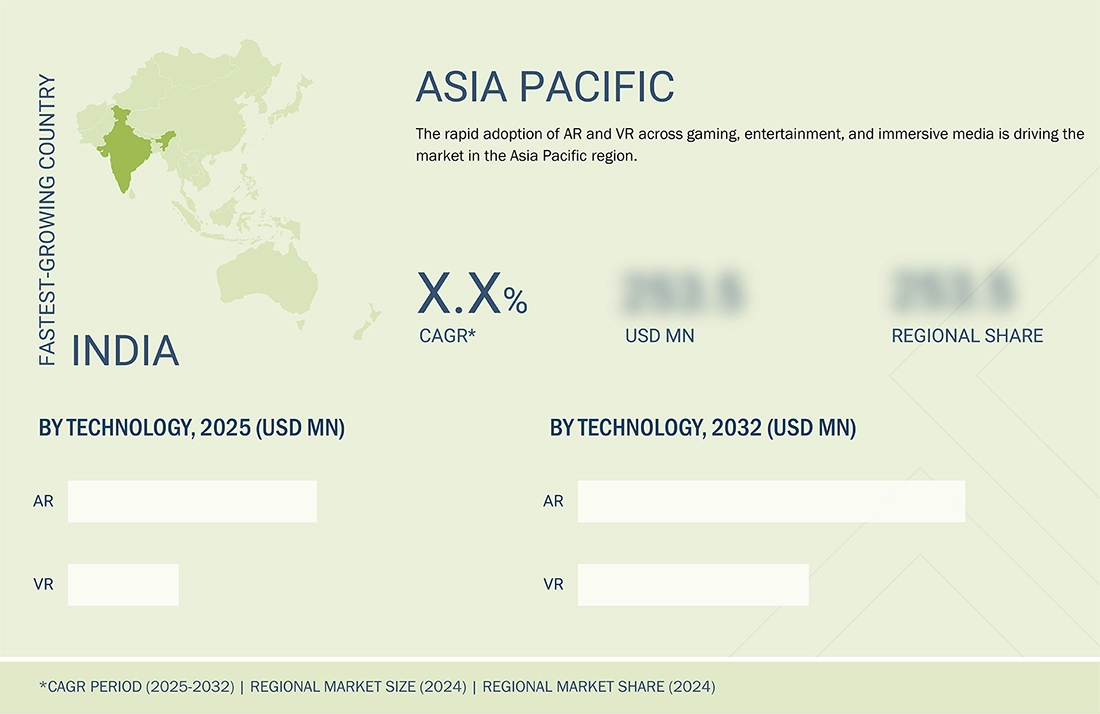
India to be fastest-growing region in AR and VR market during forecast period
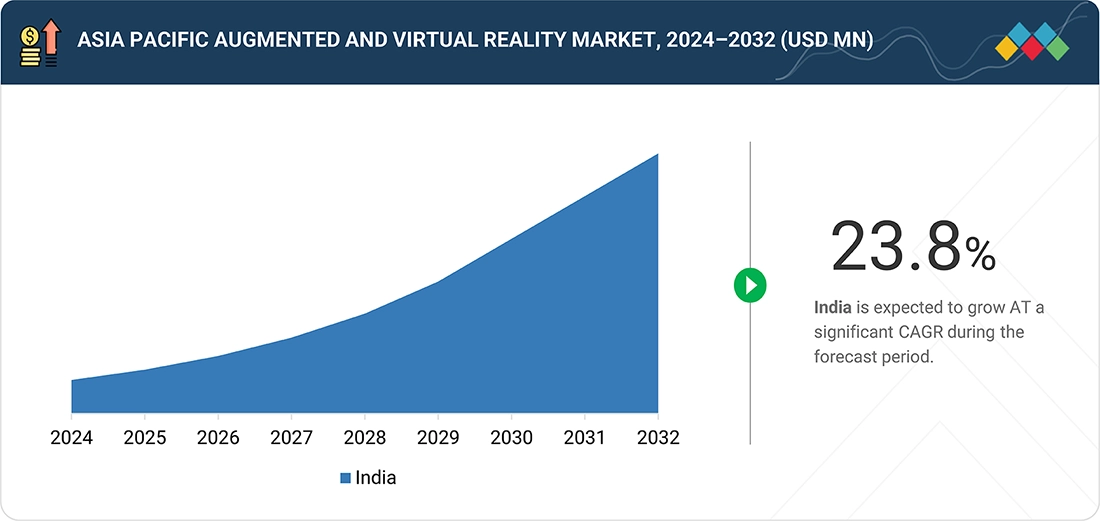
India is expected to register the highest CAGR in the Asia Pacific AR and VR market during the forecast period, driven by rapid digitalization across enterprises and a fast-growing developer ecosystem. Strong government initiatives such as Digital India, Make in India, and Smart Cities are accelerating the adoption of immersive technologies across education, healthcare, and industrial training. The expanding startup landscape and rising investments in AR/VR solutions for edtech, gaming, and enterprise applications are further supporting market growth. Increasing penetration of affordable smartphones, improving internet connectivity, and the rollout of 5G are enhancing accessibility to AR/VR experiences. Together, these factors position India as a key growth engine for the AR and VR market in the Asia Pacific region.
ASIA PACIFIC AUGMENTED AND VIRTUAL REALITY MARKET: COMPANY EVALUATION MATRIX
Stars are the leading market players in new developments, such as product launches, innovative technologies, and the adoption of growth strategies. These players have a broad portfolio, innovative product offerings, and a global presence. They have well-established channels throughout the value chain. Sony Corporation (Japan) and ByteDance (China) come under this category.
Source: Secondary Research, Interviews with Experts, MarketsandMarkets Analysis
KEY MARKET PLAYERS
- Sony Corporation (Japan)
- ByteDance (China)
- DPVR (China)
- HTC Corporation (Taiwan)
- Samsung (South Korea)
- Seiko Epson Corporation (Japan)
- Lenovo (China)
- Maxst Co., LTD. (South Korea)
- Nintendo (Japan)
- Xiaomi (China)
MARKET SCOPE
| REPORT METRIC | DETAILS |
|---|---|
| Market Size in 2024 (Value) | USD 11.58 Billion |
| Market Forecast in 2032 (Value) | USD 52.29 Billion |
| Growth Rate | CAGR of 20.7% from 2025-2032 |
| Years Considered | 2021-2032 |
| Base Year | 2024 |
| Forecast Period | 2025-2032 |
| Units Considered | Value (USD Million/Billion), Volume (Thousand Units) |
| Report Coverage | Revenue forecast, company ranking, competitive landscape, growth factors, and trends |
| Segments Covered |
|
| Countries Covered | China, India, Japan, South Korea, and Rest of Asia Pacific |
WHAT IS IN IT FOR YOU: ASIA PACIFIC AUGMENTED AND VIRTUAL REALITY MARKET REPORT CONTENT GUIDE
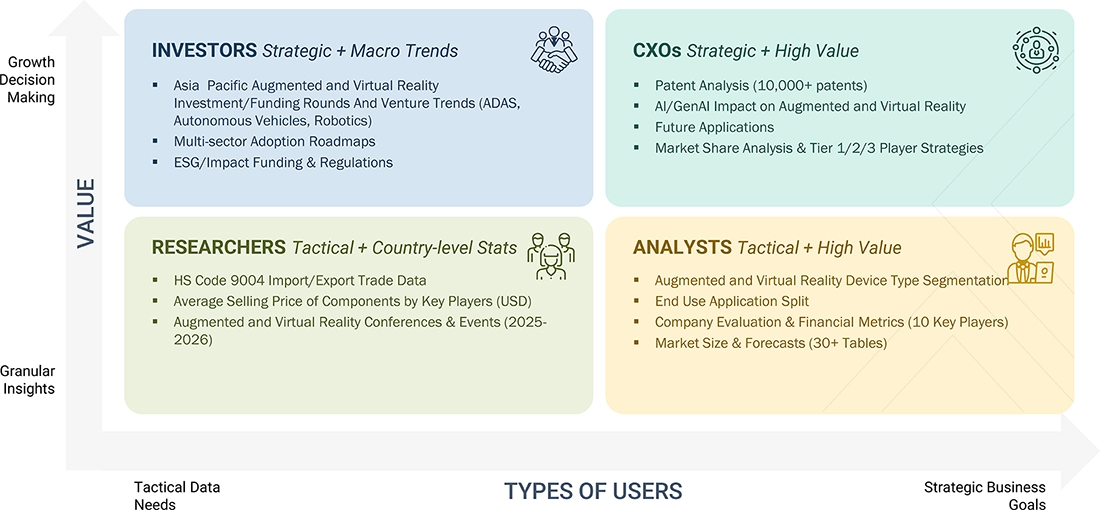
DELIVERED CUSTOMIZATIONS
We have successfully delivered the following deep-dive customizations:
| CLIENT REQUEST | CUSTOMIZATION DELIVERED | VALUE ADDS |
|---|---|---|
| Enterprise & Industrial Clients | Competitive benchmarking of AR/VR hardware and software providers (headsets, smart glasses, platforms), assessment of use-case feasibility for training, remote assistance, digital twins, and Industry 4.0 adoption across Asia Pacific | Enables enterprises to select cost-effective and scalable AR/VR solutions, reduce training errors, improve operational efficiency, and accelerate digital transformation initiatives |
RECENT DEVELOPMENTS
- January 2024 : Sony Corporation developed an immersive spatial content creation system that includes XR HMD. This system delivers high-quality 4K OLED micro displays, video see-through functions, and a pair of controllers for intuitive interaction with 3D objects and precise pointing.
- January 2023 : HTC Corporation launched VIVE XR Elite, a headset that combines mixed reality and virtual reality capabilities into one compact, lightweight, powerful, and versatile device for gaming, fitness, and productivity.
- October 2023 : DPVR introduced the E4C headset, an ideal choice for VR rotation chairs, shooting and fighting games, and other large group applications. The DPVR E4C is designed for simulation training, allowing users to learn how to operate equipment, drive a vehicle, or fly an aircraft through virtual reality.
- September 2022 : ByteDance launched PICO 4. This VR headset offers advanced features, such as sub-millimeter positioning accuracy, millisecond tracking speed, and a 4K+ Super-Vision Display.
Table of Contents
 Exclusive indicates content/data unique to MarketsandMarkets and not available with any competitors.
Methodology
The research study involved 4 major activities in estimating the size of the Asia Pacific augmented and virtual reality market. Exhaustive secondary research has been done to collect important information about the market and peer markets. The validation of these findings, assumptions, and sizing with the help of primary research with industry experts across the supply chain has been the next step. Both top-down and bottom-up approaches have been used to estimate the market size. Post which the market breakdown and data triangulation have been adopted to estimate the market sizes of segments and sub-segments.
Secondary Research
In the secondary research process, various secondary sources have been referred to for identifying and collecting information required for this study. The secondary sources include annual reports, press releases, and investor presentations of companies, white papers, and articles from recognized authors. Secondary research has been mainly done to obtain key information about the market’s value chain, the pool of key market players, market segmentation according to industry trends, regional outlook and developments from both market and technology perspectives.
Primary Research
In primary research, various primary sources from both supply and demand sides have been interviewed to obtain qualitative and quantitative insights required for this report. Primary sources from supply side include experts such as CEOs, vice presidents, marketing directors, manufacturers, technology and innovation directors, end users and related executives from multiple key companies and organizations operating in the Asia Pacific augmented and virtual reality market ecosystem.
Market Size Estimation
Top-down and bottom-up approaches have been used to estimate and validate the size of the Asia Pacific augmented and virtual reality market. The key players in the market have been identified through secondary research, and their market shares in respective regions have been determined through primary and secondary research. This entire research methodology includes the study of key insights by top players, as well as interviews with experts (such as CXOs, vice presidents, directors, and marketing executives) for quantitative and qualitative key insights. All percentage shares, splits, and breakdowns have been determined using secondary sources and verified through primary sources. All parameters that affect markets covered in this research study were accounted for, viewed in detail, verified through primary research, and analyzed to obtain the final quantitative and qualitative data. This data has been competitive and supplemented with detailed inputs and analysis from the MarketsandMarkets data repository and presented in this report.
In the market engineering process, both top-down and bottom-up approaches have been used along with data triangulation methods to estimate and validate the size of the Asia Pacific augmented and virtual reality market and other dependent submarkets. The research methodology used to estimate the market sizes includes the following:
- Analyzing the size of the Asia Pacific augmented and virtual reality market by identifying segment and subsegment revenue related to the market
- Identifying the total number of Asia Pacific augmented and virtual reality HMDs shipped globally
- Estimating the ASP of Asia Pacific augmented and virtual reality HMDs
- Estimating the size of the Asia Pacific augmented and virtual reality HMDs market (Asia Pacific augmented and virtual reality HMDs shipment * ASP of Asia Pacific augmented and virtual reality HMDs)
- Estimating the market size of other Asia Pacific augmented and virtual reality display types
- Estimating the market size of Asia Pacific augmented and virtual reality hardware market size (summation of Asia Pacific augmented and virtual reality HMDs market and market of other Asia Pacific augmented and virtual reality display types)
- Estimating the market size of Asia Pacific augmented and virtual reality’s new software by determining its percentage increase with respect to Asia Pacific augmented and virtual reality hardware market size
- Estimating the market size of Asia Pacific augmented and virtual reality’s retrofitted software by determining its percentage increase with respect to Asia Pacific augmented and virtual reality new software market size
- Estimating the Asia Pacific augmented and virtual reality software market size (summation of Asia Pacific augmented and virtual reality’s new software market and market of Asia Pacific augmented and virtual reality’s retrofitted software)
- Estimating the Asia Pacific augmented and virtual reality market size (summation of Asia Pacific augmented and virtual reality software market size and augmented and virtual reality hardware market size)
- Identifying the upcoming projects related to augmented and virtual reality by various companies in different regions and forecasting the market size based on these developments and other important parameters.
Data Triangulation
After arriving at the overall market size by the market size estimation process explained in the earlier section, the overall Asia Pacific augmented and virtual reality market has been divided into several segments and subsegments. To complete the overall market engineering process and arrive at the exact statistics for all segments, the data triangulation and market breakdown procedures have been used, wherever applicable. The data has been triangulated by studying various factors and trends from both the demand and supply side perspectives. Along with data triangulation and market breakdown, the market has been validated by top-down and bottom-up approaches.
Market Definition
AR improves the natural environment by overlaying potential digital information which includes images, text, or 3D objects. This augmentation can be actualized in many devices such as AR head-mounted displays (HMDs), smartphones, tablets, AR smart glasses, and heads-up displays (HUDs). On top of a user's view of the actual world, the technology lays computer-generated elements—thus making it interactive and enriched. One of the common examples of AR is the Pokémon GO game, whereby digital creatures seem to exist within an actual world when viewed through the camera of a smartphone.
On the other hand, VR blacks out users into a completely computer-created environment and replace the real world with a simulated one physically. Users usually put on and wear VR head-mounted displays, which, covering the field of vision, often incorporate motion tracking sensors. This sort of head mounted displays, that give users a feeling of existing in a virtual world, is called a feeling of presence in frontier interact in and navigate this digital space as if it were real. Common uses of VR include gaming, training simulations, virtual tours, and immersive storytelling experiences.
Stakeholders
- Raw material and manufacturing equipment suppliers
- Semiconductor foundries
- Original Equipment Manufacturers (OEMs)
- Asia pacific augmented and virtual reality device manufacturers
- Original design manufacturers (ODMs) and OEM technology solution providers
- Software, and Technology Providers
- Standardization and Testing Firms
- Government Bodies such as Regulatory Authorities and Policymakers
- Research Institutes and Organizations
- Market Research and Consulting Firms
- Technology investors
The main objectives of this study are as follows:
- To define, analyze and forecast the Asia Pacific augmented and virtual reality market size, by virtual reality technology, offering, device type, and application in terms of value
- To define, analyze and forecast the augmented reality market size, by device type, in terms of volume.
- To provide detailed information regarding the major drivers, restraints, opportunities, and challenges influencing the growth of the Asia Pacific augmented and virtual reality market
- To study the complete supply chain and related industry segments for the ar and vr market
- To strategically analyze the micromarkets1 with respect to individual growth trends, prospects, and contributions to the total market
- To analyze the supply chain, market ecosystem; trends/disruptions impacting customer’s business; technology analysis; pricing analysis; Porter’s five forces model; key stakeholders & buying criteria; case study analysis; trade analysis; patent analysis; key conferences & events, 2024–2025; regulations related to the Asia Pacific augmented and virtual reality market; and investment and funding scenario.
- To analyze opportunities in the market for various stakeholders by identifying the high-growth segments of the market.
- To strategically profile the key players and comprehensively analyze their market position in terms of ranking, core competencies, company valuation and financial metrics and product/brand comparison; along with detailing the competitive landscape for the market leaders.
- To analyze competitive developments such as product launches, product developments, partnerships, collaborations, acquisitions, joint investments, strategic supplier relations, contracts, acquisitions, expansions and research and development (R&D) activities carried out by players in the Asia Pacific augmented and virtual reality market.
Customizations Options:
With the given market data, MarketsandMarkets offers customizations according to the company’s specific needs. The following customization options are available for the report:
Company Information
- Detailed analysis and profiling of additional market players (up to 5)
Geographic Information
- Detailed analysis of additional countries (up to 5)
Key Questions Addressed by the Report
What is the projected market value of the Asia Pacific Augmented Reality and Virtual Reality market?
The Asia Pacific Augmented Reality and Virtual Reality market is projected to reach a significant market value by the forecast period, driven by increasing adoption across gaming, retail, healthcare, and industrial applications.
Which region is expected to dominate the Asia Pacific Augmented Reality and Virtual Reality market?
China is expected to dominate the Asia Pacific Augmented Reality and Virtual Reality market due to strong government support, rapid technological advancements, and growing investments in immersive technologies.
What are the key segments of the Asia Pacific Augmented Reality and Virtual Reality market?
The market is segmented by technology, component, device type, application, and country, with augmented reality, hardware devices, and gaming and enterprise applications accounting for a major share.
Who are the major key players in the Asia Pacific Augmented Reality and Virtual Reality market?
Major key players in the Asia Pacific Augmented Reality and Virtual Reality market include Sony Group Corporation, Samsung Electronics Co., Ltd., HTC Corporation, Panasonic Holdings Corporation, and Microsoft Corporation.
What factors are driving the growth of the Asia Pacific Augmented Reality and Virtual Reality market?
The growth of the Asia Pacific Augmented Reality and Virtual Reality market is driven by rising demand for immersive experiences, increasing smartphone penetration, advancements in AR and VR technologies, and growing adoption across multiple industries.


Personalize This Research
- Triangulate with your Own Data
- Get Data as per your Format and Definition
- Gain a Deeper Dive on a Specific Application, Geography, Customer or Competitor
- Any level of Personalization
Let Us Help You
- What are the Known and Unknown Adjacencies Impacting the Asia Pacific Augmented and Virtual Reality Market
- What will your New Revenue Sources be?
- Who will be your Top Customer; what will make them switch?
- Defend your Market Share or Win Competitors
- Get a Scorecard for Target Partners

Custom Market Research Services
We Will Customise The Research For You, In Case The Report Listed Above Does Not Meet With Your Requirements
Get 10% Free CustomisationTESTIMONIALS

Tetsuya Ohhira
Business Development Manager-Technology Business
Nikon Corporation,
Leading Japanese MNC specializing in optics and imaging productswww.nikon.com
MarketsandMarkets™ response
is quick. Their attitude is flexible and positive. Analyst Insights are globally considered and
significant. Client Services quickly respond to our inquiry and demand. Their wide range of global
surveys help us make our strategic plan.
We hope Knowledge Store will be easier to search
for a report.
VP - Marketing & Business Development
Leading Provider of Process Control Solutions
We engaged with MarketsandMarkets on a study to perform an analysis and recommend a Go-To-Market strategy for metrology and process control in the semiconductor market. The study was tailored to our targets and needs with well-defined milestones. Our overall experience with the MarketsandMarkets team was very good throughout the project in all aspects including the analysis methodologies used, the quality and depth of primary and secondary data sets, the professionalism and flexibility of the team and the ability to meet the target schedule and milestones. We want to thank MarketsandMarkets team for a job well done.






Growth opportunities and latent adjacency in Asia Pacific Augmented and Virtual Reality Market