Asia Pacific Machine Vision Market

Asia Pacific Machine Vision Market by Component (Cameras, Frame Grabbers, Optics, LED Lighting, Processors, AI-based Machine Vision Software), Type (PC-based, Smart Camera-based), Deployment (General, Robotic Cell), Vision Type - Forecast to 2030




OVERVIEW
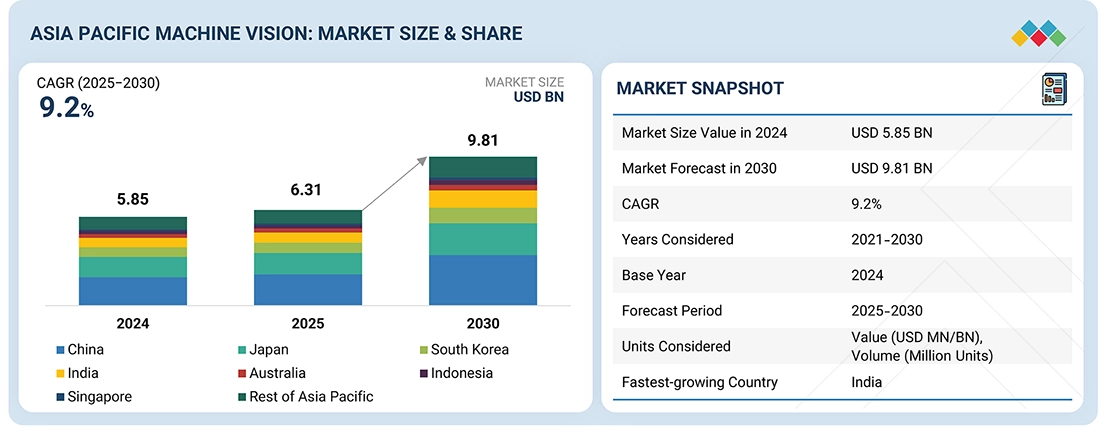
Source: Secondary Research, Interviews with Experts, MarketsandMarkets Analysis
The Asia Pacific machine vision market is projected to reach USD 9.81 billion by 2030, up from USD 5.85 billion in 2024, growing at a CAGR of 9.2% from 2025 to 2030. Growth is supported by the region’s expanding electronics and semiconductor manufacturing base, accelerating automation in automotive and EV production, rising adoption of AI-driven inspection systems, and increasing investments in smart factory and industrial digitalization initiatives across the Asia Pacific.
Market Size & Forecast
KEY TAKEAWAYS
-
By CountryChina dominates the Asia Pacific machine vision market, accounting for 32% in 2024.
-
By ComponentBy component, the software segment is expected to register the highest CAGR of 8.7%.
-
By IndustryBy industry, the food & beverages segment is projected to grow at the fastest rate from 2025 to 2030.
-
Competitive LandscapeOmron Corporation, Sony Group Corporation, and KEYENCE Corporation were identified as key players in the Asia Pacific machine vision market, given their strong market share and extensive product portfolios.
-
Competitive LandscapeKyoto Robotics Corporation, and Qualitas Technologies have distinguished themselves among startups and SMEs by securing strong footholds in specialized niche areas, underscoring their potential as emerging market leaders
The Asia Pacific machine vision market is experiencing strong growth, driven by the rapid adoption of automation and the rising demand for high-precision inspection across various manufacturing sectors. Expanding electronics, semiconductor, automotive, and food & beverages industries are accelerating deployment, supported by advancements in AI-enabled vision systems, 3D imaging, and edge-based processing that enhance accuracy, productivity, and real-time decision-making across Asia Pacific industrial operations.
TRENDS & DISRUPTIONS IMPACTING CUSTOMERS' CUSTOMERS
The impact on customers’ businesses in the Asia Pacific machine vision market is accelerating as the region moves from conventional inspection practices to AI-driven and automated vision technologies. Advancements in deep learning inspection, 3D and robotic vision, embedded vision platforms, edge AI cameras, and cloud-enabled analytics are strengthening quality control, traceability, and automation across electronics, automotive, semiconductor, food and beverage, and industrial manufacturing sectors. This evolution is driving a growing demand for zero-defect production, predictive quality monitoring, and fully automated inspection processes, resulting in higher productivity, reduced downtime, and improved operational efficiency across Asia Pacific industries.
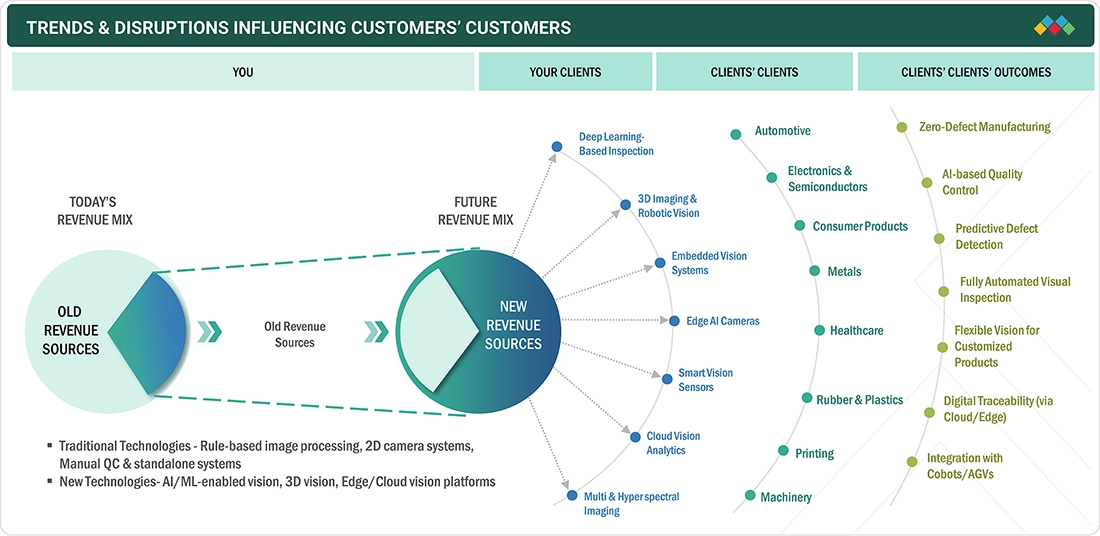
Source: Secondary Research, Interviews with Experts, MarketsandMarkets Analysis
MARKET DYNAMICS

Level
-
Expanding manufacturing activities across the Asia Pacific are accelerating the adoption of automated machine vision systems

-
Increasing shift toward AI-enabled vision for defect detection in high-volume electronics and automotive production


Level
-
High implementation costs limit adoption among cost-sensitive manufacturers


Level
-
Strong shift toward smart cameras, embedded vision, and edge AI to support smart factory expansion

-
Expanding electronics, semiconductor, and packaging sectors in the Asia Pacific provide strong demand for precision vision systems


Level
-
Shortage of skilled talent to support advanced machine vision integration across the Asia Pacific

-
Increasing cybersecurity risks as factories adopt connected and IoT-based vision platforms

Source: Secondary Research, Interviews with Experts, MarketsandMarkets Analysis
Driver: Expanding manufacturing activities across the Asia Pacific are accelerating the adoption of automated machine vision systems
Asia Pacific’s rapidly growing manufacturing base, strong electronics and semiconductor production, and rising investment in smart automation are driving widespread deployment of machine vision technologies. Industries such as automotive, electronics, and food processing are increasingly integrating AI-enabled vision systems to improve accuracy, reduce defects, and enhance productivity. This momentum is strengthening the Asia Pacific’s leadership in advanced manufacturing capabilities.
Restraint: High implementation costs limit adoption among cost-sensitive manufacturers
Many small and mid-sized manufacturers in the Asia Pacific face challenges due to the high upfront costs of machine vision hardware, software, and integration. Budget limitations, limited access to skilled technical teams, and the need for specialized engineering support slow adoption. For many businesses, scaling automation requires phased investments, vendor-assisted integration, and more affordable options for vision systems.
Opportunity: Strong shift toward smart cameras, embedded vision, and edge AI to support smart factory expansion
Rapid digital transformation across the Asia Pacific is fueling demand for compact smart cameras, embedded vision modules, and edge AI systems that enhance real-time inspection and process automation. These technologies support high-speed production environments and enable predictive insights. As manufacturing facilities adopt smarter workflows, suppliers offering scalable, flexible, and high-performance vision solutions are seeing significant growth opportunities.
Challenge: Shortage of skilled talent to support advanced machine vision integration across the Asia Pacific
The Asia Pacific faces a widening talent gap in computer vision, robotics integration, and automation engineering, limiting manufacturers’ ability to deploy and optimize advanced vision systems. Companies often struggle to hire specialists for tasks such as AI training, system calibration, and integration. This skills shortage prolongs deployment timelines and highlights the need for workforce development, upskilling, and more intuitive machine vision solutions.
Asia Pacific Machine Vision Market: COMMERCIAL USE CASES ACROSS INDUSTRIES
| COMPANY | USE CASE DESCRIPTION | BENEFITS |
|---|---|---|
 |
Machine vision systems perform real-time robotic path correction for chassis assembly, automated torque verification, and inline 3D inspection of complex stamped metal components. | Higher assembly accuracy | Reduced production downtime| Improved consistency in robotic operations |
 |
High-resolution vision systems detect wafer-level packaging defects, verify micro-LED placement accuracy, and perform hyperspectral inspection for identifying material inconsistencies in display manufacturing. | Enhanced defect detection | Increased yield in display panels | Better reliability of micro-components |
 |
Machine vision-enabled overlay metrology ensures the precise alignment of multiple lithography layers, monitors edge bead removal, and facilitates the verification of nanoscale pattern integrity during chip fabrication. | Improved nanoscale precision | Reduced layer misalignment | Higher process stability for advanced node |
 |
Vision-guided robots handle battery-module stacking, inspect thermal interface materials, and monitor electrode coating uniformity in EV battery manufacturing lines. | Reduced battery defects | Improved energy-density consistency | Higher safety and reliability of EV batteries |
 |
Machine vision validates flex-circuit bonding on mobile devices, verifies connector seating force, and performs ultra-fast inspection of micro-screws in automated smartphone assembly lines. | Faster assembly cycles | Fewer mechanical failures; Better overall product durability |
Logos and trademarks shown above are the property of their respective owners. Their use here is for informational and illustrative purposes only.
MARKET ECOSYSTEM
The Asia Pacific machine vision market ecosystem is supported by regional hardware and software providers, including Keyence, Sony, Omron, Panasonic, and Advantech, which collectively supply industrial cameras, smart vision sensors, embedded imaging systems, processors, and advanced vision software. These technologies enable deployment across key Asia Pacific end-user industries, including consumer electronics (Samsung, Sony, LG), automotive manufacturing (Toyota, Hyundai), pharmaceuticals (Sun Pharma, Cipla), food & beverages (Yili, Marico), and industrial machinery (Mitsubishi, Yaskawa). This interconnected regional ecosystem strengthens inspection accuracy, automation, traceability, and data-driven decision-making across the Asia Pacific’s rapidly expanding manufacturing landscape.
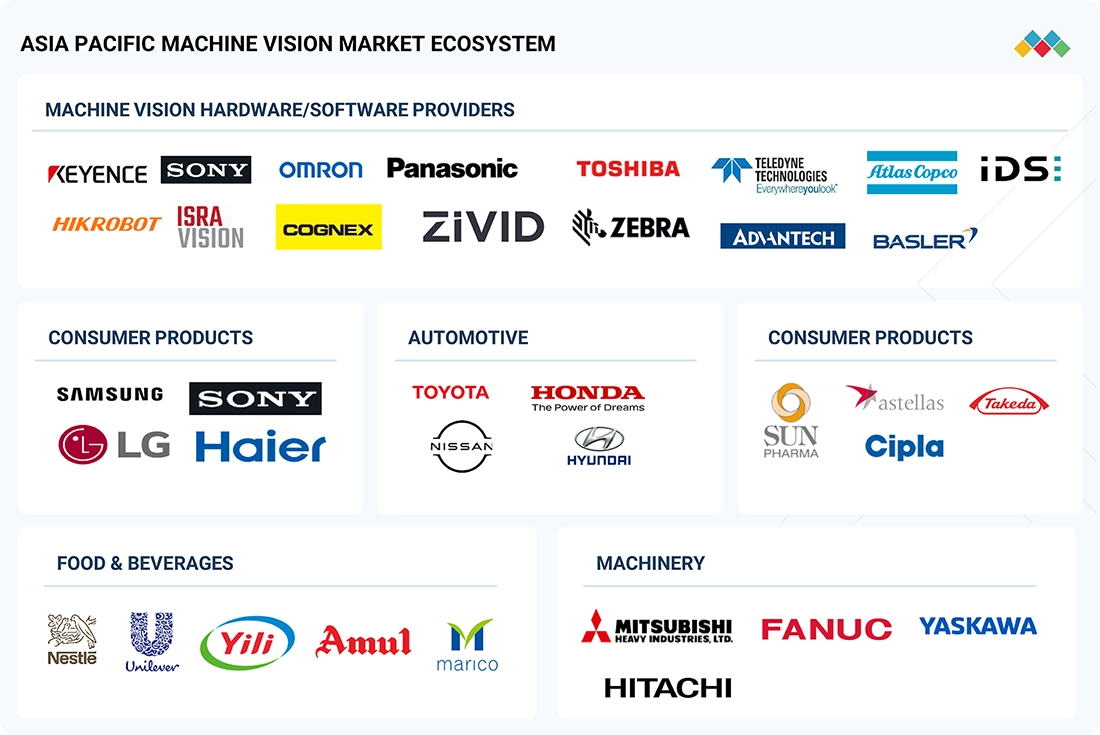
Logos and trademarks shown above are the property of their respective owners. Their use here is for informational and illustrative purposes only.
MARKET SEGMENTS
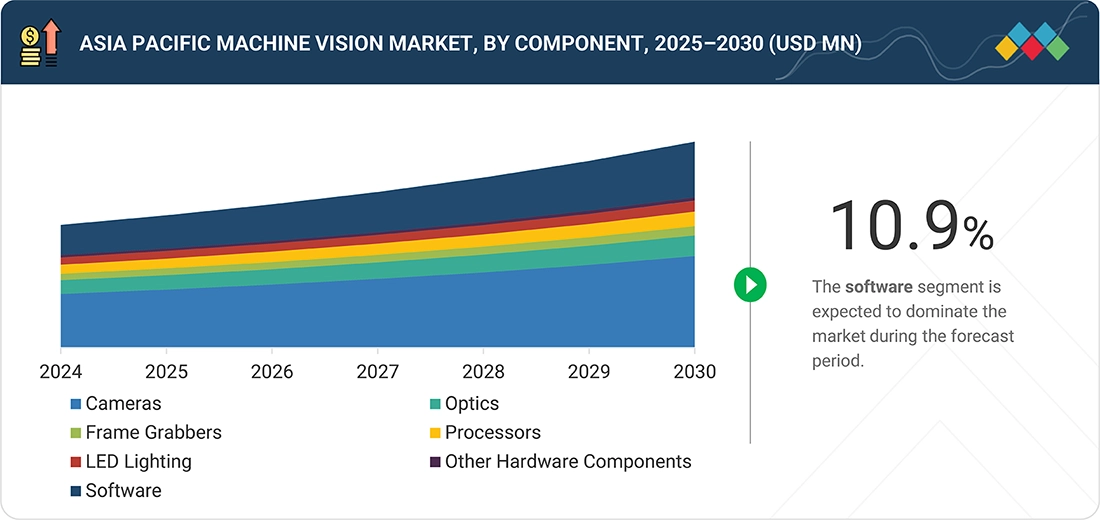
Source: Secondary Research, Interviews with Experts, MarketsandMarkets Analysis
Asia Pacific Machine Vision Market, By Component
Cameras hold the largest share of the Asia Pacific machine vision market. They are expected to maintain their lead throughout the forecast period, driven by the rapid expansion of electronics and semiconductor manufacturing, growing adoption of AI-powered inspection, increasing use of high-resolution CMOS and smart cameras, and the rise of edge-processing solutions supporting high-speed production lines across the Asia Pacific region. Their essential role in ensuring defect-free output, stabilizing production quality, and enabling automation strengthens their position within Asia Pacific manufacturing ecosystems.
Asia Pacific Machine Vision Market, By Industry
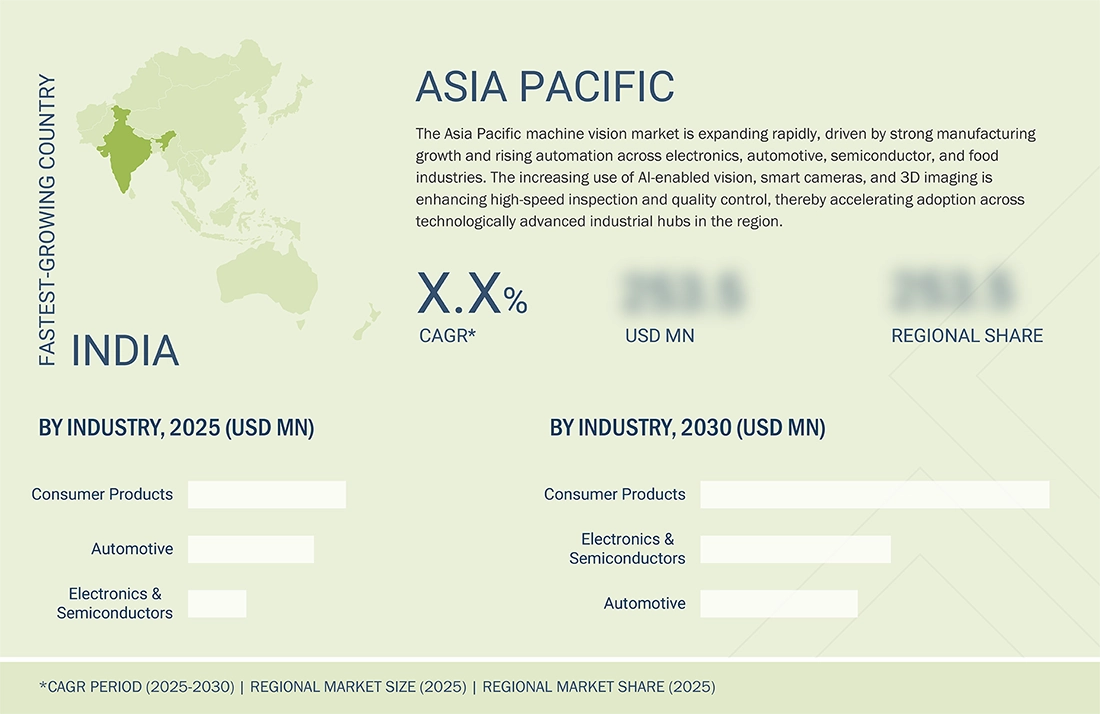
The food & beverages segment leads the Asia Pacific machine vision market, supported by rapid growth in large-scale processing, rising demand for packaged food, and stricter regional safety standards. The adoption of vision systems for seal inspection, contamination detection, labeling accuracy, and hygiene monitoring is increasing, helping manufacturers reduce wastage, maintain consistency, and meet evolving quality and compliance requirements across the Asia Pacific.
REGION
India is expected to be the fastest-growing region in Asia Pacific machine vision market during the forecast period
India is projected to record the fastest growth in the Asia Pacific machine vision market during the forecast period. The rapid expansion of manufacturing, increasing adoption of industrial automation, and rising use of AI-driven vision systems across the automotive, electronics, pharmaceuticals, and food processing industries are accelerating market demand. Government-led digitalization initiatives, growing investments in smart factories, and the shift toward real-time inspection and quality control solutions are strengthening India’s position as a key growth engine in the regional market.
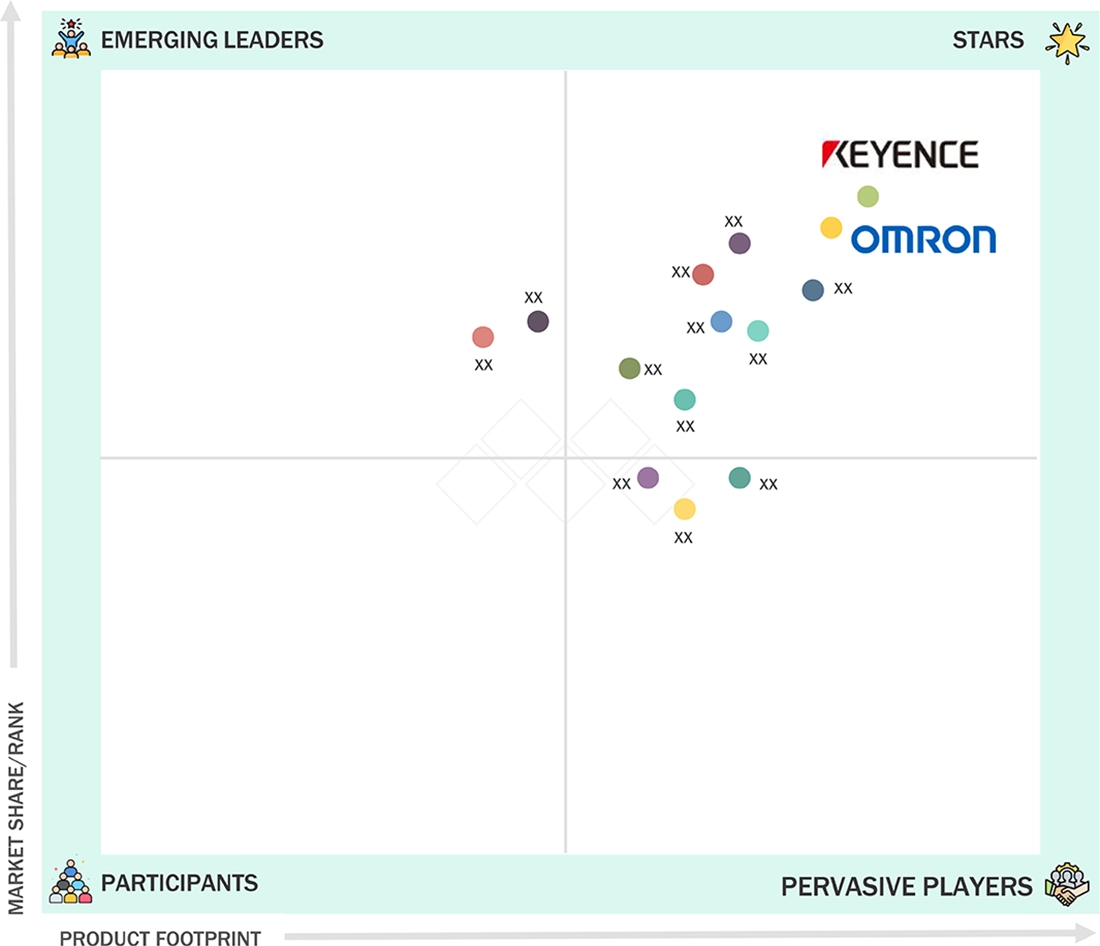
Asia Pacific Machine Vision Market: COMPANY EVALUATION MATRIX
In the Asia Pacific machine vision market matrix, Keyence and Omron (Star Players) lead with strong innovation capability and extensive regional deployment. Keyence drives adoption through high-performance smart cameras, AI-based inspection tools, and easy-to-integrate vision systems, which are widely used in electronics, automotive, and precision manufacturing. Omron strengthens the market with its combined vision, robotics, and automation platforms that support high-speed inspection and assembly. Together, they are accelerating APAC’s transition toward intelligent quality control and advanced smart factory operations.
Source: Secondary Research, Interviews with Experts, MarketsandMarkets Analysis
KEY MARKET PLAYERS
- Keyence Corporation (Japan)
- Omron Corporation (Japan)
- Sony Group Corporation (Japan)
- Canon Inc. (Japan)
- Cognex Corporation (US)
- Basler AG (Germany)
- Teledyne Technologies Inc. (US)
- SICK AG (Germany)
- Texas Instruments Incorporated (United States)
- Zebra Technologies Corp. (United States)
- AMETEK Inc. (United States)
- Emerson Electric Co. (United States)
- Atlas Copco AB (Sweden)
- TKH Group (Netherlands)
- Qualitas Technologies (India)
MARKET SCOPE
| REPORT METRIC | DETAILS |
|---|---|
| Market Size in 2024 (Value) | USD 5.85 Billion |
| Market Forecast in 2030 (Value) | USD 9.81 Billion |
| Growth Rate | CAGR of 9.2% from 2025-2030 |
| Years Considered | 2021-2030 |
| Base Year | 2024 |
| Forecast Period | 2025-2030 |
| Units Considered | Value (USD Million/Billion), Volume (Million Units) |
| Report Coverage | Revenue forecast, company ranking, competitive landscape, growth factors, and trends |
| Segments Covered |
|
| Regions Covered | Asia Pacific |
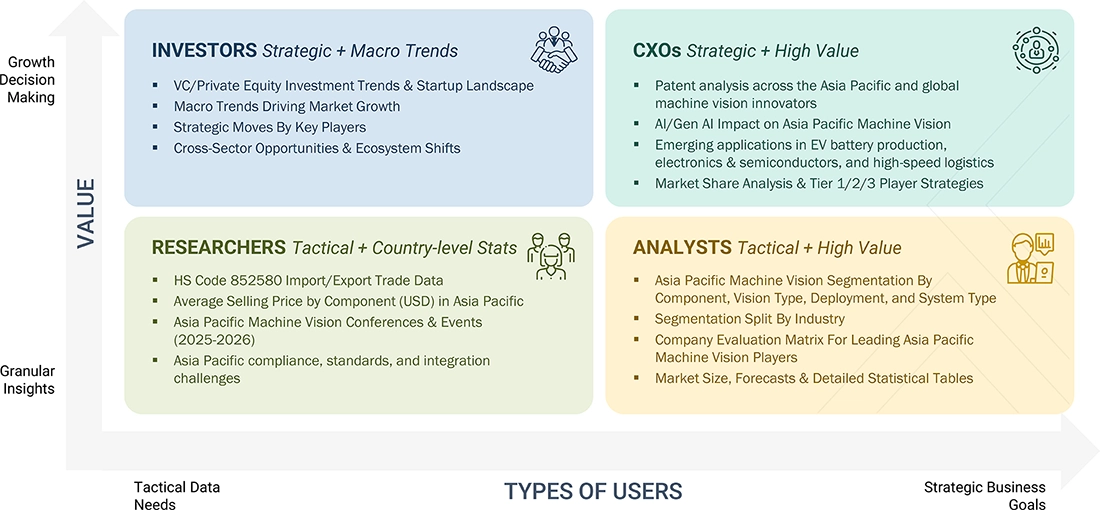
WHAT IS IN IT FOR YOU: Asia Pacific Machine Vision Market REPORT CONTENT GUIDE
DELIVERED CUSTOMIZATIONS
We have successfully delivered the following deep-dive customizations:
| CLIENT REQUEST | CUSTOMIZATION DELIVERED | VALUE ADDS |
|---|---|---|
| Local Competitive Landscape |
|
|
| Regional Market Entry Strategy |
|
|
| Application-Specific Opportunity Assessment |
|
|
| Technology Adoption by End-use Industries |
|
|
RECENT DEVELOPMENTS
- March 2025 : Keyence Corporation’s AI-enabled vision sensor automates part detection, position verification, and counting with high accuracy. Its advanced algorithms outperform traditional sensors and deliver stable performance in challenging environments, making complex inspection tasks simpler and more reliable.
- November 2024 : Sony Group Corporation launched the IMX925 stacked CMOS image sensor, featuring a back-illuminated pixel structure and global shutter for industrial imaging. This sensor delivers 394 fps high-speed processing and 24.55 effective megapixels.
- October 2024 : Sony Group Corporation announced the release of the ISX038 CMOS image sensor for automotive cameras. This sensor is designed to enhance automotive vision systems with its advanced image processing capabilities.
Table of Contents
 Exclusive indicates content/data unique to MarketsandMarkets and not available with any competitors.
Methodology
The study involved four major activities for estimating the current size of the Asia Pacific machine vision market. Exhaustive secondary research has been done to collect information on the market. The next step is to validate these findings, assumptions, and size with industry experts across the value chain through primary research. Both the top-down and bottom-up approaches have been employed to estimate the complete market size. After that, market breakdown and data triangulation methods have been used to estimate the market size of the segments and subsegments. Two sources of information, secondary and primary, have been used to identify and collect information for an extensive technical and commercial study of the Asia Pacific machine vision market.
Secondary Research
Various secondary sources have been referred to in the secondary research process to identify and collect information important for this study. The secondary sources include annual reports, press releases, and investor presentations of companies; white papers; journals and certified publications; and articles from recognized authors, websites, directories, and databases. Secondary research has been conducted to obtain key information about the industry’s supply chain, the market’s value chain, the total pool of key players, market segmentation according to the industry trends (to the bottom-most level), regional markets, and key developments from market- and technology-oriented perspectives. Secondary data has been collected and analyzed to determine the overall market size, which is further validated through primary research.
Primary Research
Extensive primary research was conducted after gaining knowledge about the current scenario of the Asia Pacific machine vision market through secondary research.
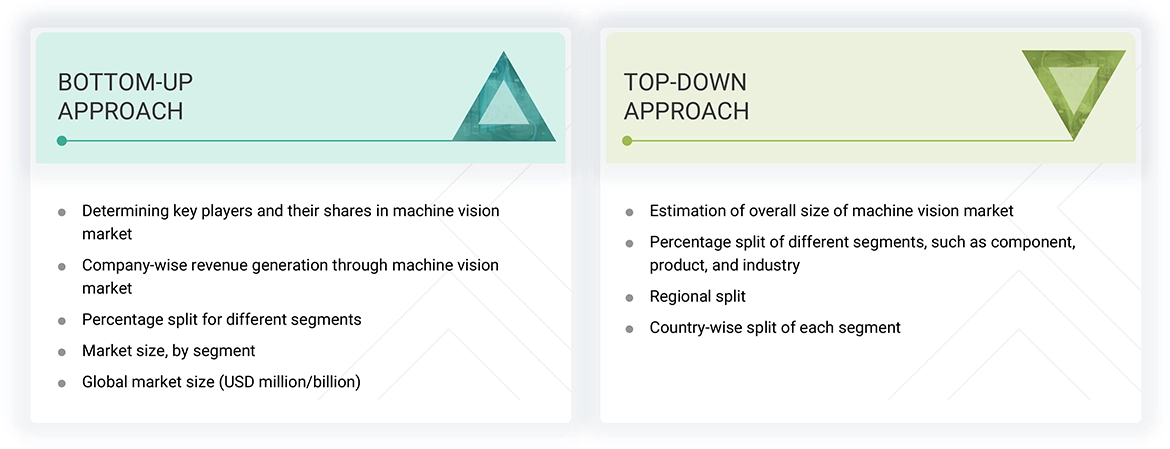
Both the top-down and bottom-up approaches have been used to estimate and validate the total size of the Asia Pacific machine vision market. These methods have also been used extensively to estimate the size of various subsegments in the market. The following research methodology has been used to estimate the market size:
- Major players in the market have been identified through extensive secondary research.
- The industry’s value chain and market size (in terms of value) have been determined through primary and secondary research processes.
- All percentage shares, splits, and breakdowns have been determined using secondary sources and verified through primary sources.
Asia Pacific Machine Vision Market : Top-Down and Bottom-Up Approach
Data Triangulation
After arriving at the overall size of the Asia Pacific machine vision market from the market size estimation process explained above, the total market has been split into several segments and subsegments. Data triangulation and market breakdown procedures have been employed, wherever applicable, to complete the overall market engineering process and arrive at the exact statistics for all segments and subsegments of the market. The data has been triangulated by studying various factors and trends from both the demand and supply sides. Along with this, the market size has been validated using both the top-down and bottom-up approaches.
Market Definition
Machine vision systems use a combination of hardware and software to provide operational guidance to devices in executing their functions. Visual inspections are automated, and product assembly equipment are precisely guided using sensors (cameras), processing hardware, and software algorithms. The system relies on digital sensors installed in cameras with specialized optics to acquire images. These images are then processed, analyzed, and measured by artificial intelligence (AI) technology embedded in the computer hardware for decision-making. AI allows machines to learn from experience, intercept new inputs, and perform human-like tasks. Machine learning and natural language processing (NLP), used to train computers, are also used in Asia Pacific machine vision to perform specific tasks by processing large data captured by cameras. Machine vision systems offer fast response, a tailored approach, accurate information, and fewer redundancies—all essential to achieving higher organizational efficiency. Machine vision systems encompass all industrial and non-industrial applications.
Key Stakeholders
- Government bodies and policymakers
- Industry organizations, forums, alliances, and associations
- Raw material suppliers and distributors
- Research institutes and organizations
- Original equipment manufacturers (OEMs)
- Technology, service, and solution providers
- Intellectual property (IP) core and licensing providers
- Market research and consulting firms
Report Objectives
- To describe, segment, and forecast the overall Asia Pacific machine vision market by application, vision type, deployment, component, system type, and industry, in terms of value
- To provide an overview of the recent trends in the market
- To provide detailed information regarding the drivers, restraints, opportunities, and challenges influencing the growth of the market
- To analyze the supply chain, trends/disruptions impacting customer business, market/ecosystem map, pricing analysis, and regulatory landscape pertaining to the Asia Pacific machine vision market
- To strategically analyze micromarkets with respect to individual growth trends, prospects, and contributions to the overall market size.
- To analyze opportunities in the market for stakeholders and provide a competitive landscape of the market
- To strategically profile the key players and comprehensively analyze their market positions in terms of their ranking and core competencies, along with detailing the competitive landscape for market leaders
- To analyze competitive developments, such as product launches, acquisitions, collaborations, agreements, and partnerships, in the Asia Pacific machine vision market
- To provide ecosystem analysis, case study analysis, patent analysis, technology analysis, value chain analysis, trends/disruptions impacting customer business, impact of AI/Gen AI, key conferences and events, pricing analysis, Porter’s five forces analysis, and regulations pertaining to the market under study
- To provide a macroeconomic outlook based on all the regions in the region chapter
Available Customizations:
With the given market data, MarketsandMarkets offers customizations according to the company’s specific needs. The following customization options are available for the report:
Company Information:
- Detailed analysis and profiling of additional market players (up to 5)
Key Questions Addressed by the Report
What is the projected value of the Asia Pacific machine vision market?
The Asia Pacific machine vision market is projected to reach USD 5.2 billion by 2030 from USD 3.4 billion in 2025, growing at a CAGR of 8.9%.
Which country leads the Asia Pacific machine vision market?
China leads the Asia Pacific machine vision market due to strong manufacturing capabilities and increasing automation across industries.
Which segment dominates the market by offering?
The hardware segment dominates the market, driven by high demand for cameras, sensors, and vision processing systems.
Which application segment is expected to grow the fastest?
The quality inspection and automation segment is expected to grow at the highest CAGR due to increasing adoption in electronics and automotive industries.
Who are the key players in the Asia Pacific machine vision market?
Key players include Keyence Corporation, Cognex Corporation, Omron Corporation, Basler AG, and Sony Corporation.


Personalize This Research
- Triangulate with your Own Data
- Get Data as per your Format and Definition
- Gain a Deeper Dive on a Specific Application, Geography, Customer or Competitor
- Any level of Personalization
Let Us Help You
- What are the Known and Unknown Adjacencies Impacting the Asia Pacific Machine Vision Market
- What will your New Revenue Sources be?
- Who will be your Top Customer; what will make them switch?
- Defend your Market Share or Win Competitors
- Get a Scorecard for Target Partners

Custom Market Research Services
We Will Customise The Research For You, In Case The Report Listed Above Does Not Meet With Your Requirements
Get 10% Free CustomisationTESTIMONIALS

Tetsuya Ohhira
Business Development Manager-Technology Business
Nikon Corporation,
Leading Japanese MNC specializing in optics and imaging productswww.nikon.com
MarketsandMarkets™ response
is quick. Their attitude is flexible and positive. Analyst Insights are globally considered and
significant. Client Services quickly respond to our inquiry and demand. Their wide range of global
surveys help us make our strategic plan.
We hope Knowledge Store will be easier to search
for a report.
VP - Marketing & Business Development
Leading Provider of Process Control Solutions
We engaged with MarketsandMarkets on a study to perform an analysis and recommend a Go-To-Market strategy for metrology and process control in the semiconductor market. The study was tailored to our targets and needs with well-defined milestones. Our overall experience with the MarketsandMarkets team was very good throughout the project in all aspects including the analysis methodologies used, the quality and depth of primary and secondary data sets, the professionalism and flexibility of the team and the ability to meet the target schedule and milestones. We want to thank MarketsandMarkets team for a job well done.






Growth opportunities and latent adjacency in Asia Pacific Machine Vision Market