Asia Pacific Remotely Operated Vehicle (ROV) Market Size & Growth Analysis

Asia Pacific Remotely Operated Vehicle (ROV) Market by Size (Observation Class, Medium/Small, Work Class), Application (Military & Defense, Oil & Gas, Environmental Protection & Monitoring, Oceanography, Archaeology & Exploration), System, Speed, Propulsion, and Country - Forecast to 2030




OVERVIEW
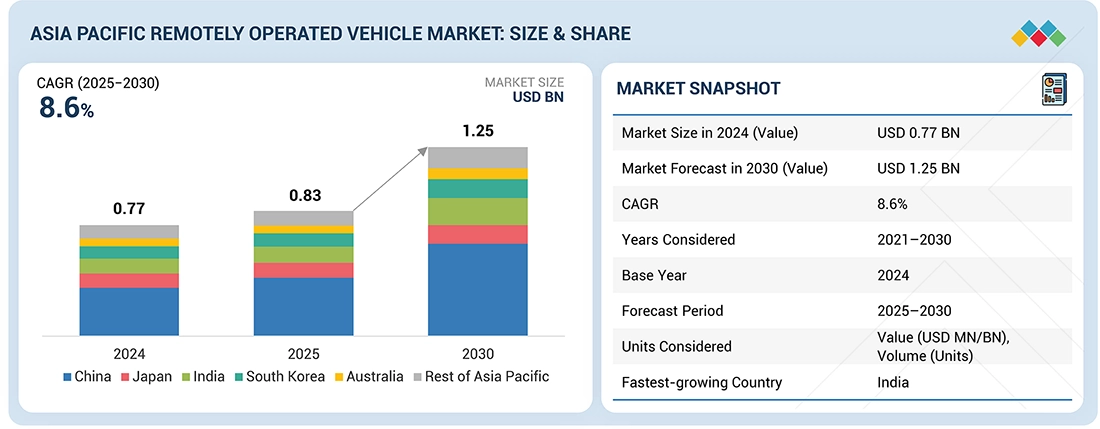
Source: Secondary Research, Interviews with Experts, MarketsandMarkets Analysis
The Asia Pacific Remotely Operated Vehicle (ROV) Market is projected to grow from USD 0.83 billion in 2025 to USD 1.25 billion by 2030 at a CAGR of 8.6%. In terms of volume, it will likely reach 10,913 units by 2030, from 5,947 units in 2025. This growth is driven by expanding offshore energy projects, increasing underwater infrastructure inspection needs, and rising demand for maritime security and scientific exploration.
Market Size & Forecast
• 2024 Market Size (Value): USD 0.73 Billion
• 2030 Market Forecast (Value): USD 1.25 Billion
• CAGR: 8.6% from 2025–2030
• China: 46.3% Revenue Share
• Observation Class Segment: Highest CAGR of 12.2%
KEY TAKEAWAYS
-
By CountryChina is estimated to account for a 46.3% revenue share in 2025.
-
By SizeThe observation class segment is expected to record the highest CAGR of 12.2% between 2025 and 2030.
-
By ApplicationMilitary & defense is expected to be the largest segment during the forecast period.
-
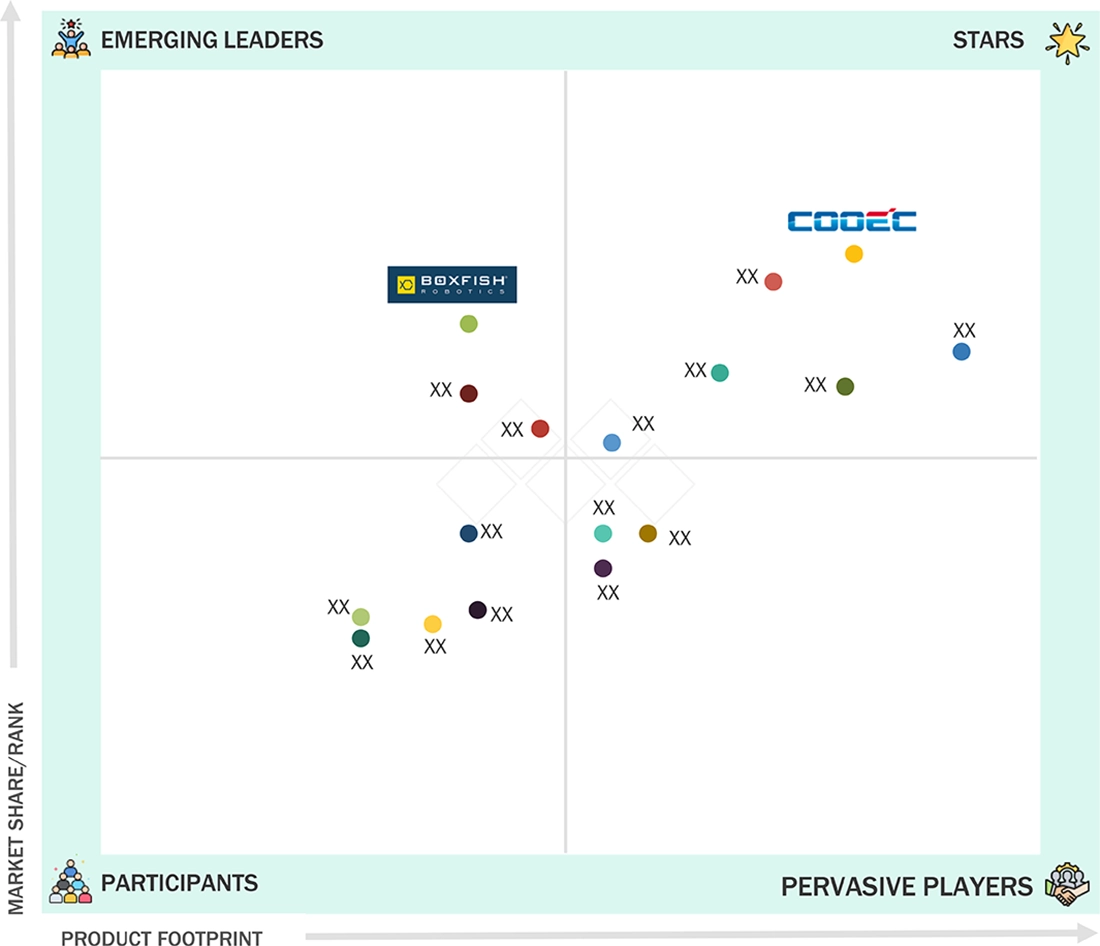
Competitive LandscapeCNOOC International Ltd., Mitsubishi Heavy Industries, Ltd., and JOHNAN Corporation were identified as star players in the Asia Pacific remotely operated vehicle market, given their strong market share and product footprint.
The Asia Pacific Remotely Operated Vehicle (ROV) Industry is experiencing rapid growth due to increasing offshore wind and subsea infrastructure development, expanding deepwater exploration, and greater use of unmanned systems for inspection and maintenance. Rising investments in maritime security, environmental monitoring, and digital subsea technologies will further boost ROV adoption across the region.
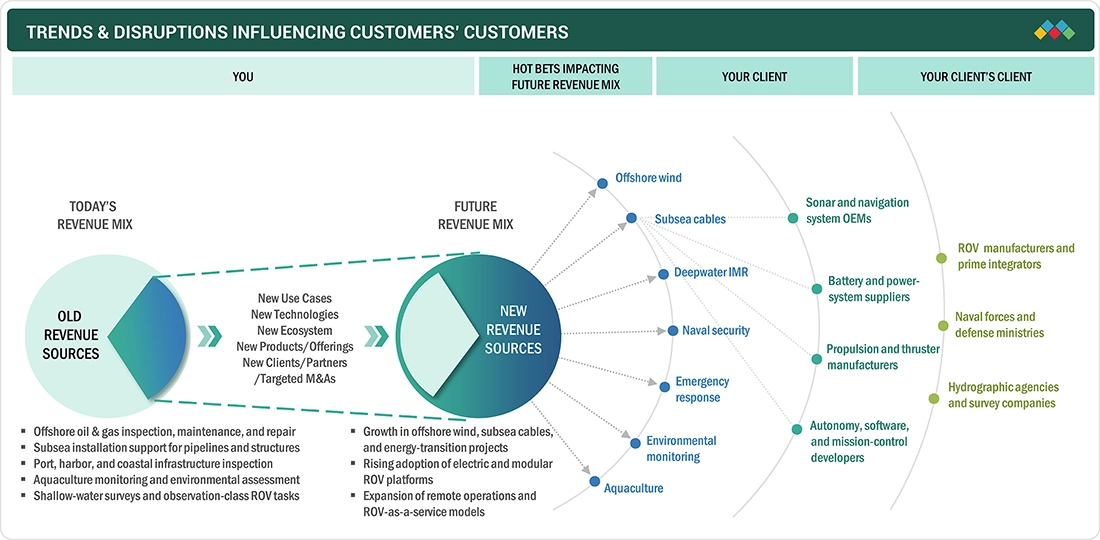
TRENDS & DISRUPTIONS IMPACTING CUSTOMERS' CUSTOMERS
The impact on customers' customers in the Asia Pacific remotely operated vehicle market is mainly driven by increasing demand for underwater infrastructure inspections, offshore energy development, and expanding marine research across the region. Many of these activities are led by national ocean agencies and universities. End users are adopting more efficient, data-driven, and remotely operated subsea solutions to support offshore wind growth, deepwater asset integrity, and maritime security. There is also growing interest in electric and modular ROV systems, remote operations, and advanced imaging and sensing tools. This shift is transforming how operations are conducted, enhancing inspection efficiency and boosting demand for next-generation ROV platforms throughout the region.
Source: Secondary Research, Interviews with Experts, MarketsandMarkets Analysis
MARKET DYNAMICS

Level
-
Expansion of offshore energy activity

-
Growth in maritime security and naval modernization programs


Level
-
Limited availability of skilled labor

-
High capital and operating costs for work-class and deepwater ROVs


Level
-
Need for underwater infrastructure inspection

-
Shift toward electric, modular, and remotely operated service models


Level
-
Difficult operating conditions

-
Fragmented regulatory and operational standards

Source: Secondary Research, Interviews with Experts, MarketsandMarkets Analysis
Driver: Expansion of offshore energy activity
Growth in offshore oil & gas activities and the rise of offshore wind projects in Asia Pacific are driving the need for subsea inspection, installation support, and maintenance. Work-class and observation-class ROVs are used for pipeline surveys, structural assessments, and general IRM tasks. As regional offshore infrastructure expands, operators increasingly depend on ROVs for routine and deepwater operations.
Restraint: Limited availability of skilled labor
ROV operations need skilled pilots, technicians, and maintenance staff, but this talent pool remains limited in many Asia Pacific countries. The shortage impacts deployment capacity and increases reliance on specialized contractors. Training requirements add time and expense, slowing wider adoption.
Opportunity: Need for underwater infrastructure inspection
Demand for underwater inspections of ports, subsea cables, aquaculture assets, and coastal structures is increasing across Asia Pacific. ROVs offer a flexible means to perform routine checks, find faults, and support compliance monitoring. As coastal infrastructure continues to grow, new and ongoing inspection needs keep emerging.
Challenge: Difficult operating conditions
Some parts of the Asia Pacific region face operational challenges like strong currents, sediment, heavy water, and low visibility. These conditions require ROVs with specialized designs, better sensors, and strong maneuvering systems. Not all operators have equipment capable of handling these conditions well, which can impact mission reliability.
ASIA PACIFIC REMOTELY OPERATED VEHICLE MARKET: COMMERCIAL USE CASES ACROSS INDUSTRIES
| COMPANY | USE CASE DESCRIPTION | BENEFITS |
|---|---|---|
 |
Underwater infrastructure inspection (dams, bridges, tunnels, ports, pipelines) | Enables non-diver, non-dewatered inspection, identifies structural issues, supports asset integrity and preventive maintenance |
 |
Deep-sea exploration at Challenger Deep; biological, geological, and sediment sampling; wreck locating; hydrothermal vent discovery; subsea mechanical operations | Enables high-depth research (≈10,900 m), discovery of new species, scientific data collection, potential biomedical/industrial applications, and ability to inspect/locate deep-sea objects |
 |
Deep-sea ROV “Haiqin” used for scientific exploration, sample collection, and multi-depth trials in South China Sea (up to 4,140 m) | Validates 6,000 m capability, enabling deep-sea surveys, biodiversity research, sample collection, and long-term scientific missions |
Logos and trademarks shown above are the property of their respective owners. Their use here is for informational and illustrative purposes only.
MARKET ECOSYSTEM
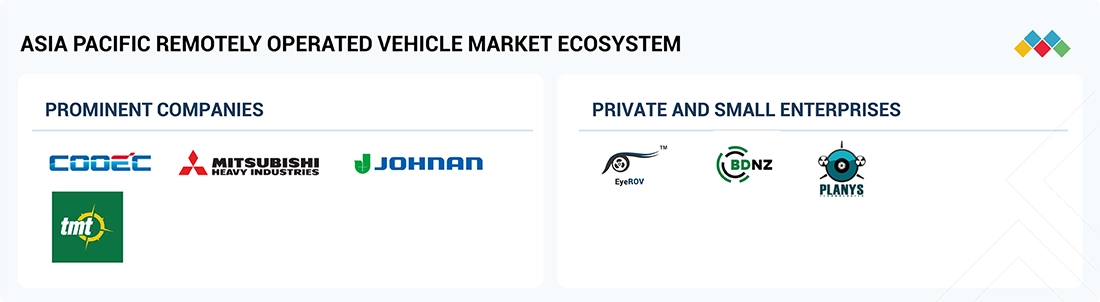
The remotely operated vehicle ecosystem in Asia Pacific is shaped by prominent companies such as COOEC, Mitsubishi Heavy Industries, JOHNAN, and Total Marine Technology, supported by specialized private enterprises, including EyeROV, Planys Technologies, and Bay Dynamics. These companies provide ROV platforms and services that integrate imaging systems, inspection tooling, and subsea control technologies to support offshore energy operations, underwater infrastructure assessment, maritime security tasks, and scientific research across the region.
Logos and trademarks shown above are the property of their respective owners. Their use here is for informational and illustrative purposes only.
MARKET SEGMENTS
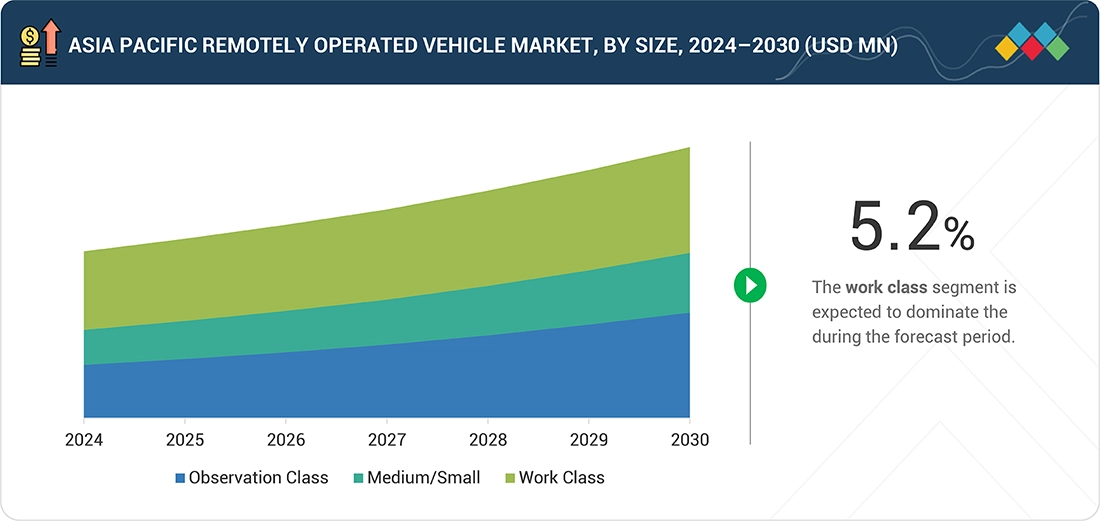
Source: Secondary Research, Interviews with Experts, MarketsandMarkets Analysis
Asia Pacific Remotely Operated Vehicle Market, By Size
Work-class ROVs hold the largest share because they are essential for deepwater oil & gas operations, subsea construction, and IMR. These activities require high-power performance and heavy-duty tools.
Asia Pacific Remotely Operated Vehicle Market, By Propulsion
Electric ROVs are becoming the largest segment as operators shift toward systems that require less maintenance and have lower operating costs. They are well-suited for inspection, environmental monitoring, and offshore wind and coastal infrastructure projects.
Asia Pacific Remotely Operated Vehicle Market, By Application
The military & defense segment is expected to be dominant in the market. This is driven by regional spending on naval modernization, underwater surveillance, mine countermeasure missions, and port security operations.
Asia Pacific Remotely Operated Vehicle Market, By System
Propulsion & mobility systems make up the largest share because they are essential for maneuverability, station-keeping, and operational performance across all ROV classes, directly affecting mission capability and operational reliability.
Asia Pacific Remotely Operated Vehicle Market, By Speed
ROVs traveling faster than 5 knots lead the market because increased thrust and maneuverability are crucial for operating in strong currents, deep waters, and offshore interventions common in Asia Pacific.
REGION
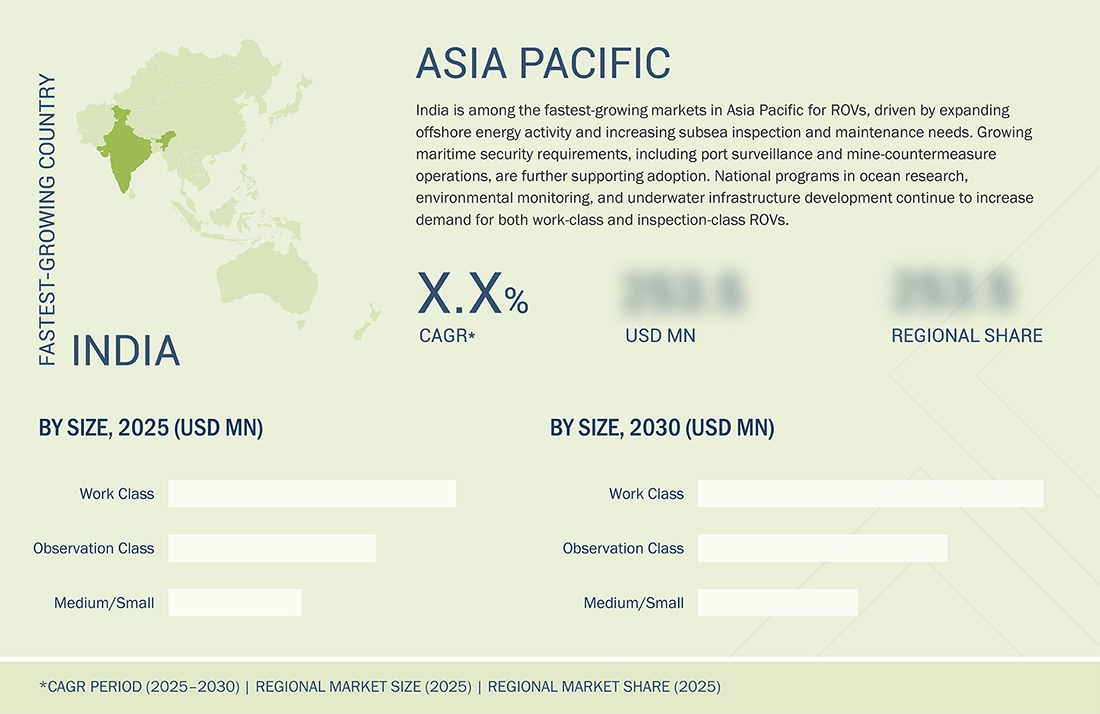
India to be fastest-growing country in Asia Pacific during forecast period
India is the fastest-growing country in the Asia Pacific region, fueled by increased offshore energy activities and the demand for subsea inspection and maintenance. Maritime security needs, such as port surveillance and mine countermeasures, are also helping boost adoption. National programs focused on ocean research, environmental monitoring, and underwater infrastructure development continue to drive demand for both work-class and inspection-class ROVs.
ASIA PACIFIC REMOTELY OPERATED VEHICLE MARKET: COMPANY EVALUATION MATRIX
In the Asia Pacific remotely operated vehicle market, COOEC (Star) leads with a strong operational presence, supported by a broad fleet of work-class and deepwater ROVs deployed across offshore energy, subsea installation, and inspection activities. Boxfish Robotics (Emerging) is strengthening its position with lightweight electric ROV platforms and advanced imaging capabilities that are gaining traction in research, environmental monitoring, and industrial inspection applications.
Source: Secondary Research, Interviews with Experts, MarketsandMarkets Analysis
KEY MARKET PLAYERS
List of Top Asia Pacific Remotely Operated Vehicle Market Companies
- COOEC International Ltd.
- Mitsubishi Heavy Industries, Ltd. (MHI)
- JOHNAN Corporation
- CHASING Innovation Co. Ltd.
- Total Marine Technology (TMT)
- Boxfish Robotics Ltd.
- QYSEA (FIFISH)
- Southern Ocean Subsea (SoSub)
- S2 ROBOTICS Co., Ltd.
- Bay Dynamics Ltd. (BDNZ)
- Planys Technologies Pvt. Ltd.
- PT Robo Marine Indonesia (RoboMarine)
- EyeROV / IROV Technologies Pvt. Ltd.
- IXAR Robotic Solutions Pvt. Ltd.
- Xera Robotics Pvt. Ltd.
MARKET SCOPE
| REPORT METRIC | DETAILS |
|---|---|
| Market Size in 2024 (Value) | USD 0.77 BN |
| Market Forecast in 2030 (Value) | USD 1.25 BN |
| Growth Rate | CAGR of 8.6% from 2025–2030 |
| Years Considered | 2021–2030 |
| Base Year | 2024 |
| Forecast Period | 2025–2030 |
| Units Considered | Value (USD Million/Billion), Volume (Units) |
| Report Coverage | Revenue forecast, company ranking, competitive landscape, growth factors, and trends |
| Segments Covered |
|
| Countries Covered | China, Japan, India, South Korea, Australia, Indonesia, Malaysia, Thailand, Vietnam, Philippines |
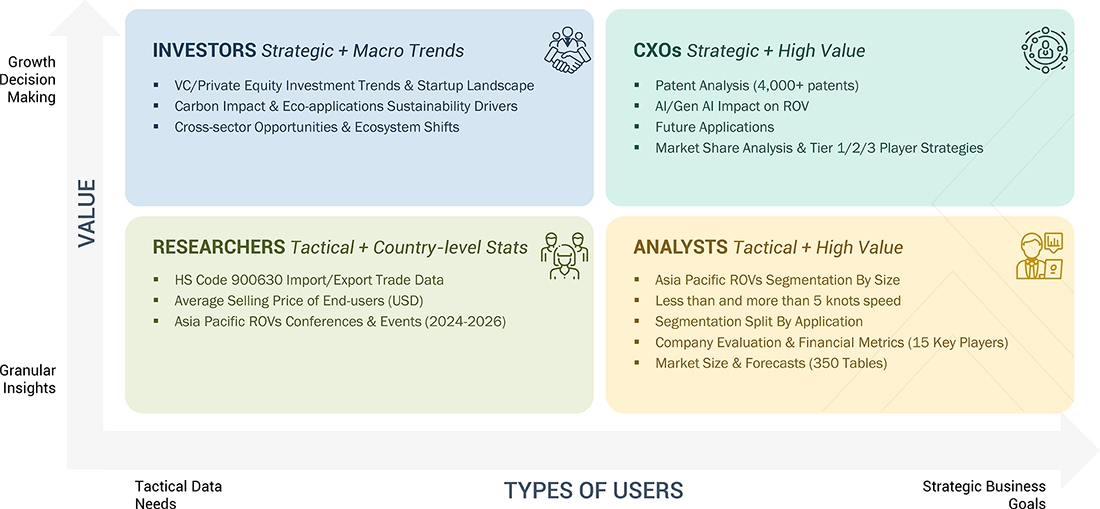
WHAT IS IN IT FOR YOU: ASIA PACIFIC REMOTELY OPERATED VEHICLE MARKET REPORT CONTENT GUIDE
DELIVERED CUSTOMIZATIONS
We have successfully delivered the following deep-dive customizations:
| CLIENT REQUEST | CUSTOMIZATION DELIVERED | VALUE ADDS |
|---|---|---|
| Leading Manufacturer | Additional segment breakdown for countries | Additional country-level market sizing tables for segments/sub-segments covered at regional/global level to gain understanding of market potential by each country |
| Emerging Leader | Additional company profiles | Competitive information on targeted players to gain granular insights on direct competition |
| Regional Market Leader | Additional country market estimates | Additional country-level deep dive for more targeted understanding of total addressable market |
RECENT DEVELOPMENTS
- October 2025 : FET secured a contract to supply two XLX EVO III work-class ROVs to Marine Platforms in Nigeria. This move helps strengthen Marine Platforms' subsea operations by using FET's new generation vehicle. The delivery supports ongoing offshore oil and gas work in the region.
- October 2025 : FET received an order from DOF for a work-class ROV and tether management system scheduled for delivery in late 2025. The system will support DOF’s subsea operations in Brazil under its ongoing offshore projects.
- November 2024 : BlueHalo acquired VideoRay to expand its work into unmanned maritime systems. VideoRay brings experience in small ROVs that are used for defense, EOD, mine countermeasures, and commercial underwater tasks. The acquisition helps strengthen BlueHalos' position in autonomous maritime technologies and combines VideoRays hardware and software with BlueHalos' existing capabilities.
Table of Contents
 Exclusive indicates content/data unique to MarketsandMarkets and not available with any competitors.
Methodology
The study involved four major activities in estimating the current size of the Asia Pacific Remotely Operated Vehicle (ROV) Market. Exhaustive secondary research was done to collect information on the Asia Pacific Remotely Operated Vehicle (ROV) Market, its adjacent markets, and its parent market. The next step was to validate these findings, assumptions, and sizing with industry experts across the value chain through primary research. Demand-side analysis was conducted to estimate the overall market size. After that, market breakdown and data triangulation procedures were employed to estimate the sizes of various segments and subsegments within the Asia Pacific Remotely Operated Vehicle (ROV) Market.
Secondary Research
During the secondary research process, various sources were consulted to identify and collect information for this study. The secondary sources included government sources, such as SIPRI; corporate filings, including annual reports, press releases, and investor presentations from companies; white papers, journals, and certified publications; and articles from recognized authors, directories, and databases.
Primary Research
Extensive primary research was conducted after acquiring information regarding the Asia Pacific Remotely Operated Vehicle (ROV) Market scenario through secondary research. Primary data was collected through questionnaires, emails, and telephonic interviews.
To know about the assumptions considered for the study, download the pdf brochure
Market Size Estimation
The top-down and bottom-up approaches were used to estimate and validate the size of the Asia Pacific Remotely Operated Vehicle (ROV) Market. The research methodology used to estimate the size of the market included the following details:
- Key players in the Asia Pacific Remotely Operated Vehicle (ROV) Market were identified through secondary research, and their market shares were determined through a combination of primary and secondary research. This included a study of the annual and financial reports of the top market players, as well as extensive interviews with leaders, including directors, engineers, marketing executives, and other key stakeholders of leading companies operating in the market.
- All percentage shares, splits, and breakdowns were determined using secondary sources and verified through primary sources.
- All possible parameters that affect the markets covered in this research study were accounted for, viewed in extensive detail, verified through primary research, and analyzed to obtain the final quantitative and qualitative data on the Asia Pacific Remotely Operated Vehicle (ROV) Market. This data was consolidated, enhanced with detailed inputs, analyzed by MarketsandMarkets, and presented in this report.

Data Triangulation
After determining the overall market size, the total market was divided into several segments and subsegments. The data triangulation and market breakdown procedures explained below were implemented, wherever applicable, to complete the overall market engineering process and arrive at the estimated market numbers for the market segments and subsegments. The data was triangulated by studying various factors and trends from the demand and supply sides. Additionally, the market size was validated using top-down and bottom-up approaches.
Market Definition
Remotely Operated Vehicle (ROV) is an unmanned, tethered underwater system operated from a surface vessel or platform, designed to perform real-time inspection, intervention, survey, maintenance, and manipulation tasks in subsea environments. ROVs rely on an umbilical cable for power, control, and high-bandwidth data transmission, enabling continuous operator oversight and precise maneuverability at varying ocean depths.
Stakeholders
- Original equipment manufacturers (OEMs)
- Manufacturers and OEMs
- Component and Subsystem Suppliers
- System Integrators
- End Users
- Service Providers
- Regulatory and Certification Bodies
- Research & Technology Institutions
- Investors and Funding Agencies
Research Objectives
- To define, describe, and forecast the Asia Pacific Remotely Operated Vehicle (ROV) Market based on Size, Application, System, Propulsion, Speed, and region.
- To identify and analyze the drivers, restraints, opportunities, and challenges influencing the growth of the market
- To identify industry trends, market trends, and technology trends currently prevailing in the market
- To analyze micro markets with respect to individual growth trends, prospects, and their contribution to the overall market
- To analyze the degree of competition in the market by analyzing recent developments adopted by leading market players
- To provide a detailed competitive landscape of the market, along with a ranking analysis of key players, and an analysis of startup companies in the market
- To strategically profile the key market players and comprehensively analyze their core competencies
- To provide a detailed competitive landscape of the Asia Pacific Remotely Operated Vehicle (ROV) market, along with a market share analysis and revenue analysis of key players
Key Questions Addressed by the Report
What is the current and projected market value of the Asia Pacific ROV market?
The Asia Pacific ROV market is projected to grow from USD 0.83 billion in 2025 to USD 1.25 billion by 2030, at a CAGR of 8.6% during the forecast period.
Which country dominates the Asia Pacific ROV market?
China dominates the Asia Pacific ROV market due to strong investments in defense capabilities, offshore energy exploration, and underwater robotics research and development.
Which segment is expected to drive growth in the Asia Pacific ROV market?
The oil and gas segment is a major driver of the Asia Pacific ROV market due to increasing offshore exploration, inspection, repair, and maintenance activities across the region.
How is the Asia Pacific ROV market segmented?
The Asia Pacific ROV market is segmented by vehicle type into ROV and AUV, by vehicle class into work class and observation class, and by application into oil and gas, defense, and other sectors, along with segmentation by activity and geography.
Who are the key players in the Asia Pacific ROV market?
Key players in the Asia Pacific ROV market include DOF Subsea AS, Helix Energy Solutions Group Inc., TechnipFMC PLC, Bourbon Offshore, Subsea 7 SA, and Kongsberg Gruppen ASA, which are actively contributing to market growth and innovation.


Personalize This Research
- Triangulate with your Own Data
- Get Data as per your Format and Definition
- Gain a Deeper Dive on a Specific Application, Geography, Customer or Competitor
- Any level of Personalization
Let Us Help You
- What are the Known and Unknown Adjacencies Impacting the Asia Pacific Remotely Operated Vehicle (ROV) Market
- What will your New Revenue Sources be?
- Who will be your Top Customer; what will make them switch?
- Defend your Market Share or Win Competitors
- Get a Scorecard for Target Partners

Custom Market Research Services
We Will Customise The Research For You, In Case The Report Listed Above Does Not Meet With Your Requirements
Get 10% Free CustomisationTESTIMONIALS






Growth opportunities and latent adjacency in Asia Pacific Remotely Operated Vehicle (ROV) Market