Remotely Operated Vehicle (ROV) Market Size, Share & Growth 2030

Remotely Operated Vehicle Market by Size (Observation Class, Medium/Small, Work-Class), Application (Military & Defense, Oil & Gas, Environmental Protection & Monitoring, Oceanography, Archaeology & Exploration), System, Speed, Propulsion, and Region – Global Forecast to 2030




REMOTELY OPERATED VEHICLE (ROV) MARKET OVERVIEW
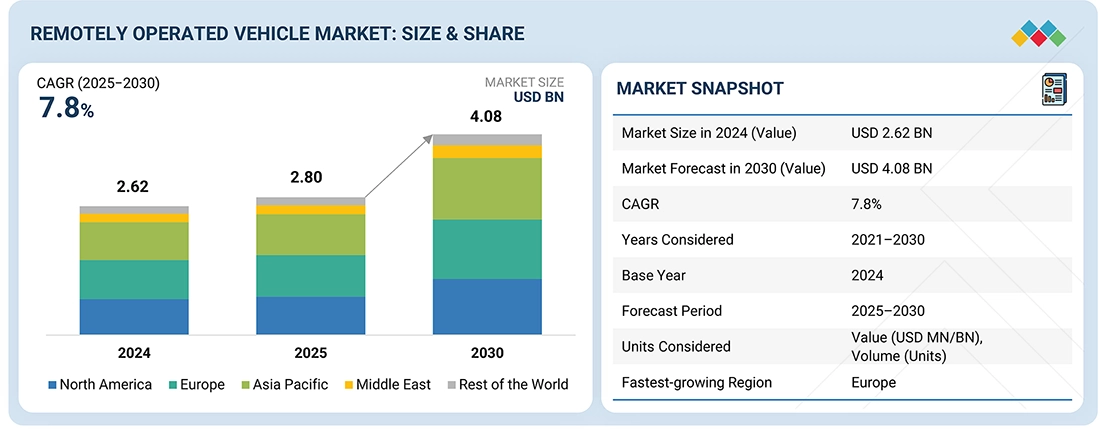
According to Marketsandmarkets, The global Remotely Operated Vehicle (ROV) Market size was valued at USD 2.80 billion in 2025 and is projected to reach USD 4.08 billion by 2030, growing at a CAGR of 7.8%. from 2025 to 2030. In terms of volume (new deliveries), it is likely to reach 31,737 units by 2030, up from 18,095 units in 2025. The market is propelled by expanding offshore energy activities, rising investments in offshore wind infrastructure, and the growing need for reliable subsea inspection and maintenance. Defense-driven applications such as underwater surveillance and mine countermeasures further support sustained procurement. Growing focus on asset integrity and safety in deep-water environments continues to reinforce demand.
REPORT SCOPE
| REPORT METRIC | DETAILS |
|---|---|
| Market Size in 2024 (Value) | USD 2.62 BN |
| Market Forecast in 2030 (Value) | USD 4.08 BN |
| Growth Rate | CAGR of 7.8% from 2025–2030 |
| Years Considered | 2021–2030 |
| Base Year | 2024 |
| Forecast Period | 2025–2030 |
| Units Considered | Value (USD BN), Volume (Units) |
| Report Coverage | Revenue forecast, company ranking, competitive landscape, growth factors, and trends |
| Segments Covered |
|
| Regions Covered | North America, Asia Pacific, Europe, Middle East, Rest of the World |
Market Size & Forecast
KEY TAKEAWAYS
-
By RegionEurope is estimated to account for a 30.2% revenue share in 2025.
-
By SizeThe observation class segment is projected to register the highest CAGR of 11.2% during the forecast period.
-
By SpeedThe >5 knots segment is expected to be dominant during the forecast period.
-
By SystemThe propulsion & mobility segment is expected to hold the largest share during the forecast period
-
By PropulsionElectric ROVs are expected to surpass other segments during the forecast period.
-
By ApplicationMilitary & defense is expected to be the leading segment during the forecast period.
-
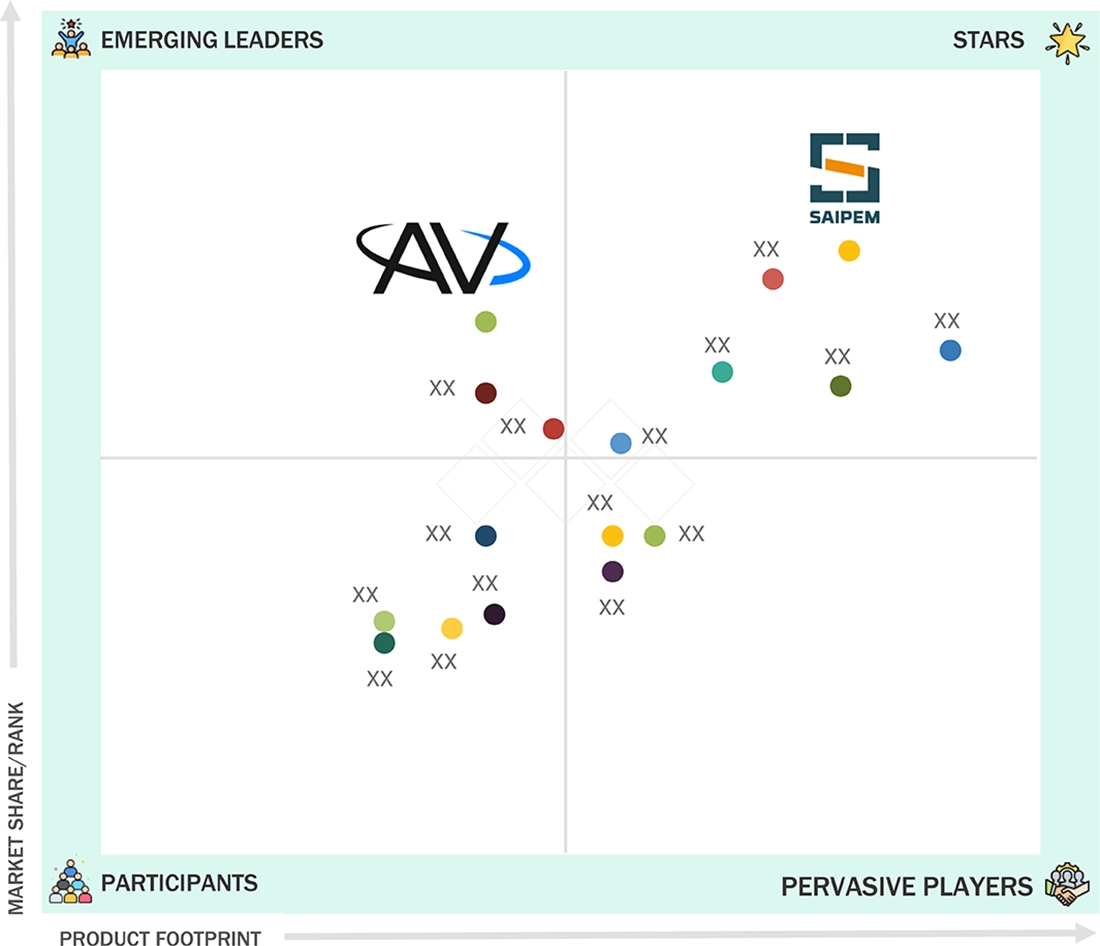
Competitive LandscapeSaipem S.p.A., L3Harris Technologies, Inc., and Oceaneering International, Inc. were identified as star players in the remotely operated vehicle market, given their strong market share and product footprint.
-
Competitive LandscapeMitsubishi Heavy Industries, Ltd., Blueye Robotics, and EyeROV have distinguished themselves among start-ups and SMEs by securing strong footholds in specialized niche areas, underscoring their potential as emerging market leaders.
The Remotely Operated Vehicle Industry is driven by expanding offshore energy operations, increasing subsea inspection needs, and sustained defense investments in underwater surveillance and mine countermeasures. Demand is expected to rise as offshore wind expansion, deep-water projects, and advanced autonomous capabilities increase operational efficiency and reduce human risk in subsea environments.
Source: Secondary Research, Interviews with Experts, MarketsandMarkets Analysis
TRENDS & DISRUPTIONS IMPACTING CUSTOMERS' CUSTOMERS
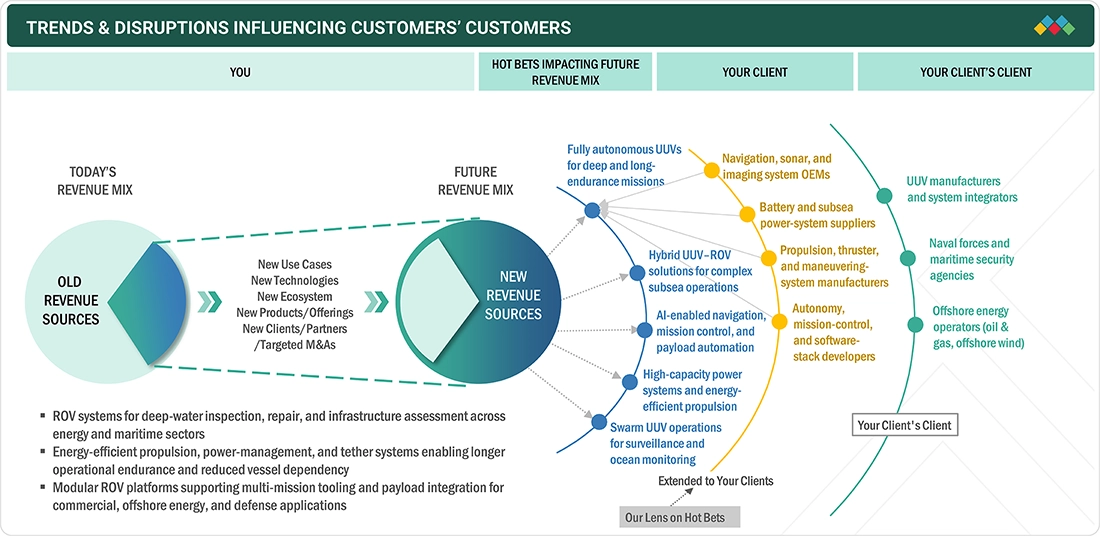
The impact on customers’ business in the remotely operated vehicle market is being shaped by evolving subsea operational requirements and rapid technological advancements. Offshore energy operators, naval organizations, and research institutions are prioritizing higher mission efficiency, precision, and automation in their ROV deployments. The shift toward autonomous capabilities, AI-enabled navigation, and long-endurance power systems is influencing operational performance and cost structures. These developments are increasing demand for integrated, scalable, and data-driven ROV solutions, defining the market’s future growth trajectory.
Source: Secondary Research, Interviews with Experts, MarketsandMarkets Analysis
MARKET DYNAMICS

Level
-
Growing subsea infrastructure in energy and renewables

-
Deep-water expansion and data-driven operations


Level
-
High acquisition, vessel, and lifecycle costs

-
Exposure to offshore spending cycles and energy price volatility


Level
-
Decommissioning and seabed resource exploration

-
Advent of autonomy and smart sensing


Level
-
Increased reliability requirements and design complexity due to harsh environments

-
Shortage of skilled ROV crews

Source: Secondary Research, Interviews with Experts, MarketsandMarkets Analysis
Driver: Growing subsea infrastructure in energy and renewables
Expanding offshore oil & gas projects and the rapid build-out of renewable subsea infrastructure are increasing the need for ROV-based inspection, repair, and maintenance. As operators move into deeper and operationally challenging environments, ROVs enable high-reliability asset monitoring, improved safety, and stronger uptime performance across critical subsea operations.
Restraint: High acquisition, vessel, and lifecycle costs
Significant capital expenditure for ROV systems, along with vessel support, maintenance, and skilled personnel requirements, slows procurement decisions and impacts overall project economics. These costs reduce investment flexibility and extend return-on-investment timelines, particularly in price-sensitive market cycles.
Opportunity: Decommissioning and seabed resource exploration
Growing decommissioning programs in mature offshore fields and expanding seabed resource exploration are creating new long-duration growth avenues. These segments require specialized inspection and intervention capability, enabling market participants to diversify revenue and reduce reliance on traditional oil and gas spending.
Challenge: Increased reliability requirements and design complexity due to harsh environments
Deployment in deeper waters and harsher subsea conditions is raising expectations for reliability, endurance, and high-precision control. Meeting these requirements demands advanced engineering, greater system robustness, and continuous innovation, increasing complexity in product development and market competition.
REMOTELY OPERATED VEHICLE (ROV) MARKET: COMMERCIAL USE CASES ACROSS INDUSTRIES
| COMPANY | USE CASE DESCRIPTION | BENEFITS |
|---|---|---|
 |
Oceaneering’s work-class ROVs conduct subsea inspection, maintenance, and repair on platforms, risers, and pipelines in deep and hazardous waters. They also support integrity assessment with real-time imaging and sensors. | Improves operational safety |Minimizes downtime | Extends asset life with accurate condition data for better planning |
 |
Fugro deploys ROVs to locate, inspect, and bury subsea export and array cables, while providing detailed geophysical mapping during installation and operations. | Reduces cable failures|Ensures reliable grid connectivity and lowers corrective maintenance costs for wind farm operators |
 |
Saab ROVs inspect fish cages, moorings, and surrounding seabed to detect fouling, damage, and environmental changes without disrupting farming operations. | Enhances farm biosecurity|Avoids costly fish escapes| Reduces diver safety risks and downtime |
Logos and trademarks shown above are the property of their respective owners. Their use here is for informational and illustrative purposes only.
MARKET ECOSYSTEM
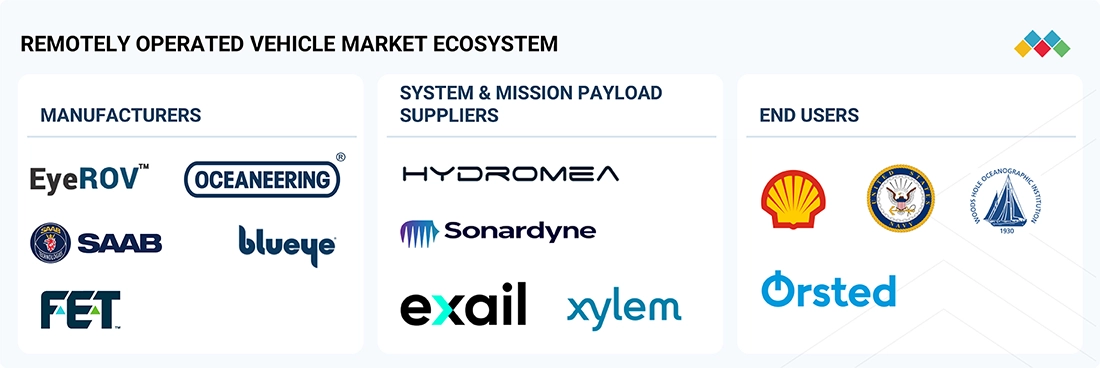
The remotely operated vehicle market ecosystem comprises manufacturers delivering specialized platforms for inspection, intervention, and complex subsea operations. System and mission payload suppliers provide advanced sensing, navigation, communication, and power technologies that enhance capability and mission efficiency. End users such as offshore energy operators, naval organizations, and research institutions create sustained demand through requirements for asset integrity, security, and exploration. Collectively, these stakeholders form a technologically driven value chain that supports the expanding scale and complexity of subsea activities.
Logos and trademarks shown above are the property of their respective owners. Their use here is for informational and illustrative purposes only.
MARKET SEGMENTS
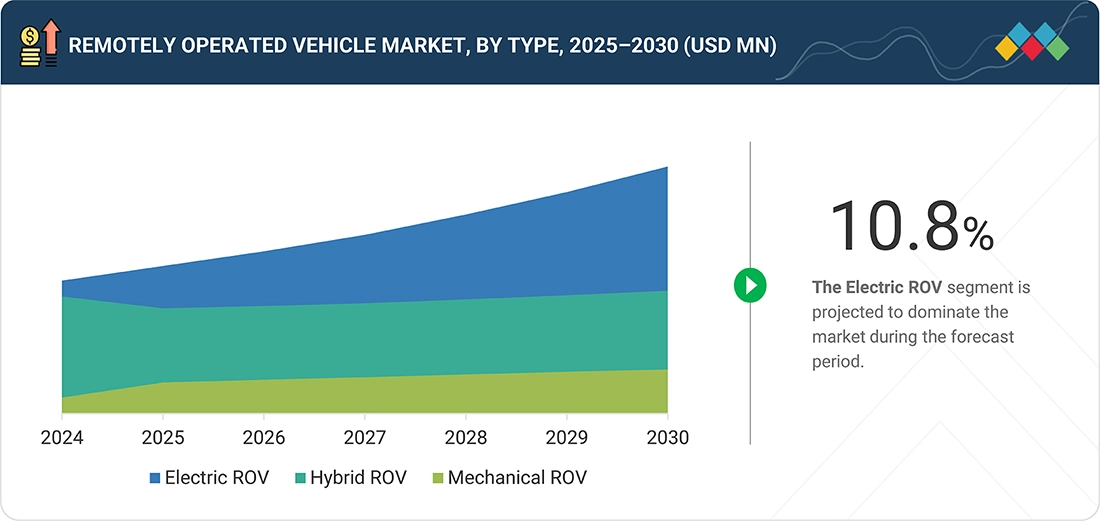
Source: Secondary Research, Interviews with Experts, MarketsandMarkets Analysis
Remotely Operated Vehicle Market, By Size
Work-class ROVs are expected to lead the market as these vehicles offer power, depth rating, and tooling capability required for complex subsea intervention and maintenance tasks. Their suitability for deepwater operations and ability to support heavy industrial workloads make them the primary choice for offshore and infrastructure-related missions.
Remotely Operated Vehicle Market, By Application
Military & defense organizations constitute the largest segment because they require ROVs for critical underwater missions, including surveillance, mine countermeasures, and strategic asset protection. Increasing government budgets and ongoing fleet modernization sustain high adoption of capable and mission-ready systems. Their focus on mission assurance and operational superiority keeps defense spending consistently ahead of commercial demand.
Remotely Operated Vehicle Market, By System
Propulsion & mobility systems dominate the market as they deliver the essential capability for precise movement, stability, and station-keeping in complex subsea environments. Advancements in thruster technology and dynamic positioning are driving productivity gains and operational safety. Given their central role in mission performance, these systems represent the most critical and highest-value component of ROV platforms.
Remotely Operated Vehicle Market, By Propulsion
Electric ROVs hold the largest share because they offer improved energy efficiency, quieter functionality, and lower maintenance costs compared with hydraulic systems. Their reliability in deep-water environments aligns well with growing offshore energy and wind development activity. Strong demand for clean, cost-effective, and scalable solutions continues to increase the adoption of electric propulsion.
Remotely Operated Vehicle Market, By Speed
ROVs operating above 5 knots dominate due to their ability to cover larger subsea areas quickly, improving mission turnaround and reducing vessel utilization costs. Their performance in strong currents and deep-water environments makes them the operational benchmark for complex inspection and intervention tasks. Faster transit also supports tighter project schedules, creating direct economic benefits for offshore operators.
REGION
Europe to be fastest-growing region in global remotely operated vehicle market during forecast period
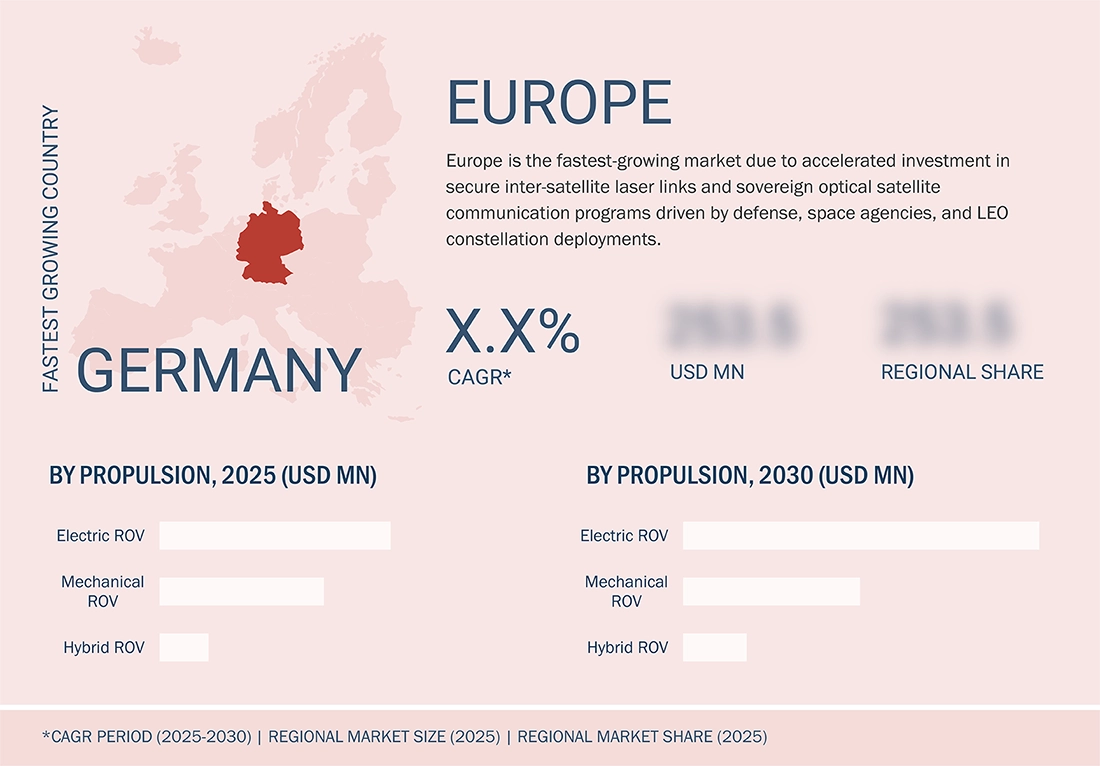
Europe is expected to be the fastest-growing region during the forecast period, driven by sustained offshore energy investments, expansion of offshore wind infrastructure, and stringent regulatory standards for subsea inspection and safety. The region’s mature industrial base, strong technological capabilities, and active maritime programs are further accelerating the adoption of advanced ROV systems. Additionally, increasing focus on decommissioning and environmental monitoring is creating steady demand across both commercial and government sectors.
The Europe Remotely Operated Vehicle Market is anticipated to rise from USD 0.85 billion in 2025 to USD 1.21 billion by 2030 at a CAGR of 7.3%. In volume terms, it is likely to reach 9,229 units by 2030, from 5,314 units in 2025. This growth is fueled by the expansion of offshore wind projects across the North Sea. Additionally, there is increased regulatory pressure throughout Europe for improved marine environmental monitoring systems.
The Remotely Operated Vehicle Market in North America is projected to grow from USD 0.78 billion in 2025 to USD 1.14 billion by 2030 at a CAGR of 7.9%. In terms of volume, it will reach 8,256 units by 2030, from 4,614 units in 2025. This growth is driven by rising demand for advanced subsea inspection, expanding offshore energy activities, and increasing adoption of ROVs across defense and critical infrastructure applications.
The Asia Pacific Remotely Operated Vehicle Market is projected to grow from USD 0.83 billion in 2025 to USD 1.25 billion by 2030 at a CAGR of 8.6%. In terms of volume, it will likely reach 10,913 units by 2030, from 5,947 units in 2025. This growth is driven by expanding offshore energy projects, increasing underwater infrastructure inspection needs, and rising demand for maritime security and scientific exploration.
REMOTELY OPERATED VEHICLE (ROV) MARKET: COMPANY EVALUATION MATRIX
In the remotely operated vehicle market matrix, SAIPEM S.p.A. (Star) leads with a strong operational presence and a robust fleet deployed across global offshore projects, supported by advanced subsea technologies and intervention capabilities. Its proven performance in deep-water inspection, repair, and construction makes it a preferred partner for major offshore energy operators in both oil & gas and renewables. Meanwhile, AeroVironment, Inc. (Emerging Leader) is strengthening its position with specialized unmanned systems and mission-focused platforms that meet evolving defense and commercial requirements. Its emphasis on autonomy, lightweight designs, and rapid deployment enhances competitiveness in high-growth segments. As demand for agile, high-performance unmanned systems rises, the company shows strong potential to advance toward the leaders’ quadrant.
Source: Secondary Research, Interviews with Experts, MarketsandMarkets Analysis
KEY MARKET PLAYERS
List of Top Remotely Operated Vehicle Companies
- Forum Energy Technologies, Inc. (US)
- Oceaneering International, Inc. (US)
- BAE Systems (UK)
- L3Harris Technologies, Inc. (US)
- Saipem S.p.A. (Italy)
- DEEPOCEAN (Norway)
- Kystdesign (Norway)
- TechnipFMC plc (UK)
- TMT (UK)
- JOHNAN Corporation (Japan)
- TKMS (Germany)
- AeroVironment, Inc. (US)
- International Submarine Engineering Limited (Canada)
- Saab AB (Sweden)
- Exail Technologies (France)
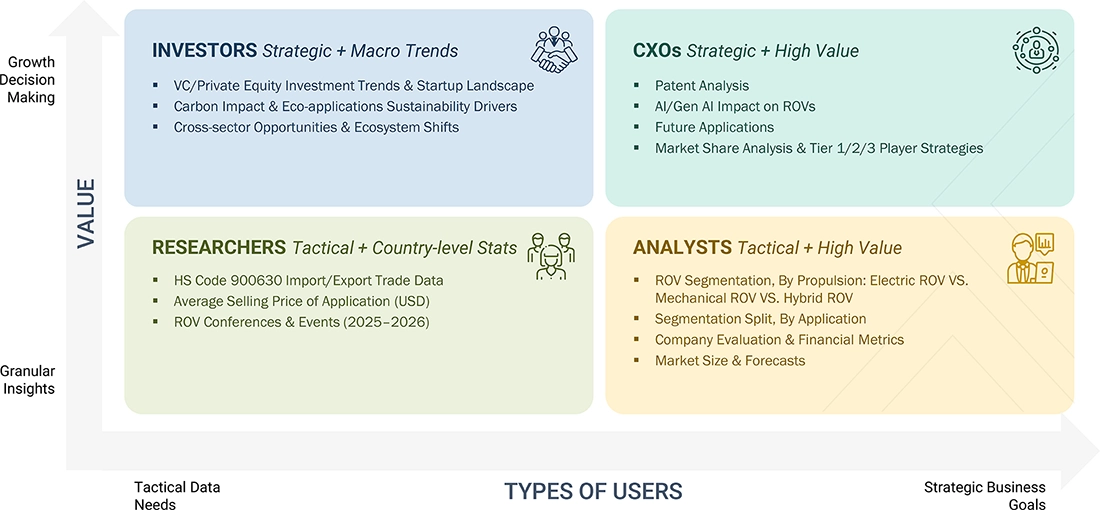
WHAT IS IN IT FOR YOU: REMOTELY OPERATED VEHICLE (ROV) MARKET REPORT CONTENT GUIDE
DELIVERED CUSTOMIZATIONS
We have successfully delivered the following deep-dive customizations:
| CLIENT REQUEST | CUSTOMIZATION DELIVERED | VALUE ADDS |
|---|---|---|
| Leading Manufacturer | Additional segment breakdown for countries |
|
| Emerging Leader | Additional company profiles | Competitive information on targeted players to gain granular insights on direct competition |
| Regional Market Leader | Additional country market estimates | Additional country-level deep dive for more targeted understanding of total addressable market |
RECENT DEVELOPMENTS
- June 2025 : Forum Energy Technologies secured a contract to supply two XLX-C work-class ROV systems to UAE-based offshore contractor CCC (Underwater Engineering). The units, rated for 3000-m operations and equipped for construction, drill support, pipeline and platform inspection, survey, and subsea asset work, will be deployed on CCC’s new deepwater support vessel
- August 2025 : Oceaneering International was awarded a suite of subsea robotics contracts by Petrobras, collectively valued at approximately USD 180 million. The scope of work includes delivery of work-class ROV services, specialized tooling packages, and comprehensive subsea survey capabilities to support inspection, maintenance, repair, decommissioning, positioning, FPSO hook-ups, mooring inspections, and pile installations offshore Brazil.
- October 2025 : Forum Energy Technologies secured a contract to supply two XLX EVO III work-class ROVs to Marine Platforms in Nigeria. The deal strengthens Marine Platforms’ subsea operational capabilities using FET’s new-generation vehicle. The delivery supports ongoing offshore oil & gas activities in the region.
Table of Contents
 Exclusive indicates content/data unique to MarketsandMarkets and not available with any competitors.
Methodology
The study involved four major activities in estimating the current size of the Remotely Operated Vehicle (ROV) Market. Exhaustive secondary research was done to collect information on the Remotely Operated Vehicle (ROV) Market, its adjacent markets, and its parent market. The next step was to validate these findings, assumptions, and sizing with industry experts across the value chain through primary research. Demand-side analysis was conducted to estimate the overall market size. After that, market breakdown and data triangulation procedures were employed to estimate the sizes of various segments and subsegments within the Remotely Operated Vehicle (ROV) Market.
Secondary Research
During the secondary research process, various sources were consulted to identify and collect information for this study. The secondary sources included government sources, such as SIPRI; corporate filings, including annual reports, press releases, and investor presentations from companies; white papers, journals, and certified publications; and articles from recognized authors, directories, and databases.
Primary Research
Extensive primary research was conducted after acquiring information regarding the Remotely Operated Vehicle (ROV) Market scenario through secondary research. Several primary interviews were conducted with market experts from the demand and supply sides across major countries of North America, Europe, Asia Pacific, the Middle East and Rest of the world. Primary data was collected through questionnaires, emails, and telephonic interviews.

To know about the assumptions considered for the study, download the pdf brochure
Market Size Estimation
The top-down and bottom-up approaches were used to estimate and validate the size of the Remotely Operated Vehicle (ROV) Market. The research methodology used to estimate the size of the market included the following details:
- Key players in the Remotely Operated Vehicle (ROV) Market were identified through secondary research, and their market shares were determined through a combination of primary and secondary research. This included a study of the annual and financial reports of the top market players, as well as extensive interviews with leaders, including directors, engineers, marketing executives, and other key stakeholders of leading companies operating in the market.
- All percentage shares, splits, and breakdowns were determined using secondary sources and verified through primary sources.
- All possible parameters that affect the markets covered in this research study were accounted for, viewed in extensive detail, verified through primary research, and analyzed to obtain the final quantitative and qualitative data on the Remotely Operated Vehicle (ROV) Market. This data was consolidated, enhanced with detailed inputs, analyzed by MarketsandMarkets, and presented in this report.

Data Triangulation
After determining the overall market size, the total market was divided into several segments and subsegments. The data triangulation and market breakdown procedures explained below were implemented, wherever applicable, to complete the overall market engineering process and arrive at the estimated market numbers for the market segments and subsegments. The data was triangulated by studying various factors and trends from the demand and supply sides. Additionally, the market size was validated using top-down and bottom-up approaches.
Market Definition
A Remotely Operated Vehicle (ROV) is an unmanned, tethered underwater system operated from a surface vessel or platform, designed to perform real-time inspection, intervention, survey, maintenance, and manipulation tasks in subsea environments. ROVs rely on an umbilical cable for power, control, and high-bandwidth data transmission, enabling continuous operator oversight and precise maneuverability at varying ocean depths.
Stakeholders
- Original equipment manufacturers (OEMs)
- Manufacturers and OEMs
- Component and Subsystem Suppliers
- System Integrators
- End Users
- Service Providers
- Regulatory and Certification Bodies
- Research & Technology Institutions
- Investors and Funding Agencies
Research Objectives
- To define, describe, and forecast the Remotely Operated Vehicle (ROV) Market based on Size, Application, System, Propulsion, Speed, and region.
- To forecast the size of different segments of the market with respect to North America, Europe, Asia Pacific, the Middle East, and the Rest of the World.
- To identify and analyze the drivers, restraints, opportunities, and challenges influencing the growth of the market
- To identify industry trends, market trends, and technology trends currently prevailing in the market
- To analyze micro markets with respect to individual growth trends, prospects, and their contribution to the overall market
- To analyze the degree of competition in the market by analyzing recent developments adopted by leading market players
- To provide a detailed competitive landscape of the market, along with a ranking analysis of key players, and an analysis of startup companies in the market
- To strategically profile the key market players and comprehensively analyze their core competencies
- To provide a detailed competitive landscape of the Remotely Operated Vehicle (ROV) market, along with a market share analysis and revenue analysis of key players
Key Questions Addressed by the Report
What is the projected size of the global remotely operated vehicle market by 2030?
The global remotely operated vehicle market is projected to grow from USD 2.80 billion in 2025 to USD 4.08 billion by 2030, registering a CAGR of 7.8%. In volume terms, new deliveries are projected to increase from 18,095 units in 2025 to 31,737 units by 2030. Pasted text
What are the major factors driving the remotely operated vehicle market?
Growth is driven by expanding subsea infrastructure in energy and renewables, increasing offshore energy activities, deep water expansion, and rising demand for subsea inspection and maintenance. Defense applications such as underwater surveillance and mine countermeasures also support sustained procurement. Pasted text
Which region is expected to grow the fastest in the remotely operated vehicle market?
Europe is expected to be the fastest growing region during the forecast period. Offshore energy investments, offshore wind expansion, stringent subsea inspection and safety requirements, decommissioning activity, and environmental monitoring are supporting regional demand. Pasted text
Which ROV size segment is expected to register the highest growth?
The observation class segment is projected to register the highest CAGR of 11.2% during the forecast period. Observation class ROVs are increasingly relevant for subsea inspection and monitoring requirements across offshore and other underwater applications. Pasted text
Which application segment is expected to dominate the remotely operated vehicle market?
Military and defense is expected to be the leading application segment during the forecast period. Defense organizations use ROVs for underwater surveillance, mine countermeasures, strategic asset protection, and other critical underwater missions. Pasted text Pasted text
Which system segment is expected to hold the largest share of the ROV market?
Propulsion and mobility systems are expected to hold the largest share during the forecast period. These systems provide precise movement, stability, and station keeping, while advances in thruster technology and dynamic positioning are improving productivity and operational safety. Pasted text Pasted text
Which propulsion technology is expected to lead the ROV market?
Electric ROVs are expected to surpass other propulsion segments during the forecast period. Their energy efficiency, quieter operation, lower maintenance costs, and suitability for deep water environments are supporting adoption, particularly in offshore energy and wind development. Pasted text Pasted text
What are the major opportunities in the remotely operated vehicle market?
Decommissioning and seabed resource exploration represent important opportunities for ROV providers. The market is also benefiting from the advent of autonomous capabilities and smart sensing, which can improve mission efficiency, precision, and operational performance in complex subsea environments. Pasted text
What are the major challenges facing the remotely operated vehicle market?
Increased reliability requirements and design complexity in harsh subsea environments remain key challenges. ROV operators and manufacturers must also address a shortage of skilled ROV crews while meeting demanding requirements for endurance, high precision control, and system robustness. Pasted text Pasted text
Which companies are recognized as leading players in the global remotely operated vehicle market?
Key companies include Forum Energy Technologies, Oceaneering International, BAE Systems, L3Harris Technologies, Saipem, DeepOcean, Kystdesign, TechnipFMC, TMT, JOHAN Corporation, TKMS, AeroVironment, International Submarine Engineering, Saab, and Exail Technologies. Saipem, L3Harris Technologies, and Oceaneering International are identified as Star players, while Mitsubishi Heavy Industries, Blueye Robotics, and EyeROV are identified among emerging startups and SMEs. Pasted text Pasted text


Personalize This Research
- Triangulate with your Own Data
- Get Data as per your Format and Definition
- Gain a Deeper Dive on a Specific Application, Geography, Customer or Competitor
- Any level of Personalization
Let Us Help You
- What are the Known and Unknown Adjacencies Impacting the Remotely Operated Vehicle Market
- What will your New Revenue Sources be?
- Who will be your Top Customer; what will make them switch?
- Defend your Market Share or Win Competitors
- Get a Scorecard for Target Partners

Custom Market Research Services
We Will Customise The Research For You, In Case The Report Listed Above Does Not Meet With Your Requirements
Get 10% Free CustomisationTESTIMONIALS






Growth opportunities and latent adjacency in Remotely Operated Vehicle Market