Asia Pacific Smart Lighting Market

Asia Pacific Smart Lighting Market by Lights and Luminaires, Lighting Controls, DALI, Power over Ethernet (PoE), Power Line Communications (PLC), Wired Hybrid Protocols, Zigbee, Bluetooth Low Energy (BLE), 6LoWPAN, and EnOcean - Forecast to 2030




OVERVIEW
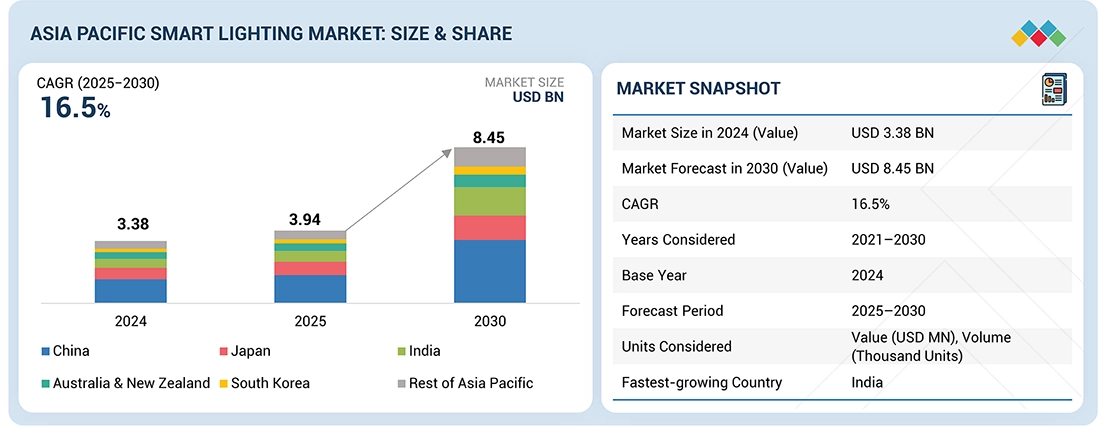
Source: Secondary Research, Interviews with Experts, MarketsandMarkets Analysis
The Asia Pacific smart lighting market is projected to reach USD 8.45 billion by 2030, up from USD 3.94 billion in 2025, at a CAGR of 16.5% from 2025 to 2030. This growth is driven by large-scale urban development, expanding smart-city programs, and the acceleration of LED-to-IoT lighting transitions across the region. The rising adoption of intelligent lighting solutions in commercial buildings, industrial facilities, residential complexes, and municipal infrastructure is strengthening overall market demand. Government-backed energy-efficiency policies, carbon-reduction targets, and nationwide LED modernization initiatives are further supporting expansion.
Market Size & Forecast
KEY TAKEAWAYS
-
By CountryBy country, China is expected to dominate the market with a share of 38.7% in 2025.
-
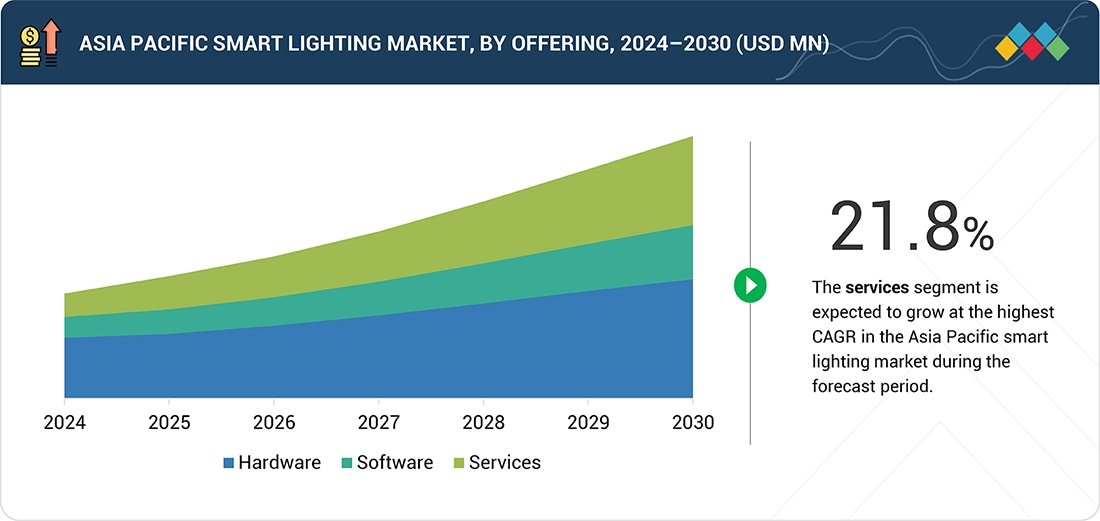
By OfferingBy offering, the services segment is expected to be the fastest-growing during the forecast period
-
By Installation TypeBy installation type, the retrofit installation segment is projected to grow at a CAGR of 27.3% from 2025 to 2030.
-
By End-use ApplicationBy end-use application, the outdoor segment is expected to grow at the highest CAGR of 19.0% during the forecast period.
-
Competitive LandscapeSignify Holdings, LEDVANCE, and Panasonic Corporation were identified as some of the star players in the Asia Pacific smart lighting market, given their strong market share and product footprint.
-
Competitive LandscapeStartups and emerging companies like Xiaomi, Tuya Smart, and Lumos Controls have established strong positions in niche segments of the smart lighting market in the Asia Pacific.
The Asia Pacific smart lighting market is experiencing rapid demand growth, driven by large-scale smart city deployments, stringent energy efficiency policies, and accelerated digital transformation across commercial, residential, and municipal infrastructure. The adoption of connected luminaires, wireless controls, PoE-based systems, and sensor-enabled lighting is increasing as organizations prioritize energy savings and sustainability targets. The expansion of smart building construction, coupled with the modernization of airports, retail centers, industrial parks, and transport hubs, is driving the shift from conventional lighting to intelligent, IoT-enabled lighting networks across the region.
TRENDS & DISRUPTIONS IMPACTING CUSTOMERS' CUSTOMERS
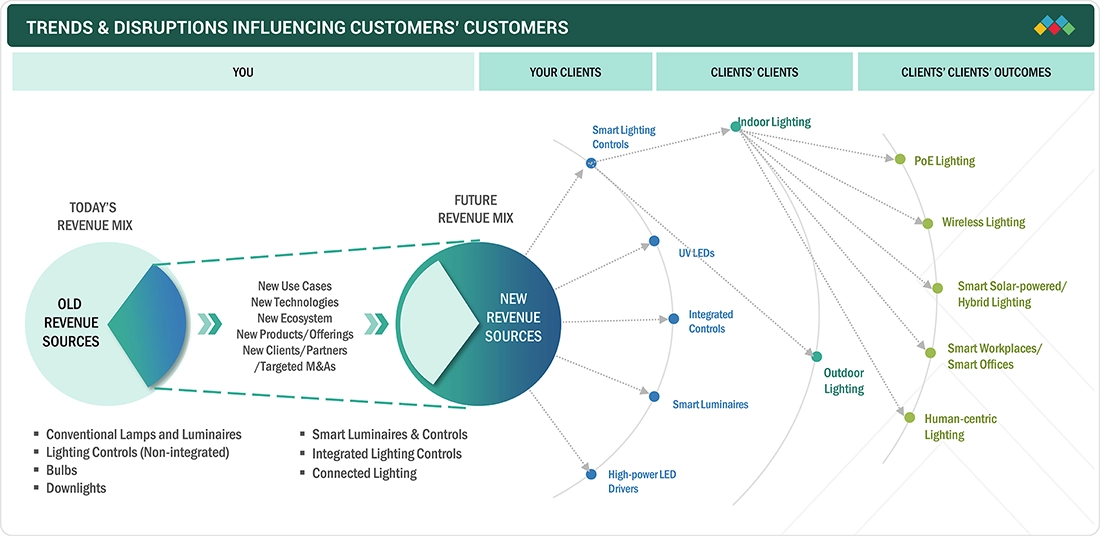
The Asia Pacific smart lighting market is rapidly shifting from conventional LED solutions to fully connected, sensor-driven lighting systems integrated with IoT, cloud analytics, and AI-based controls. Strong government-led energy-efficiency mandates, nationwide LED modernization programs, and large-scale smart-city initiatives across China, India, Japan, South Korea, and other countries in Southeast Asia are accelerating the adoption of energy-efficient solutions across commercial, residential, and public infrastructure. End users are increasingly demanding smart lighting that supports real-time analytics, occupancy-based automation, predictive maintenance, and human-centric illumination, rather than basic lighting functions. Vendors across Asia Pacific are responding with PoE-enabled networks, wireless and Matter-compatible ecosystems, UV-C and tunable lighting innovations, cloud-based management platforms, and open-protocol control systems. This evolution is transforming revenue models from product-centric to solution- and data-centric offerings, unlocking new value streams in smart luminaires, integrated controls, connected lighting, and next-generation workplace and city infrastructure.
Source: Secondary Research, Interviews with Experts, MarketsandMarkets Analysis
MARKET DYNAMICS

Level
-
Rapid Urbanization Fueling Smart Infrastructure Demand

-
Strong Government Policies Supporting Energy Efficiency


Level
-
High Upfront Deployment and Integration Costs

-
Limited Technical Expertise and System Awareness


Level
-
Smart Cities and Digital Infrastructure Expansion

-
Growth in IoT, AI, and Sensor-Based Lighting


Level
-
Cybersecurity Vulnerabilities in Connected Lighting Networks

Source: Secondary Research, Interviews with Experts, MarketsandMarkets Analysis
Driver: Rapid Urbanization Fueling Smart Infrastructure Demand
Asia Pacific’s large-scale urban development initiatives are accelerating the adoption of connected lighting systems across cities, commercial hubs, and transport corridors. Governments are prioritizing energy-efficient infrastructure to manage rising electricity consumption. Smart streetlighting is becoming a core component of smart-city blueprints across China, India, Japan, and ASEAN. This shift strongly boosts demand for adaptive and connected lighting solutions.
Restraint: High Upfront Deployment and Integration Costs
Despite long-term savings, initial investment for smart lighting, sensors, controllers, gateways, and network upgrades remains relatively high for many municipalities and SMEs. Budget constraints in emerging Asia Pacific markets limit the uptake of large-scale projects. Integration into legacy lighting networks further increases overall project costs. This cost barrier slows wider adoption.
Opportunity: Smart Cities and Digital Infrastructure Expansion
Governments in the Asia Pacific region are making substantial investments in smart city initiatives, with over 500 active projects in countries like China, India, Korea, and Japan. Key components of these projects include connected street lighting, adaptive roadway illumination, and data-driven lighting management systems. This trend is creating significant procurement opportunities for vendors in hardware, software, and services. The long-term outlook for these projects remains strong.
Challenge: Cybersecurity Vulnerabilities in Connected Lighting Networks
As lighting becomes part of the connected IoT ecosystem, security risks such as unauthorized access, device manipulation, and data leakage increase. Municipal and commercial buyers are cautious about deploying large-scale connected systems without strong cybersecurity frameworks. Ensuring secure data transmission, device authentication, and firmware integrity becomes essential. Vendors face pressure to improve security-by-design.
ASIA PACIFIC SMART LIGHTING MARKET: COMMERCIAL USE CASES ACROSS INDUSTRIES
| COMPANY | USE CASE DESCRIPTION | BENEFITS |
|---|---|---|
 |
Deployment of Interact City and Interact Pro smart-lighting systems across major Asia Pacific smart-city programs, including adaptive streetlighting, sensor-based controls, and centralized management platforms. | 25–50% reduction in municipal lighting energy use, enhanced public safety through adaptive illumination, lowered maintenance via predictive diagnostics, and strong compliance with Asia Pacific sustainability mandates. |
 |
Installation of connected LED luminaires and smart-building lighting systems in commercial complexes, airports, and transport hubs across Japan and Southeast Asia, leveraging IoT sensors and centralized control systems. | Up to 40% decrease in operational energy costs, improved occupant comfort, automated daylight-based dimming, and seamless integration with building management systems widely used across the Asia Pacific. |
 |
Smart LED modules and lighting-control solutions installed in South Korea’s commercial buildings and tech parks, incorporating AI-driven tuning and IoT-based facility insights. | Improved workplace productivity through human-centric lighting, meaningful reductions in facility energy consumption, and enhanced asset visibility through integrated IoT dashboards. |
 |
Deployment of IoT-enabled smart office and smart-industrial lighting systems in India and ASEAN markets, using sensors, connected fixtures, and energy analytics dashboards for real-time monitoring. | 20–45% energy savings, optimized workspace utilization, reduced downtime through predictive maintenance, and improved compliance with India’s energy-efficiency norms. |
Logos and trademarks shown above are the property of their respective owners. Their use here is for informational and illustrative purposes only.
MARKET ECOSYSTEM
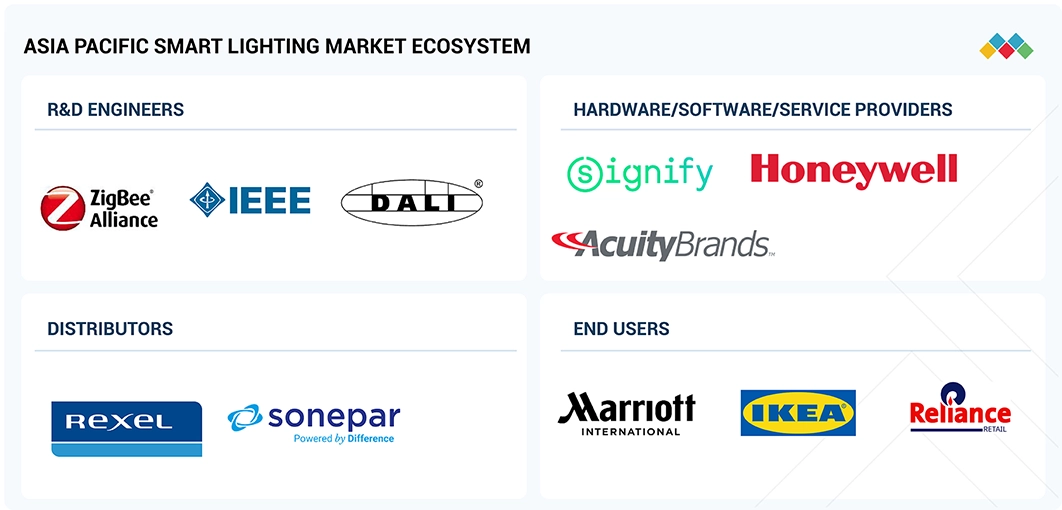
The Asia Pacific smart lighting ecosystem is driven by strong collaboration among standards bodies, solution providers, distributors, and major end users. Organizations such as the Zigbee Alliance, IEEE, and the DALI Alliance facilitate interoperability and certification across rapidly growing Asia Pacific deployments. Leading vendors, including Signify, Honeywell, and Acuity Brands, support the region with smart luminaires, wireless controls, and IoT-based lighting platforms. Distributors like Rexel and Sonepar expand market reach by supplying integrated solutions to contractors and developers. Large adopters such as Marriott, IKEA, and Reliance Retail are accelerating demand through smart-building upgrades and widespread retail modernization across the Asia Pacific.
Logos and trademarks shown above are the property of their respective owners. Their use here is for informational and illustrative purposes only.
MARKET SEGMENTS
Source: Secondary Research, Interviews with Experts, MarketsandMarkets Analysis
Asia Pacific Smart Lighting Market, by Offering
As of 2024, hardware accounts for the largest revenue share in the Asia Pacific smart lighting market, driven by massive deployments of connected LED luminaires, sensors, and IoT-enabled fixtures across commercial buildings, industrial parks, transportation hubs, and smart-city corridors. Government-led energy-efficiency programs in China, India, Japan, and Australia, combined with carbon-reduction mandates and city-wide LED modernization schemes, are accelerating the replacement of legacy fixtures.
Asia Pacific Smart Lighting Market, by Installation Type
Retrofit installations are projected to experience the fastest growth in the Asia Pacific as enterprises, retail chains, logistics operators, airports, and municipal bodies increasingly upgrade existing lighting infrastructures to connected systems. National policies promoting energy savings, green building certifications, and smart city frameworks are accelerating the adoption of retrofits. Airports, metro stations, manufacturing units, and commercial towers across the Asia Pacific are modernizing outdated fixtures with intelligent lighting to enable faster deployment without major structural redesign. As a result, retrofits are emerging as the most scalable and rapidly expanding installation pathway across the region.
Asia Pacific Smart Lighting Market, by Communication Technology
In 2024, wired communication holds a significant share of the Asia Pacific smart lighting market, supported by ongoing adoption of DALI-2, 0–10V, KNX, and BACnet-based control systems within commercial and institutional buildings. High deployment across hospitals, government facilities, airports, universities, and premium commercial towers reinforces wired connectivity as a reliable and standardized option. However, rapid construction of smart buildings and residential IoT ecosystems is also driving strong momentum for wireless technologies. While wired approaches remain dominant in mission-critical environments, wireless technologies are gaining share due to lower installation complexity and growing demand for automation in new-age buildings.
Asia Pacific Smart Lighting Market, by Distribution Channel
The online distribution channel is expected to record the fastest growth in the Asia Pacific smart lighting market as consumers and businesses increasingly shift toward e-commerce platforms for connected lighting devices, sensors, automation kits, and smart-home bundles. Leading manufacturers and regional distributors are expanding digital-first sales models, enabling both direct-to-consumer and B2B procurement. The rising preference for remote ordering, transparent comparison tools, and integrated product ecosystems is driving the growth of online channels across the Asia Pacific.
Asia Pacific Smart Lighting Market, by End-use Application
Indoor applications held the largest share of the Asia Pacific smart lighting market in 2024, driven by extensive adoption across corporate offices, technology parks, manufacturing units, educational campuses, healthcare facilities, hyperscale data centers, hospitality spaces, retail stores, and logistics hubs. Organizations in the Asia Pacific are prioritizing connected LED luminaires and automation systems to reduce energy consumption, enhance occupant comfort, comply with ESG and green-building mandates, and improve operational intelligence through sensor-driven analytics. Human-centric lighting, adaptive illumination, and occupancy-based automation are becoming essential features in modern commercial interiors, particularly in WELL-certified, LEED-certified, and energy-efficient buildings across the region.
REGION
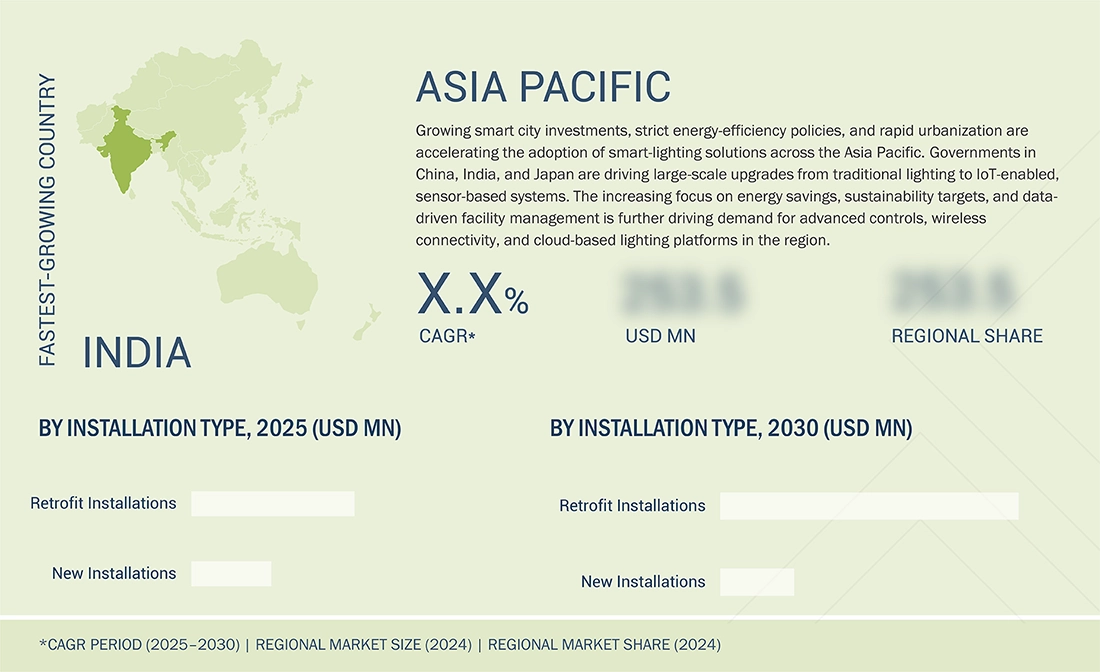
India to be the fastest-growing country in the Asia Pacific smart lighting market during the forecast period
India is the fastest-growing smart lighting market in the Asia Pacific, driven by strong government initiatives, including the Smart Cities Mission and nationwide LED modernization programs, as well as increasing adoption of green buildings. Rapid upgrades across IT parks, commercial offices, airports, metros, and municipal infrastructure are accelerating demand for connected luminaires and IoT-based controls. Growing investments in digital infrastructure, increasing ESG commitments, and expanding smart-home adoption further strengthen India’s momentum in the regional smart lighting landscape.
ASIA PACIFIC SMART LIGHTING MARKET: COMPANY EVALUATION MATRIX
In the Asia Pacific smart lighting market, Signify and LEDVANCE lead (Star) with strong regional reach and comprehensive connected-lighting portfolios that support large-scale deployments across commercial, residential, and municipal sectors. Both companies drive market advancement through innovations in smart luminaires, IoT-based controls, and cloud-enabled lighting platforms. Their robust channel networks and participation in major Asia Pacific modernization programs reinforce their leadership position in the region.
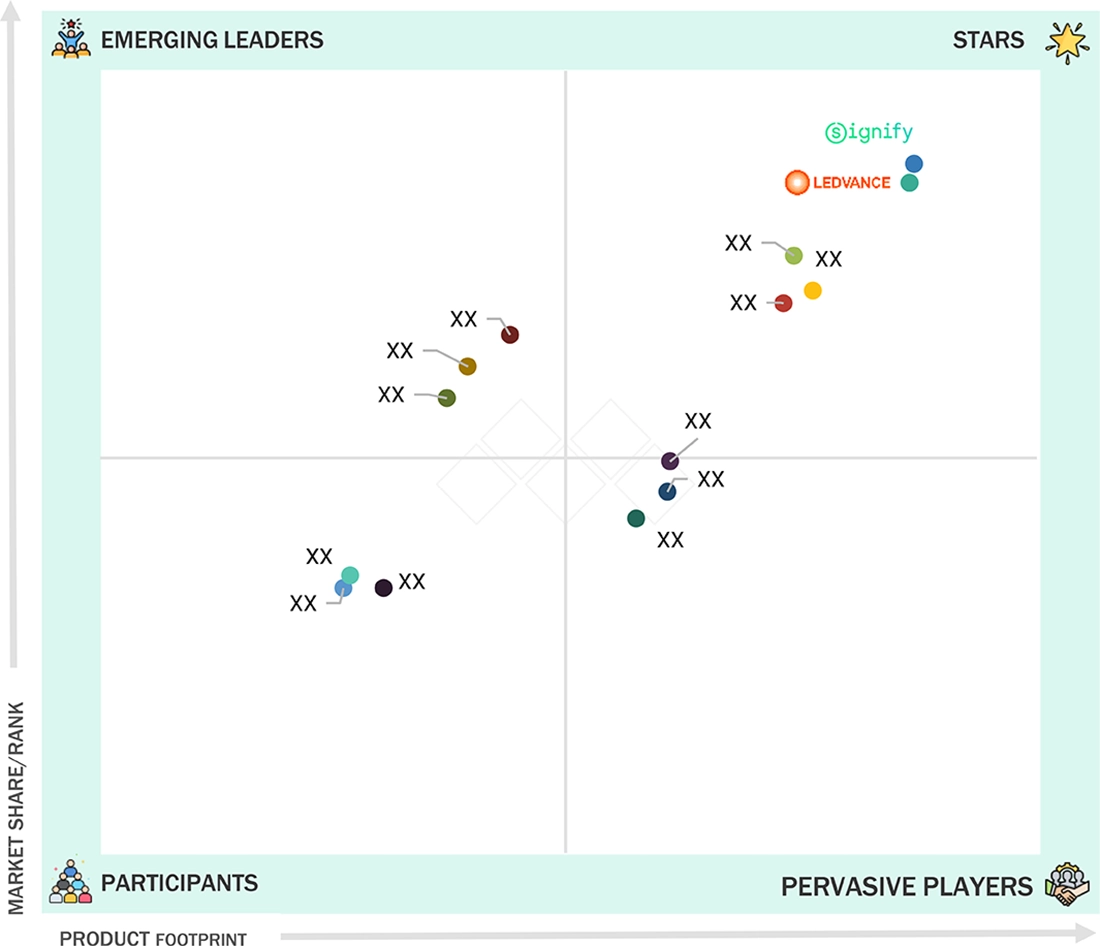
Source: Secondary Research, Interviews with Experts, MarketsandMarkets Analysis
KEY MARKET PLAYERS
- Signify Holding
- LEDVANCE GmbH
- Panasonic Corporation
- Samsung
- Xiaomi
- TP-Link Systems Inc.
- Acuity Inc.
- Wipro Lighting
- Syska
- Havells India Ltd.
- Eaton
- LIFX
- Legrand
- Schneider Electric
- Honeywell International Inc.
MARKET SCOPE
| REPORT METRIC | DETAILS |
|---|---|
| Market Size in 2024 (Value) | USD 3.38 Billion |
| Market Forecast in 2030 (Value) | USD 8.45 Billion |
| Growth Rate | CAGR of 16.5% from 2025–2030 |
| Years Considered | 2021–2030 |
| Base Year | 2024 |
| Forecast Period | 2025–2030 |
| Units Considered | Value (USD Million), Volume (Thousand Units) |
| Report Coverage | Revenue Forecast, Company Ranking, Competitive Landscape, Growth Factors, and Trends |
| Segments Covered |
|
| Countries Covered | China, Japan, India, South Korea, Australia & New Zealand, and Rest of Asia Pacific |
WHAT IS IN IT FOR YOU: ASIA PACIFIC SMART LIGHTING MARKET REPORT CONTENT GUIDE
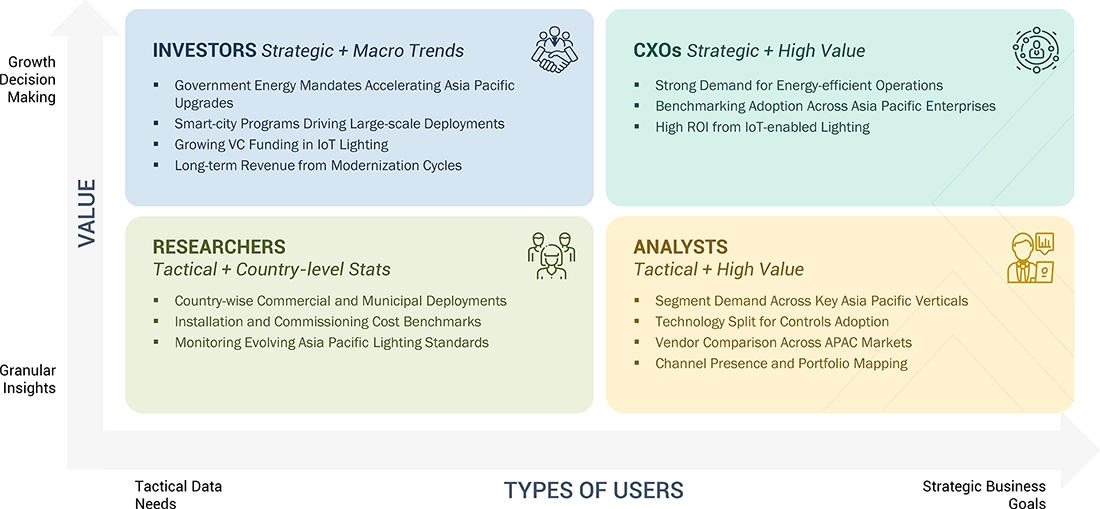
DELIVERED CUSTOMIZATIONS
We have successfully delivered the following deep-dive customizations:
| CLIENT REQUEST | CUSTOMIZATION DELIVERED | VALUE ADDS |
|---|---|---|
| Leading Asia Pacific Smart Lighting OEM |
|
|
| Retail & Hospitality Chain Operator |
|
|
| Asia Pacific Smart Lighting Manufacturer |
|
|
RECENT DEVELOPMENTS
- September 2025 : Signify has launched a new range of modular, connected solar street lights and advanced sports lighting solutions as part of its professional lighting lineup. These products are designed for urban infrastructure projects in the Asia Pacific region, smart city street lighting upgrades, and large outdoor venues. This initiative reinforces Signify's commitment to supporting the Asia Pacific's goal of achieving sustainable and energy-efficient public lighting.
- May 2025 : Panasonic Lighting launched its next-generation Wi-Fi/Matter-compatible indoor smart-lighting range for Asia Pacific markets, targeting residential and mixed-use buildings with improved energy automation and human-centric lighting controls optimized for regional climatic conditions.
- March 2025 : Signify introduced an expanded Interact City 2.0 smart-lighting suite across India, Japan, and Southeast Asia, featuring AI-based traffic-adaptive streetlighting and real-time maintenance analytics to support large-scale smart-city modernization programs.
Table of Contents
 Exclusive indicates content/data unique to MarketsandMarkets and not available with any competitors.
Methodology
The research study involved 4 major activities in estimating the size of the Asia Pacific smart lighting market. Exhaustive secondary research has been done to collect important information about the market and peer markets. The validation of these findings, assumptions, and sizing with the help of primary research with industry experts across the supply chain has been the next step. Both top-down and bottom-up approaches have been used to estimate the market size. Post which the market breakdown and data triangulation have been adopted to estimate the market sizes of segments and sub-segments.
Secondary Research
In the secondary research process, various secondary sources have been referred to for identifying and collecting information required for this study. The secondary sources include annual reports, press releases, investor presentations of companies, white papers, and articles from recognized authors. Secondary research has been mainly done to obtain key information about the market’s value chain, the pool of key market players, market segmentation according to industry trends, regional outlook, and developments from both market and technology perspectives.
Primary Research
In primary research, various primary sources from both supply and demand sides have been interviewed to obtain qualitative and quantitative insights required for this report. Primary sources from the supply side include experts such as CEOs, vice presidents, marketing directors, manufacturers, technology and innovation directors, end users, and related executives from multiple key companies and organizations operating in the Asia Pacific smart lighting market ecosystem. After interacting with industry experts, brief sessions were conducted with highly experienced independent consultants to reinforce the findings from our primary. This, along with the in-house subject matter experts’ opinions, has led us to the findings as described in the remainder of this report. The breakdown of primary respondents is as follows:
Market Size Estimation
The bottom-up procedure has been employed to arrive at the overall size of the Asia Pacific smart lighting market.
- Identification of major companies providing smart lighting hardware, software, and services
- Identification of key segments within the Asia Pacific smart lighting market
- Estimation of the Asia Pacific market size by analyzing the adoption of smart lighting solutions across different industries
- Determination of market share estimates for deployments in different end-use application segments by assessing the demand for smart lighting products and solutions
- Tracking ongoing and upcoming developments in smart lighting products
- Compilation of regional market size data for each segment to derive regional market estimates
- Conducting interviews with multiple key leaders to comprehend the Asia Pacific smart lighting market scope, product demand, future market growth, and potential impact of economic downturns
- Verification and validation of estimates through cross-checking with primary sources, discussions with leaders, and consultation with domain experts at MarketsandMarkets
- Analysis of various paid and unpaid information sources, including annual reports, press releases, white papers, and databases
The top-down approach has been used to estimate and validate the total size of the Asia Pacific smart lighting market.
- Focusing, initially, on the top-line investments and spending in the ecosystems of various industries. Tracking further splits based on product launches, advancements in smart lighting technologies, smart lighting solutions and software used for various industrial applications, and developments in the key market areas
- Representing and developing the information related to market revenue offered by key hardware, software, and service providers
- Carrying out multiple on-field discussions with key opinion leaders across each major company involved in the development of hardware and software components and services pertaining to smart lighting
- Estimating the geographic split using secondary sources based on factors such as the number of players in a specific country and region, types of products, levels of services offered, and types of software implemented.
Data Triangulation
After arriving at the overall market size—using the market size estimation processes as explained above—the market has been split into several segments and subsegments. To complete the entire market engineering process and arrive at the exact statistics of each market segment and subsegment, data triangulation and market breakdown procedures have been employed, wherever applicable. The data has been triangulated by studying various factors and trends from the demand and supply sides of the Asia Pacific smart lighting market.
Market Definition
Smart lighting systems combine automation technologies with connectivity features and intelligent control aspects to deliver enhanced efficiency and improved experience paired with convenience. The system contains LED luminaires, sensors, and wire-based or wireless communication systems to allow remote monitoring and scheduling adjustments based on occupancy status, daylight exposure, and user settings. Users can operate smart lighting systems through mobile applications, voice commands, and centralized automation networks which enable full control of brightness adjustments, color temperature settings, and hue transformation features. These devices play an essential role in residential, commercial, and industrial sectors, helping to reduce energy consumption while aiding sustainability efforts.
Key Stakeholders
- Raw material and component suppliers
- Communication network providers
- Smart lighting device manufacturers
- Original equipment manufacturers
- Semiconductor component suppliers
- Analysts and strategic business planners
- Venture capitalists and start-ups
- Research laboratories and intellectual property (IP) companies
- Technology standards organizations, forums, alliances, and associations
- Hardware vendors
- Software integrators
- Smart lighting solutions-related service providers
- End users
- Government bodies such as regulatory authorities and policymakers
Report Objectives
- To define, estimate, and forecast the Asia Pacific smart lighting market based on hardware, software, and services offerings, wired and wireless communication technologies, indoor and outdoor applications, online and offline sales distribution channels, and new and retrofit installation types
- To describe and forecast the Asia Pacific smart lighting market size, in terms of volume, by hardware offering
- To provide detailed insights regarding drivers, restraints, opportunities, and challenges influencing the growth of the market
- To analyse emerging applications and standards in the Asia Pacific smart lighting market
- To examine manufacturers of smart lighting products, their strategies, production plans, and the overall supply chain, including material and component suppliers in the Asia Pacific market
- To strategically analyse the micromarkets with respect to individual growth trends, prospects, and contributions to the overall market
- To analyse the market opportunities for stakeholders, and provide a comprehensive competitive landscape analysis
- To provide a detailed overview of the Asia Pacific smart lighting value chain and ecosystem
- To provide a detailed overview of impact of AI/Gen AI on Asia Pacific smart lighting market
- To provide information about the key technology trends, trade analysis, and patents related to the Asia Pacific smart lighting market
- To benchmark the market players using the proprietary company evaluation matrix framework, which analyses them on various parameters within the broad categories of market ranking/share and product portfolio
- To analyse competitive developments, such as partnership, acquisitions, agreements, collaborations, and product launches
- To strategically profile key players and analyse their market share, ranking, and core competencies
This research report categorizes the Asia Pacific smart lighting market based on offering, communication technology, installation type, distribution channel, end-use application, and region.
Available Customizations
With the given market data, MarketsandMarkets offers customizations according to the specific requirements of companies. The following customization options are available for the report:
- Detailed analysis and profiling of additional market players based on various blocks of the supply chain
Key Questions Addressed by the Report
What is the projected value of the Asia Pacific smart lighting market?
The Asia Pacific smart lighting market is projected to reach USD 8.45 billion by 2030 from USD 3.94 billion in 2025, growing at a CAGR of 16.5%.
Which country dominates the Asia Pacific smart lighting market?
China dominates the Asia Pacific smart lighting market, accounting for approximately 38.7% share in 2025.
Which segment leads the Asia Pacific smart lighting market by offering?
The hardware segment holds the largest share in the Asia Pacific smart lighting market due to widespread deployment of connected LED luminaires and smart lighting components.
Which segment is expected to grow the fastest in the market?
The services segment is expected to grow at the highest CAGR, driven by increasing demand for smart lighting integration and maintenance solutions.
Who are the key players in the Asia Pacific smart lighting market?
Key players include Signify Holding, LEDVANCE GmbH, Panasonic Corporation, Samsung, Xiaomi, Honeywell International Inc., Schneider Electric, and Acuity Brands.


Personalize This Research
- Triangulate with your Own Data
- Get Data as per your Format and Definition
- Gain a Deeper Dive on a Specific Application, Geography, Customer or Competitor
- Any level of Personalization
Let Us Help You
- What are the Known and Unknown Adjacencies Impacting the Asia Pacific Smart Lighting Market
- What will your New Revenue Sources be?
- Who will be your Top Customer; what will make them switch?
- Defend your Market Share or Win Competitors
- Get a Scorecard for Target Partners

Custom Market Research Services
We Will Customise The Research For You, In Case The Report Listed Above Does Not Meet With Your Requirements
Get 10% Free CustomisationTESTIMONIALS

We at Nissan Chemicals Corporation have been clients of MarketsandMarkets for more than a year now. We recently consulted MarketsandMarkets for a study, the team at MarketsandMarkets was extremely professional and organized. The business insights were very detailed and aligned well with our expectations that really helped us formulate the Business Plans and device new strategies for development themes. MarketsandMarkets offers a unique combination of expertise and dedicated engagement model. Their research findings have helped us in designing our Pricing Strategy which will make it easier for us to predict the future sales and profits for the next ten years. We look forward to working with MarketsandMarkets in the future.
VP of Strategy & New Business Development
Leading Specialty Chemical Company
The MarketsandMarkets Engagement Model, composed of both the Knowledge Store and advisory custom research, has greatly helped us in understanding our markets and making strategic decisions. The Knowledge Store is a fast way to allow everyone in our organization to understand more about most any market they are interested in. The ability to then get custom research done and get answers to specific strategic questions and market insight has been spectacular. The Markets and Markets team feel more like colleagues than vendors and their services have helped us change our culture where statements of things like growth opportunities and competitive position are always backed by industry research.

Rich Gibson,
Director, Corporate Strategy
Milliken & Company,
Leading Industrial Manufacturer of specialty chemical, floor covering, performance and protective textile materials, and healthcaremilliken.com
MarketsandMarkets is a trusted resource that helps us to better understand markets that are near-adjacencies-whether its technology, value chain or geography. Their Knowledge Store platform provides a dashboard of markets and their characteristics which is easy to use and saves us time.
Adam Shaw,
Market Development and Strategy Manager
AdvanSix Inc. USA,
An American Leader in Chemicalswww.advansix.com
The Knowledge Store from MarketsandMarkets is a valuable tool which has helped my team acquire greater insight in to the end markets that our business serves. This has enabled us to help our company build stronger strategies throughout our planning process.
TOSHIO KINOSHITA
Senior Chif Consultion Research & Consulting Division
Mitsubishi Chemical Research Corporation,
Leading Manufacturer of Chemical Productswww.mitsubishichem-res.co.jp/en/

We recently engaged with MarketsandMarkets for a study, the team not only clearly understood our business objectives but was also extremely professional in the way they handled the entire project. The study was efficiently conducted in a phase-wise manner, and the engagement model furnished us with high-quality business insights that far exceeded our expectations at each phase. We were especially happy that MarketsandMarkets could provide us with both, an English as well as a Japanese version of the study. A special thanks to the Analyst Team and Client Services Team, whose fluency in Japanese enhanced our comfort level, as we could converse with them in our preferred language.
Independent entrepreneurs
Arrow Precision
We approached MarketsandMarkets for study on Proppants Market, and their work exceeded our expectations. The study conducted was comprehensive and enabled us to view the market through the various dimensions. In addition, the team was extraordinarily responsive throughout the process and resolved our queries on time. I strongly recommend MarketsandMarkets and will certainly consider them for additional market assessments we will need in the future.
Global engineering company, Japan
Deputy Manager,
Strategic Planning OfficeThe high-quality insights shared by the MarketsandMarkets team helped us understand the pharmaceutical plant designers in a specific geography. It also captured the risks that we may likely face in communicating with our potential partners. The study would enable us identify partners, which would impact our future growth.






Growth opportunities and latent adjacency in Asia Pacific Smart Lighting Market