Automotive Lithium-Ion Battery Recycling Market

Automotive Lithium-Ion Battery Recycling Market by Source (Automotive, Non-Automotive), Battery Chemistry (LFP, NMC, LMO, NCA, LTO), Battery Component, Recycling Process (Hydrometallurgy, Pyrometallurgy, Physical/Mechanical) and Region - Forecast to 2032




OVERVIEW
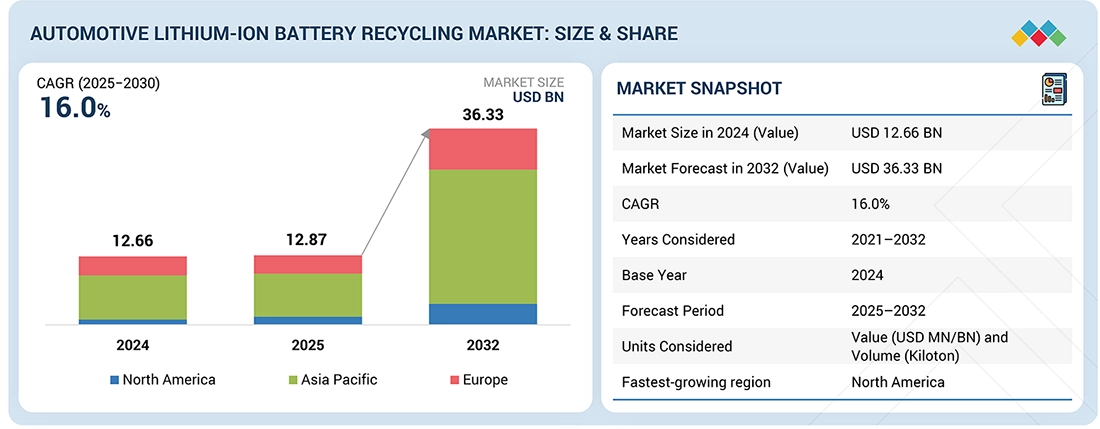
Source: Secondary Research, Interviews with Experts, MarketsandMarkets Analysis
The automotive lithium-ion battery recycling market is projected to grow from USD 12.87 billion in 2025 to USD 36.33 billion by 2032, at a CAGR of 16.0% during the forecasted period. The market for recycling automotive lithium-ion batteries is witnessing tremendous growth, primarily driven by the rapid adoption of electric vehicles and the resulting increase in battery waste. Manufacturers of automobiles and batteries are getting together to source recycled materials. Government incentives, strict environmental regulations, and policies for extended producer responsibility are all driving the adoption of closed-loop recycling and sustainable battery lifecycle management. Moreover, the environmental commitments of original equipment manufacturers (OEMs) to the non-carbon route across the value chain, along with the technological advancements in hydrometallurgical and direct recycling processes that not only increase recovery but also reduce costs, are all contributing to the growth of the market.
KEY TAKEAWAYS
-
BY REGIONAsia Pacific is estimated to account for the largest share of the automotive lithium-ion recycling market during the forecast period.
-
BY RECYCLING PROCESSBy recycling method, hydrometallurgy is expected to fastest-growing segment during the forecast period.
-
BY BATTERY COMPONENTBy battery component, the cathode active materials segment is expected to be the fastest-growing segment during the forecast period.
-
BY BATTERY CHEMISTRYBy battery chemistry, the lithium nickel cobalt aluminum oxide segment is projected to register the highest growth in the automotive lithium-ion battery recycling market, with a CAGR of 20.1% during the forecast period.
-
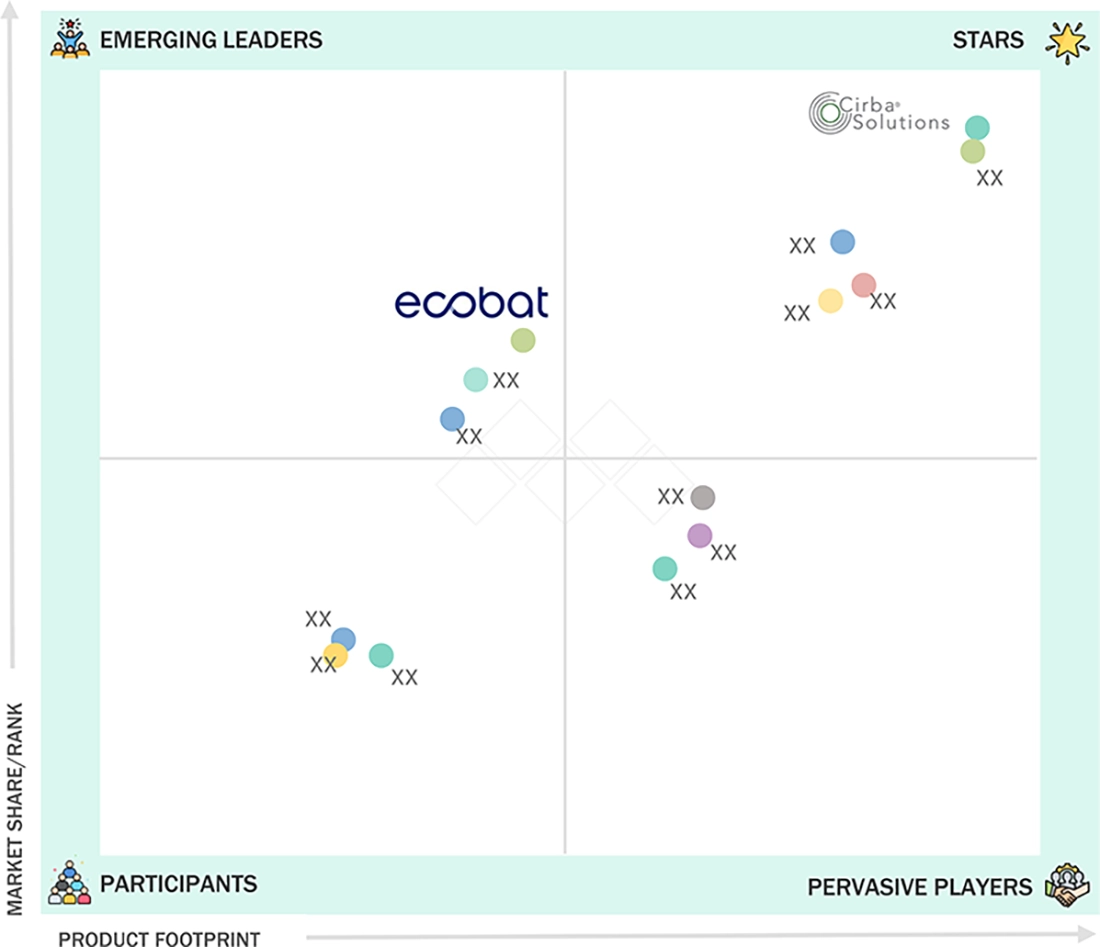
Competitive Landscape - Key PlayersContemporary Amperex Technology Co., Ltd., Umicore, and Glencore were identified as some of the star players in the automotive lithium-ion battery recycling market, given their strong market share and product footprint.
-
Competitive Landscape - StartupsEnvirostream Australia Pty Ltd., Lithion Recycling, and Battery Recycling Made Easy, among others, have distinguished themselves as startups and SMEs by securing strong footholds in specialized niche areas, underscoring their potential as emerging market leaders.
The market for recycling lithium-ion batteries used in electric vehicles is witnessing significant growth as the world transitions towards electric mobility, and a considerable number of EV batteries are reaching the end of their useful life. The increasing concern regarding the availability, price, and geopolitical distribution of essential battery minerals is driving the adoption of recycled materials to bolster the security of supply chains. Additionally, regulations concerning the collection, recycling, and compliance with environmental standards are making it mandatory for stakeholders to invest in recycling infrastructure. Meanwhile, technological advancements in recycling, increasing cooperation between car manufacturers and recyclers, and a rising focus on the circular economy are making battery recycling commercially viable.
TRENDS & DISRUPTIONS IMPACTING CUSTOMERS' CUSTOMERS
The primary factors influencing the automotive lithium-ion battery recycling market are the rapid electrification of vehicles (EVs), stricter regulations, and advancements in recycling technology. The strong support of governments in the form of EU recycled-content mandates, US localization incentives, China's traceability rules, and India's emphasis on reducing mineral imports is boosting investment and setting up capacity ahead of the sharp rise in end-of-life EV batteries post-2032. Technological advancements are shifting the market from traditional pyrometallurgy to the use of advanced hydrometallurgical and direct-recycling methods, which offer higher recovery rates, lower emissions, and improved economics. At the same time, automation, digital tools, and battery passports are enhancing efficiency, traceability, and ESG compliance.
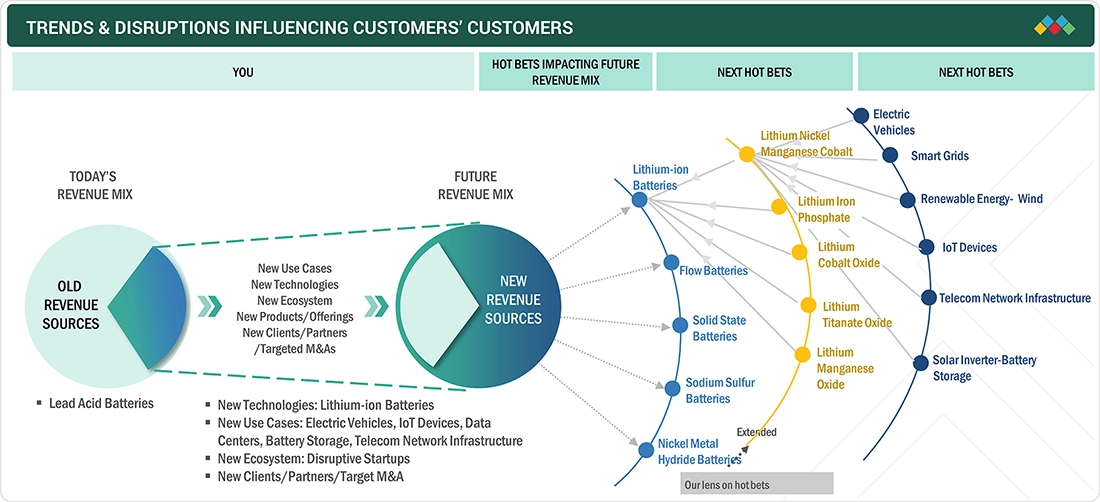
Source: Secondary Research, Interviews with Experts, MarketsandMarkets Analysis
MARKET DYNAMICS

Level
-
Rapid increase in electric vehicle (EV) adoption worldwide

-
Growing volumes of end-of-life EV batteries


Level
-
High capital costs for recycling plants and technology deployment

-
Complex battery collection, transportation, and storage logistics


Level
-
Closed-loop recycling partnerships between OEMs, recyclers, and battery makers

-
Growth of localized recycling facilities near EV and battery manufacturing hubs


Level
-
Safety risks in handling and processing high-voltage batteries

-
Commercial scale-up of advanced and direct recycling technologies

Source: Secondary Research, Interviews with Experts, MarketsandMarkets Analysis
Driver: Rapid increase in electric vehicle (EV) adoption worldwide
The widespread use of electric vehicles (EVs) has increased the number of batteries in the automotive lithium-ion battery recycling market, as it directly pushes the installed base of lithium-ion batteries. Global EV sales have been posting double-digit growth rates, and this has led to a significant increase in the number of high-capacity traction batteries produced. Consequently, the age, deterioration, or replacement of these batteries entails a significant increase in the number of spent EV packs that need to be disposed of in a safe and compliant manner, thus providing a large and steady source of material for recycling. Moreover, the presence of more EVs in the market stimulates the need for critical battery materials like lithium, nickel, cobalt, and manganese. This, in turn, enables automakers and battery manufacturers to recycle these materials back into the manufacturing process as an environmental stewardship measure.
Restraint: High capital costs for recycling plants and technology deployment
The recycling plants, along with the use of cutting-edge technology, remain the primary obstacles that the automotive lithium-ion battery recycling sector faces in the form of high capital costs. The establishment of advanced recycling facilities requires a considerable initial investment in the purchase of specialized equipment. Moreover, the capital intensity of such technology increases based on the safety systems, environmental compliance, skilled labor, and the permitting process. For many players, especially the newcomers, the long project development timelines and lack of guaranteed feedstock availability in the first years mean that the payback period is prolonged and financial risk increased. Therefore, the high capital requirements can result in a delay in capacity expansion, the emergence of new market players, and the development of new recycling technologies.
Opportunity: Closed-loop recycling partnerships between OEMs, recyclers, and battery makers
The automotive industry is an example of a recycling process that does not require much collaboration among original equipment manufacturers (OEMs), battery manufacturers, and recycling companies, due to the closed-loop recycling system, which significantly reduces the need for these partners to coordinate their activities. This process ensures a constant and recyclable material flow from used batteries to electric vehicle (EV) production. OEMs through long-term offtake commitments, joint ventures, and other strategic collaborations not only secure a source of recycled lithium, nickel, cobalt, and manganese, but also manage their costs by reducing their interaction with the raw-material markets that often experience price fluctuations. Recyclers, in turn, are assured of a certain volume of feedstock and a corresponding amount of revenue, which together make their projects more attractive to banks. Manufacturers of batteries are provided with a consistent supply of lower-carbon raw materials, which not only help them meet their sustainability goals but also assist in compliance with regulations. Hence, the closed-loop models not only enhance supply-chain resilience but also lower lifecycle emissions, making large-scale automotive lithium-ion battery recycling more economically viable.
Challenge: Safety risks in handling and processing high-voltage batteries
The management of safety risks associated with the handling and processing of high-voltage batteries is one of the most significant challenges for the automotive lithium-ion battery recycling market. The batteries of electric vehicles (EVs) can still have a considerable amount of charge left, and their condition may vary from being damaged to degraded or even thermally unstable, which consequently increases the likelihood of incidents such as electric shock, short circuit, thermal runaway, and fire occurring during the entire chain of activities from collection, transportation, and dismantling to processing. The wide array of battery pack configurations and chemistries has made the safe disassembly process not only more complicated but also more reliant on human intervention in difficult cases. As a result, the recyclers need to invest more money in specialized discharge systems, fire suppression infrastructures, trained workers, and very strict security protocols. This, on the other hand, increases the operational costs and decreases the throughput for recyclers. Solving these safety problems is necessary for the growth of the recycling industry, but the sector still faces a major operational and economic challenge.
AUTOMOTIVE LITHIUM-ION BATTERY RECYCLING MARKET: COMMERCIAL USE CASES ACROSS INDUSTRIES
| COMPANY | USE CASE DESCRIPTION | BENEFITS |
|---|---|---|
 |
Recycles end-of-life EV batteries and manufacturing scrap to produce battery-grade lithium, nickel, and cobalt for reuse in new cells | Reduces reliance on imported raw materials, lowers material costs, and strengthens domestic supply security |
 |
Processes gigafactory scrap and EOL batteries using hydrometallurgical technology to recover critical metals | High recovery rates, lower carbon footprint, early-stage revenue from scrap before large EOL volumes |
 |
Converts recycled batteries into precursor cathode materials for EV batteries | Higher value recovery, direct reuse in battery manufacturing, reduced processing steps |
 |
Provides collection, logistics, and recycling services for EV OEMs and energy storage operators | Safe handling, regulatory compliance, lifecycle sustainability for customers |
 |
Specializes in safe discharge, dismantling, and recycling of lithium-ion batteries | Fire risk mitigation, regulatory compliance, improved recycling safety |
Logos and trademarks shown above are the property of their respective owners. Their use here is for informational and illustrative purposes only.
MARKET ECOSYSTEM
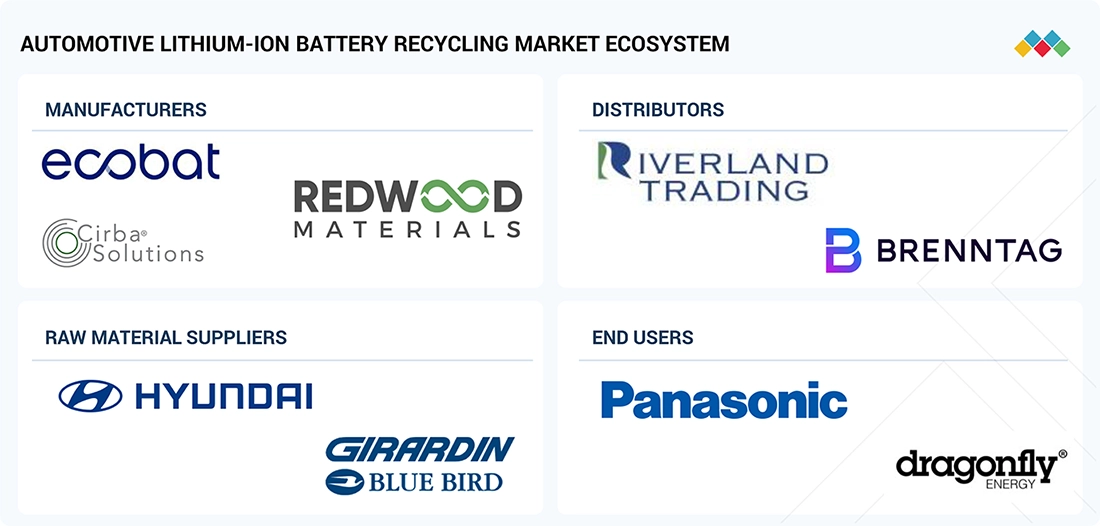
The lithium-ion battery recycling industry in the US is a circular value chain that brings together specialized recyclers, upstream suppliers, distributors, and downstream energy-storage OEMs. The main players in this ecosystem are Ecobat, Redwood Materials, and Cirba Solutions. They are the ones who take in non-functioning batteries, along with production scraps, and transform them into metals and active materials that are suitable for battery manufacturing again. Recyclers are also supplied by the large vehicle and battery manufacturers, such as Hyundai and Girardin Blue Bird, who provide the installed base of lithium-ion systems through take-back programs and end-of-life packs for electric vehicles (EVs). Midstream distributors, such as Riverland Trading and Brenntag, which are responsible for the quality, logistics, and sale of recycled plastics to chemical and battery manufacturers, ensure that these materials can be used as substitutes or complements for virgin inputs. On the demand side, OEMs like Panasonic and Dragonfly Energy, which produce recycled content, manufacture fresh cells, modules, and storage systems, and often these are backed by long-term supply or offtake agreements that give recyclers volume visibility and also work towards closing the loop in a domestic, lower-carbon battery materials supply chain.
Logos and trademarks shown above are the property of their respective owners. Their use here is for informational and illustrative purposes only.
MARKET SEGMENTS
Source: Secondary Research, Interviews with Experts, MarketsandMarkets Analysis
Automotive Lithium-Ion Battery Recycling Market, By Battery Chemistry
The NCA or lithium nickel cobalt aluminum oxide segment is projected to witness significant growth in the automotive lithium-ion battery recycling market during the forecast period. NCA batteries, due to their very high energy density coupled with the safest thermal properties, are the primary choice for luxury EV models and manufacturers focused on range. Due to the high nickel and cobalt content of the chemistry, the economic value of the end-of-life NCA batteries is significantly high. Thus, recyclers are motivated to recover the batteries. Moreover, the increasing use of advanced hydrometallurgical and direct recycling processes enhances the efficiency of obtaining high-purity valuable metals from NCA cathodes, thereby improving recycling economics.
REGION
North America is projected to witness significant growth in the market during the forecast period
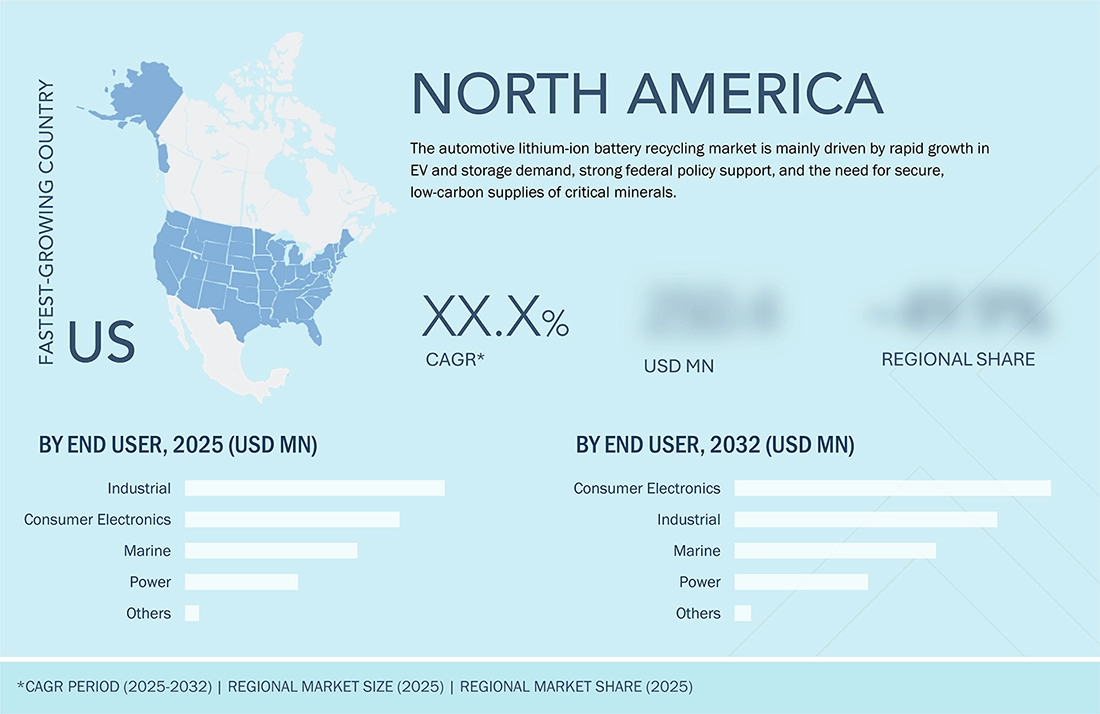
The North America automotive lithium-ion battery recycling market is expanding rapidly due to the surge in electric vehicle production and pro-local supply chain policies. Both the US and Canada are investing substantial amounts of money in electric vehicle (EV) production, mega factories, and refining battery materials; therefore, there will be a need for local recycling facilities to secure the highly sought-after minerals, such as lithium, nickel, and cobalt. Additionally, government incentives, funding programs, and new regulatory frameworks that support battery recycling and the use of recycled content are contributing to market growth. Furthermore, North American automakers are forming closed-loop partnerships with recyclers to reduce their dependency on imports of raw materials and lower lifecycle carbon emissions. The combination of growing sustainability awareness and the need for robust and secure battery supply chains is making North America the fastest-growing regional market for automotive lithium-ion battery recycling.
AUTOMOTIVE LITHIUM-ION BATTERY RECYCLING MARKET: COMPANY EVALUATION MATRIX
In the automotive lithium-ion battery recycling market matrix, Contemporary Amperex Technology Co., Ltd. (Star) leads with a strong market share and extensive product footprint, driven by its lithium battery recycling solutions, which are adopted by various end users. Envirostream Australia Pty Ltd. (Emerging Leader) demonstrates substantial product innovations compared to its competitors. While Contemporary Amperex Technology Co., Ltd. dominates through scale and diversified portfolio, Envirostream's lithium-ion battery recycling solutions show significant potential to move toward the leaders’ quadrant as demand for battery recycling continues to rise.
Source: Secondary Research, Interviews with Experts, MarketsandMarkets Analysis
KEY MARKET PLAYERS
- Contemporary Amperex Technology Co., Ltd. (China)
- Li-Cycle Corp. (Canada)
- Veolia (France)
- Umicore (Belgium)
- Glencore (Switzerland)
- Cirba Solutions (US)
- RecycLiCo Battery Materials Inc. (Canada)
- American Battery Technology Company (US)
- Accurec Recycling GmbH (Germany)
- Ecobat (US)
- Fortum (Finland)
- GEM Co., Ltd. (China)
- Aqua Metals, Inc. (US)
- Neometals Ltd. (Australia)
- Redwood Materials Inc. (US)
- Stena Recycling (Sweden)
- SK Tes (Singapore)
MARKET SCOPE
| REPORT METRIC | DETAILS |
|---|---|
| Market Size in 2024 (Value) | USD 12.66 BN |
| Market Forecast in 2032 | USD 36.33 BN |
| CAGR (2025–2032) | 16.0% |
| Years considered | 2021–2032 |
| Base Year | 2024 |
| Forecast Period | 2025–2032 |
| Units Considered | Value (USD Million/Billion) and Volume (Kiloton) |
| Report Coverage | The report defines, segments, and projects the automotive lithium-ion battery recycling market size based on recycling process, battery component, battery chemistry, and region. It strategically profiles the key players and comprehensively analyzes their market share and core competencies. It also tracks and analyzes competitive developments, such as new product development, agreements, acquisitions, and expansions that they undertake in the market. |
| Segments Covered | By Source: Industrial, Power, Marine, Consumer Electronics, and Other Sources |
| Regional Scope | North America, Asia Pacific, and Europe |
WHAT IS IN IT FOR YOU: AUTOMOTIVE LITHIUM-ION BATTERY RECYCLING MARKET REPORT CONTENT GUIDE
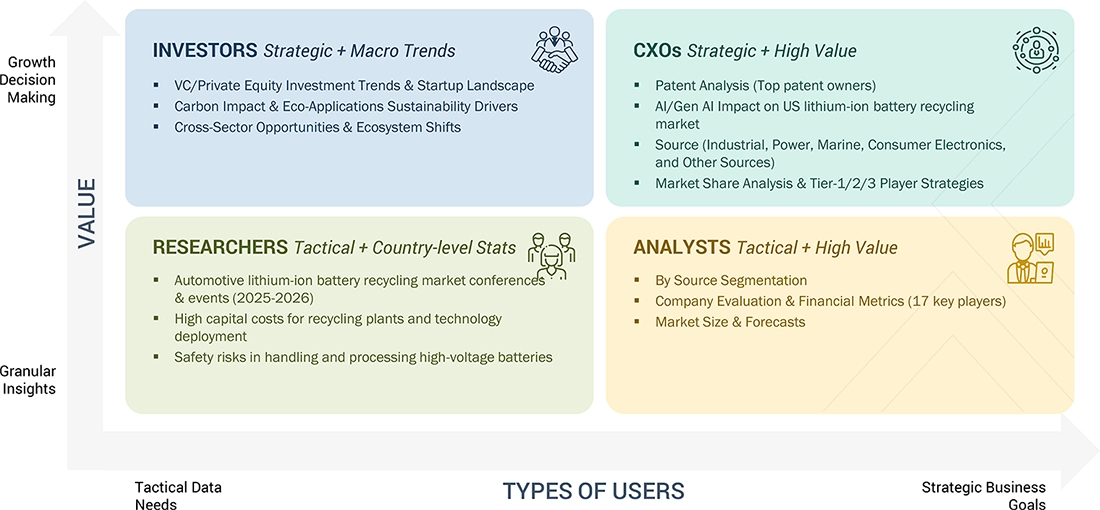
DELIVERED CUSTOMIZATIONS
We have successfully delivered the following deep-dive customizations:
| CLIENT REQUEST | CUSTOMIZATION DELIVERED | VALUE ADDS |
|---|---|---|
| EV OEMs & Automotive Tier-1 Suppliers (EV battery packs, modules, manufacturing scrap) |
|
|
| Battery Cell & Gigafactory Manufacturers (Cathode, anode, cell assembly) |
|
|
| Stationary Energy Storage Operators & Utilities (Grid-scale ESS, commercial storage) |
|
|
| Consumer Electronics Manufacturers & Retailers (Smartphones, laptops, power tools) |
|
|
| Cathode & Battery Materials Producers (CAM, precursors, refiners) |
|
|
| Logistics & Waste Management Companies |
|
|
| Government Agencies & Municipal Programs |
|
|
RECENT DEVELOPMENTS
- February 2023 : Marubeni Corporation invested USD 50 million in Cirba Solutions to expand its superior battery materials operational footprint, which supports a circular EV supply chain.
- September 2023 : American Battery Technology Company (ABTC) was among the five companies selected for competitive funding under the battery recycling portion of the 'Electric Drive Vehicle Battery Recycling and Second Life Applications' opportunity from the U.S. Department of Energy (DOE). ABTC was awarded around USD 10 million to develop and commercialize NextGen battery recycling technologies to produce low-cost and low-environmental-impact domestic battery materials.
Table of Contents
 Exclusive indicates content/data unique to MarketsandMarkets and not available with any competitors.
Methodology
The study involved four major activities in estimating the current size of the automotive lithium-ion battery recycling market. Exhaustive secondary research was done to collect information on the market, peer markets, and parent market. The next step was to validate these findings, assumptions, and sizing with the industry experts across the automotive lithium-ion battery recycling value chain through primary research. Both top-down and bottom-up approaches were employed to estimate the complete market size. Thereafter, market breakdown and data triangulation were used to estimate the market size of segments and subsegments.
Secondary Research
Secondary sources for this research study include annual reports, press releases, and investor presentations of companies; white papers; certified publications; and articles by recognized authors; gold- and silver-standard websites; automotive lithium-ion battery recycling manufacturing companies, regulatory bodies, trade directories, and databases. The secondary research was mainly used to obtain key information about the industry’s supply chain, the total pool of key players, market classification, and segmentation according to industry trends to the bottom-most level and regional markets. It has also been used to obtain information about key developments from a market-oriented perspective.
Primary Research
The automotive lithium-ion battery recycling market comprises several stakeholders, such as such as raw material suppliers, technology support providers, lithium-ion battery recyclers, and regulatory organizations in the supply chain. Various primary sources from both the supply and demand sides of the market were interviewed to obtain qualitative and quantitative information. Primary sources from the supply side included industry experts such as Chief Executive Officers (CEOs), vice presidents, marketing directors, technology and innovation directors, and related key executives from various key companies and organizations operating in the automotive lithium-ion battery recycling market. Primary sources from the demand side included directors, marketing heads, and purchase managers from various sourcing industries. Following is the breakdown of the primary respondents:
To know about the assumptions considered for the study, download the pdf brochure
Market Size Estimation
Both the top-down and bottom-up approaches have been used to estimate and validate the total size of the automotive lithium-ion battery recycling market. These approaches have also been used extensively to estimate the size of various dependent subsegments of the market. The research methodology used to estimate the market size included the following:
The following segments provide details about the overall market size estimation process employed in this study
- The key players in the market were identified through secondary research.
- The market shares in the respective regions were identified through primary and secondary research.
- The value chain and market size of the automotive lithium-ion battery recycling market, in terms of value, were determined through primary and secondary research.
- All percentage shares, splits, and breakdowns were determined using secondary sources and verified through primary sources.
- All possible parameters that affect the market covered in this research study were accounted for, viewed in extensive detail, verified through primary research, and analyzed to obtain the final quantitative and qualitative data.
- The research included the study of annual and financial reports of the top market players and interviews with industry experts, such as CEOs, VPs, directors, sales managers, and marketing executives, for key insights, both quantitative and qualitative.
Data Triangulation
After arriving at the overall market size using the market size estimation processes as explained above, the market was split into several segments and sub-segments. To complete the overall market engineering process and arrive at the exact statistics of each market segment and subsegment, the data triangulation and market breakdown procedures were employed, wherever applicable. The data was triangulated by studying various factors and trends from both the demand and supply sides in the oil & gas sector.
Market Definition
automotive lithium-ion battery recycling refers to the reuse and reprocessing of spent lithium-ion batteries to reduce their disposal as municipal solid waste or material waste. Lithium-ion batteries contain several toxic chemicals & heavy metals and disposing of them as trash has raised environmental and health concerns due to water pollution and soil contamination. automotive lithium-ion battery recycling is important not only for the recovery of valuable materials and metals but also for efficient waste management. Various types of lithium-ion batteries are available in the market, including lithium-titanate oxide (LTO), lithium-manganese oxide (LMO), lithium-iron phosphate (LFP), lithium-nickel cobalt aluminum oxide (NCA), and lithium-nickel manganese cobalt (Li-NMC). These batteries are majorly used in the automotive and non-automotive industries such as marine, power, industrial, and others. Li-ion batteries provide the required amount of power at a low cost and help reduce the weight and size of products, which are the major factors leading to the market growth. The rising demand for Li-ion batteries in electric vehicles is expected to lead to the growth of the automotive lithium-ion battery recycling market during the forecast period.
Key Stakeholders
- Raw material manufacturers
- Technology support providers
- Recyclers of Lithium-ion battery
- Traders, distributors, and suppliers
- Regulatory Bodies and Government Agencies
- Research & Development (R&D) Institutions
- End-use Industries
- Consulting Firms, Trade Associations, and Industry Bodies
- Investment Banks and Private Equity Firms
Report Objectives
- To analyze and forecast the market size of automotive lithium-ion battery recycling market in terms of value
- To provide detailed information regarding the major factors (drivers, restraints, challenges, and opportunities) influencing the regional market
- To analyze and forecast the global automotive lithium-ion battery recycling market on the basis of battery chemistry, source, recycling process, battery component, and region
- To analyze the opportunities in the market for stakeholders and provide details of a competitive landscape for market leaders
- To forecast the size of various market segments based on four major regions: North America, Europe, and Asia Pacific, along with their respective key countries
- To track and analyze the competitive developments, such as acquisitions, partnerships, collaborations, agreements and expansions in the market
- To strategically profile the key players and comprehensively analyze their market shares and core competencies
Available Customizations
With the given market data, MarketsandMarkets offers customizations according to the client-specific needs.
The following customization options are available for the report:
- Additional country-level analysis of the automotive lithium-ion battery recycling market
- Profiling of additional market players (up to 5)
Product Analysis
- Product matrix, which gives a detailed comparison of the product portfolio of each company.


Personalize This Research
- Triangulate with your Own Data
- Get Data as per your Format and Definition
- Gain a Deeper Dive on a Specific Application, Geography, Customer or Competitor
- Any level of Personalization
Let Us Help You
- What are the Known and Unknown Adjacencies Impacting the Automotive Lithium-Ion Battery Recycling Market
- What will your New Revenue Sources be?
- Who will be your Top Customer; what will make them switch?
- Defend your Market Share or Win Competitors
- Get a Scorecard for Target Partners

Custom Market Research Services
We Will Customise The Research For You, In Case The Report Listed Above Does Not Meet With Your Requirements
Get 10% Free CustomisationTESTIMONIALS
We at Nissan Chemicals Corporation have been clients of MarketsandMarkets for more than a year now. We recently consulted MarketsandMarkets for a study, the team at MarketsandMarkets was extremely professional and organized. The business insights were very detailed and aligned well with our expectations that really helped us formulate the Business Plans and device new strategies for development themes. MarketsandMarkets offers a unique combination of expertise and dedicated engagement model. Their research findings have helped us in designing our Pricing Strategy which will make it easier for us to predict the future sales and profits for the next ten years. We look forward to working with MarketsandMarkets in the future.
VP of Strategy & New Business Development
Leading Specialty Chemical Company
The MarketsandMarkets Engagement Model, composed of both the Knowledge Store and advisory custom research, has greatly helped us in understanding our markets and making strategic decisions. The Knowledge Store is a fast way to allow everyone in our organization to understand more about most any market they are interested in. The ability to then get custom research done and get answers to specific strategic questions and market insight has been spectacular. The Markets and Markets team feel more like colleagues than vendors and their services have helped us change our culture where statements of things like growth opportunities and competitive position are always backed by industry research.

Rich Gibson,
Director, Corporate Strategy
Milliken & Company,
Leading Industrial Manufacturer of specialty chemical, floor covering, performance and protective textile materials, and healthcaremilliken.com
MarketsandMarkets is a trusted resource that helps us to better understand markets that are near-adjacencies-whether its technology, value chain or geography. Their Knowledge Store platform provides a dashboard of markets and their characteristics which is easy to use and saves us time.
Adam Shaw,
Market Development and Strategy Manager
AdvanSix Inc. USA,
An American Leader in Chemicalswww.advansix.com
The Knowledge Store from MarketsandMarkets is a valuable tool which has helped my team acquire greater insight in to the end markets that our business serves. This has enabled us to help our company build stronger strategies throughout our planning process.
TOSHIO KINOSHITA
Senior Chif Consultion Research & Consulting Division
Mitsubishi Chemical Research Corporation,
Leading Manufacturer of Chemical Productswww.mitsubishichem-res.co.jp/en/

We recently engaged with MarketsandMarkets for a study, the team not only clearly understood our business objectives but was also extremely professional in the way they handled the entire project. The study was efficiently conducted in a phase-wise manner, and the engagement model furnished us with high-quality business insights that far exceeded our expectations at each phase. We were especially happy that MarketsandMarkets could provide us with both, an English as well as a Japanese version of the study. A special thanks to the Analyst Team and Client Services Team, whose fluency in Japanese enhanced our comfort level, as we could converse with them in our preferred language.
Independent entrepreneurs
Arrow Precision
We approached MarketsandMarkets for study on Proppants Market, and their work exceeded our expectations. The study conducted was comprehensive and enabled us to view the market through the various dimensions. In addition, the team was extraordinarily responsive throughout the process and resolved our queries on time. I strongly recommend MarketsandMarkets and will certainly consider them for additional market assessments we will need in the future.
Global engineering company, Japan
Deputy Manager,
Strategic Planning OfficeThe high-quality insights shared by the MarketsandMarkets team helped us understand the pharmaceutical plant designers in a specific geography. It also captured the risks that we may likely face in communicating with our potential partners. The study would enable us identify partners, which would impact our future growth.






Growth opportunities and latent adjacency in Automotive Lithium-Ion Battery Recycling Market