Bus & Public Transport Fleet Management System Market

Bus & Public Transport Fleet Management Market by Operation (Operations Management, Vehicle Maintenance & Diagnostics, Performance Management, Compliance Management), By Fleet Type (Urban Transit, Suburban & Inter-city, Shuttle) - Global Forecast to 2030




OVERVIEW
Source: Secondary Research, Interviews with Experts, MarketsandMarkets Analysis
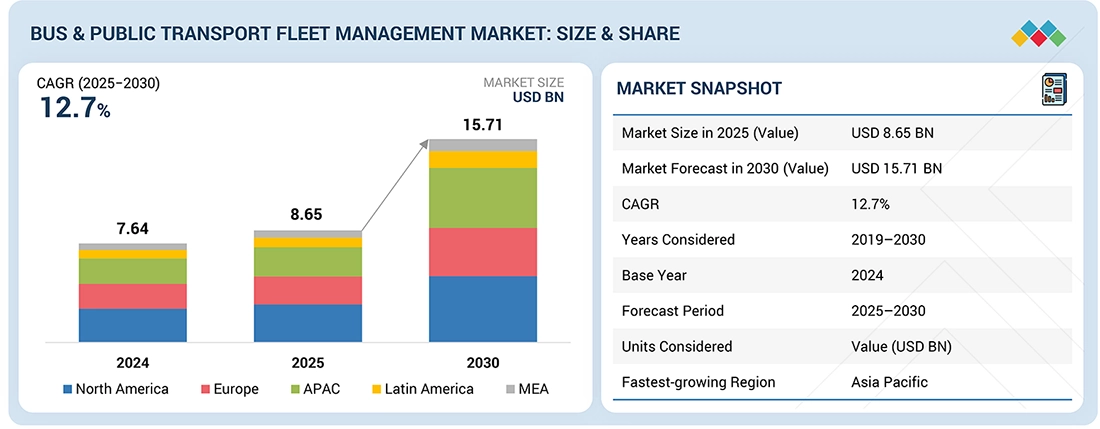
The bus and public transport fleet management market is expected to increase from USD 8.65 billion in 2025 to USD 15.71 billion by 2030, reflecting a 12.7% CAGR. Large-scale fleet upgrade programmes are being driven by fast urban growth and higher public transit use. These programmes are raising demand for telematics, energy management, and depot charging systems. Operators are also investing in passenger information displays, contactless fare systems, and improved scheduling to boost service reliability. Advances in telematics and IoT sensors support predictive maintenance and remote diagnostics, lowering downtime and life cycle costs. Adoption is also driven by stricter regulations on emissions, safety, and accessibility, as well as smart city projects and multimodal planning. Secure data exchange, dependable connectivity, and scalable managed services are needed to support large city fleets and to meet operational and environmental objectives, and long-term financial performance and resilience.
KEY TAKEAWAYS
-
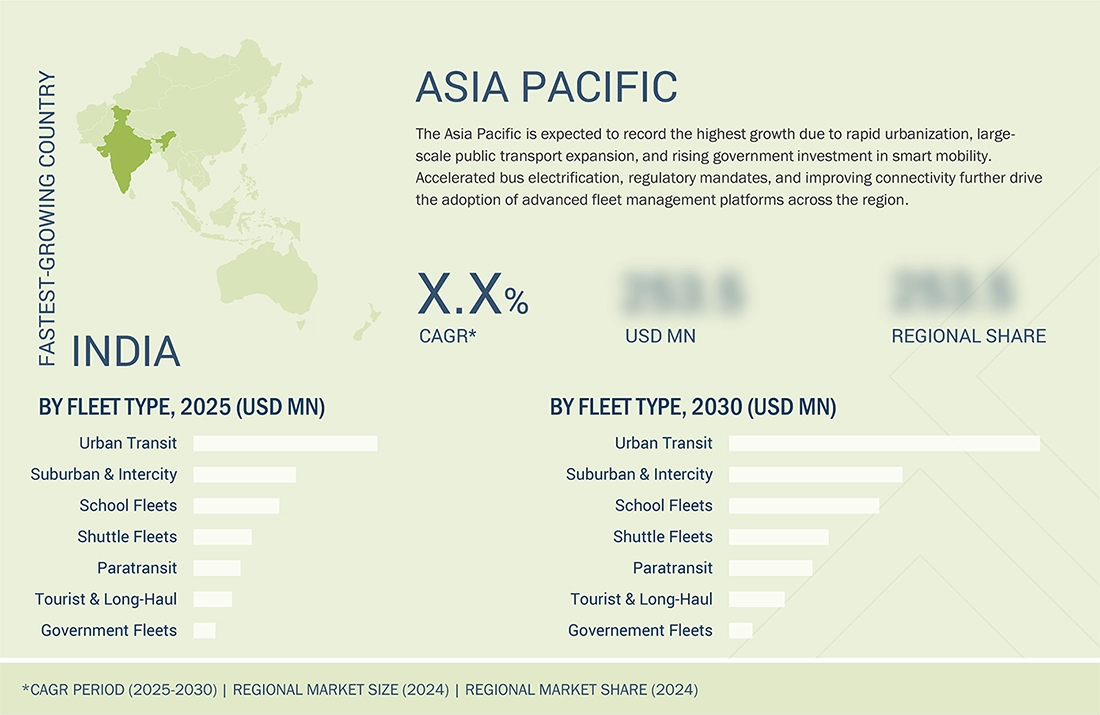
RegionBy region, the Asia Pacific is projected to grow at the highest CAGR of 15.4% from 2025-2030.
-
By OperationBy operation, the vehicle maintenance & diagnostics segment is expected to register the highest CAGR of 13.7%.
-
By Fleet TypeBy fleet type, the paratransit segment is projected to grow at a high rate of 14.0% from 2025 to 2030.
-
Competitive LandscapeGeotab, Samsara, and Verizon Connect were identified as some of the star players in the market, given their strong market share and product footprint.
Transit authorities worldwide face pressure from rapid urban growth and rising passenger numbers to speed up expansion of bus and public transport networks. Stricter emissions and safety rules across regions are raising compliance demands for fleet operators. This increases the need for fleet monitoring and telematics to track performance and comply with regulations. Operators are seeking lower costs through predictive maintenance and flexible route planning. These efforts rely on clear data analysis. Electrification programmes are being rolled out across many transport networks. Spending on smart city systems is growing. Passenger expectations for reliable service are also increasing. Combined, these trends are driving the faster adoption of integrated fleet management solutions and increased funding support.
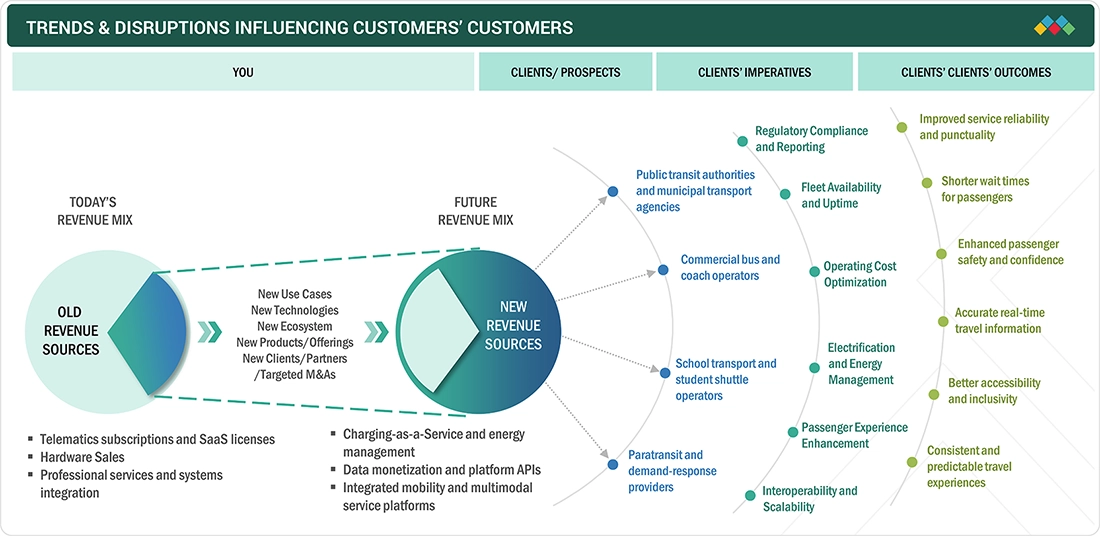
TRENDS & DISRUPTIONS IMPACTING CUSTOMERS' CUSTOMERS
Connected stakeholders make up the bus and public transport fleet management ecosystem, working together to support safe, efficient, and passenger-oriented services. Solution vendors provide integrated platforms for high-frequency and mixed-route operations. These systems include telematics, scheduling, fare management, and fleet orchestration. Hardware makers produce on-board telematics units, sensors, ticketing equipment, and charging interfaces. These parts collect real-time operational and energy data. Service firms supply connectivity, charging infrastructure, maintenance, and managed services to maintain fleets across urban and intercity corridors. Regulators and standards bodies define safety, accessibility, data privacy, and interoperability requirements that shape procurement and deployment. Dependable networks, compatible platforms, robust cybersecurity, and readiness for electrification are essential for operational resilience. Together, these elements support data-driven lifecycle management that improves reliability, lowers environmental impact, and enhances the passenger experience.
Source: Secondary Research, Interviews with Experts, MarketsandMarkets Analysis
MARKET DYNAMICS

Level
-
Government Funding for Transit Infrastructure and Fleet Modernization

-
Zero-emission Mandate Acceleration and Electric Bus Deployment Growth


Level
-
Complex Technology Integration and Legacy System Incompatibility Challenges

-
Range Limitations and Charging Infrastructure Barriers for Electric Fleet Operations


Level
-
Government-backed Smart Transportation and Digitalization Initiatives

-
Ecosystem Evolution and Vehicle Manufacturer Integration Partnerships


Level
-
Fragmented Vendor Landscape and Incompatible Technology Standards

-
Organizational Change Management and Technology Adoption Resistance

Source: Secondary Research, Interviews with Experts, MarketsandMarkets Analysis
Driver: Zero-emission Mandate Acceleration and Electric Bus Deployment Growth
Battery electric buses accounted for over 36% of all city bus sales in the European Union in 2024, overtaking diesel as the primary fuel type for the first time. This rapid transition to electrification of the fleet is creating an urgent demand for fleet management systems optimized for electric vehicle operations. Battery status monitoring, charging schedule optimization, and range planning for efficient electrified fleet operations are supported by these systems.
Restraint: Complex Technology Integration and Legacy System Incompatibility Challenges
Many transit agencies run separate systems for dispatch, maintenance, billing, and telematics, which creates data silos. Integrating modern fleet management with older infrastructure needs technical skills, capital, and often causes operational disruption. Limited IT capacity in resource-constrained public agencies makes system integration, staff training, and change management harder. These obstacles slow deployment and reduce uptake of full-featured fleet management solutions, and increase operational risk and costs.
Opportunity: Ecosystem Evolution and Vehicle Manufacturer Integration Partnerships
Vehicle manufacturers are increasingly offering direct telematics integration. This eliminates the need for aftermarket hardware installation and reduces deployment complexity. Simplified OEM integration lowers implementation barriers for public sector agencies with limited technical resources. New revenue streams are created, and market penetration is accelerated through partnerships between fleet management providers and manufacturers. Standardized OEM interfaces reduce customization needs and speed technology adoption across different transit fleets.
Challenge: Fragmented Vendor Landscape and Incompatible Technology Standards
Market regulations remain fragmented, with numerous vendors and limited platform standardization. Transit agencies struggle to integrate maintenance, routing, and telematics systems due to incompatible data formats. Vendor lock-in concerns raise switching costs and reduce procurement flexibility. Integration becomes more complex, and adoption of unified fleet management ecosystems is slowed by the lack of universal standards.
BUS & PUBLIC TRANSPORT FLEET MANAGEMENT SYSTEM MARKET: COMMERCIAL USE CASES ACROSS INDUSTRIES
| COMPANY | USE CASE DESCRIPTION | BENEFITS |
|---|---|---|
 |
Deployment of Geotab telematics across DB Regio’s bus fleet to monitor vehicle health, charging, and driver behavior, and to integrate EV and hydrogen bus data into a single operational view. | Enabled live EV/H2 battery and charging visibility, reduced fuel use and emissions, and provided data to guide fleet electrification and driver coaching for improved efficiency. |
 |
MiX telematics deployed across a chauffeured passenger fleet to monitor driver behavior, maintenance needs, and to support safety coaching and operational reporting. | Increased proportion of drivers with ‘green’ safety ratings, reduced accidents, and improved vehicle uptime through proactive maintenance alerts and behavior-based coaching. |
 |
Teletrac Navman vehicle tracking and operations tools were implemented for a specialized passenger transport operator to manage mixed fleets and wheelchair-capable vehicles. | Improved route visibility, scheduling accuracy and passenger safety while enabling better resource allocation and service reliability for special-needs passenger transport. |
Logos and trademarks shown above are the property of their respective owners. Their use here is for informational and illustrative purposes only.
MARKET ECOSYSTEM
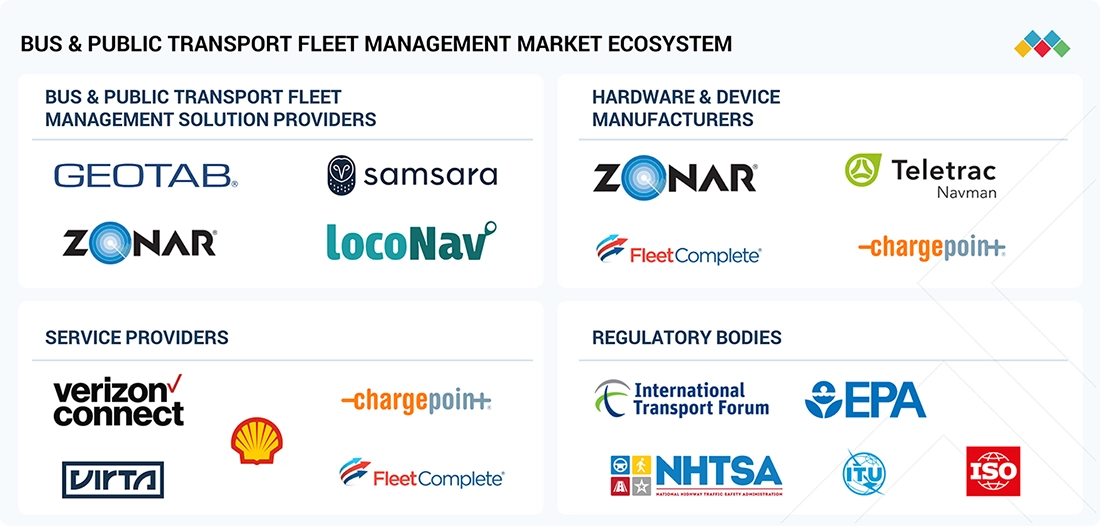
Interconnected roles within the bus and public transport fleet management ecosystem enable safe, efficient, and passenger-focused operations. Solution providers deliver integrated platforms covering telematics, scheduling, dispatch, passenger information, fare management, analytics, and fleet orchestration for high-frequency and mixed-route services. Hardware manufacturers supply on-board telematics devices, sensors, fare collection systems, passenger counters, and charging interfaces that capture real-time operational data. Service providers deliver connectivity, charging, maintenance, system integration, and managed services to keep fleets available across urban and intercity networks. Critical dependencies include reliable connectivity, interoperable platforms, and cybersecurity. Real-time visibility, predictive maintenance, and data-driven lifecycle management are enabled by these capabilities, improving reliability and the passenger experience.
Logos and trademarks shown above are the property of their respective owners. Their use here is for informational and illustrative purposes only.
MARKET SEGMENTS
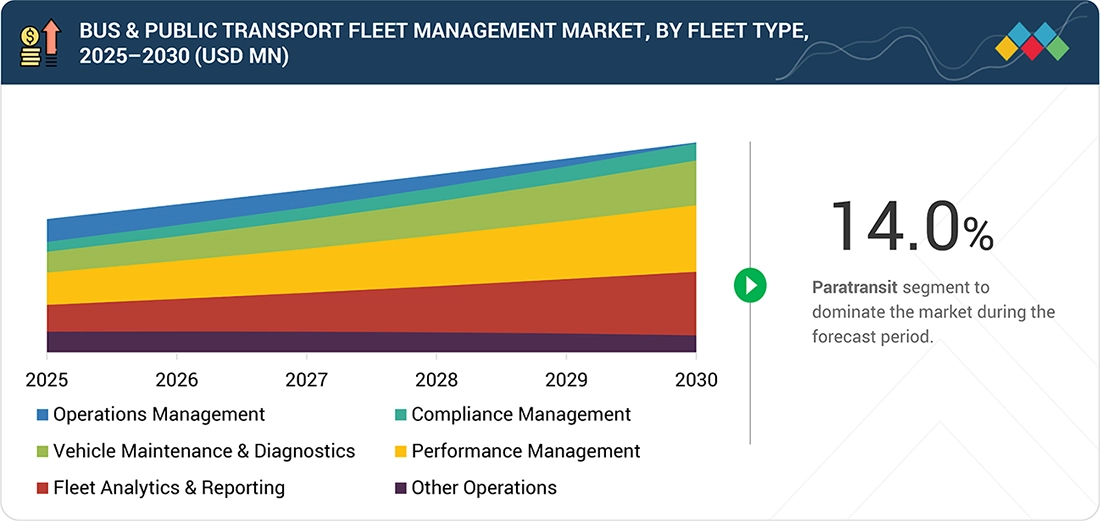
Source: Secondary Research, Interviews with Experts, MarketsandMarkets Analysis
Bus & Public Transport Fleet Management Market, By Operation
The Vehicle Maintenance & Diagnostics segment is expected to have the highest growth rate in the bus & public transport fleet management market during the forecast period. Demand for specialized maintenance and diagnostics capabilities is increasing as bus fleets become more electrified and hybridized. Uptime and service reliability are prioritized by operators, driving investment in condition-based monitoring and predictive maintenance platforms. Advanced telematics and sensors create large datasets that support machine learning for early fault detection. Transit agencies are compelled by regulatory pressure on safety and accessibility to adopt rigorous diagnostic and reporting systems. Depot visits are reduced, and vehicle service life is extended through remote diagnostics and over-the-air software updates. As a result, fleets using comprehensive maintenance and diagnostics solutions reduce downtime and lifecycle costs.
Bus & Public Transport Fleet Managment Market, By Fleet Type
Urban transit will hold the largest share. Fast urban growth and higher passenger numbers are concentrating vehicles in cities, significantly raising demand for modern fleet management systems. Urban services need advanced scheduling and real-time passenger information to manage frequent runs, complex routes, and reduce delays. Cities also focus on improving reliability and cutting emissions, prompting investment in telematics and energy management tools. The demand for interoperable systems is further strengthened by efforts to integrate various transport modes and by mobility planning based on data, which supports long-term planning. High vehicle density, frequent service, and public funding make urban transit the dominant market segment.
REGION
APAC to be fastest-growing region in Bus & Public Transport fleet management market during forecast period.
The Asia Pacific is expected to be the fastest-growing region in the bus & public transport fleet management market during the forecast period. Rapid urbanization and surging public transport demand are concentrating vehicle deployments across major Asian metropolitan areas. Sustained government investment and supportive policies are accelerating large-scale fleet modernization and electrification programs nationwide. Scale economies are created through high procurement volumes from transit agencies, which significantly reduce per-vehicle deployment and maintenance costs. Cost-competitive, tailored solutions that address diverse climatic and infrastructural requirements are offered by local manufacturers and software vendors. The demand for interoperable fleet management platforms is further strengthened by their integration with smart city initiatives and electrification roadmaps. As a result, the Asia Pacific is expected to see the fastest growth, supported by scale and strong policy backing.
BUS & PUBLIC TRANSPORT FLEET MANAGEMENT SYSTEM MARKET: COMPANY EVALUATION MATRIX
In the Bus & Public Transport Fleet Management Market, Geotab(Star) remains a leading fleet management provider, supported by a broad product portfolio, advanced tracking capabilities, and strong adoption across transport fleets. Virta (Emerging Leader) is emerging as a notable player, gaining traction with affordable, analytics-driven solutions for small and mid-sized operators.
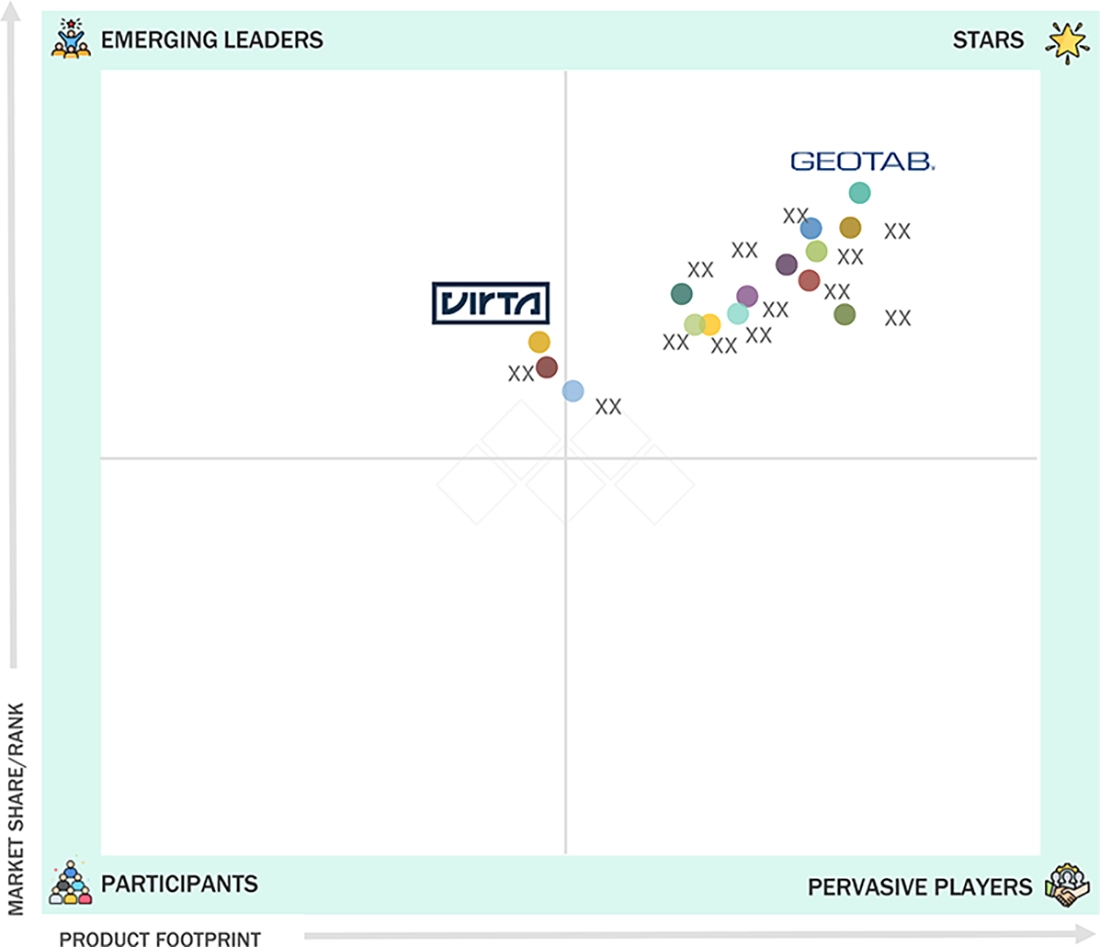
Source: Secondary Research, Interviews with Experts, MarketsandMarkets Analysis
KEY MARKET PLAYERS
- Geotab (Canada)
- Samsara (US)
- Verizon Connect (US)
- Webfleet (Netherlands)
- MiX Telematics (South Africa)
- Teletrac Navman (US)
- Fleet Complete (Canada)
- Zonar Systems (US)
- ChargePoint (US)
- Virta (Finland)
- Driivz (Israel)
- Siemens (Germany)
- ABB (Switzerland)
- Shell (UK)
- LocoNav (India)
MARKET SCOPE
| REPORT METRIC | DETAILS |
|---|---|
| Market Size in 2025 (Value) | USD 8.65 Billion |
| Market Forecast in 2030 (Value) | USD 15.71 Billion |
| Growth Rate | CAGR of 12.7% from 2025-2030 |
| Years Considered | 2019-2030 |
| Base Year | 2024 |
| Forecast Period | 2025-2030 |
| Units Considered | Value (USD Million/Billion) |
| Report Coverage | Revenue forecast, company ranking, competitive landscape, growth factors, and trends |
| Segments Covered |
|
| Regions Covered | North America, Europe, Asia Pacific, Middle East & Africa, Latin America |
WHAT IS IN IT FOR YOU: BUS & PUBLIC TRANSPORT FLEET MANAGEMENT SYSTEM MARKET REPORT CONTENT GUIDE
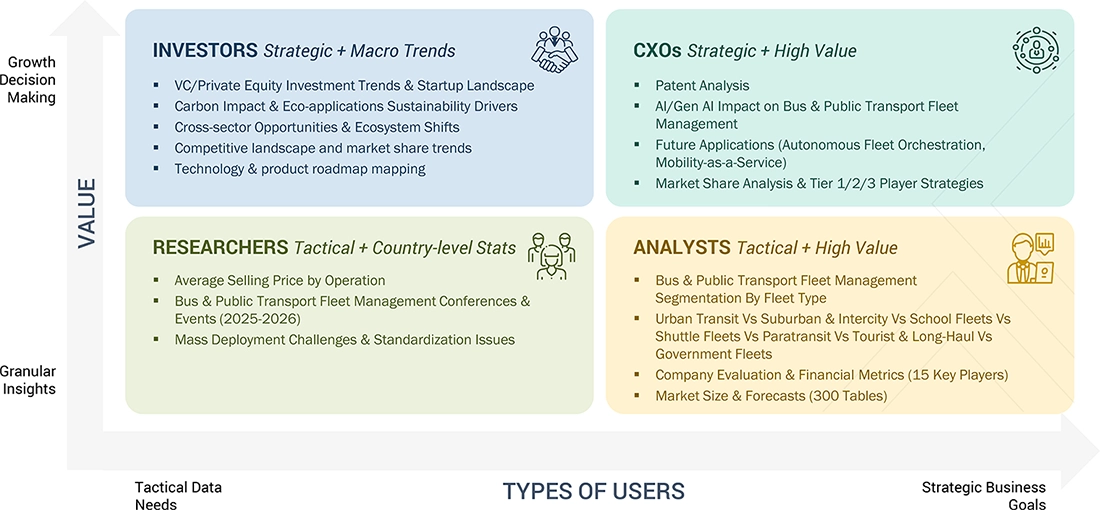
DELIVERED CUSTOMIZATIONS
We have successfully delivered the following deep-dive customizations:
| CLIENT REQUEST | CUSTOMIZATION DELIVERED | VALUE ADDS |
|---|---|---|
| Public Transport Authority |
|
|
RECENT DEVELOPMENTS
- March 2024 : Zonar expanded its MyView school bus tracking app into Canada, delivering real-time location updates, route visibility, and parent notifications. The rollout increased transparency and pupil safety features for school and local public transport operators.
- August 2024 : ChargePoint announced a partnership with Daimler Buses to integrate ChargePoint charge-management and telematics with Mercedes-Benz and Setra buses, enabling combined telematics-to-charging workflows that simplify depot charging operations for electrifying bus fleets.
- December 2024 : Virta was selected to manage EV charging operations at ten Swedish airports for Swedavia, connecting hundreds of chargers to Virta Hub to enable reservation, roaming, dynamic load management, and scalable energy services supporting airport ground fleets and public transport links.
- September 2024 : Siemens launched its Depot360 portfolio and related managed services, offering Charging-as-a-Service, depot design, financing, AI-driven operations monitoring, and managed services to accelerate depot electrification for bus and transit operators.
- July 2025 : ABB E-mobility announced a partnership with Autoservizi Troiani to electrify a portion of Rome’s public bus fleet, supplying depot chargers, mobile chargers, remote monitoring, and site implementation to support over 100 Mercedes-Benz eCitaro buses and staged infrastructure rollouts.
Table of Contents
 Exclusive indicates content/data unique to MarketsandMarkets and not available with any competitors.
Methodology
This research study relied on extensive secondary sources, including directories and databases such as Dun & Bradstreet (D&B), Hoovers, and Bloomberg BusinessWeek, to identify and collect information useful for a technical, market-oriented, and commercial study of the fleet management market. The primary sources were mainly industry experts from core and related industries, as well as preferred suppliers, manufacturers, distributors, service providers, technology developers, alliances, and organizations across all segments of the value chain of this market. In-depth interviews were conducted with primary respondents, including key industry participants, subject matter experts, C-level executives of key market players, and industry consultants, to obtain and verify critical qualitative and quantitative information.
Secondary Research
The market for companies offering fleet management solutions and services across different verticals has been estimated and projected using secondary data from paid and unpaid sources, along with analysis of their product portfolios within the fleet management ecosystem. The process also involved rating company products based on performance and quality. In the secondary research process, various sources such as the International Journal of Advanced Research (IJAR), EA Journals, and the International Journal of Technology, Innovation, and Management (IJTIM) were referred to for identifying and collecting information for this study of the fleet management market. The secondary sources included annual reports, press releases, investor presentations of companies, white papers, journals, certified publications, articles by recognized authors, directories, and databases. Secondary research was mainly used to obtain critical information about the market's supply chain, the total pool of key players, market classification, segmentation according to industry trends down to the bottommost level, regional markets, and key developments from both market- and technology-oriented perspectives, which primary sources have further validated.
Primary Research
In the primary research process, interviews were conducted with various primary sources from both the supply and demand sides to gather qualitative and quantitative information on the market. The supply-side sources included industry experts such as Chief Experience Officers (CXOs); Vice Presidents (VPs); directors from business development, marketing, and product development/innovation teams; critical executives from fleet management solution vendors, SIs, professional service providers, and industry associations; and key opinion leaders. Primary interviews were conducted to gather insights such as market statistics, revenue data from solutions and services, market breakdowns, market size estimates, market forecasts, and triangulated data. Primary research also helped understand trends related to technologies, applications, deployments, and regions. Stakeholders from the demand side, such as Chief Information Officers (CIOs), Chief Technology Officers (CTOs), Chief Strategy Officers (CSOs), and end users of fleet management solutions, were interviewed to understand the buyer’s perspective on suppliers, products, service providers, and their current usage of fleet management solutions, which would impact the overall fleet management market.
Market Size Estimation
Multiple approaches were used to estimate and forecast the size of the fleet management market. The first approach estimates market size by summing the revenue generated by companies from the sale of fleet management offerings.
The top-down and bottom-up approaches were used to estimate and validate the total size of the fleet management market. These methods were also used to estimate the size of various segments in the market. The research methodology used to estimate the market size includes the following:
- Key players in the market have been identified through extensive secondary research
- Regarding value, the industry’s supply chain and market size have been determined through primary and secondary research processes
- All percentage shares, splits, and breakups have been determined using secondary sources and verified through primary sources
Data Triangulation
After determining the overall market size, the fleet management market was segmented into several categories and subcategories. A data triangulation procedure was used to complete the overall market engineering process and arrive at the exact statistics for all segments and subsegments, wherever applicable. The data was triangulated by analyzing various factors and trends from the demand and supply sides. Along with data triangulation and market breakdown, the market size was validated using the top-down and bottom-up approaches.
Market Definition
Fleet management encompasses the activities necessary to maintain a fleet's optimal efficiency, punctuality, and financial adherence. It is the systematic approach fleet managers use to oversee fleet operations, involving continuous monitoring of activities and strategic decision-making in areas such as asset management, dispatch, and routing, as well as the acquisition and disposal of vehicles.
Key Stakeholders
- Fleet Managers
- IT Departments
- Drivers
- Digital Map Providers
- Automotive Suppliers
- Government Agencies
- Investment Firms
- Fleet Management Alliances/Groups
Report Objectives
- To determine, segment, and forecast the fleet management market by component, fleet type, powertrain, vertical, and region in terms of value
- To forecast the size of the market segments in 5 main regions: North America, Europe, Asia Pacific, Middle East Africa, and Latin America
- To provide detailed information about the major factors (drivers, restraints, opportunities, and challenges) influencing the growth of the market
- To study the complete value chain and related industry segments and perform a value chain analysis of the market landscape
- To strategically analyze the macro and micromarkets concerning individual growth trends, prospects, and contributions to the total market
- To analyze the industry trends, pricing data, patents, and innovations related to the market
- To analyze the opportunities for stakeholders by identifying the high-growth segments of the market
- To profile the key players in the market and comprehensively analyze their market share/ranking and core competencies
- To track and analyze competitive developments, such as mergers & acquisitions, product launches & developments, partnerships, agreements, collaborations, business expansions, and R&D activities
Available customizations:
With the given market data, MarketsandMarkets offers customizations as per the company’s specific needs. The following customization options are available for the report:
Country-wise Information
- Analysis for additional countries (up to five)
Company Information
- Detailed analysis and profiling of additional market players (up to 5)
Key Questions Addressed by the Report
What is the projected growth of the Bus & Public Transport Fleet Management System Market?
The Bus & Public Transport Fleet Management System Market is projected to grow from USD 8.65 billion in 2025 to USD 15.71 billion by 2030, at a CAGR of 12.7% during the forecast period.
What factors are driving the Bus & Public Transport Fleet Management System Market?
Market growth is driven by rapid urbanization, increasing public transit demand, electric bus deployment, smart city initiatives, and adoption of telematics, IoT, and predictive maintenance technologies.
Which region is expected to grow the fastest in the Bus & Public Transport Fleet Management System Market?
Asia Pacific is expected to register the highest growth rate, with a projected CAGR of 15.4% between 2025 and 2030.
Which Bus & Public Transport Fleet Management System Market segment is expected to witness the highest growth by operation?
The Vehicle Maintenance & Diagnostics segment is projected to record the highest CAGR of 13.7% during the forecast period.
Who are the key players in the Bus & Public Transport Fleet Management System Market?
Key players in the Bus & Public Transport Fleet Management System Market include Samsara, Verizon Connect, Geotab, Trapeze Group, INIT GmbH, Siemens Mobility, Hitachi Rail, Optibus, GIRO Inc., and Clever Devices, among other leading solution providers.


Personalize This Research
- Triangulate with your Own Data
- Get Data as per your Format and Definition
- Gain a Deeper Dive on a Specific Application, Geography, Customer or Competitor
- Any level of Personalization
Let Us Help You
- What are the Known and Unknown Adjacencies Impacting the Bus & Public Transport Fleet Management Market
- What will your New Revenue Sources be?
- Who will be your Top Customer; what will make them switch?
- Defend your Market Share or Win Competitors
- Get a Scorecard for Target Partners

Custom Market Research Services
We Will Customise The Research For You, In Case The Report Listed Above Does Not Meet With Your Requirements
Get 10% Free CustomisationTESTIMONIALS






Growth opportunities and latent adjacency in Bus & Public Transport Fleet Management Market