



Contrast Media Market
Report Code
MD 3577
Published in
Mar, 2026, By MarketsandMarkets™
Contrast Media Market By Type (lodinated Contrast Media), Form (Liquid, Powder), Modality (X-ray, MRI, Ultrasound), Route of Administration (Oral, Rectal), Indication (Cancer, Neurological, GI, Musculoskeletal Disorders) & Region - Global Forecast to 2031

USD 8.20B
MARKET SIZE, 2026
USD 12.08B
MARKET SIZE, 2031

7.9%
CAGR (2026-2031)

2026-2031
FORECAST PERIOD
OVERVIEW
Source: Secondary Research, Interviews with Experts, MarketsandMarkets Analysis
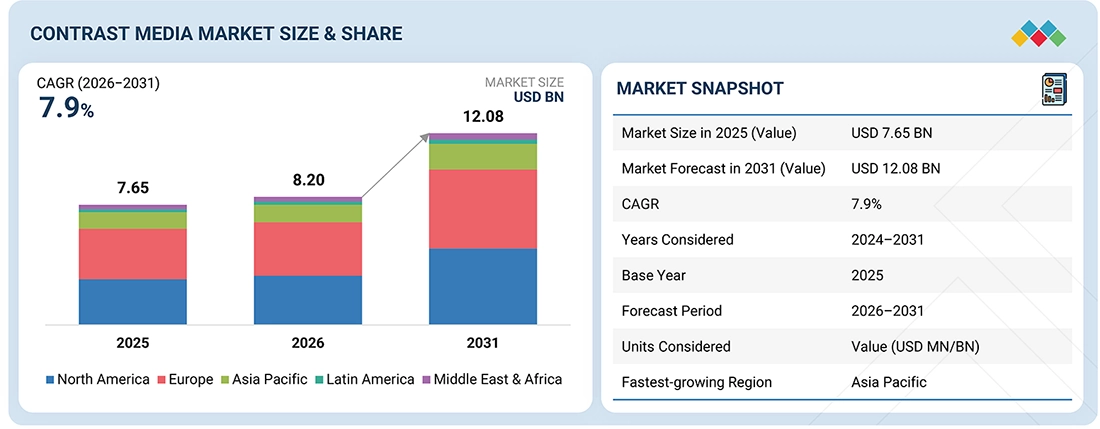
The Contrast Media market, valued at USD 7.65 billion in 2025, stood at USD 8.20 billion in 2026 and is projected to advance at a resilient CAGR of 7.9% from 2026 to 2031, culminating in a forecasted valuation of USD 12.08 billion by the end of the period. Factors driving this growth include the increase in people with chronic conditions, like cardiovascular disease, cancer and neurological disorders, and, also, increase in the number of people getting diagnostic imaging tests on a global basis. In addition, continuous advancements in technology relating to imaging modalities (CT scans, MRIs, and Interventional Radiology) have created a high demand for advanced safety and efficacy of new contrast solutions/products. The trend toward using minimally invasive methods for performing diagnostic procedures and using image-guided methods to perform interventional procedures is another driver of market growth. Emerging economies are also developing their healthcare infrastructure and are increasing the number of elderly people in their population. As well as these developing areas/countries, researchers are developing new low-osmolar/iso-osmolar types of contrast that are significantly safer than current marketed contrast materials, creating additional growth opportunities for the global contrast media market.
KEY TAKEAWAYS
-
MARKET SNAPSHOT:
Base Year Market Size (2025): USD 7.65 Billion
Current Market Size (2026): USD 8.20 Billion
Forecast Market Size (2031): USD 12.08 Billion
CAGR (2026–2031): 7.9% -
SEGMENT LEADERSHIP:
By Region: Asia Pacific is projected to witness the highest CAGR of 9.5%.
By Type: Iodinated contrast media is estimated to account for the highest market share of 55% in 2026.
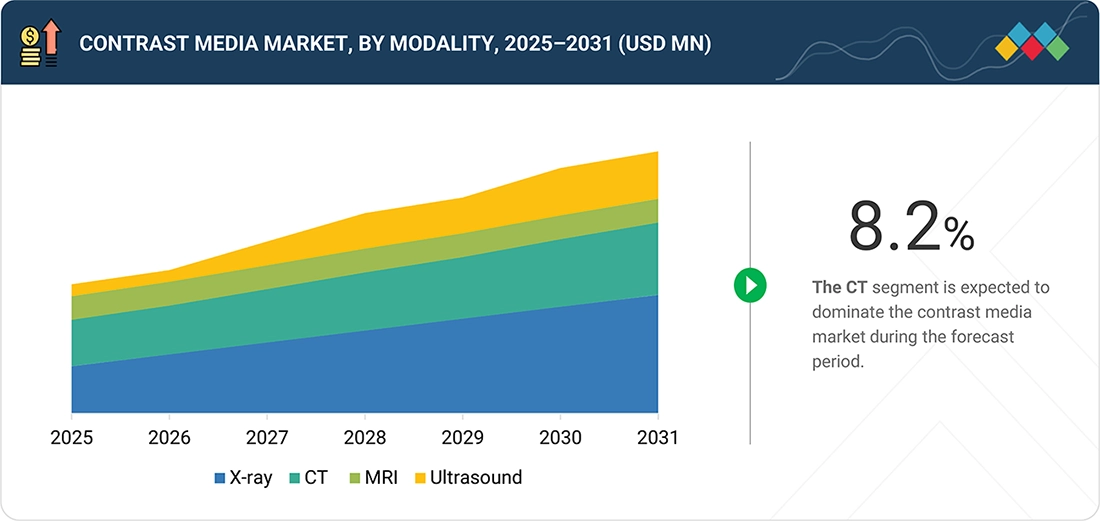
By Modality: CT is expected to register the highest CAGR of 8.2%.
By Indication: Cardiovascular disease is expected to dominate the market with a 48.0% revenue share in 2026.
By Route of Administration: Intravascular is estimated to account for the largest market share of 77.0% in 2026.
By Form: Liquid is projected to grow at the fastest rate of 7.7% from 2026 to 2031.
By Application: Interventional radiology is estimated to account for the largest market share of 40.0% in 2026.
By End User: Diagnostic imaging centers are projected to register the highest CAGR of 9.0% during the forecast period. -
MARKET OUTLOOK & COMPETITIVE LANDSCAPE:
GE HealthCare (US), Bracco Imaging S.p.A. (Italy), Bayer AG (Germany), and Guerbet (France) were identified as star players due to their strong global market presence, extensive contrast agent portfolios, advanced R&D capabilities, and well-established distribution networks across developed and emerging regions.
Jodas Expoim Pvt. Ltd. (India), Ultratrust (India), Imax Diagnostic Imaging Limited (India), and J.B. Chemicals & Pharmaceuticals Ltd. (India) have distinguished themselves among startups and SMEs by establishing strong footholds in cost-competitive generic contrast agents, regional distribution networks, and hospital-focused supply models.
The contrast media market is driven by the is the rising demand for accurate and rapid diagnosis of chronic diseases such as cancer, cardiovascular, and neurological disorders. Market expansion has also benefited from the rise in diagnostic imaging procedures and the preference for minimally invasive, image-guided interventions. Advances in technology such as low, osmolar and iso, osmolar contrast agents, microbubble contrast agents for ultrasound imaging, and improved delivery systems contribute to patient safety and provide more accurate imaging.
TRENDS & DISRUPTIONS IMPACTING CUSTOMERS' CUSTOMERS
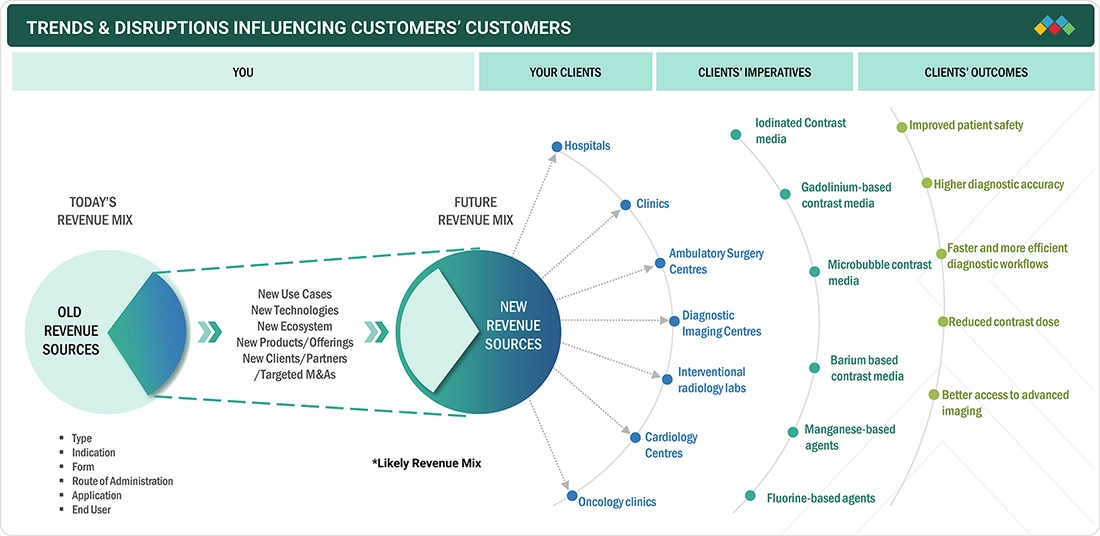
Transformative trends and various disruptions are reshaping the contrast media market. Industry players are witnessing an evolution of low, osmolar and iso, osmolar contrast agents to more sophisticated levels, along with the introduction of gadolinium-based macrocyclic formulations and microbubble contrast agents for ultrasound, which are aimed at enhancing safety and increasing diagnostic accuracy. A growing number of hospitals and diagnostic imaging centers are adopting artificial intelligence (AI), driven imaging analysis, automated injector systems, and dose optimization technology as means of improving the efficiency of their workflows and reducing the occurrence of adverse events.
Source: Secondary Research, Interviews with Experts, MarketsandMarkets Analysis
MARKET DYNAMICS

Drivers
Impact
Level
Level
-
Rising Prevalence of Chronic Diseases

-
Advancements in Contrast Agent Formulations


RESTRAINTS
Impact
Level
Level
-
Risk of Adverse Reactions

-
High Cost of Imaging Procedures


OPPORTUNITIES
Impact
Level
Level
-
Growth of Interventional Radiology and Image-Guided Procedures

-
Development of Microbubble and Ultrasound Contrast Agents


CHALLENGES
Impact
Level
Level
-
Workforce Shortages in Radiology

-
Supply Chain Vulnerabilities

Source: Secondary Research, Interviews with Experts, MarketsandMarkets Analysis
Driver: Rising Prevalence of Chronic Diseases
The increase in chronic diseases is a major driver of growth for the contrast media industry. The WHO states that almost 75% of the number of deaths worldwide are from non-communicable diseases, resulting in around 43 million people dying every year. Cardiovascular Diseases affect 620 million individuals globally, and diabetes affects over 800 million people worldwide. Because diagnostic imaging techniques like contrast-enhanced CT, MRI, and angiography depend on contrast media for better visualization of vascular systems, tissues, and pathological alterations, this increased global disease load immediately translates into higher volumes of these procedures. One of the main factors driving the growth in contrast media utilization across diagnostic imaging and interventional radiology applications is the rising frequency of chronic diseases.
Restraint: Risk of Adverse Reactions
The risk of adverse reactions from the use of contrast media is a major factor limiting the market growth. Iodinated and gadolinium, based contrast agents are capable of causing various side effects, ranging from mild symptoms like nausea and itching to more severe conditions, e. g., contrast, induced nephropathy (CIN), allergic reactions, and even anaphylaxis in patients who are predisposed. Due to the concerns about the potential harm to health from these, doctors tend to be more careful in giving contrast, enhanced imaging, especially to patients who already have kidney problems or allergies, thus limiting the total usage. Besides, stricter regulatory controls and safety checks also have an impact on hospital guidelines and could lead to a decrease in the number of procedures carried out in high, risk groups.
Opportunity: Development of Microbubble and Ultrasound Contrast Agents
The rise in the use of contrast-enhanced ultrasound is opening up considerable opportunities for the contrast media market. Microbubble-based contrast agents offer real-time visualization of blood vessels with a very high level of safety since they are not nephrotoxic and, therefore, are ideal for patients with renal impairment. The use of these agents is going up in liver lesion characterization, cardiac imaging, and vascular diagnostics, which in turn is leading to a decrease in the use of CT and MRI for those indications. Besides that, ultrasound systems are cheaper and more easily available, especially in developing countries, which is an added factor for the CEUS growth. The ongoing research in making microbubbles more stable and capable of targeted imaging will likely broaden the clinical applications and be a factor for the future market growth.
Challenge: Supply Chain Vulnerabilities
The market for contrast agents is the high level of dependence on iodine for producing iodinated contrast agents as well as for some advanced formulations and rare earth materials. The number of countries producing iodine around the world is limited, so disruptions within the supply chain could easily be caused by Geopolitical tensions,Trade limitations and Disruptions in production. At the same time, any shortages or price fluctuations in these key raw materials could immediately impact the production capacity and pricing of the manufactured products. Another form of uncertainty regarding the supply of raw materials arises through restrictions on mining and environmental regulations. The presence of these uncertainties surrounding the supply of raw materials increases the level of risk associated with manufacturing operations. As a result, temporary shortages of products within medical facilities may result from decreased access to supply chains that are affected by external factors (such as geopolitical instability).
CONTRAST MEDIA MARKET SIZE, GROWTH, SHARE & TRENDS ANALYSIS: COMMERCIAL USE CASES ACROSS INDUSTRIES
| COMPANY | USE CASE DESCRIPTION | BENEFITS |
|---|---|---|
 |
It provides a comprehensive portfolio of iodinated and gadolinium-based agents for CT, MRI, and X-ray imaging. | Enhances diagnostic clarity across diverse patient populations while utilizing sustainable, recyclable packaging systems. |
 |
It offers specialized contrast agents and syringeless injectors (like Max 3) for MRI and ultrasound (CEUS) applications. | Improves lesion visualization with high-relaxivity agents that require lower gadolinium doses, prioritizing patient safety. |
 |
It develops high-quality contrast media for MRI (Gadavist) and the first FDA-approved agent for Contrast-Enhanced Mammography. | Facilitates precise detection of CNS lesions and breast pathologies through advanced imaging and personalized dosing software. |
 |
It designs innovative macrocyclic agents (Elucirem) and digital injection management solutions like Contrast&Care. | Enables high-quality imaging at half the conventional gadolinium dose, reducing potential long-term tissue deposition. |
 |
Aplio i-series Ultrasound Systems – Incorporates Micro-Vascular Imaging (SMI) and contrast-enhanced ultrasound (CEUS) for vascular imaging in peripheral and abdominal applications | Enables visualization of low-velocity blood flow in micro vessels, enhances detection of vascular lesions and plaque morphology, supports real-time evaluation without ionizing radiation, and improves diagnostic accuracy in early vascular disease detection |
Logos and trademarks shown above are the property of their respective owners. Their use here is for informational and illustrative purposes only.
MARKET ECOSYSTEM
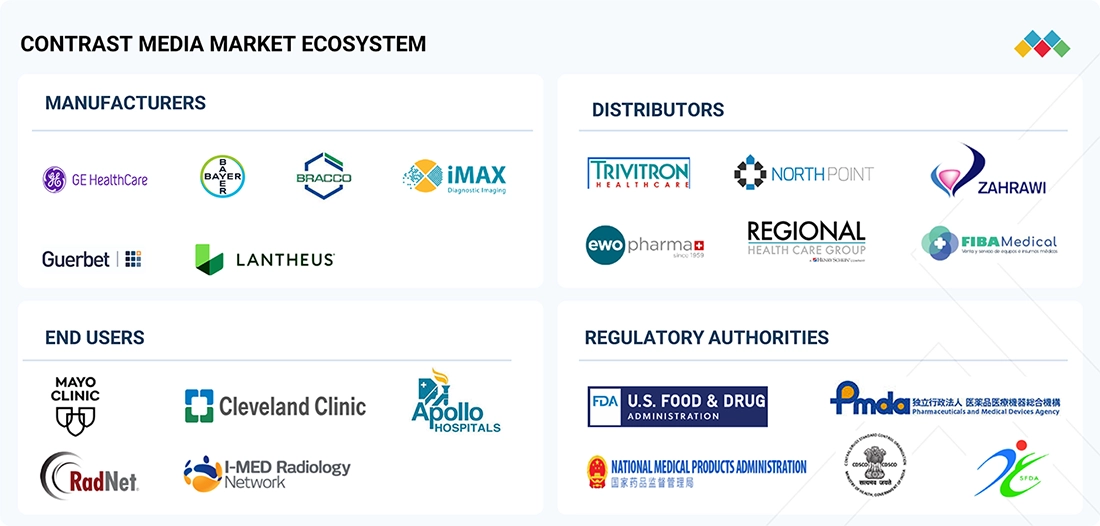
The contrast media market comprises various stakeholders, including manufacturers of contrast media, suppliers of raw materials, distributors, healthcare facilities such as hospitals and diagnostic imaging centers, universities and research sites, regulatory authorities, and together they create a complex network of exchange and value creation. Manufacturers innovate by developing better iodinated and gadolinium-based contrast agents, new formulation technologies, and safer contrasts. Suppliers provide the active pharmaceutical ingredient (API) or excipient required for manufacturing contrast agents for the four primary types of imaging modalities: CT, MRI, ultrasound, and interventional procedures. Distributors or group purchasing organizations (GPOs) facilitate the availability of contrast media products in different regions and across the global healthcare systems. Regulatory authorities such as the U.S. Food and Drug Administration (FDA) and the European Medicines Agency (EMA) set high, quality standards, issue guidelines for the efficacy, and continue pharmacovigilance after the product is approved for use. Hospitals, diagnostic imaging centers, and research institutions play a vital role in clinical adoption and evaluation of contrast agents across CT, MRI, ultrasound, and interventional procedures. Key companies operating in this ecosystem include Bayer AG (Germany), Bracco Imaging S.p.A. (Italy), and Guerbet (France), GE HealthCare (US)a, mong others, forming an integrated and highly regulated global value chain.
Logos and trademarks shown above are the property of their respective owners. Their use here is for informational and illustrative purposes only.
MARKET SEGMENTS
Source: Secondary Research, Interviews with Experts, MarketsandMarkets Analysis
Contrast Media Market, By Type
Iodinated contrast media are anticipated to hold the highest CAGR as a result of a growing number of CT scans and interventional procedures globally. The clinical preference is continually being driven by its high image clarity and strong compatibility with advanced CT imaging systems. The rising usage in cardiovascular, oncology, and trauma diagnostics is also helping to increase the demand. Continuous product innovations oriented towards the development of low, osmolar, and iso, osmolar formulations are enhancing patient safety and acceptance. Moreover, the increasing availability of emergency and outpatient imaging services is speeding up the use of iodinated contrast agents.
Contrast Media Market, By Form
The liquid form is the rapidly expanding segment in the contrast media market as it can be easily administered by intravenous and oral routes during imaging procedures. It gives quicker absorption and even distribution in the body which helps in obtaining clearer and more accurate diagnostic results. The growing use of automated injectors and infusion systems is also a factor in the increased use of liquid contrast agents. Besides this, liquid formulations allow for better dosing flexibility and they are compatible with the latest CT and MRI systems. The increasing number of outpatient and emergency imaging procedures is another factor driving demand for liquid contrast media.
Contrast Media Market, By Modality
CT is the fastest growing modality in the contrast media market. This is because it has been most widely adopted for the rapid and accurate diagnosis of cardiovascular, neurological, and oncological conditions. The rise in the prevalence of chronic diseases and trauma cases has resulted in the increasing demand for CT, based imaging procedures. The technological innovations such as multi, slice CT scanners and AI, based image reconstruction have made possible high quality images and increased diagnostic accuracy. CT scans have the advantage of shorter examination times and allow more patients to be seen than other modalities. Moreover, the increasing utilization of CT in emergency care and preventive screening programs is giving an extra boost to the demand for contrast-enhanced CT imaging.
Contrast Media Market, By Indication
Cardiovascular disease has the fastest growing market share of all the contrast media indications globally due to the increasing incidence of cardiovascular diseases resulting from an aging population, sedentary lifestyle, increasing rates of obesity and diabetes and as people will have access to more advanced diagnostic modalities such as CT angiograms, Coronary angiograms, and Cardiac MRIs which are all requiring the use of contrast. There are also dynamic markets (emerging countries) where access to interventional cardiology procedures and better healthcare infrastructure will support market growth. Finally, there will continue to be advances in technology related to Cardiac Imaging systems and hence improved accuracy and significant increase in new procedure volumes.
Contrast Media Market, By Route of Administration
The oral route of administration is the fastest, growing modality in the contrast media market mainly because it is non-invasive and provides better patient comfort than injectable methods. For gastrointestinal imaging and abdominal CT scans, it is broadly used as it lessens the work of intravenous access. The increasing focus on outpatient and preventive diagnostics has led to a higher demand for contrast agents that are easier to administer. A decreased risk of allergic reactions and increased formulation stability have also helped to broaden the use of these agents. Increasingly, patients are becoming aware of and prefer safer, more convenient diagnostic procedures which is another factor driving market growth.
Contrast Media Market, By Application
By application, contrast media market is categorized into radiology, interventional radiology, interventional cardiology. Contrast?????? media market share is led by radiology, which is a major contributor to diagnostic imaging and the largest number of contrast-enhanced procedures carried out worldwide. In general, CT, MRI, and angiography are the main methods where contrast agents are used to make the images clearer and to be more accurate in diagnosing a wider range of diseases that include cardiovascular, neurological, and oncological ones. As a result, the prevalence of these chronic diseases, the need for early and accurate diagnosis, and the upgrading of hospital and diagnostic center infrastructures for advanced imaging procedures have become some of the reasons for the rising use of contrast media in radiology. Besides that, the use of contrast agents as a standard step in imaging protocols and their regular application in radiological procedures contribute significantly to radiology being the largest driver of the market ??????demand.
REGION
Asia Pacific to be fastest-growing region in global vascular imaging market during forecast period
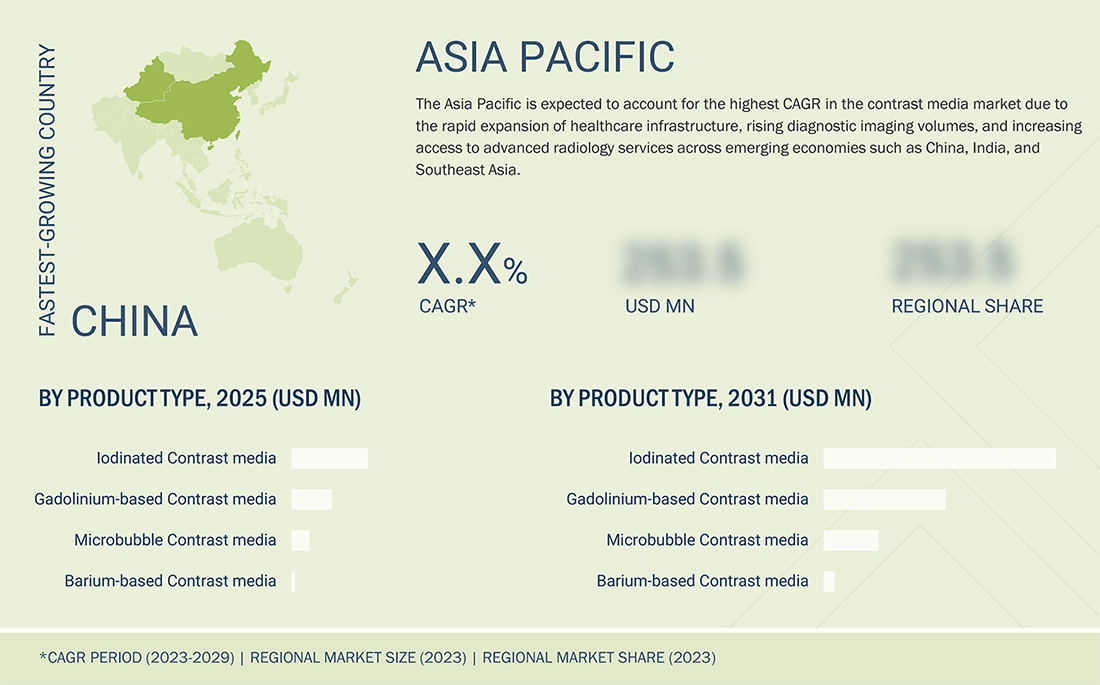
The Asia Pacific is the fastest growing region in the contrast media market.The main reasons behind this are the rapid development of healthcare facilities and an upsurge in the number of diagnostic imaging centers. The demand for advanced imaging techniques is being driven by the rising prevalence of chronic and lifestyle diseases, such as cancer and cardiovascular disorders. Also, improved awareness about early diagnosis and better healthcare access along with increased government support are contributing to the market expansion. In addition to that, medical tourism and the existence of low, cost manufacturing hubs are also facilitating a rapid adoption of the contrast media in the region..
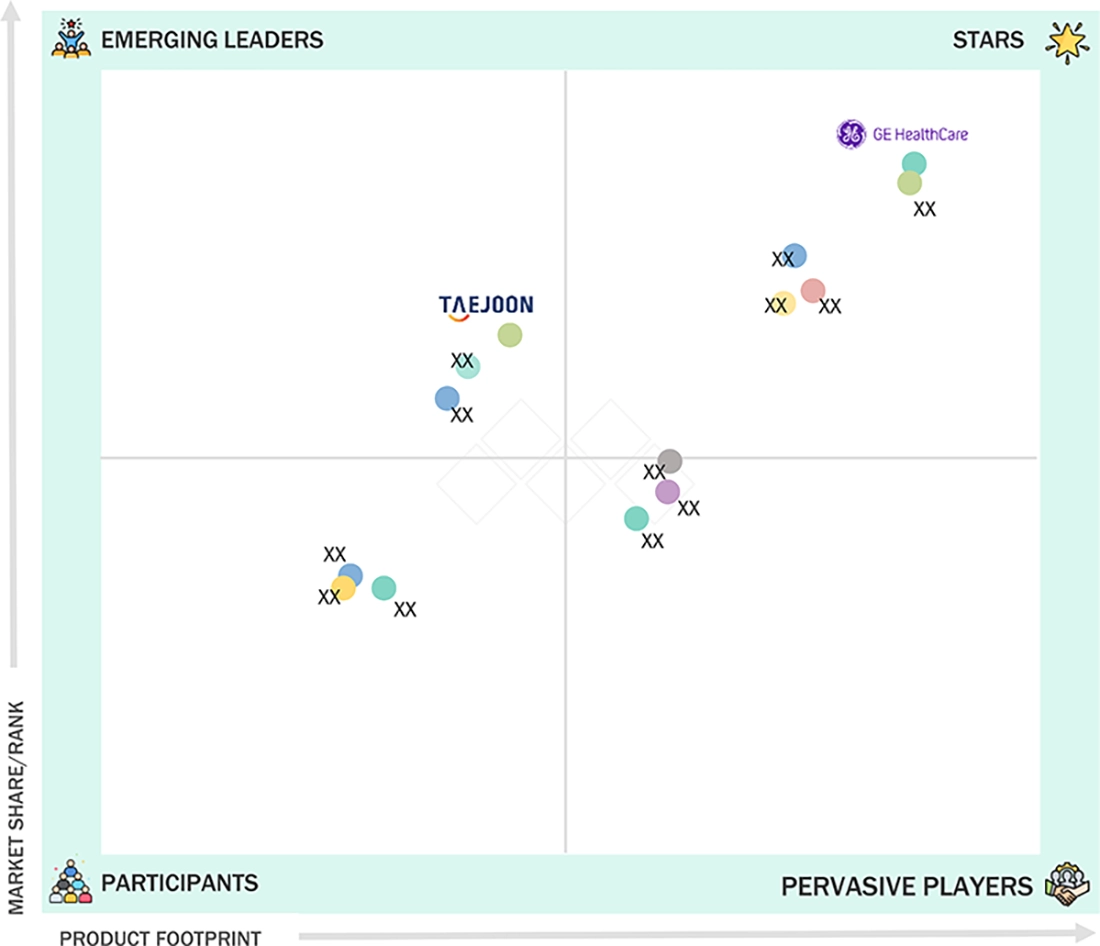
CONTRAST MEDIA MARKET SIZE, GROWTH, SHARE & TRENDS ANALYSIS: COMPANY EVALUATION MATRIX
Bracco Imaging S.p.A., Bayer AG lead the contrast media market with with high product footprints and robust business strategies. They possess extensive portfolios and lead in innovation. Emerging leaders, such asTaejoon Pharm Co., Ltd., Yangtze River Pharmaceutical (YZJ) Group, strong product innovation but may currently lack the expansive business reach or long-term strategic depth of the Stars. Pervasive players, including J.B. Chemicals & Pharmaceuticals Limited, Sanochemia Pharmazeutika GmbH, have strong business strategies and global presence but tend to offer more specialized, limited, or less diversified product lines. Participants are niche players with narrow offerings and limited strategic development, contributing minimally to competitive market dynamics.
Source: Secondary Research, Interviews with Experts, MarketsandMarkets Analysis
KEY MARKET PLAYERS
- GE HealthCare (US)
- Bracco Imaging S.p.A. (Italy)
- Bayer AG (Germany)
- Guerbet (US)
- Lantheus Medical Imaging (US)
- Unijules Life Sciences Ltd. (India)
- J.B. Chemicals & Pharmaceuticals Limited (India)
- Sanochemia Pharmazeutika GmbH (Germany)
- Taejoon Pharm Co., Ltd. (South Korea)
- Jodas Expoim (India)
MARKET SCOPE
| REPORT METRIC | DETAILS |
|---|---|
| Market Size in 2025 (Value) | USD 8.20 Billion |
| Market Forecast in 2031 (Value) | USD 12.08 Billion |
| Growth Rate | CAGR of 7.9% from 2026-2031 |
| Years Considered | 2024-2031 |
| Base Year | 2025 |
| Forecast Period | 2026-2031 |
| Units Considered | Value (USD Billion) |
| Report Coverage | Revenue forecast, company ranking, competitive landscape, growth factors, and trends |
| Segments Covered |
|
| Regions Covered | North America, Asia Pacific, Europe, Latin America, Middle East & Africa |
| Related Segment & Geographic Reports |
Asia-Pacific Contrast Media Market Europe Contrast Media Market United States Contrast Media Market |
WHAT IS IN IT FOR YOU: CONTRAST MEDIA MARKET SIZE, GROWTH, SHARE & TRENDS ANALYSIS REPORT CONTENT GUIDE
DELIVERED CUSTOMIZATIONS
We have successfully delivered the following deep-dive customizations:
| CLIENT REQUEST | CUSTOMIZATION DELIVERED | VALUE ADDS |
|---|---|---|
| Contrast Media Manufacturer |
|
|
| Healthcare Provider / Hospital Network |
|
|
| Investor / Private Equity Firm |
|
|
RECENT DEVELOPMENTS
- Febuary 2026 : India’s CDSCO approved Bayer’s Ultravist (Iopromide Injection) as the first iodinated contrast agent for use in Contrast-Enhanced Mammography (CEM). This landmark decision provides a faster, more accessible diagnostic alternative to breast MRI for visualizing breast lesions and improving cancer detection across India.
- Febuary 2025 : GE HealthCare is investing $138 million to construct a new 32,000-square-foot manufacturing facility in Cork, Ireland, to meet a projected doubling in global demand for iodine-based contrast media over the next decade.
- April 2023 : GE HealthCare expanded its contrast media portfolio by introducing Pixoscan (gadobutrol), a macrocyclic, non-ionic magnetic resonance imaging (MRI) gadolinium-based contrast agent (GBCA). Pixoscan underwent regulatory review via a decentralized procedure (DCP), securing marketing authorization in Austria.
- October 2023 : The European Commission granted Guerbet marketing authorization (MA) for Elucirem (Gadopiclenol). This followed a positive opinion from the European Medicines Agency’s Committee for Medicinal Products for Human Use (CHMP) for its use as an MRI contrast agent.
Table of Contents
 Exclusive indicates content/data unique to MarketsandMarkets and not available with any competitors.
TITLE
PAGE NO
1
INTRODUCTION
24
2
EXECUTIVE SUMMARY
29
3
PREMIUM INSIGHTS
35
4
MARKET OVERVIEW
Precision diagnostics and multimodal imaging drive market growth amid safety and regulatory challenges.
39
4.1
INTRODUCTION
4.2
MARKET DYNAMICS
4.2.1
DRIVERS
4.2.1.1
ADVANCEMENTS IN CONTRAST AGENT FORMULATIONS
4.2.1.2
PRECISION DIAGNOSTICS ENABLED BY TARGETED AND ACTIVATABLE CONTRAST AGENTS
4.2.1.3
GOVERNMENT INVESTMENTS AND HEALTHCARE PROCUREMENT INITIATIVES
4.2.1.4
RISING NUMBER OF CONTRAST-MEDIATED SCANS
4.2.2
RESTRAINTS
4.2.2.1
LIMITED CIRCULATION TIME AND STABILITY OF CERTAIN CONTRAST AGENTS
4.2.2.2
ENVIRONMENTAL PERSISTENCE OF GADOLINIUM-BASED CONTRAST AGENTS
4.2.3
OPPORTUNITIES
4.2.3.1
EXPANSION OF MULTIMODAL IMAGING TECHNOLOGIES
4.2.3.2
EXPANSION OF CONTRAST-ENHANCED ULTRASOUND (CEUS) APPLICATIONS IN PEDIATRIC IMAGING
4.2.3.3
INCREASING DEMAND FOR LOW-DOSE, HIGH-RELAXIVITY CONTRAST AGENTS FOR NEONATES AND INFANTS
4.2.4
CHALLENGES
4.2.4.1
SAFETY AND TOXICITY CONCERNS ASSOCIATED WITH GADOLINIUM AND NANOPARTICLE-BASED CONTRAST AGENTS
4.2.4.2
COMPLEX REGULATORY APPROVAL PATHWAYS FOR NOVEL AND MULTIMODAL CONTRAST AGENTS
4.2.4.3
COMPLEXITY IN SCALABLE SYNTHESIS AND STANDARDIZATION OF NANOPARTICLE-BASED CONTRAST AGENTS
4.3
UNMET NEEDS
4.4
STRATEGIC MOVES BY TIER-1/2/3 PLAYERS
5
INDUSTRY TRENDS
Navigate shifting healthcare trends with strategic insights on global macroeconomic and pricing dynamics.
50
5.1
PORTER’S FIVE FORCES ANALYSIS
5.2
MACROECONOMIC INDICATORS
5.2.1
INTRODUCTION
5.2.2
HEALTHCARE EXPENDITURE AND INFRASTRUCTURE OUTLOOK
5.2.2.1
MACROECONOMIC OUTLOOK FOR NORTH AMERICA
5.2.3
MACROECONOMIC OUTLOOK FOR EUROPE
5.2.4
MACROECONOMIC OUTLOOK FOR ASIA PACIFIC
5.2.5
MACROECONOMIC OUTLOOK FOR LATIN AMERICA
5.2.6
MACROECONOMIC OUTLOOK FOR MIDDLE EAST & AFRICA
5.3
SUPPLY CHAIN ANALYSIS
5.4
ECOSYSTEM ANALYSIS
5.5
PRICING ANALYSIS
5.5.1
AVERAGE SELLING PRICE TREND, BY REGION
5.5.2
AVERAGE SELLING PRICE OF CONTRAST MEDIA PRODUCTS, BY KEY PLAYER
5.5.3
AVERAGE SELLING PRICE TREND OF CONTRAST MEDIA PRODUCTS, BY KEY PLAYER, 2024
5.6
TRADE DATA ANALYSIS
5.6.1
IMPORT DATA (HS CODE 300630)
5.6.2
EXPORT DATA (HS CODE 300630)
5.7
KEY CONFERENCES & EVENTS, 2026–2027
5.8
TRENDS/DISRUPTIONS IMPACTING CUSTOMER BUSINESS
5.9
INVESTMENT & FUNDING SCENARIO
5.10
CASE STUDY ANALYSIS
5.10.1
CASE STUDY 1: MACROCYCLIC CONTRAST AGENTS FOR IMPROVED MRI SAFETY
5.10.2
CASE STUDY 2: IODINATED CONTRAST MEDIA OPTIMIZATION IN CT IMAGING
5.10.3
CASE STUDY 3: LOW-DOSE MRI CONTRAST AGENT FOR PEDIATRIC MRI IMAGING
5.11
IMPACT OF 2025 US TARIFF- CONTRAST MEDIA MARKET
5.11.1
INTRODUCTION
5.11.2
KEY TARIFF RATES
5.11.3
PRICE IMPACT ANALYSIS
5.11.4
IMPACT ON COUNTRY/REGION
5.11.5
IMPACT ON END USERS
6
CUSTOMER LANDSCAPE & BUYER BEHAVIOR
Unlock unmet user needs and stakeholder influence in contrast media buying decisions.
70
6.1
BUYER STAKEHOLDERS & BUYING EVALUATION CRITERIA
6.1.1
BUYING CRITERIA
6.1.2
DECISION-MAKING PROCESS
6.2
ADOPTION BARRIERS & INTERNAL CHALLENGES
6.3
UNMET NEEDS FROM END USERS
6.3.1
UNMET NEEDS FROM END USERS
7
STRATEGIC DISRUPTION THROUGH TECHNOLOGY, PATENTS, AND AI ADOPTION
Harness AI and patents to revolutionize contrast media, unlocking new market potential and applications.
76
7.1
KEY TECHNOLOGIES
7.1.1
CONTRAST-ENHANCED ULTRASOUND (CEUS) ADVANCEMENTS
7.1.1.1
TARGETED AND MOLECULAR CONTRAST AGENTS
7.1.1.2
ADVANCED GADOLINIUM-BASED AGENTS AND HYPERPOLARIZED TECHNIQUES
7.1.2
COMPLEMENTARY TECHNOLOGIES
7.1.2.1
AUTOMATED CONTRAST INJECTOR SYSTEMS
7.2
PATENT ANALYSIS
7.2.1
CONTRAST MEDIA MARKET: LIST OF PATENTS
7.3
FUTURE APPLICATIONS
7.4
IMPACT OF AI/GEN AI ON CONTRAST MEDIA MARKET
7.4.1
TOP USE CASES AND MARKET POTENTIAL
7.4.2
BEST PRACTICES IN CONTRAST MEDIA.
7.4.3
CASE STUDIES OF AI IMPLEMENTATION IN CONTRAST MEDIA MARKET
7.4.4
INTERCONNECTED ADJACENT ECOSYSTEM AND IMPACT ON MARKET PLAYERS
7.4.5
CLIENT READINESS TO ADOPT GENERATIVE AI IN CONTRAST MEDIA MARKET
7.5
SUCCESS STORIES AND REAL-WORLD APPLICATIONS
8
CONTRAST MEDIA MARKET, BY TYPE
Market Size & Growth Rate Forecast Analysis to 2031 in USD Million | 5 Data Tables
85
8.1
INTRODUCTION
8.2
IODINATED CONTRAST MEDIA
8.2.1
RISING ADOPTION OF CT IMAGING INCREASES DEMAND
8.3
GADOLINIUM-BASED CONTRAST MEDIA
8.3.1
SAFETY CONCERNS ASSOCIATED WITH GADOLINIUM-BASED CONTRAST AGENTS RESTRAIN MARKET GROWTH
8.4
MICROBUBBLE CONTRAST MEDIA
8.4.1
GROWING PHYSICIAN PREFERENCE FOR CONTRAST-ENHANCED ULTRASOUND DRIVES ADOPTION
8.5
BARIUM-BASED CONTRAST MEDIA
8.5.1
ADVERSE EFFECTS ASSOCIATED WITH BARIUM SULFATE CONTRAST MEDIA LIMIT CLINICAL USAGE
9
CONTRAST MEDIA MARKET, BY FORM
Market Size & Growth Rate Forecast Analysis to 2031 in USD Million | 4 Data Tables
92
9.1
INTRODUCTION
9.2
LIQUID
9.2.1
CONVENIENCE OF USE IN HOSPITALS AND DIAGNOSTIC CENTERS TO DRIVE MARKET GROWTH
9.3
POWDER
9.3.1
CONVENIENT HANDLING, STORAGE, AND TRANSPORTATION DRIVES INCREASED ADOPTION
9.4
OTHER FORMS
10
CONTRAST MEDIA MARKET, BY MODALITY
Market Size & Growth Rate Forecast Analysis to 2031 in USD Million | 9 Data Tables
97
10.1
INTRODUCTION
10.2
X-RAY
10.2.1
DEVELOPMENT OF SAFER, LOW-CONCENTRATION CONTRAST AGENTS FOR X-RAY - KEY OPPORTUNITY
10.3
CT
10.3.1
INCREASING NUMBER OF CT EXAMINATIONS TO PROPEL MARKET
10.4
MRI
10.4.1
INCREASING FOCUS ON NEXT-GENERATION GADOLINIUM-BASED CONTRAST AGENTS TO ENHANCE SAFETY AND IMAGING PERFORMANCE
10.5
ULTRASOUND
10.5.1
FLEXIBLE AND LOW-COST DIAGNOSTIC IMAGING MODALITY – KEY FACTORS DRIVING MARKET GROWTH
11
CONTRAST MEDIA MARKET, BY ROUTE OF ADMINISTRATION
Market Size & Growth Rate Forecast Analysis to 2031 in USD Million | 8 Data Tables
105
11.1
INTRODUCTION
11.2
INTRAVASCULAR ROUTE
11.2.1
INCREASING CLINICAL RELIANCE FOR ENHANCED DIAGNOSTIC IMAGING AND TREATMENT OUTCOMES TO DRIVE SEGMENT
11.2.1.1
INTRAVENOUS (IV) ROUTE
11.2.1.2
INTRA-ARTERIAL (IA) ROUTE
11.3
ORAL ROUTE
11.3.1
ENHANCING GASTROINTESTINAL VISUALIZATION WITH ORAL CONTRAST AGENTS IN DIAGNOSTIC IMAGING
11.4
RECTAL ROUTE
11.4.1
RISING DEMAND FOR ACCURATE POST-SURGICAL COMPLICATION DETECTION TO DRIVE ADOPTION
11.5
OTHER ROUTES
12
CONTRAST MEDIA MARKET, BY INDICATION
Market Size & Growth Rate Forecast Analysis to 2031 in USD Million | 7 Data Tables
114
12.1
INTRODUCTION
12.2
CARDIOVASCULAR DISEASE
12.2.1
HIGH BURDEN OF CVD TO DRIVE MARKET
12.3
CANCER
12.3.1
ADVANCED ONCOLOGIC DIAGNOSTICS THROUGH CONTRAST-ENHANCED ULTRASOUND IMAGING TO BOOST SEGMENT
12.4
GASTROINTESTINAL DISORDERS
12.4.1
EXPANDING ROLE OF CEUS IN PEDIATRIC GASTROINTESTINAL DISORDERS AND NEONATAL IMAGING TO PROPEL GROWTH
12.5
MUSCULOSKELETAL DISORDERS
12.5.1
RISING INCIDENCE OF WORK-RELATED MUSCULOSKELETAL DISORDERS TO SUPPORT MARKET GROWTH
12.6
NEUROLOGICAL DISORDERS
12.6.1
INCREASING BURDEN OF NEUROLOGICAL DISORDERS DRIVES DEMAND
12.7
NEPHROLOGICAL DISORDERS
12.7.1
RISING PREVALENCE OF END-STAGE RENAL DISEASE TO DRIVE DEMAND
13
CONTRAST MEDIA MARKET, BY APPLICATION
Market Size & Growth Rate Forecast Analysis to 2031 in USD Million | 4 Data Tables
123
13.1
INTRODUCTION
13.2
RADIOLOGY
13.2.1
GROWING NUMBER OF DIAGNOSTIC PROCEDURES TO DRIVE MARKET
13.3
INTERVENTIONAL RADIOLOGY
13.3.1
RISING ADOPTION OF MINIMALLY INVASIVE INTERVENTIONS TO DRIVE MARKET
13.4
INTERVENTIONAL CARDIOLOGY
13.4.1
RISING INCIDENCE OF CARDIAC DISEASES TO DRIVE MARKET
14
CONTRAST MEDIA MARKET, BY END USER
Market Size & Growth Rate Forecast Analysis to 2031 in USD Million | 3 Data Tables
128
14.1
INTRODUCTION
14.2
HOSPITALS, CLINICS, AND AMBULATORY SURGERY CENTERS
14.2.1
INCREASING ADOPTION OF DIAGNOSTIC IMAGING MODALITIES TO DRIVE MARKET
14.3
DIAGNOSTIC IMAGING CENTERS
14.3.1
INCREASING NUMBER OF PRIVATE IMAGING CENTERS TO PROPEL MARKET
15
CONTRAST MEDIA MARKET, BY REGION
Comprehensive coverage of 8 Regions with country-level deep-dive of 14 Countries | 67 Data Tables.
133
15.1
INTRODUCTION
15.2
NORTH AMERICA
15.2.1
US
15.2.1.1
RISING INCIDENCE OF CHRONIC DISEASES TO DRIVE MARKET
15.2.2
CANADA
15.2.2.1
GROWTH INFLUENCED BY SUPPLY EXPANSION AND INCREASING MARKET COMPETITION
15.3
EUROPE
15.3.1
GERMANY
15.3.1.1
PRESENCE OF WELL-ESTABLISHED PLAYERS TO SUPPORT MARKET GROWTH
15.3.2
FRANCE
15.3.2.1
GROWTH SUPPORTED BY HIGH IMAGING UTILIZATION AND EXPANDING CLINICAL APPLICATIONS
15.3.3
UK
15.3.3.1
INNOVATION IN NEXT-GENERATION MRI CONTRAST AGENTS TO DRIVE GROWTH
15.3.4
ITALY
15.3.4.1
GROWTH DRIVEN BY INNOVATION IN ULTRASOUND CONTRAST AGENTS AND PRODUCT EXPANSION
15.3.5
SPAIN
15.3.5.1
SHIFT TOWARD SAFER AND COST-EFFICIENT LOW-OSMOLAR CONTRAST AGENTS IN CT IMAGING TO BOOST MARKET
15.3.6
REST OF EUROPE
15.4
ASIA PACIFIC
15.4.1
CHINA
15.4.1.1
STRONG DOMESTIC CAPABILITIES AND STRATEGIC SUPPLY CHAIN POSITION DRIVE MARKET GROWTH
15.4.2
JAPAN
15.4.2.1
ADVANCED IMAGING INFRASTRUCTURE AND STRATEGIC INDUSTRY EXPANSION TO DRIVE DEMAND
15.4.3
INDIA
15.4.3.1
EXPANDING DOMESTIC MANUFACTURING AND INCREASING IMAGING DEMAND TO PROPEL MARKET GROWTH
15.4.4
AUSTRALIA
15.4.5
SOUTH KOREA
15.4.5.1
AI-DRIVEN IMAGING OPTIMIZATION AND RISING EARLY-ONSET CANCER BURDEN RESHAPING DEMAND
15.4.6
REST OF ASIA PACIFIC
15.4.7
LATIN AMERICA
15.4.7.1
COST-SENSITIVE PROCUREMENT AND RISING CT IMAGING VOLUMES DRIVE CONTRAST MEDIA UTILIZATION
15.4.8
BRAZIL
15.4.8.1
RISING DISEASE BURDEN DRIVES DEMAND AMID SAFETY AND ACCESS CHALLENGES
15.4.9
MEXICO
15.4.9.1
RISING CKD BURDEN, LOW HEALTHCARE SPENDING, AND ENVIRONMENTAL CONCERNS INFLUENCE CONTRAST MEDIA UTILIZATION
15.4.10
REST OF LATIN AMERICA
15.4.10.1
FRAGMENTED ACCESS, IMPORT DEPENDENCE, AND PUBLIC–PRIVATE IMBALANCE SHAPING CONTRAST MEDIA UTILIZATION
15.4.11
MIDDLE EAST & AFRICA
15.4.11.1
HIGH BURDEN OF CHRONIC DISEASES TO DRIVE MARKET
15.4.12
GCC COUNTRIES
15.4.12.1
INCREASING GOVERNMENT INVESTMENTS IN HEALTHCARE SECTOR AND GROWING PHARMACEUTICALS INDUSTRY TO DRIVE MARKET
15.4.13
REST OF MIDDLE EAST & AFRICA
15.4.13.1
IMPORT DEPENDENCE AND UNBALANCED IMAGING ACCESS DRIVING SELECTIVE CONTRAST MEDIA UTILIZATION
16
COMPETITIVE LANDSCAPE
Uncover leading strategies and financial dominance shaping the contrast media market's competitive edge.
173
16.1
INTRODUCTION
16.2
KEY PLAYERS’ STRATEGIES/RIGHT TO WIN
16.2.1
OVERVIEW OF STRATEGIES ADOPTED BY KEY PLAYERS IN CONTRAST MEDIA MARKET
16.3
REVENUE ANALYSIS OF KEY PLAYERS IN CONTRAST MEDIA MARKET 2021–2025
16.4
MARKET SHARE ANALYSIS, 2024
16.4.1
MARKET RANKING OF KEY PLAYERS, 2024
16.5
COMPANY VALUATION & FINANCIAL METRICS
16.5.1
FINANCIAL METRICS
16.5.2
COMPANY VALUATION
16.6
BRAND/PRODUCT COMPARISON
16.7
COMPANY EVALUATION MATRIX: KEY PLAYERS, 2025
16.7.1
STARS
16.7.2
PERVASIVE PLAYERS
16.7.3
EMERGING LEADERS
16.7.4
PARTICIPANTS
16.7.5
COMPANY FOOTPRINT: KEY PLAYERS, 2025
16.7.5.1
COMPANY FOOTPRINT
16.7.5.2
REGION FOOTPRINT
16.7.5.3
PRODUCT TYPE FOOTPRINT
16.7.5.4
MODALITY FOOTPRINT
16.7.5.5
ROUTE OF ADMINISTRATION FOOTPRINT
16.7.5.6
INDICATION FOOTPRINT
16.7.5.7
END USER FOOTPRINT
16.8
COMPANY EVALUATION MATRIX: STARTUPS/SMES, 2025
16.8.1
PROGRESSIVE COMPANIES
16.8.2
RESPONSIVE COMPANIES
16.8.3
DYNAMIC COMPANIES
16.8.4
STARTING BLOCKS
16.8.5
COMPETITIVE BENCHMARKING OF STARTUPS/SMES, 2025
16.8.5.1
CONTRAST MEDIA MARKET: COMPETITIVE BENCHMARKING OF STARTUPS/SMES
16.9
COMPETITIVE SCENARIO
16.9.1
PRODUCT LAUNCHES & APPROVALS
16.9.2
DEALS
16.9.3
EXPANSIONS
17
COMPANY PROFILES
In-depth Company Profiles of Leading Market Players with detailed Business Overview, Product and Service Portfolio, Recent Developments, and Unique Analyst Perspective (MnM View)
197
17.1
KEY PLAYERS
17.1.1
GE HEALTHCARE
17.1.1.1
BUSINESS OVERVIEW
17.1.1.2
PRODUCTS OFFERED
17.1.1.3
RECENT DEVELOPMENTS
17.1.1.3.1
PRODUCT LAUNCHES
17.1.1.4
MNM VIEW
17.1.1.4.1
KEY STRENGTHS
17.1.1.4.2
STRATEGIC CHOICES
17.1.1.4.3
WEAKNESSES & COMPETITIVE THREATS
17.1.2
BRACCO IMAGING
17.1.3
BAYER AG
17.1.4
GUERBET
17.1.5
LANTHEUS HOLDINGS, INC.
17.1.6
UNIJULES LIFE SCIENCES LTD.
17.1.7
J.B. CHEMICALS & PHARMACEUTICALS LIMITED
17.1.8
SANOCHEMIA PHARMAZEUTIKA
17.1.9
TAEJOON PHARM CO., LTD.
17.1.10
JODAS EXPOIM
17.1.11
IMAX DIAGNOSTIC IMAGING LIMITED
17.1.12
YANGTZE RIVER PHARMACEUTICAL GROUP
17.1.13
LIVEALTH
17.1.14
BEIJING BEILU PHARMACEUTICAL CO., LTD.
17.2
OTHER PLAYERS
17.2.1
ARCO LIFESCIENCES (I) PVT. LTD.
17.2.2
STANEX DRUGS & CHEMICALS PVT. LTD.
17.2.3
ONKO ILAÇ SAN. VE TIC. A.S.
17.2.4
FRESENIUS KABI
17.2.5
BIEM ILAC SAN. VE
17.2.6
ADVACARE PHARMA
17.2.7
FUJIFILM WAKO PURE CHEMICAL CORPORATION
17.2.8
UNISPIRE BIOPHARMA PRIVATE LIMITED
17.2.9
TRIVITRON HEALTHCARE
17.2.10
NANOPET PHARMA GMBH
18
RESEARCH METHODOLOGY
244
18.1
RESEARCH DATA
18.2
RESEARCH DESIGN
18.2.1
SECONDARY RESEARCH
18.2.1.1
OBJECTIVES OF SECONDARY RESEARCH
18.2.1.2
KEY DATA FROM SECONDARY SOURCES
18.2.2
PRIMARY RESEARCH
18.2.2.1
OBJECTIVES OF PRIMARY RESEARCH
18.2.2.2
KEY INDUSTRY INSIGHTS
18.3
MARKET SIZE ESTIMATION METHODOLOGY
18.3.1
BOTTOM-UP APPROACH
18.3.1.1
APPROACH 1: COMPANY REVENUE ESTIMATION APPROACH
18.3.1.2
APPROACH 4: PRIMARY INTERVIEWS
18.3.2
TOP-DOWN APPROACH
18.4
MARKET BREAKDOWN AND DATA TRIANGULATION
18.5
MARKET SHARE ASSESSMENT
18.6
RESEARCH ASSUMPTIONS
18.7
RESEARCH LIMITATIONS
18.8
RISK ASSESSMENT
19
APPENDIX
258
19.1
DISCUSSION GUIDE
19.2
KNOWLEDGESTORE: MARKETSANDMARKETS’ SUBSCRIPTION PORTAL
19.3
CUSTOMIZATION OPTIONS
19.4
RELATED REPORTS
19.5
AUTHOR DETAILS
LIST OF TABLES
TABLE 1
CONTRAST MEDIA MARKET: INCLUSIONS AND EXCLUSIONS
TABLE 2
CONTRAST MEDIA MARKET: IMPACT ANALYSIS OF MARKET DYNAMICS
TABLE 3
KEY TECHNOLOGICAL ADVANCEMENTS IN CONTRAST AGENT FORMULATIONS AND THEIR CLINICAL BENEFITS
TABLE 4
EMERGING TARGETED AND ACTIVATABLE CONTRAST AGENTS SUPPORTING PRECISION DIAGNOSTICS
TABLE 5
EMERGING AND CLINICAL APPLICATIONS OF CONTRAST-ENHANCED ULTRASOUND (CEUS) IN PEDIATRIC ABDOMINAL IMAGING
TABLE 6
CONTRAST AGENT MARKET: UNMET NEEDS
TABLE 7
STRATEGIC MOVES BY TIER 1, TIER 2, AND TIER 3 PLAYERS IN CONTRAST MEDIA MARKET
TABLE 8
CONTRAST MEDIA MARKET: PORTER’S FIVE FORCES
TABLE 9
NORTH AMERICA: MACROECONOMIC OUTLOOK
TABLE 10
EUROPE: MACROECONOMIC OUTLOOK
TABLE 11
ASIA PACIFIC: MACROECONOMIC INDICATORS
TABLE 12
LATIN AMERICA: MACROECONOMIC OUTLOOK
TABLE 13
MIDDLE EAST & AFRICA: MACROECONOMIC OUTLOOK
TABLE 14
CONTRAST MEDIA MARKET: ROLE OF ECOSYSTEM
TABLE 15
AVERAGE SELLING PRICE OF CONTRAST MEDIA PRODUCT TYPES, BY REGION, 2024–2026(USD)
TABLE 16
AVERAGE SELLING PRICE TREND OF CONTRAST MEDIA PRODUCTS, BY KEY PLAYER, (USD)
TABLE 17
IMPORT DATA FOR HS CODE 300630, BY COUNTRY, 2021–2025 (USD THOUSAND)
TABLE 18
EXPORT DATA FOR HS CODE 300630 BY COUNTRY, 2021–2025 (USD THOUSAND)
TABLE 19
CONTRAST MEDIA MARKET: KEY CONFERENCES & EVENTS (2026–2027)
TABLE 20
CONTRAST MEDIA APPLICATION IN MRI SAFETY AND STABILITY
TABLE 21
CONTRAST MEDIA APPLICATION IN CT IMAGING OPTIMIZATION
TABLE 22
CONTRAST MEDIA APPLICATION IN PEDIATRIC MRI IMAGING
TABLE 23
US ADJUSTED RECIPROCAL TARIFF RATES IN MEDTECH INDUSTRY
TABLE 24
INFLUENCE OF STAKEHOLDERS ON BUYING PROCESS FOR CONTRAST MEDIA MARKET, BY PRODUCT
TABLE 25
KEY BUYING CRITERIA FOR CONTRAST MEDIA MARKET, BY END USER
TABLE 26
CONTRAST MEDIA MARKET: UNMET NEED ANALYSIS
TABLE 27
KEY AGENTS USED IN CONTRAST-ENHANCED ULTRASOUND (CEUS)
TABLE 28
CONTRAST MEDIA MARKET: KEY PATENTS, 2016–2020
TABLE 29
KEY COMPANIES IMPLEMENTING AI IN CONTRAST MEDIA ECOSYSTEM
TABLE 30
CONTRAST MEDIA MARKET, BY TYPE, 2024–2031 (USD MILLION)
TABLE 31
IODINATED CONTRAST MEDIA MARKET, BY REGION, 2024–2031 (USD MILLION)
TABLE 32
GADOLINIUM-BASED CONTRAST MEDIA MARKET, BY REGION, 2024–2031 (USD MILLION)
TABLE 33
MICROBUBBLE CONTRAST MEDIA MARKET, BY REGION, 2024–2031 (USD MILLION)
TABLE 34
BARIUM-BASED CONTRAST MEDIA MARKET, BY REGION, 2024–2031 (USD MILLION)
TABLE 35
CONTRAST MEDIA MARKET, BY FORM, 2024–2031 (USD MILLION)
TABLE 36
LIQUID CONTRAST MEDIA MARKET, BY REGION, 2024–2031 (USD MILLION)
TABLE 37
POWDER CONTRAST MEDIA MARKET, BY REGION, 2024–2031 (USD MILLION)
TABLE 38
OTHER FORMS: CONTRAST MEDIA MARKET, BY REGION, 2024–2031 (USD MILLION)
TABLE 39
CONTRAST MEDIA MARKET, BY MODALITY, 2024–2031 (USD MILLION)
TABLE 40
ENGLAND: COUNT OF X-RAY IMAGING ACTIVITY ON NHS PATIENTS, MAY 2023–MAY 2024
TABLE 41
X-RAY: CONTRAST MEDIA MARKET, BY REGION, 2024–2031 (USD MILLION)
TABLE 42
ENGLAND: COUNT OF CT IMAGING ACTIVITY ON NHS PATIENTS, MAY 2023–MAY 2024
TABLE 43
CT: CONTRAST MEDIA MARKET, BY REGION, 2024–2031 (USD MILLION)
TABLE 44
ENGLAND: COUNT OF MRI IMAGING ACTIVITY ON NHS PATIENTS, MAY 2023–MAY 2024
TABLE 45
MRI: CONTRAST MEDIA MARKET, BY REGION, 2024–2031 (USD MILLION)
TABLE 46
ENGLAND: COUNT OF ULTRASOUND IMAGING ACTIVITY ON NHS PATIENTS, MAY 2023–MAY 2024
TABLE 47
ULTRASOUND: CONTRAST MEDIA MARKET, BY REGION, 2024–2031 (USD MILLION)
TABLE 48
CONTRAST MEDIA MARKET, BY ROUTE OF ADMINISTRATION, 2024–2031 (USD MILLION)
TABLE 49
INTRAVASCULAR ROUTE: CONTRAST MEDIA MARKET, BY REGION, 2024–2031 (USD MILLION)
TABLE 50
IV ROUTE: CONTRAST MEDIA MARKET, BY REGION, 2024–2031 (USD MILLION)
TABLE 51
IA ROUTE: CONTRAST MEDIA MARKET, BY REGION, 2024–2031 (USD MILLION)
TABLE 52
TYPES OF ORAL CT CONTRAST AGENTS, INCLUDING AGENTS CURRENTLY AVAILABLE AND AGENTS UNDER DEVELOPMENT
TABLE 53
ORAL ROUTE: CONTRAST MEDIA MARKET, BY REGION, 2024–2031 (USD MILLION)
TABLE 54
RECTAL ROUTE: CONTRAST MEDIA MARKET, BY REGION, 2024–2031 (USD MILLION)
TABLE 55
OTHER ROUTES: CONTRAST MEDIA MARKET, BY REGION, 2024–2031 (USD MILLION)
TABLE 56
CONTRAST MEDIA MARKET, BY INDICATION, 2024–2031 (USD MILLION)
TABLE 57
CARDIOVASCULAR DISEASE: CONTRAST MEDIA MARKET, BY REGION, 2024–2031 (USD MILLION)
TABLE 58
CANCER: CONTRAST MEDIA MARKET, BY REGION, 2024–2031 (USD MILLION)
TABLE 59
GASTROINTESTINAL DISORDERS: CONTRAST MEDIA MARKET, BY REGION, 2024–2031 (USD MILLION)
TABLE 60
MUSCULOSKELETAL DISORDERS: CONTRAST MEDIA MARKET, BY REGION, 2024–2031 (USD MILLION)
TABLE 61
NEUROLOGICAL DISORDERS: CONTRAST MEDIA MARKET, BY REGION, 2024–2031 (USD MILLION)
TABLE 62
NEPHROLOGICAL DISORDERS: CONTRAST MEDIA MARKET, BY REGION, 2024–2031 (USD MILLION)
TABLE 63
CONTRAST MEDIA MARKET, BY APPLICATION, 2024–2031 (USD MILLION)
TABLE 64
RADIOLOGY: CONTRAST MEDIA MARKET, BY REGION, 2024–2031 (USD MILLION)
TABLE 65
INTERVENTIONAL RADIOLOGY: CONTRAST MEDIA MARKET, BY REGION, 2024–2031 (USD MILLION)
TABLE 66
INTERVENTIONAL CARDIOLOGY: CONTRAST MEDIA MARKET, BY REGION, 2024–2031 (USD MILLION)
TABLE 67
CONTRAST MEDIA MARKET, BY END USER, 2024–2031 (USD MILLION)
TABLE 68
HOSPITALS, CLINICS, AND AMBULATORY SURGERY CENTERS: CONTRAST MEDIA MARKET, BY REGION, 2024–2031 (USD MILLION)
TABLE 69
DIAGNOSTIC IMAGING CENTERS: CONTRAST MEDIA MARKET, BY REGION, 2024–2031 (USD MILLION)
TABLE 70
CONTRAST MEDIA MARKET, BY REGION, 2024–2031 (USD MILLION)
TABLE 71
NORTH AMERICA: CONTRAST MEDIA MARKET, BY COUNTRY, 2024–2031 (USD MILLION)
TABLE 72
NORTH AMERICA: CONTRAST MEDIA MARKET, BY TYPE, 2024–2031 (USD MILLION)
TABLE 73
NORTH AMERICA: CONTRAST MEDIA MARKET, BY FORM, 2024–2031 (USD MILLION)
TABLE 74
NORTH AMERICA: CONTRAST MEDIA MARKET, BY MODALITY, 2024–2031 (USD MILLION)
TABLE 75
NORTH AMERICA: CONTRAST MEDIA MARKET, BY ROUTE OF ADMINISTRATION, 2024–2031 (USD MILLION)
TABLE 76
NORTH AMERICA: CONTRAST MEDIA MARKET, BY INTRAVASCULAR ROUTE, 2024–2031 (USD MILLION)
TABLE 77
NORTH AMERICA: CONTRAST MEDIA MARKET, BY INDICATION, 2024–2031 (USD MILLION)
TABLE 78
NORTH AMERICA: CONTRAST MEDIA MARKET, BY APPLICATION, 2024–2031 (USD MILLION)
TABLE 79
NORTH AMERICA: CONTRAST MEDIA MARKET, BY END USER, 2024–2031 (USD MILLION)
TABLE 80
US: CONTRAST MEDIA MARKET, BY TYPE, 2024–2031 (USD MILLION)
TABLE 81
CANADA: CONTRAST MEDIA MARKET, BY TYPE, 2024–2031 (USD MILLION)
TABLE 82
EUROPE: CONTRAST MEDIA MARKET, BY COUNTRY, 2024–2031 (USD MILLION)
TABLE 83
EUROPE: CONTRAST MEDIA MARKET, BY TYPE, 2024–2031 (USD MILLION)
TABLE 84
EUROPE: CONTRAST MEDIA MARKET, BY FORM, 2024–2031 (USD MILLION)
TABLE 85
EUROPE: CONTRAST MEDIA MARKET, BY MODALITY, 2024–2031 (USD MILLION)
TABLE 86
EUROPE: CONTRAST MEDIA MARKET, BY ROUTE OF ADMINISTRATION, 2024–2031 (USD MILLION)
TABLE 87
EUROPE: CONTRAST MEDIA MARKET, BY INTRAVASCULAR ROUTE, 2024–2031 (USD MILLION)
TABLE 88
EUROPE: CONTRAST MEDIA MARKET, BY INDICATION, 2024–2031 (USD MILLION)
TABLE 89
EUROPE: CONTRAST MEDIA MARKET, BY APPLICATION, 2024–2031 (USD MILLION)
TABLE 90
EUROPE: CONTRAST MEDIA MARKET, BY END USER, 2024–2031 (USD MILLION)
TABLE 91
GERMANY: CONTRAST MEDIA MARKET, BY TYPE, 2024–2031 (USD MILLION)
TABLE 92
FRANCE: CONTRAST MEDIA MARKET, BY TYPE, 2024–2031 (USD MILLION)
TABLE 93
UK: COUNT OF IMAGING ACTIVITY ON NHS PATIENTS, MAY 2023–MAY 2024
TABLE 94
UK: CONTRAST MEDIA MARKET, BY TYPE, 2024–2031 (USD MILLION)
TABLE 95
ITALY: CONTRAST MEDIA MARKET, BY TYPE, 2024–2031 (USD MILLION)
TABLE 96
SPAIN: CONTRAST MEDIA MARKET, BY TYPE, 2024–2031 (USD MILLION)
TABLE 97
REST OF EUROPE: CONTRAST MEDIA MARKET, BY TYPE, 2024–2031 (USD MILLION)
TABLE 98
ASIA PACIFIC: CONTRAST MEDIA MARKET, BY COUNTRY, 2024–2031 (USD MILLION)
TABLE 99
ASIA PACIFIC: CONTRAST MEDIA MARKET, BY TYPE, 2024–2031 (USD MILLION)
TABLE 100
ASIA PACIFIC: CONTRAST MEDIA MARKET, BY FORM, 2024–2031 (USD MILLION)
TABLE 101
ASIA PACIFIC: CONTRAST MEDIA MARKET, BY MODALITY, 2024–2031 (USD MILLION)
TABLE 102
ASIA PACIFIC: CONTRAST MEDIA MARKET, BY ROUTE OF ADMINISTRATION, 2024–2031 (USD MILLION)
TABLE 103
ASIA PACIFIC: CONTRAST MEDIA MARKET, BY INTRAVASCULAR ROUTE, 2024–2031 (USD MILLION)
TABLE 104
ASIA PACIFIC: CONTRAST MEDIA MARKET, BY APPLICATION, 2024–2031 (USD MILLION)
TABLE 105
ASIA PACIFIC: CONTRAST MEDIA MARKET, BY INDICATION, 2024–2031 (USD MILLION)
TABLE 106
ASIA PACIFIC: CONTRAST MEDIA MARKET, BY END USER, 2024–2031 (USD MILLION)
TABLE 107
CHINA: CONTRAST MEDIA MARKET, BY TYPE, 2024–2031 (USD MILLION)
TABLE 108
JAPAN: CONTRAST MEDIA MARKET, BY TYPE, 2024–2031 (USD MILLION)
TABLE 109
INDIA: CONTRAST MEDIA MARKET, BY TYPE, 2024–2031 (USD MILLION)
TABLE 110
HIGH CANCER BURDEN AND STRONG HEALTHCARE SPENDING – KEY DEMAND DRIVERS
TABLE 111
AUSTRALIA: CONTRAST MEDIA MARKET, BY TYPE, 2024–2031 (USD MILLION)
TABLE 112
SOUTH KOREA: CONTRAST MEDIA MARKET, BY TYPE, 2024–2031 (USD MILLION)
TABLE 113
REST OF ASIA PACIFIC: CONTRAST MEDIA MARKET, BY TYPE, 2024–2031 (USD MILLION)
TABLE 114
LATIN AMERICA: CONTRAST MEDIA MARKET, BY COUNTRY, 2024–2031 (USD MILLION)
TABLE 115
LATIN AMERICA: CONTRAST MEDIA MARKET, BY TYPE, 2024–2031 (USD MILLION)
TABLE 116
LATIN AMERICA: CONTRAST MEDIA MARKET, BY FORM, 2024–2031 (USD MILLION)
TABLE 117
LATIN AMERICA: CONTRAST MEDIA MARKET, BY MODALITY, 2024–2031 (USD MILLION)
TABLE 118
LATIN AMERICA: CONTRAST MEDIA MARKET, BY ROUTE OF ADMINISTRATION, 2024–2031 (USD MILLION)
TABLE 119
LATIN AMERICA: CONTRAST MEDIA MARKET, BY INTRAVASCULAR ROUTE, 2024–2031 (USD MILLION)
TABLE 120
LATIN AMERICA: CONTRAST MEDIA MARKET, BY APPLICATION, 2024–2031 (USD MILLION)
TABLE 121
LATIN AMERICA: CONTRAST MEDIA MARKET, BY INDICATION, 2024–2031 (USD MILLION)
TABLE 122
LATIN AMERICA: CONTRAST MEDIA MARKET, BY END USER, 2024–2031 (USD MILLION)
TABLE 123
BRAZIL: CONTRAST MEDIA MARKET, BY TYPE, 2024–2031 (USD MILLION)
TABLE 124
MEXICO: CONTRAST MEDIA MARKET, BY TYPE, 2024–2031 (USD MILLION)
TABLE 125
REST OF LATIN AMERICA: CONTRAST MEDIA MARKET, BY TYPE, 2024–2031 (USD MILLION)
TABLE 126
MIDDLE EAST & AFRICA: CONTRAST MEDIA MARKET, BY COUNTRY, 2024–2031 (USD MILLION)
TABLE 127
MIDDLE EAST & AFRICA: CONTRAST MEDIA MARKET, BY TYPE, 2024–2031 (USD MILLION)
TABLE 128
MIDDLE EAST & AFRICA: CONTRAST MEDIA MARKET, BY FORM, 2024–2031 (USD MILLION)
TABLE 129
MIDDLE EAST & AFRICA: CONTRAST MEDIA MARKET, BY MODALITY, 2024–2031 (USD MILLION)
TABLE 130
MIDDLE EAST & AFRICA: CONTRAST MEDIA MARKET, BY ROUTE OF ADMINISTRATION, 2024–2031 (USD MILLION)
TABLE 131
MIDDLE EAST & AFRICA: CONTRAST MEDIA MARKET, BY INTRAVASCULAR ROUTE, 2024–2031 (USD MILLION)
TABLE 132
MIDDLE EAST & AFRICA: CONTRAST MEDIA MARKET, BY APPLICATION, 2024–2031 (USD MILLION)
TABLE 133
MIDDLE EAST & AFRICA: CONTRAST MEDIA MARKET, BY INDICATION, 2024–2031 (USD MILLION)
TABLE 134
MIDDLE EAST & AFRICA: CONTRAST MEDIA MARKET, BY END USER, 2024–2031 (USD MILLION)
TABLE 135
GCC COUNTRIES: CONTRAST MEDIA MARKET, BY TYPE, 2024–2031 (USD MILLION)
TABLE 136
REST OF MIDDLE EAST & AFRICA: CONTRAST MEDIA MARKET, BY TYPE, 2024–2031 (USD MILLION)
TABLE 137
OVERVIEW OF STRATEGIES DEPLOYED BY KEY PLAYERS IN CONTRAST MEDIA MARKET, 2022–2025
TABLE 138
CONTRAST MEDIA MARKET: DEGREE OF COMPETITION
TABLE 139
CONTRAST MEDIA MARKET: REGION FOOTPRINT
TABLE 140
CONTRAST MEDIA MARKET: PRODUCT TYPE FOOTPRINT
TABLE 141
CONTRAST MEDIA MARKET: MODALITY FOOTPRINT
TABLE 142
CONTRAST MEDIA MARKET: ROUTE OF ADMINISTRATION FOOTPRINT
TABLE 143
CONTRAST MEDIA MARKET: INDICATION FOOTPRINT
TABLE 144
CONTRAST MEDIA MARKET: END USER FOOTPRINT
TABLE 145
CONTRAST MEDIA MARKET: COMPETITIVE BENCHMARKING OF KEY STARTUPS/ SME PLAYERS, BY PRODUCT TYPE, AND REGION
TABLE 146
CONTRAST MEDIA MARKET: PRODUCT LAUNCHES & APPROVALS, JANUARY 2023–JUNE 2026
TABLE 147
CONTRAST MEDIA MARKET: DEALS, JANUARY 2023–JUNE 2026
TABLE 148
CONTRAST MEDIA MARKET: EXPANSIONS, JANUARY 2023–JUNE 2026
TABLE 149
GE HEALTHCARE: COMPANY OVERVIEW
TABLE 150
GE HEALTHCARE: PRODUCTS OFFERED
TABLE 151
GE HEALTHCARE: PRODUCT LAUNCHES, JANUARY 2023–JANUARY 2026
TABLE 152
BRACCO IMAGING: COMPANY OVERVIEW
TABLE 153
BRACCO IMAGING: PRODUCTS OFFERED
TABLE 154
BRACCO IMAGING: PRODUCT LAUNCHES, JANUARY 2023–JANUARY 2026
TABLE 155
BRACCO IMAGING: DEALS, JANUARY 2023–JANUARY 2026
TABLE 156
BAYER AG: COMPANY OVERVIEW
TABLE 157
BAYER AG: PRODUCTS OFFERED
TABLE 158
BAYER AG: EXPANSIONS, JANUARY 2023–JANUARY 2026
TABLE 159
GUERBET : COMPANY OVERVIEW
TABLE 160
GUERBET: PRODUCTS OFFERED
TABLE 161
GUERBET : PRODUCT APPROVALS, JANUARY 2023–JANUARY 2026
TABLE 162
LANTHEUS HOLDINGS, INC.: COMPANY OVERVIEW
TABLE 163
LANTHEUS HOLDINGS, INC.: PRODUCTS OFFERED
TABLE 164
UNIJULES LIFE SCIENCES LTD.: COMPANY OVERVIEW
TABLE 165
UNIJULES LIFE SCIENCES LTD. PRODUCTS OFFERED
TABLE 166
J.B. CHEMICALS & PHARMACEUTICALS LIMITED: COMPANY OVERVIEW
TABLE 167
J.B. CHEMICALS & PHARMACEUTICALS LIMITED: PRODUCTS OFFERED
TABLE 168
SANOCHEMIA PHARMAZEUTIKA: BUSINESS OVERVIEW
TABLE 169
SANOCHEMIA PHARMAZEUTIKA GMBH : PRODUCTS OFFERED
TABLE 170
TAEJOON PHARM CO., LTD.: BUSINESS OVERVIEW
TABLE 171
TAEJOON PHARM CO., LTD: PRODUCTS OFFERED
TABLE 172
JODAS EXPOIM: BUSINESS OVERVIEW
TABLE 173
JODAS EXPOIM : PRODUCTS OFFERED
TABLE 174
IMAX DIAGNOSTIC IMAGING LIMITED: BUSINESS OVERVIEW
TABLE 175
IMAX DIAGNOSTIC IMAGING LIMITED : PRODUCTS OFFERED
TABLE 176
IMAX DIAGNOSTIC IMAGING LIMITED : PIPELINE PRODUCTS
TABLE 177
YANGTZE RIVER PHARMACEUTICAL GROUP: BUSINESS OVERVIEW
TABLE 178
YANGTZE RIVER PHARMACEUTICAL GROUP: PIPELINE PRODUCTS
TABLE 179
LIVEALTH: BUSINESS OVERVIEW
TABLE 180
LIVEALTH: PRODUCTS OFFERED
TABLE 181
BEIJING BEILU PHARMACEUTICAL CO., LTD.: BUSINESS OVERVIEW
TABLE 182
BEIJING BEILU PHARMACEUTICAL CO., LTD.: PRODUCTS OFFERED
TABLE 183
BEIJING BEILU PHARMACEUTICAL CO., LTD.: OTHER DEVELOPMENTS, JANUARY 2023–JANUARY 2026
TABLE 184
ARCO LIFESCIENCES (I) PVT. LTD.: COMPANY OVERVIEW
TABLE 185
STANEX DRUGS & CHEMICALS PVT. LTD.: COMPANY OVERVIEW
TABLE 186
ONKO ILAC SAN. VE TIC. A.S.: COMPANY OVERVIEW
TABLE 187
FRESENIUS KABI: COMPANY OVERVIEW
TABLE 188
BIEM ILAC SAN. VE: COMPANY OVERVIEW
TABLE 189
ADVACARE PHARMA: COMPANY OVERVIEW
TABLE 190
FUJIFILM WAKO CHEMICAL CORPORATION: COMPANY OVERVIEW
TABLE 191
TRIVITRON HEALTHCARE: COMPANY OVERVIEW
TABLE 192
NANOPET PHARMA GMBH: COMPANY OVERVIEW
TABLE 193
CONTRAST MEDIA MARKET: RESEARCH ASSUMPTIONS
LIST OF FIGURES
FIGURE 1
CONTRAST MEDIA MARKET SEGMENTATION AND REGIONAL SCOPE
FIGURE 2
MARKET SCENARIO
FIGURE 3
GLOBAL CONTRAST MEDIA MARKET, 2023–2031
FIGURE 4
MAJOR STRATEGIES ADOPTED BY KEY PLAYERS IN CONTRAST MEDIA MARKET, 2020–2025
FIGURE 5
DISRUPTIONS INFLUENCING GROWTH OF CONTRAST MEDIA MARKET
FIGURE 6
HIGH-GROWTH SEGMENTS IN CONTRAST MEDIA MARKET, 2025–2031
FIGURE 7
ASIA PACIFIC TO REGISTER HIGHEST CAGR IN CONTRAST MEDIA MARKET DURING FORECAST PERIOD
FIGURE 8
CONTRAST MEDIA MARKET DRIVEN BY RISING IMAGING VOLUMES, LOW-DOSE INNOVATIONS, AND EXPANDING ADOPTION ACROSS KEY REGIONS
FIGURE 9
NORTH AMERICA TO COMMAND LARGEST MARKET SHARE
FIGURE 10
HOSPITALS, CLINICS, AND AMBULATORY SURGERY CENTERS ACCOUNTED FOR LARGEST MARKET SHARE IN 2024
FIGURE 11
CHINA TO REGISTER HIGHEST GROWTH RATE FROM 2025 TO 2031
FIGURE 12
CONTRAST AGENT MARKET: DRIVERS, RESTRAINTS, OPPORTUNITIES, AND CHALLENGES
FIGURE 13
CONTRAST MEDIA MARKET: PORTER’S FIVE FORCES ANALYSIS
FIGURE 14
CONTRAST MEDIA MARKET: SUPPLY CHAIN ANALYSIS
FIGURE 15
CONTRAST MEDIA MARKET: ECOSYSTEM ANALYSIS
FIGURE 16
AVERAGE SELLING PRICE TREND OF CONTRAST MEDIA PRODUCTS, BY REGION, 2026–2024 (USD)
FIGURE 17
AVERAGE SELLING PRICE OF CONTRAST MEDIA PRODUCTS, BY KEY PLAYER
FIGURE 18
CONTRAST MEDIA MARKET: TRENDS/DISRUPTIONS IMPACTING CUSTOMER BUSINESS
FIGURE 19
CONTRAST MEDIA MARKET: FUNDING SCENARIO, 2019–2023 (USD MILLION)
FIGURE 20
NUMBER OF DEALS IN CONTRAST MEDIA MARKET, BY KEY PLAYER, 2019–2023
FIGURE 21
VALUE OF DEALS IN CONTRAST MEDIA MARKET, BY KEY PLAYER, 2019–2023 (USD)
FIGURE 22
INFLUENCE OF KEY STAKEHOLDERS ON BUYING PROCESS FOR CONTRAST MEDIA MARKET, BY PRODUCT
FIGURE 23
KEY BUYING CRITERIA FOR END USERS
FIGURE 24
CONTRAST MEDIA MARKET: UNMET NEED ANALYSIS
FIGURE 25
PATENT ANALYSIS FOR CONTRAST MEDIA MARKET, JANUARY 2015–DECEMBER 2025
FIGURE 26
KEY AI USE CASES IN CONTRAST MEDIA ECOSYSTEM
FIGURE 27
NORTH AMERICA: CONTRAST MEDIA MARKET SNAPSHOT
FIGURE 28
ASIA PACIFIC: CONTRAST MEDIA MARKET SNAPSHOT
FIGURE 29
REVENUE ANALYSIS OF KEY PLAYERS IN CONTRAST MEDIA MARKET, 2021–2025 (USD MILLION)
FIGURE 30
CONTRAST MEDIA MARKET SHARE ANALYSIS OF KEY PLAYERS, 2024
FIGURE 31
RANKING OF KEY PLAYERS IN CONTRAST MEDIA MARKET (2024)
FIGURE 32
EV/EBITDA OF TOP PLAYERS (2026)
FIGURE 33
YEAR-TO-DATE (YTD) PRICE TOTAL RETURN AND 5-YEAR STOCK BETA OF TOP PLAYERS (2026)
FIGURE 34
CONTRAST MEDIA MARKET: BRAND/PRODUCT COMPARATIVE ANALYSIS
FIGURE 35
CONTRAST MEDIA MARKET: COMPANY EVALUATION MATRIX (KEY PLAYERS), 2025
FIGURE 36
CONTRAST MEDIA MARKET: COMPANY FOOTPRINT
FIGURE 37
CONTRAST MEDIA MARKET: COMPANY EVALUATION MATRIX (STARTUPS/SMES), 2025
FIGURE 38
GE HEALTHCARE: COMPANY SNAPSHOT (2025)
FIGURE 39
BAYER AG: COMPANY SNAPSHOT (2025)
FIGURE 40
GUERBET: COMPANY SNAPSHOT (2025)
FIGURE 41
LANTHEUS HOLDINGS, INC.: COMPANY SNAPSHOT (2025)
FIGURE 42
J.B. CHEMICALS & PHARMACEUTICALS LIMITED: COMPANY SNAPSHOT (2025)
FIGURE 43
CONTRAST MEDIA MARKET: RESEARCH DATA
FIGURE 44
CONTRAST MEDIA MARKET: RESEARCH DESIGN
FIGURE 45
PRIMARY SOURCES
FIGURE 46
BREAKDOWN OF PRIMARY INTERVIEWS: BY COMPANY TYPE, DESIGNATION, AND REGION
FIGURE 47
BREAKDOWN OF PRIMARY INTERVIEWS: SUPPLY-SIDE AND DEMAND-SIDE PARTICIPANTS
FIGURE 48
RESEARCH METHODOLOGY: HYPOTHESIS BUILDING
FIGURE 49
CONTRAST MEDIA MARKET SIZE ESTIMATION: APPROACH 1 (COMPANY REVENUE ESTIMATION)
FIGURE 50
MARKET SIZE ESTIMATION: TOP-DOWN APPROACH
FIGURE 51
DATA TRIANGULATION
Methodology
The study involved four main activities to estimate the current size of the contrast media market. Extensive secondary research was conducted to gather information on the market, peer, and parent markets. The next step was to validate these findings, assumptions, and sizing with industry experts across the value chain through primary research. Both top-down and bottom-up methods were used to estimate the overall market size. Subsequently, market segmentation and data triangulation were employed to estimate the market sizes of various segments and subsegments.
Secondary Research
The secondary research process involves the widespread use of secondary sources, directories, databases (such as Bloomberg Businessweek, Factiva, and D&B Hoovers), white papers, annual reports, company house documents, investor presentations, and SEC filings of companies. Secondary research was used to identify and collect information useful for the extensive, technical, market-oriented, and commercial contrast media market study. It was also used to obtain important information about the key players and market classification & segmentation according to industry trends to the bottom-most level, and key developments related to market and technology perspectives. A database of the key industry leaders was also prepared using secondary research.
Primary Research
In the primary research process, various supply and demand sources were interviewed to obtain qualitative and quantitative information for this report. The primary sources on the supply side include industry experts such as CEOs, vice presidents, marketing and sales directors, technology & innovation directors, and other key executives from leading companies and organizations in the contrast media market. The primary sources from the demand side include hospitals and multispecialty healthcare systems, and diagnostic imaging and radiology centers. Primary research was conducted to validate the market segmentation, identify key players, and gather insights on key industry trends & key market dynamics.
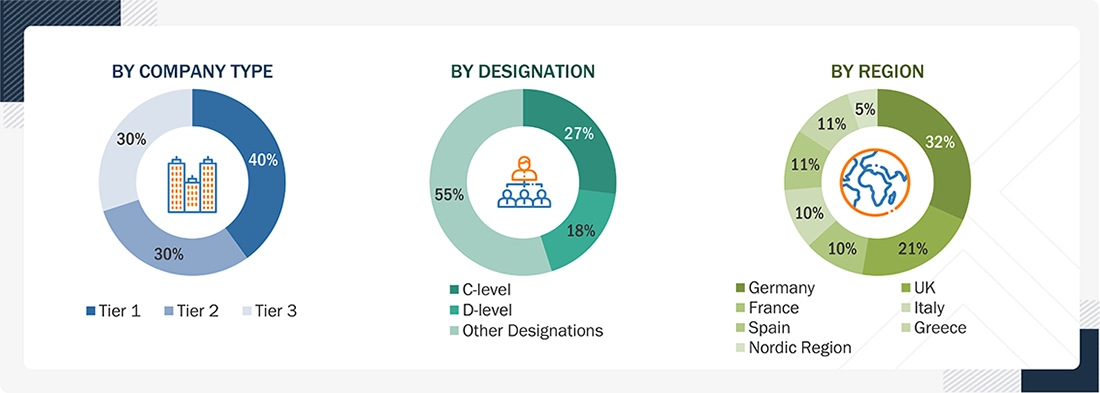
*Others include sales managers, marketing managers, business development managers, product managers, distributors, and suppliers.
Note: Companies are classified into tiers based on their total revenue. As of 2025, Tier 1 = >USD 1,000 million, Tier 2 = USD 500–1,000 million, and Tier 3 = USD 500 million.
To know about the assumptions considered for the study, download the pdf brochure
Market Size Estimation
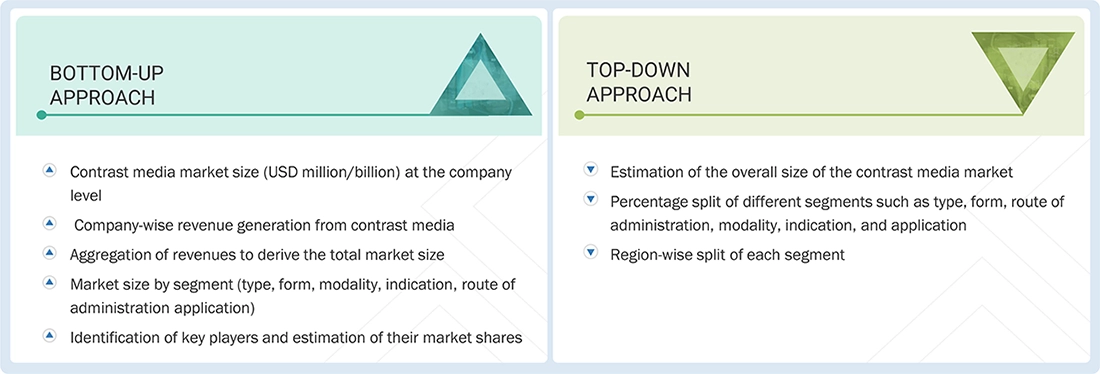
In this report, the contrast media market’s size was determined using the revenue share analysis of leading players. For this purpose, key market players were identified, and their market revenues were determined using insights gathered during the primary and secondary research phases. Secondary research included analyzing the annual and financial reports of the top market players. In contrast, primary research included extensive interviews with key opinion leaders, including CEOs, directors, and senior marketing executives.
Segmental revenues were calculated based on the revenue mapping of major solution/service providers to calculate the global market value. This process involved the following steps:
- Generating a list of major global players operating in the contrast media market.
- Mapping annual revenues generated by major global players from the type segment (or nearest reported business unit/product category)
- Revenue mapping of major players to cover a major share of the global market, as of 2025
- Extrapolating the global value of the contrast media market industry
Contrast Media Market : Top-Down and Bottom-Up Approach
Data Triangulation
After arriving at the overall market size through the market size estimation process explained above, the global contrast media market was segmented and subsegmented. Data triangulation and market breakdown procedures were employed to complete the overall market engineering process and obtain exact statistics for all segments and subsegments. The data was triangulated by studying various factors and trends from both the demand and supply sides. Additionally, the contrast media market was validated using top-down and bottom-up approaches.
Market Definition
Contrast media are administered to patients to enhance the visibility of internal organs, tissues, and blood vessels during diagnostic techniques such as X-ray, CT, MRI, and ultrasound. The market includes iodinated, gadolinium-based, microbubble, and barium-based contrast media used across hospitals, diagnostic centers, clinics, and ambulatory surgery centers.
Key Stakeholders
- Manufacturers and Suppliers
- Healthcare Providers
- Regulatory Authorities
- Distributors and Wholesalers
- Logistics and Cold-Chain Providers
- Healthcare IT and PACS Providers
- Training and Professional Associations
- Venture capitalists and investors
- Radiology centers
- Medical imaging and nuclear medicine consultants
Report Objectives
- To define, describe, and forecast the size of the contrast media market based on type, form, route of administration, modality, indication, application, end user, and region
- To provide detailed information regarding the major factors influencing the growth potential of the global contrast media market (drivers, restraints, opportunities, challenges, and trends)
- To analyze the micro markets with respect to individual growth trends, prospects, and contributions to the global contrast media market.
- To analyze key growth opportunities in the global contrast media market for key stakeholders and provide details of the competitive landscape for market leaders
- To forecast the size of market segments and/or subsegments with respect to five major regions, namely, North America (US and Canada), Europe (Germany, France, UK, Italy, Spain, and Rest of Europe), Asia Pacific (Japan, China, India, Australia, South Korea, and Rest of Asia Pacific), Latin America (Brazil, Mexico, and Rest of Latin America), and the Middle East & Africa
- To profile the key players in the contrast media market and comprehensively analyze their market shares and core competencies
- To track and analyze the competitive developments undertaken in the global contrast media market, such as product launches, agreements, expansions, and mergers & acquisitions
Available customizations:
Based on the given market data, MarketsandMarkets offers customizations tailored to the company’s specific needs. The following customization options are available for the present global contrast media market report:
Product Analysis
- Product matrix, which gives a detailed comparison of the product portfolios of the top five companies
Company Information
- Detailed analysis and profiling of additional market players (up to five)
Geographic Analysis
- Further breakdown of the Rest of Europe contrast media market into Russia, Belgium, the Netherlands, Switzerland, Austria, Finland, Sweden, Poland, and Portugal, among others
- Further breakdown of the Rest of Asia Pacific contrast media market into Singapore, Taiwan, New Zealand, the Philippines, Malaysia, and other APAC countries
- Further breakdown of the Latin American contrast media market into Colombia, Chile, Argentina, and Peru, among others
Fact checked
Personalize This Research
- Triangulate with your Own Data
- Get Data as per your Format and Definition
- Gain a Deeper Dive on a Specific Application, Geography, Customer or Competitor
- Any level of Personalization
Let Us Help You
- What are the Known and Unknown Adjacencies Impacting the Contrast Media Market
- What will your New Revenue Sources be?
- Who will be your Top Customer; what will make them switch?
- Defend your Market Share or Win Competitors
- Get a Scorecard for Target Partners

Custom Market Research Services
We Will Customise The Research For You, In Case The Report Listed Above Does Not Meet With Your Requirements
Get 10% Free CustomisationTESTIMONIALS

JAYANT RAJPUROHIT
Director of Market Insights, Data and Analytics
SFI Health,
Leading Pharmaceutical Companywww.sfihealth.com/

We at SFI Health approached MarketsandMarkets for an Opportunity Assessment on "Incidence and Prevalence of Focus Indications" as we wanted to know the most attractive HCPs like Physician, Functional MD, Naturopath and Pharmacist. The project was critical for us to ensure our focus on the right target which would enable sustainable growth and profitability for SFI Health. The business insights provided exceeded our expectations and we were extremely impressed. The team at MarketsandMarkets is highly professional and detail oriented and very well understood our business needs. MarketsandMarkets offers a unique combination of expertise and dedicated engagement model. We identified 2 new products to be launched in coming months, based on the research findings provided by MarketsandMarkets. We are happy with the services and would strongly recommend MarketsandMarkets to my peers in the industry.

BEATRIZ DE LA CALLE
Head of Commercial Analytics
Qualicaps,
Leading Pharmaceutical Companywww.qualicaps.com/

We partnered with MarketsandMarkets for an assessment study on hard empty capsules. The team was extremely professional in understanding our business requirements and we received timely responses to all our queries. The market intelligence and the recommendations has met our business requirements. We were extremely impressed to see the final study results; it really exceeded our expectations. The market intelligence offered by MarketsandMarkets, and clarity on next steps will help us achieve our business objective for the Year 2021. We are happy with the services and would strongly recommend MarketsandMarkets to my peers in the industry.

Bob Williams,
Senior Director Business Development & Innovation
Bracco Diagnostics Inc.,
Italian Multinational in life sciences sector and a World Leader in imaging diagnosticsimaging.bracco.com/us-en
We were pleased with targeted insights that MarketsandMarkets identified from a custom study on the 'Radiation Dose Management Solutions Market'. Your team identified and characterized the market participants as well as underlying trends accurately. This study was useful to Bracco in formulating business strategies for our dose monitoring product lines and we thank MarketsandMarkets for the job well done.
Cody Coonradt,
Market Development and Strategy Manager
3M Health Information Systems,
Leader in Health care Coding, Payment & Analytics Solutions.www.3m.com/3M/en_US/health-information-systems-us
The value for our organization comes from three things: depth of research, specificity of segments and being easy to work with. As important as the first two are, the third can't be underestimated. MarketsandMarkets, maybe more than any other research vendor, wants to know what is top of mind for our team and what big questions we are grappling to answer.
Their customer first approach and high value engagement model, have given us great analysis and excellent value for money
- Rest Of Europe Contrast Media Market
- Rest Of Asia Pacific Contrast Media Market
- US Contrast Media Market
- Canada Contrast Media Market
- Germany Contrast Media Market
- France Contrast Media Market
- UK Contrast Media Market
- Italy Contrast Media Market
- Spain Contrast Media Market
- China Contrast Media Market
- Japan Contrast Media Market
- India Contrast Media Market
- Australia Contrast Media Market
- South Korea Contrast Media Market
- Brazil Contrast Media Market
- Mexico Contrast Media Market
Growth opportunities and latent adjacency in Contrast Media Market






MarketsandMarkets
Jun, 2022
1) The contrast media/contrast agents market is segmented into barium-based contrast media, iodinated contrast media, gadolinium-based contrast media, and microbubble contrast media. In 2020, the iodinated contrast media segment accounted for the largest share of XX of the contrast media/contrast agents market. The large share of this segment can be attributed to the increasing demand for early disease diagnosis and image-guided procedures (resulting in a rising volume of CT and Xray procedures). 2) The barium-based contrast media market is expected to register low growth due to its limited use in various procedures and the associated adverse effects of these agents on organs. 3) Microbubble contrast agents are generally regarded as safe to use and are gaining popularity because of the large number of ongoing academic research activities exploring various attributes of microbubbles in off-label indications (in diagnosis as well as drug delivery). The growing number of approvals for microbubble contrast agents in major markets is also driving the growth of this market segment..
Pisal
May, 2022
We need the list of vendors in Contrast Media Market. Please help .
Elan
May, 2022
Can you please help us with study related to contrast media injectors market ?.
M.Y.Zahid
Nov, 2019
We intend to import and sale to our customer non ionic contract media, X-Ray, Angiography, CT, MRI users, Please send us price list. M.Y.Zahid, [email protected].
Orion
Jun, 2026
After reviewing the Contrast Media Market report, I see steady demand linked to rising imaging procedures, which makes me cautious about capacity planning for suppliers in this space..
Lyra
Jun, 2026
I find the segmentation of the Contrast Media Market particularly useful for understanding how iodinated and gadolinium-based agents are evolving alongside advances in CT and MRI workflows..
Nova
Jun, 2026
From an investment standpoint, the Contrast Media Market shows resilient growth drivers, but I would closely monitor regulatory pressure and safety concerns that could impact long-term margins..