



Medical Tubing Market
Report Code
CH 4564
Published in
Jul, 2026, By MarketsandMarkets™
Medical Tubing Market by Material (Plastics, Rubbers, Specialty Polymers), Application (Bulk Disposable Tubing, Catheters & Cannulas, Drug Delivery Systems), Structure (Single-Lumen, Multi-Lumen, Co-Extruded, Braided) - Global Forecast To 2031

USD 19.64 BN
MARKET SIZE, 2031

CAGR 7.9%
(2026-2031)

330
REPORT PAGES

260
MARKET TABLES
OVERVIEW
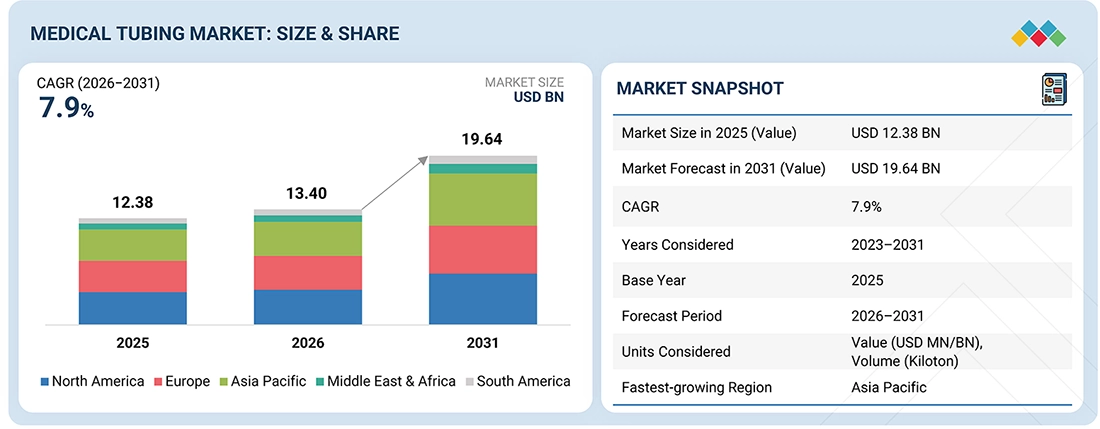
Source: Secondary Research, Interviews with Experts, MarketsandMarkets Analysis
The medical tubing market is projected to reach USD 19.64 billion by 2031 from USD 13.40 billion in 2026, at a CAGR of 7.9%. The global medical tubing market is experiencing strong growth, driven by the rising demand for advanced medical devices, increasing adoption of minimally invasive procedures, growing preference for single-use and disposable medical products, and expanding pharmaceutical and biotechnology industries. Rising healthcare expenditure, continuous advancements in medical-grade material technologies, and increasing investments in healthcare infrastructure across both developed and emerging economies are further supporting market growth worldwide.
KEY TAKEAWAYS
-
BY REGIONBy region, North America accounted for 30.6% of the medical tubing market in 2026, driven by advanced healthcare infrastructure, high healthcare spending, and the strong presence of leading medical device manufacturers across the region.
-
BY MATERIALBy material, the rubbers segment accounted for 57.3% of the market in 2026, owing to its excellent flexibility, biocompatibility, durability, and resistance to chemicals and sterilization processes.
-
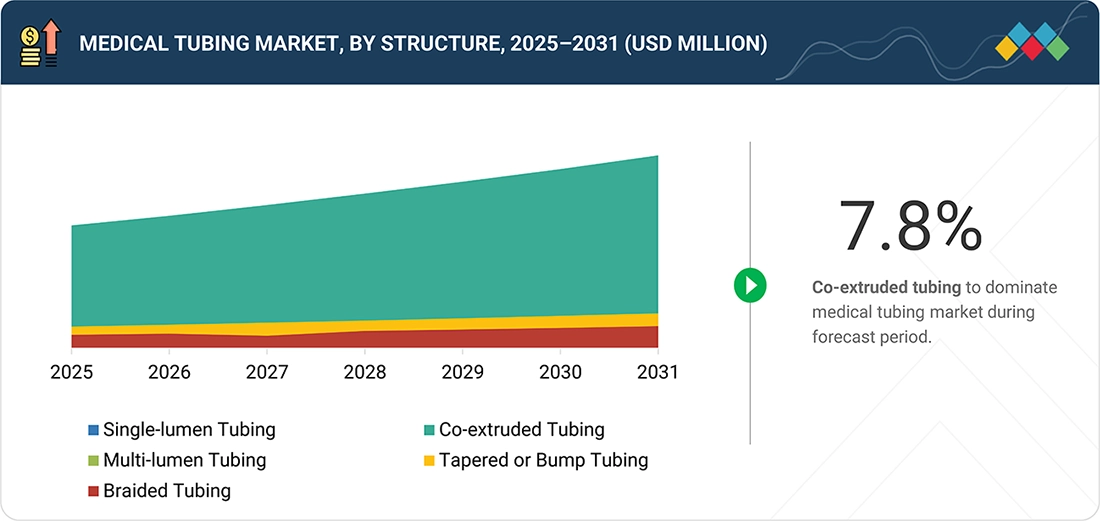
BY STRUCTUREBy structure, the co-extruded tubing segment accounted for 59.9% of the market in 2026, owing to its superior mechanical strength, enhanced barrier properties, multi-material functionality, and increasing adoption in advanced medical devices.
-
BY APPLICATIONBy application, the catheters & cannulas segment accounted for 49.3% of the market in 2026, driven by the rising number of minimally invasive procedures, the increasing prevalence of chronic diseases, and the growing demand for precision fluid management devices.
-
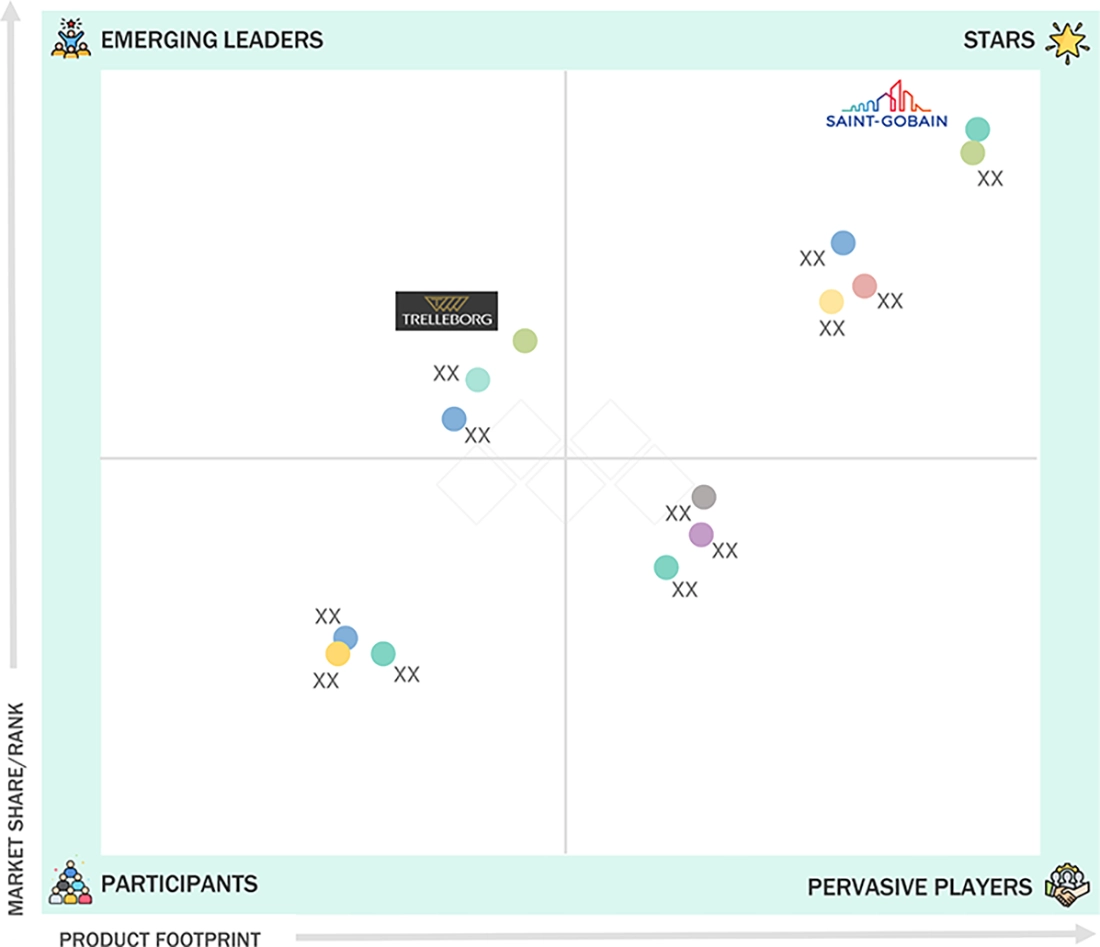
COMPETITIVE LANDSCAPE - KEY PLAYERSSaint-Gobain, Freudenberg Medical, W. L. Gore & Associates, Inc., and The Lubrizol Corporation were identified as some of the star players in the medical tubing market (global), given their strong market share and product footprint.
-
COMPETITIVE LANDSCAPE - STARTUPS/SMESOptinova and ICU Medical, Inc. have distinguished themselves among startups and SMEs by securing strong footholds in specialized niche areas, underscoring their potential as emerging market leaders.
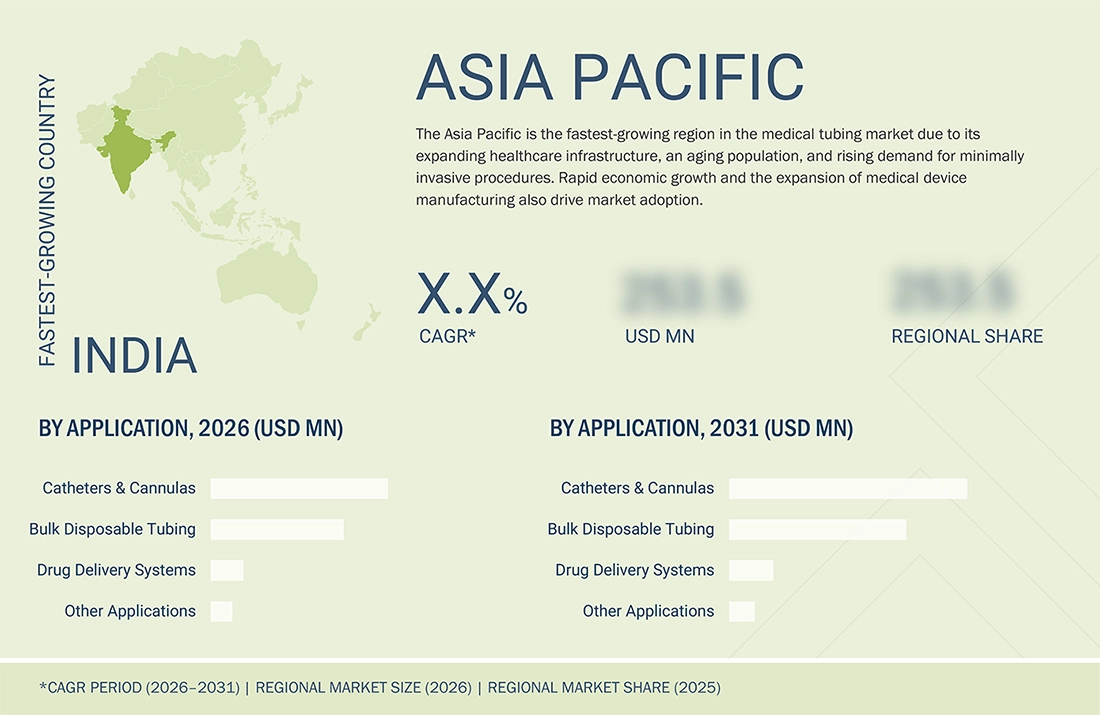
The global medical tubing market is experiencing regional growth, driven by expanding healthcare infrastructure and increasing demand for advanced medical devices. The Asia Pacific region is the fastest-growing market, driven by expanding healthcare infrastructure, increasing medical device manufacturing, rising healthcare expenditure, and rapid growth in China, India, Japan, South Korea, and Southeast Asia. North America is seeing strong demand, fueled by high healthcare expenditure, a well-established medical device manufacturing industry, and increasing adoption of minimally invasive procedures. Europe is supported by stringent regulatory standards, growing demand for high-quality medical devices, and rising investments in healthcare modernization. Meanwhile, South America and the Middle East & Africa are seeing gradual growth, supported by improving healthcare infrastructure, increasing government healthcare investments, and expanding access to advanced medical technologies.
TRENDS & DISRUPTIONS IMPACTING CUSTOMERS' CUSTOMERS
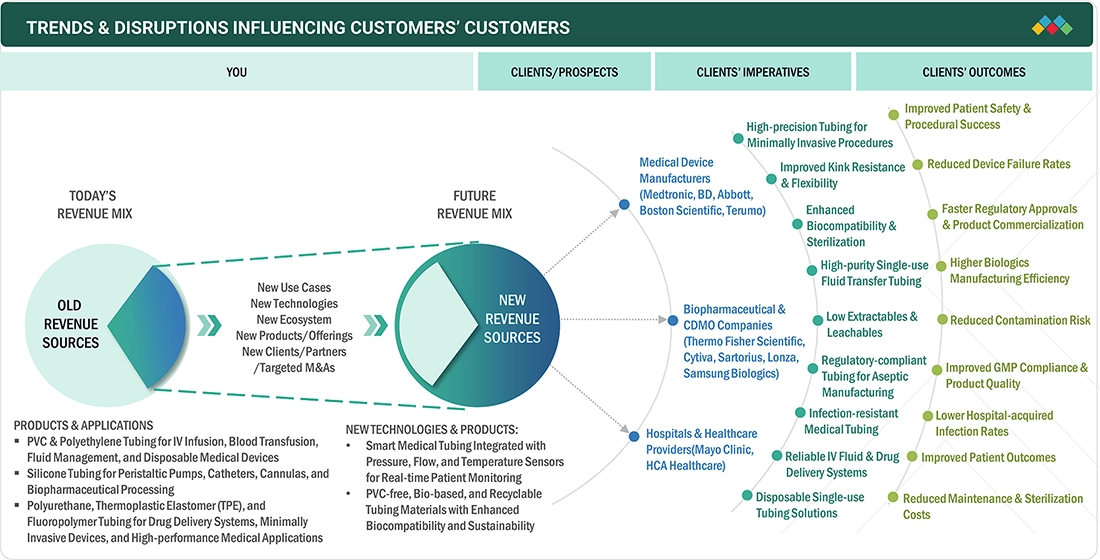
Technological advancements and evolving healthcare demands are driving major disruptions across the medical device, pharmaceutical, and biotechnology sectors. A growing focus on minimally invasive procedures, patient safety, precision drug delivery, and next-generation medical devices is accelerating innovation and creating new growth opportunities across the value chain. The shift from conventional tubing to multi-layer co-extruded, braided, and high-performance specialty polymer tubing, along with the development of smart tubing technologies, antimicrobial materials, and advanced biocompatible polymers, is reshaping the competitive landscape.
Source: Secondary Research, Interviews with Experts, MarketsandMarkets Analysis
MARKET DYNAMICS

Drivers
Impact
Level
Level
-
Growing geriatric population

-
Increasing demand for minimally invasive medical procedures


RESTRAINTS
Impact
Level
Level
-
Limited material compatibility

-
Environmental and disposal concerns


OPPORTUNITIES
Impact
Level
Level
-
Advancements in biocompatible and smart materials

-
Increasing governmental expenditure for upgrading and developing healthcare infrastructure


CHALLENGES
Impact
Level
Level
-
High production costs and marketing complexities

Source: Secondary Research, Interviews with Experts, MarketsandMarkets Analysis
Driver: Growing geriatric population
The medical tubing market is growing steadily due to the rising geriatric population and increasing prevalence of chronic diseases worldwide. As the demand for healthcare services increases, hospitals and medical facilities are expanding their capabilities and adopting advanced medical devices. These devices require reliable tubing solutions for applications such as fluid management, drug delivery, minimally invasive procedures, and patient care. Medical tubing is widely preferred due to its biocompatibility, flexibility, durability, and safe performance in critical healthcare environments. As healthcare systems continue to evolve globally, the demand for advanced medical tubing solutions is expected to increase.
Restraint: Limited material compatibility
Despite strong growth potential, the medical tubing market faces challenges due to limited material compatibility with certain medical applications and stringent performance requirements. Manufacturers must ensure that tubing materials meet specific standards related to chemical resistance, sterilization, biocompatibility, and long-term reliability. Compatibility issues with drugs, fluids, and sterilization processes can restrict material selection and increase development complexity. Additionally, the need for specialized materials and higher production costs may limit adoption, particularly in cost-sensitive markets.
Opportunity: Advancements in biocompatible and smart materials
Significant growth opportunities in the medical tubing market are emerging due to advancements in biocompatible materials, specialty polymers, and smart tubing technologies. Increasing investments in healthcare infrastructure, especially in emerging economies, are supporting the adoption of advanced medical devices. The growing demand for minimally invasive procedures, drug delivery systems, catheter-based technologies, and biopharmaceutical processing is creating new opportunities for high-performance tubing solutions. Additionally, the integration of smart sensors and advanced monitoring capabilities into medical tubing is enabling real-time patient monitoring and improved clinical outcomes.
Challenge: High production costs and marketing complexities
The medical tubing market faces challenges associated with complex manufacturing processes and stringent quality requirements. Producing high-precision tubing with consistent performance, dimensional accuracy, and compliance with global medical standards requires advanced extrusion technologies and specialized expertise. Furthermore, fluctuations in raw material prices, supply chain disruptions, and the need for continuous innovation in material development increase production costs and create challenges for manufacturers operating in a competitive market.
MEDICAL TUBING MARKET: COMMERCIAL USE CASES ACROSS INDUSTRIES
| COMPANY | USE CASE DESCRIPTION | BENEFITS |
|---|---|---|
 |
Saint-Gobain manufactures a broad portfolio of medical-grade tubing, including silicone, thermoplastic elastomer (TPE), PVC, and specialty polymer tubing used in IV infusion systems, peristaltic pumps, catheters, biopharmaceutical processing, and surgical drainage applications. | Its medical tubing offers excellent chemical compatibility with common drug formulations, low extractables and leachables profiles, consistent dimensional tolerances for leak-free connections, and kink resistance critical for uninterrupted fluid delivery in clinical settings. |
 |
Freudenberg Medical specializes in silicone, PEEK, polyurethane, multi-lumen, and micro-extruded tubing for catheter systems, implantable devices, biopharmaceutical fluid transfer, and minimally invasive procedures. | Its tubing solutions withstand high burst pressures without deformation, maintain dimensional stability across sterilization cycles (including EtO and gamma irradiation), exhibit low protein adsorption for drug-contact lumens, and offer custom multi-lumen configurations that reduce device assembly complexity. |
 |
Lubrizol provides provides medical-grade thermoplastic polyurethane (TPU) materials used in catheter shafts, vascular access devices, drug delivery systems, and minimally invasive medical devices. | Lubrizol's tubing materials are inherently biocompatible and hemocompatible for blood-contacting applications, resistant to kinking and permanent deformation, bondable with standard medical adhesives, sterilization-compatible, and capable of being co-extruded with radiopaque fillers or drug-eluting compounds for advanced catheter functionality. |
 |
W. L. Gore & Associates manufactures ePTFE and fluoropolymer-based tubing used in bioprocessing fluid transfer lines, minimally invasive surgical tubing, and high-purity pharmaceutical fluid pathways. | Gore's tubing provides exceptional resistance to a wide range of aggressive pharmaceutical solvents and sterilants, ultra-smooth inner bore surfaces that minimize particulate shedding and bacterial adhesion, stable flow performance under pressure fluctuations, and compliance with FDA 21 CFR and USP standards for use in drug manufacturing and delivery environments. |
Logos and trademarks shown above are the property of their respective owners. Their use here is for informational and illustrative purposes only.
MARKET ECOSYSTEM
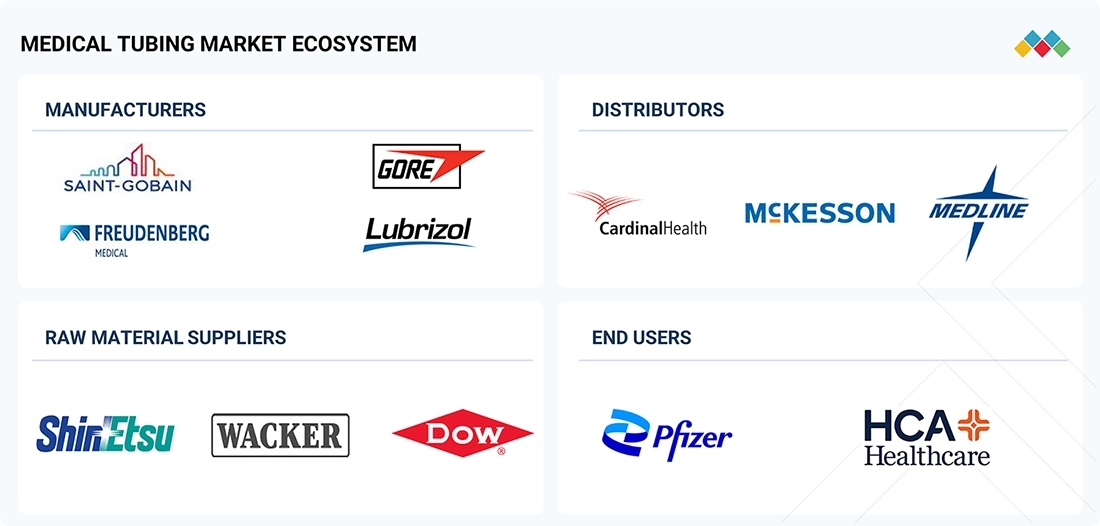
The medical tubing ecosystem analysis identifies and evaluates the interconnected relationships among key stakeholders, including raw material suppliers, tubing manufacturers, OEMs, distributors, healthcare providers, and end users. Raw material suppliers provide essential inputs such as plastics, rubbers, and specialty medical-grade polymers. Medical device manufacturers and OEMs convert these materials into high-performance tubing solutions used in catheters, IV systems, drug delivery devices, dialysis equipment, and respiratory care systems. Regulatory bodies and standards organizations define compliance requirements through stringent safety, biocompatibility, and quality regulations, influencing product design and material selection. Distributors and healthcare supply chains play a critical role in ensuring efficient availability of tubing products across hospitals, clinics, and pharmaceutical facilities. End users across hospitals, ambulatory surgical centers, diagnostic laboratories, pharmaceutical companies, and biotechnology firms drive demand for safe, precise, and reliable fluid management solutions.
Logos and trademarks shown above are the property of their respective owners. Their use here is for informational and illustrative purposes only.
MARKET SEGMENTS
Source: Secondary Research, Interviews with Experts, MarketsandMarkets Analysis
Medical Tubing Market, by Material
Specialty polymers are the fastest-growing material segment in the global medical tubing market. Their rising adoption is driven by excellent mechanical strength, high thermal stability, superior chemical resistance, and outstanding biocompatibility. Specialty polymer-based tubing provides reliable performance under demanding medical conditions while maintaining long-term durability and dimensional stability. Its ability to withstand repeated sterilization cycles and harsh clinical environments makes it suitable for advanced applications, including minimally invasive devices, catheter systems, drug delivery systems, and implantable medical components. Increasing demand for high-performance materials and next-generation medical devices is further accelerating the growth of specialty polymers in the global medical tubing market.
Medical Tubing Market, by Structure
Co-extruded tubing is the largest segment of the global medical tubing structure market. Its dominance is driven by the ability to combine multiple layers into a single tubing system, enabling superior mechanical strength, enhanced barrier properties, and improved flexibility. This multi-layer construction allows optimization of performance characteristics such as chemical resistance, kink resistance, and controlled fluid transfer, making it highly suitable for complex medical applications. Co-extruded tubing is widely used in critical healthcare areas such as IV systems, catheter assemblies, drug delivery devices, and advanced surgical procedures where precision and reliability are essential. Its strong compatibility with medical-grade materials and ability to meet stringent performance and regulatory requirements further support its widespread adoption. Due to the increasing demand for high-performance, multifunctional tubing solutions in modern medical devices, co-extruded tubing continues to hold the largest share of the global medical tubing market.
Medical Tubing Market, by Application
Catheters & cannulas are the largest segment in the global medical tubing application market. Its dominance is driven by the widespread use of these devices in critical and routine healthcare procedures requiring precise fluid and gas delivery. Medical tubing plays a vital role in ensuring safe insertion, controlled flow, and reliable performance in these applications, making it essential for patient care. The increasing prevalence of chronic diseases, the growing number of surgical and diagnostic procedures, and the rising adoption of minimally invasive treatments are further accelerating demand. Catheters and cannulas are widely used in hospitals, ambulatory surgical centers, and emergency care settings, where sterility, biocompatibility, and reliability of performance are critical. As a result, this segment continues to hold the largest share in the global medical tubing market.
REGION
Asia Pacific to be fastest-growing market for medical tubing during forecast period
The medical tubing market in the Asia Pacific is growing rapidly, supported by expanding healthcare infrastructure, increasing healthcare expenditure, and the growing presence of medical device manufacturers. The region benefits from rising demand for advanced medical technologies, increasing surgical procedures, and growing adoption of minimally invasive treatments. The rising prevalence of chronic diseases, improving healthcare access, and the growth of pharmaceutical and biopharmaceutical manufacturing are further driving market expansion. Overall, increasing investments in healthcare infrastructure, favorable manufacturing capabilities, and growing demand for cost-effective medical devices position the Asia Pacific as a key growth market for medical tubing.
MEDICAL TUBING MARKET: COMPANY EVALUATION MATRIX
In the medical tubing market matrix, Saint-Gobain (Star), a France-based company, leads the market through its high-performance medical tubing solutions, including thermoplastic and specialty polymer-based systems, which find extensive applications across fluid management, biopharmaceutical processing, laboratory systems, and drug delivery applications. Trelleborg AB (Emerging Leader) is gaining traction with its advanced polymer engineering capabilities and precision medical tubing solutions used in fluid transfer, catheter-based systems, and other critical healthcare applications, supported by continuous innovation in high-performance medical materials and manufacturing technologies.
Source: Secondary Research, Interviews with Experts, MarketsandMarkets Analysis
KEY MARKET PLAYERS
- Saint-Gobain (France)
- Freudenberg Medical (US)
- W. L. Gore & Associates, Inc. (US)
- The Lubrizol Corporation (US)
- Nordson Corporation (US)
- TE Connectivity (Switzerland)
- Elkem ASA (Norway)
- Trelleborg AB (Sweden)
- RAUMEDIC AG (Germany)
- Teknor Apex (US)
MARKET SCOPE
| REPORT METRIC | DETAILS |
|---|---|
| Market Size in 2025 (Value) | USD 12.38 Billion |
| Market Forecast in 2026 (Value) | USD 13.40 Billion |
| Market Forecast in 2031 (Value) | USD 19.64 Billion |
| Growth Rate | CAGR of 7.9% from 2026–2031 |
| Years Considered | 2023–2031 |
| Base Year | 2025 |
| Forecast Period | 2026–2031 |
| Units Considered | Value (USD Million/Billion), Volume (Kiloton) |
| Report Coverage | Revenue Forecast, Company Ranking, Competitive Landscape, Growth Factors, Trends |
| Segments Covered |
|
| Regions Covered | North America, Asia Pacific, Europe, South America, Middle East & Africa |
WHAT IS IN IT FOR YOU: MEDICAL TUBING MARKET REPORT CONTENT GUIDE
DELIVERED CUSTOMIZATIONS
We have successfully delivered the following deep-dive customizations:
| CLIENT REQUEST | CUSTOMIZATION DELIVERED | VALUE ADDS |
|---|---|---|
| Leading Medical Tubing Supplier |
|
Supported go-to-market strategy and positioning vs. competitors |
| Country-level insights for high-growth regions | Provided detailed market sizing and forecasts for the Asia Pacific and North America markets | Helped the client identify region-specific growth hotspots and investment opportunities |
| Identify emerging medical tubing technologies | Conducted technology scouting and feasibility analysis for advanced materials and smart tubing solutions | Supported investment decisions and innovation roadmap for clients |
| Evaluate regulatory compliance for new market entry | Compiled country-specific regulatory requirements, biocompatibility standards, and quality certifications | Ensured smooth market entry and minimized legal risks |
RECENT DEVELOPMENTS
- June 2026: The Lubrizol Corporation, in collaboration with Polyhose, inaugurated a new medical manufacturing facility in Chennai, India, dedicated to producing precision-extruded medical tubing for minimally invasive neurovascular and cardiovascular devices. The ISO 13485-certified facility uses materials including polyamides, nylon, Pebax®, polypropylene, polyethylene, and Lubrizol’s medical-grade TPU, and expands regional production capacity for medical tubing serving Indian and global customers.
- November 2025: Freudenberg Medical acquired Fuji Seiko, a Japan-based manufacturer specializing in high-precision metal tubing. The acquisition strengthened Freudenberg Medical’s precision-tubing capabilities and expanded its manufacturing footprint for minimally invasive medical-device applications, making it a directly relevant development for the medical-tubing value chain.
- July 2025 : Saint-Gobain expanded its partnership with Qosina, a major global supplier of medical device components. The agreement added multiple new Saint-Gobain tubing SKUs (including bioprocessing and medical-grade tubing) to Qosina’s distribution portfolio. This enables broader availability of Saint-Gobain’s medical tubing products across OEM and biopharma supply chains, along with improved access to technical documentation, specifications, and ordering channels.
- June 2025 : Lubrizol expanded its collaboration with IMCD to strengthen the distribution of medical-grade thermoplastic polyurethane (TPU) solutions across North America. The agreement extends their existing partnership in Europe to the US and Canada, enabling improved market penetration, inventory management, and customer access to Lubrizol’s medical TPU portfolio for medical device applications.
- November 2024 : Freudenberg Medical expanded its new manufacturing facility in Carrick-on-Shannon, Co. Leitrim, Ireland. The 16,500 sq. ft. addition has increased the site's total footprint to 157,000 sq. ft. and strengthened its capacity and capabilities to manufacture advanced catheters used in electrophysiology, structural heart, and peripheral vascular therapies.
Table of Contents
 Exclusive indicates content/data unique to MarketsandMarkets and not available with any competitors.
TITLE
PAGE NO
1
INTRODUCTION
25
2
EXECUTIVE SUMMARY
29
3
PREMIUM INSIGHTS
34
4
MARKET OVERVIEW
Explore booming healthcare innovations amid stringent regulations and evolving market dynamics.
37
4.1
INTRODUCTION
4.2
MARKET DYNAMICS
4.2.1
DRIVERS
4.2.1.1
GROWING AGING POPULATION AND CHRONIC DISEASES
4.2.1.2
INCREASING HEALTHCARE INFRASTRUCTURE INVESTMENTS
4.2.1.3
INCREASING DEMAND FOR MINIMALLY INVASIVE MEDICAL PROCEDURES
4.2.1.4
ADVANCEMENTS IN EXTRUSION TECHNOLOGY
4.2.1.5
STRINGENT QUALITY STANDARDS AND REGULATIONS
4.2.2
RESTRAINTS
4.2.2.1
LIMITED MATERIAL COMPATIBILITY
4.2.2.2
ENVIRONMENTAL AND DISPOSAL CONCERNS
4.2.3
OPPORTUNITIES
4.2.3.1
ADVANCEMENTS IN BIOCOMPATIBLE AND SMART MATERIALS
4.2.3.2
EXPANSION OF MEDICAL TOURISM AND HIGH-END HEALTHCARE FACILITIES
4.2.4
CHALLENGES
4.2.4.1
HIGH PRODUCTION COSTS AND MARKETING COMPLEXITIES
4.3
UNMET NEEDS AND WHITE SPACES
4.3.1
UNMET NEEDS IN MEDICAL TUBING MARKET
4.3.2
WHITE SPACE OPPORTUNITIES
4.4
INTERCONNECTED MARKETS AND CROSS-SECTOR OPPORTUNITIES
4.4.1
INTERCONNECTED MARKETS
4.4.2
CROSS-SECTOR OPPORTUNITIES
4.5
EMERGING BUSINESS MODELS AND ECOSYSTEM SHIFTS
4.5.1
EMERGING BUSINESS MODELS
4.5.2
ECOSYSTEM SHIFTS
4.6
STRATEGIC MOVES BY TIER 1/2/3 PLAYERS
4.6.1
KEY MOVES AND STRATEGIC FOCUS
4.7
PORTER’S FIVE FORCES ANALYSIS
4.7.1
THREAT OF NEW ENTRANTS
4.7.2
THREAT OF SUBSTITUTES
4.7.3
BARGAINING POWER OF SUPPLIERS
4.7.4
BARGAINING POWER OF BUYERS
4.7.5
INTENSITY OF COMPETITIVE RIVALRY
5
INDUSTRY TRENDS
Navigate global regulatory landscapes and trade dynamics shaping the medical tubing industry's future.
51
5.1
INTRODUCTION
5.2
VALUE CHAIN ANALYSIS
5.3
REGULATORY LANDSCAPE
5.3.1
REGULATIONS
5.3.1.1
NORTH AMERICA
5.3.1.2
ASIA PACIFIC
5.3.1.3
EUROPE
5.3.2
STANDARDS
5.3.2.1
ISO STANDARD
5.3.2.2
FOOD AND DRUG ADMINISTRATION (FDA)
5.3.2.3
ASTM (AMERICAN SOCIETY FOR TESTING AND MATERIALS) STANDARDS
5.3.3
REGULATORY BODIES, GOVERNMENT AGENCIES, AND OTHER ORGANIZATIONS
5.4
TRADE ANALYSIS
5.4.1
IMPORT SCENARIO (HS CODE 3917)
5.4.2
EXPORT SCENARIO (HS CODE 3917)
5.5
ECOSYSTEM ANALYSIS
5.6
TRENDS/DISRUPTIONS IMPACTING CUSTOMER BUSINESS
5.7
CASE STUDY ANALYSIS
5.7.1
FREUDENBERG MEDICAL TO PROVIDE SPECIALTY BALLOON CATHETERS
5.7.2
W. L. GORE & ASSOCIATES, INC. PROVIDES GORE STA-PURE PUMP TUBING
6
TECHNOLOGICAL ADVANCEMENTS, AI-DRIVEN IMPACT, PATENTS, INNOVATIONS, AND FUTURE APPLICATIONS
AI-driven innovations redefine medical tubing with sustainable, minimally invasive technologies and strategic patent insights.
62
6.1
TECHNOLOGY ANALYSIS
6.1.1
KEY TECHNOLOGIES
6.1.1.1
EXTRUSION TECHNOLOGY
6.1.1.2
ADVANCED MATERIAL TECHNOLOGIES
6.1.2
COMPLEMENTARY TECHNOLOGIES
6.1.2.1
SMART TECHNOLOGIES AND CONNECTIVITY
6.1.2.2
SURFACE TREATMENT AND MODIFICATION
6.2
KEY CONFERENCES AND EVENTS, 2026–2027
6.3
PATENT ANALYSIS
6.3.1
METHODOLOGY
6.3.2
DOCUMENT TYPES
6.3.3
PUBLICATION TRENDS IN LAST 10 YEARS
6.3.4
INSIGHTS
6.3.5
LEGAL STATUS OF PATENTS
6.3.6
JURISDICTION ANALYSIS
6.3.7
TOP APPLICANTS
6.4
FUTURE APPLICATIONS
6.4.1
ADVANCED, MINIMALLY INVASIVE, AND ROBOTIC SURGERY
6.4.2
CARDIOVASCULAR AND NEUROVASCULAR INTERVENTIONS
6.4.3
CELL AND GENE THERAPY
6.4.4
SUSTAINABLE MEDICAL TUBING
6.5
IMPACT OF AI/GEN AI ON MEDICAL TUBING MARKET
6.6
PRICING ANALYSIS
6.6.1
AVERAGE SELLING PRICE, BY REGION, 2022–2025
6.6.2
AVERAGE SELLING PRICE FOR TOP THREE APPLICATIONS, BY KEY PLAYER, 2025
6.6.3
AVERAGE SELLING PRICE TREND, BY MATERIAL, 2022–2025
6.7
INVESTMENT AND FUNDING SCENARIO
6.8
ADOPTION BARRIERS & INTERNAL CHALLENGES
6.9
UNMET NEEDS IN VARIOUS END-USE INDUSTRIES
6.10
MARKET PROFITABILITY
6.10.1
REVENUE POTENTIAL
6.10.2
COST DYNAMICS
6.10.3
MARGIN OPPORTUNITIES IN KEY END-USE SECTORS
7
CUSTOMER LANDSCAPE & BUYER BEHAVIOR
Understand key stakeholders and criteria shaping purchasing decisions amid evolving US tariff impacts.
75
7.1
INTRODUCTION
7.2
DECISION-MAKING PROCESS
7.3
KEY STAKEHOLDERS AND BUYING CRITERIA
7.3.1
KEY STAKEHOLDERS IN BUYING PROCESS
7.3.2
BUYING CRITERIA
7.4
MACROECONOMIC INDICATORS
7.4.1
HEALTHCARE EXPENDITURES
7.5
IMPACT OF 2025 US TARIFF – OVERVIEW
7.5.1
INTRODUCTION
7.5.2
KEY TARIFF RATES
7.5.3
PRICE IMPACT ANALYSIS
7.5.4
IMPACT ON COUNTRY/REGION
7.5.4.1
US
7.5.4.2
EUROPE
7.5.4.3
ASIA PACIFIC
7.5.5
IMPACT ON END-USE INDUSTRIES
8
MEDICAL TUBING MARKET, BY APPLICATION
Market Size & Growth Rate Forecast Analysis to 2031 in USD Million and Kilotons | 4 Data Tables
82
8.1
INTRODUCTION
8.2
BULK DISPOSABLE TUBING
8.2.1
DEMAND FROM HOSPITALS, HOME HEALTHCARE PROVIDERS, AND EMERGENCY CARE PROVIDERS TO BOOST MARKET
8.2.2
DIALYSIS TUBING
8.2.2.1
GROWING AGING POPULATION TO DRIVE DEMAND
8.2.3
INTRAVENOUS TUBING
8.2.3.1
TECHNOLOGICAL ADVANCEMENTS TO DRIVE MARKET
8.3
CATHETERS & CANNULAS
8.3.1
RISING CARDIOVASCULAR DISEASES AND DEMAND FOR MINIMALLY INVASIVE SURGICAL PROCEDURES TO DRIVE MARKET
8.3.2
CATHETERS
8.3.2.1
INCREASE IN CHRONIC DISEASES CONTRIBUTING TO SIGNIFICANT DEMAND
8.3.2.2
CARDIOVASCULAR CATHETERS
8.3.2.2.1
GROWING ELDERLY POPULATION AND HIGH INCIDENCE OF CARDIOVASCULAR DISEASES TO DRIVE MARKET
8.3.2.3
IV CATHETERS
8.3.2.3.1
DEMAND FOR DIRECT DELIVERY OF MEDICATION AND NUTRIENTS INTO BLOODSTREAM TO FUEL GROWTH
8.3.2.4
URINARY CATHETERS
8.3.2.4.1
RISING INCIDENCES OF URINARY TRACT INFECTIONS AND GROWING NEED FOR ADVANCED TECHNOLOGIES TO DRIVE DEMAND
8.3.3
CANNULAS
8.3.3.1
EVOLVING HEALTHCARE SECTOR AND STRINGENT REGULATORY REQUIREMENTS TO SUPPORT MARKET GROWTH
8.4
DRUG DELIVERY SYSTEMS
8.4.1
PRECISE DRUG DELIVERY TO TARGET SITES TO DRIVE DEMAND
8.4.2
NASOGASTRIC
8.4.2.1
NEED FOR ENTERAL FEEDING AND DRAINAGE TO FUEL DEMAND
8.4.3
NEBULIZERS
8.4.3.1
CONVERSION OF LIQUID MEDICATIONS TO MISTS FOR INHALATION TO DRIVE MARKET
8.5
OTHER APPLICATIONS
8.5.1
PERISTALTIC PUMP TUBING
8.5.1.1
WIDE DEMAND FOR MINIMIZING CONTAMINATION TO BOOST MARKET
8.5.2
GAS SUPPLY TUBING
8.5.2.1
INCREASING MINIMALLY INVASIVE SURGERIES TO SUPPORT MARKET GROWTH
8.5.3
SMOKE EVACUATION TUBING
8.5.3.1
POPULARITY OF COSMETIC PROCEDURES AND MEDICAL TOURISM TO DRIVE MARKET
9
MEDICAL TUBING MARKET, BY MATERIAL
Market Size & Growth Rate Forecast Analysis to 2031 in USD Million and Kilotons | 4 Data Tables
91
9.1
INTRODUCTION
9.2
PLASTICS
9.2.1
BIOCOMPATIBILITY, CHEMICAL STABILITY, AND COST-EFFECTIVENESS TO BOOST MARKET
9.2.2
POLYVINYL CHLORIDE (PVC)
9.2.3
POLYOLEFIN
9.2.3.1
POLYETHYLENE (PE)
9.2.3.2
POLYPROPYLENE (PP)
9.2.4
POLYAMIDE
9.2.5
POLYTETRAFLUOROETHYLENE (PTFE)
9.2.6
POLYETHER ETHER KETONE (PEEK)
9.2.7
POLYCARBONATE (PC)
9.3
RUBBERS
9.3.1
SIGNIFICANT DURABILITY AND RESILIENCE TO DRIVE DEMAND
9.3.2
THERMOPLASTIC ELASTOMER (TPE)
9.3.3
THERMOPLASTIC POLYURETHANE (TPU)
9.3.4
SILICONE
9.3.5
POLYURETHANE (PU)
9.3.6
ETHYLENE PROPYLENE DIENE MONOMER (EPDM)
9.3.7
LATEX
9.4
SPECIALTY POLYMERS
9.4.1
BIOABSORBABLE POLYMERS
9.4.2
ETHYLENE VINYL ACETATE (EVA)
9.5
OTHER MATERIALS
10
MEDICAL TUBING MARKET, BY STRUCTURE
Market Size & Growth Rate Forecast Analysis to 2031 in USD Million and Kilotons | 4 Data Tables
99
10.1
INTRODUCTION
10.2
SINGLE-LUMEN
10.2.1
DEMAND FOR ADMINISTRATION OF FLUIDS AND MEDICATION, AIRWAY MANAGEMENT, AND PATIENT NUTRITION TO DRIVE MARKET
10.3
CO-EXTRUDED
10.3.1
DURABILITY, LUBRICITY, OPACITY, RADIOPACITY, AND TENSILE STRENGTH TO BOOST MARKET
10.4
MULTI-LUMEN
10.4.1
NON-TOXICITY, BIOCOMPATIBILITY, AND INERTNESS TO FUEL MARKET DEMAND
10.5
TAPERED OR BUMP TUBING
10.5.1
ENHANCED FUNCTIONALITIES IN CVC, PICC, AND DRUG DELIVERY CATHETERS TO DRIVE MARKET
10.6
BRAIDED TUBING
10.6.1
GOOD STRENGTH, STEERABILITY, AND PRESSURE RESISTANCE TO DRIVE MARKET
11
MEDICAL TUBING MARKET, BY REGION
Comprehensive coverage of 8 Regions with country-level deep-dive of 19 Countries | 140 Data Tables.
105
11.1
INTRODUCTION
11.2
NORTH AMERICA
11.2.1
US
11.2.1.1
HIGH DISPOSABLE INCOME AND STRONG HEALTHCARE INFRASTRUCTURE TO DRIVE MARKET
11.2.2
CANADA
11.2.2.1
AGING POPULATION AND INCREASING HEALTHCARE EXPENDITURE TO SUPPORT MARKET GROWTH
11.2.3
MEXICO
11.2.3.1
HIGH INVESTMENTS AND LOW MANUFACTURING COSTS TO FUEL DEMAND
11.3
EUROPE
11.3.1
GERMANY
11.3.1.1
ADVANCED MEDICAL FACILITIES AND R&D INVESTMENTS TO DRIVE MARKET
11.3.2
FRANCE
11.3.2.1
RISING ELDERLY POPULATION TO FUEL MARKET GROWTH
11.3.3
UK
11.3.3.1
INNOVATION, TECHNOLOGICAL ADVANCEMENTS, AND INVESTMENTS TO DRIVE MARKET
11.3.4
SPAIN
11.3.4.1
GROWING AGING POPULATION AND IMPROVEMENTS IN HEALTHCARE SYSTEM TO INCREASE CONSUMPTION
11.3.5
ITALY
11.3.5.1
GROWING GERIATRIC POPULATION AND STRONG FOCUS ON RESEARCH AND INNOVATION TO DRIVE MARKET
11.3.6
NETHERLANDS
11.3.6.1
RISING HOME CARE TREATMENT TO INCREASE DEMAND
11.3.7
REST OF EUROPE
11.4
ASIA PACIFIC
11.4.1
CHINA
11.4.1.1
INVESTMENTS IN MANUFACTURING MEDICAL DEVICES TO SUPPORT MARKET
11.4.2
JAPAN
11.4.2.1
JAPAN’S AGING POPULATION INCREASES DEMAND FOR MEDICAL TUBING
11.4.3
INDIA
11.4.3.1
GOVERNMENT INITIATIVES, HIGH PURCHASING POWER, AND RISING MANUFACTURING OUTPUT TO FUEL DEMAND
11.4.4
SOUTH KOREA
11.4.4.1
MEDICAL TOURISM TO LEAD TO MARKET GROWTH
11.4.5
REST OF ASIA PACIFIC
11.5
MIDDLE EAST & AFRICA
11.5.1
GCC COUNTRIES
11.5.1.1
SAUDI ARABIA
11.5.1.1.1
GOVERNMENT INITIATIVES TO SUPPORT MARKET GROWTH
11.5.1.2
UAE
11.5.1.2.1
GOVERNMENT FUNDING AND RAPIDLY DEVELOPING PRIVATE HEALTH SECTOR TO DRIVE MARKET
11.5.1.3
REST OF GCC
11.5.1.3.1
GOVERNMENT FUNDING AND RAPIDLY DEVELOPING PRIVATE HEALTH SECTOR TO DRIVE MARKET
11.5.2
SOUTH AFRICA
11.5.2.1
GROWING HEALTHCARE SECTOR TO DRIVE MARKET
11.5.3
EGYPT
11.5.3.1
TECHNOLOGICAL ADVANCEMENTS AND IMPROVING HEALTHCARE SECTOR TO FUEL DEMAND
11.5.4
REST OF MIDDLE EAST & AFRICA
11.6
SOUTH AMERICA
11.6.1
BRAZIL
11.6.1.1
DEMOGRAPHIC SHIFTS COUPLED WITH INCREASING INVESTMENTS IN HEALTHCARE SECTOR TO DRIVE MARKET
11.6.2
ARGENTINA
11.6.2.1
GROWING AGING POPULATION TO DRIVE MARKET
11.6.3
REST OF SOUTH AMERICA
12
COMPETITIVE LANDSCAPE
Analyze key players' strategies and market share to uncover emerging leaders in medical tubing.
158
12.1
OVERVIEW
12.2
KEY PLAYER STRATEGIES/RIGHT TO WIN, 2020–2026
12.3
REVENUE ANALYSIS, 2025
12.4
MARKET SHARE ANALYSIS, 2025
12.5
COMPANY VALUATION AND FINANCIAL METRICS
12.6
BRAND COMPARISON
12.6.1
BIO-SIL TUBING
12.6.2
HELIXFLEX
12.6.3
ISOPLAST ETPU MEDICAL TUBING
12.6.4
GORE STA-PURE PUMP TUBING SERIES PFL
12.7
COMPANY EVALUATION MATRIX: KEY PLAYERS, 2025
12.7.1
STARS
12.7.2
EMERGING LEADERS
12.7.3
PERVASIVE PLAYERS
12.7.4
PARTICIPANTS
12.7.5
COMPANY FOOTPRINT: KEY PLAYERS, 2025
12.7.5.1
COMPANY FOOTPRINT
12.7.5.2
REGION FOOTPRINT
12.7.5.3
STRUCTURE FOOTPRINT
12.7.5.4
MATERIAL FOOTPRINT
12.7.5.5
APPLICATION FOOTPRINT
12.8
COMPANY EVALUATION MATRIX: STARTUPS/SMES, 2025
12.8.1
PROGRESSIVE COMPANIES
12.8.2
RESPONSIVE COMPANIES
12.8.3
DYNAMIC COMPANIES
12.8.4
STARTING BLOCKS
12.8.5
COMPETITIVE BENCHMARKING: STARTUPS/SMES, 2025
12.8.5.1
DETAILED LIST OF KEY STARTUPS/SMES
12.8.5.2
COMPETITIVE BENCHMARKING OF STARTUPS/SMES
12.9
COMPETITIVE SCENARIO
12.9.1
PRODUCT LAUNCHES
12.9.2
DEALS
12.9.3
OTHER DEVELOPMENTS
13
COMPANY PROFILES
In-depth Company Profiles of Leading Market Players with detailed Business Overview, Product and Service Portfolio, Recent Developments, and Unique Analyst Perspective (MnM View)
185
13.1
KEY PLAYERS
13.1.1
SAINT-GOBAIN
13.1.1.1
BUSINESS OVERVIEW
13.1.1.2
PRODUCTS/SOLUTIONS/SERVICES OFFERED
13.1.1.3
RECENT DEVELOPMENTS
13.1.1.3.1
DEALS
13.1.1.4
MNM VIEW
13.1.1.4.1
RIGHT TO WIN
13.1.1.4.2
STRATEGIC CHOICES
13.1.1.4.3
WEAKNESSES AND COMPETITIVE THREATS
13.1.2
FREUDENBERG MEDICAL
13.1.3
THE LUBRIZOL CORPORATION
13.1.4
W. L. GORE & ASSOCIATES, INC.
13.1.5
NORDSON CORPORATION
13.1.6
TE CONNECTIVITY
13.1.7
ELKEM ASA
13.1.8
TRELLEBORG AB
13.1.9
RAUMEDIC AG
13.1.10
SPECTRUM PLASTICS GROUP
13.1.11
ZEUS COMPANY LLC
13.2
OTHER PLAYERS
13.2.1
ATAG SPA
13.2.2
DAVIS STANDARD
13.2.3
FBK MEDICAL TUBING
13.2.4
PROTERIAL CABLE AMERICA, INC.
13.2.5
ICO RALLY
13.2.6
ICU MEDICAL, INC.
13.2.7
KRATON CORPORATION
13.2.8
MICROLUMEN INC.
13.2.9
MDC INDUSTRIES
13.2.10
NEWAGE INDUSTRIES
13.2.11
OPTINOVA
13.2.12
PARKER HANNIFIN CORP.
13.2.13
TEEL PLASTICS
13.2.14
VESTA INC.
13.2.15
SMOOTH-BOR PLASTICS
14
RESEARCH METHODOLOGY
246
14.1
RESEARCH DATA
14.1.1
SECONDARY DATA
14.1.1.1
LIST OF KEY SECONDARY SOURCES
14.1.1.2
KEY DATA FROM SECONDARY SOURCES
14.1.2
PRIMARY DATA
14.1.2.1
KEY DATA FROM PRIMARY SOURCES
14.1.2.2
LIST OF PRIMARY INTERVIEW PARTICIPANTS—DEMAND AND SUPPLY SIDE
14.1.2.3
KEY INDUSTRY INSIGHTS
14.1.2.4
BREAKDOWN OF INTERVIEWS WITH EXPERTS
14.2
MARKET SIZE ESTIMATION
14.2.1
BOTTOM-UP APPROACH
14.2.2
TOP-DOWN APPROACH
14.3
DATA TRIANGULATION
14.4
ASSUMPTIONS
14.5
LIMITATIONS AND RISKS
15
APPENDIX
254
15.1
DISCUSSION GUIDE
15.2
KNOWLEDGESTORE: MARKETSANDMARKETS’ SUBSCRIPTION PORTAL
15.3
CUSTOMIZATION OPTIONS
15.4
RELATED REPORTS
15.5
AUTHOR DETAILS
LIST OF TABLES
TABLE 1
LIST OF STANDARDS AND REGULATIONS FOR MEDICAL TUBING
TABLE 2
MEDICAL TUBING MARKET: PORTER’S FIVE FORCES ANALYSIS
TABLE 3
NORTH AMERICA: REGULATORY BODIES, GOVERNMENT AGENCIES, AND OTHER ORGANIZATIONS
TABLE 4
ASIA PACIFIC: REGULATORY BODIES, GOVERNMENT AGENCIES, AND OTHER ORGANIZATIONS
TABLE 5
EUROPE: REGULATORY BODIES, GOVERNMENT AGENCIES, AND OTHER ORGANIZATIONS
TABLE 6
ROLE OF COMPANIES IN MEDICAL TUBING ECOSYSTEM
TABLE 7
MEDICAL TUBING MARKET: LIST OF KEY CONFERENCES AND EVENTS, 2026–2027
TABLE 8
TOP 10 PATENT OWNERS OVER LAST ELEVEN YEARS, 2015–2024
TABLE 9
MEDICAL TUBING MARKET: UNMET NEEDS IN KEY END-USE SECTORS
TABLE 10
INFLUENCE OF STAKEHOLDERS ON BUYING PROCESS FOR TOP THREE APPLICATIONS (%)
TABLE 11
KEY BUYING CRITERIA FOR TOP THREE APPLICATIONS
TABLE 12
HEALTHCARE EXPENDITURES (USD BILLION)
TABLE 13
US TARIFF RATES
TABLE 14
MEDICAL TUBING MARKET, BY APPLICATION, 2022–2025 (KILOTON)
TABLE 15
MEDICAL TUBING MARKET, BY APPLICATION, 2026–2031 (KILOTON)
TABLE 16
MEDICAL TUBING MARKET, BY APPLICATION, 2022–2025 (USD MILLION)
TABLE 17
MEDICAL TUBING MARKET, BY APPLICATION, 2026–2031 (USD MILLION)
TABLE 18
MEDICAL TUBING MARKET, BY MATERIAL, 2022–2025 (KILOTON)
TABLE 19
MEDICAL TUBING MARKET, BY MATERIAL, 2026–2031 (KILOTON)
TABLE 20
MEDICAL TUBING MARKET, BY MATERIAL, 2022–2025 (USD MILLION)
TABLE 21
MEDICAL TUBING MARKET, BY MATERIAL, 2026–2031 (USD MILLION)
TABLE 22
MEDICAL TUBING MARKET, BY STRUCTURE, 2022–2025 (KILOTON)
TABLE 23
MEDICAL TUBING MARKET, BY STRUCTURE, 2026–2031 (KILOTON)
TABLE 24
MEDICAL TUBING MARKET, BY STRUCTURE, 2022–2025 (USD MILLION)
TABLE 25
MEDICAL TUBING MARKET, BY STRUCTURE, 2026–2031 (USD MILLION)
TABLE 26
MEDICAL TUBING MARKET, BY REGION, 2022–2025 (KILOTON)
TABLE 27
MEDICAL TUBING MARKET, BY REGION, 2026–2031 (KILOTON)
TABLE 28
MEDICAL TUBING MARKET, BY REGION, 2022–2025 (USD MILLION)
TABLE 29
MEDICAL TUBING MARKET, BY REGION, 2026–2031 (USD MILLION)
TABLE 30
NORTH AMERICA: MEDICAL TUBING MARKET, BY COUNTRY, 2022–2025 (KILOTON)
TABLE 31
NORTH AMERICA: MEDICAL TUBING MARKET, BY COUNTRY, 2026–2031 (KILOTON)
TABLE 32
NORTH AMERICA: MEDICAL TUBING MARKET, BY COUNTRY, 2022–2025 (USD MILLION)
TABLE 33
NORTH AMERICA: MEDICAL TUBING MARKET, BY COUNTRY, 2026–2031 (USD MILLION)
TABLE 34
NORTH AMERICA: MEDICAL TUBING MARKET, BY APPLICATION, 2022–2025 (KILOTON)
TABLE 35
NORTH AMERICA: MEDICAL TUBING MARKET, BY APPLICATION, 2026–2031 (KILOTON)
TABLE 36
NORTH AMERICA: MEDICAL TUBING MARKET, BY APPLICATION, 2022–2025 (USD MILLION)
TABLE 37
NORTH AMERICA: MEDICAL TUBING MARKET, BY APPLICATION, 2026–2031 (USD MILLION)
TABLE 38
US: MEDICAL TUBING MARKET, BY APPLICATION, 2022–2025 (KILOTON)
TABLE 39
US: MEDICAL TUBING MARKET, BY APPLICATION, 2026–2031 (KILOTON)
TABLE 40
US: MEDICAL TUBING MARKET, BY APPLICATION, 2022–2025 (USD MILLION)
TABLE 41
US: MEDICAL TUBING MARKET, BY APPLICATION, 2026–2031 (USD MILLION)
TABLE 42
CANADA: MEDICAL TUBING MARKET, BY APPLICATION, 2022–2025 (KILOTON)
TABLE 43
CANADA: MEDICAL TUBING MARKET, BY APPLICATION, 2026–2031 (KILOTON)
TABLE 44
CANADA: MEDICAL TUBING MARKET, BY APPLICATION, 2022–2025 (USD MILLION)
TABLE 45
CANADA: MEDICAL TUBING MARKET, BY APPLICATION, 2026–2031 (USD MILLION)
TABLE 46
MEXICO: MEDICAL TUBING MARKET, BY APPLICATION, 2022–2025 (KILOTON)
TABLE 47
MEXICO: MEDICAL TUBING MARKET, BY APPLICATION, 2026–2031 (KILOTON)
TABLE 48
MEXICO: MEDICAL TUBING MARKET, BY APPLICATION, 2022–2025 (USD MILLION)
TABLE 49
MEXICO: MEDICAL TUBING MARKET, BY APPLICATION, 2026–2031 (USD MILLION)
TABLE 50
EUROPE: MEDICAL TUBING MARKET, BY COUNTRY, 2022–2025 (KILOTON)
TABLE 51
EUROPE: MEDICAL TUBING MARKET, BY COUNTRY, 2026–2031 (KILOTON)
TABLE 52
EUROPE: MEDICAL TUBING MARKET, BY COUNTRY, 2022–2025 (USD MILLION)
TABLE 53
EUROPE: MEDICAL TUBING MARKET, BY COUNTRY, 2026–2031 (USD MILLION)
TABLE 54
EUROPE: MEDICAL TUBING MARKET, BY APPLICATION, 2022–2025 (KILOTON)
TABLE 55
EUROPE: MEDICAL TUBING MARKET, BY APPLICATION, 2026–2031 (KILOTON)
TABLE 56
EUROPE: MEDICAL TUBING MARKET, BY APPLICATION, 2022–2025 (USD MILLION)
TABLE 57
EUROPE: MEDICAL TUBING MARKET, BY APPLICATION, 2026–2031 (USD MILLION)
TABLE 58
GERMANY: MEDICAL TUBING MARKET, BY APPLICATION, 2022–2025 (KILOTON)
TABLE 59
GERMANY: MEDICAL TUBING MARKET, BY APPLICATION, 2026–2031 (KILOTON)
TABLE 60
GERMANY: MEDICAL TUBING MARKET, BY APPLICATION, 2022–2025 (USD MILLION)
TABLE 61
GERMANY: MEDICAL TUBING MARKET, BY APPLICATION, 2026–2031 (USD MILLION)
TABLE 62
FRANCE: MEDICAL TUBING MARKET, BY APPLICATION, 2022–2025 (KILOTON)
TABLE 63
FRANCE: MEDICAL TUBING MARKET, BY APPLICATION, 2026–2031 (KILOTON)
TABLE 64
FRANCE: MEDICAL TUBING MARKET, BY APPLICATION, 2022–2025 (USD MILLION)
TABLE 65
FRANCE: MEDICAL TUBING MARKET, BY APPLICATION, 2026–2031 (USD MILLION)
TABLE 66
UK: MEDICAL TUBING MARKET, BY APPLICATION, 2022–2025 (KILOTON)
TABLE 67
UK: MEDICAL TUBING MARKET, BY APPLICATION, 2026–2031 (KILOTON)
TABLE 68
UK: MEDICAL TUBING MARKET, BY APPLICATION, 2022–2025 (USD MILLION)
TABLE 69
UK: MEDICAL TUBING MARKET, BY APPLICATION, 2026–2031 (USD MILLION)
TABLE 70
SPAIN: MEDICAL TUBING MARKET, BY APPLICATION, 2022–2025 (KILOTON)
TABLE 71
SPAIN: MEDICAL TUBING MARKET, BY APPLICATION, 2026–2031 (KILOTON)
TABLE 72
SPAIN: MEDICAL TUBING MARKET, BY APPLICATION, 2022–2025 (USD MILLION)
TABLE 73
SPAIN: MEDICAL TUBING MARKET, BY APPLICATION, 2026–2031 (USD MILLION)
TABLE 74
ITALY: MEDICAL TUBING MARKET, BY APPLICATION, 2022–2025 (KILOTON)
TABLE 75
ITALY: MEDICAL TUBING MARKET, BY APPLICATION, 2026–2031 (KILOTON)
TABLE 76
ITALY: MEDICAL TUBING MARKET, BY APPLICATION, 2022–2025 (USD MILLION)
TABLE 77
ITALY: MEDICAL TUBING MARKET, BY APPLICATION, 2026–2031 (USD MILLION)
TABLE 78
NETHERLANDS: MEDICAL TUBING MARKET, BY APPLICATION, 2022–2025 (KILOTON)
TABLE 79
NETHERLANDS: MEDICAL TUBING MARKET, BY APPLICATION, 2026–2031 (KILOTON)
TABLE 80
NETHERLANDS: MEDICAL TUBING MARKET, BY APPLICATION, 2022–2025 (USD MILLION)
TABLE 81
NETHERLANDS: MEDICAL TUBING MARKET, BY APPLICATION, 2026–2031 (USD MILLION)
TABLE 82
REST OF EUROPE: MEDICAL TUBING MARKET, BY APPLICATION, 2022–2025 (KILOTON)
TABLE 83
REST OF EUROPE: MEDICAL TUBING MARKET, BY APPLICATION, 2026–2031 (KILOTON)
TABLE 84
REST OF EUROPE: MEDICAL TUBING MARKET, BY APPLICATION, 2022–2025 (USD MILLION)
TABLE 85
REST OF EUROPE: MEDICAL TUBING MARKET, BY APPLICATION, 2026–2031 (USD MILLION)
TABLE 86
ASIA PACIFIC: MEDICAL TUBING MARKET, BY COUNTRY, 2022–2025 (KILOTON)
TABLE 87
ASIA PACIFIC: MEDICAL TUBING MARKET, BY COUNTRY, 2026–2031 (KILOTON)
TABLE 88
ASIA PACIFIC: MEDICAL TUBING MARKET, BY COUNTRY, 2022–2025 (USD MILLION)
TABLE 89
ASIA PACIFIC: MEDICAL TUBING MARKET, BY COUNTRY, 2026–2031 (USD MILLION)
TABLE 90
ASIA PACIFIC: MEDICAL TUBING MARKET, BY APPLICATION, 2022–2025 (KILOTON)
TABLE 91
ASIA PACIFIC: MEDICAL TUBING MARKET, BY APPLICATION, 2026–2031 (KILOTON)
TABLE 92
ASIA PACIFIC: MEDICAL TUBING MARKET, BY APPLICATION, 2022–2025 (USD MILLION)
TABLE 93
ASIA PACIFIC: MEDICAL TUBING MARKET, BY APPLICATION, 2026–2031 (USD MILLION)
TABLE 94
CHINA: MEDICAL TUBING MARKET, BY APPLICATION, 2022–2025 (KILOTON)
TABLE 95
CHINA: MEDICAL TUBING MARKET, BY APPLICATION, 2026–2031 (KILOTON)
TABLE 96
CHINA: MEDICAL TUBING MARKET, BY APPLICATION, 2022–2025 (USD MILLION)
TABLE 97
CHINA: MEDICAL TUBING MARKET, BY APPLICATION, 2026–2031 (USD MILLION)
TABLE 98
JAPAN: MEDICAL TUBING MARKET, BY APPLICATION, 2022–2025 (KILOTON)
TABLE 99
JAPAN: MEDICAL TUBING MARKET, BY APPLICATION, 2026–2031 (KILOTON)
TABLE 100
JAPAN: MEDICAL TUBING MARKET, BY APPLICATION, 2022–2025 (USD MILLION)
TABLE 101
JAPAN: MEDICAL TUBING MARKET, BY APPLICATION, 2026–2031 (USD MILLION)
TABLE 102
INDIA: MEDICAL TUBING MARKET, BY APPLICATION, 2022–2025 (KILOTON)
TABLE 103
INDIA: MEDICAL TUBING MARKET, BY APPLICATION, 2026–2031 (KILOTON)
TABLE 104
INDIA: MEDICAL TUBING MARKET, BY APPLICATION, 2022–2025 (USD MILLION)
TABLE 105
INDIA: MEDICAL TUBING MARKET, BY APPLICATION, 2026–2031 (USD MILLION)
TABLE 106
SOUTH KOREA: MEDICAL TUBING MARKET, BY APPLICATION, 2022–2025 (KILOTON)
TABLE 107
SOUTH KOREA: MEDICAL TUBING MARKET, BY APPLICATION, 2026–2031 (KILOTON)
TABLE 108
SOUTH KOREA: MEDICAL TUBING MARKET, BY APPLICATION, 2022–2025 (USD MILLION)
TABLE 109
SOUTH KOREA: MEDICAL TUBING MARKET, BY APPLICATION, 2026–2031 (USD MILLION)
TABLE 110
REST OF ASIA PACIFIC: MEDICAL TUBING MARKET, BY APPLICATION, 2022–2025 (KILOTON)
TABLE 111
REST OF ASIA PACIFIC: MEDICAL TUBING MARKET, BY APPLICATION, 2026–2031 (KILOTON)
TABLE 112
REST OF ASIA PACIFIC: MEDICAL TUBING MARKET, BY APPLICATION, 2022–2025 (USD MILLION)
TABLE 113
REST OF ASIA PACIFIC: MEDICAL TUBING MARKET, BY APPLICATION, 2026–2031 (USD MILLION)
TABLE 114
MIDDLE EAST & AFRICA: MEDICAL TUBING MARKET, BY COUNTRY, 2022–2025 (KILOTON)
TABLE 115
MIDDLE EAST & AFRICA: MEDICAL TUBING MARKET, BY COUNTRY, 2026–2031 (KILOTON)
TABLE 116
MIDDLE EAST & AFRICA: MEDICAL TUBING MARKET, BY COUNTRY, 2022–2025 (USD MILLION)
TABLE 117
MIDDLE EAST & AFRICA: MEDICAL TUBING MARKET, BY COUNTRY, 2026–2031 (USD MILLION)
TABLE 118
MIDDLE EAST & AFRICA: MEDICAL TUBING MARKET, BY APPLICATION, 2022–2025 (KILOTON)
TABLE 119
MIDDLE EAST & AFRICA: MEDICAL TUBING MARKET, BY APPLICATION, 2026–2031 (KILOTON)
TABLE 120
MIDDLE EAST & AFRICA: MEDICAL TUBING MARKET, BY APPLICATION, 2022–2025 (USD MILLION)
TABLE 121
MIDDLE EAST & AFRICA: MEDICAL TUBING MARKET, BY APPLICATION, 2026–2031 (USD MILLION)
TABLE 122
SAUDI ARABIA: MEDICAL TUBING MARKET, BY APPLICATION, 2022–2025 (KILOTON)
TABLE 123
SAUDI ARABIA: MEDICAL TUBING MARKET, BY APPLICATION, 2026–2031 (KILOTON)
TABLE 124
SAUDI ARABIA: MEDICAL TUBING MARKET, BY APPLICATION, 2022–2025 (USD MILLION)
TABLE 125
SAUDI ARABIA: MEDICAL TUBING MARKET, BY APPLICATION, 2026–2031 (USD MILLION)
TABLE 126
UAE: MEDICAL TUBING MARKET, BY APPLICATION, 2022–2025 (KILOTON)
TABLE 127
UAE: MEDICAL TUBING MARKET, BY APPLICATION, 2026–2031 (KILOTON)
TABLE 128
UAE: MEDICAL TUBING MARKET, BY APPLICATION, 2022–2025 (USD MILLION)
TABLE 129
UAE: MEDICAL TUBING MARKET, BY APPLICATION, 2026–2031 (USD MILLION)
TABLE 130
REST OF GCC: MEDICAL TUBING MARKET, BY APPLICATION, 2022–2025 (KILOTON)
TABLE 131
REST OF GCC: MEDICAL TUBING MARKET, BY APPLICATION, 2026–2031 (KILOTON)
TABLE 132
REST OF GCC: MEDICAL TUBING MARKET, BY APPLICATION, 2022–2025 (USD MILLION)
TABLE 133
REST OF GCC: MEDICAL TUBING MARKET, BY APPLICATION, 2026–2031 (USD MILLION)
TABLE 134
SOUTH AFRICA: MEDICAL TUBING MARKET, BY APPLICATION, 2022–2025 (KILOTON)
TABLE 135
SOUTH AFRICA: MEDICAL TUBING MARKET, BY APPLICATION, 2026–2031 (KILOTON)
TABLE 136
SOUTH AFRICA: MEDICAL TUBING MARKET, BY APPLICATION, 2022–2025 (USD MILLION)
TABLE 137
SOUTH AFRICA: MEDICAL TUBING MARKET, BY APPLICATION, 2026–2031 (USD MILLION)
TABLE 138
EGYPT: MEDICAL TUBING MARKET, BY APPLICATION, 2022–2025 (KILOTON)
TABLE 139
EGYPT: MEDICAL TUBING MARKET, BY APPLICATION, 2026–2031 (KILOTON)
TABLE 140
EGYPT: MEDICAL TUBING MARKET, BY APPLICATION, 2022–2025 (USD MILLION)
TABLE 141
EGYPT: MEDICAL TUBING MARKET, BY APPLICATION, 2026–2031 (USD MILLION)
TABLE 142
REST OF MIDDLE EAST & AFRICA: MEDICAL TUBING MARKET, BY APPLICATION, 2022–2025 (KILOTON)
TABLE 143
REST OF MIDDLE EAST & AFRICA: MEDICAL TUBING MARKET, BY APPLICATION, 2026–2031 (KILOTON)
TABLE 144
REST OF MIDDLE EAST & AFRICA: MEDICAL TUBING MARKET, BY APPLICATION, 2022–2025 (USD MILLION)
TABLE 145
REST OF MIDDLE EAST & AFRICA: MEDICAL TUBING MARKET, BY APPLICATION, 2026–2031 (USD MILLION)
TABLE 146
SOUTH AMERICA: MEDICAL TUBING MARKET, BY COUNTRY, 2022–2025 (KILOTON)
TABLE 147
SOUTH AMERICA: MEDICAL TUBING MARKET, BY COUNTRY, 2026–2031 (KILOTON)
TABLE 148
SOUTH AMERICA: MEDICAL TUBING MARKET, BY COUNTRY, 2022–2025 (USD MILLION)
TABLE 149
SOUTH AMERICA: MEDICAL TUBING MARKET, BY COUNTRY, 2026–2031 (USD MILLION)
TABLE 150
SOUTH AMERICA: MEDICAL TUBING MARKET, BY APPLICATION, 2022–2025 (KILOTON)
TABLE 151
SOUTH AMERICA: MEDICAL TUBING MARKET, BY APPLICATION, 2026–2031 (KILOTON)
TABLE 152
SOUTH AMERICA: MEDICAL TUBING MARKET, BY APPLICATION, 2022–2025 (USD MILLION)
TABLE 153
SOUTH AMERICA: MEDICAL TUBING MARKET, BY APPLICATION, 2026–2031 (USD MILLION)
TABLE 154
BRAZIL: MEDICAL TUBING MARKET, BY APPLICATION, 2022–2025 (KILOTON)
TABLE 155
BRAZIL: MEDICAL TUBING MARKET, BY APPLICATION, 2026–2031 (KILOTON)
TABLE 156
BRAZIL: MEDICAL TUBING MARKET, BY APPLICATION, 2022–2025 (USD MILLION)
TABLE 157
BRAZIL: MEDICAL TUBING MARKET, BY APPLICATION, 2026–2031 (USD MILLION)
TABLE 158
ARGENTINA: MEDICAL TUBING MARKET, BY APPLICATION, 2022–2025 (KILOTON)
TABLE 159
ARGENTINA: MEDICAL TUBING MARKET, BY APPLICATION, 2026–2031 (KILOTON)
TABLE 160
ARGENTINA: MEDICAL TUBING MARKET, BY APPLICATION, 2022–2025 (USD MILLION)
TABLE 161
ARGENTINA: MEDICAL TUBING MARKET, BY APPLICATION, 2026–2031 (USD MILLION)
TABLE 162
REST OF SOUTH AMERICA: MEDICAL TUBING MARKET, BY APPLICATION, 2022–2025 (KILOTON)
TABLE 163
REST OF SOUTH AMERICA: MEDICAL TUBING MARKET, BY APPLICATION, 2026–2031 (KILOTON)
TABLE 164
REST OF SOUTH AMERICA: MEDICAL TUBING MARKET, BY APPLICATION, 2022–2025 (USD MILLION)
TABLE 165
REST OF SOUTH AMERICA: MEDICAL TUBING MARKET, BY APPLICATION, 2026–2031 (USD MILLION)
TABLE 166
MEDICAL TUBING MARKET: OVERVIEW OF STRATEGIES ADOPTED BY KEY PLAYERS, 2020–2026
TABLE 167
MEDICAL TUBING MARKET: DEGREE OF COMPETITION, 2025
TABLE 168
MEDICAL TUBING MARKET: REGION FOOTPRINT
TABLE 169
MEDICAL TUBING MARKET: STRUCTURE FOOTPRINT
TABLE 170
MEDICAL TUBING MARKET: MATERIAL FOOTPRINT
TABLE 171
MEDICAL TUBING MARKET: APPLICATION FOOTPRINT
TABLE 172
MEDICAL TUBING MARKET: KEY STARTUPS/SMES
TABLE 173
MEDICAL TUBING MARKET: COMPETITIVE BENCHMARKING OF STARTUPS/SMES
TABLE 174
MEDICAL TUBING MARKET: PRODUCT LAUNCHES, JANUARY 2020–JULY 2026
TABLE 175
MEDICAL TUBING MARKET: DEALS, JANUARY 2020–JULY 2026
TABLE 176
MEDICAL TUBING MARKET: OTHER DEVELOPMENTS, JANUARY 2020–JULY 2026
TABLE 177
SAINT-GOBAIN: COMPANY OVERVIEW
TABLE 178
SAINT-GOBAIN: PRODUCTS/SOLUTIONS/SERVICES OFFERED
TABLE 179
SAINT-GOBAIN: DEALS, JANUARY 2020–JULY 2026
TABLE 180
FREUDENBERG MEDICAL: COMPANY OVERVIEW
TABLE 181
FREUDENBERG MEDICAL: PRODUCTS/SOLUTIONS/SERVICES OFFERED
TABLE 182
FREUDENBERG MEDICAL: PRODUCT LAUNCHES, JANUARY 2020–JULY 2026
TABLE 183
FREUDENBERG MEDICAL: DEALS, JANUARY 2020–JULY 2026
TABLE 184
FREUDENBERG MEDICAL: EXPANSIONS, JANUARY 2020–JULY 2026
TABLE 185
THE LUBRIZOL CORPORATION: COMPANY OVERVIEW
TABLE 186
THE LUBRIZOL CORPORATION: PRODUCTS/SOLUTIONS/SERVICES OFFERED
TABLE 187
THE LUBRIZOL CORPORATION: DEALS, JANUARY 2020–JULY 2026
TABLE 188
THE LUBRIZOL CORPORATION: EXPANSIONS, JANUARY 2020–JULY 2026
TABLE 189
W. L. GORE & ASSOCIATES, INC.: COMPANY OVERVIEW
TABLE 190
W. L. GORE & ASSOCIATES, INC.: PRODUCTS/SOLUTIONS/SERVICES OFFERED
TABLE 191
NORDSON CORPORATION: COMPANY OVERVIEW
TABLE 192
NORDSON CORPORATION: PRODUCTS/SOLUTIONS/SERVICES OFFERED
TABLE 193
NORDSON CORPORATION: PRODUCT LAUNCHES, JANUARY 2020–JULY 2026
TABLE 194
NORDSON CORPORATION: DEALS, JANUARY 2020–JULY 2026
TABLE 195
TE CONNECTIVITY: COMPANY OVERVIEW
TABLE 196
TE CONNECTIVITY: PRODUCTS/SOLUTIONS/SERVICES OFFERED
TABLE 197
TE CONNECTIVITY: PRODUCT LAUNCHES, JANUARY 2020–JULY 2026
TABLE 198
ELKEM ASA: COMPANY OVERVIEW
TABLE 199
ELKEM ASA: PRODUCTS/SOLUTIONS/SERVICES OFFERED
TABLE 200
ELKEM ASA: DEALS, JANUARY 2020–JULY 2026
TABLE 201
ELKEM ASA: EXPANSIONS, JANUARY 2020–JULY 2026
TABLE 202
TRELLEBORG AB: COMPANY OVERVIEW
TABLE 203
TRELLEBORG AB: PRODUCTS/SOLUTIONS/SERVICES OFFERED
TABLE 204
TRELLEBORG AB: DEALS, JANUARY 2020–JULY 2026
TABLE 205
TRELLEBORG AB: OTHER DEVELOPMENTS, JANUARY 2020–JULY 2026
TABLE 206
RAUMEDIC AG: COMPANY OVERVIEW
TABLE 207
RAUMEDIC AG: PRODUCTS/SOLUTIONS/SERVICES OFFERED
TABLE 208
RAUMEDIC AG: PRODUCT LAUNCHES, JANUARY 2020–JULY 2026
TABLE 209
RAUMEDIC AG: DEALS, JANUARY 2020–JULY 2026
TABLE 210
RAUMEDIC AG: EXPANSIONS, JANUARY 2020–JULY 2026
TABLE 211
SPECTRUM PLASTICS GROUP: COMPANY OVERVIEW
TABLE 212
SPECTRUM PLASTICS GROUP: PRODUCTS/SOLUTIONS/SERVICES OFFERED
TABLE 213
SPECTRUM PLASTICS GROUP: DEALS, JANUARY 2020–JULY 2026
TABLE 214
SPECTRUM PLASTICS GROUP: EXPANSIONS, JANUARY 2020–JULY 2026
TABLE 215
ZEUS COMPANY LLC: COMPANY OVERVIEW
TABLE 216
ZEUS COMPANY LLC: PRODUCTS/SOLUTIONS/SERVICES OFFERED
TABLE 217
ZEUS COMPANY LLC: PRODUCT LAUNCHES, JANUARY 2020–JULY 2026
TABLE 218
ZEUS COMPANY LLC: EXPANSIONS, JANUARY 2020–JULY 2026
TABLE 219
ATAG SPA: COMPANY OVERVIEW
TABLE 220
DAVIS STANDARD: COMPANY OVERVIEW
TABLE 221
FBK MEDICAL TUBING: COMPANY OVERVIEW
TABLE 222
PROTERIAL CABLE AMERICA, INC.: COMPANY OVERVIEW
TABLE 223
ICO RALLY: COMPANY OVERVIEW
TABLE 224
ICU MEDICAL, INC.: COMPANY OVERVIEW
TABLE 225
KRATON CORPORATION: COMPANY OVERVIEW
TABLE 226
MICROLUMEN INC.: COMPANY OVERVIEW
TABLE 227
MDC INDUSTRIES: COMPANY OVERVIEW
TABLE 228
NEWAGE INDUSTRIES: COMPANY OVERVIEW
TABLE 229
OPTINOVA: COMPANY OVERVIEW
TABLE 230
PARKER HANNIFIN CORP.: COMPANY OVERVIEW
TABLE 231
TEEL PLASTICS: COMPANY OVERVIEW
TABLE 232
VESTA INC.: COMPANY OVERVIEW
TABLE 233
SMOOTH-BOR PLASTICS: COMPANY OVERVIEW
TABLE 234
LIST OF KEY SECONDARY SOURCES
LIST OF FIGURES
FIGURE 1
MEDICAL TUBING MARKET SEGMENTATION AND REGIONAL SCOPE
FIGURE 2
KEY INSIGHTS AND MARKET HIGHLIGHTS
FIGURE 3
GLOBAL MEDICAL TUBING MARKET, 2022–2031 (USD MILLION)
FIGURE 4
MAJOR STRATEGIES ADOPTED BY KEY PLAYERS IN MEDICAL TUBING MARKET, 2020–2026
FIGURE 5
DISRUPTIVE TRENDS IMPACTING GROWTH OF MEDICAL TUBING MARKET
FIGURE 6
HIGH-GROWTH SEGMENTS IN MEDICAL TUBING MARKET, 2026–2031
FIGURE 7
ASIA PACIFIC TO REGISTER HIGHEST GROWTH RATE DURING FORECAST PERIOD
FIGURE 8
ASIA PACIFIC TO REGISTER HIGHEST GROWTH IN MEDICAL TUBING MARKET DURING FORECAST PERIOD
FIGURE 9
SPECIALTY POLYMERS SEGMENT TO REGISTER HIGHEST CAGR DURING FORECAST PERIOD
FIGURE 10
BRAIDED-TUBING SEGMENT TO REGISTER HIGHEST CAGR DURING FORECAST PERIOD
FIGURE 11
BULK DISPOSABLE TUBING SEGMENT TO LEAD OVERALL MARKET BY 2031
FIGURE 12
INDIA TO REGISTER HIGHEST CAGR DURING FORECAST PERIOD
FIGURE 13
DRIVERS, RESTRAINTS, OPPORTUNITIES, AND CHALLENGES IN MEDICAL TUBING MARKET
FIGURE 14
MEDICAL TUBING MARKET: PORTER’S FIVE FORCES ANALYSIS
FIGURE 15
MEDICAL TUBING MARKETING MARKET: VALUE CHAIN ANALYSIS
FIGURE 16
IMPORT DATA FOR HS CODE 3917-COMPLIANT PRODUCTS, BY KEY COUNTRY, 2021–2025 (USD MILLION)
FIGURE 17
EXPORT DATA RELATED TO HS CODE 3917-COMPLIANT PRODUCTS, BY KEY COUNTRY, 2021–2025 (USD MILLION)
FIGURE 18
MEDICAL TUBING MARKET: KEY PARTICIPANT IN ECOSYSTEM
FIGURE 19
MEDICAL TUBING MARKET: ECOSYSTEM ANALYSIS
FIGURE 20
TRENDS/DISRUPTIONS IMPACTING CUSTOMER BUSINESS IN MEDICAL TUBING MARKET
FIGURE 21
MEDICAL TUBING MARKET: GRANTED PATENTS, 2016–2025
FIGURE 22
NUMBER OF PATENTS PER YEAR, 2016–2025
FIGURE 23
LEGAL STATUS OF PATENTS, 2016–2025
FIGURE 24
TOP JURISDICTION, BY DOCUMENT, 2016–2025
FIGURE 25
TOP 10 PATENT APPLICANTS, 2016–2025
FIGURE 26
FUTURE APPLICATIONS
FIGURE 27
AVERAGE SELLING PRICE, BY REGION, 2022–2025 (USD/KG)
AVERAGE SELLING PRICE FOR TOP THREE APPLICATIONS, BY KEY PLAYER,
2025
(USD/KG)
71
FIGURE 29
AVERAGE SELLING PRICE TREND, BY MATERIAL, 2022–2025 (USD/KG)
FIGURE 30
MEDICAL TUBING, INVESTMENT AND FUNDING SCENARIO, 2020–2024
FIGURE 31
MEDICAL TUBING MARKET: DECISION-MAKING FACTORS
FIGURE 32
INFLUENCE OF STAKEHOLDERS ON BUYING PROCESS FOR TOP THREE APPLICATIONS
FIGURE 33
KEY BUYING CRITERIA FOR TOP THREE APPLICATIONS
FIGURE 34
CATHETERS & CANNULAS TO BE LARGEST APPLICATION OF MEDICAL TUBING MARKET DURING FORECAST PERIOD
FIGURE 35
RUBBERS SEGMENT TO LEAD MEDICAL TUBING MARKET DURING FORECAST PERIOD
FIGURE 36
MULTI-LUMEN SEGMENT TO DOMINATE MEDICAL TUBING MARKET DURING FORECAST PERIOD
FIGURE 37
INDIA TO BE FASTEST-GROWING MARKET FOR MEDICAL TUBING DURING FORECAST PERIOD
FIGURE 38
NORTH AMERICA: MEDICAL TUBING MARKET SNAPSHOT
FIGURE 39
ASIA PACIFIC: MEDICAL TUBING MARKET SNAPSHOT
FIGURE 40
MEDICAL TUBING MARKET: REVENUE ANALYSIS OF KEY COMPANIES, 2023–2025
FIGURE 41
MEDICAL TUBING MARKET SHARE ANALYSIS, 2025
FIGURE 42
MEDICAL TUBING MARKET: COMPANY VALUATION OF LEADING COMPANIES, 2025
FIGURE 43
MEDICAL TUBING MARKET: FINANCIAL METRICS OF LEADING COMPANIES, 2025
FIGURE 44
BRAND COMPARISON
FIGURE 45
COMPANY EVALUATION MATRIX, KEY PLAYERS, 2025
FIGURE 46
MEDICAL TUBING MARKET: COMPANY FOOTPRINT
FIGURE 47
MEDICAL TUBING MARKET: COMPANY EVALUATION MATRIX (STARTUPS/SMES), 2025
FIGURE 48
SAINT-GOBAIN: COMPANY SNAPSHOT
FIGURE 49
FREUDENBERG GROUP: COMPANY SNAPSHOT
FIGURE 50
NORDSON CORPORATION: COMPANY SNAPSHOT
FIGURE 51
TE CONNECTIVITY: COMPANY SNAPSHOT
FIGURE 52
ELKEM ASA: COMPANY SNAPSHOT
FIGURE 53
TRELLEBORG AB: COMPANY SNAPSHOT
FIGURE 54
MEDICAL TUBING MARKET: RESEARCH DESIGN
FIGURE 55
MEDICAL TUBING MARKET: BOTTOM-UP APPROACH
FIGURE 56
MEDICAL TUBING MARKET: TOP-DOWN APPROACH
FIGURE 57
MARKET SIZE ESTIMATION: MEDICAL TUBING MARKET, TOP-DOWN APPROACH
FIGURE 58
MEDICAL TUBING MARKET: DATA TRIANGULATION
Methodology
The study involved four major activities to estimate the current size of the global medical tubing market. Exhaustive secondary research was conducted to gather information on the market, the peer product market, and the parent product group market. The next step was to validate these findings, assumptions, and sizes with industry experts across the medical tubing value chain through primary research. The top-down and bottom-up approaches were employed to estimate the overall size of the medical tubing market. After that, market breakdown and data triangulation procedures were used to determine the sizes of the market's different segments and subsegments.
Secondary Research
The market for companies offering medical tubing is arrived at by secondary data available through paid and unpaid sources, analyzing the product portfolios of the major companies in the ecosystem, and rating the companies by their performance and quality. Various secondary sources, such as Business Standard, Bloomberg, World Bank, and Factiva, were referred to identify and collect information for this study on the medical tubing market. In the secondary research process, various secondary sources were referred to identify and collect information related to the study. Secondary sources included annual reports, press releases, and investor presentations of door vendors, forums, certified publications, and whitepapers. Secondary research was used to obtain critical information on the industry’s value chain, key players, market classification, and segmentation from market- and technology-oriented perspectives.
Primary Research
In the primary research process, various primary sources from both the supply and demand sides were interviewed to obtain qualitative and quantitative information for this report. The primary sources from the supply side included industry experts, such as Chief Executive Officers (CEOs), Vice Presidents (VPs), marketing directors, technology and innovation directors, and related key executives from several key companies and organizations operating in the medical tubing market. After the complete market engineering (calculations for market statistics, market breakdown, market size estimates, market forecasting, and data triangulation), extensive primary research was conducted to gather information and verify and validate the critical numbers derived. Primary research was also conducted to identify segmentation types, industry trends, the competitive landscape of medical tubing among various market players, and key market dynamics, including drivers, restraints, opportunities, challenges, and key players' strategies. In the complete market engineering process, the top-down and bottom-up approaches and several data triangulation methods were extensively used to perform the market estimation and market forecasting for the overall market segments and subsegments listed in this report. Extensive qualitative and quantitative analyses were conducted on the complete market engineering process to identify key information/insights throughout the report.
The following is the breakdown of primary respondents:
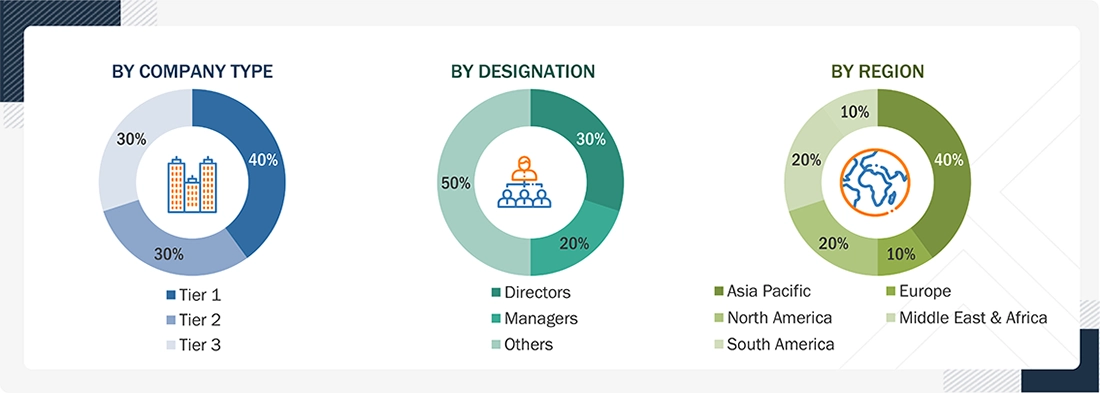
Note 1: Others include sales, marketing, and product managers.
Note 2: Tier 1: >USD 1 Billion; Tier 2: USD 500 million–1 Billion; and Tier 3: <USD 500 million.
To know about the assumptions considered for the study, download the pdf brochure
Market Size Estimation
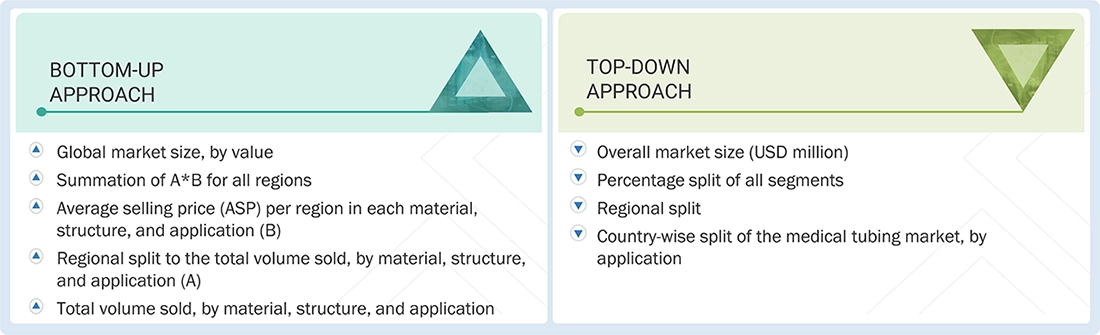
The top-down and bottom-up approaches were used to estimate and validate the size of the global medical tubing market. These approaches were also used extensively to estimate the size of various dependent market segments. The research methodology used to estimate the market size included the following:
Medical Tubing Market : Top-Down and Bottom-Up Approach
Data Triangulation
After arriving at the overall market size using the market size estimation processes, the market was split into several segments and subsegments. The data triangulation and market breakup procedures were employed, where applicable, to complete the overall market engineering process and derive the exact statistics for each market segment and subsegment. The data was triangulated by studying various factors and trends from both the demand and supply sides.
Market Definition
Medical tubing consists of high-quality tubes primarily used in medical devices and hospital systems to safely transport gases, liquids, and other medically important materials. To achieve the best biological compatibility, flexibility, chemical resistance, and sterilizability, medical-grade materials are chosen. Manufacturing techniques such as accurate extrusion, co-extrusion, braiding, and other quality production processes result in tubing with very precise sizes and mechanical properties that are simply superior.
Medical tubing manufacturers predominantly rely on plastics, rubber, and various specialty polymers as raw materials for their products. Medical tubing can be available in several forms, such as single-lumen, multi-lumen, co-extruded, and braided configurations, to meet the requirements of various medical devices. Medical tubing can deliver fluids and gases in a safe and reliable manner, and so it can find several uses in bulk disposable tubing, catheters & cannulas, drug delivery systems, and other medical applications where it is a necessity. Medical tubing is one of the main materials for devices and pharmaceuticals, biotechnology, diagnostics, and healthcare areas, in which its applications span across infusion, dialysis, progressive ventilators, surgical operations through minimal incisions, different laboratory equipment, and other healthcare systems that require very precise levels of purity and that meet regulatory compliance standards.
Key Stakeholders
- Medical tubing manufacturers
- Medical-grade material suppliers
- Medical device manufacturers
- Pharmaceutical and biotechnology companies
- Healthcare providers (hospitals, clinics, and ambulatory surgical centers)
- Regulatory bodies and industry associations
- Research institutes and diagnostic laboratories
Report Objectives
- To define, describe, and forecast the size of the global medical tubing market, based on material, structure, application, and region in terms of value.
- To provide detailed information on the significant drivers, restraints, opportunities, and challenges influencing the market
- To strategically analyze micromarkets concerning individual growth trends, prospects, and their contribution to the market
- To assess the growth opportunities in the market for stakeholders and provide details on the competitive landscape for market leaders
- To forecast the market size of segments and subsegments for North America, Europe, Asia Pacific, South America, and the Middle East & Africa
- To strategically profile key players and comprehensively analyze their market shares and core competencies
- To analyze competitive developments such as product launches, acquisitions, expansions, partnerships, and agreements in the medical tubing market
- To provide the impact of AI/Gen AI on the market
Available customizations:
With the given market data, MarketsandMarkets offers customizations according to client-specific needs.
The following customization options are available for the medical tubing market report:
Product analysis
-
A product matrix that gives a detailed comparison of the product portfolio of each company
Geographic analysis
-
A further breakdown of the medical tubing market for additional countries
Company information
-
Detailed analysis and profiling of additional market players (up to five)
Key Questions Addressed by the Report
What primary factor is propelling the growth of the medical tubing market?
Increasing demand for minimally invasive medical procedures.
How is the medical tubing market segmented?
The market is segmented based on material, application, structure, and region.
What are the major challenges in the medical tubing market?
High cost of producing and marketing medical tubing products.
What are the major opportunities in the medical tubing market?
Customization and innovation in polymers and tubing structure, along with increasing governmental expenditure on healthcare infrastructure.
Which region has the largest demand?
North America has the highest demand for medical tubing.
Who are the major manufacturers of medical tubing?
Major manufacturers include Saint-Gobain (France), Freudenberg Medical (US), W. L. Gore & Associates, Inc. (US), The Lubrizol Corporation (US), Nordson Corporation (US), TE Connectivity (Switzerland), Elkem ASA (Norway), Trelleborg AB (Sweden), RAUMEDIC AG (Germany), Teknor Apex (US), Spectrum Plastics Group (US), and Zeus Company LLC (US).
Fact checked
Personalize This Research
- Triangulate with your Own Data
- Get Data as per your Format and Definition
- Gain a Deeper Dive on a Specific Application, Geography, Customer or Competitor
- Any level of Personalization
Let Us Help You
- What are the Known and Unknown Adjacencies Impacting the Medical Tubing Market
- What will your New Revenue Sources be?
- Who will be your Top Customer; what will make them switch?
- Defend your Market Share or Win Competitors
- Get a Scorecard for Target Partners

Custom Market Research Services
We Will Customise The Research For You, In Case The Report Listed Above Does Not Meet With Your Requirements
Get 10% Free CustomisationTESTIMONIALS

We at Nissan Chemicals Corporation have been clients of MarketsandMarkets for more than a year now. We recently consulted MarketsandMarkets for a study, the team at MarketsandMarkets was extremely professional and organized. The business insights were very detailed and aligned well with our expectations that really helped us formulate the Business Plans and device new strategies for development themes. MarketsandMarkets offers a unique combination of expertise and dedicated engagement model. Their research findings have helped us in designing our Pricing Strategy which will make it easier for us to predict the future sales and profits for the next ten years. We look forward to working with MarketsandMarkets in the future.
VP of Strategy & New Business Development
Leading Specialty Chemical Company
The MarketsandMarkets Engagement Model, composed of both the Knowledge Store and advisory custom research, has greatly helped us in understanding our markets and making strategic decisions. The Knowledge Store is a fast way to allow everyone in our organization to understand more about most any market they are interested in. The ability to then get custom research done and get answers to specific strategic questions and market insight has been spectacular. The Markets and Markets team feel more like colleagues than vendors and their services have helped us change our culture where statements of things like growth opportunities and competitive position are always backed by industry research.

Rich Gibson,
Director, Corporate Strategy
Milliken & Company,
Leading Industrial Manufacturer of specialty chemical, floor covering, performance and protective textile materials, and healthcaremilliken.com
MarketsandMarkets is a trusted resource that helps us to better understand markets that are near-adjacencies-whether its technology, value chain or geography. Their Knowledge Store platform provides a dashboard of markets and their characteristics which is easy to use and saves us time.
Adam Shaw,
Market Development and Strategy Manager
AdvanSix Inc. USA,
An American Leader in Chemicalswww.advansix.com
The Knowledge Store from MarketsandMarkets is a valuable tool which has helped my team acquire greater insight in to the end markets that our business serves. This has enabled us to help our company build stronger strategies throughout our planning process.
TOSHIO KINOSHITA
Senior Chif Consultion Research & Consulting Division
Mitsubishi Chemical Research Corporation,
Leading Manufacturer of Chemical Productswww.mitsubishichem-res.co.jp/en/

We recently engaged with MarketsandMarkets for a study, the team not only clearly understood our business objectives but was also extremely professional in the way they handled the entire project. The study was efficiently conducted in a phase-wise manner, and the engagement model furnished us with high-quality business insights that far exceeded our expectations at each phase. We were especially happy that MarketsandMarkets could provide us with both, an English as well as a Japanese version of the study. A special thanks to the Analyst Team and Client Services Team, whose fluency in Japanese enhanced our comfort level, as we could converse with them in our preferred language.
Independent entrepreneurs
Arrow Precision
We approached MarketsandMarkets for study on Proppants Market, and their work exceeded our expectations. The study conducted was comprehensive and enabled us to view the market through the various dimensions. In addition, the team was extraordinarily responsive throughout the process and resolved our queries on time. I strongly recommend MarketsandMarkets and will certainly consider them for additional market assessments we will need in the future.
Global engineering company, Japan
Deputy Manager,
Strategic Planning OfficeThe high-quality insights shared by the MarketsandMarkets team helped us understand the pharmaceutical plant designers in a specific geography. It also captured the risks that we may likely face in communicating with our potential partners. The study would enable us identify partners, which would impact our future growth.
- US Medical Tubing Market
- CANADA Medical Tubing Market
- MEXICO Medical Tubing Market
- GERMANY Medical Tubing Market
- FRANCE Medical Tubing Market
- UK Medical Tubing Market
- SPAIN Medical Tubing Market
- ITALY Medical Tubing Market
- The Netherlands Medical Tubing Market
- CHINA Medical Tubing Market
- JAPAN Medical Tubing Market
- INDIA Medical Tubing Market
- SOUTH KOREA Medical Tubing Market
- Saudi Arabia Medical Tubing Market
- UAE Medical Tubing Market
- SOUTH AFRICA Medical Tubing Market
- EGYPT Medical Tubing Market
- BRAZIL Medical Tubing Market
- ARGENTINA Medical Tubing Market
- South America Medical Tubing Market
- Rest Of Europe Medical Tubing Market
- Rest Of Asia Pacific Medical Tubing Market
- GCC Countries Medical Tubing Market






Growth opportunities and latent adjacency in Medical Tubing Market