Data Center Networking Market

Data Center Networking Market by Offering (Network Infrastructure, Software, Services), Network Infrastructure (Switches, Routers, NICs & Offload, AI/HPC Hardware), Workload (AI & HPC, General IT), Data Center Size, End User, and Region - Forecast to 2031




OVERVIEW
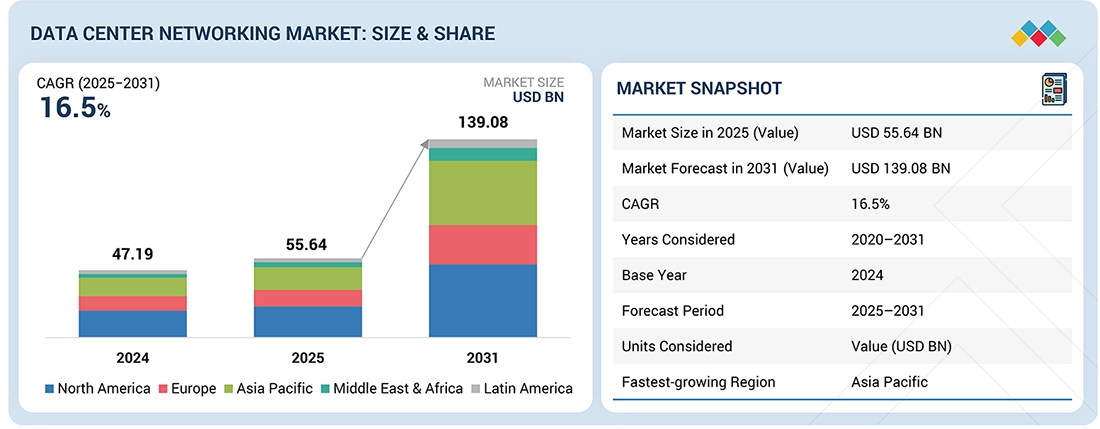
Source: Secondary Research, Interviews with Experts, MarketsandMarkets Analysis
The data center networking market is growing strongly and is expected to increase from USD 55.64 billion in 2025 to USD 139.08 billion by 2031, at a CAGR of 16.5%. This growth is mainly due to the rapid increase in cloud computing, artificial intelligence (AI) workloads, and ongoing digital transformation across enterprises and cloud providers.
As organizations use more AI applications, virtual machines, and distributed systems, the need for fast, reliable, and scalable network infrastructure is increasing. Companies are investing in high-speed Ethernet switches, interconnect solutions, and software-based networking technologies to handle large volumes of data and ensure smooth application performance.
Automation and network monitoring tools are also being used to improve efficiency and reduce operational issues. In addition, the expansion of hyperscale data centers, growth of colocation facilities, and increasing use of hybrid and multi-cloud environments are driving network infrastructure investments. As businesses continue to modernize their IT environments and support data-heavy applications, data center networking is becoming essential for stable and high-performance digital operations.
Market Size and Forecast:
- 2024 Market Size: USD 47.19 Billion
- 2025 Estimated Market Size: USD 55.64 Billion
- 2031 Forecasted Market Size: USD 139.08 Billion
- Growth Rate (2025-2031): CAGR of 16.5%
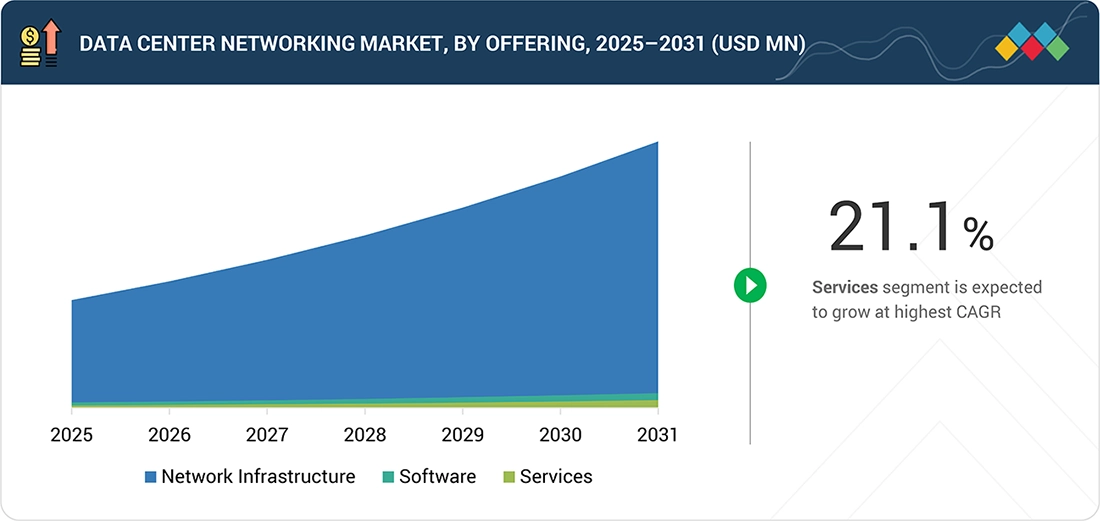
- Services segment grow at CAGR of 21.1%
- Forecast period: 2025–2031
- Asia Pacific is expected highest CAGR of 18.9%.
Key Market Trends and Insights
- By Applications : Include AI clusters, multi-cloud hosting, big data, and general IT workloads.
- By Components: Switches, routers, network interface cards (NICs), and offload hardware.
-
Growth Drivers: Key drivers are hyperscaler expansions, AI/HPC workloads, colocation pre-leasing, and SDN automation.
- Major Trends: It include 400G/800G Ethernet upgrades, AI-driven automation, and smart switching.
- Future Outlook: The future outlook shows strong growth driven by cloud AI hyperscale data centers and edge computing.
KEY TAKEAWAYS
-
BY REGIONNorth America is expected to hold the largest market value of USD 21,831.3 million in 2025.
-
BY OFFERINGThe network infrastructure segment is expected to hold the largest market value in 2025.
-
BY NETWORK INFRASTRUCTUREThe data center router segment is expected to grow at the highest CAGR of 18.1% during the forecast period.
-
BY SOFTWAREThe network security software segment is expected to be the second-fastest-growing during the forecast period.
-
BY SERVICEThe support & maintenance service segment is expected to hold the largest market value in 2025.
-
BY WORKLOAD TYPEThe AI & HPC segment is expected to grow at the highest CAGR during the forecast period.
-
BY DATA CENTER SIZE & CAPACITYThe large data centers segment is expected to hold the largest market value in 2025.
-
BY END USERThe colocation data center segment is expected to be the second fastest-growing market during the forecast period.
-
COMPETITIVE LANDSCAPEThe data center networking market is highly competitive, with leading players such as Cisco, Arista Networks, NVIDIA, Huawei, and HPE offering advanced switching, routing, and AI-optimized networking solutions. These vendors leverage strong global presence, continuous innovation, and deep integration with hyperscale and enterprise environments to deliver scalable, high-performance, and automated networking infrastructure, strengthening their market leadership.
-
COMPETITIVE LANDSCAPEAlkira, Arrcus Inc., Aviz Networks, and DriveNets are emerging players gaining traction with cloud-native, software-defined, and disaggregated networking solutions. Their focus on flexibility, automation, and cost-efficient architectures enables enterprises and service providers to build scalable and agile data center networks, supporting growing adoption in modern cloud and multi-cloud environments.
The data center networking market is expanding as organizations prioritize high-performance, scalable connectivity to support growing cloud adoption, AI workloads, and increasing data traffic. Adoption is rising because modern networking solutions offer high-speed data transfer, automation, real-time network visibility, and improved operational efficiency. Cloud-driven architectures, software-defined networking, and AI-optimized infrastructure are accelerating this shift by enabling faster deployment, intelligent traffic management, and more efficient, scalable network operations across hyperscale, colocation, and enterprise data centers.
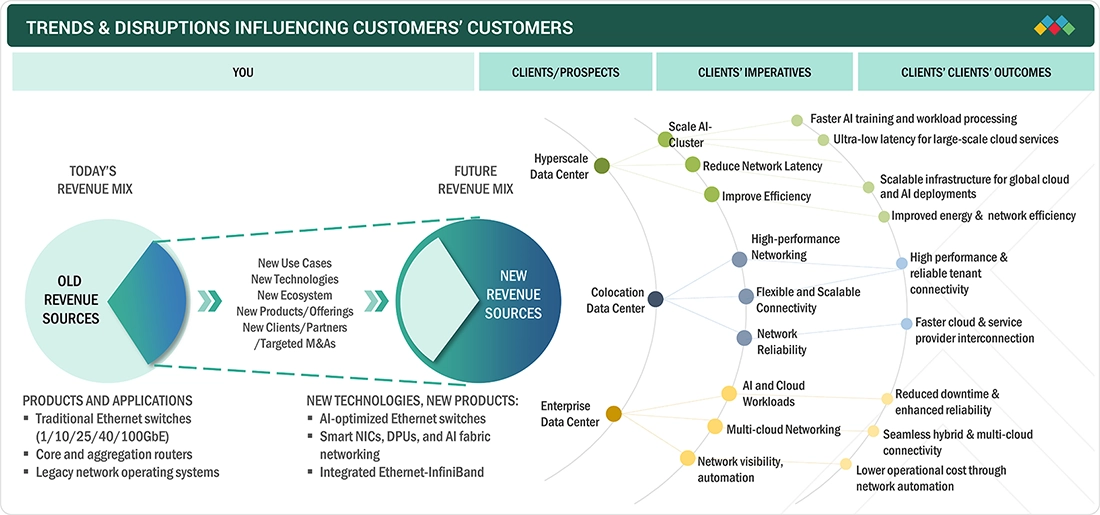
TRENDS & DISRUPTIONS IMPACTING CUSTOMERS' CUSTOMERS
Businesses are increasing their investments in data center networking to support AI applications, faster data processing, and reliable connectivity across different environments such as hyperscale data centers, colocation facilities, and enterprise data centers. Industries including cloud service providers, financial institutions, healthcare organizations, and e-commerce companies rely on strong networking infrastructure to maintain application performance and ensure continuous service availability. End users benefit from faster data transfer speeds, lower delays, and more reliable network performance, which improves overall user experience and business continuity. Technologies such as AI-based network automation, high-speed Ethernet connectivity such as 400 GbE and 800 GbE, and software-defined networking are helping organizations manage networks more efficiently. These solutions allow companies to use their infrastructure more effectively, reduce manual work, and improve operational efficiency. As a result, organizations are better prepared to support modern applications and digital services, while maintaining stable and scalable networking environments.
The data center networking market was valued at about USD 55.64 billion in 2025. It is expected to reach USD 139.08 billion by 2031, at a CAGR of 16.5%. Revenue growth is supported by rapid cloud computing adoption, AI workloads, hyperscale and colocation expansion, hybrid/multi-cloud environments, and enterprise investment in high-speed Ethernet switching, interconnects, and software-based networking.
Investment is concentrated in AI-optimized networking — high-speed 400G/800G Ethernet switching, InfiniBand fabrics, optical interconnects, and software-defined networking for hyperscale and colocation buildouts. Hyperscaler capital spending is the key funding driver.
Source: Secondary Research, Interviews with Experts, MarketsandMarkets Analysis
MARKET DYNAMICS

Level
-
Hyperscaler Capacity Expansion Programs Driving Full-Fabric Networking Demand

-
High Colocation Pre-leasing Converting Capacity Commitments into Immediate Networking Demand


Level
-
Interoperability Limitations and Vendor Lock-In Slowing Multi-Vendor Adoption

-
Grid Power Constraints Limiting the Pace of Networking Expansion


Level
-
Higher Revenue per Deployment Through Smart, Offload-Capable Switching

-
AI Cluster Expansion Accelerating High-Speed Fabric Adoption


Level
-
Power and Grid Constraints Delaying Networking Deployment Timelines

-
Component Supply Constraints and Extended Lead Times Limiting Networking Equipment Availability

Source: Secondary Research, Interviews with Experts, MarketsandMarkets Analysis
Driver: Hyperscaler Capacity Expansion Programs Driving Full-Fabric Networking Demand
The expansion of hyperscale data centers is a key factor driving demand for networking equipment. Cloud providers are continuously developing new data center campuses and expanding existing ones to support rising demand for cloud services and AI workloads. Before computing systems can operate, the full networking layer must be installed, including switches, routers, and high-speed connectivity solutions. Hyperscale operators usually follow standardized deployment models, which results in large and consistent procurement of networking hardware. Major companies such as Amazon, Microsoft, and Meta are making significant investments in infrastructure, directly increasing demand for networking components. As these facilities scale further, additional networking equipment is required to handle growing traffic and maintain reliable connectivity. This creates ongoing demand for networking hardware aligned with data center expansion cycles.
Restraint: Interoperability Limitations and Vendor Lock-In Slowing Multi-Vendor Adoption
Many companies are limited in their ability to implement a multi-vendor strategy due to the constraints of vendor lock-in, as well as other compatibility issues with specific proprietary hardware/software systems, and must keep to the same vendor if they already have their system installed. There are many implementation costs that arise when migrating to a different vendor, including the redesign of the network architecture, retraining of staff, and testing of the new vendor's product, and all of these potential costs create greater exposure and risk for organizations. As a result, many organizations cannot use or do not want to use a multi-vendor infrastructure. Other networking solutions require highly complex integrations that may be beyond an organization's technical capability, thereby limiting both companies' flexibility and vendor diversification because of the very limited interoperability available in today's networking marketplace.
Opportunities: Higher Revenue per Deployment Through Smart, Offload-Capable Switching
The increasing use of AI and advanced applications is changing the role of networking equipment, especially switches. Modern switches are now designed with advanced processing capabilities, security features, and workload handling functions. These improvements increase the value and price of networking equipment, which leads to higher revenue for vendors. Smart switches can handle some processing tasks directly, reducing the load on computing systems and improving overall efficiency. This allows organizations to improve performance while managing workloads more effectively. As AI adoption continues to grow, demand for advanced networking equipment is expected to increase, creating new revenue opportunities for networking vendors.
Challenge: Power and Grid Constraints Delaying Networking Deployment Timelines
Power availability is becoming a major challenge for data center networking deployments. Data centers require large amounts of electricity to operate networking equipment and computing infrastructure. In some locations, delays in power infrastructure development can slow down networking equipment installation and activation. This can delay project timelines and affect revenue generation for networking vendors. Data center operators may need to adjust deployment schedules based on power availability rather than business demand. Differences between physical construction completion and power readiness can also create delays. As a result, power and grid limitations are becoming a key challenge affecting networking infrastructure deployment.
DATA CENTER NETWORKING MARKET: COMMERCIAL USE CASES ACROSS INDUSTRIES
| COMPANY | USE CASE DESCRIPTION | BENEFITS |
|---|---|---|
 |
Daimler partnered with Cisco to modernize its legacy data center infrastructure and build a scalable, software-defined network foundation. The objective was to standardize networking across multiple global data centers, improve security, and support hybrid cloud environments. Cisco deployed Nexus switching platforms and software-defined networking capabilities to create a unified and future-ready data center architecture. This enabled consistent network operations, improved automation, and seamless integration across distributed IT environments. | Daimler established a unified, software-defined network fabric that improved scalability, security, and operational efficiency across global data centers. The new architecture enabled progress toward a zero-trust security framework and simplified network management. It also provided a flexible foundation to support hybrid cloud deployments and future digital initiatives. Overall, the solution improved operational consistency and ensured long-term infrastructure scalability. |
 |
CoreWeave collaborated with NVIDIA to build a scalable AI cloud infrastructure using NVIDIA BlueField DPUs, Quantum InfiniBand, and Spectrum Ethernet networking. The goal was to support large-scale GPU workloads, improve multi-tenant isolation, and optimize performance and efficiency. The deployment enabled offloading networking, storage, and security functions from CPUs to DPUs. This created a high-performance, secure, and efficient infrastructure optimized for AI workloads. | CoreWeave improved infrastructure performance, scalability, and efficiency while reducing CPU workload and operational overhead. The DPU-powered architecture increased throughput by 1.6× and improved performance per watt by 3.84×. It also enabled secure multi-tenant isolation and high-speed GPU-to-GPU communication. The solution provided a scalable and cost-efficient foundation to support rapidly growing AI workloads. |
 |
Costaisa Group partnered with Huawei to modernize its legacy data center network and support digital healthcare services. Huawei deployed CloudEngine switches and iMaster NCE-Fabric solutions to enable automated network provisioning and hybrid cloud integration. The solution provided centralized management, real-time monitoring, and intelligent network automation. This helped Costaisa accelerate digital transformation and improve IT infrastructure efficiency. | Costaisa achieved faster service provisioning, improved operational efficiency, and enhanced network visibility. Automation reduced manual workload and enabled faster deployment of digital healthcare services. The intelligent network improved reliability and enabled proactive fault detection. Overall, the solution created a scalable, secure, and future-ready infrastructure supporting Costaisa’s digital growth. |
 |
Hot Aisle partnered with Dell Technologies to build a high-performance AI cloud platform using Dell PowerSwitch networking, PowerEdge servers, and Enterprise SONiC. The objective was to support large-scale GPU clusters and deliver cost-effective high-performance computing services. The open networking architecture enabled automation, programmability, and scalability. This allowed Hot Aisle to efficiently deploy and manage AI infrastructure. | Hot Aisle enabled high-speed connectivity supporting 128-GPU clusters operating at 400 Gbps, improving AI training performance. The open, scalable infrastructure reduced operational costs and improved deployment efficiency. It also enabled the company to deliver enterprise-grade AI computing services to a broader customer base. Dell’s support helped accelerate deployment and ensured reliable, scalable cloud operations. |
 |
City of Breda partnered with Extreme Networks to build a future-ready network infrastructure supporting digital government services. Extreme deployed ExtremeSwitching, Fabric Connect, and ExtremeCloud IQ to enable centralized management, automation, and analytics. The solution provided network insights to support better decision-making and improve public service delivery. This enabled Breda to modernize its digital infrastructure and support smart city initiatives. | The City of Breda gained real-time network insights to support data-driven decision-making and improve citizen services. The automated network reduced IT workload and improved operational efficiency. The scalable infrastructure enabled the city to support growing digital service demands and future automation initiatives. Overall, the deployment established a future-ready digital foundation for smart city transformation. |
Logos and trademarks shown above are the property of their respective owners. Their use here is for informational and illustrative purposes only.
MARKET ECOSYSTEM
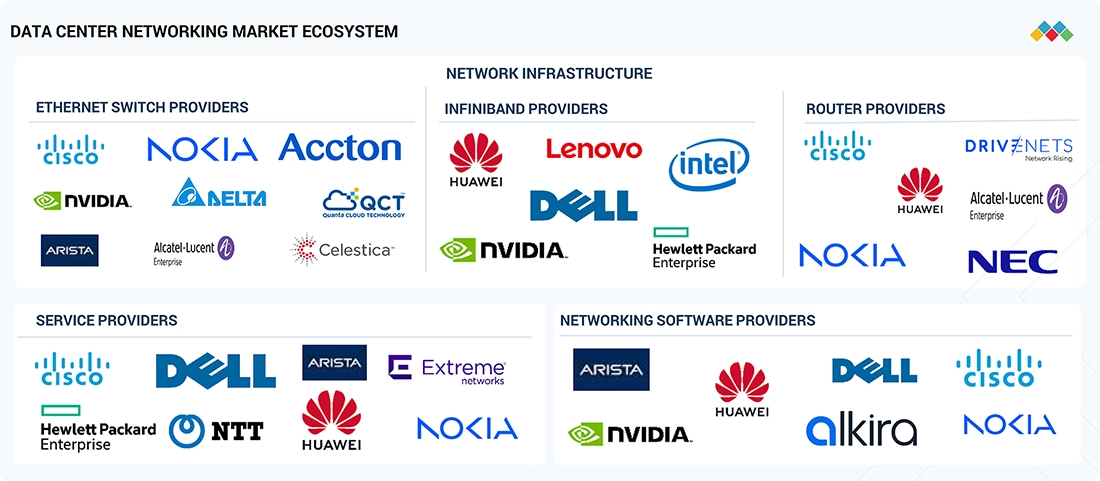
The data center networking ecosystem consists of multiple vendors that together support the deployment and operation of network infrastructure. Ethernet switch providers supply the primary equipment that connects servers and storage within data centers and enables internal data flow. Router vendors enable communication between data centers and external networks, including enterprise locations and cloud environments. InfiniBand providers deliver high-speed, low-latency connectivity that is widely used in AI and high-performance computing environments where fast data transfer is critical. Network software vendors offer platforms that help organizations manage, monitor, and configure their networks to ensure smooth operations. In addition, service providers assist with installation, system integration, and ongoing maintenance. Each of these vendors plays an important role in ensuring that data center networks function reliably and support growing workload requirements.
Logos and trademarks shown above are the property of their respective owners. Their use here is for informational and illustrative purposes only.
Also Read: Data Center Busways Market Report
MARKET SEGMENTS
Source: Secondary Research, Interviews with Experts, MarketsandMarkets Analysis
Data Center Networking Market, By Offering
Network infrastructure accounts for the largest share of the data center networking market because it provides the physical foundation required for connectivity. Switches, routers, and interconnect systems enable communication between servers, storage, and external networks. Every data center requires significant investment in this hardware to operate efficiently. The growth of hyperscale facilities and increasing AI deployments is driving demand for high-capacity networking equipment. At the same time, upgrades to faster technologies such as 400G and 800G Ethernet are increasing infrastructure spending. Since networking hardware is installed during the early stages of deployment, it ensures steady and consistent demand, making it the largest segment.
Data Center Networking Market, By Network Infrastructure
Data center routers are expected to grow at the highest CAGR due to increasing demand for data center interconnect (DCI), multi-cloud connectivity, and WAN integration. As enterprises and hyperscalers expand geographically, routers enable secure and high-speed connectivity between distributed data centers. The rise of hybrid and multi-cloud environments is increasing reliance on advanced routing solutions. AI workloads and large-scale data transfer also require high-throughput routing infrastructure. Additionally, growing internet traffic and edge deployments are accelerating router adoption. This drives faster growth compared with other networking infrastructure components.
Data Center Networking Market, By Software
Networking management, automation & observability software is becoming increasingly important as organizations adopt automated and software-controlled network operations. Network management and monitoring platforms allow organizations to configure and monitor their networks from centralized systems. These tools help reduce manual work and improve operational efficiency. Monitoring tools provide real-time visibility into network performance and help identify potential issues before they affect operations. As data center networks become more complex due to cloud and AI workloads, software solutions are essential for managing performance and reliability. This drives continued demand for networking software solutions.
Data Center Networking Market, By Service
Networking services, including support and maintenance, are expected to grow rapidly due to increasing network complexity. Data center operators require regular monitoring, troubleshooting, and performance optimization to ensure stable operations. As networks expand and become faster, maintenance requirements increase. Regular updates, hardware servicing, and lifecycle management are necessary to maintain performance. AI and cloud workloads also require specialized support, which increases demand for technical services. This makes support and maintenance services an important part of the networking market.
Data Center Networking Market, By Workload Type
General-purpose workloads represent the largest share of networking demand because they include the majority of enterprise applications. These workloads include business applications, databases, web hosting, and internal IT services. Most organizations rely on general-purpose computing for daily operations. These applications require a reliable and scalable networking infrastructure. Although AI workloads are growing quickly, general-purpose workloads still represent the largest volume of demand. This ensures continued investment in networking infrastructure to support these applications.
Data Center Networking Market, By Data Center Size & Capacity
Medium-sized data centers are expected to grow rapidly due to increasing digital adoption by enterprises. Many organizations are deploying medium-sized facilities to support cloud computing, regional workloads, and edge computing. These data centers provide a balance between cost, scalability, and operational flexibility. They are commonly used by enterprises, colocation providers, and government organizations. The growth of regional cloud deployments and edge computing is increasing demand for medium-sized data centers. This is driving investment in networking infrastructure within this segment.
Data Center Networking Market, By End User
Hyperscale data centers represent the largest share of networking investments because of large infrastructure deployments by cloud providers such as AWS, Microsoft, and Google. These facilities require extensive networking equipment to support cloud services, AI workloads, and global operations. Hyperscale operators deploy large numbers of switches, routers, and interconnect systems. Continuous expansion and upgrades drive strong demand for networking equipment. These environments also require advanced automation and high-speed connectivity. This makes hyperscale data centers the largest contributor to networking market revenue.
REGION
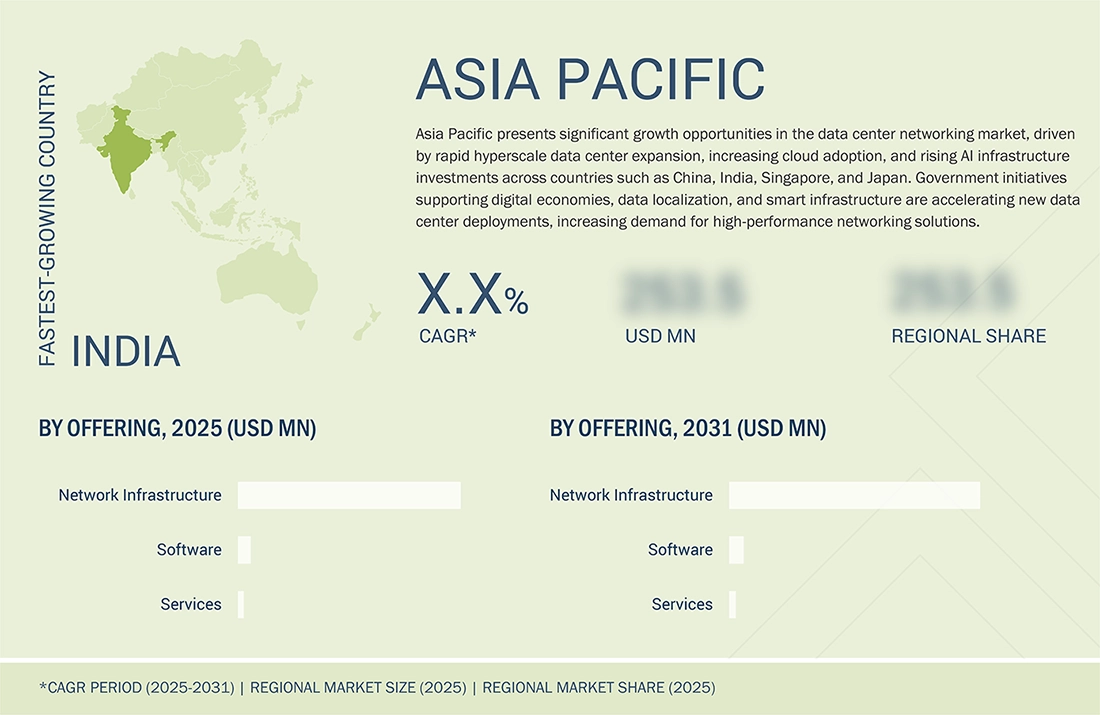
Asia Pacific is expected to register a CAGR of 18.9% in the data center networking market during the forecast period.
Asia Pacific is expected to experience the fastest growth in the data center networking market due to increasing cloud adoption, AI infrastructure expansion, and digital transformation. Countries such as China, India, Japan, Singapore, and Australia are seeing strong data center development. Cloud providers and colocation operators are investing heavily in new facilities. Government initiatives supporting digital infrastructure and data localization are also driving deployments. The growing number of internet users, increasing enterprise cloud adoption, and expansion of 5g networks are increasing networking demand. Emerging markets are also seeing new data center construction. This is driving strong growth in networking infrastructure across the Asia Pacific region.
Asia Pacific is the fastest-growing region in the data center networking market, projected at an 18.9% CAGR over the forecast period. Growth is led by rapid cloud adoption, AI infrastructure expansion, and digital transformation, with China, India, Japan, Singapore, and Australia driving heavy data center development. Cloud and colocation operators are investing aggressively in new facilities, while government digital-infrastructure and data-localization initiatives, rising internet and enterprise cloud users, and 5G rollout are lifting networking demand — including in emerging markets.
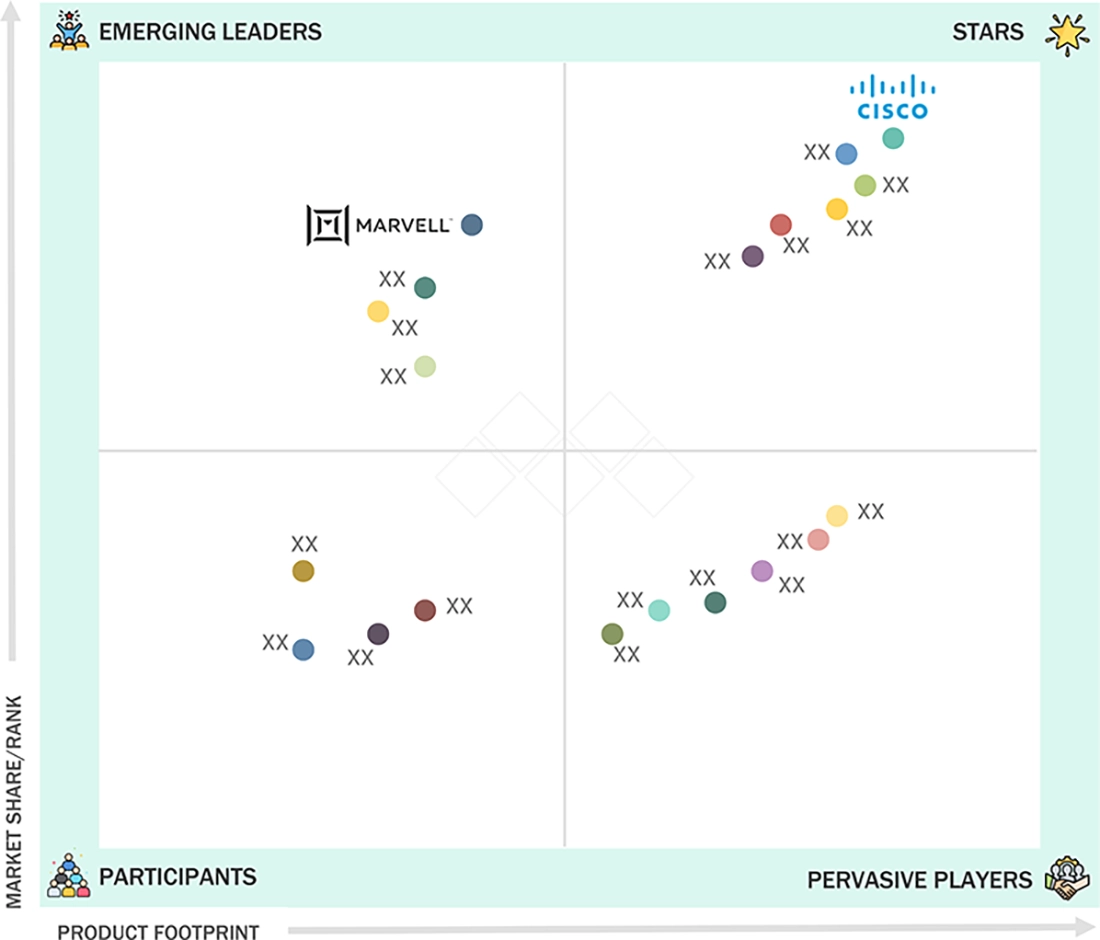
DATA CENTER NETWORKING MARKET: COMPANY EVALUATION MATRIX
Cisco is considered a Star player in the data center networking market due to its comprehensive portfolio of switching, routing, and software-defined networking solutions widely adopted across enterprise, hyperscale, and cloud environments. Its strong focus on high-performance Ethernet platforms, network automation, security integration, and AI-ready infrastructure strengthens its leadership position. Cisco’s global presence, continuous innovation, and deep relationships with cloud providers and large enterprises further reinforce its market dominance. Marvell Technology, meanwhile, is recognized as an Emerging Leader, gaining momentum through its advanced networking silicon, Ethernet switch chips, and high-speed interconnect solutions supporting AI and cloud data centers. Its focus on enabling high-bandwidth, low-latency connectivity and expanding partnerships with hyperscale and infrastructure providers is strengthening its position in the data center networking ecosystem.
Cisco, Arista Networks, NVIDIA, Huawei, and HPE continue to strengthen their positions by expanding their AI-optimized networking portfolios and enhancing switching and routing capabilities for hyperscale and enterprise data centers.
Source: Secondary Research, Interviews with Experts, MarketsandMarkets Analysis
KEY MARKET PLAYERS
- Cisco (US)
- Arista Networks (US)
- NVIDIA (US)
- Huawei (China)
- Hewlett Packard Enterprise (US)
- Dell Technologies (US)
- Extreme Networks (US)
- Nokia (Finland)
- H3C (China)
- Accton Technology (Taiwan)
- Broadcom (US)
- ZTE (China)
- NEC (Japan)
- Marvell (US)
- Intel (US)
- AMD (US)
- Quanta Cloud Technology (Taiwan)
- Delta Electronics (Taiwan)
- Celestica (Canada)
- Foxconn (Taiwan)
- Palo Alto Networks (US)
- Fortinet (US)
- Napatech (Denmark)
- Ruijie Networks (China)
- Arrcus (US)
- Alkira (US)
- Aviz Networks (US)
- DriveNets (Israel)
- Alcatel-Lucent Enterprise (France)
- Hedgehog (US)
- ZPE Systems (US)
MARKET SCOPE
| REPORT METRIC | DETAILS |
|---|---|
| Market Size in 2025 (Value) | USD 55.64 Billion |
| Market Forecast in 2031 (Value) | USD 139.08 Billion |
| Growth Rate | CAGR of 16.5% from 2025 to 2031 |
| Years Considered | 2020–2031 |
| Base Year | 2024 |
| Forecast Period | 2025–2031 |
| Units Considered | Value (USD Billion) |
| Report Coverage | Revenue Forecast, Company Ranking, Competitive Landscape, Growth Factors, and Trends |
| Top Companies |
|
| Growth Drivers |
|
| Segments Covered |
|
| Regional Scope | North America, Asia Pacific, Europe, the Middle East & Africa, and Latin America |
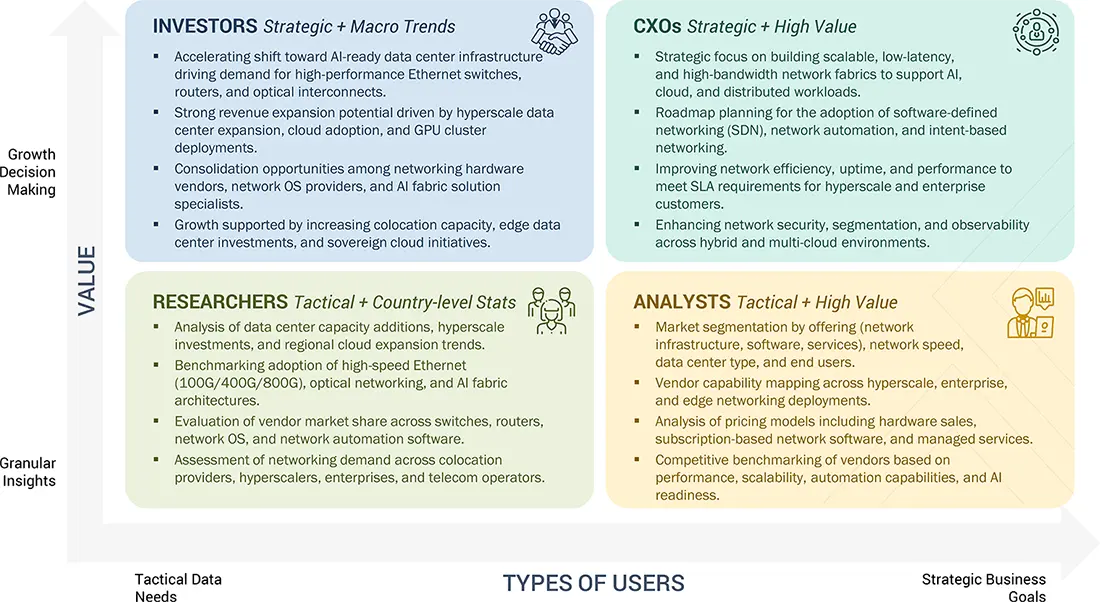
WHAT IS IN IT FOR YOU: DATA CENTER NETWORKING MARKET REPORT CONTENT GUIDE
DELIVERED CUSTOMIZATIONS
We have successfully delivered the following deep-dive customizations:
| CLIENT REQUEST | CUSTOMIZATION DELIVERED | VALUE ADDS |
|---|---|---|
| Leading Solution Provider (US) | In-depth segmentation of the North American data center networking market, including detailed analysis by offering (network infrastructure, software, and services), workload type, data center size, and end user. Extended regional breakdowns for Europe, Asia Pacific, the Middle East & Africa, and Latin America, highlighting infrastructure investments, hyperscale expansion, and enterprise adoption trends. | Identifies high-growth opportunities driven by AI infrastructure expansion, hyperscale data center development, and cloud adoption. Enables optimized network infrastructure planning aligned with scalability, performance, and automation requirements. Supports strategic investment decisions by providing insights into regional deployment trends, capacity expansion, and technology adoption across enterprise and hyperscale environments. |
| Leading Solution Provider (EU) | Detailed profiling of additional data center networking vendors (up to 5 companies), including switching, routing, software-defined networking solutions, product portfolios, strategic partnerships, and regional presence across enterprise, hyperscale, and colocation markets. | Provides competitive intelligence to support strategic positioning and vendor benchmarking. Identifies market gaps and emerging technology trends such as AI-driven networking, network automation, and high-speed Ethernet adoption. Supports targeted growth strategies by aligning product development, partnerships, and expansion initiatives. |
RECENT DEVELOPMENTS
- June 2026 : HPE introduced the QFX5252 switch with UALink-over-Ethernet (UALoE) support, enabling an open alternative to NVIDIA's NVLink for large-scale AI GPU clusters. The launch strengthens HPE's AI networking portfolio following the Juniper integration.
- February 2026 : Cisco Systems announced the Silicon One G300, a 102.4 Tbps switching platform designed to support large-scale AI data center deployments beyond hyperscalers. The G300 was positioned to power new Cisco N9000 and Cisco 8000 systems, incorporating high-density Ethernet, advanced optics, and liquid cooling to improve energy efficiency and GPU utilization for AI workloads. Cisco also updated Nexus One with a unified management plane and AI-driven operations to simplify deployment and scaling across on-premises and cloud environments.
- December 2025 : HPE introduced the AMD “Helios” AI rack-scale solution featuring industry-first Ethernet-based scale-up networking using HPE Juniper Networking switches and Broadcom Tomahawk 6 silicon. The open Ethernet architecture delivers up to 260 TB/s of scale-up bandwidth to support trillion-parameter AI training and inference workloads in AI data centers.
- October 2025 : Arista launched its next-generation R4 Series platforms for AI data centers, routed backbones, and large-scale cloud networks. The portfolio introduces 800GbE connectivity, 3.2 Tbps HyperPorts, hierarchical deep buffering, and integrated MACsec/IPsec/VXLANsec security, supporting high-density AI training, inference, and east–west traffic in spine–leaf architectures.
- October 2025 : NVIDIA expanded its partnership with Meta to integrate Spectrum-X Ethernet switches into Meta’s FBOSS open networking platform, enabling large-scale GPU interconnection and improved AI training efficiency across hyperscale data centers.
- April 2024 : Huawei introduced the Xinghe Intelligent Fabric Solution for the Asia Pacific region, offering ultra-powerful performance, ultra-stable reliability, ultra-fast deployment, and ultra-intelligent O&M. Leveraging AI Turbo and NSLB algorithm, it ensured zero packet loss, network-wide load balancing, and over 98% high link utilization on average, marking a significant upgrade to data center networks in the intelligent era.
Table of Contents
 Exclusive indicates content/data unique to MarketsandMarkets and not available with any competitors.
Methodology
This research study on the data center networking market involved extensive secondary sources, directories, IEEE Communication-Efficient: Algorithms and Systems, International Journal of Innovation and Technology Management, and paid databases. Primary sources included industry experts from core and related industries, third-party service providers, consulting service providers, end users, and other commercial enterprises. In-depth interviews with primary respondents, including key industry participants and subject matter experts, were conducted to obtain and verify critical qualitative and quantitative information and assess the market’s prospects.
Secondary Research
In the secondary research process, various sources were referred to identify and collect information for this study. Secondary sources included annual reports, press releases, and investor presentations of companies; white papers, journals, and certified publications; and articles from recognized authors, directories, and databases. The data was also collected from other secondary sources, such as journals, government websites, blogs, and vendors’ websites.
Primary Research
During the primary research process, interviews were conducted with various sources from both the supply and demand sides to gather qualitative and quantitative information on the market. The primary sources on the supply side included industry experts, such as chief experience officers (CXOs), vice presidents (VPs), data center procurement managers, and directors specializing in business development, marketing, and data center operations. It also included key executives from the data center industry, professional service providers, industry associations, and other key opinion leaders.
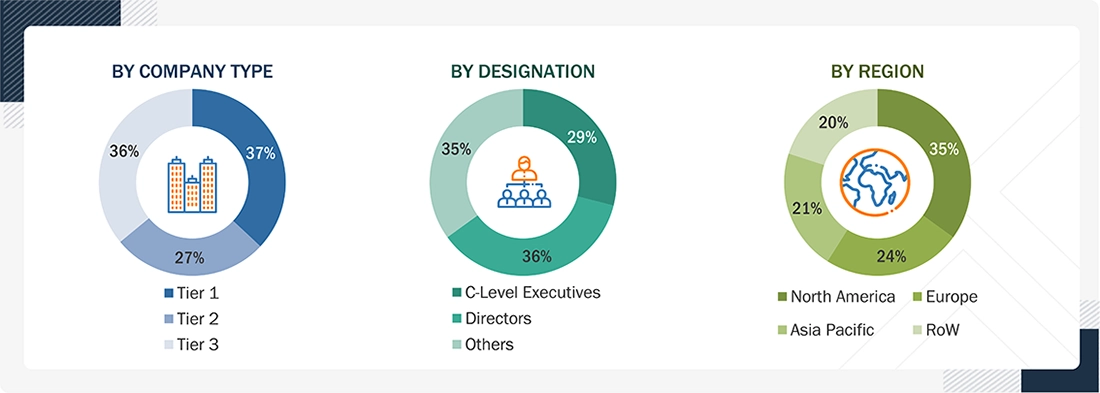
Breakup of Primary Profiles :
Notes:
Tier 1 companies’ revenues are more than USD 1 billion; tier 2 companies’ revenues range between USD 500 million and USD 1 billion; and tier 3 companies’ revenues range between USD 50 million and USD 500 million.
Other designations include sales managers, marketing managers, data center procurement managers, and product managers.
Source: Industry Experts
To know about the assumptions considered for the study, download the pdf brochure
Market Size Estimation
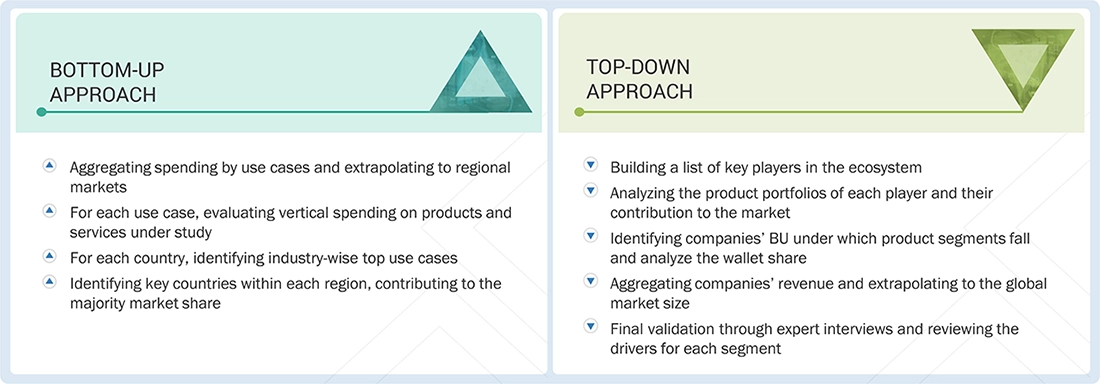
Multiple approaches were adopted to estimate and forecast the data center networking market. The first approach involved estimating the market size based on companies’ revenue from data center networking sales.
Source: Secondary Research and MarketsandMarkets Analysis
Market Size Estimation Methodology: Top-down Approach
The top-down approach estimates the overall data center networking market size by starting with a macro-level view, such as total IT spending or digital transformation expenditures. High-level industry or market values are divided and allocated into segments based on identified proportions by offering, workload type, data center size & capacity, end user, and region using researched splits. This approach uses broad market trends, industry reports, and expert insights to proportionately allocate the total value across sub-markets, regions, and countries. It ensures that the overall estimation remains aligned with recognized industry benchmarks, enabling accurate segmentation and a holistic market perspective.
Market Size Estimation Methodology: Bottom-up Approach
The bottom-up approach for estimating the data center networking market size involves aggregating data at the most granular level, such as company revenues, to build up to the global figure. This process begins by collecting company-level revenue data for data center networking solutions, software, and services. By analyzing the market share and revenue of key players and integrating percentage splits across segments, such as service line or industry, the total market size is calculated. Additional segmentation is performed by region or vertical, ensuring comprehensive coverage. The method then validates market estimates by comparing and consolidating segment results, providing a robust, detailed market-size assessment derived from concrete, ground-level business activity.
Data Triangulation
After determining the overall market size using the market estimation processes described above, the market was segmented and subsegmented. Data triangulation and market segmentation procedures were employed, where applicable, to complete the overall market engineering process and determine the exact statistics for each market segment and subsegment. The overall market size was then used in the top-down approach to estimate the size of other individual markets by applying percentage splits to the market segmentation.
Market Definition
Data center networking is the ecosystem of hardware, software, and services that enable high-performance data communication within and between data centers. It includes data center switches (Ethernet and InfiniBand), routers, network interface cards (NICs), DPUs/IPUs, AI & HPC networking hardware, network operating systems (NOS), software-defined networking (SDN), network management & automation platforms, and related professional services.
Key Stakeholders
- Network hardware vendors
- Networking software vendors
- Data center operators
- Hyperscale cloud providers
- Enterprise IT teams
- Network architects and engineers
- System integrators
- Semiconductor vendors
- Telecom providers
- Government and public sector organizations
Report Objectives
- To define, describe, and forecast the data center networking market based on offering, network infrastructure type, software, service, workload type, data center size & capacity, end user, and region
- To forecast the market size of five major regional segments: North America, Europe, Asia Pacific, the Middle East & Africa, and Latin America
- To strategically analyze the market subsegments with respect to individual growth trends, demand drivers, and their contributions to the overall market
- To provide detailed information regarding the major factors influencing market growth (drivers, restraints, opportunities, and challenges)
- To analyze macro and micro market dynamics, including hyperscale expansion, AI & HPC adoption, and high-speed networking transitions (400G/800G and above)
- To analyze technology trends, innovation developments, and pricing dynamics related to switches, routers, NICs, DPUs/IPUs, and networking software
- To analyze opportunities for stakeholders and provide a detailed competitive landscape of major market participants
- To assess the impact of AI, generative AI, and accelerator-driven workloads on data center networking demand
- To profile key players in the market and comprehensively analyze their market share, product portfolios, and core competencies
- To track and analyze competitive developments such as mergers & acquisitions, product launches, partnerships, collaborations, and capacity expansions in the market
Available customizations:
Based on the given market data, MarketsandMarkets offers customizations tailored to the company’s specific needs. The following customization options are available for the report:
Product Analysis
- The product matrix provides a detailed comparison of the product portfolio of each company.
Geographic Analysis Based on Feasibility
- Further breakup of the North American data center networking market
- Further breakup of the European data center networking market
- Further breakup of the Asia Pacific data center networking market
- Further breakup of the Middle East & African data center networking market
- Further breakup of the Latin American data center networking market
Company Information
- Detailed analysis and profiling of additional market players (up to five)
Key Questions Addressed by the Report
What is the projected size of the Data Center Networking Market by 2031?
The Data Center Networking Market is projected to grow from USD 55.64 billion in 2025 to USD 139.08 billion by 2031, at a CAGR of 16.5%.
What is driving investment in the Data Center Networking Market?
Growing AI workloads, cloud computing adoption, hyperscale data center expansion, and hybrid multi-cloud deployments are the primary investment drivers.
Which trends are shaping the Data Center Networking Market?
Major trends include 400G/800G Ethernet adoption, AI-driven network automation, software-defined networking, and intelligent switching technologies.
Which region is expected to grow the fastest in the Data Center Networking Market?
The Asia Pacific region is expected to register the highest growth during the forecast period with a CAGR of 18.9%
Who are the leading players in the Data Center Networking Market?
Key companies include Cisco Systems, NVIDIA, Arista Networks, Juniper Networks, Broadcom, and Hewlett Packard Enterprise.


Personalize This Research
- Triangulate with your Own Data
- Get Data as per your Format and Definition
- Gain a Deeper Dive on a Specific Application, Geography, Customer or Competitor
- Any level of Personalization
Let Us Help You
- What are the Known and Unknown Adjacencies Impacting the Data Center Networking Market
- What will your New Revenue Sources be?
- Who will be your Top Customer; what will make them switch?
- Defend your Market Share or Win Competitors
- Get a Scorecard for Target Partners

Custom Market Research Services
We Will Customise The Research For You, In Case The Report Listed Above Does Not Meet With Your Requirements
Get 10% Free CustomisationTESTIMONIALS
- US Data Center Networking Market
- Canada Data Center Networking Market
- UK Data Center Networking Market
- Germany Data Center Networking Market
- France Data Center Networking Market
- Italy Data Center Networking Market
- China Data Center Networking Market
- India Data Center Networking Market
- Japan Data Center Networking Market
- Saudi Arabia Data Center Networking Market
- UAE Data Center Networking Market
- South Africa Data Center Networking Market
- Brazil Data Center Networking Market
- Mexico Data Center Networking Market






Growth opportunities and latent adjacency in Data Center Networking Market