Digital Education Market Size, Share & Growth Forecast to 2031

Digital Education Market by Learning Model (Self-paced, Blended, Microlearning, Adaptive, Mobile), Course Type (Academic, Test Preparation, Professional Certification & Skill Development, Vocational Training, Corporate Training) - Global Forecast to 2031




OVERVIEW
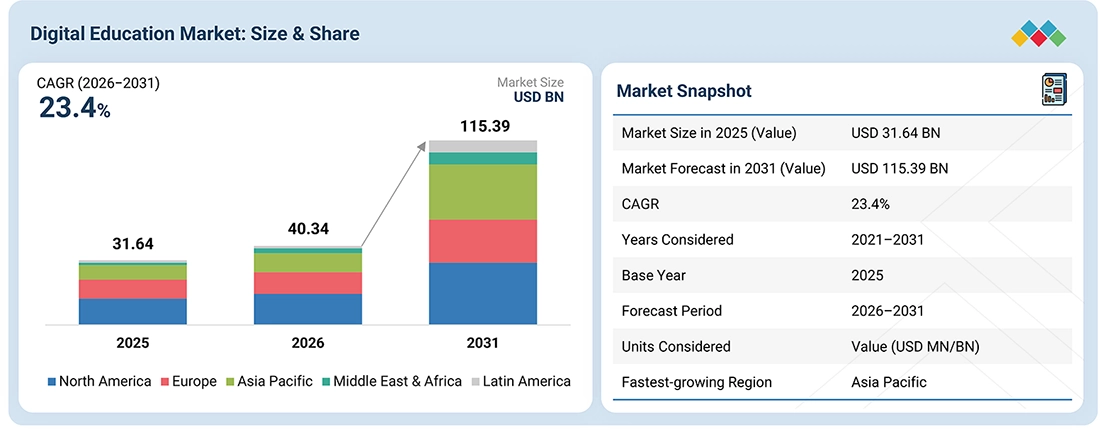
Source: Secondary Research, Interviews with Experts, MarketsandMarkets Analysis
The global digital education market is witnessing significant growth from USD 40.34 billion in 2026 to USD 115.39 billion by 2031, reflecting a CAGR of 23.4% as educational institutions and enterprises face rising demand for personalized learning, workforce upskilling, and scalable content delivery. Organizations are adopting digital education platforms to streamline course delivery, real-time analytics, and adaptive learning paths, especially as demand widens across academic, corporate, and lifelong learning segments. The push toward AI-driven personalization, immersive technologies, and automation is further accelerating digital education deployments. Cloud-based platforms are also expanding adoption by offering faster implementation and lower upfront costs. Additionally, hybrid and blended learning models are driving demand for real-time engagement tracking and adaptive content delivery.
Market Size and Forecast:
- Market Size Value in 2025: USD 31.64 Billion
- Market Size Value in 2026: USD 40.34 Billion
- Revenue Forecast in 2031: USD 115.39 Billion
- Growth Rate: CAGR of 23.4% from 2026 to 2031
- Data available from 2021 to 2031
- Base year: 2025
- Forecast period: 2026-2031
- Fastest Growing Region: Asia Pacific
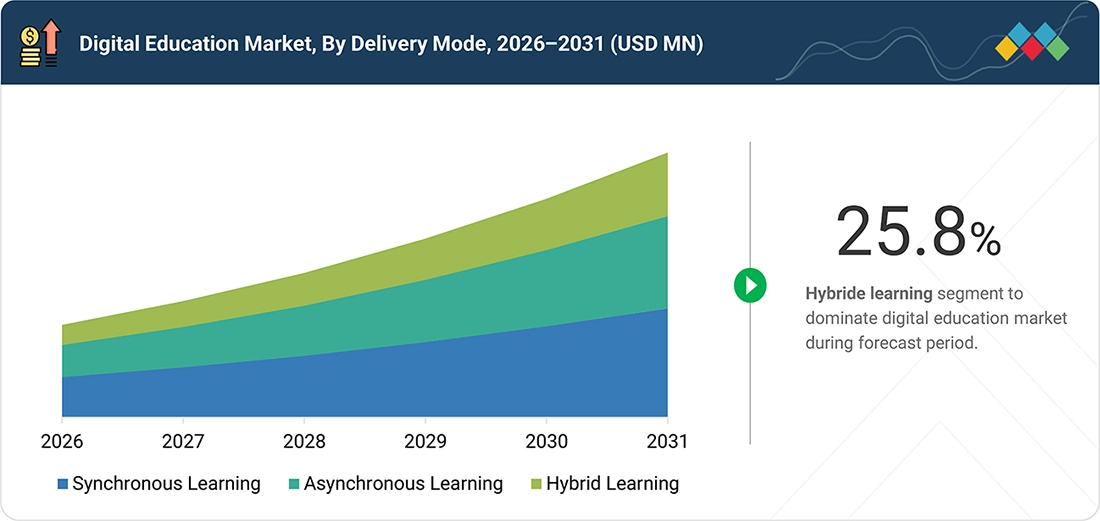
- Hybrid learning segment is expected to grow at the highest CAGR of 25.8% during the forecast period.
Key Market Trends and Insights
- Future Outlook: The Digital Education Market is driven by increasing demand for personalized learning, workforce upskilling, and flexible, scalable digital learning solutions.
-
Key Growth Drivers: Rising internet penetration, cloud-based learning platforms, increasing demand for professional certification, and investments in AI-driven education are driving market growth.
- Latest Trends: Growing adoption of AI-powered personalized learning, blended learning models, adaptive learning technologies, mobile learning, and real-time learning analytics.
- Growth Opportunities: Increasing demand for workforce upskilling, professional certifications, corporate training, and scalable digital learning solutions is creating opportunities for digital education providers.
KEY TAKEAWAYS
-
BY REGIONNorth America is expected to hold the largest market share in the digital education market during the forecast period.
-
BY LEARNING MODELThe instructor-led online learning segment is expected to hold the largest market value, accounting for around 34% share in 2026.
-
BY COURSE TYPEThe professional certification & skill development segment is expected to grow at the fastest CAGR of 26.2%.
-
BY DELIVERY MODEThe synchronous learning segment is expected to hold the largest market share, accounting for around 44% share in 2026.
-
BY END USERThe academic institutions segment is expected to hold the largest market value, accounting for around 49% share in 2026.
-
BY LEARNING MODEL (CAGR)The blended learning segment is expected to register the highest CAGR of 27.8% during the forecast period.
-
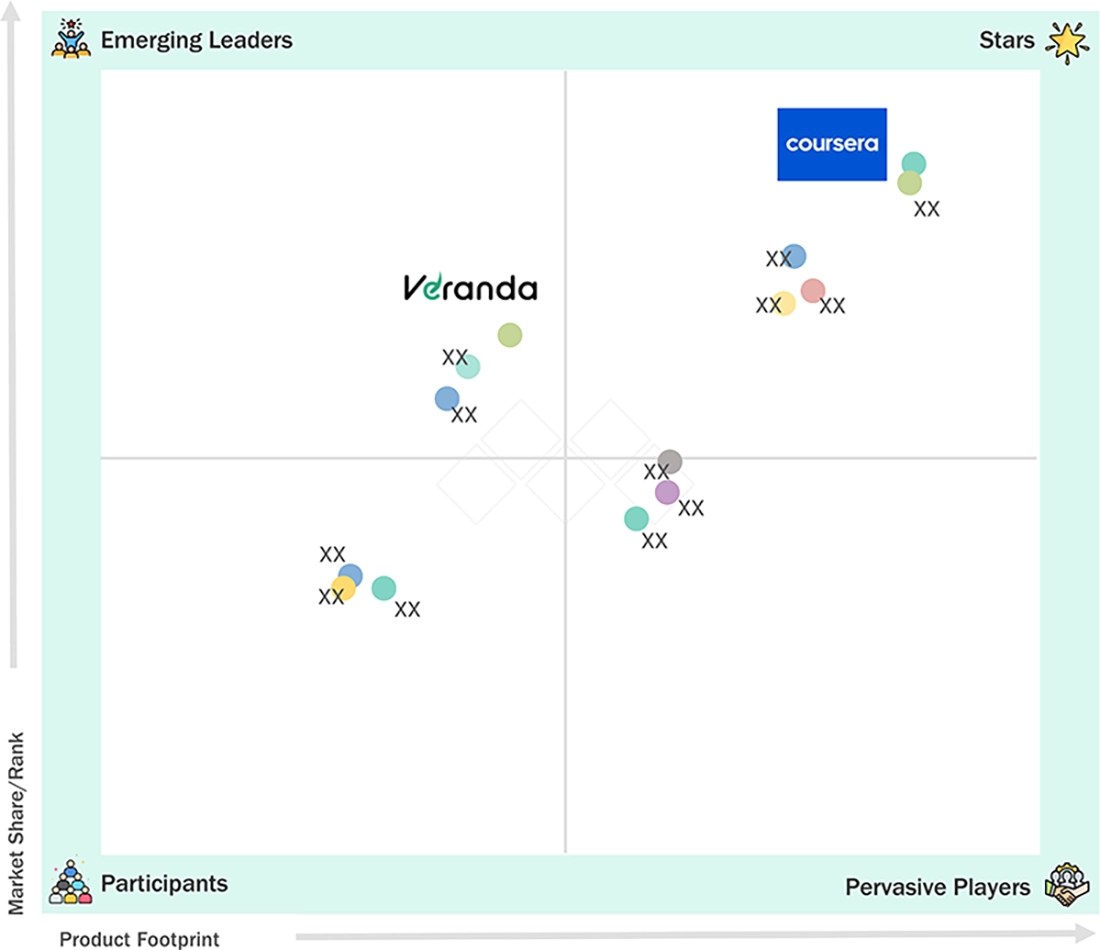
COMPETITIVE LANDSCAPEThe digital education market is highly competitive, with leaders like Coursera, Skillsoft, LinkedIn Learning, Pluralsight, and edX positioned as top "stars" offering robust, enterprise-grade digital learning and skills management platforms. These vendors distinguish themselves with integrated content libraries, cloud scalability, AI-powered personalization, global compliance support, and deep enterprise-level functionality making them preferred choices for large organizations and complex learning environments.
-
COMPETITIVE LANDSCAPEUdacity, Intellipaat, and DataCamp are recognized as strong niche-focused players in the digital education market due to their agile, cost-efficient, and skill-specific course offerings. These vendors specialize in flexible, industry-aligned certification programs tailored for individual learners and mid-sized enterprises.
The digital education market is expanding as institutions and enterprises prioritize personalized, AI-driven learning to address skill gaps, evolving learner expectations, and growing content delivery complexity. Adoption is rising because modern digital education platforms offer real-time analytics, adaptive learning paths, and improved engagement tracking. Cloud-based and AI-enabled solutions are accelerating this shift by making personalized learning faster, more accurate, and easier to scale.
TRENDS & DISRUPTIONS IMPACTING CUSTOMERS' CUSTOMERS
The digital education market is being reshaped by rising adoption of AI-driven personalization, adaptive learning paths, and immersive technologies, which are transforming how institutions and enterprises deliver content and manage learner outcomes. According to the Digital Education Council's 2024 Global AI Student Survey, 86% of students already use artificial intelligence in their studies, indicating a substantial shift toward AI-driven learning methods. Cloud-native digital education platforms are becoming the default choice, enabling faster deployment, seamless integrations, and broader scalability across academic and corporate environments. Real-time learner engagement tracking, enriched by analytics and mobile access, is improving personalized content delivery. At the same time, disruptions such as infrastructure gaps in rural regions, evolving data privacy regulations, and rising demand for verifiable credentials are pushing providers to rely on more scalable, compliant learning platforms. Hybrid and blended learning models are also redefining how institutions balance flexibility, engagement, and cost efficiency.
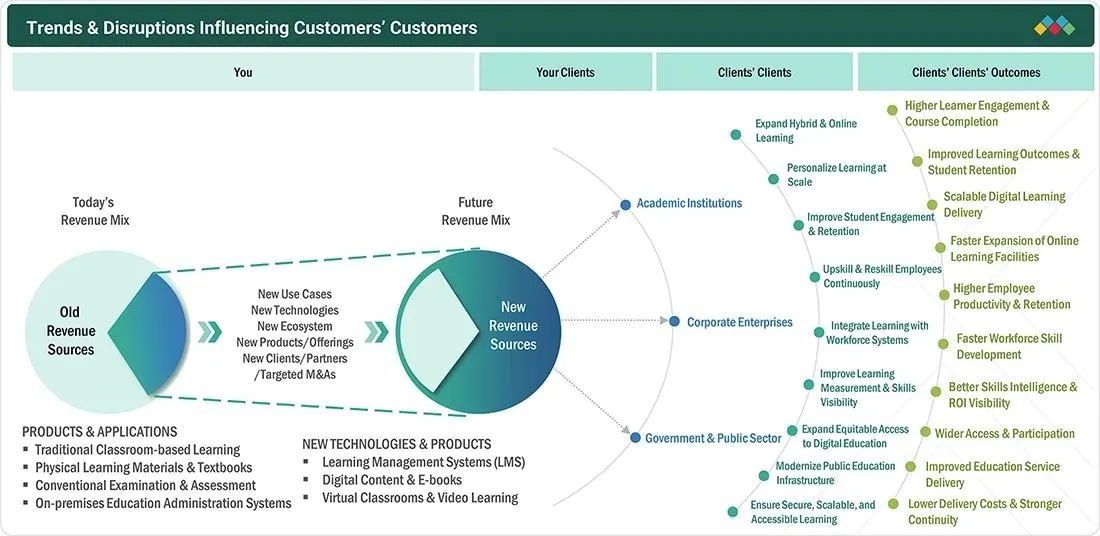
Source: Secondary Research, Interviews with Experts, MarketsandMarkets Analysis
MARKET DYNAMICS

Level
-
Growing demand for personalized learning driven by adaptive technologies

-
Gamification enhancing student engagement in learning


Level
-
Infrastructure shortage in rural areas limits digital education access

-
Prolonged screen time strains raise concerns among parents and educators


Level
-
Blockchain integration enables instant credential verification for institutions and employers

-
Transforming microlearning and modular learning with digital education


Level
-
Insufficient teacher training hampers effective integration of digital tools

-
Insufficient interaction in virtual classrooms hinders student engagement

Source: Secondary Research, Interviews with Experts, MarketsandMarkets Analysis
Driver: Growing demand for personalized learning driven by adaptive technologies
Adaptive learning systems are being implemented as traditional education models are limited in fulfilling the needs of unique and varied students. Such technologies use AI and machine learning (ML) algorithms to study individual learning patterns and offer personalized educational experiences. For instance, in October 2024, Anthology, a software company, and Obrizum, a Cambridge-based AI company, announced a partnership to adapt its adaptive learning technology and incorporate it into the Blackboard learning management system. The alliance is expected to make personalized learning available to millions of students across the globe, with tools like automated recommendations and progress tracking, enhancing student engagement and providing educators with real-time insights into student performance. Additionally, the South Korean government initiated an AI education program, introducing AI digital textbooks in March 2025 for 3rd, 4th, 7th, and 10th grades, with full implementation expected by 2028. To facilitate this transition, the country has already invested USD 0.74 billion in teacher training, empowering educators to use AI tools for promoting personalized learning in classrooms.
Restraint: Infrastructure shortage in rural areas
Infrastructural issues such as the low availability of internet connections, unstable power supply, and a lack of digital devices pose significant challenges to the development of the digital education market. These hindrances limit students' ability to fully engage with online learning, particularly in low-income and rural areas, which in turn reduces market demand and slows the pace of adoption. The 2025 report on the education crisis in Nigeria by the United Nations International Children's Emergency Fund (UNICEF) shows that only 36% of the Nigerian population is connected to the Internet, 78% are not digitally literate, and less than half of all teachers are appropriately skilled in ICT. To counter these barriers, governments around the world are investing in infrastructure improvements. For instance, the UK government recently committed approximately USD 58.30 million to enhance internet connectivity in schools, focusing on wireless networks and fiber upgrades, aiming to ensure schools achieve the necessary digital infrastructure to provide equal opportunities in technology.
Opportunity: Blockchain integration in education systems facilitates instant credential verification for employers and institutions
The integration of blockchain technology for credential verification is helping digital education by introducing a secure, transparent, and immutable method of issuing and validating academic credentials. Traditional systems typically use paper-based certificates and manual verification, which may be time-consuming, expensive, and subject to fraud. Blockchain decentralized ledger technology eliminates such issues, providing a verifiable, immutable record of accomplishments that can be immediately verified. For instance, in April 2025, Sharjah Maritime Academy (SMA) launched blockchain-powered micro-credentials through a partnership with Educhain, a blockchain-based platform. This project allows students to achieve verifiable digital badges, which are competency- and skill-oriented. These qualifications can be instantly verified, saving significant time and reducing administration overheads, and can be easily shared on professional platforms like LinkedIn, boosting international employability of students.
Challenge: Insufficient teacher training hampers effective integration of digital tools
Inadequate training of teachers presents a challenge in the development and expansion of the online education market by causing a chasm between existing technologies and their optimal use in classrooms. The potential of online and blended learning models is not fully utilized when teachers lack the skills to use digital technology in their teaching methods. This gap is clearly illustrated by India's UDISE (Unified District Information System for Education) 2023-24 report, which highlights that only 26.7% of the country's 9.8 million school teachers have received training in computer-based teaching, leaving over 73% untrained. The deficiency is greater at the foundational level, where only 20.2% of teachers are digitally trained. Addressing this challenge will require large-scale investment in professional development and continuous support systems to enable teachers to become active facilitators of technology-driven learning.
DIGITAL EDUCATION MARKET : COMMERCIAL USE CASES ACROSS INDUSTRIES
| COMPANY | USE CASE DESCRIPTION | BENEFITS |
|---|---|---|
 |
Maxis, a leading telecommunications company operating in an industry marked by high fixed costs, low margins, and constant technological change, sought to drive data and AI upskilling to boost employee productivity and enhance customer experience. By partnering with Coursera, Maxis accessed a comprehensive platform offering a balanced mix of business and digital skill courses tailored to its workforce needs. | Through the partnership, Maxis drove strong learner engagement across the organization, with employees completing over 16,000 courses and 700 certifications, strengthening the company's data and AI capabilities and supporting its broader learning and development strategy. |
 |
Sage, a global software organization, needed to simplify its notoriously complex tech stack and better secure its operations as it scaled its cloud offerings. Sage adopted Pluralsight Skills, leveraging its content libraries and Skill IQ capabilities to deliver tailored, data-driven learning experiences aligned to each employee's proficiency and the company's highest-risk products. | Over 1,300 Sage engineering employees now learn new skills weekly and stay accountable to quarterly upskilling goals, with 60% of team members completing more than the recommended courses. The company has seen measurable increases in time spent on security learning and stronger receptiveness to security initiatives. |
 |
Siemens sought to fuel future-ready skills across its ASEAN operations amid rapid technological change. The company partnered with LinkedIn Learning to launch its 'SkillUp! Learning Challenge,' aimed at building 'NextSkills' across its regional workforce through structured, career-aligned learning content. | The initiative strengthened a culture of continuous learning across Siemens' ASEAN workforce, supporting employee skill development aligned to evolving business and technology needs, and reinforcing Siemens' broader workforce transformation goals in the region. |
Logos and trademarks shown above are the property of their respective owners. Their use here is for informational and illustrative purposes only.
MARKET ECOSYSTEM
The digital education ecosystem includes content providers, learning platform vendors, credentialing partners, and cloud infrastructure providers working together to deliver end-to-end personalized learning. Core digital education platforms offer modules for course delivery, assessments, analytics, and credentialing, while academic institutions and corporate training providers ensure content relevance across use cases. Cloud providers support scalable, secure infrastructure required for large-scale learner bases. Technology partners specializing in AI, immersive technologies, and analytics enhance platform capabilities with personalization, adaptive assessments, and real-time engagement tracking. End users including academic institutions, corporate enterprises, and government bodies form the demand side of the ecosystem, supported by accreditation bodies and regulatory authorities that shape credentialing standards. Together, these stakeholders create a connected environment enabling accessible and effective digital learning.
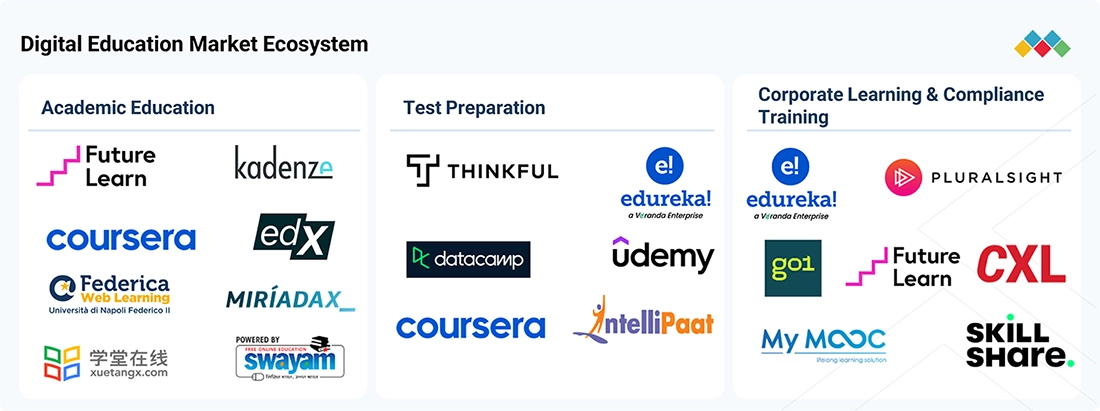
Logos and trademarks shown above are the property of their respective owners. Their use here is for informational and illustrative purposes only.
MARKET SEGMENTS
Source: Secondary Research, Interviews with Experts, MarketsandMarkets Analysis
Digital Education Market, By Learning Model
The instructor-led online learning model offers the advantage of real-time interaction and the flexibility of online platforms. This allows learners to engage directly with instructors, ask questions, and receive immediate responses while studying remotely. It is primarily in demand for corporate training, higher education, and professional certification programs, where well-planned guidance and sessions led by experts are essential for developing necessary skills. The learning process is further enhanced by advancements in video conferencing, interactive learning management systems, and virtual collaboration tools, which make education more engaging and practical.
Digital Education Market, By Course Type
As industries rapidly evolve with advancements in AI, data analytics, cybersecurity, and emerging technologies, there is a growing demand for continuous upskilling and reskilling among professionals. Digital platforms offer flexible, accessible, and industry-relevant certification programs that cater to working individuals seeking career advancement or transitions. The rise of micro-credentials, modular learning, and partnerships between digital education providers and industry leaders further enhances the credibility and applicability of these courses, driving the professional certification and skill development segment to register the highest CAGR during the forecast period.
Digital Education Market, By Delivery Mode
Hybrid learning combines synchronous and asynchronous formats, offering flexibility by enabling participation through scheduled interactions while allowing learners to study independently at their convenience. Hybrid learning is increasingly adopted by educational institutions, corporate training providers, and government programs to accommodate diverse learning needs and optimize resource utilization. The rising accessibility of digital platforms, content libraries, assessment tools, and collaboration possibilities is accelerating hybrid learning to register the highest CAGR during the forecast period.
Digital Education Market, By End User
Based on end user, the academic institutions segment is expected to hold the largest share of the digital education market during the forecast period. The widespread adoption of digital platforms by schools, colleges, and universities is driving this growth as these institutions increasingly integrate online learning tools to enhance teaching and learning experiences. The shift toward blended and hybrid learning models, accelerated by the pandemic, has led to a sustained demand for digital content, virtual classrooms, and learning management systems.
REGION
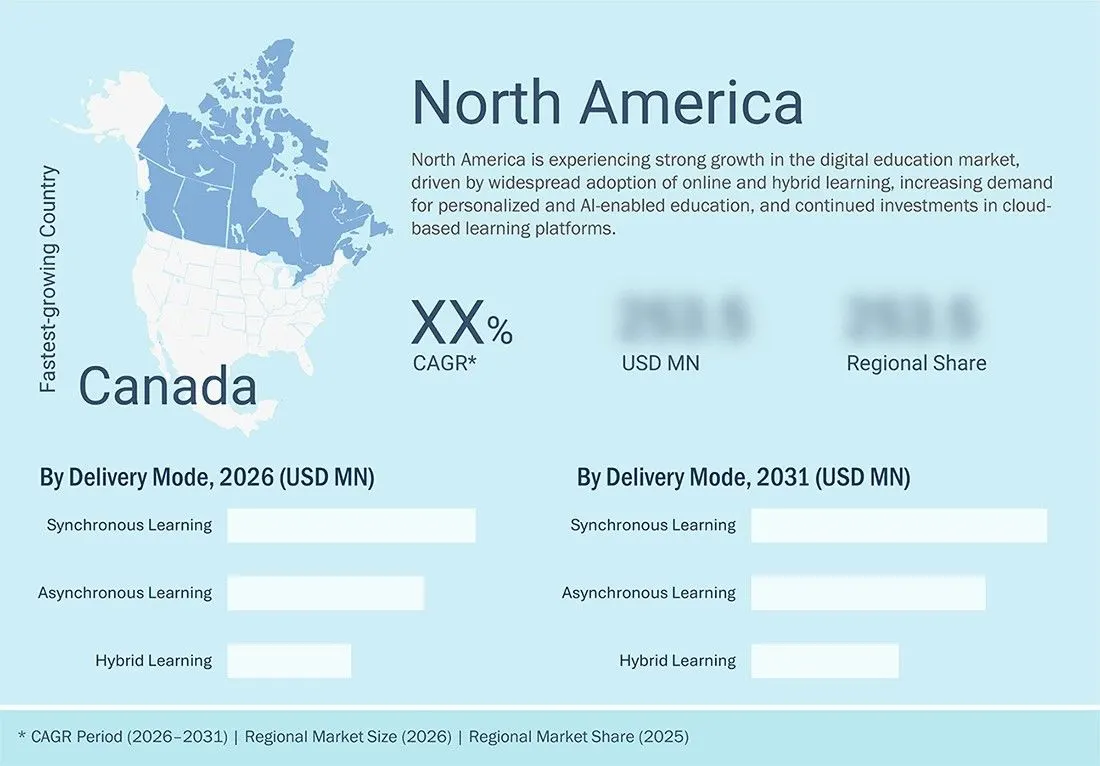
Canada is expected to register the highest CAGR in the digital education market during the forecast period.
North America accounted for the largest share of the global digital education market, driven by its advanced digital infrastructure, high internet penetration, widespread adoption of online learning platforms, and significant investments in digital education across academic institutions and enterprises. The region’s well-established education technology ecosystem, coupled with increasing adoption of AI-powered, personalized, and adaptive learning solutions, is expected to further support market growth.
DIGITAL EDUCATION MARKET : COMPANY EVALUATION MATRIX
In the digital education market, Coursera is evaluated as a Star due to its strong global university partnerships, comprehensive course catalog, and continuous innovation in AI-driven personalization and enterprise upskilling. Its combination with Udemy in 2026 further strengthens its integrated platform and large enterprise customer base, positioning it as a top-tier vendor with strong market influence. Skillsoft, meanwhile, is viewed as an Emerging Leader, gaining momentum through its AI-native skills management platform and recognition as a Leader in IDC MarketScape for IT Training Services and a Strategic Leader in the Fosway 9-Grid for Digital Learning. Its focus on enterprise workforce readiness and strategic partnerships, such as its integration with edX, strengthens its upward trajectory.
Source: Secondary Research, Interviews with Experts, MarketsandMarkets Analysis
KEY MARKET PLAYERS
- Coursera (US)
- Skillsoft (US)
- LinkedIn Learning (US)
- Pluralsight (US)
- edX (US)
- Udacity (US)
- Intellipaat (India)
- Swayam (India)
- Veranda Learning (India)
- Alison (Ireland)
- Iversity (Germany)
- NovoEd (US)
- XeutangX (China)
- Khan Academy (US)
- Kadenze (US)
- Fedrica Web Learning (Italy)
- My Mooc (France)
- Treehouse (US)
- Skillshare (US)
- CXL (US)
- Go1 (Australia)
- DataCamp (US)
- Platzi (US)
- Chegg (US)
- Duolingo (US)
MARKET SCOPE
| REPORT METRIC | DETAILS |
|---|---|
| Market Size in 2025 (Base Value) | USD 31.64 Billion |
| Market Forecast in 2026 (Value) | USD 40.34 Billion |
| Market Forecast in 2031 (value) | USD 115.39 Billion |
| Growth Rate | CAGR of 23.4% from 2026-2031 |
| Years Considered | 2021-2031 |
| Base Year | 2025 |
| Forecast Period | 2026-2031 |
| Units Considered | Value (USD Million/Billion) |
| Report Coverage | Revenue forecast, company ranking, competitive landscape, growth factors, and trends. |
| Segments Covered |
|
| Regional Scope | North America, Europe, Asia Pacific, Middle East & Africa, and Latin America |
WHAT IS IN IT FOR YOU: DIGITAL EDUCATION MARKET REPORT CONTENT GUIDE
DELIVERED CUSTOMIZATIONS
We have successfully delivered the following deep-dive customizations:
| CLIENT REQUEST | CUSTOMIZATION DELIVERED | VALUE ADDS |
|---|---|---|
| Leading Solution Provider (US) | In-depth segmentation of the North America digital education market Extended regional breakdowns for: Europe Asia Pacific Middle East & Africa Latin America | Identifies high-growth opportunities across AI-driven personalization, cloud adoption, and institutional modernization Enables tailored integration strategies aligning content, platforms, and learner data systems Supports optimized technology investments and resource alignment to enhance interoperability, scalability, and operational efficiency across connected learning environments |
| Leading Solution Provider (EU) | Detailed profiling of additional market players (up to 5 vendors), including course portfolios, strategic initiatives, and regional presence | Enhances competitive intelligence for strategic planning and go-to-market execution Reveals market gaps and white spaces for differentiation and innovation Supports targeted growth initiatives by aligning course development and enrollment strategies with unmet learner needs and emerging demand clusters |
RECENT DEVELOPMENTS
- December 2025 : Skillsoft partnered with edX to integrate university and company-led courses, including executive education programs from institutions such as the University of Oxford, Harvard University, and the London School of Economics, directly into the Skillsoft Percipio Platform. The partnership connects academic and professional learning to how organizations build, apply, and track skills across the workforce, aligning learning investment with workforce readiness and business outcomes.
- May 2026 : Coursera completed its combination with Udemy in an all-stock transaction valued at approximately USD 2.5 billion, first announced in December 2025. The combined platform brings together Coursera's university-affiliated degree and certification programs with Udemy's instructor-led course marketplace, reaching over 290 million learners, 18,000 enterprise customers, and a global network of 95,000 content creators. Udemy's common stock was delisted from Nasdaq upon completion of the transaction, and the combined company continues to operate under the Coursera brand.
- April 2025 : Coursera launched Compass, an AI-driven feature that personalizes course recommendations based on learners' career goals. By completing a brief quiz, users receive tailored content suggestions aligned with 60 in-demand roles, supplemented by localized salary and job data across 39 countries. Compass aims to streamline career advancement pathways.
Table of Contents
 Exclusive indicates content/data unique to MarketsandMarkets and not available with any competitors.
Methodology
This research study used extensive secondary sources, directories, and databases, such as D&B Hoovers, Bloomberg Businessweek, and Factiva, to identify and collect information for a technical, market-oriented, and commercial study of the global digital education market. We also considered other market-related reports and analyses published by various industry associations and consortiums, such as the National Security Agency (NSA) and SC Magazine, during the extensive secondary research. Primary sources were mainly industry experts from the core and related industries, including preferred suppliers, manufacturers, distributors, service providers, technology developers, and technologists from companies and organizations across all segments of this industry’s value chain. We conducted in-depth interviews with primary respondents, including key industry participants, subject-matter experts, C-level executives of key market players, and industry consultants, to gather and validate critical qualitative and quantitative information and assess prospects. The market has been estimated by analyzing driving factors such as the need to improve compliance within an organization, enhance operational efficiency, and simplify workflows to eliminate bottlenecks.
Secondary Research
The market size of companies offering digital education solutions was determined using secondary data from paid and unpaid sources, analyzing the product portfolios of major companies in the ecosystem, and rating companies based on their product capabilities and business strategies.
In the secondary research process, we referred to various sources to identify and collect information for the study. Secondary sources included annual reports, press releases, investor presentations, product data sheets, white papers, journals, certified publications, and articles from recognized authors, government websites, directories, and databases.
Secondary research was mainly used to obtain key information about the industry’s supply chain, the total pool of key players, market classification and segmentation according to industry trends to the bottom-most level, regional markets, and key developments from both market- and technology-oriented perspectives, all of which were further validated by primary sources.
Primary Research
In the primary research process, we interviewed various primary sources from the supply and demand sides to obtain qualitative and quantitative information for this report. Supply-side primary sources included industry experts such as chief executive officers (CEOs), vice presidents (VPs), marketing directors, technology and innovation directors, and other key executives from companies and organizations operating in the digital education market.
We conducted primary interviews to gather insights, including market statistics, the latest market-disrupting trends, new use cases, revenue data for products and services, market breakdowns, market size estimates, market forecasts, and data triangulation. Primary research also helped us understand technology trends, segmentation types, industry trends, and regions. Demand-side stakeholders, such as chief information officers (CIOs), chief technology officers (CTOs), chief security officers (CSOs), the installation teams of governments/end users using digital education platforms, and digital initiatives project teams, were interviewed to understand the buyer’s perspective on suppliers, products, service providers, and their current use of services, which would affect the overall digital education market.
Breakdown of Primary Profiles
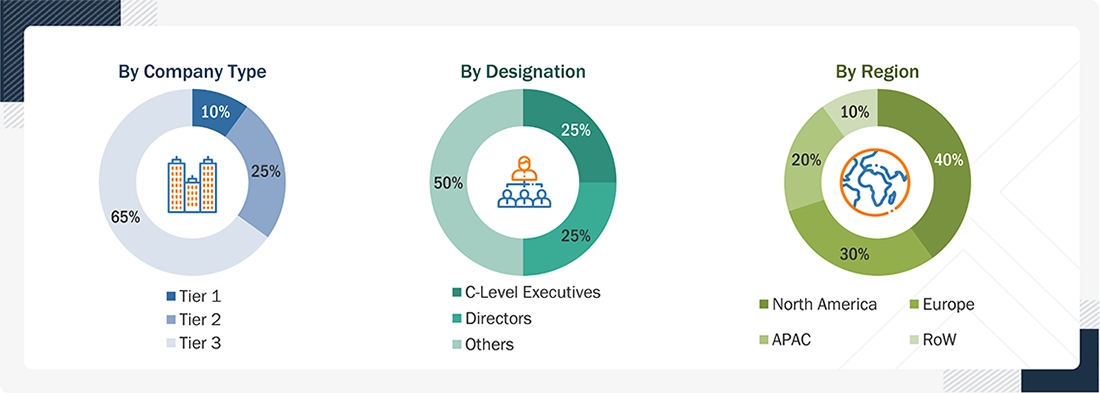
Note 1: Tier 1 companies have revenues greater than USD 10 billion; tier 2 companies’ revenues range between USD 1 and 10 billion; and tier 3 companies’ revenues range between USD 500 million and 1 billion.
Note 2: Others include sales, marketing, and product managers.
Source: Secondary Literature, Interviews with Experts, and MarketsandMarkets Analysis
To know about the assumptions considered for the study, download the pdf brochure
Market Size Estimation
Multiple approaches were adopted to estimate and forecast the digital education market. The first approach estimated market size by summing the companies’ revenue generated through service sales.
Top-down and Bottom-up Approach of Digital Education Market
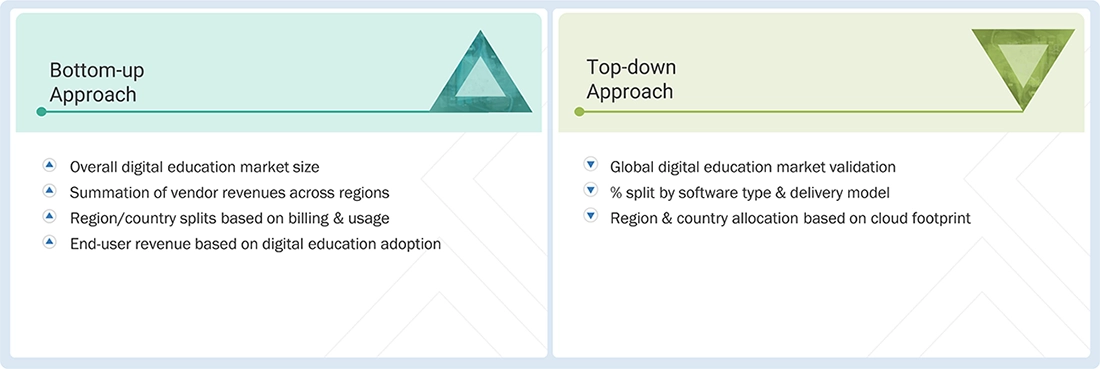
Source: Annual Reports, SEC Filings, Secondary Research, Interviews with Experts, and MarketsandMarkets Analysis
The research methodology used to estimate the market size included the following:
- Primary and secondary research was conducted to assess the revenue contributions of major market participants in each country, with secondary research identifying these participants.
- Critical insights were obtained by conducting in-depth interviews with industry professionals, including directors, CEOs, VPs, and marketing executives, and by reading the annual and financial reports of the top firms in the market.
- Primary sources were used to verify all percentage splits and breakups, which we calculated using secondary sources.
Data Triangulation
Once we determined the overall market size, we divided the market into segments and subsegments using the previously described market size estimation procedures. When needed, we used market breakdown and data triangulation procedures to complete the market engineering process and specify exact figures for each market segment and subsegment. The data was triangulated by examining several variables and patterns from the government entities’ supply and demand sides.
Market Definition
Considering the views of various sources and associations, MarketsandMarkets defines digital education as “the use of digital technologies and tools to facilitate teaching and learning. It encompasses online learning platforms, virtual classrooms, digital content, and interactive resources that enhance access to education beyond traditional settings. Digital education enables personalized learning, supports flexible study environments, and fosters collaboration through technology. It includes a broad spectrum of formats such as e-learning, blended learning, and mobile learning. With advancements in artificial intelligence and cloud computing, digital education plays a crucial role in equipping learners with essential digital skills and promoting inclusive, lifelong learning opportunities across various age groups and educational contexts.”
Key Stakeholders
- Students
- Teachers & Educators
- Educational Institutions
- EdTech Companies
- Governments & Regulatory Bodies
- Parents & Guardians
- Content Providers & Publishers
- Technology Providers
- Investors & Venture Capitalists
- NGOs & Foundations
- Telecommunication Companies
- Assessment & Accreditation Bodies
Report Objectives
- To define, describe, and forecast the global digital education market based on learning model (self-paced online learning, instructor-led online learning, blended learning, microlearning, adaptive learning, and mobile learning), delivery mode (synchronous learning, asynchronous, and hybrid classrooms), course type (academic education, test preparation, professional certifications & skill development, vocational training, and corporate learning & compliance training), end user (academic institutions, corporates & enterprises, government & public sector, and edtech companies), and region
- To forecast the market size of the five major regional segments: North America, Europe, Asia Pacific, the Middle East & Africa, and Latin America
- To strategically analyze the market subsegments with respect to individual growth trends, prospects, and contributions to the total market
- To provide detailed information related to the major factors influencing the growth of the market (drivers, restraints, opportunities, and challenges)
- To strategically analyze macro and micromarkets with respect to growth trends, prospects, and their contributions to the overall market
- To analyze industry trends, patents and innovations, and pricing data related to the digital education market
- To analyze the opportunities in the market for stakeholders and provide details of the competitive landscape for major players
- To analyze the impact of AI/GenAI on the global digital education market
- To profile key players in the market and comprehensively analyze their market share/ranking and core competencies
- To track and analyze competitive developments, such as mergers & acquisitions, product developments, and partnerships & collaborations in the market
Available customizations:
MarketsandMarkets provides customizations based on the company’s unique requirements using market data. The following customization options are available for the report.
Product analysis
- The product matrix provides a detailed comparison of each company’s portfolio.
Geographic analysis
- Further breakdown of the digital education market
Company information
- Detailed analysis and profiling of five additional market players
Key Questions Addressed by the Report
What is the projected size of the Digital Education Market by 2031?
The Digital Education Market is projected to grow from USD 40.34 billion in 2026 to USD 115.39 billion by 2031, registering a compound annual growth rate (CAGR) of 23.4% during the forecast period.
What are the key factors driving the growth of the Digital Education Market?
The Digital Education Market is driven by increasing demand for personalized learning, workforce upskilling, cloud-based learning platforms, AI-powered educational tools, and flexible learning solutions. Growing adoption of digital technologies by educational institutions and enterprises is also supporting market expansion.
Which segment is expected to grow the fastest in the Digital Education Market?
The blended learning segment, under learning model, is expected to register the highest CAGR of 27.8% during the forecast period. Its growth is driven by the combination of online learning and instructor-led teaching, offering flexibility and interactive learning experiences.
Which region holds the largest share of the Digital Education Market?
North America is expected to hold the largest share of the Digital Education Market during the forecast period. The region benefits from advanced digital infrastructure, high internet penetration, widespread adoption of online learning platforms, and investments in educational technology.
Who are the key players in the Digital Education Market?
Key players in the Digital Education Market include Skillsoft, Coursera, LinkedIn Learning, Pluralsight, edX, Udacity, Intellipaat, SWAYAM, Veranda Learning, and Alison. These companies offer digital learning platforms, professional certification programs, and online education solutions.
What opportunities are emerging in the Digital Education Market?
Major opportunities in the Digital Education Market include AI-powered personalized learning, corporate training and professional skill development, microlearning, adaptive learning technologies, and hybrid learning solutions. Increasing demand for lifelong learning and digital skills is creating opportunities for digital education providers.


Personalize This Research
- Triangulate with your Own Data
- Get Data as per your Format and Definition
- Gain a Deeper Dive on a Specific Application, Geography, Customer or Competitor
- Any level of Personalization
Let Us Help You
- What are the Known and Unknown Adjacencies Impacting the Digital Education Market
- What will your New Revenue Sources be?
- Who will be your Top Customer; what will make them switch?
- Defend your Market Share or Win Competitors
- Get a Scorecard for Target Partners

Custom Market Research Services
We Will Customise The Research For You, In Case The Report Listed Above Does Not Meet With Your Requirements
Get 10% Free CustomisationTESTIMONIALS
- US Digital Education Market
- Canada Digital Education Market
- UK Digital Education Market
- Germany Digital Education Market
- France Digital Education Market
- Italy Digital Education Market
- China Digital Education Market
- Japan Digital Education Market
- India Digital Education Market
- UAE Digital Education Market
- South Africa Digital Education Market
- Brazil Digital Education Market
- Mexico Digital Education Market
- Rest Of Europe Digital Education Market
- Rest Of Asia Pacific Digital Education Market
- Rest Of Latin America Digital Education Market
- GCC Digital Education Market
- Ksa Digital Education Market
- Rest Of GCC Digital Education Market






Growth opportunities and latent adjacency in Digital Education Market