Digital Signature Market

Digital Signature Market by Offering (Hardware, Software, and Services), Type (SES, AES, and QES), End User (Individual and Enterprises), Business Function (Finance & Accounting, Legal, IT, HR, Sales, and Marketing) - Global Forecast to 2031




OVERVIEW
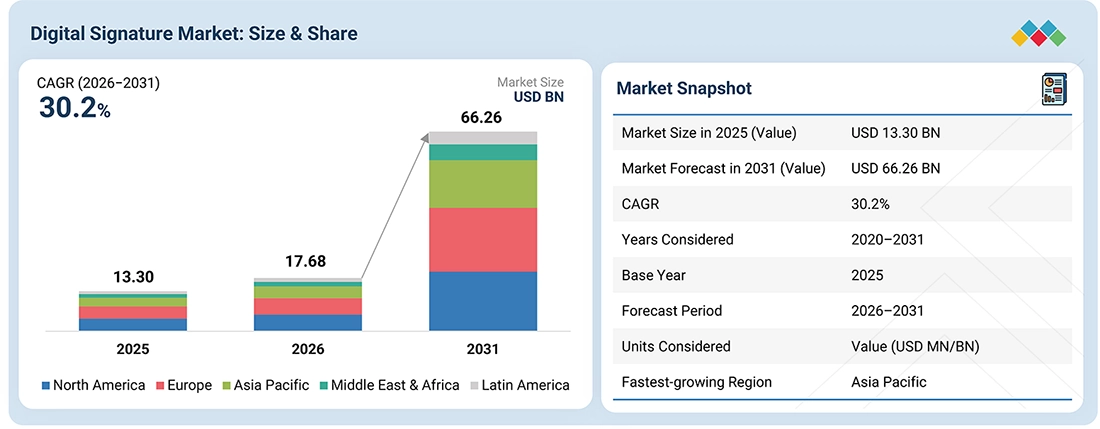
Source: Secondary Research, Interviews with Experts, MarketsandMarkets Analysis
The digital signature market is projected to grow from USD 17.68 billion in 2026 to USD 66.26 billion by 2031, at a CAGR of 30.2%. The growth of the digital signature industry is attributed to increasing digital crimes and the arising need for the safety of workflows. The rising threats of phishing attacks, identity theft, and document falsification have been prompting businesses to implement digital signatures to enable them to verify the signer’s identity and ensure the security of documents. Furthermore, digital signatures enable the automation of many paper-intensive processes in various business operations related to contract management, onboarding, approvals, and compliance documentation.
Market Size and Forecast:
- Market Size Value in 2025: USD 13.30 billion
- Market Size Value in 2026: USD 17.68 billion
- Revenue Forecast in 2031: USD 66.26 billion
- Growth Rate: CAGR of 30.2% from 2026 to 2031
- Data available from 2020 to 2031
- Base year: 2025
- Forecast period: 2026-2031
- Fastest Growing Region: Asia Pacific
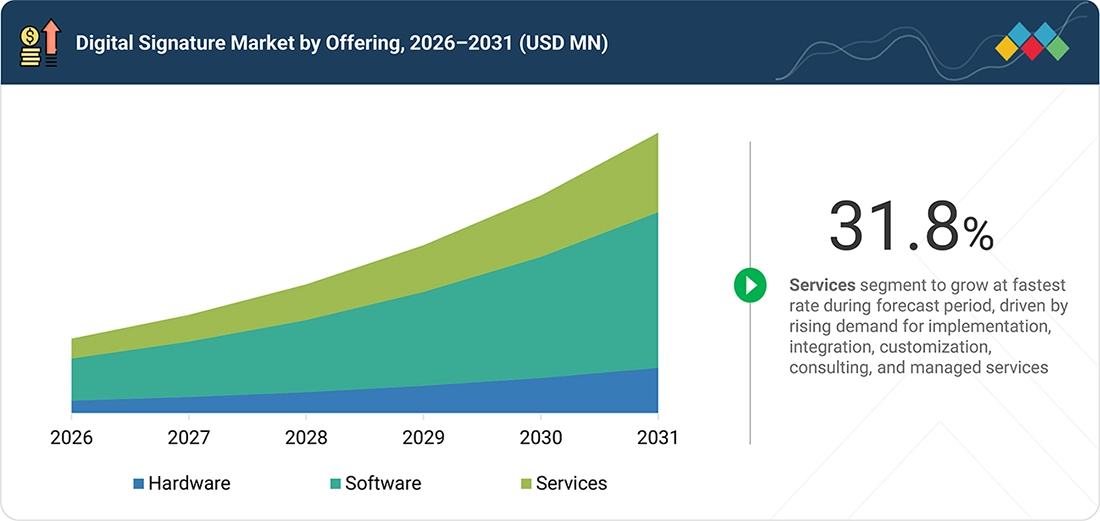
- Software segment to dominate the Digital Signature market at a CAGR of 31.8%
Key Market Trends and Insights
- Growth Driver: Rising digital transformation and compliance needs drive digital signature market adoption.
-
Growth Drivers: Cloud security, remote work, and paperless workflows accelerate market growth.
- Opportunities: Growing e-commerce, BFSI, and government digitization create market opportunities.
- AI Impact: AI enhances identity verification, fraud detection, and secure digital document authentication.
KEY TAKEAWAYS
-
BY REGIONNorth America is estimated to account for the largest share (approx. 31%) of the digital signature market in 2026.
-
BY OFFERINGBy offering, the software segment is estimated to dominate the market in 2026.
-
BY TYPEBy type, the advanced electronic signature (AES) segment is projected to exhibit the highest growth rate during the forecast period.
-
BY DEPLOYMENT MODEBy deployment mode, the cloud segment is expected to register the highest CAGR of 32.2% during the forecast period.
-
BY BUSINESS FUNCTIONBy business function, the legal operations segment is projected to witness the highest growth rate from 2026 to 2031.
-
BY END USERBy end user, the enterprise segment is estimated to account for the largest market share in 2026.
-
BY VERTICALBy vertical, the legal segment is projected to record the highest CAGR of 33.4% during the forecast period.
-
COMPETITIVE LANDSCAPE - KEY PLAYERSDocusign, Adobe, and Thales are the leading players in the digital signature market, offering secure eSignature and digital signing solutions, identity verification, PKI, certificate management, electronic seals, and digital trust services to support compliant and streamlined digital transactions across enterprises and regulated industries.
-
COMPETITIVE LANDSCAPE - STARTUPS/SMEsSigniX and Penneo are emerging providers offering specialized digital signing, identity verification, agreement management, PKI, and workflow automation solutions to strengthen secure digital transactions, paperless processes, and regulatory compliance across enterprises and industry-specific applications.
With digital transformation taking place in both the business and public sectors, organizations are increasingly implementing electronic signatures to facilitate paperless transactions, remote authorizations, and secure digital authentication. The combination of electronic signatures with various technologies such as digital identity, PKI, cloud platforms, and enterprise applications is expanding the application scope of electronic signatures in different industries. This process leads to an increase in the need for efficient, interoperable, and secure signing solutions, allowing companies to make large-scale electronic transactions.
TRENDS & DISRUPTIONS IMPACTING CUSTOMERS' CUSTOMERS
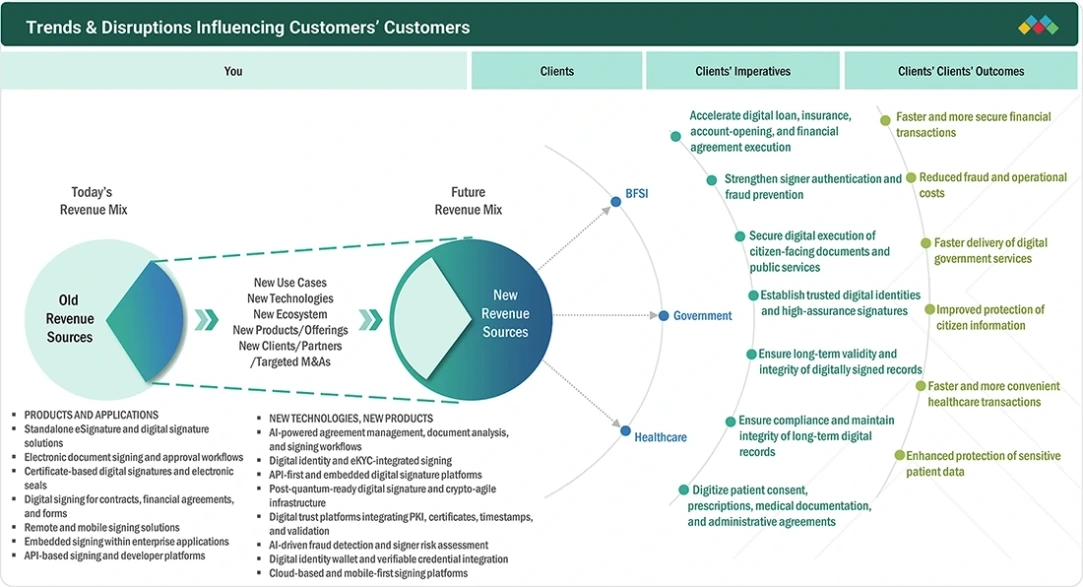
The digital signature market is undergoing a shift from standalone signing solutions toward AI-powered, identity-centric, and cloud-enabled digital trust platforms. As customers increasingly prioritize secure, seamless, and automated transactions, vendors are expanding into AI-driven agreement management, digital identity, fraud prevention, API-based signing, and integrated trust services. Docusign’s recent product developments illustrate this transition, with AI supporting document preparation, agreement analysis, and workflow automation. These developments are reshaping customer requirements across BFSI, government, and healthcare, creating demand for faster execution, stronger security, compliance, and improved management of digital agreements.
Source: Secondary Research, Interviews with Experts, MarketsandMarkets Analysis
MARKET DYNAMICS

Level
-
Rising incidences of digital frauds

-
Stringent regulatory standards and data privacy compliances


Level
-
High initial setup costs


Level
-
Digital signature adoption through cloud-enhanced security solutions

-
Surge in adoption of AI technologies


Level
-
Interoperability issues in cross-vendor digital signature solutions

Source: Secondary Research, Interviews with Experts, MarketsandMarkets Analysis
Driver: Rising incidences of digital frauds
Rising digital fraud, identity theft, and document tampering are increasing the demand for secure digital signature solutions. Digital signatures provide signer authentication, document integrity, audit trails, and tamper detection, strengthening trust in digital transactions. According to Thales, in 2025, 19% of consumers reported that their personal data had been compromised during the previous year, highlighting persistent digital security concerns. This growing security awareness is encouraging organizations to adopt certificate-based signatures, identity verification, PKI, and stronger authentication mechanisms across financial, government, healthcare, and enterprise workflows.
Restraint: High initial setup costs
High initial setup costs can restrain adoption of digital signature solutions, particularly among SMEs and organizations transitioning from paper-based processes. Expenses can include software licenses, implementation, system integration, digital certificates, PKI infrastructure, identity verification, HSMs, and employee training. According to Entrust, in its 2024 PKI and Post-Quantum Trends Study, 59% of organizations identified PKI orchestration complexity as a challenge, illustrating the technical and operational effort associated with establishing secure trust infrastructure. These costs can delay deployment and encourage organizations to prioritize cloud-based and managed signing services.
Opportunity: Digital signature adoption through cloud-enhanced security solutions
Cloud-enhanced security solutions present significant opportunities by enabling organizations to deploy digital signatures without extensive on-premises infrastructure. Cloud platforms provide scalable signing, centralized certificate management, identity verification, authentication, and security controls while supporting remote and distributed users. According to Adobe, in 2026, Adobe Document Cloud solutions process more than 6 billion electronic and digital signature transactions annually, demonstrating the scale of cloud-enabled signing adoption. Growing integration with CRM, ERP, document management, and digital identity platforms is further expanding opportunities for cloud-based digital signature solutions.
Challenge: Interoperability issues in cross-vendor digital signature solutions
Interoperability remains a key challenge as organizations increasingly combine digital signature platforms, certificate authorities, PKI systems, identity providers, and enterprise applications from multiple vendors. Differences in certificate formats, trust frameworks, signature standards, validation mechanisms, and APIs can complicate cross-platform verification and cross-border transactions. According to GlobalSign, in 2026, its Digital Signing Service surpassed 6 million signatures in June, highlighting the growing scale of digital signing ecosystems. Ensuring seamless validation across diverse platforms, therefore, requires adherence to common standards, interoperable trust frameworks, and standardized integration mechanisms.
DIGITAL SIGNATURE MARKET: COMMERCIAL USE CASES ACROSS INDUSTRIES
| COMPANY | USE CASE DESCRIPTION | BENEFITS |
|---|---|---|
 |
Customers of the company’s therapy devices were required to have a prescription. However, obtaining physical signatures from doctors can be time-consuming. To simplify obtaining prescriptions, the manufacturer turned to Docusign’s Digital Transaction Management solution for healthcare providers, which fulfilled all of their requirements. | Instead of taking more than a day, it now takes just hours or minutes to get a doctor’s signature, and patients can get the care they need faster. Digital transaction management is used to streamline the device prescription workflow; patients get released earlier from the hospital, and wound victims get the care they need as quickly as possible and in large numbers. |
 |
The H&R Block District Manager uploads a spreadsheet containing the details of the new tax agents. The workflow generates an individualized agreement for each tax agent, manages the employee’s process, and then the manager signs the agreement. Upon completion of the signing process, all parties receive a copy of the signed agreement and send a copy to human resources for central record keeping. | H&R Block realized an immediate ROI from the Secure Signing solution. It delivered stronger governance outcomes around their employment contracts while reducing the time staff spend on the process and providing employees greater convenience. The project was a success, and it has naturally increased interest in how digital signing can be used to improve a range of other processes. |
|
|
Salesforce recruits new candidates across five continents to increase its global growth. In this competitive technology industry, even the smallest details matter. Salesforce’s senior director of recruitment operations wanted to ditch the signature and digital agreement paperwork to keep pace with candidates’ expectations and the competition. | Docusign is available in 43 languages and in 188 countries. This has helped Salesforce greatly because it often hires in multiple countries and must contend with offer letters and other agreements in different languages. This seamless integration between Workday and Docusign increased the headcount of newly hired employees. |
Logos and trademarks shown above are the property of their respective owners. Their use here is for informational and illustrative purposes only.
MARKET ECOSYSTEM
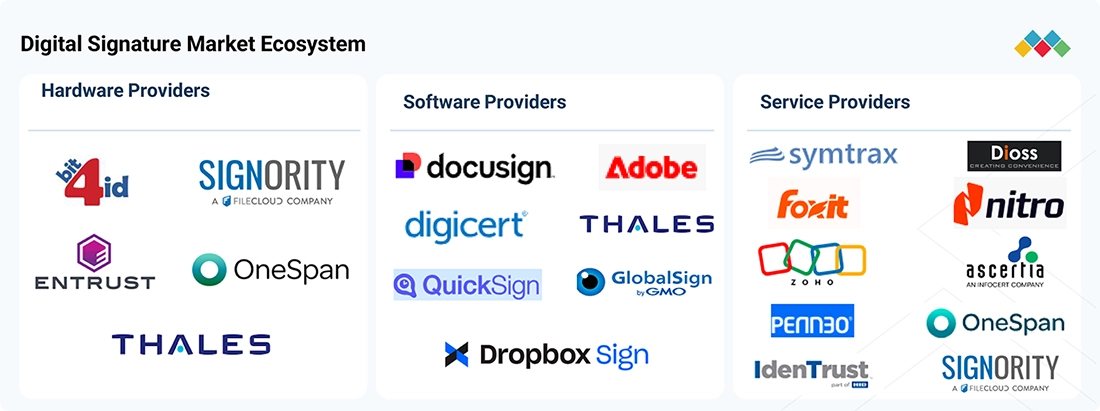
The digital signature ecosystem comprises hardware, software, and service providers that collectively support secure digital signing and digital trust. Hardware providers such as Entrust and Thales enable cryptographic key protection, while software providers including Docusign and Adobe deliver eSignature, document, and agreement-management capabilities. Service providers complement these offerings through implementation, integration, managed signing, and trust services, creating an interconnected ecosystem that supports secure, compliant, and scalable digital transactions across enterprises and regulated industries.
Logos and trademarks shown above are the property of their respective owners. Their use here is for informational and illustrative purposes only.
MARKET SEGMENTS
Source: Secondary Research, Interviews with Experts, MarketsandMarkets Analysis
Digital Signature Market, by Offering
The software segment holds the largest market share as organizations increasingly adopt digital signature platforms to automate document signing, authentication, and approval workflows. Software-based solutions enable integration with CRM, ERP, document management, and business applications, improving operational efficiency and reducing dependence on paper-based processes. Their scalability, ease of deployment, and ability to support secure remote transactions further strengthen adoption across enterprises and regulated industries.
Digital Signature Market, by Type
The Simple Electronic Signature (SES) segment holds the largest market share due to its simplicity, accessibility, and suitability for routine, low-risk digital transactions. SES solutions require minimal technical infrastructure and can be easily incorporated into everyday business workflows, making them attractive for SMEs and enterprises. Their user-friendly nature supports applications such as internal approvals, routine agreements, and general document execution.
Digital Signature Market, by Business Function
The finance and accounting segment holds the largest market share because financial operations involve extensive documentation, approvals, invoices, contracts, and audit records requiring secure and verifiable authorization. Digital signatures help accelerate invoice approvals, financial reporting, procurement documentation, and transaction processing while maintaining document integrity and auditability. Their ability to streamline paper-intensive workflows and support compliance makes them particularly valuable for finance teams.
Digital Signature Market, by Deployment Mode
The on-premises segment holds the largest market share as organizations requiring greater control over sensitive documents, cryptographic keys, and signing infrastructure continue to prefer internally managed deployments. On-premises solutions support stringent security, data governance, and compliance requirements, particularly among large enterprises and regulated sectors. They also provide organizations with greater control over system configuration, access management, and integration with existing IT infrastructure.
Digital Signature Market, by End User
The enterprise segment holds the largest market share because large organizations conduct high volumes of contracts, approvals, onboarding activities, and interdepartmental documentation. Enterprises increasingly deploy digital signatures across HR, finance, procurement, legal, sales, and customer workflows to improve efficiency, security, and compliance. Integration with existing enterprise applications and the need to manage geographically distributed operations further encourage widespread adoption.
Digital Signature Market, by Vertical
The BFSI segment holds the largest market share due to the sector's extensive use of digital documentation for customer onboarding, KYC, lending, insurance, account opening, and financial transactions. Digital signatures enable faster approvals while supporting authentication, document integrity, fraud prevention, and regulatory compliance. The shift toward digital banking and remote financial services is further increasing demand for secure and efficient signing solutions.
REGION
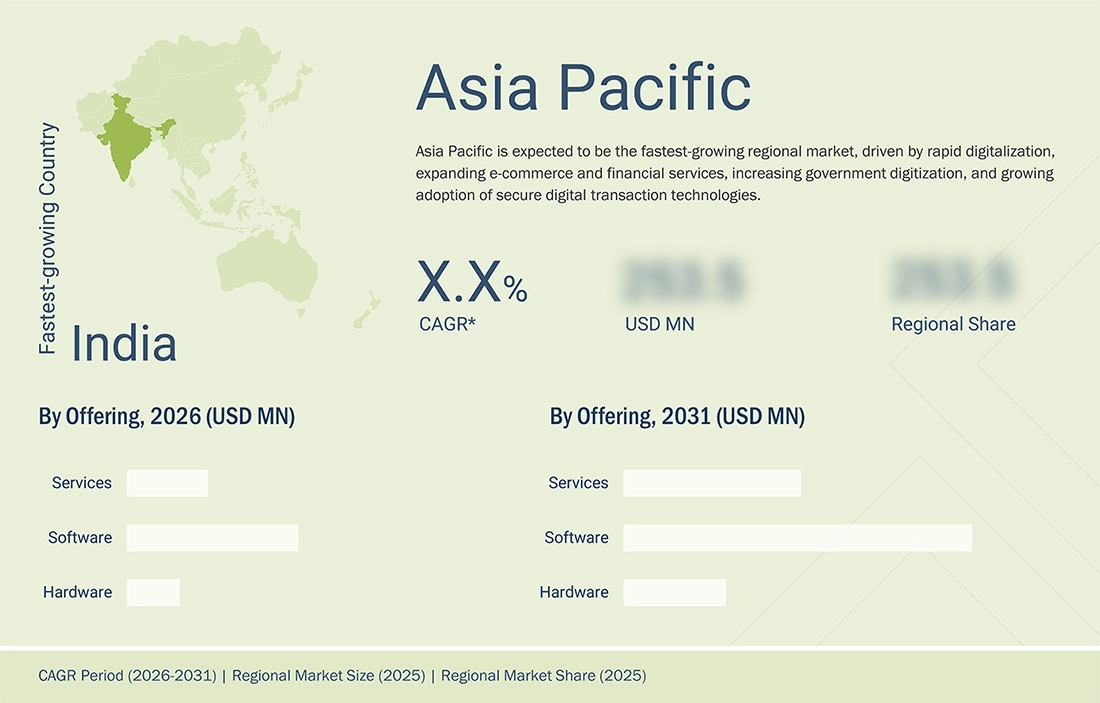
Asia Pacifc to be fastest-growing region in global digital signature market during forecast period.
Asia Pacific is expected to be the fastest-growing regional market for digital signatures, driven by rapid digital transformation, expanding e-commerce, increasing smartphone and internet penetration, and government-led digitalization initiatives. Countries such as India, China, Japan, and Singapore are strengthening digital transaction ecosystems and legal frameworks, while enterprises increasingly adopt cloud-based and mobile-enabled signing solutions. Growing integration with ERP, CRM, financial, and government platforms is further accelerating adoption across the region.
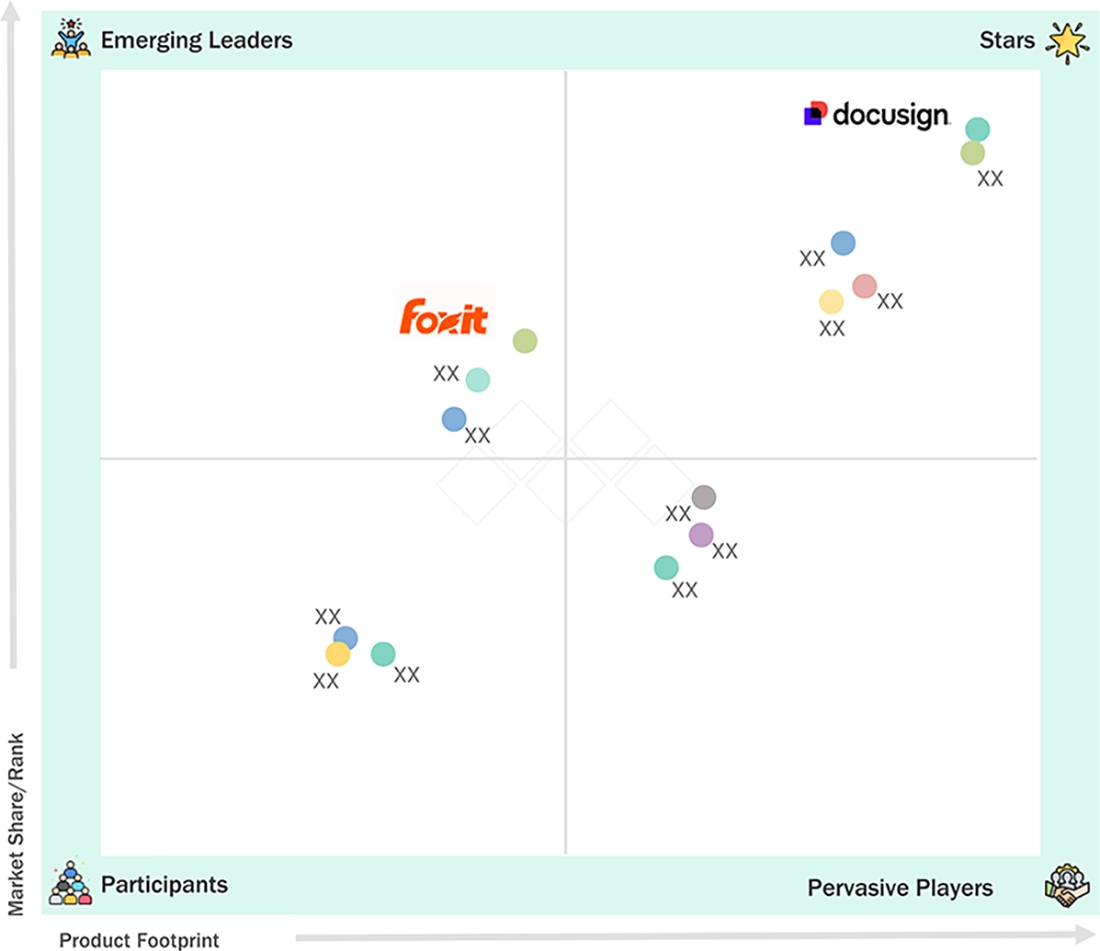
DIGITAL SIGNATURE MARKET: COMPANY EVALUATION MATRIX
Docusign (Key Player) maintains a strong position through its eSignature and Intelligent Agreement Management (IAM) platform, combining AI-powered agreement preparation, signing, analysis, workflow automation, and integrations to streamline end-to-end agreement processes. Foxit (Emerging Player) is strengthening its presence through Foxit eSign, offering legally binding electronic signatures, secure document workflows, bulk signing, and integrations with enterprise applications and cloud platforms.
Source: Secondary Research, Interviews with Experts, MarketsandMarkets Analysis
KEY MARKET PLAYERS
- Docusign (US)
- Adobe (US)
- Thales (France)
- Entrust (US)
- GlobalSign (Belgium)
- Zoho (India)
- DigiCert (US)
- OneSpan (US)
- Ascertia (UK)
- Dropbox Sign (US)
- IdenTrust (US)
MARKET SCOPE
| REPORT METRIC | DETAILS |
|---|---|
| Market Size in 2025 (Value) | USD 13.30 Billion |
| Market Size in 2026 (Value) | USD 17.68 Billion |
| Market Forecast in 2031 (Value) | USD 66.26 Billion |
| Growth Rate | CAGR of 30.2% from 2026 to 2031 |
| Years Considered | 2020-2031 |
| Base Year | 2025 |
| Forecast Period | 2026-2031 |
| Units Considered | Value (USD Million/Billion) |
| Report Coverage | Revenue forecast, company ranking, competitive landscape, growth factors, and trends |
| Segments Covered |
|
| Regions Covered | North America, Europe, Asia Pacific, Middle East & Africa, Latin America |
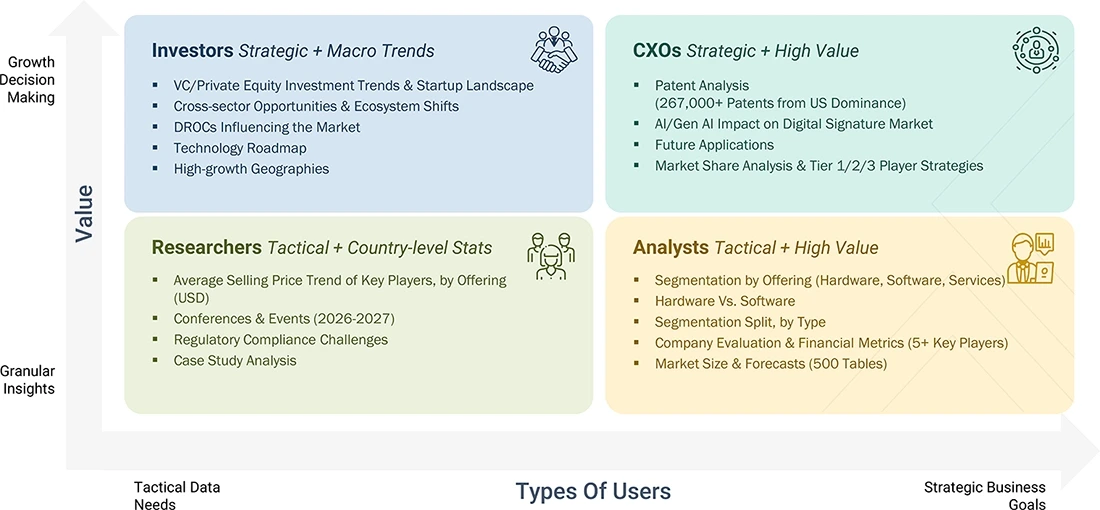
WHAT IS IN IT FOR YOU: DIGITAL SIGNATURE MARKET REPORT CONTENT GUIDE
DELIVERED CUSTOMIZATIONS
We have successfully delivered the following deep-dive customizations:
| CLIENT REQUEST | CUSTOMIZATION DELIVERED | VALUE ADDS |
|---|---|---|
| Leading Solution Provider (US) | Product Analysis: Detailed comparison of leading digital signature providers, covering eSignature capabilities, digital identity and authentication, PKI, certificate management, electronic seals, timestamps, agreement management, API/SDK integration, AI-powered agreement intelligence, security, compliance, and deployment flexibility. The analysis evaluates end-to-end digital signing workflows across enterprise applications, cloud platforms, and regulated use cases. | Stronger understanding of competitive positioning in the digital signature market, with insights into vendor capabilities across eSignature, digital trust, identity, AI-enabled agreement management, integration ecosystems, security, and compliance. The analysis supports vendor selection, partnership evaluation, product strategy, and investment decisions. Docusign's expansion into AI-powered agreement management and agentic workflows illustrates the market's shift toward intelligent, integrated signing platforms. |
| Leading Service Provider (EU) | Company Information: Detailed profiling and evaluation of additional digital signature and trust service providers (up to 5), covering eSignature platforms, qualified trust services, digital identity, PKI, certificate lifecycle management, electronic seals, timestamps, validation and preservation services, API-based signing, regional regulatory compliance, global presence, and strategic partnerships across BFSI, government, healthcare, and IT. | Comprehensive perspective on the evolving digital trust ecosystem, highlighting increasing convergence of eSignatures with identity, PKI, AI-powered agreement management, and trust services. The analysis identifies opportunities for vendor differentiation through interoperability, regulatory alignment, automation, secure digital workflows, and scalable cloud/API-based services, supporting strategic partnerships, vendor selection, and long-term digital trust transformation. |
RECENT DEVELOPMENTS
- March 2026 : Docusign introduced enhancements including an AI-powered eSignature home page, multi-document AI summaries and Q&A, unified eSignature and digital signature management, enhanced Workspaces, and expanded identity evidence retrieval through APIs.
- July 2025 : Adobe enhanced Acrobat Sign in its July 2025 release with PDF/A-2b support for long-term compliant archiving, WhatsApp-based agreement notifications, and strengthened security through account sharing controls and restricted agreement access.
- August 2026 : Fujitsu partnered with DigiCert to deliver automated digital certificate lifecycle management services across Australia and New Zealand, combining DigiCert ONE with Fujitsu’s consulting, integration, and managed services expertise to improve digital trust, operational resilience, and post-quantum readiness.
- November 2025 : Zenoo partnered with Ascertia to integrate identity verification, e-signatures, and SigningHub services, enabling faster, secure, and compliant end-to-end digital onboarding experiences across regulated industries.
Table of Contents
 Exclusive indicates content/data unique to MarketsandMarkets and not available with any competitors.
Methodology
Secondary research was conducted to collect information useful for this technical, market-oriented, and commercial study of the digital signature market. The next step involved validating these findings, assumptions, and sizing with industry experts across the value chain using primary research. Different approaches, including top-down and bottom-up methods, were employed to estimate the total market size. After that, the market breakup and data triangulation procedures were used to estimate the market size of the segments and subsegments of the market.
Secondary Research
During the secondary research process, various secondary sources were consulted to identify and collect information relevant to the study. The secondary sources included annual reports, press releases, investor presentations of digital signature vendors, forums, certified publications, and whitepapers. The secondary research was mainly used to obtain key information about the industry’s supply chain, the total pool of key players, market classification and segmentation according to industry trends to the bottom-most level, regional markets, and key developments from both market- and technology-oriented perspectives, all of which were further validated by primary sources.
Primary Research
In the primary research process, various primary sources from both the supply and demand sides were interviewed to obtain qualitative and quantitative information for this report. The primary sources from the supply side included industry experts such as chief executive officers (CEOs), vice presidents (VPs), marketing directors, technology and innovation directors, and other key executives from major companies and organizations operating in the digital signature market.
In the market engineering process, top-down and bottom-up approaches were extensively used, along with several data triangulation methods, to estimate and forecast the overall market segments and subsegments listed in this report. Extensive qualitative and quantitative analyses were performed on the complete market engineering process to present key information/insights throughout the report.
After the complete market engineering process (including calculations for market statistics, market breakups, market size estimates, market forecasts, and data triangulation), extensive primary research was conducted to gather information and verify & validate the derived critical numbers. The primary research was also conducted to identify the segmentation types, industry trends, competitive landscape of digital signature market players, and key market dynamics, such as drivers, restraints, opportunities, challenges, and key strategies.
Breakup of Primary Study:

Note: Tier 1 companies receive revenues higher than USD 10 billion; Tier 2 companies' revenues range between USD 1 and 10 billion; and Tier 3 companies' revenues range between USD 500 million and USD 1 billion. Other designations include sales, marketing, and product managers.
Source: Industry Experts
To know about the assumptions considered for the study, download the pdf brochure
Market Size Estimation
Top-down and bottom-up approaches were employed to estimate and validate the size of the digital signature market and of various dependent subsegments within it. The research methodology used to estimate the market size included the following: critical players in the market were identified through secondary research, and their market shares in the respective regions were determined through both primary and secondary research. This procedure involved analyzing the annual and financial reports of the top market players and conducting extensive interviews with key industry leaders, including CEOs, VPs, directors, and marketing executives, to gather valuable insights.
All percentage splits and breakdowns were determined using secondary sources and verified through primary sources. All parameters that affect the market covered in this study were accounted for, examined in detail, verified through primary research, and analyzed to obtain final quantitative and qualitative data. This data was consolidated with detailed inputs and analysis from MarketsandMarkets.
Digital Signature Market : Top-Down and Bottom-Up Approach

Data Triangulation
The market was divided into several segments and subsegments after determining the overall market size using the market size estimation processes explained above. Data triangulation and market breakup procedures were employed, where applicable, to complete the overall market engineering process and arrive at the exact statistics for each market segment and subsegment. The data was triangulated by studying various factors and trends from both the demand and supply sides.
Market Definition
According to MarketsandMarkets, “a digital signature is an electronic form of a signature that uses an advanced mathematical technique to verify the authenticity and integrity of digital messages/documents as well as the identity of the signer. Digital signatures are safer and more secure than traditional pen-and-paper signatures. The digital signature ensures the information originates from the signer and is unaltered. They are the fastest way to authenticate a signer’s identity and are strong proof that the signer and no one else has signed the document”.
Key Stakeholders
- Chief Technology and Data Officers
- Business Analysts
- Information Technology (IT) Professionals
- Government Agencies
- Investors and Venture Capitalists
- Small and Medium-sized Enterprises (SMEs) and Large Enterprises
- Third-party Providers
- Consultants/Consultancies/Advisory Firms
- Managed and Professional Service Providers
Report Objectives
- To describe and forecast the digital signature market by offering, type, business function, deployment mode, end user, vertical, and region, as well as analyze the various macroeconomic and microeconomic factors that affect market growth
- To forecast the market size of five major regions: North America, Europe, Asia Pacific, the Middle East & Africa, and Latin America
- To analyze the subsegments of the market concerning individual growth trends, prospects, and contributions to the overall market
- To provide detailed information related to the primary factors (drivers, restraints, opportunities, and challenges) influencing the growth of the market.
- To analyze opportunities in the market for stakeholders by identifying high-growth segments of the market
- To profile the key players of the market and comprehensively analyze their market size and core competencies
- To analyze competitive developments, such as product launches, mergers and acquisitions, partnerships, agreements, and collaborations, in the market
Available customizations:
With the given market data, MarketsandMarkets offers customizations based on company-specific needs. The following customization options are available for the report:
Product Analysis
- Further breakdown of the Asia Pacific market into countries that contribute to the regional market size.
- Further breakdown of the North American market into countries that contribute to the regional market size.
- Further breakdown of the Latin American market into countries that contribute to the regional market size.
- Further breakdown of the Middle Eastern & African market into countries that contribute to the regional market size.
- Further breakdown of the European market into countries that contribute to the regional market size.
Company Information
- Detailed analysis and profiling of additional market players (up to 5)
Country Information
-
Additional country-level analysis of the dermatology devices market
Key Questions Addressed by the Report
What are the opportunities in the global digital signature market?
Enhancement of customer experiences with digital signature integration, digital signature adoption through cloud-enhanced security solutions, navigating the wave of digital signature market consolidations, and AI-enhanced security will pave the way for the digital signature market’s growth.
What is a digital signature?
According to MarketsandMarkets, a digital signature is an electronic form of a signature that uses an advanced mathematical technique to verify the authenticity and integrity of digital messages/documents as well as the identity of the signer. Digital signatures are safer and more secure than traditional pen-and-paper signatures. The digital signature ensures the information originates from the signer and is unaltered. They are the fastest way to authenticate a signer’s identity and are strong proof that the signer and no one else has signed the document.
Which region will have the largest share of the digital signature market?
North America is expected to account for the largest market share during the forecast period.
Which are the major market players covered in the report?
Some of the major vendors include DocuSign (US), Adobe (US), Thales (France), DigiCert (US), Entrust (US), eSign (China), Foxit Software (US), Ascertia (UK), GlobalSign (Belgium), Zoho (India), OneSpan (US), IdenTrust (US).
What is the current size of the digital signature market?
The global digital signature market size is projected to grow from USD 17.68 billion in 2026 to USD 66.26 billion by 2031 at a compound annual growth rate (CAGR) of 30.2% during the forecast period.


Personalize This Research
- Triangulate with your Own Data
- Get Data as per your Format and Definition
- Gain a Deeper Dive on a Specific Application, Geography, Customer or Competitor
- Any level of Personalization
Let Us Help You
- What are the Known and Unknown Adjacencies Impacting the Digital Signature Market
- What will your New Revenue Sources be?
- Who will be your Top Customer; what will make them switch?
- Defend your Market Share or Win Competitors
- Get a Scorecard for Target Partners

Custom Market Research Services
We Will Customise The Research For You, In Case The Report Listed Above Does Not Meet With Your Requirements
Get 10% Free CustomisationTESTIMONIALS






Growth opportunities and latent adjacency in Digital Signature Market