



Manufacturing Execution System Market Size 2026-2032
Report Code
SE 2339
Published in
Oct, 2026, By MarketsandMarkets™
Manufacturing Execution System Market by Offering (Services, Software), Deployment Mode (On-premises, Cloud, Hybrid), Industry (Food & Beverages, Oil & Gas, Chemicals, Pharmaceuticals & Life Sciences, Automotive) - Global Forecast to 2032

USD 32.83 BN
MARKET SIZE, 2032

CAGR 11.3%
(2026-2032)

300
REPORT PAGES

150
MARKET TABLES
OVERVIEW
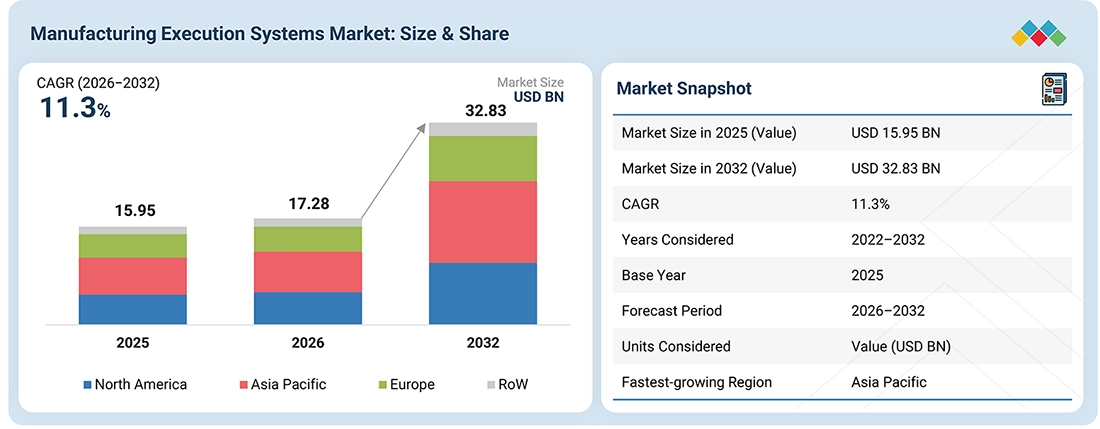
Source: Secondary Research, Interviews with Experts, MarketsandMarkets Analysis
The global manufacturing execution systems market is projected to reach USD 32.83 billion by 2032 from an estimated USD 17.28 billion in 2026, growing at an estimated CAGR of 11.3%. The market is expected to expand steadily, driven by increasing adoption of industrial automation, smart manufacturing, real-time production monitoring, and digital transformation initiatives. Rising demand for production traceability, quality management, regulatory compliance, and operational efficiency is further accelerating MES adoption across automotive, pharmaceuticals, electronics, aerospace, and food & beverage industries. Additionally, advancements in cloud-based manufacturing software, artificial intelligence (AI), Industrial Internet of Things (IIoT), digital twins, and predictive analytics are enabling more connected, scalable, and data-driven manufacturing operations across diverse industrial sectors.
KEY TAKEAWAYS
-
By RegionNorth America is expected to account for approximately 31% share of the manufacturing execution systems market by 2032, supported by early adoption of Industry 4.0 technologies, strong investments in smart manufacturing infrastructure, increasing demand for real-time production monitoring, and the presence of leading industrial automation and manufacturing software providers across the US and Canada.
-
By OfferingBy offering, the services segment is projected to register the CAGR of 12.2% from 2026 to 2032, driven by increasing demand for system implementation, integration, customization, software upgrades, and ongoing technical support.
-
By IndustryBy industry, the pharmaceuticals & life sciences segment is expected to register 15.3% CAGR during 2026–2032, driven by stringent regulatory requirements and rising demand for electronic batch records, product traceability, and automated quality control.
-
By Deployment ModeBased on deployment mode, the cloud segment is expected to hold the largest market share by 2032, driven by its scalability, lower upfront infrastructure costs, remote accessibility, and faster software updates. Increasing adoption of cloud-based manufacturing solutions to enable real-time production monitoring, multi-site coordination, and integration with enterprise systems is expected to support segment growth.
-
Competitive Landscape (Key Players)Key players in the manufacturing execution systems market include Siemens (Germany), Dassault Systèmes (France), SAP SE (Germany), Rockwell Automation (US), and Honeywell International Inc. (US), supported by continuous advancements in digital manufacturing, industrial automation, cloud-based platforms, real-time production monitoring, and data analytics.
-
Competitive Landscape (SMEs/Startup Players)SMEs and startups in the manufacturing execution systems market include MasterControl Solutions, Inc. (US), Miracom, Inc. (South Korea), MPDV (Germany), Parsec Automation, LLC (US), and Andea (Poland), offering configurable and industry-specific manufacturing execution solutions. These companies focus on real-time production monitoring, quality management, traceability, shop-floor optimization, and integration with enterprise systems to address evolving customer requirements and support digital manufacturing.
The manufacturing execution systems market is witnessing strong growth driven by increasing adoption of industrial automation, Industry 4.0, smart manufacturing, and connected production environments. Growing demand for real-time production monitoring, product traceability, automated quality management, and operational efficiency is accelerating MES deployment across automotive, pharmaceuticals, electronics, aerospace, and food & beverages industries. Additionally, advancements in cloud-based MES platforms, artificial intelligence (AI), Industrial Internet of Things (IIoT), digital twins, and predictive analytics are further strengthening market expansion globally.
TRENDS & DISRUPTIONS IMPACTING CUSTOMERS' CUSTOMERS
Trends in Industry 4.0, smart manufacturing, industrial automation, and digital transformation are reshaping demand for manufacturing execution systems globally. Manufacturers are increasingly adopting MES solutions to enable real-time production monitoring, improve quality control, enhance traceability, and integrate shop-floor operations with enterprise systems, supporting greater operational efficiency, data-driven decision-making, regulatory compliance, and reduced production downtime.
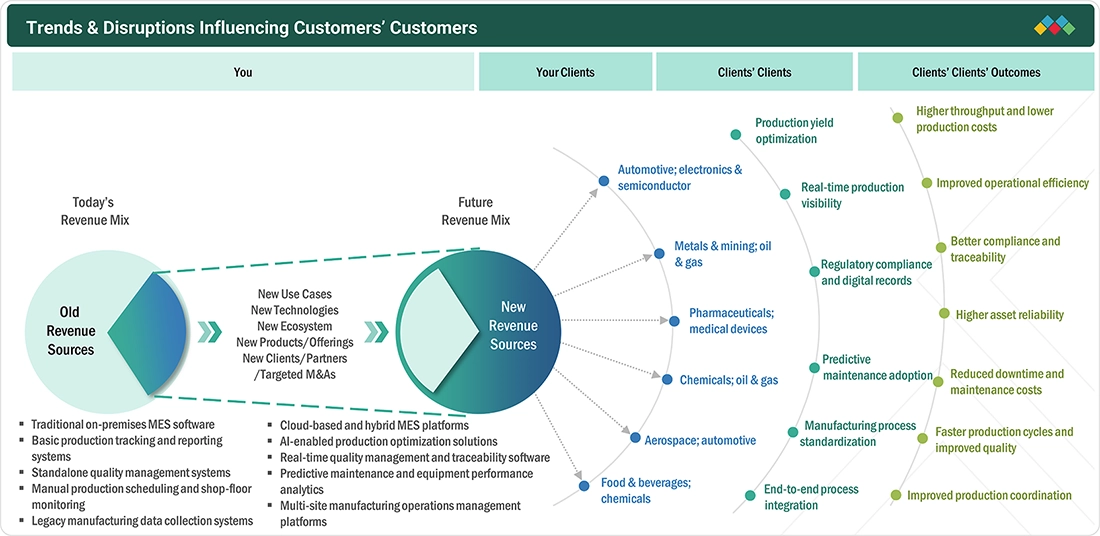
Source: Secondary Research, Interviews with Experts, MarketsandMarkets Analysis
MARKET DYNAMICS

Drivers
Impact
Level
Level
-
Rising Demand for Product Traceability and Regulatory Compliance

-
Growing Complexity of Multi-product Manufacturing


RESTRAINTS
Impact
Level
Level
-
Extended Deployment Timelines Due to Manufacturing Process Customization Requirements

-
High Initial Investment Required for MES Software Implementation and Integration


OPPORTUNITIES
Impact
Level
Level
-
Increasing Adoption of Composable MES Platforms and Modular Software Architectures

-
Expansion of MES Applications in Battery Gigafactories and Electric Vehicle Manufacturing


CHALLENGES
Impact
Level
Level
-
Increasing Cybersecurity Risks Across Connected Manufacturing Systems and Operations

-
Difficulty Standardizing Manufacturing Data Across Multiple Production Facilities

Source: Secondary Research, Interviews with Experts, MarketsandMarkets Analysis
Driver: Rising Demand for Product Traceability and Regulatory Compliance
Increasing regulatory requirements across pharmaceuticals, food & beverages, medical devices, and other manufacturing industries are driving demand for MES solutions. These systems enable real-time production tracking, electronic batch records, automated documentation, and end-to-end product traceability, helping manufacturers maintain compliance, improve quality control, and reduce documentation errors.
Restraint: Extended Deployment Timelines Due to Manufacturing Process Customization Requirements
MES implementation often requires extensive customization to accommodate specific production workflows, quality procedures, equipment configurations, and reporting requirements. Integration with existing ERP, SCADA, and shop-floor systems can further extend deployment timelines, increase implementation costs, and delay the realization of operational benefits.
Opportunity: Increasing Adoption of Composable MES Platforms and Modular Software Architectures
Manufacturers are increasingly seeking flexible MES platforms that allow individual functions, such as production scheduling, quality management, inventory tracking, and performance monitoring, to be implemented according to their needs. Modular architectures enable easier upgrades, phased deployment, and integration with existing manufacturing systems, creating opportunities for MES providers to serve businesses of different sizes and complexities.
Challenge: Increasing Cybersecurity Risks Across Connected Manufacturing Systems and Operations
The growing connectivity between MES platforms, industrial equipment, enterprise applications, and cloud environments increases exposure to cyberattacks, unauthorized access, and operational data breaches. MES providers and manufacturers must strengthen access controls, data protection, network security, and system monitoring while maintaining reliable production operations and protecting sensitive manufacturing information.
MANUFACTURING EXECUTION SYSTEM MARKET SIZE 2030: COMMERCIAL USE CASES ACROSS INDUSTRIES
| COMPANY | USE CASE DESCRIPTION | BENEFITS |
|---|---|---|
 |
BASF Coatings implemented Siemens Opcenter to digitize production and batch data, improve process transparency, and support real-time tracking of process vessels. The implementation also aimed to reduce system interfaces and paper-based processes | Improved production transparency | Reduced manual documentation | Better batch data management | Reduced interface complexity | Enhanced operational control |
 |
Hyundai Doosan Infracore adopted DELMIA Apriso to standardize manufacturing processes and synchronize production operations across facilities in South Korea and China as part of its Factory of the Future initiative | Standardized manufacturing processes | Improved coordination across global plants | Greater production visibility | Enhanced manufacturing consistency | Better operational synchronization |
 |
ContiTech implemented SAP Digital Manufacturing at a greenfield facility in Mexico to establish standardized production processes, improve product traceability from material receipt to finished goods, and create a scalable manufacturing template for additional facilities. | End-to-end product traceability | Standardized manufacturing processes | Scalable plant deployment | Improved production data visibility | Better manufacturing coordination |
 |
Rockwell Automation provides FactoryTalk Production Centre and other FactoryTalk MES solutions to integrate shop-floor operations with enterprise systems, supporting production tracking, quality management, and process control across manufacturing environments. | Improved production monitoring | Better quality management | Enhanced shop-floor integration | Greater process consistency | Improved operational decision-making |
 |
Whirlpool China implemented GE Vernova's Proficy MES alongside automation and SCADA technologies at a new dishwasher factory. The solution connected production equipment, captured component and process data, and supported material traceability across manufacturing operations | Connected more than 300 machines | Improved component and process traceability | Enhanced production visibility | Better manufacturing coordination | Support for on-time delivery |
Logos and trademarks shown above are the property of their respective owners. Their use here is for informational and illustrative purposes only.
MARKET ECOSYSTEM
The manufacturing execution systems ecosystem comprises automation and industrial software providers, MES solution developers, hardware and equipment suppliers, system integrators, cloud and IT infrastructure providers, and end users. Automation and industrial software providers supply PLC, SCADA, ERP, and industrial IoT technologies that support data exchange between enterprise systems and shop-floor operations. MES solution developers deliver software for production scheduling, real-time monitoring, quality management, traceability, and performance optimization. System integrators and consulting partners support implementation, customization, legacy system integration, and workforce training, while cloud and IT infrastructure providers enable secure data storage, remote access, and scalable deployment. End users, including automotive manufacturers, pharmaceutical companies, electronics producers, food and beverage manufacturers, and industrial equipment suppliers, deploy MES solutions to improve productivity, ensure regulatory compliance, reduce production downtime, and enhance manufacturing efficiency.
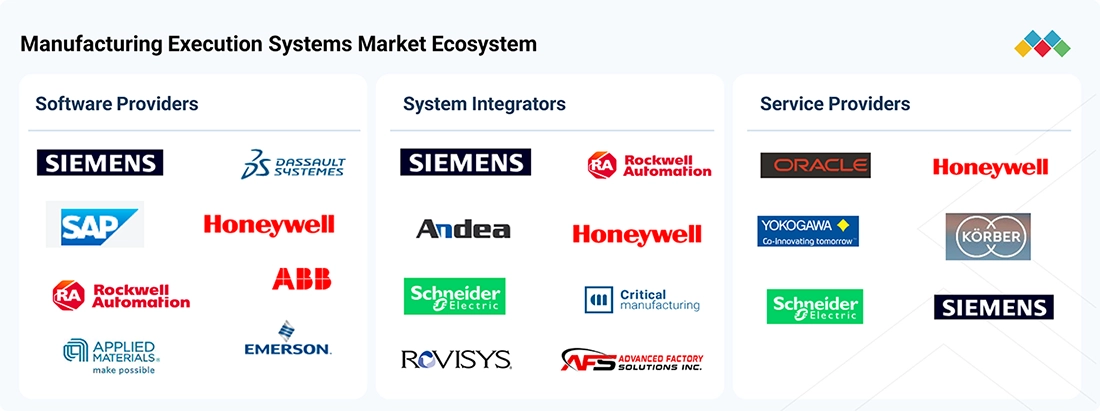
Logos and trademarks shown above are the property of their respective owners. Their use here is for informational and illustrative purposes only.
MARKET SEGMENTS
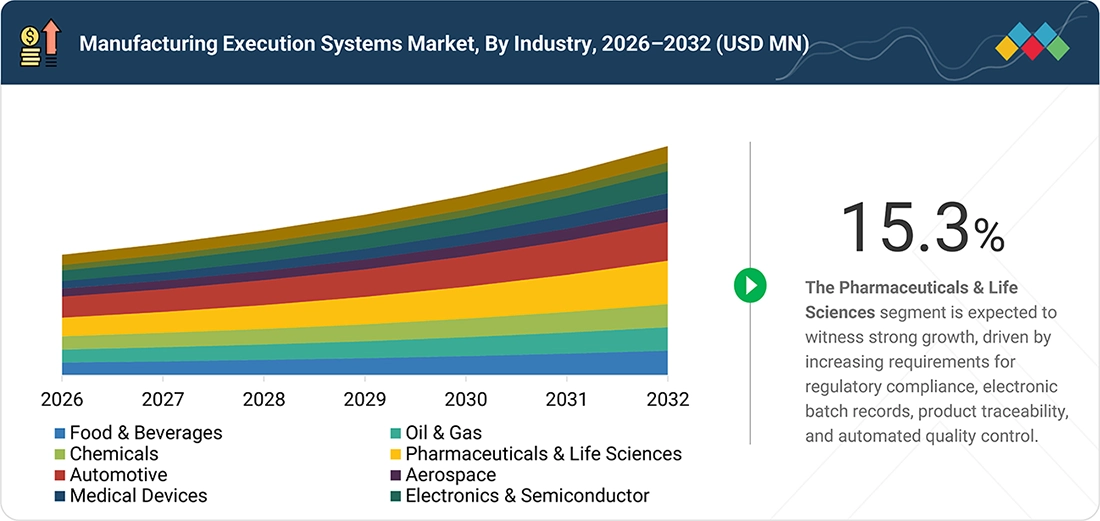
Source: Secondary Research, Interviews with Experts, MarketsandMarkets Analysis
Manufacturing Execution Systems Market, By Offering
The services segment is expected to register the highest CAGR during 2026–2032, driven by increasing demand for implementation, system integration, customization, and ongoing technical support. The growing complexity of manufacturing operations and the need to integrate MES with ERP, SCADA, and Industrial IoT platforms are further increasing demand for professional services. Additionally, rising adoption of cloud-based MES, system upgrades, employee training, and cybersecurity support is expected to drive sustained growth in the services segment.
Manufacturing Execution Systems Market, By Deployment Mode
The hybrid segment is expected to register the highest CAGR during 2026–2032, as manufacturers seek to combine the flexibility of cloud-based solutions with the security and control of on-premises systems. Hybrid deployment enables businesses to retain sensitive production data locally while leveraging cloud capabilities for analytics, remote monitoring, and multi-site coordination. Growing demand for flexible integration with legacy manufacturing infrastructure and gradual cloud migration is expected to further support the segment’s growth.
Manufacturing Execution Systems Market, By Industry
The pharmaceuticals & life sciences segment is expected to hold the largest market share by 2032, driven by stringent regulatory requirements, the need for product traceability, and increasing adoption of electronic batch records. Growing production of biologics, vaccines, and complex drugs is further increasing demand for MES solutions that support real-time process monitoring, automated quality management, data integrity, and manufacturing compliance.
REGION
Asia Pacific to record fastest growth in global manufacturing execution systems market during forecast period
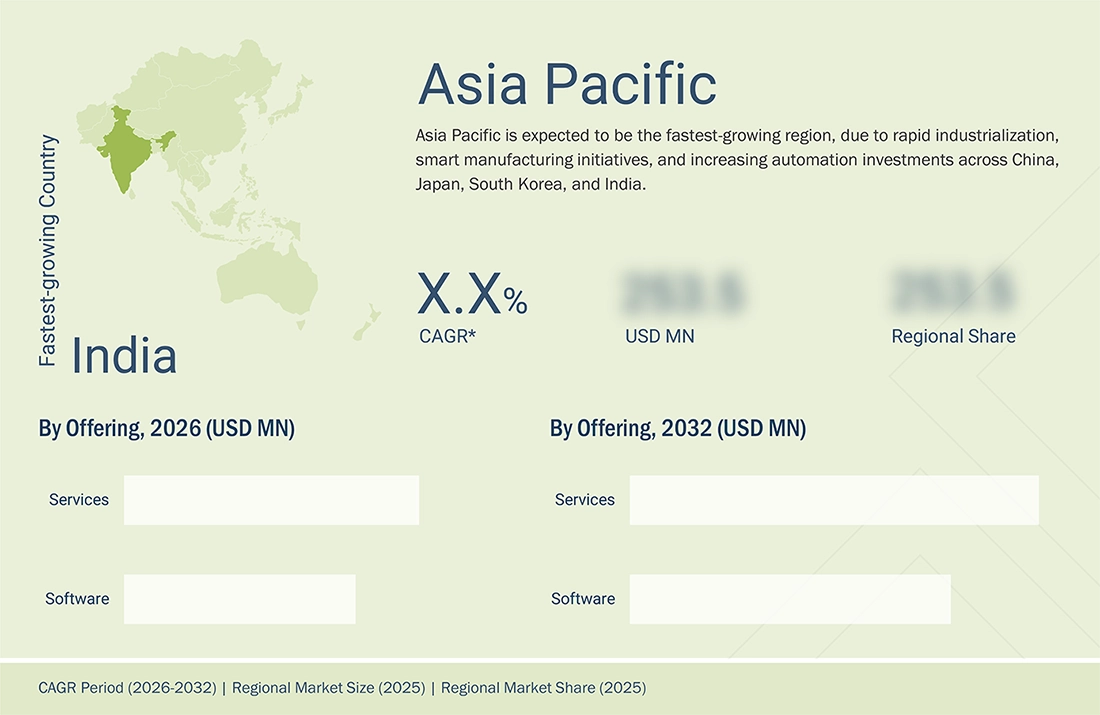
Asia Pacific is expected to register the highest CAGR in the manufacturing execution systems market during the forecast period, driven by rapid industrialization, expanding Industry 4.0 initiatives, and increasing adoption of smart manufacturing technologies across China, Japan, South Korea, and India. Growing investments in automotive, electronics, semiconductor, pharmaceuticals, and other manufacturing industries are accelerating MES deployment to improve production visibility, quality control, and operational efficiency. Additionally, government initiatives supporting digital transformation, rising automation investments, and increasing demand for real-time production monitoring and regulatory compliance are expected to further drive MES adoption across the region.
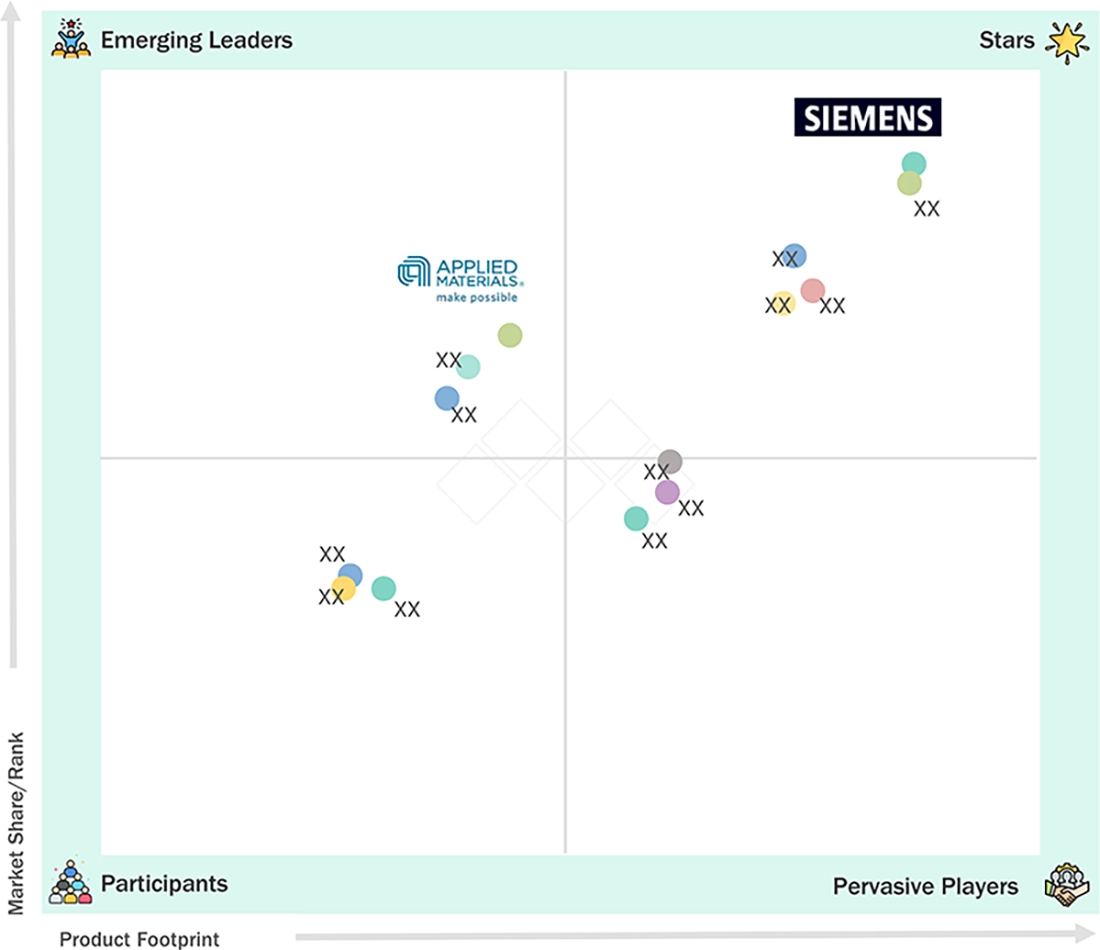
MANUFACTURING EXECUTION SYSTEM MARKET SIZE 2030: COMPANY EVALUATION MATRIX
In the manufacturing execution systems market matrix, Siemens is positioned as a Star, supported by its comprehensive MES portfolio, advanced industrial automation capabilities, and strong presence in digital manufacturing through its Opcenter platform. Applied Materials, Inc. is positioned as an Emerging Leader, driven by its expertise in semiconductor manufacturing technologies, process control, and smart factory solutions, with growing opportunities to support advanced semiconductor production through integrated manufacturing intelligence, process optimization, and data-driven operational improvements.
Source: Secondary Research, Interviews with Experts, MarketsandMarkets Analysis
KEY MARKET PLAYERS
- Siemens (Germany)
- Dassault Systèmes (France)
- SAP SE (Germany)
- Rockwell Automation (US)
- Honeywell International Inc. (US)
- ABB (Switzerland)
- Applied Materials (US)
- Emerson Electric Co. (US)
- GE Vernova (US)
- Schneider Electric (France)
MARKET SCOPE
| REPORT METRIC | DETAILS |
|---|---|
| Market Size in 2025 (Value) | USD 15.95 Billion |
| Market Size in 2026 (Value) | USD 17.28 Billion |
| Market Forecast in 2032 (Value) | USD 32.83 Billion |
| Growth Rate | 11.3% |
| Years Considered | 2022-2032 |
| Base Year | 2025 |
| Forecast Period | 2026-2032 |
| Units Considered | Value (USD Billion) |
| Report Coverage | Revenue Forecast, Company Ranking, Competitive Landscape, Growth Factors, and Trends |
| Segments Covered |
|
| Regions Covered | North America, Europe, Asia Pacific, RoW |
WHAT IS IN IT FOR YOU: MANUFACTURING EXECUTION SYSTEM MARKET SIZE 2030 REPORT CONTENT GUIDE
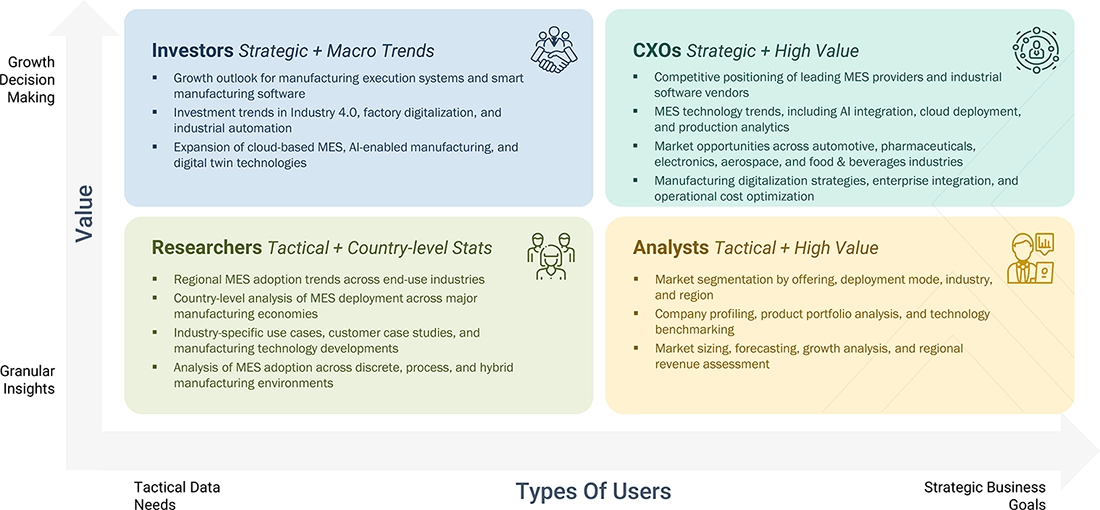
DELIVERED CUSTOMIZATIONS
We have successfully delivered the following deep-dive customizations:
| CLIENT REQUEST | CUSTOMIZATION DELIVERED | VALUE ADDS |
|---|---|---|
| MES Software & Solution Provider |
|
|
| Industrial Automation & Control System Provider |
|
|
| MES Software Developer & Vendor |
|
|
| Cloud MES & Digital Manufacturing Solution Provider |
|
|
| System Integrator & MES Implementation Partner |
|
|
RECENT DEVELOPMENTS
- May 2026 : Körber announced the launch of PAS-X Neo, a cloud-native MES designed for small and mid-sized pharmaceutical and biopharmaceutical manufacturers, with initial availability expected in November 2026. The platform aims to simplify implementation through standardized templates, AI-assisted configuration, and GMP-compliant features, enabling manufacturers to digitize shop-floor operations while reducing implementation complexity and IT infrastructure requirements.
- April 2026 : SAP introduced agentic AI capabilities for manufacturing and supply chain operations, enabling businesses to identify production and supply disruptions, assess operational constraints, and automate workflow decisions. The initiative strengthens the integration of manufacturing execution with production planning, logistics, and enterprise applications, supporting improved operational efficiency and real-time decision-making.
- March 2026 : GE Vernova completed the sale of its Proficy software business to TPG for USD 600 million, establishing Proficy as an independent software company serving manufacturing and infrastructure customers. Its portfolio includes MES, HMI/SCADA, industrial data management, and analytics solutions, strengthening its standalone position in the industrial software market.
- December 2025 : ECI Software Solutions acquired Amper Technologies, adding its FactoryOS MES platform to ECI’s manufacturing software portfolio. The acquisition strengthens integration between ERP and shop-floor execution through AI-powered production insights, real-time machine monitoring, smart scheduling, and overall equipment effectiveness (OEE) tracking, helping manufacturers improve operational visibility and productivity.
- May 2025 : Cybord expanded its OEM agreement with Siemens Digital Industries Software to integrate its AI-powered visual inspection technology into Siemens’ Opcenter MES, enabling real-time electronic component defect detection and enhanced traceability. The collaboration aims to improve product quality, reduce rework and scrap, and strengthen production quality control in electronics manufacturing.
Table of Contents
 Exclusive indicates content/data unique to MarketsandMarkets and not available with any competitors.
TITLE
PAGE NO
1
INTRODUCTION
15
2
EXECUTIVE SUMMARY
3
PREMIUM INSIGHTS
4
MARKET OVERVIEW
Outlines emerging trends, technology impact, and regulatory signals affecting growth trajectory and stakeholder decisions.
4.1
INTRODUCTION
4.2
MARKET DYNAMICS
4.2.1
DRIVERS
4.2.2
RESTRAINTS
4.2.3
OPPORTUNITIES
4.2.4
CHALLENGES
4.3
INTERCONNECTED MARKETS AND CROSS-SECTOR OPPORTUNITIES
4.4
STRATEGIC MOVES BY TIER 1/2/3 PLAYERS
5
INDUSTRY TRENDS
Presents a concise view of industry direction, strategic priorities, and key indicators influencing market momentum.
5.1
PORTER’S FIVE FORCES ANALYSIS
5.2
MACROECONOMIC OUTLOOK
5.2.1
INTRODUCTION
5.2.2
GDP TRENDS AND FORECAST
5.2.3
TRENDS IN INDUSTRIAL AUTOMATION AND SMART MANUFACTURING
5.2.4
TRENDS IN INDUSTRY 4.0 AND INDUSTRIAL INTERNET OF THINGS (IIOT)
5.3
VALUE CHAIN ANALYSIS
5.4
ECOSYSTEM ANALYSIS
5.5
PRICING ANALYSIS
5.5.1
AVERAGE SELLING PRICE TREND OF MANUFACTURING EXECUTION SYSTEMS, BY KEY PLAYER (2022-2025)
5.5.2
AVERAGE SELLING PRICE TREND OF MANUFACTURING EXECUTION SYSTEMS, BY REGION (2022-2025)
5.6
TRADE ANALYSIS
5.6.1
IMPORT SCENARIO
5.6.2
EXPORT SCENARIO
5.7
KEY CONFERENCES AND EVENTS, 2026–2027
5.8
TRENDS/DISRUPTIONS IMPACTING CUSTOMER BUSINESS
5.9
INVESTMENT AND FUNDING SCENARIO
5.10
CASE STUDY ANALYSIS
5.11
IMPACT OF US TARIFF – MANUFACTURING EXECUTION SYSTEMS MARKET
5.11.1
INTRODUCTION
5.11.2
KEY TARIFF RATES
5.11.3
PRICE IMPACT ANALYSIS
5.11.4
IMPACT ON COUNTRIES/REGIONS
5.11.4.1
US
5.11.4.2
EUROPE
5.11.4.3
ASIA PACIFIC
5.11.5
IMPACT ON END-USE INDUSTRIES
6
TECHNOLOGICAL ADVANCEMENTS, AI-DRIVEN IMPACT, PATENTS, INNOVATIONS, AND FUTURE APPLICATIONS
6.1
KEY/EMERGING TECHNOLOGIES
6.2
COMPLEMENTARY TECHNOLOGIES
6.3
TECHNOLOGY/PRODUCT ROADMAP
6.4
PATENT ANALYSIS
6.5
FUTURE APPLICATIONS
6.6
IMPACT OF AI/GEN AI ON MANUFACTURING EXECUTION SYSTEMS MARKET
6.6.1
TOP USE CASES AND MARKET POTENTIAL
6.6.2
BEST PRACTICES IN MANUFACTURING EXECUTION SYSTEMS MARKET
6.6.3
CASE STUDIES OF AI IMPLEMENTATION IN MANUFACTURING EXECUTION SYSTEMS MARKET
6.6.4
INTERCONNECTED ADJACENT ECOSYSTEM AND IMPACT ON MARKET PLAYERS
6.6.5
CLIENTS’ READINESS TO ADOPT GENERATIVE AI IN MANUFACTURING EXECUTION SYSTEMS MARKET
7
REGULATORY LANDSCAPE AND SUSTAINABILITY INITIATIVES
7.1
REGIONAL REGULATIONS AND COMPLIANCE
7.1.1
REGULATORY BODIES, GOVERNMENT AGENCIES, AND OTHER ORGANIZATIONS
7.1.2
INDUSTRY STANDARDS
7.2
SUSTAINABILITY INITIATIVES
7.3
SUSTAINABILITY IMPACT AND REGULATORY POLICY INITIATIVES
8
CUSTOMER LANDSCAPE
8.1
DECISION-MAKING PROCESS
8.2
KEY STAKEHOLDERS INVOLVED IN BUYING PROCESS AND THEIR EVALUATION CRITERIA
8.3
ADOPTION BARRIERS AND INTERNAL CHALLENGES
8.4
UNMET NEEDS OF VARIOUS END-USE INDUSTRIES
9
MANUFACTURING EXECUTION SYSTEMS MARKET, BY OFFERING
Market Size, Volume & Forecast – USD Million
9.1
INTRODUCTION
9.2
SOFTWARE
9.3
SERVICES
10
MANUFACTURING EXECUTION SYSTEMS MARKET, BY DEPLOYMENT MODE
Market Size, Volume & Forecast – USD Million
10.1
INTRODUCTION
10.2
ON-PREMISES
10.3
CLOUD
10.4
HYBRID
11
MANUFACTURING EXECUTION SYSTEMS MARKET, BY INDUSTRY
Market Size, Volume & Forecast – USD Million
11.1
INTRODUCTION
11.2
FOOD & BEVERAGES
11.3
OIL & GAS
11.4
CHEMICALS
11.5
PHARMACEUTICALS & LIFE SCIENCES
11.6
AUTOMOTIVE
11.7
AEROSPACE
11.8
MEDICAL DEVICES
11.9
ELECTRONICS & SEMICONDUCTOR
11.10
MINING
11.11
OTHER INDUSTRIES (PULP & PAPER, WATER & WASTEWATER TREATMENT)
12
MANUFACTURING EXECUTION SYSTEMS MARKET, BY REGION
Market Size, Volume & Forecast – USD Million
12.1
INTRODUCTION
12.2
NORTH AMERICA
12.2.1
US
12.2.2
CANADA
12.2.3
MEXICO
12.3
EUROPE
12.3.1
GERMANY
12.3.2
UK
12.3.3
FRANCE
12.3.4
ITALY
12.3.5
SPAIN
12.3.6
NETHERLANDS
12.3.7
SWITZERLAND
12.3.8
NORDICS
12.3.9
REST OF EUROPE
12.4
ASIA PACIFIC
12.4.1
CHINA
12.4.2
JAPAN
12.4.3
INDIA
12.4.4
SOUTH KOREA
12.4.5
INDONESIA
12.4.6
SINGAPORE
12.4.7
MALAYSIA
12.4.8
REST OF ASIA PACIFIC
12.5
ROW
12.5.1
SOUTH AMERICA
12.5.1.1
BRAZIL
12.5.1.2
ARGENTINA
12.5.1.3
REST OF SOUTH AMERICA
12.5.2
MIDDLE EAST
12.5.2.1
BAHRAIN
12.5.2.2
KUWAIT
12.5.2.3
OMAN
12.5.2.4
QATAR
12.5.2.5
SAUDI ARABIA
12.5.2.6
UNITED ARAB EMIRATES (UAE)
12.5.2.7
REST OF MIDDLE EAST
12.5.3
AFRICA
12.5.3.1
SOUTH AFRICA
12.5.3.2
REST OF AFRICA
13
MANUFACTURING EXECUTION SYSTEMS MARKET, COMPETITIVE LANDSCAPE
13.1
OVERVIEW
13.2
KEY PLAYER COMPETITIVE STRATEGIES/RIGHT TO WIN
13.3
REVENUE ANALYSIS, 2021-2025
13.4
MARKET SHARE ANALYSIS, 2025 (TOP 5 PLAYERS)
13.5
BRAND/PRODUCT/TECHNOLOGY COMPARISON
13.6
COMPANY EVALUATION MATRIX: KEY PLAYERS,
13.6.1
STARS
13.6.2
EMERGING LEADERS
13.6.3
PERVASIVE PLAYERS
13.6.4
PARTICIPANTS
13.6.5
COMPANY FOOTPRINT: KEY PLAYERS,
13.6.5.1
COMPANY FOOTPRINT
13.6.5.2
REGION FOOTPRINT
13.6.5.3
END-USE INDUSTRY FOOTPRINT
13.6.5.4
OFFERING FOOTPRINT
13.6.5.5
DEPLOYMENT FOOTPRINT
13.7
COMPANY EVALUATION MATRIX: STARTUPS/SMES,
13.7.1
PROGRESSIVE COMPANIES
13.7.2
RESPONSIVE COMPANIES
13.7.3
DYNAMIC COMPANIES
13.7.4
STARTING BLOCKS
13.7.5
COMPETITIVE BENCHMARKING: STARTUPS/SMES,
13.7.5.1
DETAILED LIST OF KEY STARTUPS/SMES
13.7.5.2
COMPETITIVE BENCHMARKING OF KEY STARTUPS/SMES
13.8
COMPANY VALUATION AND FINANCIAL METRICS
13.9
COMPETITIVE SCENARIO
13.9.1
PRODUCT LAUNCHES
13.9.2
DEALS
13.9.3
EXPANSIONS
14
MANUFACTURING EXECUTION SYSTEMS MARKET, COMPANY PROFILES
14.1
INTRODUCTION
14.2
KEY PLAYERS
14.2.1
SIEMENS
14.2.2
DASSAULT SYSTÈMES
14.2.3
SAP
14.2.4
ROCKWELL AUTOMATION
14.2.5
HONEYWELL INTERNATIONAL INC.
14.2.6
ABB
14.2.7
APPLIED MATERIALS, INC.
14.2.8
EMERSON ELECTRIC CO.
14.2.9
GENERAL ELECTRIC
14.2.10
ORACLE
14.2.11
SCHNEIDER ELECTRIC
14.2.12
KORBER AG
14.2.13
YOKOGAWA ELECTRIC CORPORATION
14.2.14
INFOR
14.2.15
EPICOR SOFTWARE CORPORATION
14.2.16
APTEAN
14.3
OTHER PLAYERS
14.3.1
42Q
14.3.2
AEGIS SOFTWARE
14.3.3
CEREXIO
14.3.4
CRITICAL MANUFACTURING
14.3.5
EYELIT
14.3.6
FORCAM GMBH
14.3.7
IBASE-T
14.3.8
MPDV
14.3.9
MIRACOM INC CO., LTD.
14.3.10
PARSEC AUTOMATION CORP.
14.3.11
TEBIS TECHNISCHE INFORMATIONSSYSTEME AG
14.3.12
THROUGHPUT CONSULTING INC.
14.3.13
ANDEA
14.3.14
MASTERCONTROL SOLUTIONS, INC
15
RESEARCH METHODOLOGY
15.1
RESEARCH DATA
15.1.1
SECONDARY DATA
15.1.1.1
KEY DATA FROM SECONDARY SOURCES
15.1.1.2
LIST OF KEY SECONDARY SOURCES
15.1.2
PRIMARY DATA
15.1.2.1
KEY DATA FROM PRIMARY SOURCES
15.1.2.2
KEY PRIMARY PARTICIPANTS
15.1.2.3
BREAKDOWN OF PRIMARY INTERVIEWS
15.1.2.4
KEY INDUSTRY INSIGHTS
15.2
MARKET SIZE ESTIMATION
15.2.1
BOTTOM-UP APPROACH
15.2.2
TOP-DOWN APPROACH
15.2.3
MARKET SIZE CALCULATION FOR BASE YEAR
15.3
MARKET FORECAST APPROACH
15.3.1
SUPPLY SIDE
15.3.2
DEMAND SIDE
15.4
DATA TRIANGULATION
15.5
RESEARCH ASSUMPTIONS
15.6
RESEARCH LIMITATIONS
15.7
RISK ASSESSMENT
16
APPENDIX
16.1
DISCUSSION GUIDE
16.2
KNOWLEDGESTORE: MARKETSANDMARKETS’ SUBSCRIPTION PORTAL
16.3
CUSTOMIZATION OPTIONS
16.4
RELATED REPORTS
16.5
AUTHOR DETAILS
Methodology
The study involved four major activities in estimating the current size of the manufacturing execution systems market. Exhaustive secondary research has been done to collect information on the market, peer market, and parent market. To validate these findings, assumptions, and sizing with industry experts across the value chain through primary research has been the next step. Both top-down and bottom-up approaches have been employed to estimate the complete market size. After that, market breakdown and data triangulation methods have been used to estimate the market size of segments and subsegments. Two sources of information—secondary and primary—have been used to identify and collect information for an extensive technical and commercial study of the manufacturing execution systems market.
Secondary Research
Various secondary sources have been referred to in the secondary research process to identify and collect information important for this study. The secondary sources include annual reports, press releases, and investor presentations of companies; white papers; journals and certified publications; and articles from recognized authors, websites, directories, and databases. Secondary research has been conducted to obtain key information about the industry’s supply chain, the market’s value chain, the total pool of key players, market segmentation according to the industry trends (to the bottom-most level), regional markets, and key developments from market- and technology-oriented perspectives. The secondary data has been collected and analyzed to determine the overall market size, further validated by primary research.
Primary Research
Extensive primary research has been conducted after gaining knowledge about the current scenario of the manufacturing execution systems market through secondary research. Several primary interviews have been conducted with experts from the demand and supply sides across four major regions—North America, Europe, Asia Pacific and RoW. This primary data has been collected through questionnaires, emails, and telephonic interviews.
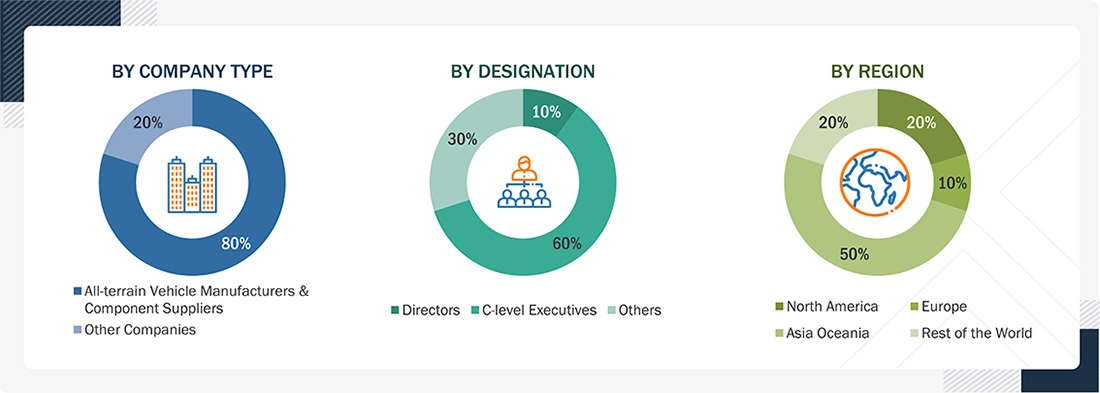
Note: RoW mainly comprises the Middle East, Africa, and South America.
Other designations include product managers, sales managers, and marketing managers.
Three tiers of companies have been defined based on their total revenue as of 2025: tier 3: revenue less than USD 500 million; tier 2: revenue between USD 500 million and 1 billion; and tier 1: revenue more than USD 1 billion.
To know about the assumptions considered for the study, download the pdf brochure
Market Size Estimation
Both top-down and bottom-up approaches have been used to estimate and validate the total size of the manufacturing execution systems market. These methods have also been used extensively to estimate the size of various subsegments in the market. The following research methodology has been used to estimate the market size:
- Major players in the industry and markets have been identified through extensive secondary research.
- The industry’s value chain and market size (in terms of value) have been determined through primary and secondary research processes.
- All percentage shares, splits, and breakdowns have been determined using secondary sources and verified through primary sources.
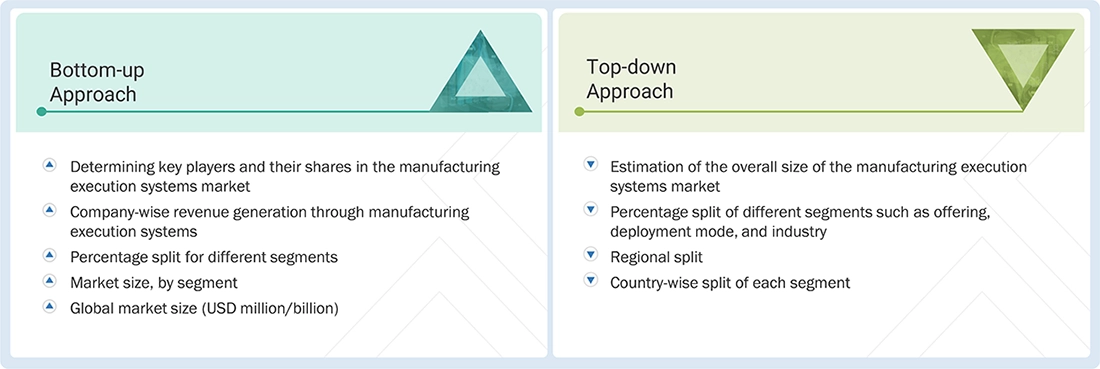
Data Triangulation
After arriving at the overall size of the manufacturing execution systems market from the market size estimation process explained above, the total market has been split into several segments and subsegments. Data triangulation and market breakdown procedures have been employed, wherever applicable, to complete the overall market engineering process and arrive at the exact statistics for all segments and subsegments of the market. The data has been triangulated by studying various factors and trends from both the demand and supply sides. Along with this, the market size has been validated using both top-down and bottom-up approaches.
Market Definition
The manufacturing execution systems market refers to software designed to maximize real-time factory production management by integrating operational technology (OT) with information technology (IT). Unlike enterprise resource planning (ERP) systems, MES offers granular visibility, control, and coordination of the manufacturing process at the shop-floor level. These systems maximize production efficiency through optimized monitoring, quality assurance, workflow automation, and compliance with regulatory requirements.
Propelled by Industry 4.0, smart manufacturing, and real-time analytics needs, MES solutions assist manufacturers in minimizing downtime, enhancing agility, and maximizing the use of resources. Industries such as automotive, electronics, pharmaceuticals, aerospace, and food & beverages depend on MES for smooth production, supply chain synchronization, and improved decision-making.
Key Stakeholders
- Associations and regulatory authorities (especially responsible for developing standards related to plant maintenance)
- Government bodies, venture capitalists, and private equity firms
- Automation consultants
- Automation system integrators
- ERP developers
- MES distributors and providers
- Process and discrete industries
- Research organizations and consulting companies
- Technology providers
- Technology investors, standards organizations, forums, alliances, and associations
Report Objectives
- To describe, segment, and forecast the overall manufacturing execution systems market, by deployment mode, offering, application, and industry, in terms of value
- To describe and forecast the market for four key regions: North America, Europe, Asia Pacific, and Rest of the World (RoW), along with their respective countries, in terms of value
- To describe the applications and leveraging entities of manufacturing execution systems and software
- To provide an overview of the recent trends in the market
- To provide detailed information regarding the drivers, restraints, opportunities, and challenges influencing the growth of the market
- To analyze the supply chain, trends/disruptions impacting customers’ business, market/ecosystem map, pricing analysis, and regulatory landscape pertaining to the manufacturing execution systems market
- To strategically analyze micromarkets1 with respect to individual growth trends, prospects, and contributions to the overall market size
- To analyze opportunities in the market for stakeholders and provide a competitive landscape of the market
- To strategically profile the key players and comprehensively analyze their market positions in terms of their ranking and core competencies, along with detailing the competitive landscape for market leaders
- To analyze competitive developments, such as product launches, acquisitions, collaborations, agreements, and partnerships, in the manufacturing execution systems market
- To provide ecosystem analysis, case study analysis, patent analysis, technology analysis, value chain analysis, trends/disruptions impacting customer business, the impact of AI/Gen AI, key conferences and events, pricing analysis, Porter’s five forces analysis, and regulations pertaining to the market under study
- To provide a macroeconomic outlook based on all the regions in the region chapter
Available customizations:
With the given market data, MarketsandMarkets offers customizations according to the company’s specific needs. The following customization options are available for the report:
Company Information:
- Detailed analysis and profiling of additional market players (up to 5)
Key Questions Addressed by the Report
What is the current size of the Manufacturing Execution Systems (MES) market?
The global MES market is valued at approximately USD 15.95 billion in 2025 and is projected to reach USD 25.78 billion by 2030.
What is the expected growth rate of the MES market?
The MES market is expected to grow at a CAGR of 10.1% during the forecast period from 2025 to 2030.
What are the major growth drivers for the MES market?
Key growth drivers include increasing adoption of Industry 4.0, demand for real-time production monitoring, connected supply chains, IT-OT integration, industrial automation, and operational efficiency improvements.
Which industry holds the largest share in the MES market?
The automotive industry holds the largest market share due to complex manufacturing processes, quality control requirements, and the need for complete component traceability.
What are the latest trends shaping the MES market?
Key trends include cloud and hybrid MES deployment, AI-enabled manufacturing, predictive analytics, smart factories, Industrial IoT (IIoT) integration, and digital transformation initiatives.
Which deployment model is witnessing the fastest growth?
The hybrid deployment model is growing the fastest because it combines the security and control of on-premises systems with the scalability and analytics capabilities of cloud platforms.
Who are the leading companies operating in the MES market?
Major MES vendors include Siemens, Dassault Systèmes, SAP SE, Rockwell Automation, and Honeywell International.
Which region is expected to grow the fastest in the MES market?
The Asia Pacific region is projected to register the highest growth, with a CAGR of approximately 11.2%, driven by industrialization, smart manufacturing investments, and government initiatives in countries such as China and India.
What challenges could affect MES market growth?
Major challenges include high implementation and maintenance costs, customization complexities, integration issues with legacy systems, and cybersecurity concerns related to manufacturing data.
What strategic insights does the MES market report provide?
The report provides market sizing, forecasts, competitive landscape analysis, industry segmentation, regional opportunities, value chain analysis, pricing trends, investment outlook, and emerging technology trends influencing MES adoption.
Fact checked
Personalize This Research
- Triangulate with your Own Data
- Get Data as per your Format and Definition
- Gain a Deeper Dive on a Specific Application, Geography, Customer or Competitor
- Any level of Personalization
Let Us Help You
- What are the Known and Unknown Adjacencies Impacting the Manufacturing Execution System Market
- What will your New Revenue Sources be?
- Who will be your Top Customer; what will make them switch?
- Defend your Market Share or Win Competitors
- Get a Scorecard for Target Partners

Custom Market Research Services
We Will Customise The Research For You, In Case The Report Listed Above Does Not Meet With Your Requirements
Get 10% Free CustomisationTESTIMONIALS

Tetsuya Ohhira
Business Development Manager-Technology Business
Nikon Corporation,
Leading Japanese MNC specializing in optics and imaging productswww.nikon.com
MarketsandMarkets™ response
is quick. Their attitude is flexible and positive. Analyst Insights are globally considered and
significant. Client Services quickly respond to our inquiry and demand. Their wide range of global
surveys help us make our strategic plan.
We hope Knowledge Store will be easier to search
for a report.
VP - Marketing & Business Development
Leading Provider of Process Control Solutions
We engaged with MarketsandMarkets on a study to perform an analysis and recommend a Go-To-Market strategy for metrology and process control in the semiconductor market. The study was tailored to our targets and needs with well-defined milestones. Our overall experience with the MarketsandMarkets team was very good throughout the project in all aspects including the analysis methodologies used, the quality and depth of primary and secondary data sets, the professionalism and flexibility of the team and the ability to meet the target schedule and milestones. We want to thank MarketsandMarkets team for a job well done.
- US Manufacturing Execution System Market
- Canada Manufacturing Execution System Market
- Mexico Manufacturing Execution System Market
- UK Manufacturing Execution System Market
- Germany Manufacturing Execution System Market
- France Manufacturing Execution System Market
- Italy Manufacturing Execution System Market
- Spain Manufacturing Execution System Market
- Netherlands Manufacturing Execution System Market
- Switzerland Manufacturing Execution System Market
- China Manufacturing Execution System Market
- Japan Manufacturing Execution System Market
- India Manufacturing Execution System Market
- South Korea Manufacturing Execution System Market
- Singapore Manufacturing Execution System Market
- Malaysia Manufacturing Execution System Market
- Indonesia Manufacturing Execution System Market
- Nordics Manufacturing Execution System Market
- Rest Of Europe Manufacturing Execution System Market
- Rest Of Asia Pacific Manufacturing Execution System Market
- Bahrain Manufacturing Execution System Market
- Kuwait Manufacturing Execution System Market
- Oman Manufacturing Execution System Market
- Qatar Manufacturing Execution System Market
- Rest Of Middle East Manufacturing Execution System Market
- Saudi Arabia Manufacturing Execution System Market
- UAE Manufacturing Execution System Market
- Argentina Manufacturing Execution System Market
- North America Manufacturing Execution System Market
- Europe Manufacturing Execution System Market
- Asia Pacific Manufacturing Execution System Market
- Rest of World Manufacturing Execution System Market
- Middle East Manufacturing Execution System Market
- South America Manufacturing Execution System Market
Growth opportunities and latent adjacency in Manufacturing Execution System Market



Christopher
Apr, 2022
Looking for market reports that include, quantify, and segment Redzone Business Systems. .
Donald
Apr, 2026
Why does the automotive industry dominate MES adoption compared to other sectors?.
Dennis
Apr, 2026
How important is MES in enabling Industry 4.0 and smart factory initiatives?.
Asmaa
Dec, 2025
Looking for market prospects by region?.