



Edtech and Smart Classrooms Market SIze, Share, Growth & Industry Outlook
Report Code
TC 1519
Published in
Aug, 2025, By MarketsandMarkets™
Edtech and Smart Classrooms Market by Solution (Projection & Display Systems, Adaptive & Personalized Learning, Assessment & Grading Tools, AR & VR & Simulations), End User (K-12, Higher Education, Vocational Training Centers) - Global Forecast to 2030

USD 353.1 BN
MARKET SIZE, 2030

CAGR 12.3%
(2025-2030)

301
REPORT PAGES

323
MARKET TABLES
OVERVIEW
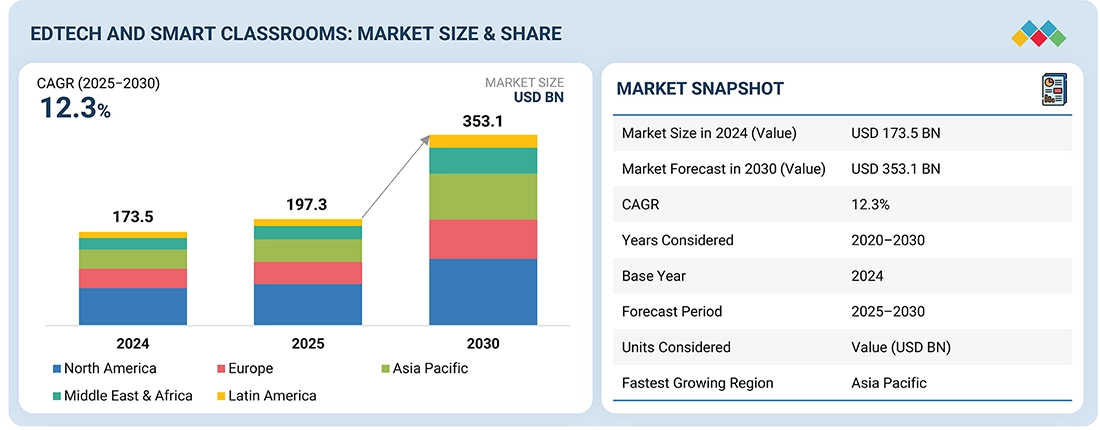
Source: Secondary Research, Interviews with Experts, MarketsandMarkets Analysis
The edtech and smart classrooms market is estimated to be USD 197.3 billion in 2025 and is projected to reach USD 353.1 billion by 2030, registering a CAGR of 12.3% during 2025–2030. The widespread availability of smartphones, tablets, and affordable internet connectivity is significantly boosting EdTech adoption. In emerging economies, where access to traditional education infrastructure may be limited, mobile-first learning models have become the primary medium of education.
Market Size and Forecast:
- 2024 Market Size: USD 173.05 Billion
- 2025 Projected Market Size: USD 197.3 Billion
- 2030 Forecasted Market Size: USD 353.1 Billion
- Growth Rate (2025-2030): CAGR of 12.3%
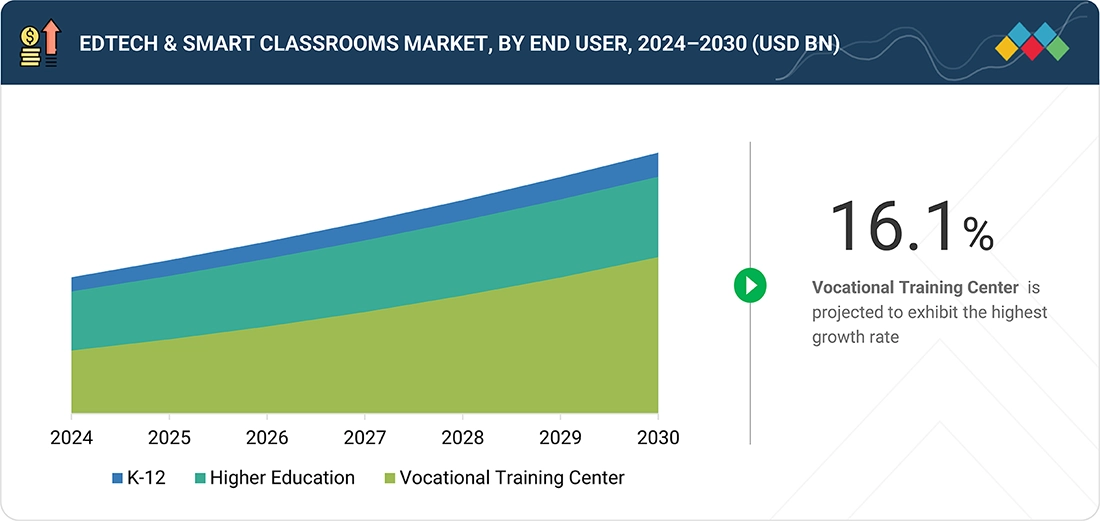
- Vocational Training Center segment is register the highest CAGR of 16.1%
- Forecast period: 2025–2030
Key Market Trends and Insights
- AI Impact: shifting education from a standardized, one-size-fits-all model to an intelligent, adaptive, and highly personalized ecosystem
-
Growth Drivers: AI-driven personalization, mobile learning, and cloud infrastructure
- Latest Trends: AI-powered personalization, cloud integration, and immersive learning
- Emerging Opportunities: institutions increasingly adopt AI-powered adaptive learning, AR/VR-enabled immersive tools, and hybrid cloud-based platforms to enhance student engagement and operational efficiency.
KEY TAKEAWAYS
-
BY REGIONAsia Pacific is expected to grow fastest, with a CAGR of 15.4%, driven by the region's high digital adoption and mobile-first consumer base. The growing adoption of immersive technologies, such as AR and VR, is reshaping Asia Pacific’s learning ecosystem.
-
BY SOLUTIONBy solution the adaptive & personalized learning segment is expected to register the highest CAGR of 17.8%. The rise of AI-powered tools is driving personalized and adaptive learning experiences, offering customized content and real-time feedback to improve student outcomes
-
BY END USERAmong the differentend users of edtech and smart classrooms, K-12 is expected to have the largest market size in 2025. K-12 institutions are rapidly integrating smart classroom tools such as interactive whiteboards, digital content libraries, gamified learning platforms, and AI-powered adaptive learning systems to enhance engagement and improve learning outcomes.
-
BY DEPLOYMENT TYPEThe continuous growth of the cloud deployment segment is driven by the increasing demand for personalized learning experiences, as cloud-based platforms can leverage data analytics and AI to deliver customized content and provide real-time feedback.
-
COMPETITIVE LANDSCAPEThe major market players have adopted both organic and inorganic strategies including partnerships, collaborations, and investments. For instance, in March 2025, Pearson launched a new AI-powered tool called the Smart Lesson Generator, designed to help English language teachers create curriculum-aligned lesson plans in seconds. The tool aimed to reduce the administrative burden on educators, who spend several hours a week on lesson preparation.
The shift from passive learning to active engagement is driving the edtech and smart classrooms market. Modern classrooms are increasingly integrating AR/VR, gamification, and multimedia-based teaching tools to foster collaboration and critical thinking. Interactive platforms encourage peer-to-peer discussions, group projects, and immersive experiences that replicate real-world scenarios, making learning more engaging and effective. Such solutions not only appeal to digital-native students but also align with evolving educational practices focused on experiential learning. By boosting attention spans and knowledge retention, collaborative tools are reshaping classrooms into dynamic ecosystems. Their rising popularity across schools, universities, and training institutes is fueling market demand worldwide.
TRENDS & DISRUPTIONS IMPACTING CUSTOMERS' CUSTOMERS
The impact on consumers’ business emerges from customer trends and disruptions such as AI-driven personalization, immersive learning technologies, and connected classroom ecosystems. The hot bets are the clients of EdTech and Smart Classroom solution providers, including educational institutions and platform developers, who are rapidly adopting digital learning tools, IoT-enabled devices, and data analytics to enhance engagement, improve learning outcomes, and drive operational efficiency across the education value chain.
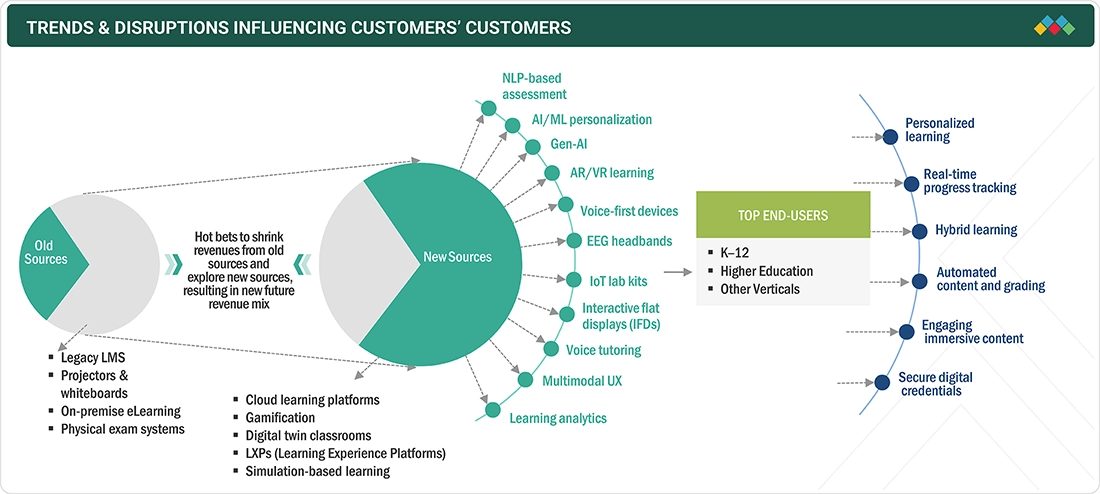
Source: Secondary Research, Interviews with Experts, MarketsandMarkets Analysis
MARKET DYNAMICS

Drivers
Impact
Level
Level
-
Mobile Learning & AI-based Personalization

-
Increasing Adoption of LMS & Cloud-based Education Platforms


RESTRAINTS
Impact
Level
Level
-
High capital expenditure for integrated smart classroom hardware

-
Limited infrastructure and bandwidth in rural and underserved areas


OPPORTUNITIES
Impact
Level
Level
-
Rising demand for AR/VR-enabled immersive learning solutions

-
Demand for interoperable, analytics-enabled platforms


CHALLENGES
Impact
Level
Level
-
Integration with legacy systems and cross-platform compatibility

-
Cybersecurity risks and regulatory compliance

Source: Secondary Research, Interviews with Experts, MarketsandMarkets Analysis
Driver: Mobile Learning & AI-based Personalization
Increasing mobile learning and AI-based personalization adoption is expected to drive the edtech and smart classroom market. Personalized learning has become a critical differentiator for edtech providers as institutions seek to improve learner outcomes, engagement, and retention. AI-based personalization enables real-time content adaptation and outcome-aligned instruction catering to individual learner needs, enhancing teaching effectiveness and student progression. In June 2025, D2L launched multiple AI-powered enhancements to its Lumi platform within Brightspace, including Lumi Outcomes and Study Support, which automate outcome alignment and deliver targeted content recommendations, streamlining course delivery and advancing personalized learning at scale. In parallel, mobile learning platforms continue to reshape access and flexibility in education by allowing students to learn anywhere and anytime. In February 2024, Instructure introduced offline access for its Canvas Student app, enabling learners to download assignments and materials on mobile devices and maintain continuity in low-connectivity environments. Vendors integrating mobile-first strategies with robust AI personalization features are well-positioned to capitalize on the evolving needs of educational institutions worldwide, offering scalable solutions that support equitable access, tailored instruction, and continuous learner engagement across geographies and modalities.
Restraint: High capital expenditure for integrated smart classroom hardware
High capital expenditure associated with integrated smart classroom hardware substantially restrains the growth of the edtech and smart classroom market. While demand is increasing for advanced solutions such as interactive whiteboards, AR/VR modules, sensor-enabled attendance systems, and multi-device integration, the initial investment required for full-scale deployment remains prohibitively high for many institutions, particularly in public and low-income private sectors. According to a March 2024 UNESCO-led global teacher survey, over 52% of educators in developing countries reported that their institutions lack access to interactive whiteboards or smart panels, citing budget limitations as the primary barrier. This excludes recurring costs for maintenance, upgrades, and technical training. These high costs are particularly challenging for educational institutions in developing economies and rural districts, where budget allocations for Digital Transformation remain limited. As a result, many schools opt for partial deployments or delay adoption altogether, restricting the market’s overall scale. Vendors must respond by offering modular, scalable hardware bundles, leasing-based procurement models, and device-agnostic platforms that reduce upfront expenditures. Strategic partnerships with government bodies, local system integrators, and financing providers can also help broaden adoption and reduce the financial burden for educational institutions seeking innovative classroom modernization
Opportunity: Rising demand for AR/VR-enabled immersive learning solutions
The growing demand for AR/VR-enabled immersive learning solutions creates significant opportunities in the edtech and smart classroom market. As educational institutions seek to enhance engagement, retention, and conceptual clarity, immersive technologies are gaining traction across K–12, higher education, and vocational training segments. AR/VR tools allow learners to interact with 3D models, simulate real-world environments, and access experiential content that transcends traditional instruction methods. In May 2024, Lenovo introduced its ThinkReality VRX headset tailored for education, enabling institutions to deploy virtual science labs, language immersion modules, and career simulations through a centralized platform. The product reduces the dependency on physical infrastructure while expanding learning accessibility across geographies. Vendors should respond by offering curriculum-aligned AR/VR content, educator training programs, and device management solutions that streamline classroom integration. Similarly, in March 2025, Discovery Education partnered with immersive content developers to integrate AR-based STEM modules into its platform, targeting increased student interaction and measurable learning outcomes. Such collaborations highlight the potential for vendors to differentiate through specialized content offerings and partnerships with content creators. To capture this opportunity, providers must ensure cross-platform compatibility, affordable deployment models, and compliance with institutional IT policies, positioning immersive learning as a core component of digitally transformed classrooms
Challenge:Integration with legacy systems and cross-platform compatibility
Integration with legacy systems and ensuring cross-platform compatibility continues to challenge the widespread adoption of innovative classroom technologies. Many educational institutions, particularly in public and underserved segments, still operate on outdated infrastructure and fragmented digital ecosystems that lack interoperability with modern learning tools. According to a 2024 survey by Clever involving over 1,500 K–12 teachers in US schools, 68% of respondents reported that their learning management systems (LMS) do not integrate well with one or more learning applications, resulting in limited student access, disrupted instructional flow, and increased administrative complexity. This disconnect restricts the effectiveness of digital initiatives and prevents educators from using real-time insights for personalized learning. As institutions implement multiple platforms for assessment, content delivery, and engagement, poor system compatibility further drives up IT overhead and training costs. Vendors must prioritize open architecture, standardized APIs, and compatibility with dominant operating systems and LMS platforms. Modular product design, built-in integration tools, and dedicated onboarding support can ease institutional transitions from legacy environments. For instance, Instructure, through its Canvas LMS, has responded effectively by offering robust integration capabilities with Google Workspace, Microsoft Teams, and third-party edtech tools, positioning itself as a vendor aligned with the interoperability needs of modern educational environments
Edtech and Smart Classrooms Market: COMMERCIAL USE CASES ACROSS INDUSTRIES
| COMPANY | USE CASE DESCRIPTION | BENEFITS |
|---|---|---|
 |
You Employed, Inc. implemented Canvas LMS to transition in-person workforce training to a scalable online format across 17 countries, ensuring multilingual support and localized curriculum delivery. | Seamless transition to remote learning; improved localization and regional alignment; unified global curriculum; enhanced learner experience; strengthened platform adoption. |
 |
Agora Cyber Charter School integrated Mystery Science with LMS tools to align the virtual science curriculum with Pennsylvania STEELS standards, encouraging interactive, inquiry-based learning from grades K–5. | Improved engagement and comprehension; shift to student-led learning; reduced instructional complexity; fostered collaboration and critical thinking; established a scalable science framework. |
 |
Saanich School District deployed D2L Brightspace Core and Guardian modules to digitize student progress reporting, automate data uploads, and enhance real-time communication between parents and educators. | Secure digital reporting eliminating paper inefficiencies; increased parent engagement; improved visibility into academic performance; reduced administrative workload; supported sustainability. |
Logos and trademarks shown above are the property of their respective owners. Their use here is for informational and illustrative purposes only.
MARKET ECOSYSTEM
The EdTech and Smart Classrooms market ecosystem comprises content developers, hardware manufacturers, software platform providers, system integrators, and end-users such as schools, universities, and corporate training centers. It operates through seamless collaboration between technology enablers (AI, AR/VR, IoT) and educational institutions to deliver personalized, interactive, and data-driven learning experiences. This ecosystem enhances teaching efficiency and student engagement while driving digital transformation in education globally.
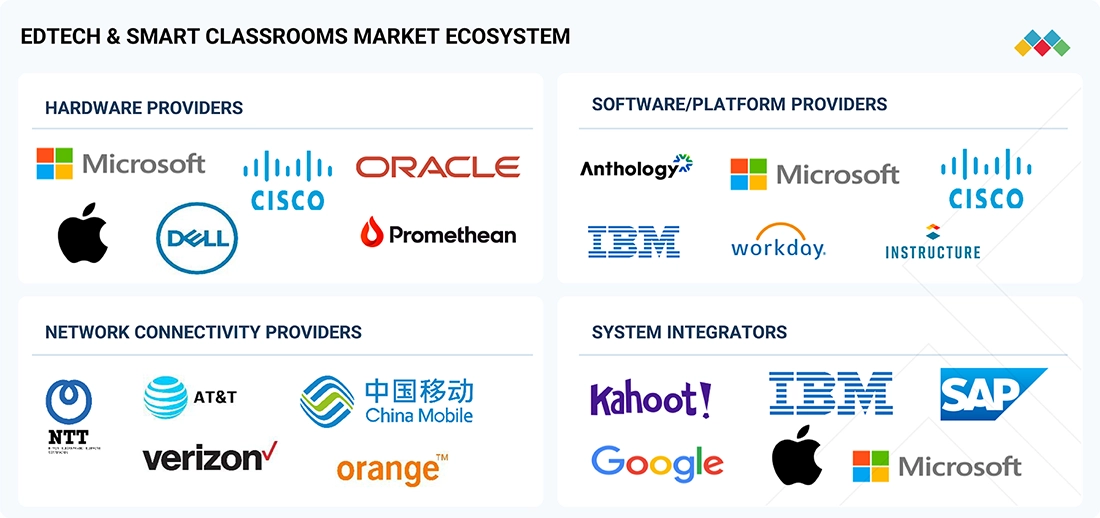
Logos and trademarks shown above are the property of their respective owners. Their use here is for informational and illustrative purposes only.
MARKET SEGMENTS
Source: Secondary Research, Interviews with Experts, MarketsandMarkets Analysis
EdTech and Smart Classrooms Market, By Solution
The projection and display systems solutions are expected to have the largest market share during the forecast period. it refers to hardware technologies like interactive projectors, smart boards, flat panels, and large displays that enable visual learning and real-time engagement in classrooms. These systems transform traditional teaching methods by providing dynamic content delivery, multimedia integration, and collaborative tools. A major trend driving adoption is the shift toward interactive flat panel displays (IFPDs), which are increasingly replacing conventional projectors due to higher resolution, touch-screen interactivity, and durability. Additionally, the rise of AR/VR-compatible displays is reshaping immersive learning experiences in subjects like science, geography, and history.
EdTech and Smart Classrooms Market, By End User
Unlike traditional academic institutions, vocational training centers emphasize hands-on, practical learning in areas such as healthcare, automotive, construction, hospitality, and information technology. The adoption of smart classroom technologies such as AR/VR simulations for real-world practice, AI-powered personalized learning platforms, and digital content libraries is transforming vocational education into a more immersive and effective experience. Governments and educational bodies across regions are increasing their investments in technical and vocational education and training (TVET) programs to bridge skill gaps, particularly in developing economies where employability is a critical concern. Moreover, the emphasis on lifelong learning and alternative education pathways is driving enrollment in vocational institutes.
EdTech and Smart Classrooms Market, By Deployment Type
Hybrid cloud segment solutions are projected to witness the fastest growth rate during the forecast period. The hybrid cloud segment combines the scalability of public cloud with the security of private infrastructure, making it an ideal choice for institutions balancing accessibility and compliance. This model allows sensitive data such as student records and examination systems to remain in private environments, while high-volume applications like video lectures, learning content, and collaboration tools are managed through public cloud platforms. The adoption of hybrid cloud is accelerating as regulatory frameworks such as GDPR in Europe and FERPA in the U.S. drive the need for data protection without compromising on flexibility. Vendors like IBM, Oracle, and Microsoft are actively offering hybrid solutions tailored for education, integrating AI-powered analytics, adaptive learning, and AR/VR applications.
REGION
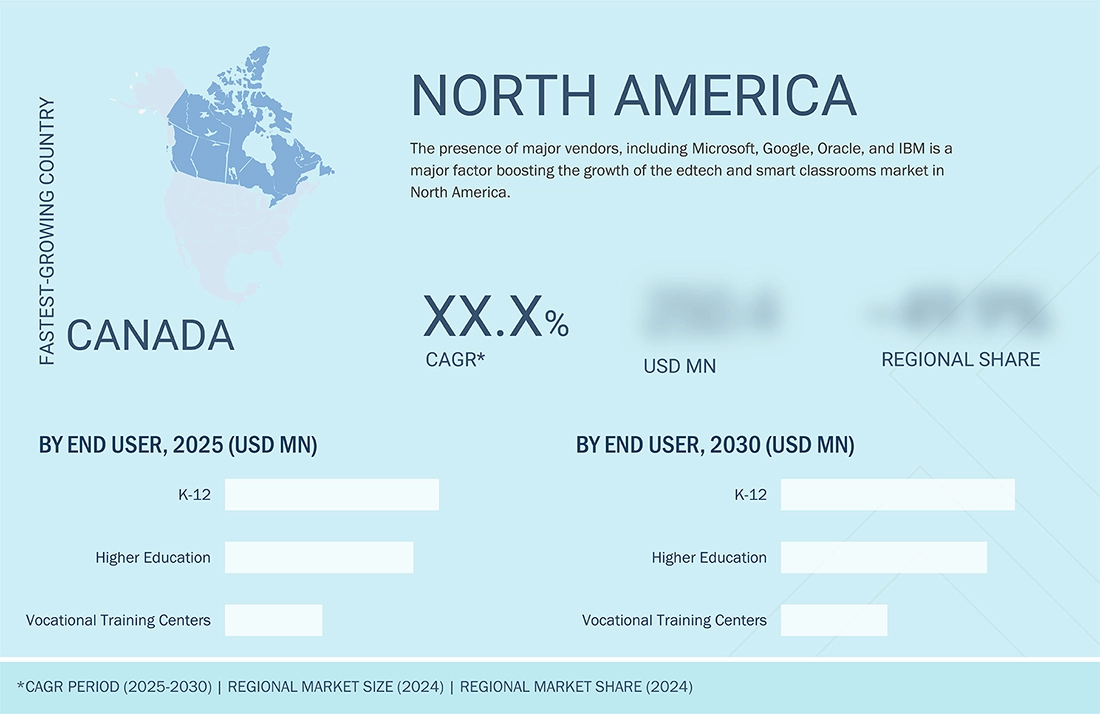
North America is estimated to account for the largest market share during the forecast period
The North American edtech market is undergoing rapid transformation as universities and schools continue to embrace hybrid and blended learning models that became mainstream in the post-pandemic period. Major technology providers, including Google, Microsoft, and Instructure, are integrating AI-driven analytics into learning management systems, enabling institutions to monitor student performance with greater accuracy and improve learning outcomes. Collaboration between edtech companies and higher education institutions is also on the rise, with platforms such as Coursera for Campus and edX being embedded into traditional curricula to provide students with broader access to online courses and certifications. At the same time, startups catering to K–12 education, including Outschool and Nearpod, are scaling their digital content offerings. Their growth reflects a clear trend toward more flexible, engaging, and personalized classroom experiences that address the evolving needs of students and teachers alike.
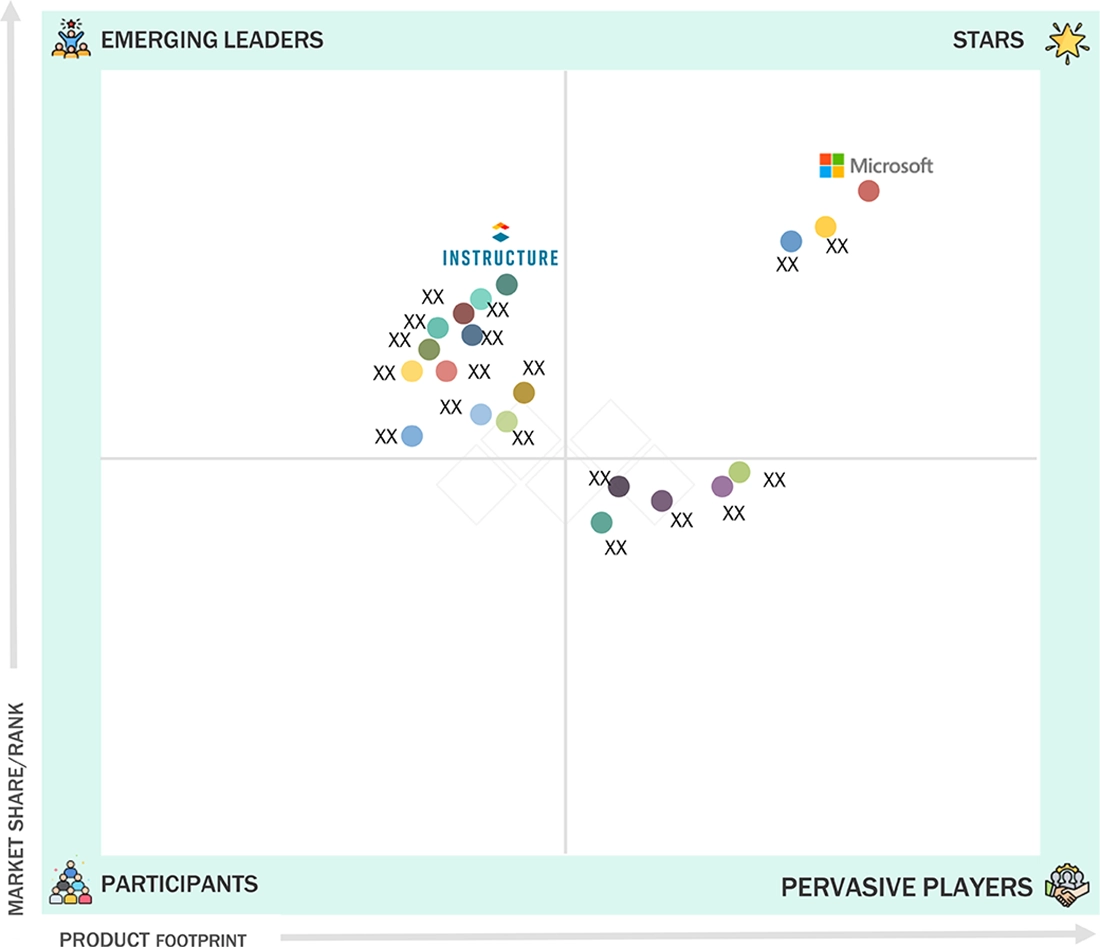
Edtech and Smart Classrooms Market: COMPANY EVALUATION MATRIX
In the edtech & smart classrooms market matrix, Microsoft. (Star) lleads with a broad portfolio of digital classroom tools and scalable, cloud-based learning solutions, powering collaboration and accessibility at global scale. Instructure (Emerging Leader) excels through its Canvas LMS and expanding ecosystem, driving student engagement and educator support with seamless integration and interoperability. While Microsoft dominates with scale and ecosystem integration, Instructure shows strong growth potential to advance toward the leaders’ quadrant with its expanding enterprise security portfolio.
Source: Secondary Research, Interviews with Experts, MarketsandMarkets Analysis
KEY MARKET PLAYERS
MARKET SCOPE
| REPORT METRIC | DETAILS |
|---|---|
| Market Size Value in 2024 | USD 173.5 Billion |
| Revenue Forecast in 2030 | USD 353.1 Billion |
| Growth Rate | CAGR of 12.3% from 2025-2030 |
| Years Considered | 2020–2030 |
| Base year | 2024 |
| Forecast period | 2025–2030 |
| Units considered | Value (USD) Million/Billion |
| Report Coverage | Revenue forecast, company ranking, competitive landscape, growth factors, and trends |
| Segments Covered | By Solutions, End User, and Deployment Type |
| Regional Scope | North America, Europe, Asia Pacific, Middle East & Africa, and Latin America |
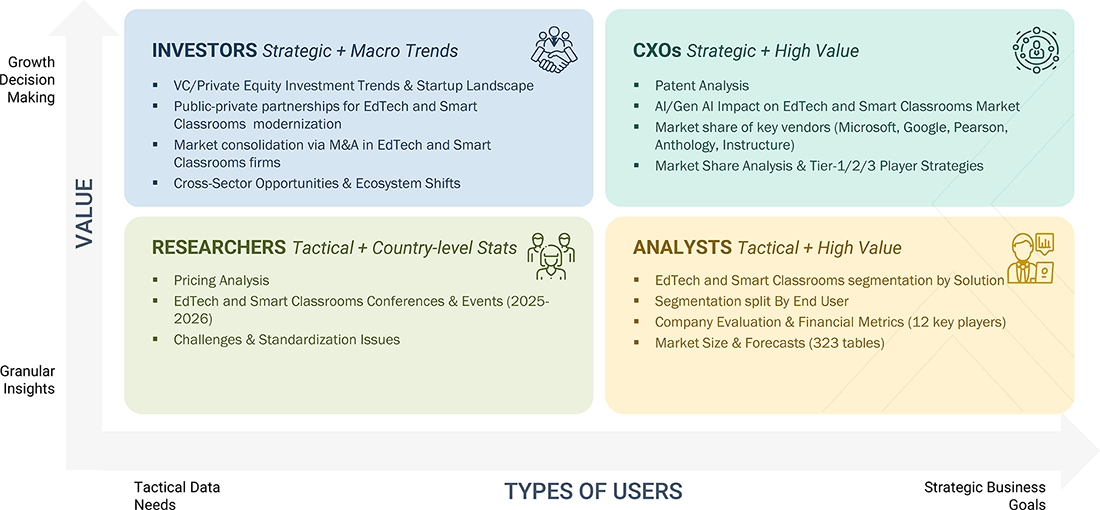
WHAT IS IN IT FOR YOU: Edtech and Smart Classrooms Market REPORT CONTENT GUIDE
DELIVERED CUSTOMIZATIONS
We have successfully delivered the following deep-dive customizations:
| CLIENT REQUEST | CUSTOMIZATION DELIVERED | VALUE ADDS |
|---|---|---|
| Leading Service Provider (US) | Regional Analysis: • Further breakdown of the North American edtech & smart classrooms market • Further breakdown of the European edtech & smart classrooms market • Further breakdown of the Asia Pacific edtech & smart classrooms market • Further breakdown of the Middle Eastern & African edtech & smart classrooms market • Further breakdown of the Latin American edtech & smart classrooms market | • Identifies high-growth regional opportunities, enabling tailored market entry strategies. • Optimizes resource allocation and investment based on region-specific demand and trends. |
| Company Information | Detailed analysis and profiling of additional market players (up to 5) | • Broadens competitive insights, helping clients make informed strategic and investment decisions. • Reveals market gaps and opportunities, supporting differentiation and targeted growth initiatives. |
RECENT DEVELOPMENTS
- January 2026: Microsoft (US) announced Microsoft Elevate for Educators along with new AI-powered education capabilities in Microsoft 365 Copilot, providing educators and students with education-specific AI tools and training to support teaching, learning, and responsible AI use in schools.
- January 2026: Google (US) announced new Gemini and Google Classroom capabilities, including an updated Classroom dashboard with student-engagement metrics, AI-assisted teaching tools, audio/video assignment recording, learning-standards tagging, and expanded Gemini integration for educators.
- September 2025: McGraw Hill (US) launched Sharpen Advantage, an AI-powered enterprise learning solution for higher education that enables faculty and administrators to create personalized, mobile-native learning experiences and expand the company’s digital learning capabilities for institutions.
- August 2025: Instructure (US) introduced an education-specific YouTube experience through Canvas Studio, providing distraction-free educational video playback with additional security and supporting interactive digital learning through video, discussions, quizzes, and engagement analytics.
- April 2025: Pearson (UK) introduced Smart Lesson Generator, an AI-powered tool that creates curriculum-aligned English-language lesson materials based on teachers’ learning objectives, topics, and vocabulary, helping streamline lesson preparation and support classroom instruction.
Table of Contents
 Exclusive indicates content/data unique to MarketsandMarkets and not available with any competitors.
TITLE
PAGE NO
1
INTRODUCTION
29
2
RESEARCH METHODOLOGY
34
3
EXECUTIVE SUMMARY
44
4
PREMIUM INSIGHTS
47
5
MARKET OVERVIEW AND INDUSTRY TRENDS
Embrace transformative learning with AI-driven personalization and gamified, immersive education solutions.
50
5.1
INTRODUCTION
5.2
MARKET DYNAMICS
5.2.1
DRIVERS
5.2.1.1
Increase in adoption of LMS and cloud-based education platforms
5.2.1.2
Mobile learning and AI-based personalization
5.2.1.3
Government-funded digital learning initiatives
5.2.1.4
Rise in demand for gamified interactive display deployments
5.2.2
RESTRAINTS
5.2.2.1
Limited infrastructure and bandwidth in rural and underserved areas
5.2.2.2
High capital expenditure for integrated smart classroom hardware
5.2.3
OPPORTUNITIES
5.2.3.1
Demand for interoperable, analytics-enabled platforms
5.2.3.2
Rise in preference for hybrid learning models
5.2.3.3
Rise in demand for AR/VR-enabled immersive learning solutions
5.2.4
CHALLENGES
5.2.4.1
Integration with legacy systems and cross-platform compatibility
5.2.4.2
Cybersecurity risks and regulatory compliance
5.3
CASE STUDY ANALYSIS
5.3.1
GENERATION: YOU EMPLOYED, INC. EMPLOYED SCALES GLOBAL WORKFORCE TRAINING WITH INSTRUCTURE'S CANVAS LMS
5.3.2
FORT BEND ISD FUTURE-PROOFED CLASSROOMS WITH SMART TECHNOLOGIES’ OPS MODULES
5.3.3
CHONG GENE HANG COLLEGE PARTNERS WITH LENOVO FOR AI-DRIVEN EDUCATION
5.3.4
AGORA CYBER CHARTER SCHOOL ENHANCED VIRTUAL SCIENCE INSTRUCTION WITH DISCOVERY EDUCATION’S MYSTERY SCIENCE
5.3.5
SAANICH SCHOOL DISTRICT STREAMLINES STUDENT PROGRESS REPORTING WITH D2L
5.4
ECOSYSTEM ANALYSIS
5.5
SUPPLY CHAIN ANALYSIS
5.6
TECHNOLOGY ANALYSIS
5.6.1
KEY TECHNOLOGIES
5.6.1.1
Learning management systems (LMS)
5.6.1.2
Interactive flat panel displays (IFPDs)
5.6.1.3
Virtual classroom platforms
5.6.1.4
Digital content creation tools
5.6.2
COMPLEMENTARY TECHNOLOGIES
5.6.2.1
AI-powered assessment tools
5.6.2.2
Classroom management software
5.6.2.3
Video-based learning platforms
5.6.2.4
Adaptive learning engines
5.6.3
ADJACENT TECHNOLOGIES
5.6.3.1
Augmented reality (AR) for experiential learning
5.6.3.2
Blockchain for academic credentialing
5.6.3.3
Learning record stores (LRS)
5.7
PORTER’S FIVE FORCES ANALYSIS
5.7.1
THREAT OF NEW ENTRANTS
5.7.2
THREAT OF SUBSTITUTES
5.7.3
BARGAINING POWER OF SUPPLIERS
5.7.4
BARGAINING POWER OF BUYERS
5.7.5
INTENSITY OF COMPETITIVE RIVALRY
5.8
PRICING ANALYSIS
5.8.1
AVERAGE SELLING PRICE OF KEY PLAYERS, BY REGION
5.8.2
INDICATIVE PRICING ANALYSIS FOR EDTECH & SMART CLASSROOM SOLUTIONS
5.9
PATENT ANALYSIS
5.10
TRADE ANALYSIS
5.10.1
IMPORT SCENARIO
5.10.2
EXPORT SCENARIO
5.11
REGULATORY LANDSCAPE
5.11.1
REGULATORY BODIES, GOVERNMENT AGENCIES, AND OTHER ORGANIZATIONS
5.11.2
KEY REGULATIONS
5.11.2.1
North America
5.11.2.2
Europe
5.11.2.3
Asia Pacific
5.11.2.4
Rest of the World
5.11.2.5
General Data Protection Regulation
5.11.2.6
SEC Rule 17a-4
5.11.2.7
ISO/IEC 27001
5.11.2.8
University Grants Commission Regulations, 2018
5.11.2.9
Higher Education Opportunity Act - 2008
5.11.2.10
Distance Learning and Innovation Regulation
5.11.3
REGULATIONS, BY REGION
5.12
TRENDS AND DISRUPTIONS IMPACTING CUSTOMERS’ BUSINESSES
5.13
KEY STAKEHOLDERS AND BUYING CRITERIA
5.13.1
KEY STAKEHOLDERS IN BUYING PROCESS
5.13.2
BUYING CRITERIA
5.14
KEY CONFERENCES AND EVENTS, 2025–2026
5.15
IMPACT OF GENERATIVE AI ON EDTECH & SMART CLASSROOM MARKET
5.15.1
USE CASES OF GENERATIVE AI IN EDTECH & SMART CLASSROOMS MARKET
5.15.2
CASE STUDIES
5.15.2.1
iSchoolConnect and Google Cloud transform AI-driven admissions in higher education
5.15.2.2
Saxion University leverages D2L and LearnWise AI to streamline LMS transition and student support
5.15.3
VENDOR INITIATIVE
5.15.3.1
D2L
5.16
BUSINESS MODELS
5.17
INVESTMENT LANDSCAPE AND FUNDING SCENARIO
5.18
IMPACT OF 2025 US TARIFF
5.18.1
INTRODUCTION
5.18.2
KEY TARIFF RATES
5.18.3
IMPACT ON COUNTRY/REGION
5.18.3.1
North America
5.18.3.2
Europe
5.18.3.3
Asia Pacific
5.18.4
IMPACT ON END-USE INDUSTRIES
5.18.4.1
Manufacturing & industrial (Industrial IoT)
5.18.4.2
Telecommunications & 5G networks
5.18.4.3
Healthcare & life sciences
5.18.4.4
Retail
5.18.4.5
Transportation & automotive
5.18.4.6
Energy & utilities
5.18.4.7
Government & defense
6
EDTECH & SMART CLASSROOMS MARKET, BY SOLUTION
Market Size & Growth Rate Forecast Analysis to 2030 in USD Million | 22 Data Tables
102
6.1
INTRODUCTION
6.1.1
SOLUTION: MARKET DRIVERS
6.2
LEARNING CONTENT & CURRICULUM MANAGEMENT
6.2.1
ACCELERATING PERSONALIZED LEARNING THROUGH AI-ENABLED CONTENT PLATFORMS
6.3
CLASSROOM INTERACTION & COLLABORATION TOOLS
6.3.1
ENHANCING STUDENT ENGAGEMENT VIA INTERACTIVE AND INCLUSIVE COLLABORATION TOOLS
6.4
PROJECTION & DISPLAY SYSTEMS
6.4.1
TRANSFORMING LESSON DELIVERY WITH IMMERSIVE AND INTERACTIVE VISUALIZATION TECHNOLOGIES
6.5
STUDENT MONITORING & ATTENDANCE MANAGEMENT
6.5.1
AUTOMATING ATTENDANCE AND ENGAGEMENT TRACKING TO IMPROVE CLASSROOM ACCOUNTABILITY
6.6
ASSESSMENT & GRADING TOOLS
6.6.1
ENABLING ADAPTIVE EVALUATION AND REAL-TIME FEEDBACK THROUGH AI-DRIVEN ASSESSMENT PLATFORMS
6.7
STUDENT INFORMATION SYSTEMS (SIS) & SCHOOL ERP
6.7.1
STREAMLINING ACADEMIC AND ADMINISTRATIVE OPERATIONS VIA INTEGRATED DIGITAL SYSTEMS
6.8
ADAPTIVE & PERSONALIZED LEARNING
6.8.1
DELIVERING TAILORED LEARNING EXPERIENCES WITH AI-POWERED ADAPTIVE PLATFORMS
6.9
AUGMENTED REALITY (AR), VIRTUAL REALITY (VR), AND SIMULATIONS
6.9.1
FACILITATING EXPERIENTIAL LEARNING THROUGH IMMERSIVE AR/VR TECHNOLOGIES
6.10
SPECIAL EDUCATION & ACCESSIBILITY TOOLS
6.10.1
PROMOTING INCLUSIVE LEARNING THROUGH AI-ENHANCED ACCESSIBILITY SOLUTIONS
6.11
OTHER SOLUTIONS
7
EDTECH & SMART CLASSROOMS MARKET, BY END USER
Market Size & Growth Rate Forecast Analysis to 2030 in USD Million | 8 Data Tables
115
7.1
INTRODUCTION
7.1.1
END USER: MARKET DRIVERS
7.2
K–12
7.2.1
ENGAGING YOUNG LEARNERS THROUGH INTERACTIVE MEDIA, GAMIFICATION, AND SMART CLASSROOM INFRASTRUCTURE
7.3
HIGHER EDUCATION
7.3.1
ENHANCING LEARNING AND RESEARCH WITH CLOUD-BASED TOOLS, LECTURE CAPTURE, AND IMMERSIVE TECHNOLOGIES
7.4
VOCATIONAL TRAINING CENTERS
7.4.1
ENABLING HANDS-ON SKILL DEVELOPMENT VIA AR/VR AND SPECIALIZED TECHNICAL TRAINING SOLUTIONS
8
EDTECH & SMART CLASSROOMS MARKET, BY DEPLOYMENT TYPE
Market Size & Growth Rate Forecast Analysis to 2030 in USD Million | 14 Data Tables
122
8.1
INTRODUCTION
8.1.1
DEPLOYMENT TYPE: MARKET DRIVERS
8.2
ON-PREMISES
8.2.1
ENSURING DATA SECURITY AND SYSTEM CONTROL THROUGH LOCAL HOSTING AND CUSTOM INTEGRATION
8.3
CLOUD
8.3.1
SCALING ACCESS AND FLEXIBILITY WITH CLOUD-BASED EDTECH PLATFORMS FOR REMOTE AND HYBRID LEARNING
8.3.2
PRIVATE
8.3.3
PUBLIC
8.3.4
HYBRID
9
EDTECH & SMART CLASSROOMS MARKET, BY REGION
Market Size & Growth Rate Forecast Analysis to 2030 in USD Million | 180 Data Tables
131
9.1
INTRODUCTION
9.2
NORTH AMERICA
9.2.1
NORTH AMERICA: MACROECONOMIC OUTLOOK
9.2.2
US
9.2.3
CANADA
9.3
EUROPE
9.3.1
EUROPE: MACROECONOMIC OUTLOOK
9.3.2
UK
9.3.3
GERMANY
9.3.4
FRANCE
9.3.5
ITALY
9.3.6
REST OF EUROPE
9.4
ASIA PACIFIC
9.4.1
ASIA PACIFIC: MACROECONOMIC OUTLOOK
9.4.2
CHINA
9.4.3
INDIA
9.4.4
JAPAN
9.4.5
AUSTRALIA & NEW ZEALAND
9.4.6
SOUTH KOREA
9.4.7
REST OF ASIA PACIFIC
9.5
MIDDLE EAST & AFRICA
9.5.1
MIDDLE EAST & AFRICA: MACROECONOMIC OUTLOOK
9.5.2
UNITED ARAB EMIRATES
9.5.3
KINGDOM OF SAUDI ARABIA
9.5.4
SOUTH AFRICA
9.5.5
REST OF MIDDLE EAST & AFRICA
9.6
LATIN AMERICA
9.6.1
LATIN AMERICA: MACROECONOMIC OUTLOOK
9.6.2
BRAZIL
9.6.3
MEXICO
9.6.4
REST OF LATIN AMERICA
10
COMPETITIVE LANDSCAPE
Discover top strategies driving market dominance and emerging leaders shaping the competitive landscape.
203
10.1
INTRODUCTION
10.2
KEY PLAYER STRATEGIES/RIGHT TO WIN, 2022–2025
10.3
REVENUE ANALYSIS, 2020–2024
10.4
MARKET SHARE ANALYSIS, 2024
10.5
BRAND/PRODUCT COMPARISON
10.6
COMPANY VALUATION AND FINANCIAL METRICS
10.6.1
COMPANY VALUATION
10.6.2
FINANCIAL METRICS
10.7
COMPANY EVALUATION MATRIX: KEY PLAYERS, 2024
10.7.1
STARS
10.7.2
EMERGING LEADERS
10.7.3
PERVASIVE PLAYERS
10.7.4
PARTICIPANTS
10.7.5
COMPANY FOOTPRINT: KEY PLAYERS, 2024
10.7.5.1
Company footprint
10.7.5.2
Regional footprint
10.7.5.3
Deployment type footprint
10.7.5.4
End user footprint
10.8
COMPANY EVALUATION MATRIX: STARTUPS/SMES, 2024
10.8.1
PROGRESSIVE COMPANIES
10.8.2
RESPONSIVE COMPANIES
10.8.3
DYNAMIC COMPANIES
10.8.4
STARTING BLOCKS
10.8.5
COMPETITIVE BENCHMARKING: STARTUPS/SMES, 2024
10.8.5.1
Detailed list of key startups/SMEs
10.8.5.2
Competitive benchmarking of key startups/SMEs
10.9
COMPETITIVE SCENARIO
10.9.1
PRODUCT LAUNCHES
10.9.2
DEALS
11
COMPANY PROFILES
In-depth Company Profiles of Leading Market Players with detailed Business Overview, Product and Service Portfolio, Recent Developments, and Unique Analyst Perspective (MnM View)
224
11.1
INTRODUCTION
11.2
KEY PLAYERS
11.2.1
MICROSOFT
11.2.1.1
Business overview
11.2.1.2
Products/Solutions/Services offered
11.2.1.3
Recent developments
11.2.1.4
MnM view
11.2.2
GOOGLE
11.2.3
PEARSON
11.2.4
ANTHOLOGY
11.2.5
INSTRUCTURE
11.2.6
CISCO
11.2.7
IBM
11.2.8
MCGRAW HILL
11.2.9
ORACLE
11.2.10
POWERSCHOOL
11.3
OTHER PLAYERS
11.3.1
2U INC
11.3.2
ELLUCIAN
11.3.3
TURNITIN
11.3.4
KAHOOT!
11.3.5
SMART TECHNOLOGIES
11.3.6
IXL LEARNING
11.3.7
D2L
11.3.8
WORKDAY
11.3.9
PROMETHEAN
11.3.10
DISCOVERY EDUCATION
11.3.11
BYJU’S
11.3.12
YUANFUDAO
11.3.13
VIPKID
11.3.14
17ZUOYE
11.3.15
SEESAW
11.3.16
UDACITY
11.3.17
AGE OF LEARNING
11.3.18
NEARPOD
12
ADJACENT/RELATED MARKETS
282
12.1
INTRODUCTION
12.2
LEARNING MANAGEMENT SYSTEM MARKET
12.2.1
MARKET DEFINITION
12.2.2
MARKET OVERVIEW
12.2.3
LEARNING MANAGEMENT SYSTEM MARKET, BY OFFERING
12.2.4
LEARNING MANAGEMENT SYSTEM MARKET, BY DELIVERY MODE
12.2.5
LEARNING MANAGEMENT SYSTEM MARKET, BY ORGANIZATION SIZE
12.2.6
LEARNING MANAGEMENT SYSTEM MARKET, BY DEPLOYMENT TYPE
12.2.7
LEARNING MANAGEMENT SYSTEM MARKET, BY APPLICATION AREA
12.2.8
LEARNING MANAGEMENT SYSTEM MARKET, BY USER TYPE
12.2.9
LEARNING MANAGEMENT SYSTEM MARKET, BY REGION
12.3
SMART LEARNING MARKET
12.3.1
MARKET DEFINITION
12.3.2
MARKET OVERVIEW
12.3.3
SMART LEARNING MARKET, BY OFFERING
12.3.4
SMART LEARNING MARKET, BY HARDWARE
12.3.5
SMART LEARNING MARKET, BY SOLUTION
12.3.6
SMART LEARNING MARKET, BY SERVICE
12.3.7
SMART LEARNING MARKET, BY LEARNING TYPE
12.3.8
SMART LEARNING MARKET, BY END USER
12.3.9
SMART LEARNING MARKET, BY REGION
13
APPENDIX
294
13.1
DISCUSSION GUIDE
13.2
KNOWLEDGESTORE: MARKETSANDMARKETS’ SUBSCRIPTION PORTAL
13.3
CUSTOMIZATION OPTIONS
13.4
RELATED REPORTS
13.5
AUTHOR DETAILS
LIST OF TABLES
TABLE 1
USD EXCHANGE RATES, 2022–2024
TABLE 2
LIST OF KEY PRIMARY INTERVIEW PARTICIPANTS
TABLE 3
FACTOR ANALYSIS
TABLE 4
RESEARCH ASSUMPTIONS
TABLE 5
EDTECH & SMART CLASSROOM MARKET: ROLE OF PLAYERS IN ECOSYSTEM
TABLE 6
IMPACT OF PORTER’S FIVE FORCES ON EDTECH & SMART CLASSROOMS MARKET
TABLE 7
AVERAGE SELLING PRICE OF KEY PLAYERS, BY REGION, 2025 (USD)
TABLE 8
INDICATIVE PRICING ANALYSIS FOR EDTECH & SMART CLASSROOM SOLUTIONS, BY KEY PLAYERS
TABLE 9
PATENTS GRANTED TO VENDORS IN EDTECH & SMART CLASSROOMS MARKET
TABLE 10
IMPORT DATA FOR HS CODE 8528, BY COUNTRY, 2020–2024 (USD MILLION)
TABLE 11
EXPORT DATA FOR HS CODE 8528, BY COUNTRY, 2020–2024 (USD MILLION)
TABLE 12
NORTH AMERICA: REGULATORY BODIES, GOVERNMENT AGENCIES, AND OTHER ORGANIZATIONS
TABLE 13
EUROPE: REGULATORY BODIES, GOVERNMENT AGENCIES, AND OTHER ORGANIZATIONS
TABLE 14
ASIA PACIFIC: REGULATORY BODIES, GOVERNMENT AGENCIES, AND OTHER ORGANIZATIONS
TABLE 15
MIDDLE EAST & AFRICA: REGULATORY BODIES, GOVERNMENT AGENCIES, AND OTHER ORGANIZATIONS
TABLE 16
LATIN AMERICA: LIST OF REGULATORY BODIES, GOVERNMENT AGENCIES, AND OTHER ORGANIZATIONS
TABLE 17
NORTH AMERICA: LIST OF REGULATIONS
TABLE 18
EUROPE: LIST OF REGULATIONS
TABLE 19
ASIA PACIFIC: LIST OF REGULATIONS
TABLE 20
MIDDLE EAST & AFRICA: LIST OF REGULATIONS
TABLE 21
LATIN AMERICA: LIST OF REGULATIONS
TABLE 22
INFLUENCE OF STAKEHOLDERS ON BUYING PROCESS FOR TOP END USERS
TABLE 23
KEY BUYING CRITERIA FOR END USER
TABLE 24
EDTECH & SMART CLASSROOM MARKET: DETAILED LIST OF CONFERENCES AND EVENTS, 2025–2026
TABLE 25
US ADJUSTED RECIPROCAL TARIFF RATES
TABLE 26
EDTECH & SMART CLASSROOMS MARKET, BY SOLUTION, 2020–2024 (USD MILLION)
TABLE 27
EDTECH & SMART CLASSROOMS MARKET, BY SOLUTION, 2025–2030 (USD MILLION)
TABLE 28
LEARNING CONTENT & CURRICULUM MANAGEMENT SOLUTIONS MARKET, BY REGION, 2020–2024 (USD MILLION)
TABLE 29
LEARNING CONTENT & CURRICULUM MANAGEMENT SOLUTIONS MARKET, BY REGION, 2025–2030 (USD MILLION)
TABLE 30
CLASSROOM INTERACTION & COLLABORATION TOOLS MARKET, BY REGION, 2020–2024 (USD MILLION)
TABLE 31
CLASSROOM INTERACTION & COLLABORATION TOOLS MARKET, BY REGION, 2025–2030 (USD MILLION)
TABLE 32
PROJECTION & DISPLAY SYSTEMS MARKET, BY REGION, 2020–2024 (USD MILLION)
TABLE 33
PROJECTION & DISPLAY SYSTEMS MARKET, BY REGION, 2025–2030 (USD MILLION)
TABLE 34
STUDENT MONITORING & ATTENDANCE MANAGEMENT MARKET, BY REGION, 2020–2024 (USD MILLION)
TABLE 35
STUDENT MONITORING & ATTENDANCE MANAGEMENT MARKET, BY REGION, 2025–2030 (USD MILLION)
TABLE 36
ASSESSMENT & GRADING TOOLS MARKET, BY REGION, 2020–2024 (USD MILLION)
TABLE 37
ASSESSMENT & GRADING TOOLS MARKET, BY REGION, 2025–2030 (USD MILLION)
TABLE 38
STUDENT INFORMATION SYSTEMS (SIS) & SCHOOL ERP MARKET, BY REGION, 2020–2024 (USD MILLION)
TABLE 39
STUDENT INFORMATION SYSTEMS (SIS) & SCHOOL ERP MARKET, BY REGION, 2025–2030 (USD MILLION)
TABLE 40
ADAPTIVE & PERSONALIZED LEARNING MARKET, BY REGION, 2020–2024 (USD MILLION)
TABLE 41
ADAPTIVE & PERSONALIZED LEARNING MARKET, BY REGION, 2025–2030 (USD MILLION)
TABLE 42
AUGMENTED REALITY (AR), VIRTUAL REALITY (VR), AND SIMULATIONS MARKET,BY REGION, 2020–2024 (USD MILLION)
TABLE 43
AUGMENTED REALITY (AR), VIRTUAL REALITY (VR), AND SIMULATIONS MARKET, BY REGION, 2025–2030 (USD MILLION)
TABLE 44
SPECIAL EDUCATION & ACCESSIBILITY TOOLS MARKET, BY REGION, 2020–2024 (USD MILLION)
TABLE 45
SPECIAL EDUCATION & ACCESSIBILITY TOOLS MARKET, BY REGION, 2025–2030 (USD MILLION)
TABLE 46
OTHER EDTECH & SMART CLASSROOM SOLUTIONS MARKET, BY REGION, 2020–2024 (USD MILLION)
TABLE 47
OTHER EDTECH & SMART CLASSROOM SOLUTIONS MARKET, BY REGION, 2025–2030 (USD MILLION)
TABLE 48
EDTECH & SMART CLASSROOMS MARKET, BY END USER, 2020–2024 (USD MILLION)
TABLE 49
EDTECH & SMART CLASSROOMS MARKET, BY END USER, 2025–2030 (USD MILLION)
TABLE 50
EDTECH & SMART CLASSROOMS MARKET FOR K–12, BY REGION, 2020–2024 (USD MILLION)
TABLE 51
EDTECH & SMART CLASSROOMS MARKET FOR K–12, BY REGION, 2025–2030 (USD MILLION)
TABLE 52
EDTECH & SMART CLASSROOMS MARKET FOR HIGHER EDUCATION, BY REGION, 2020–2024 (USD MILLION)
TABLE 53
EDTECH & SMART CLASSROOMS MARKET FOR HIGHER EDUCATION, BY REGION, 2025–2030 (USD MILLION)
TABLE 54
EDTECH & SMART CLASSROOMS MARKET FOR VOCATIONAL TRAINING CENTERS, BY REGION, 2020–2024 (USD MILLION)
TABLE 55
EDTECH & SMART CLASSROOMS MARKET FOR VOCATIONAL TRAINING CENTERS, BY REGION, 2025–2030 (USD MILLION)
TABLE 56
EDTECH & SMART CLASSROOMS MARKET, BY DEPLOYMENT TYPE, 2020–2024 (USD MILLION)
TABLE 57
EDTECH & SMART CLASSROOMS MARKET, BY DEPLOYMENT TYPE, 2025–2030 (USD MILLION)
TABLE 58
ON-PREMISE EDTECH & SMART CLASSROOMS MARKET, BY REGION, 2020–2024 (USD MILLION)
TABLE 59
ON-PREMISE EDTECH & SMART CLASSROOMS MARKET, BY REGION, 2025–2030 (USD MILLION)
TABLE 60
CLOUD-BASED EDTECH & SMART CLASSROOMS MARKET, BY REGION, 2020–2024 (USD MILLION)
TABLE 61
CLOUD-BASED EDTECH & SMART CLASSROOMS MARKET, BY REGION, 2025–2030 (USD MILLION)
TABLE 62
CLOUD-BASED EDTECH & SMART CLASSROOMS MARKET, BY CLOUD TYPE, 2020–2024 (USD MILLION)
TABLE 63
CLOUD-BASED EDTECH & SMART CLASSROOMS MARKET, BY CLOUD TYPE, 2025–2030 (USD MILLION)
TABLE 64
PRIVATE CLOUD-BASED EDTECH & SMART CLASSROOMS MARKET, BY REGION, 2020–2024 (USD MILLION)
TABLE 65
PRIVATE CLOUD-BASED EDTECH & SMART CLASSROOMS MARKET, BY REGION, 2025–2030 (USD MILLION)
TABLE 66
PUBLIC CLOUD-BASED EDTECH & SMART CLASSROOMS MARKET, BY REGION, 2020–2024 (USD MILLION)
TABLE 67
PUBLIC CLOUD-BASED EDTECH & SMART CLASSROOMS MARKET, BY REGION, 2025–2030 (USD MILLION)
TABLE 68
HYBRID CLOUD-BASED EDTECH & SMART CLASSROOMS MARKET, BY REGION, 2020–2024 (USD MILLION)
TABLE 69
HYBRID CLOUD-BASED EDTECH & SMART CLASSROOMS MARKET, BY REGION, 2025–2030 (USD MILLION)
TABLE 70
EDTECH & SMART CLASSROOMS MARKET, BY REGION, 2020–2024 (USD MILLION)
TABLE 71
EDTECH & SMART CLASSROOMS MARKET, BY REGION, 2025–2030 (USD MILLION)
TABLE 72
NORTH AMERICA: EDTECH & SMART CLASSROOMS MARKET, BY SOLUTION, 2020–2024 (USD MILLION)
TABLE 73
NORTH AMERICA: EDTECH & SMART CLASSROOMS MARKET, BY SOLUTION, 2025–2030 (USD MILLION)
TABLE 74
NORTH AMERICA: EDTECH & SMART CLASSROOMS MARKET, BY END USER, 2020–2024 (USD MILLION)
TABLE 75
NORTH AMERICA: EDTECH & SMART CLASSROOMS MARKET, BY END USER, 2025–2030 (USD MILLION)
TABLE 76
NORTH AMERICA: EDTECH & SMART CLASSROOMS MARKET, BY DEPLOYMENT TYPE, 2020–2024 (USD MILLION)
TABLE 77
NORTH AMERICA: EDTECH & SMART CLASSROOMS MARKET, BY DEPLOYMENT TYPE, 2025–2030 (USD MILLION)
TABLE 78
NORTH AMERICA: EDTECH & SMART CLASSROOMS MARKET, BY CLOUD TYPE, 2020–2024 (USD MILLION)
TABLE 79
NORTH AMERICA: EDTECH & SMART CLASSROOMS MARKET, BY CLOUD TYPE, 2025–2030 (USD MILLION)
TABLE 80
NORTH AMERICA: EDTECH & SMART CLASSROOMS MARKET, BY COUNTRY, 2020–2024 (USD MILLION)
TABLE 81
NORTH AMERICA: EDTECH & SMART CLASSROOMS MARKET, BY COUNTRY, 2025–2030 (USD MILLION)
TABLE 82
US: EDTECH & SMART CLASSROOMS MARKET, BY SOLUTION, 2020–2024 (USD MILLION)
TABLE 83
US: EDTECH & SMART CLASSROOMS MARKET, BY SOLUTION, 2025–2030 (USD MILLION)
TABLE 84
US: EDTECH & SMART CLASSROOMS MARKET, BY END USER, 2020–2024 (USD MILLION)
TABLE 85
US: EDTECH & SMART CLASSROOMS MARKET, BY END USER, 2025–2030 (USD MILLION)
TABLE 86
US: EDTECH & SMART CLASSROOMS MARKET, BY DEPLOYMENT TYPE, 2020–2024 (USD MILLION)
TABLE 87
US: EDTECH & SMART CLASSROOMS MARKET, BY DEPLOYMENT TYPE, 2025–2030 (USD MILLION)
TABLE 88
US: EDTECH & SMART CLASSROOMS MARKET, BY CLOUD TYPE, 2020–2024 (USD MILLION)
TABLE 89
US: EDTECH & SMART CLASSROOMS MARKET, BY CLOUD TYPE, 2025–2030 (USD MILLION)
TABLE 90
CANADA: EDTECH & SMART CLASSROOMS MARKET, BY SOLUTION, 2020–2024 (USD MILLION)
TABLE 91
CANADA: EDTECH & SMART CLASSROOMS MARKET, BY SOLUTION, 2025–2030 (USD MILLION)
TABLE 92
CANADA: EDTECH & SMART CLASSROOMS MARKET, BY END USER, 2020–2024 (USD MILLION)
TABLE 93
CANADA: EDTECH & SMART CLASSROOMS MARKET, BY END USER, 2025–2030 (USD MILLION)
TABLE 94
CANADA: EDTECH & SMART CLASSROOMS MARKET, BY DEPLOYMENT TYPE, 2020–2024 (USD MILLION)
TABLE 95
CANADA: EDTECH & SMART CLASSROOMS MARKET, BY DEPLOYMENT TYPE, 2025–2030 (USD MILLION)
TABLE 96
CANADA: EDTECH & SMART CLASSROOMS MARKET, BY CLOUD TYPE, 2020–2024 (USD MILLION)
TABLE 97
CANADA: EDTECH & SMART CLASSROOMS MARKET, BY CLOUD TYPE, 2025–2030 (USD MILLION)
TABLE 98
EUROPE: EDTECH & SMART CLASSROOMS MARKET, BY SOLUTION, 2020–2024 (USD MILLION)
TABLE 99
EUROPE: EDTECH & SMART CLASSROOMS MARKET, BY SOLUTION, 2025–2030 (USD MILLION)
TABLE 100
EUROPE: EDTECH & SMART CLASSROOMS MARKET, BY END USER,2020–2024 (USD MILLION)
TABLE 101
EUROPE: EDTECH & SMART CLASSROOMS MARKET, BY END USER, 2025–2030 (USD MILLION)
TABLE 102
EUROPE: EDTECH & SMART CLASSROOMS MARKET, BY DEPLOYMENT TYPE, 2020–2024 (USD MILLION)
TABLE 103
EUROPE: EDTECH & SMART CLASSROOMS MARKET, BY DEPLOYMENT TYPE, 2025–2030 (USD MILLION)
TABLE 104
EUROPE: EDTECH & SMART CLASSROOMS MARKET, BY CLOUD TYPE,2020–2024 (USD MILLION)
TABLE 105
EUROPE: EDTECH & SMART CLASSROOMS MARKET, BY CLOUD TYPE, 2025–2030 (USD MILLION)
TABLE 106
EUROPE: EDTECH & SMART CLASSROOMS MARKET, BY COUNTRY, 2020–2024 (USD MILLION)
TABLE 107
EUROPE: EDTECH & SMART CLASSROOMS MARKET, BY COUNTRY, 2025–2030 (USD MILLION)
TABLE 108
UK: EDTECH & SMART CLASSROOMS MARKET, BY SOLUTION, 2020–2024 (USD MILLION)
TABLE 109
UK: EDTECH & SMART CLASSROOMS MARKET, BY SOLUTION, 2025–2030 (USD MILLION)
TABLE 110
UK: EDTECH & SMART CLASSROOMS MARKET, BY END USER, 2020–2024 (USD MILLION)
TABLE 111
UK: EDTECH & SMART CLASSROOMS MARKET, BY END USER, 2025–2030 (USD MILLION)
TABLE 112
UK: EDTECH & SMART CLASSROOMS MARKET, BY DEPLOYMENT TYPE, 2020–2024 (USD MILLION)
TABLE 113
UK: EDTECH & SMART CLASSROOMS MARKET, BY DEPLOYMENT TYPE, 2025–2030 (USD MILLION)
TABLE 114
UK: EDTECH & SMART CLASSROOMS MARKET, BY CLOUD TYPE, 2020–2024 (USD MILLION)
TABLE 115
UK: EDTECH & SMART CLASSROOMS MARKET, BY CLOUD TYPE, 2025–2030 (USD MILLION)
TABLE 116
GERMANY: EDTECH & SMART CLASSROOMS MARKET, BY SOLUTION, 2020–2024 (USD MILLION)
TABLE 117
GERMANY: EDTECH & SMART CLASSROOMS MARKET, BY SOLUTION, 2025–2030 (USD MILLION)
TABLE 118
GERMANY: EDTECH & SMART CLASSROOMS MARKET, BY END USER, 2020–2024 (USD MILLION)
TABLE 119
GERMANY: EDTECH & SMART CLASSROOMS MARKET, BY END USER, 2025–2030 (USD MILLION)
TABLE 120
GERMANY: EDTECH & SMART CLASSROOMS MARKET, BY DEPLOYMENT TYPE, 2020–2024 (USD MILLION)
TABLE 121
GERMANY: EDTECH & SMART CLASSROOMS MARKET, BY DEPLOYMENT TYPE, 2025–2030 (USD MILLION)
TABLE 122
GERMANY: EDTECH & SMART CLASSROOMS MARKET, BY CLOUD TYPE, 2020–2024 (USD MILLION)
TABLE 123
GERMANY: EDTECH & SMART CLASSROOMS MARKET, BY CLOUD TYPE, 2025–2030 (USD MILLION)
TABLE 124
FRANCE: EDTECH & SMART CLASSROOMS MARKET, BY SOLUTION, 2020–2024 (USD MILLION)
TABLE 125
FRANCE: EDTECH & SMART CLASSROOMS MARKET, BY SOLUTION, 2025–2030 (USD MILLION)
TABLE 126
FRANCE: EDTECH & SMART CLASSROOMS MARKET, BY END USER, 2020–2024 (USD MILLION)
TABLE 127
FRANCE: EDTECH & SMART CLASSROOMS MARKET, BY END USER, 2025–2030 (USD MILLION)
TABLE 128
FRANCE: EDTECH & SMART CLASSROOMS MARKET, BY DEPLOYMENT TYPE, 2020–2024 (USD MILLION)
TABLE 129
FRANCE: EDTECH & SMART CLASSROOMS MARKET, BY DEPLOYMENT TYPE, 2025–2030 (USD MILLION)
TABLE 130
FRANCE: EDTECH & SMART CLASSROOMS MARKET, BY CLOUD TYPE, 2020–2024 (USD MILLION)
TABLE 131
FRANCE: EDTECH & SMART CLASSROOMS MARKET, BY CLOUD TYPE, 2025–2030 (USD MILLION)
TABLE 132
ITALY: EDTECH & SMART CLASSROOMS MARKET, BY SOLUTION, 2020–2024 (USD MILLION)
TABLE 133
ITALY: EDTECH & SMART CLASSROOMS MARKET, BY SOLUTION, 2025–2030 (USD MILLION)
TABLE 134
ITALY: EDTECH & SMART CLASSROOMS MARKET, BY END USER, 2020–2024 (USD MILLION)
TABLE 135
ITALY: EDTECH & SMART CLASSROOMS MARKET, BY END USER, 2025–2030 (USD MILLION)
TABLE 136
ITALY: EDTECH & SMART CLASSROOMS MARKET, BY DEPLOYMENT TYPE, 2020–2024 (USD MILLION)
TABLE 137
ITALY: EDTECH & SMART CLASSROOMS MARKET, BY DEPLOYMENT TYPE, 2025–2030 (USD MILLION)
TABLE 138
ITALY: EDTECH & SMART CLASSROOMS MARKET, BY CLOUD TYPE,2020–2024 (USD MILLION)
TABLE 139
ITALY: EDTECH & SMART CLASSROOMS MARKET, BY CLOUD TYPE, 2025–2030 (USD MILLION)
TABLE 140
ASIA PACIFIC: EDTECH & SMART CLASSROOMS MARKET, BY SOLUTION, 2020–2024 (USD MILLION)
TABLE 141
ASIA PACIFIC: EDTECH & SMART CLASSROOMS MARKET, BY SOLUTION, 2025–2030 (USD MILLION)
TABLE 142
ASIA PACIFIC: EDTECH & SMART CLASSROOMS MARKET, BY END USER, 2020–2024 (USD MILLION)
TABLE 143
ASIA PACIFIC: EDTECH & SMART CLASSROOMS MARKET, BY END USER, 2025–2030 (USD MILLION)
TABLE 144
ASIA PACIFIC: EDTECH & SMART CLASSROOMS MARKET, BY DEPLOYMENT TYPE, 2020–2024 (USD MILLION)
TABLE 145
ASIA PACIFIC: EDTECH & SMART CLASSROOMS MARKET, BY DEPLOYMENT TYPE, 2025–2030 (USD MILLION)
TABLE 146
ASIA PACIFIC: EDTECH & SMART CLASSROOMS MARKET, BY CLOUD TYPE,2020–2024 (USD MILLION)
TABLE 147
ASIA PACIFIC: EDTECH & SMART CLASSROOMS MARKET, BY CLOUD TYPE, 2025–2030 (USD MILLION)
TABLE 148
ASIA PACIFIC: EDTECH & SMART CLASSROOMS MARKET, BY COUNTRY,2020–2024 (USD MILLION)
TABLE 149
ASIA PACIFIC: EDTECH & SMART CLASSROOMS MARKET, BY COUNTRY, 2025–2030 (USD MILLION)
TABLE 150
CHINA: EDTECH & SMART CLASSROOMS MARKET, BY SOLUTION, 2020–2024 (USD MILLION)
TABLE 151
CHINA: EDTECH & SMART CLASSROOMS MARKET, BY SOLUTION, 2025–2030 (USD MILLION)
TABLE 152
CHINA: EDTECH & SMART CLASSROOMS MARKET, BY END USER, 2020–2024 (USD MILLION)
TABLE 153
CHINA: EDTECH & SMART CLASSROOMS MARKET, BY END USER, 2025–2030 (USD MILLION)
TABLE 154
CHINA: EDTECH & SMART CLASSROOMS MARKET, BY DEPLOYMENT TYPE, 2020–2024 (USD MILLION)
TABLE 155
CHINA: EDTECH & SMART CLASSROOMS MARKET, BY DEPLOYMENT TYPE,2025–2030 (USD MILLION)
TABLE 156
CHINA: EDTECH & SMART CLASSROOMS MARKET, BY CLOUD TYPE, 2020–2024 (USD MILLION)
TABLE 157
CHINA: EDTECH & SMART CLASSROOMS MARKET, BY CLOUD TYPE, 2025–2030 (USD MILLION)
TABLE 158
INDIA: EDTECH & SMART CLASSROOMS MARKET, BY SOLUTION, 2020–2024 (USD MILLION)
TABLE 159
INDIA: EDTECH & SMART CLASSROOMS MARKET, BY SOLUTION, 2025–2030 (USD MILLION)
TABLE 160
INDIA: EDTECH & SMART CLASSROOMS MARKET, BY END USER, 2020–2024 (USD MILLION)
TABLE 161
INDIA: EDTECH & SMART CLASSROOMS MARKET, BY END USER, 2025–2030 (USD MILLION)
TABLE 162
INDIA: EDTECH & SMART CLASSROOMS MARKET, BY DEPLOYMENT TYPE, 2020–2024 (USD MILLION)
TABLE 163
INDIA: EDTECH & SMART CLASSROOMS MARKET, BY DEPLOYMENT TYPE, 2025–2030 (USD MILLION)
TABLE 164
INDIA: EDTECH & SMART CLASSROOMS MARKET, BY CLOUD TYPE, 2020–2024 (USD MILLION)
TABLE 165
INDIA: EDTECH & SMART CLASSROOMS MARKET, BY CLOUD TYPE, 2025–2030 (USD MILLION)
TABLE 166
JAPAN: EDTECH & SMART CLASSROOMS MARKET, BY SOLUTION, 2020–2024 (USD MILLION)
TABLE 167
JAPAN: EDTECH & SMART CLASSROOMS MARKET, BY SOLUTION, 2025–2030 (USD MILLION)
TABLE 168
JAPAN: EDTECH & SMART CLASSROOMS MARKET, BY END USER, 2020–2024 (USD MILLION)
TABLE 169
JAPAN: EDTECH & SMART CLASSROOMS MARKET, BY END USER, 2025–2030 (USD MILLION)
TABLE 170
JAPAN: EDTECH & SMART CLASSROOMS MARKET, BY DEPLOYMENT TYPE, 2020–2024 (USD MILLION)
TABLE 171
JAPAN: EDTECH & SMART CLASSROOMS MARKET, BY DEPLOYMENT TYPE,2025–2030 (USD MILLION)
TABLE 172
JAPAN: EDTECH & SMART CLASSROOMS MARKET, BY CLOUD TYPE, 2020–2024 (USD MILLION)
TABLE 173
JAPAN: EDTECH & SMART CLASSROOMS MARKET, BY CLOUD TYPE, 2025–2030 (USD MILLION)
TABLE 174
AUSTRALIA & NEW ZEALAND: EDTECH & SMART CLASSROOMS MARKET, BY SOLUTION, 2020–2024 (USD MILLION)
TABLE 175
AUSTRALIA & NEW ZEALAND: EDTECH & SMART CLASSROOMS MARKET, BY SOLUTION, 2025–2030 (USD MILLION)
TABLE 176
AUSTRALIA & NEW ZEALAND: EDTECH & SMART CLASSROOMS MARKET, BY END USER, 2020–2024 (USD MILLION)
TABLE 177
AUSTRALIA & NEW ZEALAND: EDTECH & SMART CLASSROOMS MARKET, BY END USER, 2025–2030 (USD MILLION)
TABLE 178
AUSTRALIA & NEW ZEALAND: EDTECH & SMART CLASSROOMS MARKET, BY DEPLOYMENT TYPE, 2020–2024 (USD MILLION)
TABLE 179
AUSTRALIA & NEW ZEALAND: EDTECH & SMART CLASSROOMS MARKET, BY DEPLOYMENT TYPE, 2025–2030 (USD MILLION)
TABLE 180
AUSTRALIA & NEW ZEALAND: EDTECH & SMART CLASSROOMS MARKET, BY CLOUD TYPE, 2020–2024 (USD MILLION)
TABLE 181
AUSTRALIA & NEW ZEALAND: EDTECH & SMART CLASSROOMS MARKET, BY CLOUD TYPE, 2025–2030 (USD MILLION)
TABLE 182
SOUTH KOREA: EDTECH & SMART CLASSROOMS MARKET, BY SOLUTION, 2020–2024 (USD MILLION)
TABLE 183
SOUTH KOREA: EDTECH & SMART CLASSROOMS MARKET, BY SOLUTION, 2025–2030 (USD MILLION)
TABLE 184
SOUTH KOREA: EDTECH & SMART CLASSROOMS MARKET, BY END USER, 2020–2024 (USD MILLION)
TABLE 185
SOUTH KOREA: EDTECH & SMART CLASSROOMS MARKET, BY END USER, 2025–2030 (USD MILLION)
TABLE 186
SOUTH KOREA: EDTECH & SMART CLASSROOMS MARKET, BY DEPLOYMENT TYPE, 2020–2024 (USD MILLION)
TABLE 187
SOUTH KOREA: EDTECH & SMART CLASSROOMS MARKET, BY DEPLOYMENT TYPE, 2025–2030 (USD MILLION)
TABLE 188
SOUTH KOREA: EDTECH & SMART CLASSROOMS MARKET, BY CLOUD TYPE, 2020–2024 (USD MILLION)
TABLE 189
SOUTH KOREA: EDTECH & SMART CLASSROOMS MARKET, BY CLOUD TYPE, 2025–2030 (USD MILLION)
TABLE 190
MIDDLE EAST & AFRICA: EDTECH & SMART CLASSROOMS MARKET, BY SOLUTION, 2020–2024 (USD MILLION)
TABLE 191
MIDDLE EAST & AFRICA: EDTECH & SMART CLASSROOMS MARKET, BY SOLUTION, 2025–2030 (USD MILLION)
TABLE 192
MIDDLE EAST & AFRICA: EDTECH & SMART CLASSROOMS MARKET, BY END USER, 2020–2024 (USD MILLION)
TABLE 193
MIDDLE EAST & AFRICA: EDTECH & SMART CLASSROOMS MARKET, BY END USER, 2025–2030 (USD MILLION)
TABLE 194
MIDDLE EAST & AFRICA: EDTECH & SMART CLASSROOMS MARKET, BY DEPLOYMENT TYPE, 2020–2024 (USD MILLION)
TABLE 195
MIDDLE EAST & AFRICA: EDTECH & SMART CLASSROOMS MARKET, BY DEPLOYMENT TYPE, 2025–2030 (USD MILLION)
TABLE 196
MIDDLE EAST & AFRICA: EDTECH & SMART CLASSROOMS MARKET, BY CLOUD TYPE, 2020–2024 (USD MILLION)
TABLE 197
MIDDLE EAST & AFRICA: EDTECH & SMART CLASSROOMS MARKET, BY CLOUD TYPE, 2025–2030 (USD MILLION)
TABLE 198
MIDDLE EAST & AFRICA: EDTECH & SMART CLASSROOMS MARKET, BY COUNTRY, 2020–2024 (USD MILLION)
TABLE 199
MIDDLE EAST & AFRICA: EDTECH & SMART CLASSROOMS MARKET, BY COUNTRY, 2025–2030 (USD MILLION)
TABLE 200
UNITED ARAB EMIRATES: EDTECH & SMART CLASSROOMS MARKET, BY SOLUTION, 2020–2024 (USD MILLION)
TABLE 201
UNITED ARAB EMIRATES: EDTECH & SMART CLASSROOMS MARKET, BY SOLUTION, 2025–2030 (USD MILLION)
TABLE 202
UNITED ARAB EMIRATES: EDTECH & SMART CLASSROOMS MARKET, BY END USER, 2020–2024 (USD MILLION)
TABLE 203
UNITED ARAB EMIRATES: EDTECH & SMART CLASSROOMS MARKET, BY END USER, 2025–2030 (USD MILLION)
TABLE 204
UNITED ARAB EMIRATES: EDTECH & SMART CLASSROOMS MARKET, BY DEPLOYMENT TYPE, 2020–2024 (USD MILLION)
TABLE 205
UNITED ARAB EMIRATES: EDTECH & SMART CLASSROOMS MARKET, BY DEPLOYMENT TYPE, 2025–2030 (USD MILLION)
TABLE 206
UNITED ARAB EMIRATES: EDTECH & SMART CLASSROOMS MARKET, BY CLOUD TYPE, 2020–2024 (USD MILLION)
TABLE 207
UNITED ARAB EMIRATES: EDTECH & SMART CLASSROOMS MARKET, BY CLOUD TYPE, 2025–2030 (USD MILLION)
TABLE 208
KINGDOM OF SAUDI ARABIA: EDTECH & SMART CLASSROOMS MARKET, BY SOLUTION, 2020–2024 (USD MILLION)
TABLE 209
KINGDOM OF SAUDI ARABIA: EDTECH & SMART CLASSROOMS MARKET, BY SOLUTION, 2025–2030 (USD MILLION)
TABLE 210
KINGDOM OF SAUDI ARABIA: EDTECH & SMART CLASSROOMS MARKET, BY END USER, 2020–2024 (USD MILLION)
TABLE 211
KINGDOM OF SAUDI ARABIA: EDTECH & SMART CLASSROOMS MARKET, BY END USER, 2025–2030 (USD MILLION)
TABLE 212
KINGDOM OF SAUDI ARABIA: EDTECH & SMART CLASSROOMS MARKET, BY DEPLOYMENT TYPE, 2020–2024 (USD MILLION)
TABLE 213
KINGDOM OF SAUDI ARABIA: EDTECH & SMART CLASSROOMS MARKET, BY DEPLOYMENT TYPE, 2025–2030 (USD MILLION)
TABLE 214
KINGDOM OF SAUDI ARABIA: EDTECH & SMART CLASSROOMS MARKET, BY CLOUD TYPE, 2020–2024 (USD MILLION)
TABLE 215
KINGDOM OF SAUDI ARABIA: EDTECH & SMART CLASSROOMS MARKET, BY CLOUD TYPE, 2025–2030 (USD MILLION)
TABLE 216
SOUTH AFRICA: EDTECH & SMART CLASSROOMS MARKET, BY SOLUTION, 2020–2024 (USD MILLION)
TABLE 217
SOUTH AFRICA: EDTECH & SMART CLASSROOMS MARKET, BY SOLUTION, 2025–2030 (USD MILLION)
TABLE 218
SOUTH AFRICA: EDTECH & SMART CLASSROOMS MARKET, BY END USER,2020–2024 (USD MILLION)
TABLE 219
SOUTH AFRICA: EDTECH & SMART CLASSROOMS MARKET, BY END USER, 2025–2030 (USD MILLION)
TABLE 220
SOUTH AFRICA: EDTECH & SMART CLASSROOMS MARKET, BY DEPLOYMENT TYPE, 2020–2024 (USD MILLION)
TABLE 221
SOUTH AFRICA: EDTECH & SMART CLASSROOMS MARKET, BY DEPLOYMENT TYPE, 2025–2030 (USD MILLION)
TABLE 222
SOUTH AFRICA: EDTECH & SMART CLASSROOMS MARKET, BY CLOUD TYPE, 2020–2024 (USD MILLION)
TABLE 223
SOUTH AFRICA: EDTECH & SMART CLASSROOMS MARKET, BY CLOUD TYPE, 2025–2030 (USD MILLION)
TABLE 224
LATIN AMERICA: EDTECH & SMART CLASSROOMS MARKET, BY SOLUTION, 2020–2024 (USD MILLION)
TABLE 225
LATIN AMERICA: EDTECH & SMART CLASSROOMS MARKET, BY SOLUTION, 2025–2030 (USD MILLION)
TABLE 226
LATIN AMERICA: EDTECH & SMART CLASSROOMS MARKET, BY END USER, 2020–2024 (USD MILLION)
TABLE 227
LATIN AMERICA: EDTECH & SMART CLASSROOMS MARKET, BY END USER, 2025–2030 (USD MILLION)
TABLE 228
LATIN AMERICA: EDTECH & SMART CLASSROOMS MARKET, BY DEPLOYMENT TYPE, 2020–2024 (USD MILLION)
TABLE 229
LATIN AMERICA: EDTECH & SMART CLASSROOMS MARKET, BY DEPLOYMENT TYPE, 2025–2030 (USD MILLION)
TABLE 230
LATIN AMERICA: EDTECH & SMART CLASSROOMS MARKET, BY CLOUD TYPE, 2020–2024 (USD MILLION)
TABLE 231
LATIN AMERICA: EDTECH & SMART CLASSROOMS MARKET, BY CLOUD TYPE, 2025–2030 (USD MILLION)
TABLE 232
LATIN AMERICA: EDTECH & SMART CLASSROOMS MARKET, BY COUNTRY, 2020–2024 (USD MILLION)
TABLE 233
LATIN AMERICA: EDTECH & SMART CLASSROOMS MARKET, BY COUNTRY, 2025–2030 (USD MILLION)
TABLE 234
BRAZIL: EDTECH & SMART CLASSROOMS MARKET, BY SOLUTION, 2020–2024 (USD MILLION)
TABLE 235
BRAZIL: EDTECH & SMART CLASSROOMS MARKET, BY SOLUTION, 2025–2030 (USD MILLION)
TABLE 236
BRAZIL: EDTECH & SMART CLASSROOMS MARKET, BY END USER,2020–2024 (USD MILLION)
TABLE 237
BRAZIL: EDTECH & SMART CLASSROOMS MARKET, BY END USER, 2025–2030 (USD MILLION)
TABLE 238
BRAZIL: EDTECH & SMART CLASSROOMS MARKET, BY DEPLOYMENT TYPE, 2020–2024 (USD MILLION)
TABLE 239
BRAZIL: EDTECH & SMART CLASSROOMS MARKET, BY DEPLOYMENT TYPE, 2025–2030 (USD MILLION)
TABLE 240
BRAZIL: EDTECH & SMART CLASSROOMS MARKET, BY CLOUD TYPE, 2020–2024 (USD MILLION)
TABLE 241
BRAZIL: EDTECH & SMART CLASSROOMS MARKET, BY CLOUD TYPE, 2025–2030 (USD MILLION)
TABLE 242
MEXICO: EDTECH & SMART CLASSROOMS MARKET, BY SOLUTION, 2020–2024 (USD MILLION)
TABLE 243
MEXICO: EDTECH & SMART CLASSROOMS MARKET, BY SOLUTION, 2025–2030 (USD MILLION)
TABLE 244
MEXICO: EDTECH & SMART CLASSROOMS MARKET, BY END USER, 2020–2024 (USD MILLION)
TABLE 245
MEXICO: EDTECH & SMART CLASSROOMS MARKET, BY END USER, 2025–2030 (USD MILLION)
TABLE 246
MEXICO: EDTECH & SMART CLASSROOMS MARKET, BY DEPLOYMENT TYPE, 2020–2024 (USD MILLION)
TABLE 247
MEXICO: EDTECH & SMART CLASSROOMS MARKET, BY DEPLOYMENT TYPE, 2025–2030 (USD MILLION)
TABLE 248
MEXICO: EDTECH & SMART CLASSROOMS MARKET, BY CLOUD TYPE, 2020–2024 (USD MILLION)
TABLE 249
MEXICO: EDTECH & SMART CLASSROOMS MARKET, BY CLOUD TYPE, 2025–2030 (USD MILLION)
TABLE 250
OVERVIEW OF STRATEGIES ADOPTED BY KEY EDTECH & SMART CLASSROOM MARKET PLAYERS, 2022–2025
TABLE 251
EDTECH & SMART CLASSROOMS MARKET: DEGREE OF COMPETITION, 2024
TABLE 252
EDTECH & SMART CLASSROOMS MARKET: REGIONAL FOOTPRINT, 2024
TABLE 253
EDTECH & SMART CLASSROOMS MARKET: DEPLOYMENT TYPE FOOTPRINT, 2024
TABLE 254
EDTECH & SMART CLASSROOMS MARKET: END USER FOOTPRINT, 2024
TABLE 255
EDTECH & SMART CLASSROOMS MARKET: LIST OF KEY STARTUPS/SMES, 2024
TABLE 256
EDTECH & SMART CLASSROOMS MARKET: COMPETITIVE BENCHMARKING OF KEY STARTUPS/SMES, 2O24
TABLE 257
EDTECH & SMART CLASSROOMS MARKET: PRODUCT LAUNCHES, JANUARY 2022–JULY 2025
TABLE 258
EDTECH & SMART CLASSROOMS MARKET: DEALS, JANUARY 2022–JULY 2025
TABLE 259
MICROSOFT: BUSINESS OVERVIEW
TABLE 260
MICROSOFT: PRODUCTS/SOLUTIONS/SERVICES OFFERED
TABLE 261
MICROSOFT: PRODUCT LAUNCHES
TABLE 262
MICROSOFT: DEALS
TABLE 263
GOOGLE: BUSINESS OVERVIEW
TABLE 264
GOOGLE: PRODUCTS/SOLUTIONS/SERVICES OFFERED
TABLE 265
GOOGLE: PRODUCT LAUNCHES
TABLE 266
GOOGLE: DEALS
TABLE 267
PEARSON: BUSINESS OVERVIEW
TABLE 268
PEARSON: PRODUCTS/SOLUTIONS/SERVICES OFFERED
TABLE 269
PEARSON: PRODUCT LAUNCHES
TABLE 270
PEARSON: DEALS
TABLE 271
ANTHOLOGY: BUSINESS OVERVIEW
TABLE 272
ANTHOLOGY: PRODUCTS/SOLUTIONS/SERVICES OFFERED
TABLE 273
ANTHOLOGY: PRODUCT LAUNCHES
TABLE 274
ANTHOLOGY: DEALS
TABLE 275
INSTRUCTURE: BUSINESS OVERVIEW
TABLE 276
INSTRUCTURE: PRODUCTS/SOLUTIONS/SERVICES OFFERED
TABLE 277
INSTRUCTURE: PRODUCT LAUNCHES
TABLE 278
INSTRUCTURE: DEALS
TABLE 279
CISCO: BUSINESS OVERVIEW
TABLE 280
CISCO: PRODUCTS/SOLUTIONS/SERVICES OFFERED
TABLE 281
CISCO: DEALS
TABLE 282
IBM: BUSINESS OVERVIEW
TABLE 283
IBM: PRODUCTS/SOLUTIONS/SERVICES OFFERED
TABLE 284
IBM: PRODUCT LAUNCHES
TABLE 285
IBM: DEALS
TABLE 286
MCGRAW HILL: BUSINESS OVERVIEW
TABLE 287
MCGRAW HILL: PRODUCTS/SOLUTIONS/SERVICES OFFERED
TABLE 288
MCGRAW HILL: DEALS
TABLE 289
ORACLE: BUSINESS OVERVIEW
TABLE 290
ORACLE: PRODUCTS/SOLUTIONS/SERVICES OFFERED
TABLE 291
ORACLE: PRODUCT LAUNCHES
TABLE 292
POWERSCHOOL: BUSINESS OVERVIEW
TABLE 293
POWERSCHOOL: PRODUCTS/SOLUTIONS/SERVICES OFFERED
TABLE 294
POWERSCHOOL: PRODUCT LAUNCHES
TABLE 295
POWERSCHOOL: DEALS
TABLE 296
LEARNING MANAGEMENT SYSTEM MARKET, BY OFFERING, 2018–2022 (USD MILLION)
TABLE 297
LEARNING MANAGEMENT SYSTEM MARKET, BY OFFERING, 2023–2028 (USD MILLION)
TABLE 298
LEARNING MANAGEMENT SYSTEM MARKET, BY DELIVERY MODE, 2018–2022 (USD MILLION)
TABLE 299
LEARNING MANAGEMENT SYSTEM MARKET, BY DELIVERY MODE, 2023–2028 (USD MILLION)
TABLE 300
LEARNING MANAGEMENT SYSTEM MARKET, BY ORGANIZATION SIZE, 2018–2022 (USD MILLION)
TABLE 301
LEARNING MANAGEMENT SYSTEM MARKET, BY ORGANIZATION SIZE, 2023–2028 (USD MILLION)
TABLE 302
LEARNING MANAGEMENT SYSTEM MARKET, BY DEPLOYMENT TYPE, 2018–2022 (USD MILLION)
TABLE 303
LEARNING MANAGEMENT SYSTEM MARKET, BY DEPLOYMENT TYPE, 2023–2028 (USD MILLION)
TABLE 304
LEARNING MANAGEMENT SYSTEM MARKET, BY APPLICATION AREA, 2018–2022 (USD MILLION)
TABLE 305
LEARNING MANAGEMENT SYSTEM MARKET, BY APPLICATION AREA, 2023–2028 (USD MILLION)
TABLE 306
LEARNING MANAGEMENT SYSTEM MARKET, BY USER TYPE, 2018–2022 (USD MILLION)
TABLE 307
LEARNING MANAGEMENT SYSTEM MARKET, BY USER TYPE, 2023–2028 (USD MILLION)
TABLE 308
LEARNING MANAGEMENT SYSTEM MARKET, BY REGION, 2018–2022 (USD MILLION)
TABLE 309
LEARNING MANAGEMENT SYSTEM MARKET, BY REGION, 2023–2028 (USD MILLION)
TABLE 310
SMART LEARNING MARKET, BY OFFERING, 2018–2023 (USD MILLION)
TABLE 311
SMART LEARNING MARKET, BY OFFERING, 2024–2029 (USD MILLION)
TABLE 312
SMART LEARNING MARKET, BY HARDWARE, 2018–2023 (USD MILLION)
TABLE 313
SMART LEARNING MARKET, BY HARDWARE, 2024–2029 (USD MILLION)
TABLE 314
SMART LEARNING MARKET, BY SOLUTION, 2018–2023 (USD MILLION)
TABLE 315
SMART LEARNING MARKET, BY SOLUTION, 2024–2029 (USD MILLION)
TABLE 316
SMART LEARNING MARKET, BY SERVICE, 2018–2023 (USD MILLION)
TABLE 317
SMART LEARNING MARKET, BY SERVICE, 2024–2029 (USD MILLION)
TABLE 318
SMART LEARNING MARKET, BY LEARNING TYPE, 2018–2023 (USD MILLION)
TABLE 319
SMART LEARNING MARKET, BY LEARNING TYPE, 2024–2029 (USD MILLION)
TABLE 320
SMART LEARNING MARKET, BY END USER, 2018–2023 (USD MILLION)
TABLE 321
SMART LEARNING MARKET, BY END USER, 2024–2029 (USD MILLION)
TABLE 322
SMART LEARNING MARKET, BY REGION, 2018–2023 (USD MILLION)
TABLE 323
SMART LEARNING MARKET, BY REGION, 2024–2029 (USD MILLION)
LIST OF FIGURES
FIGURE 1
EDTECH & SMART CLASSROOMS MARKET SEGMENTATION
FIGURE 2
STUDY YEARS CONSIDERED
FIGURE 3
EDTECH & SMART CLASSROOMS MARKET: RESEARCH DESIGN
FIGURE 4
SECONDARY SOURCES
FIGURE 5
SECONDARY SOURCES, BY COMPANY TYPE, DESIGNATION, AND REGION
FIGURE 6
KEY INSIGHTS FROM INDUSTRY EXPERTS
FIGURE 7
EDTECH & SMART CLASSROOMS MARKET: TOP-DOWN AND BOTTOM-UP APPROACHES
FIGURE 8
APPROACH 1 (SUPPLY SIDE): REVENUE OF VENDORS IN EDTECH & SMART CLASSROOMS MARKET
FIGURE 9
APPROACH 2 (DEMAND SIDE): EDTECH & SMART CLASSROOMS MARKET
FIGURE 10
MARKET SIZE ESTIMATION METHODOLOGY: DEMAND-SIDE ANALYSIS
FIGURE 11
MARKET SIZE ESTIMATION USING BOTTOM-UP APPROACH
FIGURE 12
DATA TRIANGULATION
FIGURE 13
EDTECH & SMART CLASSROOMS MARKET, 2023–2030 (USD MILLION)
FIGURE 14
EDTECH & SMART CLASSROOMS MARKET: REGIONAL AND COUNTRY-WISE SHARES, 2025
FIGURE 15
INCREASING ADOPTION OF CLOUD-BASED PLATFORMS, AR/VR, AND AI-ENABLED TOOLS TO DRIVE THE MARKET
FIGURE 16
CLOUD SEGMENT TO ACCOUNT FOR LARGER MARKET SHARE IN 2025
FIGURE 17
PROJECTION & DISPLAY SYSTEMS TO BE LARGEST SOLUTIONS MARKET IN 2025
FIGURE 18
K–12 SEGMENT TO LEAD GLOBAL MARKET AMONG END USERS IN 2025
FIGURE 19
K–12 SEGMENT AND US TO ACCOUNT FOR SIGNIFICANT MARKET SHARES IN NORTH AMERICA IN 2025
FIGURE 20
EDTECH & SMART CLASSROOM MARKET: DRIVERS, RESTRAINTS, OPPORTUNITIES, AND CHALLENGES
FIGURE 21
EDTECH & SMART CLASSROOM MARKET: ECOSYSTEM ANALYSIS
FIGURE 22
EDTECH & SMART CLASSROOM MARKET: SUPPLY CHAIN ANALYSIS
FIGURE 23
EDTECH & SMART CLASSROOMS MARKET: PORTER’S FIVE FORCES ANALYSIS
FIGURE 24
AVERAGE SELLING PRICE ACROSS KEY PLAYERS, BY REGION, 2025 (USD)
FIGURE 25
NUMBER OF PATENTS GRANTED IN LAST 10 YEARS, 2015–2025
FIGURE 26
IMPORT DATA FOR HS CODE 8528, BY COUNTRY, 2020–2024 (USD MILLION)
FIGURE 27
EXPORT DATA FOR HS CODE 8528, BY COUNTRY, 2020–2024 (USD MILLION)
FIGURE 28
REVENUE SHIFT AND NEW REVENUE POCKETS FOR PLAYERS IN EDTECH & SMART CLASSROOM MARKET
FIGURE 29
INFLUENCE OF STAKEHOLDERS ON BUYING PROCESS FOR TOP END USERS
FIGURE 30
KEY BUYING CRITERIA FOR END USER
FIGURE 31
MARKET POTENTIAL OF GENERATIVE AI IN ENHANCING EDTECH & SMART CLASSROOM ACROSS KEY USE CASES
FIGURE 32
EDTECH & SMART CLASSROOM MARKET: INVESTMENT LANDSCAPE AND FUNDING SCENARIO, 2025 (USD MILLION)
FIGURE 33
PROJECTION & DISPLAY SYSTEMS SEGMENT TO HAVE LARGEST MARKET SIZE DURING FORECAST PERIOD
FIGURE 34
VOCATIONAL TRAINING CENTERS SEGMENT TO GROW AT HIGHER CAGR DURING FORECAST PERIOD
FIGURE 35
CLOUD DEPLOYMENT TO GROW AT HIGHER CAGR DURING FORECAST PERIOD
FIGURE 36
HYBRID SEGMENT TO GROW AT HIGHER CAGR DURING FORECAST PERIOD
FIGURE 37
NORTH AMERICA: MARKET SNAPSHOT
FIGURE 38
ASIA PACIFIC: MARKET SNAPSHOT
FIGURE 39
REVENUE ANALYSIS OF KEY PLAYERS IN EDTECH & SMART CLASSROOMS MARKET, 2023–2024 (USD MILLION)
FIGURE 40
SHARES OF LEADING COMPANIES IN EDTECH & SMART CLASSROOMS MARKET, 2024
FIGURE 41
EDTECH & SMART CLASSROOMS MARKET: BRAND/PRODUCT COMPARISON
FIGURE 42
COMPANY VALUATION OF KEY VENDORS, 2025 (USD BILLION)
FIGURE 43
FINANCIAL METRICS OF KEY VENDORS, 2025
FIGURE 44
EDTECH & SMART CLASSROOMS MARKET: COMPANY EVALUATION MATRIX(KEY PLAYERS), 2024
FIGURE 45
EDTECH & SMART CLASSROOMS MARKET: COMPANY FOOTPRINT, 2024
FIGURE 46
EDTECH & SMART CLASSROOMS MARKET: COMPANY EVALUATION MATRIX (STARTUPS/SMES), 2024
FIGURE 47
MICROSOFT: COMPANY SNAPSHOT
FIGURE 48
GOOGLE: COMPANY SNAPSHOT
FIGURE 49
PEARSON: COMPANY SNAPSHOT
FIGURE 50
CISCO: COMPANY SNAPSHOT
FIGURE 51
IBM: COMPANY SNAPSHOT
FIGURE 52
ORACLE: COMPANY SNAPSHOT
Methodology
This research study involved the extensive use of secondary sources, directories, and databases, such as Dun & Bradstreet (D&B) Hoovers and Bloomberg BusinessWeek, to identify and collect information useful for a technical, market-oriented, and commercial study of the edtech and smart classrooms market. The primary sources have been mainly industry experts from the core and related industries and preferred suppliers, manufacturers, distributors, service providers, technology developers, alliances, and organizations related to all segments of the value chain of this market. In-depth interviews have been conducted with various primary respondents, including key industry participants, subject matter experts, C-level executives of key market players, and industry consultants, to obtain and verify critical qualitative and quantitative information.
Secondary Research
The market size of companies offering edtech and smart classrooms worldwide was arrived at based on secondary data available through paid and unpaid sources. It was also arrived at by analyzing the product portfolio of major companies and rating them based on their performance and quality. In the secondary research process, various secondary sources were referred to identify and collect information for the study. The secondary sources included annual reports, press releases, and investor presentations of companies; white papers, journals, and certified publications; and articles from recognized authors, directories, and databases.
Secondary research was mainly used to obtain key information about the industry’s value chain and supply chain and to identify key players through various solutions and services, market classification and segmentation according to offerings of major players, industry trends related to technologies, applications, and regions, and key developments from both market-oriented and technology-oriented perspectives.
Primary Research
In the primary research process, various primary sources from the supply and demand sides were interviewed to obtain qualitative and quantitative information on the market. The primary sources from the supply side included various industry experts, including Chief Experience Officers (CXOs), Vice Presidents (VPs), directors from business development, marketing, and product development/innovation teams, related key executives from edtech and smart classrooms solution vendors, professional service providers, industry associations, and key opinion leaders.
Primary interviews were conducted to gather insights, such as market statistics, revenue data collected from solutions and services, market breakups, market size estimations, market forecasts, and data triangulation. Primary research also helped in understanding various trends related to technologies, applications, deployments, and regions. Stakeholders from the demand side, such as Chief Information Officers (CIOs), Chief Technology Officers (CTOs), Chief Strategy Officers (CSOs), and end users using edtech and smart classrooms solutions, were interviewed to understand the buyer’s perspective on suppliers, products, service providers, and their current usage of edtech and smart classrooms solutions, which would impact the overall edtech and smart classrooms market.
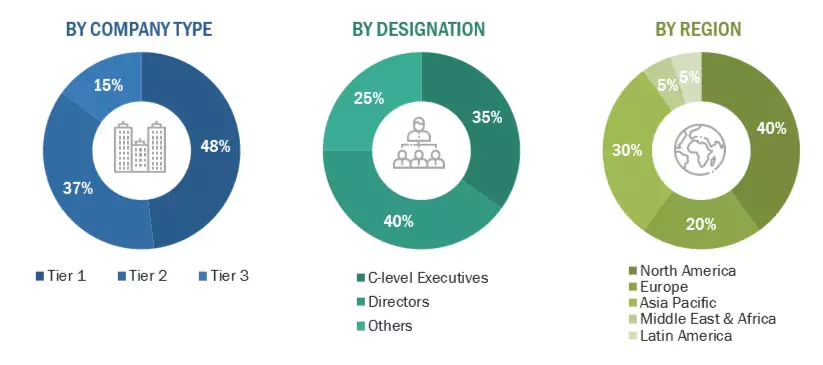
*Others include sales managers, marketing managers, and product managers.
Note: Tier 1 companies’ revenue is more than USD 1 billion; Tier 2 companies’ revenue ranges between USD 500 million and USD
1 billion; and Tier 3 companies’ revenue ranges between USD 100 million and USD 500 million
To know about the assumptions considered for the study, download the pdf brochure
Market Size Estimation
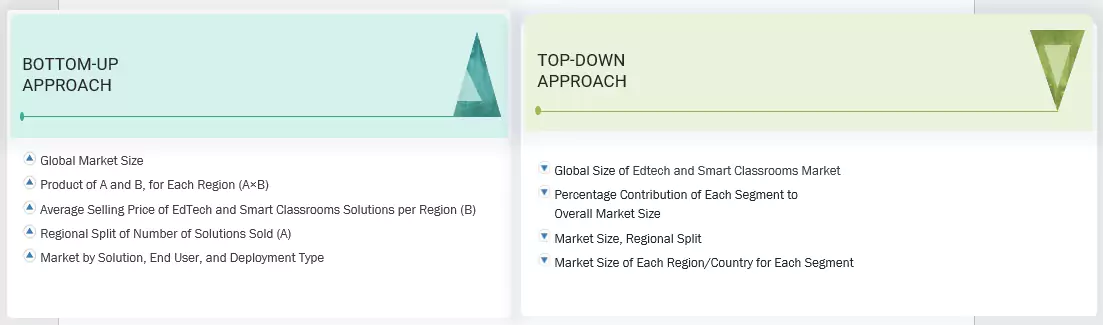
Multiple approaches were adopted to estimate and forecast the size of the edtech and smart classrooms market. The first approach involves estimating market size by summing up the revenue generated by companies through the sale of edtech and smart classrooms solutions.
Top-down and bottom-up approaches were used to estimate and validate the total size of the edtech and smart classrooms market. These methods were also extensively used to estimate the size of various market segments. The research methodology used to evaluate the market size is listed below.
- Key players in the market have been identified through extensive secondary research.
- In terms of value, the industry’s supply chain and market size have been determined through primary and secondary research processes.
- All shares, splits, and breakups have been determined using secondary sources and verified through primary sources.
Edtech and Smart Classrooms Market : Top-Down and Bottom-Up Approach
Data Triangulation
After determining the overall market size, the edtech and smart classrooms market was divided into several segments and subsegments. A data triangulation procedure was used to complete the overall market engineering process and arrive at the exact statistics for all segments and subsegments, wherever applicable. The data was triangulated by studying various factors and trends from the demand and supply sides. Along with data triangulation and market breakdown, the market size was validated by the top-down and bottom-up approaches.
Market Definition
Edtech, or educational technology, refers to the use of digital tools, software, and hardware to facilitate learning and improve educational outcomes. It encompasses a wide range of solutions, from simple learning apps and online course platforms to complex systems for institutional management and data analytics. A smart classroom is a specific implementation of edtech within a physical learning space. It is an environment where technology is integrated seamlessly to enhance teaching and collaboration. This typically includes the use of interactive whiteboards, high-speed internet, connected devices, and specialized software to create a more engaging, interactive, and efficient learning experience for both students and instructors.
Stakeholders
- System Integrators
- EdTech and Smart Classrooms Hardware and Solution Vendors
- Resellers and Distributors
- Universities and Schools
- Teachers/Professors
- School Board Members
- Research Organizations
- Enterprise Users
- Technology Providers
- Venture Capitalists, Private Equity Firms, and Startup Companies
Report Objectives
- To determine and forecast the global edtech and smart classrooms market by solution, end user, deployment type, and region
- To forecast the size of the market segments for North America, Europe, Asia Pacific, Latin America, and the Middle East & Africa
- To provide detailed information about the major factors (drivers, restraints, opportunities, and challenges) influencing the growth of the edtech and smart classrooms market
- To analyze each submarket concerning individual growth trends, prospects, and contributions to the overall edtech and smart classrooms market
- To analyze the opportunities in the market for stakeholders by identifying the high-growth segments of the edtech and smart classrooms market
- To profile the key market players; provide a comparative analysis based on business overviews, regional presence, product offerings, business strategies, and key financials; and illustrate the market’s competitive landscape
- Track and analyze the competitive developments in the market, such as mergers and acquisitions, product developments, partnerships and collaborations, and research and development (R&D) activities.
Available Customizations
With the given market data, MarketsandMarkets offers customizations to meet the company’s specific needs. The following customization options are available for the report:
Geographic Analysis as per Feasibility
- Analysis for additional countries (up to five)
Company Information
- Detailed analysis and profiling of additional market players (up to 5)
Key Questions Addressed by the Report
What is the definition of the edtech and smart classrooms market?
Edtech and smart classrooms refer to the use of digital technologies, interactive tools, and connected learning environments to enhance teaching and learning. They enable personalized, engaging, and collaborative education across K-12, higher education, and vocational training centers.
What is the market size of the edtech and smart classrooms market?
The edtech and smart classrooms market is projected to grow from USD 197.3 billion in 2025 to USD 353.1 billion by 2030 at a CAGR of 12.3% from 2025 to 2030.
What are the major drivers of the edtech and smart classrooms market?
The major drivers of the edtech and smart classrooms market include the increasing adoption of LMS and cloud-based education platforms, mobile learning and AI-based personalization, government-funded digital learning initiatives, and rising demand for gamified interactive display deployments.
Who are the key players operating in the edtech and smart classrooms market?
The key players profiled in the edtech and smart classrooms market include Pearson (UK), Cisco (US), Anthology (US), IBM (US), McGraw-Hill Education (US), Google (US), Microsoft (US), Oracle (US), PowerSchool (US), Instructure (US), 2U (US), Ellucian (US), Turnitin (US), Kahoot (Norway), Smart Technologies (Canada), IXL Learning (US), D2L (Canada), Workday (US), Discovery Education (US), Promethean (US), Byju’s (India), Yuanfudao (China), VipKid (US), 17Zuoye (China), Seesaw (US), Nearpod (US), Age of Learning (US), and Brightbytes (US).
What are the key technological trends prevailing in the edtech and smart classrooms market?
Key technological trends in the edtech and smart classrooms market include the adoption of AI and ML for personalized learning, AR/VR for immersive education, and cloud-based platforms for scalability and accessibility. Additionally, the use of IoT-enabled smart devices and data analytics is enhancing real-time performance tracking and collaborative learning experiences.
Fact checked
Personalize This Research
- Triangulate with your Own Data
- Get Data as per your Format and Definition
- Gain a Deeper Dive on a Specific Application, Geography, Customer or Competitor
- Any level of Personalization
Let Us Help You
- What are the Known and Unknown Adjacencies Impacting the Edtech and Smart Classrooms Market
- What will your New Revenue Sources be?
- Who will be your Top Customer; what will make them switch?
- Defend your Market Share or Win Competitors
- Get a Scorecard for Target Partners

Custom Market Research Services
We Will Customise The Research For You, In Case The Report Listed Above Does Not Meet With Your Requirements
Get 10% Free CustomisationTESTIMONIALS
- US Edtech and Smart Classrooms Market
- Canada Edtech and Smart Classrooms Market
- UK Edtech and Smart Classrooms Market
- Germany Edtech and Smart Classrooms Market
- France Edtech and Smart Classrooms Market
- Italy Edtech and Smart Classrooms Market
- China Edtech and Smart Classrooms Market
- India Edtech and Smart Classrooms Market
- Japan Edtech and Smart Classrooms Market
- South Korea Edtech and Smart Classrooms Market
- Brazil Edtech and Smart Classrooms Market
- Mexico Edtech and Smart Classrooms Market
- South Africa Edtech and Smart Classrooms Market
- United Arab Emirates Edtech and Smart Classrooms Market
- Rest Of Europe Edtech and Smart Classrooms Market
- Australia And New Zealand Edtech and Smart Classrooms Market
- Rest Of Asia Pacific Edtech and Smart Classrooms Market
Growth opportunities and latent adjacency in Edtech and Smart Classrooms Market






MnM Analyst
Feb, 2023
The following potential trends that could continue to influence the industry are based on recent and past developments in the EdTech and smart classroom market:
These are just a few possible trends that could influence the market for EdTech and smart classrooms in the upcoming years. However, it's crucial to remember that the industry is rapidly changing and that new trends and technologies may develop that we are unable to foresee at this time..
Anderson
Feb, 2023
What are the trends in EdTech and Smart Classroom Market in 2023?.
Greed
Jul, 2026
How are smart classrooms improving student engagement and learning outcomes?.
Romie
Jul, 2026
Why is AI becoming essential in modern education systems?.
Alask
Jul, 2026
Why is data-driven education gaining strong market demand?.
Bricks
Jul, 2026
What role does Business Intelligence play in the future of education?.