Europe Artificial Intelligence (AI) Market

Europe Artificial Intelligence (AI) Market by Infrastructure (Compute, Memory, Networking, Storage), Software (Conversational Assistants, No Code/Low Code, BI & Analytics, Developer Platforms), Technology (ML, NLP, Generative AI) - Forecast to 2032




OVERVIEW
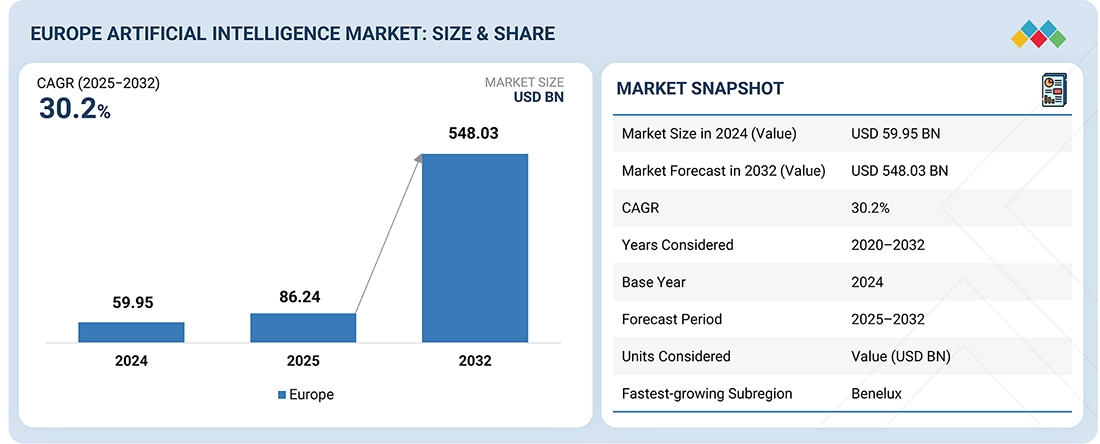
Source: Secondary Research, Interviews with Experts, MarketsandMarkets Analysis
The Europe artificial intelligence (AI) market was estimated at USD 86.24 billion in 2025 and is projected to reach USD 548.03 billion by 2032, growing at a CAGR of 30.2% from 2025 to 2032. Market growth is driven by the strong regulatory framework, rapid enterprise digital transformation, and rising adoption of trustworthy and responsible AI solutions across key industries. The EU AI Act, GDPR compliance, and emphasis on ethical, transparent, and human-centric AI are accelerating demand for secure and scalable AI deployment. Additionally, a few leading collaborative AI initiatives, such as the European Laboratory for Learning and Intelligent Systems (ELLIS) and GAIA-X, aimed to strengthen the region's digital sovereignty and leadership in AI.
KEY TAKEAWAYS
-
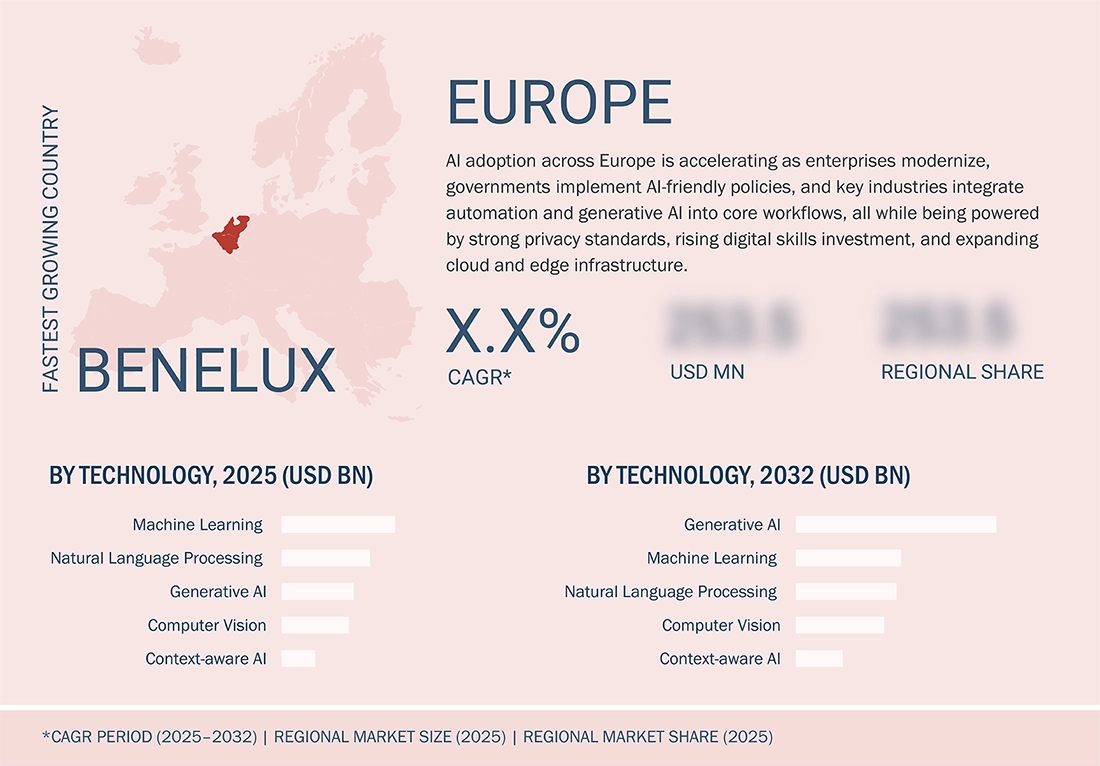
By Sub-regionBy subregion, Benelux is expected to register the highest CAGR of 35.2% during the forecast period.
-
By TechnologyBy technology, the machine learning segment is expected to dominate the market with a share of 30.3% in 2025.
-
By Business FunctionBy business function, the operations & supply chain segment is projected to grow at the fastest rate of 31.7% during the forecast period.
-
By Enterprise End UserBy enterprise end user, the software & technology providers segment is expected to dominate the market with a share of 17.8% in 2025.
-
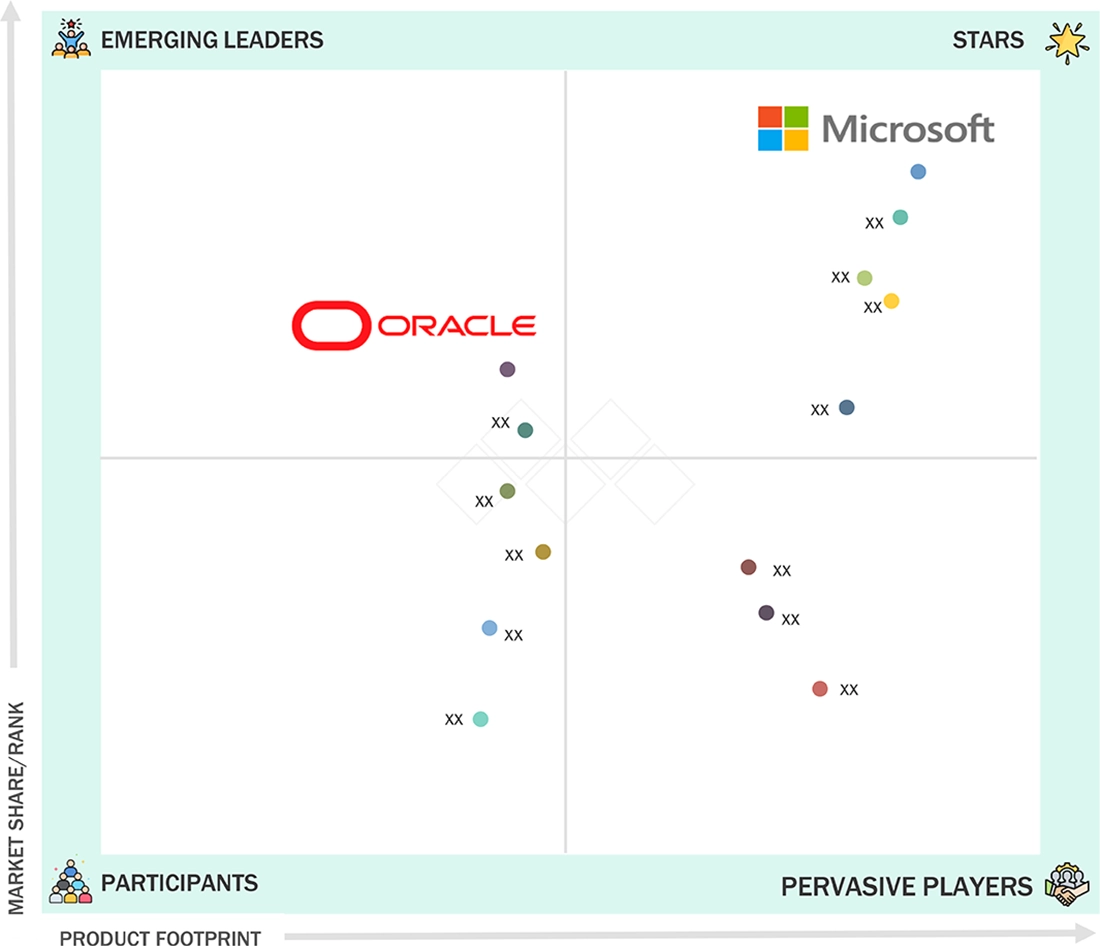
Competitive LandscapeGoogle, Microsoft, NVIDIA, Oracle, and AWS were identified as some of the star players in the Europe AI market, given their strong market share and product footprint.
-
Competitive LandscapeAnthropic, Scale AI, C3.ai, and Dialpad, among others, have distinguished themselves among startups and SMEs by securing strong footholds in the Europe AI market, underscoring their potential as emerging market leaders.
Several EU funding programs, including Horizon Europe & Digital Europe, support advanced AI research, foundation models, robotics, healthcare AI, climate AI, and industrial AI, aiming to scale AI adoption in Europe. The surge in automation, the expansion of edge AI across manufacturing and mobility, and the EU's strategic push for digital sovereignty are expected to fuel demand for AI in the region. Furthermore, increasing investments in smart factories, autonomous systems, and sustainable energy to strengthen AI demand. The region's rapid adoption of privacy-preserving AI technologies such as federated learning and secure data processing is creating a strong foundation for scalable AI innovation. AI adoption across Europe is accelerating as organizations prioritize compliant and transparent AI systems that align with EU regulatory expectations. Companies like Anthropic report rapid growth in Europe, citing “huge demand” among enterprise clients in the UK and the broader region.
TRENDS & DISRUPTIONS IMPACTING CUSTOMERS' CUSTOMERS
Enterprises are deploying AI solutions to modernize operations, enhance productivity, and support multilingual customer engagement. Public administrations are deploying AI for digital public services, identity verification, and secure data management. A strong focus on ethical AI, combined with a rise in investments in digital skills, leads to faster AI adoption. The EU AI Act and Digital Europe Programme provide strong momentum for AI adoption across the region. Vendors like NVIDIA and Perplexity are partnering with European firms to build AI models tailored to European languages and cultural contexts, reflecting demand for localized AI tools. The UK, Germany, and France are at the forefront in AI and generative AI adoption with a mature AI startup ecosystem.
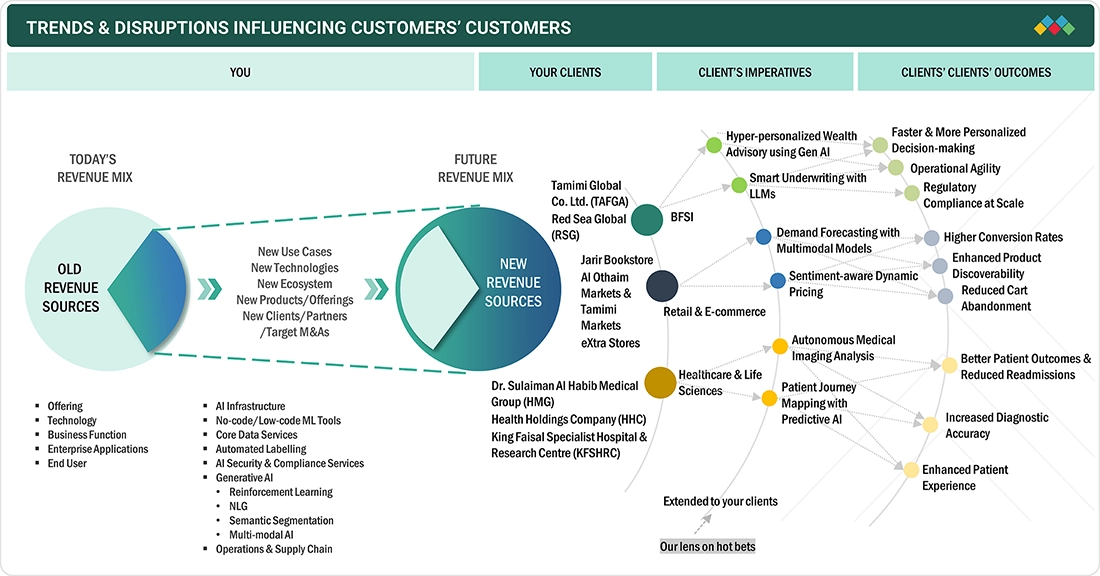
Source: Secondary Research, Interviews with Experts, MarketsandMarkets Analysis
MARKET DYNAMICS

Level
-
EU’s unified strategy for trustworthy and sovereign AI accelerates adoption across Europe

-
Advancements in Europe HPC, data infrastructure, and cross-border data spaces


Level
-
Stringent compliance requirements under GDPR and EU AI Act

-
Fragmented AI readiness across EU member states


Level
-
Europe’s linguistic diversity unlocks massive opportunities for AI-powered content localization

-
Expansion of EU AI-native and sovereign infrastructure


Level
-
Persistent concerns around bias, fairness, and model accountability

-
Legacy infrastructure and talent gaps slowing AI modernization

Source: Secondary Research, Interviews with Experts, MarketsandMarkets Analysis
Driver: EU’s unified strategy for trustworthy and sovereign AI accelerates adoption across Europe
Europe is building a stable and predictable regulatory framework that supports large-scale AI adoption across enterprises. Regulations such as the GDPR and the upcoming EU AI Act promote the safe and responsible use of AI. Organizations must meet strict requirements around data protection, transparency, algorithmic accountability, and risk management. This often increases costs and slows AI deployment for high-risk and generative AI use cases in regulated industries.
Restraint: Stringent compliance requirements under GDPR and the EU AI Act
Europe’s robust legal framework, centered on the GDPR and the forthcoming EU AI Act, ensures the safe and responsible adoption of AI, but also introduces complexity and compliance overhead for organizations. Businesses must meet strict requirements related to data protection, transparency, algorithmic accountability, and risk management. While these regulations build trust, they also extend development timelines, increase operational costs, and pose challenges for companies adopting high-risk or generative AI systems within regulated industries.
Opportunity: Europe’s linguistic diversity unlocks massive opportunities for AI-powered content localization
Europe's linguistic diversity is a strong advantage for AI adoption. With 24 official EU languages, the regions created high demand for AI based translation, content generation, and localized digital experiences. Generative AI, NLP models, and speech technologies supports organizations to communicate with diverse audiences and personalize customer interactions. This drives opportunities across e-commerce, media, education, and public services across Europe.
Challenge: Persistent concerns around bias, fairness, and model accountability
As AI continues to grow, organizations in Europe also face challenges related to algorithmic bias, fairness, and explainability. These concerns are critical across finance, government, healthcare, and public administration. Meeting Europe's ethical and transparency standards requires continuous model monitoring, audits, and human oversight. These requirements can slow AI deployment and raise ongoing operational costs.
EUROPE ARTIFICIAL INTELLIGENCE (AI) MARKET: COMMERCIAL USE CASES ACROSS INDUSTRIES
| COMPANY | USE CASE DESCRIPTION | BENEFITS |
|---|---|---|
 |
Mars partnered with Microsoft to transform supply chain operations using AI. Microsoft implemented Azure Machine Learning to enable predictive analytics and real-time insights, allowing for the development of AI models that facilitate accurate demand forecasting and production planning. | Azure Machine Learning improved supply chain resilience, enabled real-time demand forecasting, and reduced waste and inefficiencies. It also enhanced responsiveness and scalable AI-powered decision-making across Mars' global supply network. |
 |
Perplexity AI collaborated with NVIDIA to enhance the efficiency and quality of its models. To optimize large language model performance while managing infrastructure costs, NVIDIA helped integrate the NeMo framework and optimize the inference stack for efficient LLM deployment. | NVIDIA enabled Perplexity AI to achieve 3x faster inference speeds and lower compute and energy costs. It enhanced model accuracy and scalability, enabled faster iteration, and streamlined deployment cycles to minimize engineering overhead while optimizing workflows. |
 |
Notion partnered with OpenAI to embed generative AI into its productivity platform. OpenAI's large language models were integrated to power Notion AI, providing features such as auto-summarization, idea generation, content expansion, and translation. | OpenAI's integration enhanced user productivity and creativity, enabling faster content creation and summarization. It increased platform engagement and user satisfaction, achieving competitive product differentiation through embedded AI. |
Logos and trademarks shown above are the property of their respective owners. Their use here is for informational and illustrative purposes only.
MARKET ECOSYSTEM
The Europe AI ecosystem comprises a comprehensive network of hardware providers, software platforms, and service providers. Leading AI hardware providers, including NVIDIA, AMD, Intel, and IBM, deliver the computational infrastructure through specialized AI chips, memory and storage systems, and networking equipment that are essential for training and deploying machine learning models. On the software side, AI development platforms from companies such as Scale AI, C3.ai, and Dialpad work in conjunction with foundation models from OpenAI, Google, Meta, and Anthropic to provide the building blocks for AI applications. Complementing this infrastructure, AI service providers offer specialized capabilities, including data labeling and annotation, model training and tuning, analytics and consulting, as well as comprehensive end-to-end AI solutions.
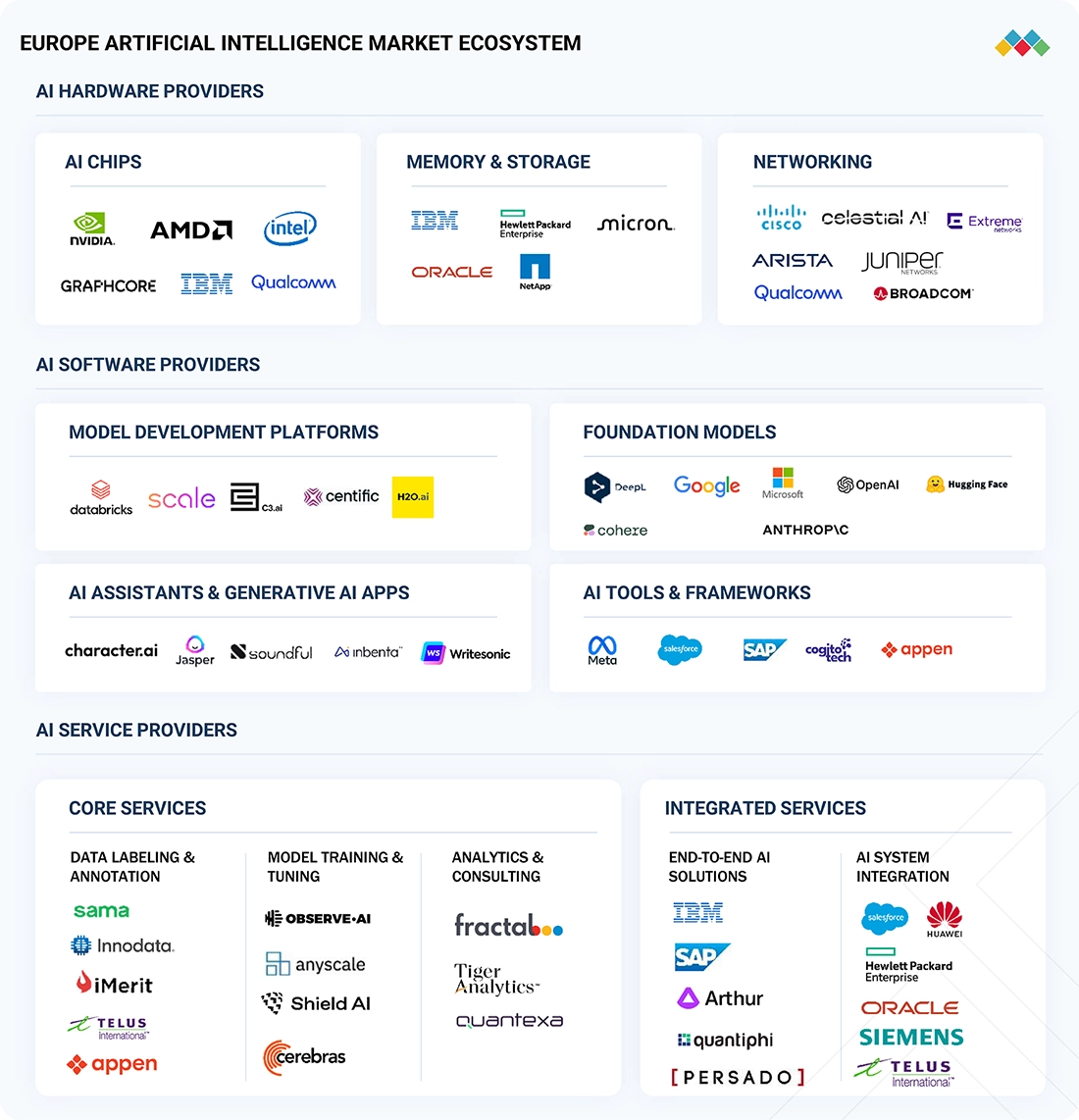
Logos and trademarks shown above are the property of their respective owners. Their use here is for informational and illustrative purposes only.
MARKET SEGMENTS
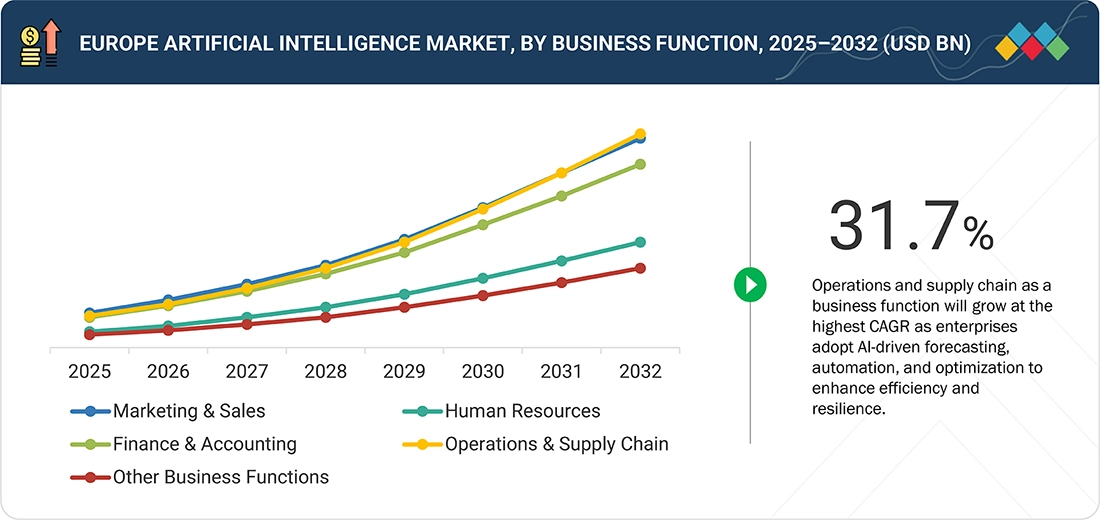
Source: Secondary Research, Interviews with Experts, MarketsandMarkets Analysis
Europe Artificial Intelligence Market, by Offering
By 2025, the AI infrastructure segment is projected to dominate the market. This growth is driven by substantial investments in sovereign cloud platforms, high-performance computing (HPC), edge AI, and interoperable EU data spaces. Governments and enterprises are prioritizing the development of local, compliant AI infrastructure to reduce their dependence on global cloud providers.
Europe Artificial Intelligence Market, by Technology
Generative AI is expected to grow rapidly due to the rising demand from enterprises for multilingual content creation, the automation of knowledge workflows, and the development of scalable, GDPR-compliant AI solutions across key industries. Additionally, there is an increasing need for automated content generation, multilingual communication tools, and intelligent digital assistants, all of which will contribute to the growth of AI. Europe is particularly focused on responsible AI, with expanding infrastructure and accelerated adoption across various sectors, including banking, manufacturing, healthcare, retail, and public services.
Europe Artificial Intelligence Market, by Business Function
By 2025, the marketing and sales business functions will dominate the market. The growth is driven by the need for personalized digital campaigns, customer insights, and multilingual content generation. Enterprises in Europe are investing in AI solutions to improve lead conversion, optimize advertising end, and enhance customer engagement.
Europe Artificial Intelligence Market, by Enterprise End User
The healthcare and life sciences sectors are projected to experience the fastest growth during the forecast period. Hospitals, research institutions, and pharmaceutical companies are increasingly adopting AI for applications such as image analysis, drug discovery, and clinical workflow automation. The rising demand for digital health solutions is driving the need for AI technologies that provide medical insights and enable personalized care. Additionally, the necessity for cost-efficient healthcare delivery, the aging population, and advancements in genomics and bioinformatics are contributing to the growing demand for AI solutions in Europe.
REGION
Benelux is the fastest-growing sub-region in the Europe AI market
The Benelux region has strong innovation ecosystems and early government support for the development of responsible AI technologies. Additionally, it has a robust digital AI infrastructure and actively participates in various AI initiatives and cross-border research collaborations. This blend of technological maturity, regulatory coherence, and innovation across key industries positions the Benelux as one of the fastest-growing hubs for AI adoption.
EUROPE ARTIFICIAL INTELLIGENCE (AI) MARKET: COMPANY EVALUATION MATRIX
In the Europe AI market matrix, Microsoft (Star) leads with its expansive AI ecosystem, powered by Azure AI, Copilot, and advanced machine learning services, which enable businesses to innovate, automate, and scale intelligent solutions across various industries. Its integration of generative AI into productivity tools, strong enterprise partnerships, and commitment to responsible AI practices solidify its leadership in driving the global AI transformation. Oracle (Emerging Leader) is strengthening its position in the Europe AI market through its rapidly expanding OCI AI infrastructure, enterprise-grade generative AI services, and deep integration of AI capabilities across its cloud applications suite. With a strong focus on industry-specific AI workflows, autonomous databases, and cost-efficient GPU-based compute, Oracle is emerging as a key challenger, enabling enterprises to accelerate AI adoption with robust performance, security, and scalability.
Source: Secondary Research, Interviews with Experts, MarketsandMarkets Analysis
KEY MARKET PLAYERS
- SAP (Germany)
- Microsoft (US)
- IBM (US)
- Oracle (US)
- AWS (US)
- Siemens (Germany)
- NVIDIA (US)
- OpenAI (US)
- Google (US)
- H20.ai (US)
- Salesforce (US)
- Graphcore (UK)
- DeepL (Germany)
- Synthesia (UK)
- Gamaya (Switzerland)
MARKET SCOPE
| REPORT METRIC | DETAILS |
|---|---|
| Market Size in 2024 (Value) | USD 59.95 BN |
| Market Forecast in 2032 (Value) | USD 548.03 BN |
| CAGR | 30.2% |
| Years Considered | 2020–2032 |
| Base Year | 2024 |
| Forecast Period | 2025–2032 |
| Units Considered | Value (USD BN) |
| Fastest-growing Sub-region | Benelux |
| Report Coverage | Revenue Forecast, Company Ranking, Competitive Landscape, Growth Factors, and Trends |
| Segments Covered |
|
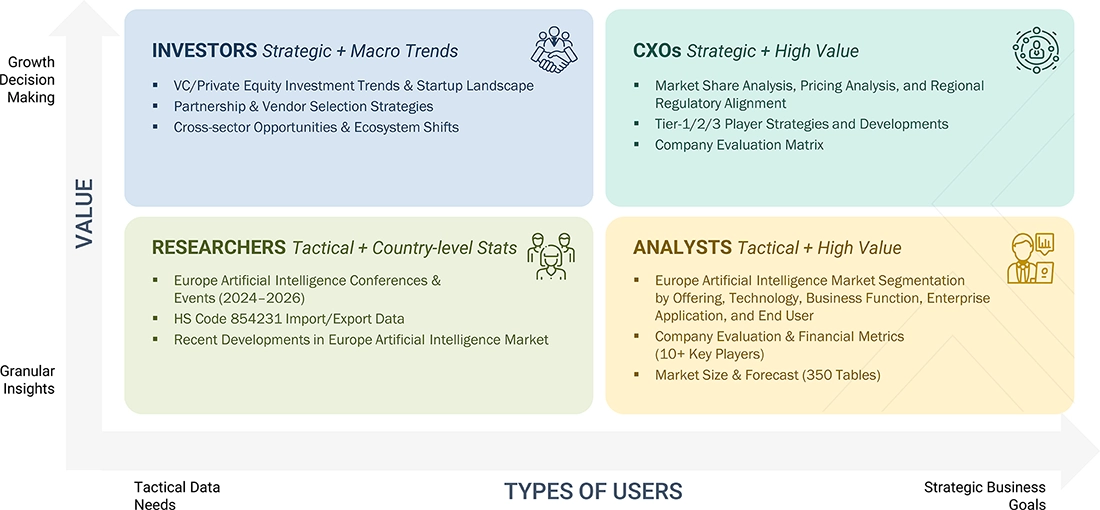
WHAT IS IN IT FOR YOU: EUROPE ARTIFICIAL INTELLIGENCE (AI) MARKET REPORT CONTENT GUIDE
DELIVERED CUSTOMIZATIONS
We have successfully delivered the following deep-dive customizations:
| CLIENT REQUEST | CUSTOMIZATION DELIVERED | VALUE ADDS |
|---|---|---|
| IT Infrastructure Service Provider |
|
|
| Telecom & Cloud Provider |
|
|
RECENT DEVELOPMENTS
- April 2025 : Oracle launched the Oracle Cloud Infrastructure (OCI) File Storage, a fully managed service designed for AI/ML training and inference, and high-performance computing. OCI automates deployment, scaling, and maintenance, allowing users to concentrate on applications instead of infrastructure management. OCI deploys and maintains all Lustre (a type of parallel distributed file system) server components, including metadata, management, and storage servers.
- April 2025 : Amazon Lex V2 was updated with generative AI capabilities, including support for Bedrock Knowledge Base, Guardrails, Anthropic Claude 3 Haiku, and Sonnet models. These enhancements are integrated within the QnA built-in slot. Furthermore, Lex V2 now also supports the QinConnect built-in intent to connect bots with Amazon Connect.
- March 2025 : Microsoft has announced a major enhancement to its Azure AI ecosystem through the integration of NVIDIA NIM microservices and NVIDIA AgentIQ into Azure AI Foundry, marking a significant step forward in enabling scalable, production-ready agentic AI workflows for US enterprises. The collaboration brings zero-configuration deployment, GPU-optimized model performance, and real-time telemetry into the Azure environment, allowing organizations to build, test, and operationalize generative AI agents with unprecedented speed.
- March 2025 : NVIDIA launched the NVIDIA AI Data Platform, a customizable reference design for a new class of enterprise AI infrastructure aimed at demanding AI inference workloads. Leading storage providers are collaborating with NVIDIA to build customized AI data platforms using NVIDIA Blackwell GPUs, BlueField DPUs, Spectrum-X networking, and the NVIDIA Dynamo open-source inference library. The platform brings accelerated computing and AI to enterprise storage, enabling AI query agents to generate insights from data in near real time.
- March 2025 : IBM introduced several new capabilities in its Watsonx AI Assistant. Conversational search now supports more languages, including French, Spanish, German, and Brazilian Portuguese, expanding its global reach. Additionally, there is improved accuracy in understanding free-text responses, which reduces errors and enhances data gathering. These updates demonstrate a focus on leveraging advanced AI models to enhance the user experience and expand language support.
Table of Contents
 Exclusive indicates content/data unique to MarketsandMarkets and not available with any competitors.
Methodology
In the primary research process, a diverse range of stakeholders from both the supply and demand sides of the artificial intelligence ecosystem were interviewed to gather qualitative and quantitative insights specific to this market. From the supply side, key industry experts, such as chief executive officers (CEOs), vice presidents (VPs), marketing directors, technology & innovation directors, and technical leads from vendor companies offering artificial intelligence infrastructure, software & services were consulted. Additionally, system integrators, service providers, and IT service firms that implement and support artificial intelligence were included in the study. On the demand side, input from IT decision-makers, infrastructure managers, and business heads of prominent enterprise end users was collected to understand the user perspectives and adoption challenges within targeted industries.
The primary research ensured that all crucial parameters affecting the artificial intelligence market—from technological advancements and evolving use cases (predictive maintenance, fraud detection, customer service automation, content generation, personalized recommendations, etc.) to regulatory and compliance needs (GDPR, CCPA, Europe AI Act, AIDA, etc.) were considered. Each factor was thoroughly analyzed, verified through primary research, and evaluated to obtain precise quantitative and qualitative data for this market.
Secondary Research
Once the initial phase of market engineering was completed, including detailed calculations for market statistics, segment-specific growth forecasts, and data triangulation, an additional round of primary research was undertaken. This step was crucial for refining and validating critical data points, such as AI offerings (artificial intelligence infrastructure, software & services), industry adoption trends, the competitive landscape, and key market dynamics like demand drivers (growth in adoption of autonomous artificial intelligence, rise of deep learning and machine learning technologies, advancements in computing power and availability of large databases), challenges (lack of transparency and explainability in decision-making process of AI, concerns related to bias and inaccurately generated output, integration challenges and lack of understanding of state-of-the-art systems), and opportunities (advancements in AI-native infrastructure enhancing scalability and performance, expansion of edge AI capabilities for real-time data processing and decision-making, advancements in generative AI to open new avenues for AI-powered content creation).
Primary Research
In the complete market engineering process, the top-down and bottom-up approaches and several data triangulation methods were extensively used to perform the market estimation and market forecast for the overall market segments and subsegments listed in this report. Extensive qualitative and quantitative analysis was performed on the complete market engineering process to record the critical information/insights throughout the report.
Market Size Estimation
To estimate and forecast the artificial intelligence market and its dependent submarkets, both top-down and bottom-up approaches were employed. This multi-layered analysis was further reinforced through data triangulation, incorporating primary and secondary research inputs. The market figures were also validated against the existing MarketsandMarkets repository for accuracy. The following research methodology has been used to estimate the market size:
Data Triangulation
After arriving at the overall market size using the market size estimation processes as explained above, the market was split into several segments and subsegments. To complete the overall market engineering process and arrive at the exact statistics of each market segment and subsegment, data triangulation and market breakup procedures were employed, wherever applicable. The overall market size was then used in the top-down procedure to estimate the size of other individual markets via percentage splits of the market segmentation.
Market Definition
Many theoretical definitions of artificial intelligence center on a machine's capacity to mimic human behavior or carry out tasks that call for intelligence, but given the majority of current applications, artificial intelligence can be described as “systems that employ methods that can gather data and use it to predict, suggest, or make decisions with varying degrees of autonomy and select the best course of action to accomplish particular objectives”. AI systems leverage advanced techniques such as deep learning, reinforcement learning, and probabilistic reasoning to process data, recognize patterns, and make autonomous decisions or provide predictive analytics. These systems are designed to improve over time through iterative training and adaptation, often utilizing large-scale data and high-performance computing infrastructure to optimize performance and accuracy.
Stakeholders
- AI software developers
- AI infrastructure providers
- AI-integrated service providers
- AI training dataset providers
- Core data service providers
- Business analysts
- Cloud service providers
- Consulting service providers
- Enterprise end users
- Distributors and Value-added Resellers (VARs)
- Government agencies
- Independent Software Vendors (ISVs)
- Managed service providers
- Market research and consulting firms
- Support & maintenance service providers
- System Integrators (SIs)/Migration service providers
- Language service providers
- Technology providers
- Academia & research institutions
- Investors & venture capital firms
Report Objectives
- To define, describe, and forecast the artificial intelligence market, by offering, business function, technology, enterprise application, and end user
- To provide detailed information related to major factors (drivers, restraints, opportunities, and industry-specific challenges) influencing the market growth
- To analyze the micro markets with respect to individual growth trends, prospects, and their contribution to the total market
- To analyze the opportunities in the market for stakeholders by identifying the high-growth segments of the artificial intelligence market
- To analyze opportunities in the market and provide details of the competitive landscape for stakeholders and market leaders
- To forecast the market size of segments for five main regions: North America, Europe, Asia Pacific, the Middle East & Africa, and Latin America
- To profile the key players and comprehensively analyze their market ranking and core competencies
- To analyze competitive developments, such as partnerships, product launches, and mergers and acquisitions, in the artificial intelligence market
Available Customizations
With the given market data, MarketsandMarkets offers customizations as per the company’s specific needs. The following customization options are available for the report:
Product Analysis
- Product matrix provides a detailed comparison of the product portfolio of each company
Geographic Analysis as per Feasibility
- Further breakup of the North American market for artificial intelligence
- Further breakup of the European market for artificial intelligence
- Further breakup of the Asia Pacific market for artificial intelligence
- Further breakup of the Middle Eastern & African market for artificial intelligence
- Further breakup of the Latin American market for artificial intelligence
Company Information
- Detailed analysis and profiling of additional market players (up to five)
Key Questions Addressed by the Report
What is the projected size of the Europe Artificial Intelligence (AI) market by 2032?
The Europe AI market is projected to grow from USD 86.24 billion in 2025 to USD 548.03 billion by 2032, at a CAGR of 30.2%.
What are the key growth drivers of the Europe AI market?
Market growth is driven by enterprise digital transformation, trustworthy AI adoption, the EU AI Act, GDPR compliance, and increasing demand for secure AI solutions.
Which technology segment leads the Europe Artificial Intelligence market?
Machine Learning is expected to dominate the technology segment, accounting for 30.3% of the market in 2025.
Which companies are leading the Europe Artificial Intelligence market?
Key players include SAP, Microsoft, IBM, Oracle, AWS, Siemens, NVIDIA, OpenAI, Google, H2O.ai, Salesforce, Graphcore, DeepL, Synthesia, and Gamaya.
Which industries are accelerating AI adoption across Europe?
Manufacturing, healthcare, financial services, retail, and public sector organizations are driving widespread AI adoption across Europe
What opportunities does the Europe Artificial Intelligence market offer for buyers and enterprises?
The market offers opportunities to adopt scalable AI infrastructure, enterprise AI software, industry-specific AI solutions, and trusted AI platforms for digital transformation.
What are the major AI trends shaping the Europe market?
Key trends include rapid adoption of generative AI, AI infrastructure expansion, responsible AI development, and cloud-based enterprise AI platforms.


Personalize This Research
- Triangulate with your Own Data
- Get Data as per your Format and Definition
- Gain a Deeper Dive on a Specific Application, Geography, Customer or Competitor
- Any level of Personalization
Let Us Help You
- What are the Known and Unknown Adjacencies Impacting the Europe Artificial Intelligence (AI) Market
- What will your New Revenue Sources be?
- Who will be your Top Customer; what will make them switch?
- Defend your Market Share or Win Competitors
- Get a Scorecard for Target Partners

Custom Market Research Services
We Will Customise The Research For You, In Case The Report Listed Above Does Not Meet With Your Requirements
Get 10% Free CustomisationTESTIMONIALS






Growth opportunities and latent adjacency in Europe Artificial Intelligence (AI) Market