Europe Automated Storage and Retrieval System Market

Europe Automated Storage and Retrieval System Market by Type (Unit Load ASRS, Mini Load ASRS, Mid Load ASRS, Vertical Lift Module (VLM), Vertical Carousel, Horizontal Carousel), and Payload (<500 kg, 500-1,500 kg, >1,500 kg) - Forecast to 2030




OVERVIEW
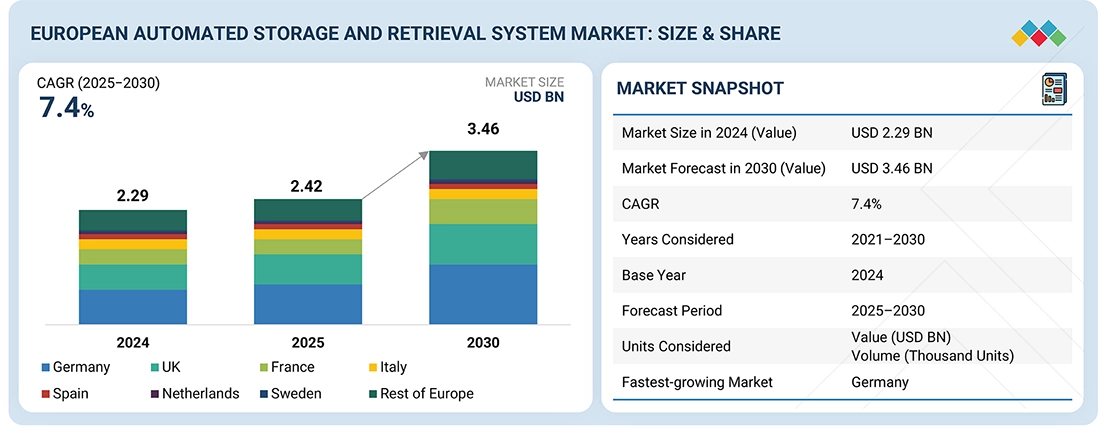
Source: Secondary Research, Interviews with Experts, MarketsandMarkets Analysis
The Europe automated storage and retrieval system market is expected to grow from USD 2.42 billion in 2025 to USD 3.46 billion by 2030, at a CAGR of 7.4%. The Europe ASRS market is growing steadily as retailers, manufacturers, and 3PLs accelerate warehouse automation to improve efficiency, accuracy, and space utilization amid rising labor shortages and e-commerce volumes. Ongoing investments in smart logistics hubs, robotics, and high-density storage systems are further strengthening adoption across major Europe economies.
Market Size & Forecast
KEY TAKEAWAYS
-
BY COUNTRYGermany is expected to dominate the Europe ASRS market, accounting for a 32.9% share in terms of value in 2025.
-
BY TYPEBy type, the vertical lift module segment is expected to witness high growth during the forecast period.
-
BY PAYLOAD CAPACITYBy payload capacity, the 500–1,500 kg segment is expected to dominate the Europe ASRS market in 2025.
-
BY INDUSTRYBy industry, the logistics segment is expected to register the highest CAGR of 9.6% during the forecast period.
-
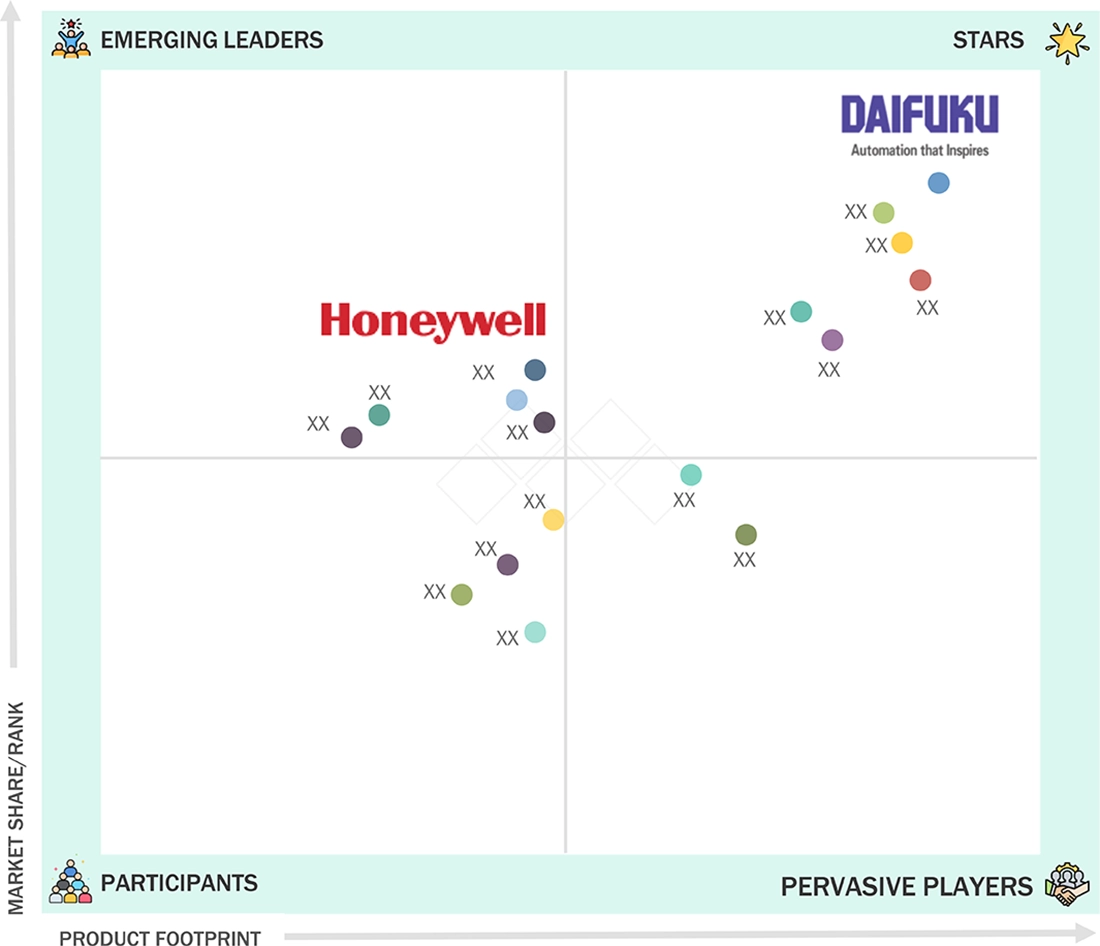
COMPETITIVE LANDSCAPE (KEY PLAYERS)Daifuku Co., Ltd., SSI SCHAEFER, and TGW Logistics Group GmbH were identified as star players in the Europe ASRS companies, given their strong market share and extensive product footprint.
-
COMPETITIVE LANDSCAPE (STARTUPS/SMES)Honeywell International Inc., Jungheinrich AG, and KNAPP AG have distinguished themselves among startups and SMEs by securing strong footholds in specialized niche areas, underscoring their potential as emerging market leaders.
The Europe ASRS industry is expanding steadily as organizations prioritize automation to manage rising order volumes, space constraints, and workforce challenges. Adoption is accelerating across sectors such as automotive, logistics, and pharmaceuticals, where high-speed storage and retrieval systems enhance operational agility and inventory accuracy. With growing investments in smart warehouses, robotics integration, and digital supply chain transformation, Europe is emerging as a key region driving next-generation, high-density automated storage solutions.
TRENDS & DISRUPTIONS IMPACTING CUSTOMERS' CUSTOMERS
The Europe ASRS market is being driven by he rapid digitalization of warehouses, rising e-commerce volumes, and increasing pressure on logistics and manufacturing operations to improve speed, accuracy, and space efficiency. As traditional material handling systems fall short, companies across the automotive, food & beverage, pharmaceutical, and retail sectors are shifting toward high-density automated storage integrated with WMS, robotics, and real-time analytics. These disruptions are reshaping supply chain strategies, enabling faster fulfillment, reducing operational costs, and accelerating investment in intelligent ASRS solutions across the region.
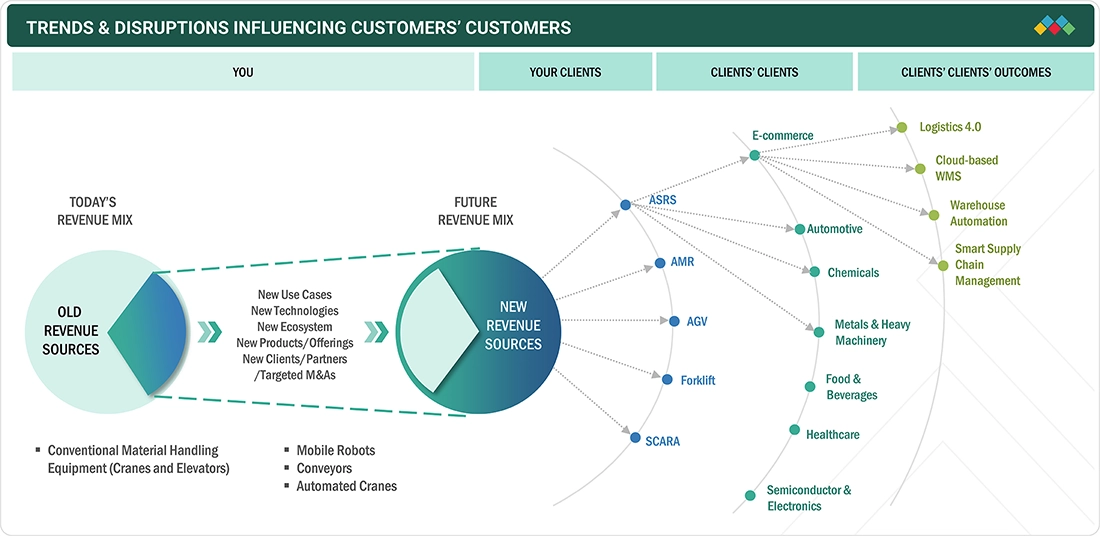
Source: Secondary Research, Interviews with Experts, MarketsandMarkets Analysis
MARKET DYNAMICS

Level
-
Rising emphasis on efficient space utilization in warehouses

-
Increasing deployment of automation technology in booming e-commerce sector


Level
-
High installation and maintenance costs

-
Risks of data security and cyber threats


Level
-
Rising implementation of strict guidelines for medical intralogistics

-
Increasing availability of modular and cost-effective ASRS solutions for SMEs


Level
-
Complexities and technical issues associated with ASRS setup

-
Challenges in adapting to ever-evolving technologies and customer demands

Source: Secondary Research, Interviews with Experts, MarketsandMarkets Analysis
Driver: Rising emphasis on efficient space utilization in warehouses
European warehouses face increasing space constraints due to high real-estate costs and growing order volumes, pushing companies to adopt high-density ASRS solutions. These systems enable vertical storage, better slotting efficiency, and improved inventory accessibility without expanding facility footprints. As a result, space optimization has become a key driver for ASRS adoption across logistics, retail, and manufacturing hubs in Europe.
Restraint: High installation and maintenance costs
ASRS deployment in Europe requires substantial upfront investment in hardware, software, integration, and facility modifications, which can limit adoption among small and mid-sized enterprises. Ongoing maintenance, specialized labor, and system upgrades add to the total cost of ownership. These financial barriers often delay modernization plans, especially in traditionally manual or cost-sensitive industries.
Opportunity: Rising implementation of strict guidelines for medical intralogistics
Europe’s strong regulatory environment for pharmaceuticals and medical devices is accelerating the need for automated, traceable, and contamination-free storage systems. ASRS offers controlled environments, precise tracking, and error-free handling that align with EU Good Distribution Practices (GDP) and hospital automation standards. This regulatory push is opening new high-value opportunities for ASRS vendors in healthcare and life sciences supply chains.
Challenge: Complexities and technical issues associated with ASRS setup
Installing ASRS requires complex integration with existing WMS, robotics, and conveyor systems, often causing disruptions during implementation in European facilities. Technical issues such as calibration, software compatibility, and downtime risk can delay project timelines. These complexities make companies cautious and increase the need for skilled integrators and phased deployment strategies.
EUROPE AUTOMATED STORAGE AND RETRIEVAL SYSTEM MARKET: COMMERCIAL USE CASES ACROSS INDUSTRIES
| COMPANY | USE CASE DESCRIPTION | BENEFITS |
|---|---|---|
 |
Multi-temperature ASRS integrating frozen, chilled, and ambient zones within one grid to automate grocery storage, improve space utilization, and eliminate manual work in sub-zero environments. | Faster order processing, higher storage density, nearly tripled capacity, reduced employee exposure to freezing conditions, and improved overall workflow efficiency. |
 |
High-throughput ASRS supporting omni-channel fulfillment with 530 Robots and 240,000 Bins, enabling rapid item retrieval and seamless integration with Rhenus’ distribution operations for Thalia. | Record-level processing speeds, doubled productivity, extremely high system uptime, optimized floor space, and faster onboarding of seasonal workers. |
 |
Automated clad-rack warehouse integrated with Michelin’s production lines using stacker cranes, conveyors, and WMS for handling custom metal containers with continuous 24/7 storage and dispatch operations. | Higher storage capacity, streamlined production flow, improved traceability, faster loading/unloading, and fully automated container movement across manufacturing stages. |
 |
End-to-end automated intralogistics system with SSI Case Picking, shuttle warehouses, robotic palletizing, and WAMAS software to support nationwide grocery distribution from a centralized hub. | High-volume order handling, improved picking accuracy, reduced transport emissions, enhanced workforce ergonomics, and a more sustainable and resilient supply chain. |
Logos and trademarks shown above are the property of their respective owners. Their use here is for informational and illustrative purposes only.
MARKET ECOSYSTEM
The Europe ASRS market ecosystem is shaped by close collaboration among hardware manufacturers, software integrators, and full-solution automation providers. Hardware and component suppliers enable the foundation for reliable sensors, controls, and mechanical systems, while software specialists deliver warehouse intelligence, orchestration, and seamless system integration. Automated storage solution providers combine these elements into turnkey systems that enhance throughput, accuracy, and space utilization. These capabilities ultimately support a diverse range of end users across retail, logistics, manufacturing, and food industries seeking higher efficiency and operational resilience.
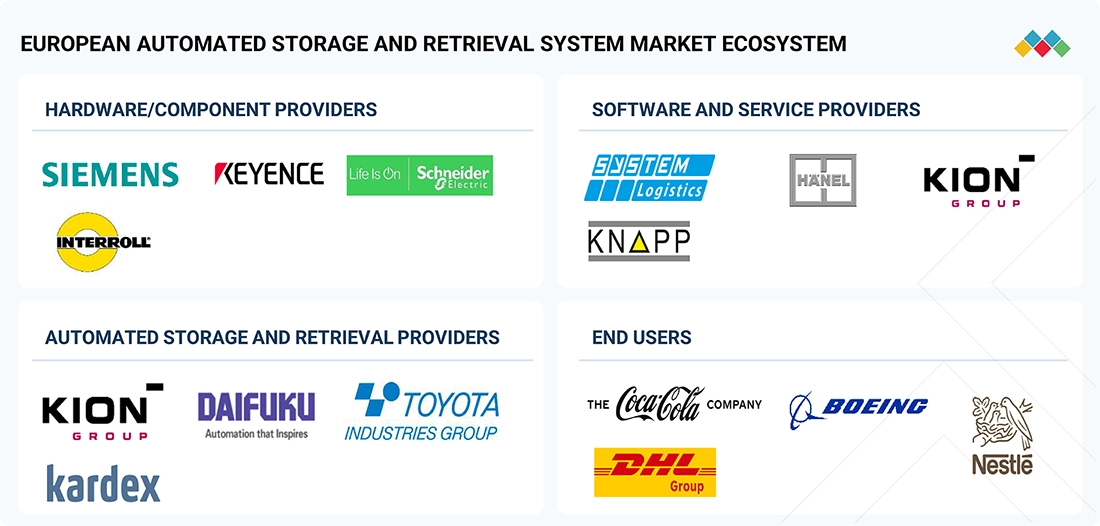
Logos and trademarks shown above are the property of their respective owners. Their use here is for informational and illustrative purposes only.
Europe Automated Storage and Retrieval System Market, by Type
Unit load ASRS dominates the European market because it is widely used in large manufacturing, automotive, and heavy industrial warehouses that require automated pallet handling. These systems offer high throughput, strong durability, and the ability to manage bulky or heavy items efficiently. Their long lifecycle, scalability, and integration with production workflows reinforce their lead over other ASRS types.
Europe Automated Storage and Retrieval System Market, by Payload Capacity
ASRS solutions exceeding 1,500 kg capacity are growing rapidly as Europe’s industrial sectors automate storage of heavy components, machinery parts, and bulk materials. Companies increasingly prefer high-payload automation to reduce manual handling, enhance safety, and optimize space in large-scale facilities. Growing investments in smart factories and advanced pallet-handling systems continue to accelerate demand in this segment.
Europe Automated Storage and Retrieval System Market, by Industry
The automotive sector leads ASRS adoption due to its complex production processes, high parts turnover, and need for precise inventory control. Automated storage enables seamless integration with assembly lines, ensuring just-in-time material flow and error-free component handling. Strong automation investments across Europe’s major automotive hubs reinforce this industry’s dominant market share.
REGION
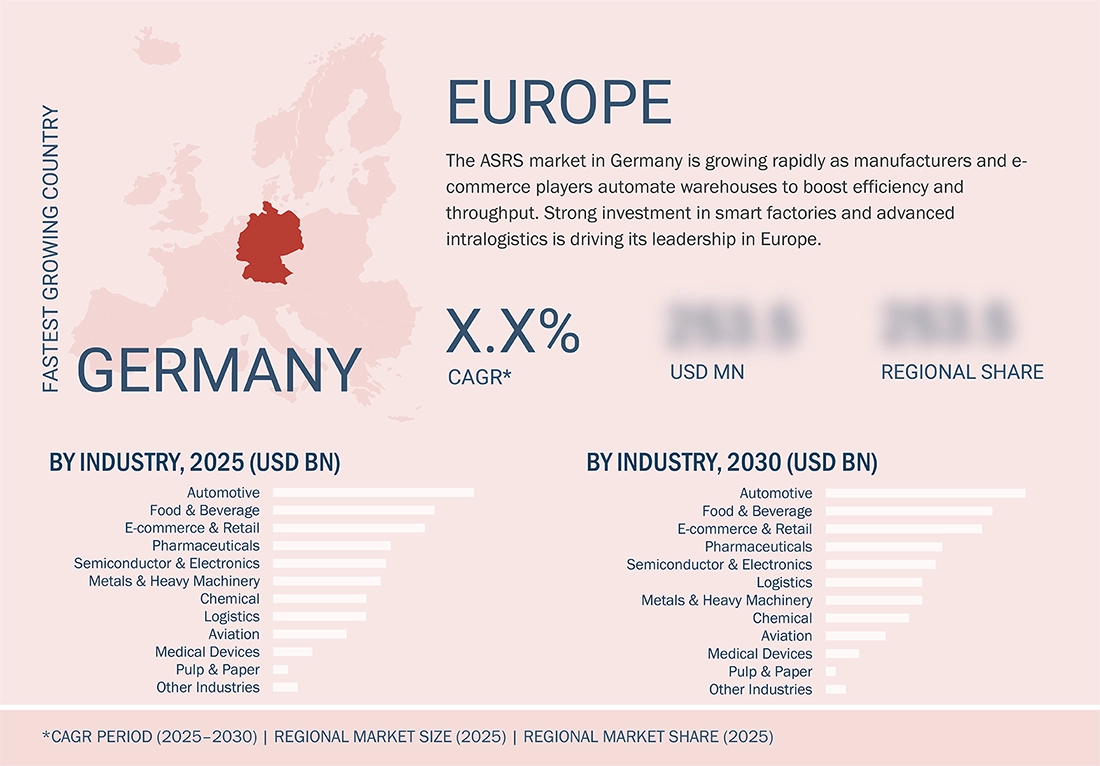
Germany is projected to lead the Europe automated storage and retrieval system market during the forecast period
Germany is poised to lead the Europe ASRS market due to its robust manufacturing base, advanced adoption of industrial automation, and high concentration of automotive and engineering facilities. The country’s emphasis on Industry 4.0 and smart factory modernization is accelerating large-scale investments in automated storage solutions. Additionally, Germany’s mature logistics network and growing e-commerce footprint further strengthen its position as the dominant ASRS market in the region.
EUROPE AUTOMATED STORAGE AND RETRIEVAL SYSTEM MARKET: COMPANY EVALUATION MATRIX
In the Europe ASRS market matrix, Daifuku maintains a strong leadership position supported by its broad automation portfolio, proven system reliability, and deep integration across high-demand sectors such as automotive, food & beverage, and industrial manufacturing. The company’s longstanding presence and continued investment in scalable, high-density ASRS technologies solidify its dominance across mature Europe logistics hubs. Meanwhile, Kardex, positioned as an emerging leader, is expanding its market influence through compact, software-enabled storage solutions and strong traction in e-commerce, retail, and pharmaceutical intralogistics.
Source: Secondary Research, Interviews with Experts, MarketsandMarkets Analysis
KEY MARKET PLAYERS
- Daifuku Co., Ltd. (Japan)
- Murata Machinery, Ltd. (Japan)
- SSI SCHAEFER (Germany)
- TGW Logistics Group (Austria)
- Kardex (Switzerland)
- BEUMER Group (Germany)
- Honeywell International Inc. (US)
- KION GROUP AG (Germany)
- KNAPP AG (Austria)
- KUKA AG (Germany)
MARKET SCOPE
| REPORT METRIC | DETAILS |
|---|---|
| Market Size in 2024 (Value) | USD 2.29 Billion |
| Market Forecast in 2030 (Value) | USD 3.46 Billion |
| Growth Rate | CAGR of 7.4% from 2025–2030 |
| Years Considered | 2021–2030 |
| Base Year | 2024 |
| Forecast Period | 2025–2030 |
| Units Considered | Value (USD Million/Billion), Volume (Thousand Units) |
| Report Coverage | Revenue Forecast, Company Ranking, Competitive Landscape, Growth Factors, and Trends |
| Segments Covered |
|
| Regional Scope | Europe (Germany, UK, France, Italy, Spain, the Netherlands, Poland, Nordic Countries, and the Rest of Europe |
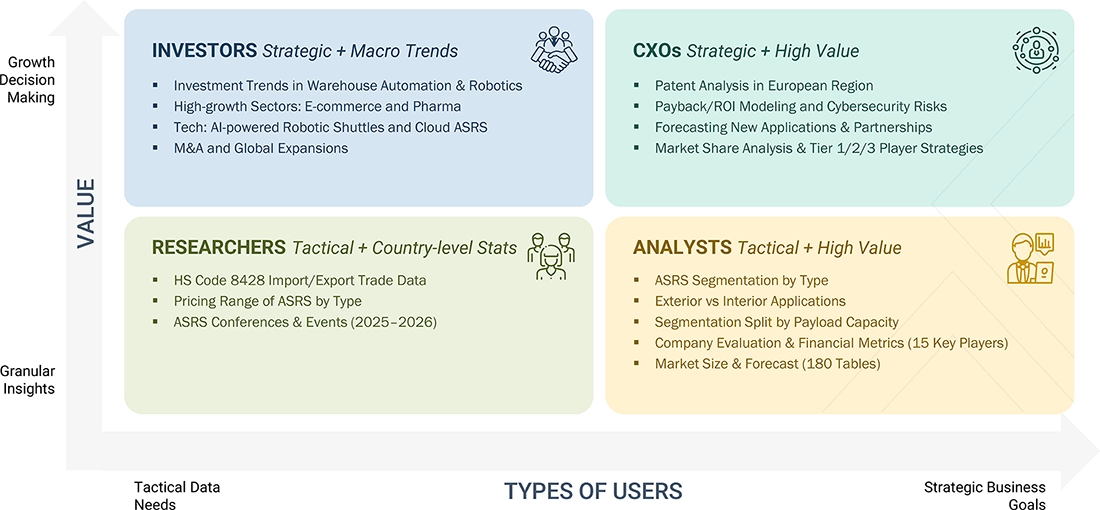
WHAT IS IN IT FOR YOU: EUROPE AUTOMATED STORAGE AND RETRIEVAL SYSTEM MARKET REPORT CONTENT GUIDE
DELIVERED CUSTOMIZATIONS
We have successfully delivered the following deep-dive customizations:
| CLIENT REQUEST | CUSTOMIZATION DELIVERED | VALUE ADDS |
|---|---|---|
| Assessment of ASRS Adoption Barriers in Europe |
|
|
| ASRS Vendor Shortlisting for Large European Distribution Center |
|
|
| Warehouse Digitalization & Robotics Integration Study |
|
|
| ASRS Cost & ROI Modeling for European Facilities |
|
|
| Country-level Regulatory & Infrastructure Impact Analysis |
|
|
RECENT DEVELOPMENTS
- November 2025 : Dematic was selected by Maria Middelares to implement the first AutoStore system for the Belgian healthcare sector. The high-density robotic storage solution will support logistics operations across multiple hospitals and medical centers, targeting a 30% efficiency improvement and enabling centralized pharmaceutical and supplies management.
- September 2025 : SSI SCHAEFER extended its long-term partnership with BD Rowa to enhance healthcare automation across Europe. The renewed agreement, which has been active since 2015 and is now extendable to 2030, integrates BD Rowa’s Vmax dispensing robot and EasyLoad system with SSI SCHAEFER’s scalable order-buffer technologies and WAMAS software, delivering high-throughput, fully traceable pharmaceutical storage and fulfillment.
- April 2024 : TGW Logistics and OPEX Corporation formed a strategic partnership to co-develop and optimize the Infinity AS/RS technology for European and US markets. TGW will incorporate the enhanced Infinity system into its LivePick solution, enabling next-generation, high-density automated order fulfillment capabilities.
- January 2023 : DHL Supply Chain launched one of Germany’s largest fully automated robotic fulfillment centers using an AutoStore system supplied by Element Logic. Located in Staufenberg, the installation features 160 robots across 6,000 m² to support Peek & Cloppenburg Düsseldorf’s e-commerce operations with faster order processing and enhanced inventory control.
Table of Contents
 Exclusive indicates content/data unique to MarketsandMarkets and not available with any competitors.
Methodology
The study involved four major activities in estimating the current size of the Europe Automated Storage and Retrieval System Market. Exhaustive secondary research has been done to collect information on the market, peer market, and parent market. To validate these findings, assumptions, and sizing with industry experts across the value chain through primary research has been the next step. Both top-down and bottom-up approaches have been employed to estimate the complete market size. After that, market breakdown and data triangulation methods have been used to estimate the market size of segments and subsegments. Two sources of information—secondary and primary—have been used to identify and collect information for an extensive technical and commercial study of the Europe Automated Storage and Retrieval System Market.
Secondary Research
Various secondary sources have been referred to in the secondary research process to identify and collect information important for this study. The secondary sources include annual reports, press releases, and investor presentations of companies; white papers; journals and certified publications; and articles from recognized authors, websites, directories, and databases. Secondary research has been conducted to obtain key information about the industry’s supply chain, the market’s value chain, the total pool of key players, market segmentation according to the industry trends (to the bottom-most level), regional markets, and key developments from market- and technology-oriented perspectives. The secondary data has been collected and analyzed to determine the overall market size, further validated by primary research..
Primary Research
Extensive primary research was conducted after gaining knowledge about the current scenario of the Europe Automated Storage and Retrieval System Market through secondary research. Several primary interviews were conducted with experts from the demand and supply sides across Europe. This primary data was collected through questionnaires, emails, and telephonic interviews.
Market Size Estimation
Both top-down and bottom-up approaches have been used to estimate and validate the total size of the Europe Automated Storage and Retrieval System Market. These methods have also been used extensively to estimate the size of various subsegments in the market. The following research methodology has been used to estimate the market size:
- Major players in the industry and markets have been identified through extensive secondary research.
- The industry’s value chain and market size (in terms of value) have been determined through primary and secondary research processes.
- All percentage shares, splits, and breakdowns have been determined using secondary sources and verified through primary sources.
Automated Storage and Retrieval System Market : Top-Down and Bottom-Up Approach
Data Triangulation
After arriving at the overall size of the Europe Automated Storage and Retrieval System Market from the market size estimation process explained above, the total market has been split into several segments and subsegments. Data triangulation and market breakdown procedures have been employed, wherever applicable, to complete the overall market engineering process and arrive at the exact statistics for all segments and subsegments of the market. The data has been triangulated by studying various factors and trends from both the demand and supply sides. Along with this, the market size has been validated using both top-down and bottom-up approaches.
Market Definition
The Automated Storage and Retrieval System Market develops, produces, and implements sophisticated systems to automate the storage and retrieval of goods in industrial, commercial, and logistics environments. Unit-load, mini-load, vertical lift modules (VLM), carousels, and Mid load ASRS solutions include automated storage & retrieval systems with the latest technologies of robotics, machine learning, and advanced sensors for optimized storage density, increased retrieval speed, and minimum human intervention. With the growing trend of Industry 4.0, an increasing focus on efficient inventory management, and a rapidly growing trend toward automation to minimize operational costs, ASRS has become an essential component of modern warehousing, manufacturing, and supply chain operations that support higher productivity and accuracy in material handling processes.
Key Stakeholders
- Associations, forums, and alliances related to automated storage and retrieval systems
- Assembly and packaging vendors
- Electronic hardware equipment manufacturers
- Companies from verticals such as automotive, chemicals, aviation, semiconductor & electronics, e-commerce, retail, food & beverages, healthcare, and metals & heavy machinery
- Integrated device manufacturers (IDMs)
- Original device manufacturers (ODMs)
- Original equipment manufacturers (OEMs)
- Original technology designers and suppliers
- Raw material suppliers
- Research institutes and organizations
- Standard organizations and regulatory authorities related to the material-handling industry
- System integrators
Report Objectives
- To define, describe, and forecast the Europe Automated Storage and Retrieval System Market , in terms of value, by type, payload capacity, industry, and region.
- To provide detailed information regarding the major factors influencing the growth of the market, namely, drivers, restraints, opportunities, and challenges.
- To strategically analyze micromarkets with respect to individual growth trends, prospects, and contributions to the total market.
- To analyze the probable impact of the recession on the market in the future.
- To study the complete value chain of the automated storage & retrieval system ecosystem, along with market trends and use cases.
- To analyze opportunities in the market for stakeholders by identifying high-growth segments of the market.
- To strategically profile key players and comprehensively analyze their core competencies along with detailing the competitive landscape for market leaders.
- To analyze competitive developments such as product launches, acquisitions, partnerships, and expansions in the Europe Automated Storage and Retrieval System Market.
- To benchmark market players using the company evaluation quadrant, which analyzes players based on various parameters within broad business categories and product strategies.
Available Customizations
With the given market data, MarketsandMarkets offers customizations according to the company’s specific needs. The following customization options are available for the report:
Company Information
- Detailed analysis and profiling of additional market players (up to 5)
Key Questions Addressed by the Report
What is the projected market value of the Europe Automated Storage and Retrieval System market by 2030?
The Europe Automated Storage and Retrieval System market is projected to reach USD 3.46 billion by 2030, growing from USD 2.42 billion in 2025 at a CAGR of 7.4%.
Which country dominates the Europe ASRS market in terms of value?
Germany is expected to dominate the Europe ASRS market, accounting for approximately 32.9% share in 2025 due to strong industrial and logistics infrastructure.
What are the key segments considered in the Europe ASRS market?
The market is segmented by type (including unit load, mini load, mid load, vertical lift module, and carousels) and by payload capacity such as less than 500 kg, 500–1,500 kg, and more than 1,500 kg.
Which segment is expected to witness significant growth in the Europe ASRS market?
The vertical lift module segment is expected to witness strong growth during the forecast period due to increasing demand for space-efficient automated storage solutions.
Who are the key players operating in the Europe Automated Storage and Retrieval System market?
Key players in the Europe ASRS market include Daifuku Co., Ltd., SSI SCHAEFER, TGW Logistics Group GmbH, Honeywell International Inc., Jungheinrich AG, and KNAPP AG, reflecting a competitive and innovation-driven landscape.


Personalize This Research
- Triangulate with your Own Data
- Get Data as per your Format and Definition
- Gain a Deeper Dive on a Specific Application, Geography, Customer or Competitor
- Any level of Personalization
Let Us Help You
- What are the Known and Unknown Adjacencies Impacting the Europe Automated Storage and Retrieval System Market
- What will your New Revenue Sources be?
- Who will be your Top Customer; what will make them switch?
- Defend your Market Share or Win Competitors
- Get a Scorecard for Target Partners

Custom Market Research Services
We Will Customise The Research For You, In Case The Report Listed Above Does Not Meet With Your Requirements
Get 10% Free CustomisationTESTIMONIALS

Tetsuya Ohhira
Business Development Manager-Technology Business
Nikon Corporation,
Leading Japanese MNC specializing in optics and imaging productswww.nikon.com
MarketsandMarkets™ response
is quick. Their attitude is flexible and positive. Analyst Insights are globally considered and
significant. Client Services quickly respond to our inquiry and demand. Their wide range of global
surveys help us make our strategic plan.
We hope Knowledge Store will be easier to search
for a report.
VP - Marketing & Business Development
Leading Provider of Process Control Solutions
We engaged with MarketsandMarkets on a study to perform an analysis and recommend a Go-To-Market strategy for metrology and process control in the semiconductor market. The study was tailored to our targets and needs with well-defined milestones. Our overall experience with the MarketsandMarkets team was very good throughout the project in all aspects including the analysis methodologies used, the quality and depth of primary and secondary data sets, the professionalism and flexibility of the team and the ability to meet the target schedule and milestones. We want to thank MarketsandMarkets team for a job well done.
Growth opportunities and latent adjacency in Europe Automated Storage and Retrieval System Market






Edward
Apr, 2026
As ASRS adoption rises across automotive, logistics, and pharmaceuticals, which sector do you think will see the fastest ROI from automation investments.
Calvin
Apr, 2026
How do you see smart warehouse investments reshaping customer expectations in terms of delivery speed, accuracy, and cost efficiency?.