Europe Hyperspectral Imaging Systems Market

Europe Hyperspectral Imaging Systems Market by Offering (Cameras, Services), Technology (Pushbroom, Snapshot, Tunable Filter, Imaging FTIR, Whiskbroom), Wavelength (Visible & NIR, SWIR, MWIR, LWIR), and Country - Forecast to 2030




OVERVIEW
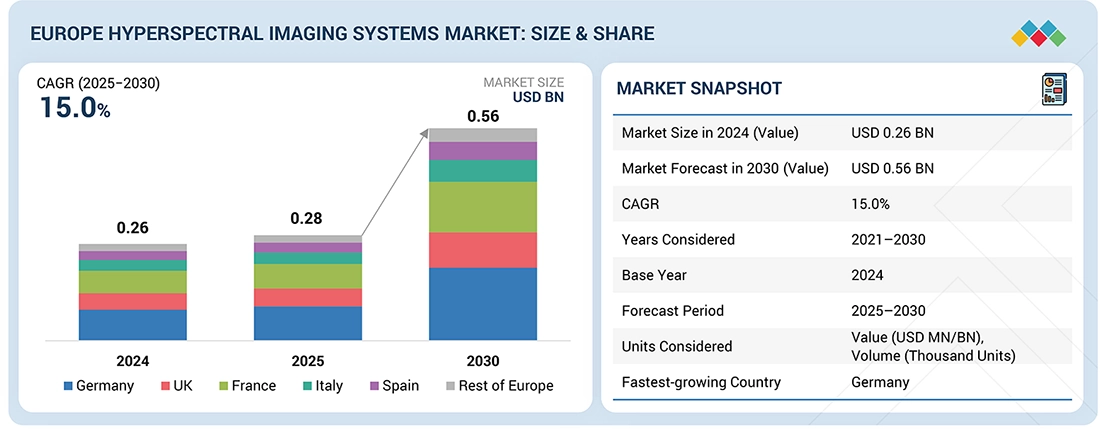
Source: Secondary Research, Interviews with Experts, MarketsandMarkets Analysis
The Europe hyperspectral imaging systems market is expected to be valued at USD 0.28 billion in 2025 and USD 0.56 billion by 2030, growing at a CAGR of 15.0% from 2025 to 2030. The growth is due to the demand for high-resolution, multi-sector imaging in defense, medical diagnostics, agriculture and remote sensing is rising across Europe. This is supported by advances in AI-enabled sensors and miniaturization that expand use cases and lower barriers to adoption.
Market Size & Forecast
KEY TAKEAWAYS
-
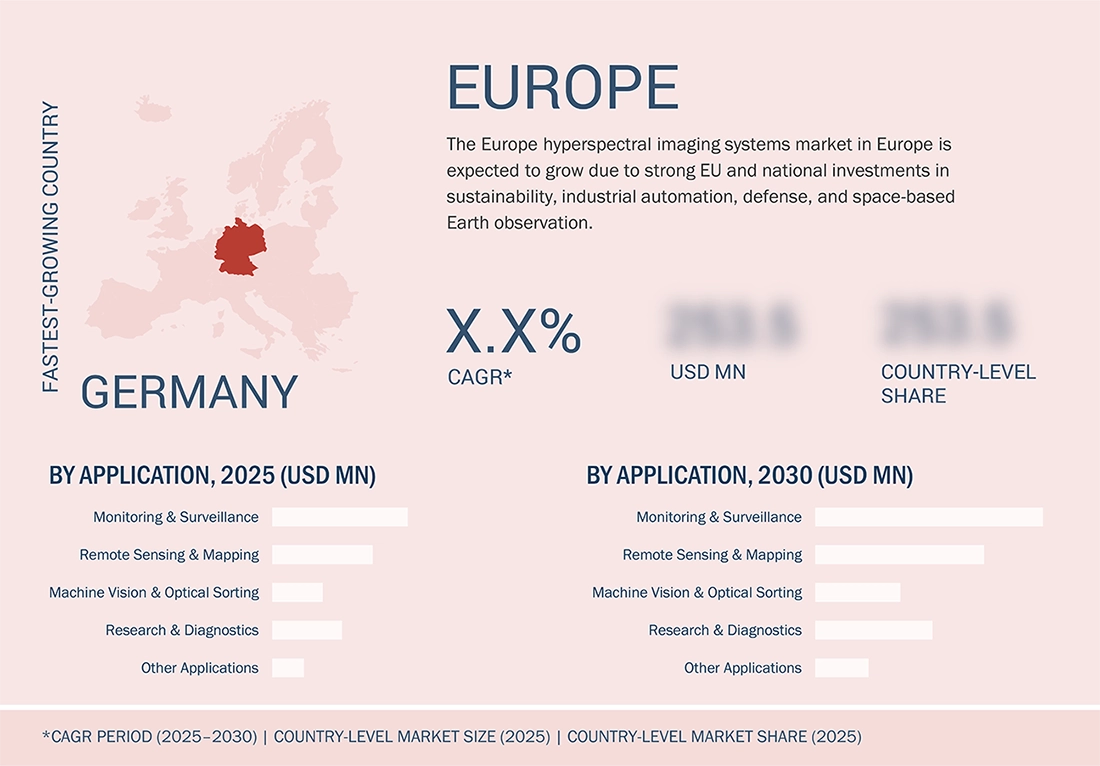
BY COUNTRYGermany is expected to dominate the Europe hyperspectral imaging systems market, with a share of ~31-34% in terms of value in 2025.
-
BY WAVELENGTHBy wavelength, the visible & NIR segment is expected to register the highest CAGR of ~9–13% during the forecast period.
-
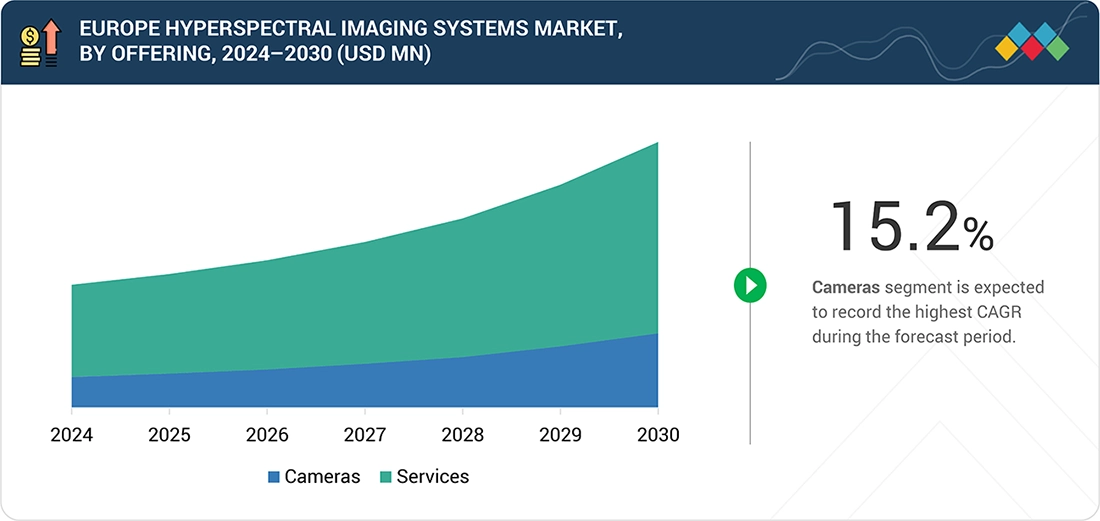
BY OFFERINGBy offering, the cameras segment is expected to register the highest CAGR of ~10% to 14% during the forecast period.
-
BY TECHNOLOGYBy technology, the pushboom/line scan segment to dominate the market during the forecast period.
-
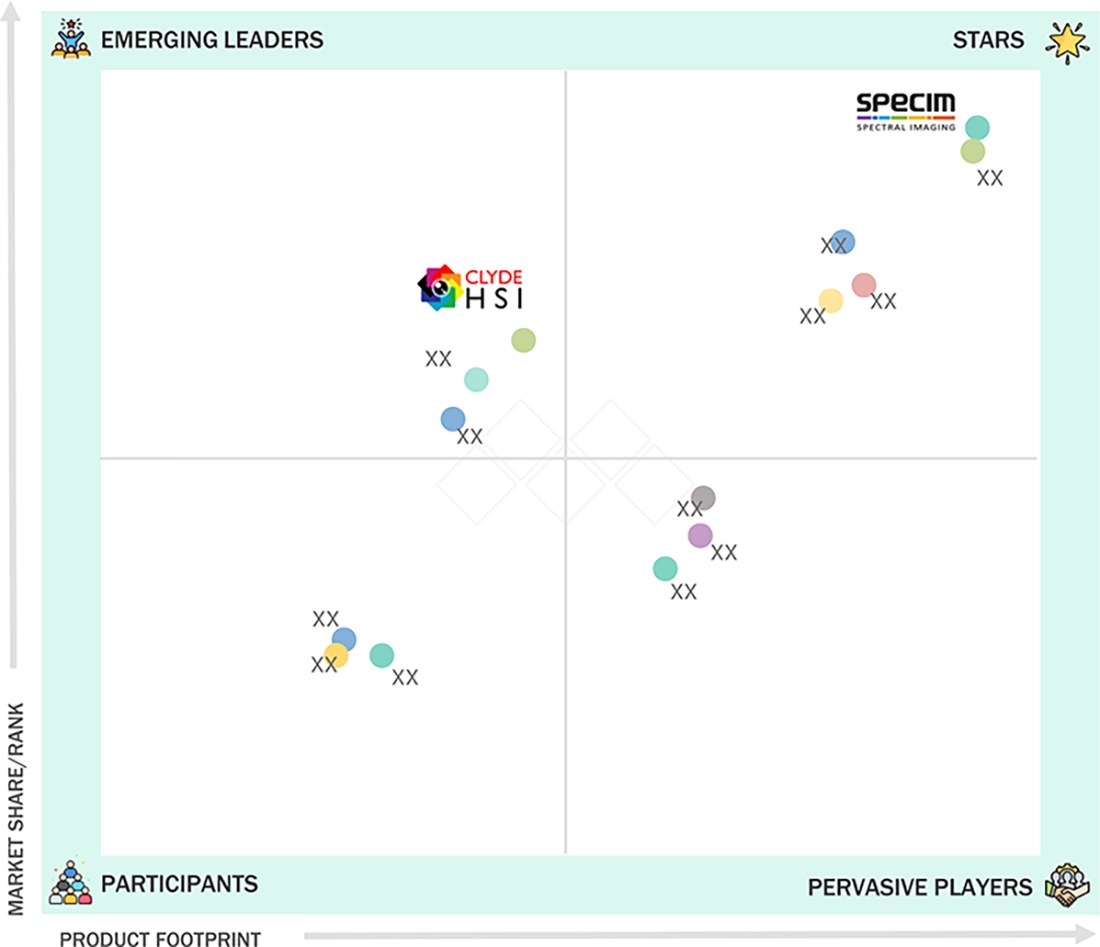
COMPETITIVE LANDSCAPE (KEY PLAYERS)Specim, Spectral Imaging Ltd, imec, XIMEA GmbH were identified as star players in the Europe hyperspectral imaging systems market due to their strong market share and extensive product footprint.
-
COMPETITIVE LANDSCAPE (STARTUPS/SMES)ClydeHSI has distinguished themselves among startups and SMEs by securing strong footholds in specialized niche areas, underscoring their potential as emerging market leaders in the Europe hyperspectral imaging systems market.
The Europe hyperspectral imaging systems market will expand as governments and enterprises increase investments in advanced sensing and imaging technologies for defense, agriculture, environmental monitoring, and industrial inspection, which require detailed spectral analysis and high data accuracy. Growing adoption of precision agriculture, remote sensing, and quality control applications, along with rising integration of hyperspectral cameras with AI and machine learning platforms, is strengthening demand. Continuous product innovations and strategic collaborations by players such as Headwall Photonics, Specim, and Resonon, including new sensor launches and partnerships with system integrators and research institutions, are further reinforcing sustained market growth.
TRENDS & DISRUPTIONS IMPACTING CUSTOMERS' CUSTOMERS
In Europe, customers in the hyperspectral imaging systems market are witnessing accelerated technological evolution reshaping adoption across industrial, environmental, and research-driven applications. Advances in sensor miniaturization, higher spectral fidelity, and improved system integration are enabling European manufacturers to deliver compact, high-precision hyperspectral solutions for food quality inspection, pharmaceuticals, industrial automation, defense, and environmental monitoring. The growing integration of AI and ML into hyperspectral data processing is improving real-time analytics, defect detection, and material classification, supporting broader commercialization. In parallel, strong public funding, ESA-led Earth observation programs, and CubeSat-based hyperspectral missions across the EU are enhancing data accessibility and affordability, while increasing use in healthcare, precision agriculture, and sustainability initiatives is driving demand for portable, application-specific hyperspectral systems.
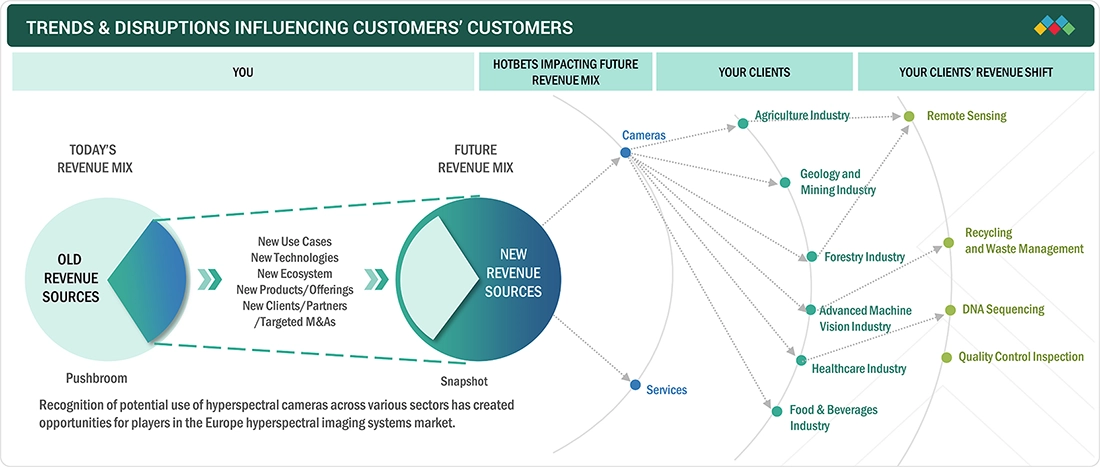
Source: Secondary Research, Interviews with Experts, MarketsandMarkets Analysis
MARKET DYNAMICS

Level
-
Strong demand for hyperspectral imaging systems in end-use industries, including agriculture

-
Increasing adoption of cost-effective, portable, and user-friendly hyperspectral imaging solutions


Level
-
Requirement for specialized technical expertise to manage hyperspectral imaging technologies

-
Absence of harmonized standards for hyperspectral data formats and processing methodologies


Level
-
Ongoing miniaturization of hyperspectral sensors

-
Growing collaborations and R&D partnerships among industry players, research institutes, and public agencies


Level
-
Efficient management, storage, and processing of large hyperspectral datasets and high-resolution imagery within European operational and regulatory frameworks

Source: Secondary Research, Interviews with Experts, MarketsandMarkets Analysis
Driver: Strong demand for hyperspectral imaging systems in end-use industries, including agriculture
In Europe, the growing adoption of hyperspectral imaging across precision agriculture, food quality inspection, pharmaceuticals, environmental monitoring, defense, and industrial automation drives the market. Strong support from EU-funded research programs, sustainability initiatives, and space-based Earth observation projects is accelerating deployment across commercial and public sectors. The focus on traceability, regulatory compliance, and advanced quality assurance is increasing the demand for accurate material identification, contamination detection, and non-destructive inspection, supporting sustained uptake of hyperspectral imaging systems.
Restraint: Requirement for specialized technical expertise to manage hyperspectral imaging technologies
The Europe hyperspectral imaging market faces challenges related to the complexity of data processing and interpretation, which requires expertise in spectral analytics, imaging physics, and AI-based data modeling. While Europe has a strong academic and research base, translating research-grade systems into scalable industrial solutions remains resource-intensive. Limited availability of application-specific talent and the need for customized integration and training can increase deployment costs and slow adoption, particularly among SMEs and cost-sensitive end users.
Opportunity: Growing collaborations and R&D partnerships among industry players, research institutes, and public agencies
In Europe, increasing collaboration among hyperspectral camera manufacturers, software developers, research institutes, space agencies, and system integrators is creating strong opportunities for market expansion. Cross-border partnerships supported by EU frameworks and ESA programs are enabling the co-development of application-specific solutions for agriculture, environmental monitoring, industrial inspection, and healthcare. These collaborations help combine optical engineering, AI-driven analytics, and domain expertise, accelerating commercialization, pilot deployments, and adoption across both public and private sectors.
Challenge: Efficient management, storage, and processing of large hyperspectral datasets and high-resolution imagery within European operational and regulatory frameworks
The expanding deployment of hyperspectral imaging systems in Europe is generating large volumes of high-resolution spectral data, creating challenges related to storage, processing, and long-term data management. Handling these datasets requires scalable cloud infrastructure, high-performance computing, and advanced analytics platforms, which can increase system complexity and cost. In addition, strict data protection, interoperability, and compliance requirements across EU member states add further complexity, reinforcing the need for secure, standardized, and scalable data management solutions.
EUROPE HYPERSPECTRAL IMAGING SYSTEMS MARKET: COMMERCIAL USE CASES ACROSS INDUSTRIES
| COMPANY | USE CASE DESCRIPTION | BENEFITS |
|---|---|---|
 |
Designs and manufactures hyperspectral cameras and systems across VNIR, SWIR, and LWIR bands for industrial inspection, food quality analysis, pharmaceuticals, environmental monitoring, and airborne applications | High spectral accuracy and robustness | Precise material identification | Contamination detection | Quality assurance across industrial and research environments |
 |
Develops snapshot hyperspectral cameras and turnkey systems for real-time industrial inspection, defense, environmental monitoring, and UAV-based imaging applications | Real-time hyperspectral capture | Faster decision-making | Compact system integration | Deployment in dynamic and mobile use cases |
 |
Provides advanced hyperspectral sensor and camera technologies based on semiconductor and nano-optics innovation for industrial, medical, and Earth observation applications | Chip-level spectral integration enables compact form factors | Scalable manufacturing | Cost-efficient deployment of hyperspectral solutions |
Logos and trademarks shown above are the property of their respective owners. Their use here is for informational and illustrative purposes only.
MARKET ECOSYSTEM
The Europe hyperspectral imaging systems market ecosystem comprises hardware providers, software providers, and end users, delivering advanced spectral imaging solutions across defense, space, precision agriculture, environmental monitoring, healthcare, and industrial quality inspection. Market is driven by strong adoption through EU-funded research programs, ESA-led Earth observation missions, and sustainability initiatives, supported by long-term collaborations and pilot deployments. Continuous product innovation and strategic partnerships among regional players, such as Specim, Cubert, and imec, are enabling scalable commercialization and broader adoption of hyperspectral imaging systems across Europe.
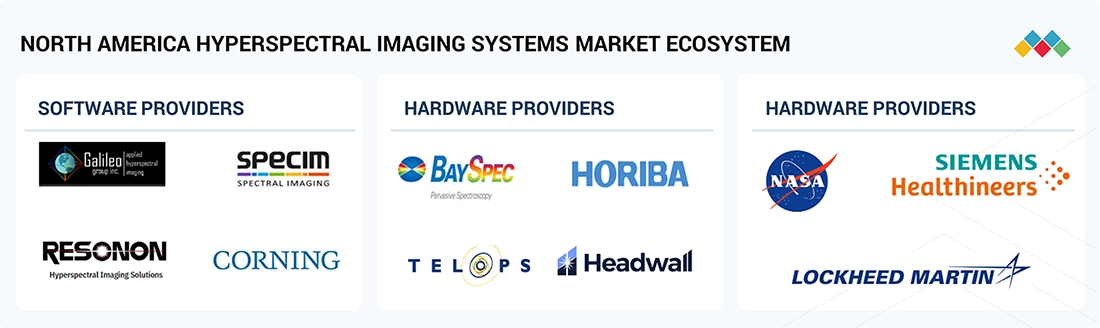
Logos and trademarks shown above are the property of their respective owners. Their use here is for informational and illustrative purposes only.
MARKET SEGMENTS
Source: Secondary Research, Interviews with Experts, MarketsandMarkets Analysis
Europe Hyperspectral Imaging Systems Market, by Wavelength
Strong demand for visible-NIR and SWIR hyperspectral systems in Europe is driven by their extensive use in precision agriculture, food quality inspection, environmental monitoring, defense surveillance, and industrial quality control. Continuous improvements in sensor sensitivity, optics, and spectral accuracy, supported by EU research funding and declining component costs, are enhancing system performance and expanding adoption across both public and commercial end users.
Europe Hyperspectral Imaging Systems Market, by Offering
Rising adoption of hyperspectral cameras across agriculture, pharmaceuticals, recycling, healthcare research, and industrial automation is supporting market growth in Europe. Advances in camera miniaturization, integration with AI-based analytics, and increased availability of application-specific systems are enabling wider deployment across enterprises, research institutions, and pilot programs, accelerating commercialization across the region.
Europe Hyperspectral Imaging Systems Market, by Technology
Pushbroom (line-scan) technology is expected to account for a significant share of the Europe hyperspectral imaging systems market due to its high spectral resolution, efficient data acquisition, and suitability for industrial inspection, airborne sensing, and environmental monitoring. Its ability to deliver consistent, high-quality spectral data over large areas, combined with proven reliability and compatibility with automation workflows, is driving strong adoption across industrial, research, and government applications.
REGION
Germany to be fastest-growing country in Europe hyperspectral Imaging systems market during forecast period
Germany is expected to be the fastest growing country in the Europe hyperspectral imaging systems market due to strong government and EU-level investments in industrial digitization, defense modernization, space programs, and environmental monitoring. Growth is further supported by robust adoption across precision manufacturing, automotive quality inspection, agriculture, and research applications, along with the presence of advanced domestic players such as Cubert GmbH and strong research-led innovation ecosystems. Increasing collaborations with ESA, Fraunhofer institutes, and industrial partners on hyperspectral payloads, industrial inspection platforms, and remote sensing programs are accelerating commercialization and deployment across the country.
EUROPE HYPERSPECTRAL IMAGING SYSTEMS MARKET: COMPANY EVALUATION MATRIX
In the Europe hyperspectral imaging systems market matrix, Specim, Spectral Imaging Ltd. (Star) leads due to its strong capabilities in hyperspectral camera design and spectral imaging technologies across VNIR, SWIR, and LWIR bands, supported by a broad product portfolio serving industrial inspection, food quality analysis, environmental monitoring, defense, and space applications. ClydeHSI (Emerging Leader) is gaining traction through its application-driven hyperspectral imaging systems and analytics, particularly for environmental monitoring, industrial analysis, and research-focused deployments, supported by growing partnerships with European research organizations. While Specim maintains leadership through scale, technology depth, and ecosystem reach, ClydeHSI’s focused innovation and expanding collaborations position it to move closer to the leaders’ quadrant as demand for high-resolution spectral imaging and advanced analytics accelerates across Europe.
Source: Secondary Research, Interviews with Experts, MarketsandMarkets Analysis
KEY MARKET PLAYERS
- Corning Incorporated (US)
- Specim, Spectral Imaging Ltd. (Finland)
- HORIBA (Japan)
- Resonon (US)
- Bayspec (US)
- Imec (Belgium)
- Headwall Photonics (US)
- Gamaya (Switzerland)
- Diaspective Vision (Germany)
- Photon etc (Canada)
- ClydeHSI (UK)
- Norsk Electro Optikk (Norway)
MARKET SCOPE
| REPORT METRIC | DETAILS |
|---|---|
| Market Size in 2024 (Value) | USD 0.26 Billion |
| Market Forecast in 2030 (Value) | USD 0.56 Billion |
| Growth Rate | CAGR of 15.0% from 2025–2030 |
| Years Considered | 2021–2030 |
| Base Year | 2024 |
| Forecast Period | 2025–2030 |
| Units Considered | Value (USD Million/Billion), Volume (Thousand Units) |
| Report Coverage | Revenue Forecast, Company Ranking, Competitive Landscape, Growth Factors, and Trends |
| Segments Covered |
|
| Countries Covered | Germany, the UK, France, Italy, Spain, Rest of Europe |
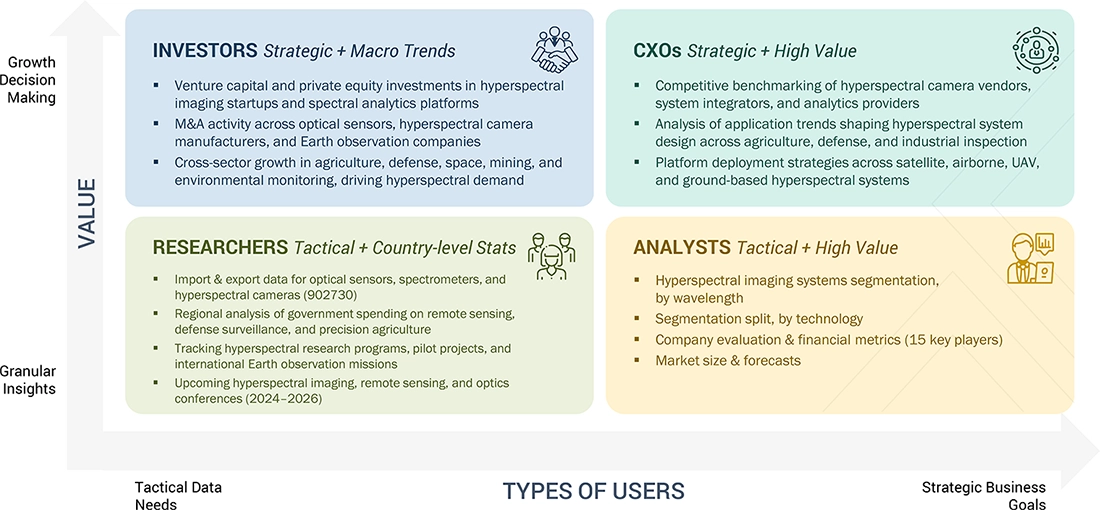
WHAT IS IN IT FOR YOU: EUROPE HYPERSPECTRAL IMAGING SYSTEMS MARKET REPORT CONTENT GUIDE
DELIVERED CUSTOMIZATIONS
We have successfully delivered the following deep-dive customizations:
| CLIENT REQUEST | CUSTOMIZATION DELIVERED | VALUE ADDS |
|---|---|---|
| Hyperspectral Imaging System Provider |
|
|
| Imaging Hardware Manufacturer |
|
|
| Software Analytics Provider |
|
|
| Defense / Space Organization |
|
|
RECENT DEVELOPMENTS
- March 2025 : Cubert GmbH announced new snapshot hyperspectral imaging solutions tailored for UAV and real-time industrial inspection use cases, supporting faster deployment across defense, environmental monitoring, and smart manufacturing applications in Europe.
- February 2025 : Specim, Spectral Imaging Ltd. expanded its hyperspectral camera portfolio with enhanced VNIR and SWIR systems optimized for industrial inspection and food quality analysis, strengthening its position across European manufacturing and agri-food markets.
Table of Contents
 Exclusive indicates content/data unique to MarketsandMarkets and not available with any competitors.
Methodology
The study involved four major activities in estimating the current size of the europe hyperspectral imaging systems market. Exhaustive secondary research collected information on the market, peer, and parent markets. The next step was to validate these findings, assumptions, and sizing with industry experts across the value chain through primary research. Both top-down and bottom-up approaches were employed to estimate the complete market size. After that, market breakdown and data triangulation were used to estimate the market size of segments and subsegments.
Secondary Research
Various secondary sources have been referred to in the secondary research process to identify and collect information important for this study. The secondary sources include annual reports, press releases, and investor presentations of companies; white papers; journals and certified publications; and articles from recognized authors, websites, directories, and databases. Secondary research has been conducted to obtain key information about the industry’s supply chain, the market’s value chain, the total pool of key players, market segmentation according to the industry trends (to the bottom-most level), regional markets, and key developments from market- and technology-oriented perspectives. The secondary data has been collected and analyzed to determine the overall market size, further validated by primary research.
List of major secondary sources
|
Sources |
Web Link |
|
Company Blogs |
What is hyperspectral Imaging?: A Comprehensive Guide - Specim Spectral Imaging |
|
Industry Journals |
|
|
Environmental Protection Agency |
Primary Research
Extensive primary research was conducted after gaining knowledge about the current scenario of the europe hyperspectral imaging systems market through secondary research. Several primary interviews were conducted with experts from both the demand and supply sides across four major regions—North America, Europe, Asia Pacific and RoW. This primary data was collected through questionnaires, emails, and telephonic interviews.
Market Size Estimation
In the complete market engineering process, both top-down and bottom-up approaches have been used, along with several data triangulation methods, to perform market estimation and forecasting for the overall market segments and subsegments listed in this report. Key players in the market have been identified through secondary research, and their market shares in the respective regions have been determined through primary and secondary research. This entire procedure includes the study of annual and financial reports of the top market players and extensive interviews for key insights (quantitative and qualitative) with industry experts (CEOs, VPs, directors, and marketing executives).
All percentage shares, splits, and breakdowns have been determined using secondary sources and verified through primary sources. All the parameters affecting the markets covered in this research study have been accounted for, viewed in detail, verified through primary research, and analyzed to obtain the final quantitative and qualitative data. This data has been consolidated and supplemented with detailed inputs and analysis from MarketsandMarkets and presented in this report. The following figure represents this study’s overall market size estimation process.
Bottom-Up Approach
- Identifying various wavelengths using europe hyperspectral imaging systems
- Analyzing the penetration of each type of wavelength through secondary and primary research
- Analyzing the penetration of europe hyperspectral imaging systems based on different applications and technologies through secondary and primary research
- Conducting multiple discussion sessions with key opinion leaders to understand the detailed working of europe hyperspectral imaging systems and their implementation in numerous applications; this helped analyze the break-up of the scope of work carried out by each major company
- Verifying and cross-checking the estimates at every level with key opinion leaders, including CEOs, directors, operation managers, and finally with MarketsandMarkets domain experts
- Studying various paid and unpaid sources of information, such as annual reports, press releases, white papers, and databases
Top-Down Approach
- Focusing initially on the top-line investments and expenditures being made in the ecosystem of the europe hyperspectral imaging systems market; further, splitting the key market areas based on product type, technology, wavelength, application, and region, and listing the key developments.
- Identifying all leading players and applications in the europe hyperspectral imaging systems market based on region through secondary research and thoroughly verifying them through a brief discussion with industry experts
- Analyzing revenues, product mix, geographic presence, and critical applications served by all identified players to estimate and arrive at percentage splits for all key segments
- Discussing splits with the industry experts to validate the information and identify critical growth pockets across all key segments
- Breaking down the total market based on verified splits and critical growth pockets across all segments
Data Triangulation
After arriving at the overall market size from the estimation process explained in the previous section, the total market was split into several segments and subsegments. Where applicable, the data triangulation procedure was employed to complete the overall market engineering process and arrive at the exact statistics for all segments and subsegments. The data was triangulated by studying various factors and trends from the demand and supply sides, and the market size was validated using top-down and bottom-up approaches.
Market Definition
Hyperspectral imaging systems are utilized to capture specific spectral bands across a continuous spectrum. Hyperspectral imaging systems are advanced imaging technologies that capture and process information across a wide range of the electromagnetic spectrum. Unlike traditional imaging systems, which typically capture images in three spectral bands (red, green, and blue), europe hyperspectral imaging systems collect spectral data across hundreds or thousands of narrow contiguous bands. These systems consist of hyperspectral cameras along with their accompanying systems. They are widely used in fields such as agriculture, environmental monitoring, mining etc.
Key Stakeholders
- Hyperspectral imaging systems providers
- Original equipment manufacturers (OEMs)
- Research organisations and consulting firms
- Technology standards organisationa
- Raw material suppliers
- Allaince and associations related to hyperspectral imaging technology
- Technology solution providers and design contractors
- Electronics and semiconductor companies
- Technology standards organizations, forums, alliances, and associations
- Analysts and strategic business planners
- Associations, organizations, and alliances related to hyperspectral imaging technology
- Universities and research organizations
- Government bodies
Report Objectives
- To describe and forecast the europe hyperspectral imaging systems market by offering, technology, wavelength, application, and region.
- To forecast the market size for various segments concerning four key regions, namely, North America, Europe, Asia Pacific, and Rest of the World (RoW), in terms of value
- To provide detailed information regarding the major factors influencing the market growth (drivers, restraints, opportunities, and challenges).
- To forecast the size of the hyperspectral cameras deployed in the europe hyperspectral imaging systems market.
- To provide a detailed overview of the value chain of hyperspectral imaging system ecosystems, along with the average selling price for hyperspectral cameras and other systems
- To strategically profile key players and comprehensively analyze their position in the europe hyperspectral imaging systems market regarding their ranking and core competencies and detail the competitive landscape for market leaders.
- To strategically analyze the ecosystem, regulatory landscape, patent landscape, Porter’s five forces, import and export scenarios, tariff analysis, and case studies about the market under study.
- To analyze strategic developments, such as product launches, related developments, acquisitions, expansions, and agreements, in the market
Customization Options
With the given market data, MarketsandMarkets offers customizations according to the company’s specific needs. The following customization options are available for the report:
Company Information
- Detailed analysis and profiling of additional market players (up to five)
Geographic Analysis
- Further breakdown of regions into respective countries
Key Questions Addressed by the Report
What is the projected value of the Europe hyperspectral imaging systems market?
The Europe hyperspectral imaging systems market is projected to reach USD 0.56 billion by 2030 from USD 0.28 billion in 2025, growing at a CAGR of 15.0%.
Which country dominates the Europe hyperspectral imaging systems market?
Germany dominates the Europe hyperspectral imaging systems market, accounting for approximately 31–34% share in 2025.
Which offering segment leads the Europe hyperspectral imaging systems market?
The cameras segment is expected to lead the market and register strong growth due to increasing adoption across multiple industries.
Which technology segment dominates the market?
The pushbroom (line-scan) technology segment dominates the Europe hyperspectral imaging systems market due to its high spectral resolution and efficiency.
Who are the key players in the Europe hyperspectral imaging systems market?
Key players include Corning Incorporated, Specim, Spectral Imaging Ltd., HORIBA, Bayspec Inc., and Headwall Photonics.


Personalize This Research
- Triangulate with your Own Data
- Get Data as per your Format and Definition
- Gain a Deeper Dive on a Specific Application, Geography, Customer or Competitor
- Any level of Personalization
Let Us Help You
- What are the Known and Unknown Adjacencies Impacting the Europe Hyperspectral Imaging Systems Market
- What will your New Revenue Sources be?
- Who will be your Top Customer; what will make them switch?
- Defend your Market Share or Win Competitors
- Get a Scorecard for Target Partners

Custom Market Research Services
We Will Customise The Research For You, In Case The Report Listed Above Does Not Meet With Your Requirements
Get 10% Free CustomisationTESTIMONIALS

Tetsuya Ohhira
Business Development Manager-Technology Business
Nikon Corporation,
Leading Japanese MNC specializing in optics and imaging productswww.nikon.com
MarketsandMarkets™ response
is quick. Their attitude is flexible and positive. Analyst Insights are globally considered and
significant. Client Services quickly respond to our inquiry and demand. Their wide range of global
surveys help us make our strategic plan.
We hope Knowledge Store will be easier to search
for a report.
VP - Marketing & Business Development
Leading Provider of Process Control Solutions
We engaged with MarketsandMarkets on a study to perform an analysis and recommend a Go-To-Market strategy for metrology and process control in the semiconductor market. The study was tailored to our targets and needs with well-defined milestones. Our overall experience with the MarketsandMarkets team was very good throughout the project in all aspects including the analysis methodologies used, the quality and depth of primary and secondary data sets, the professionalism and flexibility of the team and the ability to meet the target schedule and milestones. We want to thank MarketsandMarkets team for a job well done.






Growth opportunities and latent adjacency in Europe Hyperspectral Imaging Systems Market