Europe IoT Market

Europe IoT Market by Connectivity (Cellular, LP-WAN, Satellite), Software (IoT Platforms, Application Software, Analytics Software, Security & Safety Software), Focus Areas (Smart Manufacturing, Smart Retail, Smart Healthcare) - Forecast to 2030




OVERVIEW
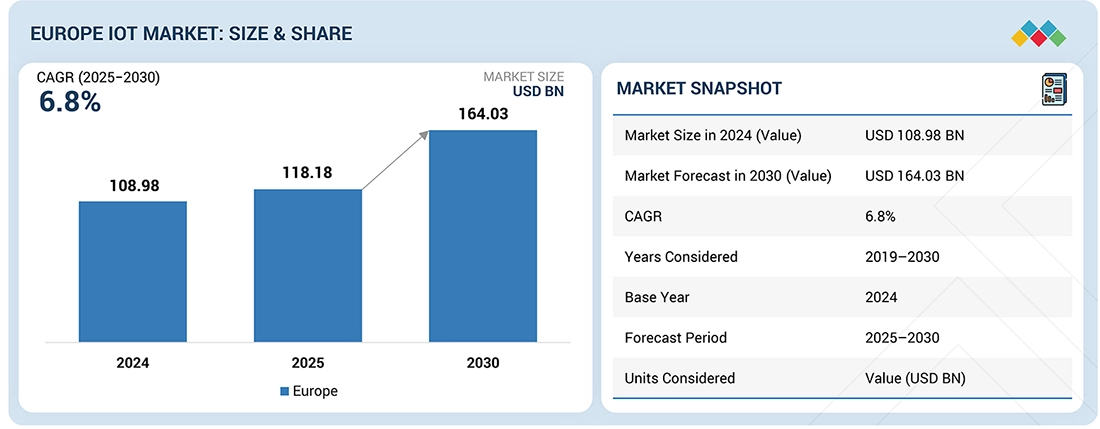
Source: Secondary Research, Interviews with Experts, MarketsandMarkets Analysis
The Europe IoT market is expected to grow from USD 118.18 billion in 2025 to USD 164.03 billion by 2030, at a CAGR of 6.8% during the forecast period. This growth is largely driven by a strong emphasis on energy efficiency and the digital transformation of factories, commonly referred to as Industry 4.0. Companies are increasingly installing smart sensors and edge computing hardware that process data locally. Additionally, they are utilizing 5G and low-power networks to ensure reliable connectivity. These innovative solutions enable businesses to reduce waste and automate manual tasks, transitioning the market from basic tracking systems to fully managed, secure systems that enhance productivity.
KEY TAKEAWAYS
-
By Module TypeBy module type, the services segment is expected to register the highest CAGR of 7.9% during the forecast period.
-
By HardwareBy hardware, the modules/sensors segment is projected to account for the largest market share in 2025.
-
By ConnectivityBy connectivity, the satellite segment is expected to be the fastest growing with a CAGR of 12.2% during the forecast period.
-
By SoftwareBy software, the IoT platforms segment is projected to hold the largest market share in 2025.
-
By ServicesBy service, the managed services segment is expected to be the fastest-growing with a CAGR of 8.3% during the forecast period.
-
By Focus AreasBy focus area, the smart manufacturing segment is projected to account for the largest market share in 2025.
-
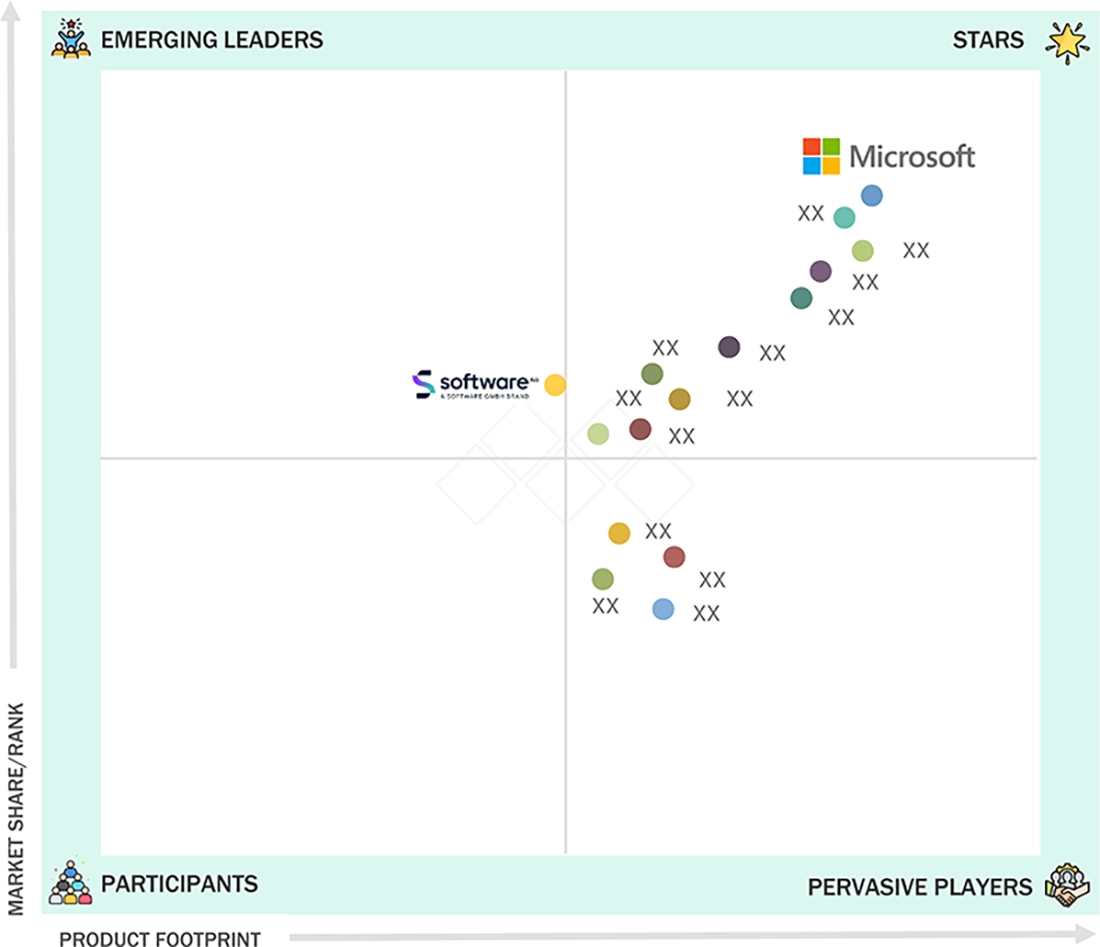
Competitive Landscape - Key PlayersCompanies like Cisco, AWS, Microsoft, Siemens, and Qualcomm were identified as some of the star players in the Europe IoT market, given their strong market share and product footprint.
-
Competitive Landscape - Startups/SMEsCompanies like HQSoftware and emnify, among others, have distinguished themselves among startups and SMEs by securing strong footholds in specialized niche areas, underscoring their potential as emerging market leaders.
The growth of IoT in Europe is significantly influenced by new cybersecurity laws and the swift advancement of smart city initiatives. Companies are focusing on creating secure hardware and on providing predictive maintenance services to anticipate machine failures. By integrating high-speed connectivity with smart data tools, these efforts enhance infrastructure resilience and enable industries to manage resources more effectively, ultimately reducing costs.
TRENDS & DISRUPTIONS IMPACTING CUSTOMERS' CUSTOMERS
The impact on consumers' businesses stems from customer trends and disruptions. Key sectors include manufacturing (IIoT), utilities, smart cities, healthcare devices, retail and logistics, automotive and transportation, agriculture, and commercial buildings. These sectors are increasingly adopting managed IoT platforms, connectivity solutions, edge computing, and device security services. Challenges such as fragmentation of standards and interoperability issues, growing device security and privacy regulations, supplier and silicon constraints, vendor consolidation, and the rise of vertical-specific platform providers are also significant factors in this landscape. Additionally, real-time analytics plays a crucial role in shaping consumer business strategies.
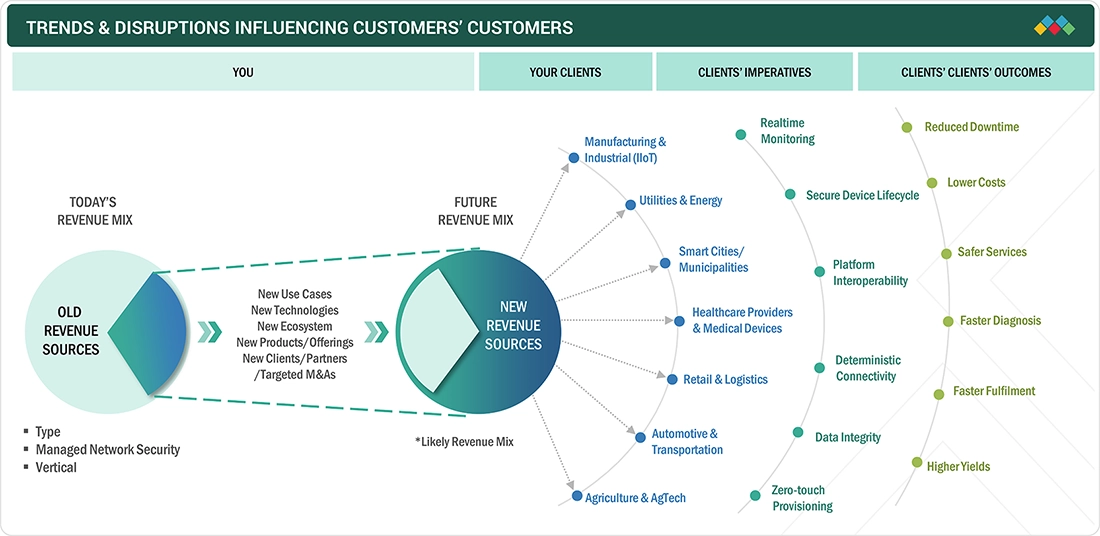
Source: Secondary Research, Interviews with Experts, MarketsandMarkets Analysis
MARKET DYNAMICS

Level
-
Industry 4.0 digitalization

-
Mandatory green transition policies


Level
-
GDPR and data sovereignty rigidity

-
Legacy infrastructure bottleneck


Level
-
Cross-border smart city collaborations

-
Need for tracking and tracing in circular economy


Level
-
Spectrum fragmentation and allocation

-
High energy costs for data processing

Source: Secondary Research, Interviews with Experts, MarketsandMarkets Analysis
Driver: Industry 4.0 digitalization
Europe's large and precise manufacturing base, especially in Germany, Northern Italy, and the Nordics, is rapidly integrating IoT to remain competitive with lower-cost regions. The push for smart factories emphasizes predictive maintenance and the development of digital twins. These tools allow manufacturers to simulate production changes in a virtual setting before implementation. This focus on efficiency and quality control helps European companies offset high labor and energy costs through extensive automation. The regional emphasis on "Mittelstand," or small and medium-sized enterprises, supports smaller manufacturers in adopting connected technologies to stay connected to global supply chains.
Restraint: GDPR and data sovereignty rigidity
While these laws protect individual privacy, the General Data Protection Regulation (GDPR) and the new Data Act make it more complicated to collect, process, and store IoT data across borders. European companies face greater administrative hurdles and legal risks when deploying large-scale sensor networks, particularly those involving cameras or biometric data. This focus on privacy usually results in a slower rollout compared to the US or China, since each deployment requires detailed Data Protection Impact Assessments (DPIAs). Many firms fear hefty non-compliance fines, which hinder experimental IoT projects that manage sensitive user information.
Opportunity: Cross-border smart city collaborations
The EU's unique setup and focus on integrated public services create opportunities for scalable IoT solutions that function across borders. Unified IoT platforms for monitoring air quality, managing traffic, or responding to emergencies can work seamlessly in various European capitals, enabling vendors to achieve rapid economies of scale. Initiatives like Gaia-X aim to establish a federated data infrastructure that allows cities to securely share IoT data, creating a collaborative ecosystem unique to the region. This exchange of data leads to better urban planning and the development of Euro-wide smart mobility solutions, simplifying travel and logistics across the continent.
Challenge: Spectrum fragmentation and allocation
Despite EU efforts to harmonize telecommunications, the actual allocation and licensing of radio spectrum for IoT protocols such as NB-IoT, Sigfox, and LoRaWAN still differ slightly among member states. This lack of perfect synchronization causes significant challenges for logistics companies moving assets across borders, as devices must be adjusted for different frequency requirements and roaming agreements. These technical gaps in the European digital market increase the complexity of device hardware, requiring multi-band support. They also complicate billing and management for fleet operators. Resolving these regulatory issues is crucial for Europe to achieve a true single digital market for the IoT.
EUROPE IOT MARKET: COMMERCIAL USE CASES ACROSS INDUSTRIES
| COMPANY | USE CASE DESCRIPTION | BENEFITS |
|---|---|---|
 |
Digital twins and predictive maintenance for factories using MindSphere | Reduced downtime, optimized throughput, and lower maintenance costs |
 |
5G private networks and IoT for utilities, transport, and industry | Reliable low-latency connectivity, remote monitoring, and operational resilience |
 |
Grid automation, robotics telemetry, and electrification IoT for energy | Improved grid reliability, energy efficiency, and optimized asset uptime |
 |
ERP-integrated IoT asset management and supply-chain telemetry | Real-time visibility, streamlined maintenance and better inventory planning |
 |
Connected building systems and mobility services via Bosch IoT Suite | Energy savings, occupant comfort, and predictive HVAC maintenance |
Logos and trademarks shown above are the property of their respective owners. Their use here is for informational and illustrative purposes only.
MARKET ECOSYSTEM
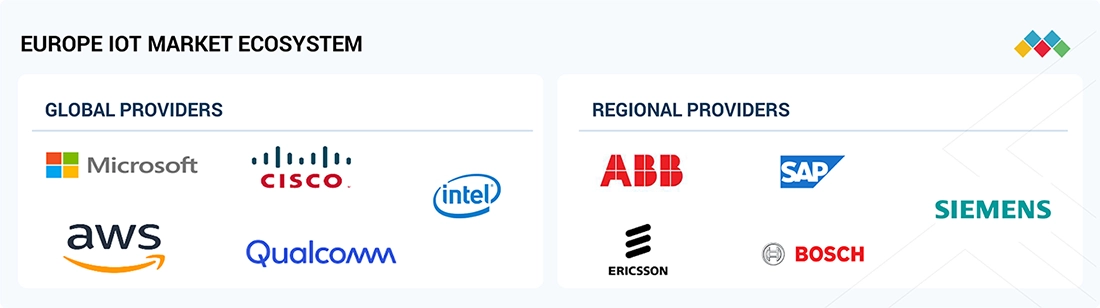
The Europe IoT ecosystem is divided into two tiers. Global providers such as Microsoft, Cisco, AWS, Intel, and Qualcomm offer cloud platforms, edge orchestration, connectivity stacks, and analytics. In contrast, regional providers like ABB, SAP, Siemens, Ericsson, and Bosch deliver industrial operational technology (OT) platforms, automation solutions, ERP-integrated IoT, private 5G, and specialized vertical solutions.
Logos and trademarks shown above are the property of their respective owners. Their use here is for informational and illustrative purposes only.
MARKET SEGMENTS
Source: Secondary Research, Interviews with Experts, MarketsandMarkets Analysis
Europe IoT Market, by Module Type
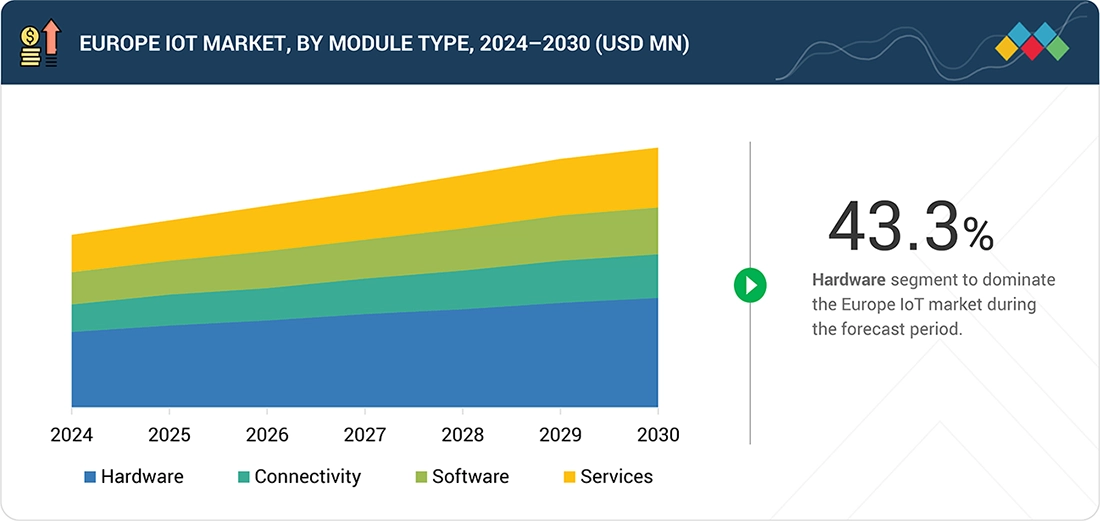
The landscape of IoT hardware in Europe is evolving to accommodate the integration of 5G and edge artificial intelligence. This shift supports large-scale industrial sensor deployments and micro-mobility solutions. Manufacturers are now concentrating on developing energy-efficient microcontrollers and adhering to the Matter standard for smart buildings. By focusing on local processing, they are reducing reliance on cloud services. This segment is also experiencing growth in smart meters and connected automotive platforms, driven by EU-wide sustainability requirements and vehicle-to-everything (V2X) mandates.
Europe IoT Market, by Hardware
The security hardware segment is growing quickly as companies prepare for the full enforcement of the EU Cyber Resilience Act. Organizations are moving toward hardware-based roots of trust and secure elements to safeguard critical infrastructure from advanced cyber-attacks. This demand is especially strong in Germany's manufacturing sector and regional healthcare systems, ensuring the integrity of medical devices and data.
Europe IoT Market, by Connectivity
Satellite IoT in Europe is gaining traction with the deployment of 5G NB-IoT LEO constellations. This helps close connectivity gaps in rural and cross-border operations. This segment is crucial for logistics, maritime, and precision agriculture, where land-based coverage is inconsistent. The rise of hybrid satellite-cellular models enables seamless tracking of assets across complicated global supply chains.
Europe IoT Market, by Software
The security and safety software segment is influenced by strict regulations like GDPR and the NIS2 Directive, which require strong data protection. Organizations are investing in AI-driven threat detection and automated response systems to combat rising ransomware threats to the public sector. Smart city projects in the UK and Germany further increase the demand for software that combines public safety with digital city infrastructure.
Europe IoT Market, by Service
Professional services form the backbone of the IoT ecosystem in Europe, addressing the region's significant shortage of specialized technical skills. Providers are shifting to outcome-based pricing, where fees link to operational improvements in smart factories and energy projects. These services are essential for integrating complex multivendor systems and ensuring compliance with changing EU digital governance policies.
Europe IoT Market, by Focus Area
Smart healthcare in Europe is evolving toward a hospital-at-home model, driven by the rapid adoption of remote patient monitoring and telemedicine. Advanced biosensors and 5G-enabled wearables support proactive chronic disease management and lessen the burden on overwhelmed clinical staff. This growth benefits from favorable government digital health policies and the rising use of IoT for real-time hospital asset tracking.
EUROPE IOT MARKET: COMPANY EVALUATION MATRIX
In the IoT market matrix, Microsoft (Star) leads with a strong market share and extensive product footprint, driven by its offering customized solutions as per customers' requirements and adopting growth strategies to achieve advanced technology consistently. Software AG (Emerging Leader) is gaining visibility with its innovative solutions to cater to future IoT demands. While Microsoft dominates through scale and a diverse portfolio, Software AG shows significant potential to move toward the leaders quadrant as demand for IoT continues to rise.
Source: Secondary Research, Interviews with Experts, MarketsandMarkets Analysis
KEY MARKET PLAYERS
- Microsoft (US)
- AWS (US)
- Cisco (US)
- Intel (US)
- Qualcomm (US)
- ABB (Switzerland)
- SAP (Germany)
- STMicroelectronics (Switzerland)
- NXP Semiconductors (Netherlands)
- TE Connectivity (Switzerland)
- Bosch (Germany)
- Software AG (Germany)
- Ericsson (Sweden)
- HQSoftware (Estonia)
- emnify (Germany)
MARKET SCOPE
| REPORT METRIC | DETAILS |
|---|---|
| Market Size in 2024 (Value) | USD 118.18 Billion |
| Market Forecast in 2030 (Value) | USD 164.03 Billion |
| Growth Rate | CAGR of 6.8% from 2025 to 2030 |
| Years Considered | 2019–2030 |
| Base Year | 2024 |
| Forecast Period | 2025–2030 |
| Units Considered | Value (USD Billion) |
| Report Coverage | Revenue Forecast, Company Ranking, Competitive Landscape, Growth Factors, and Trends |
| Segments Covered |
|
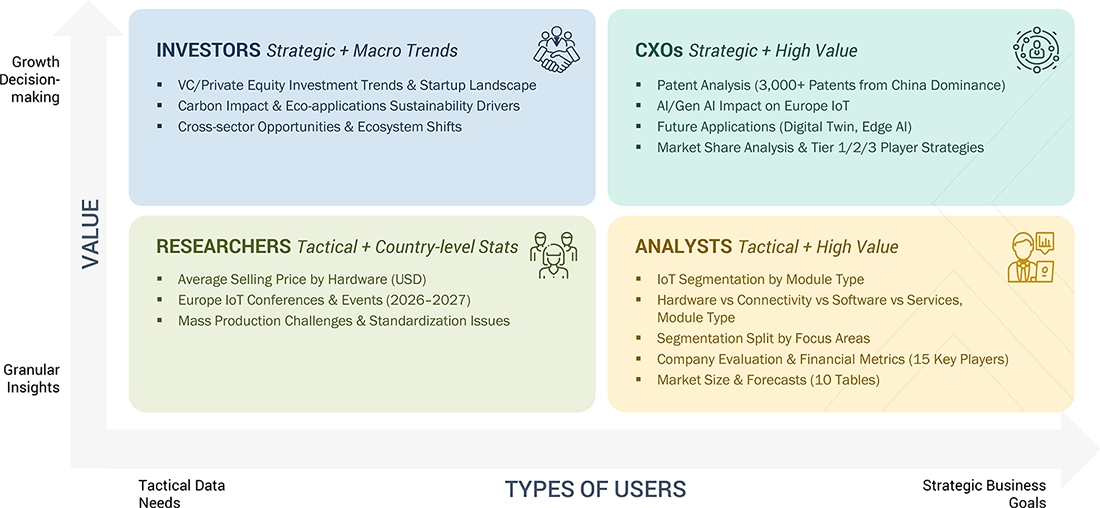
WHAT IS IN IT FOR YOU: EUROPE IOT MARKET REPORT CONTENT GUIDE
DELIVERED CUSTOMIZATIONS
We have successfully delivered the following deep-dive customizations:
| CLIENT REQUEST | CUSTOMIZATION DELIVERED | VALUE ADDS |
|---|---|---|
| Leading Solution Provider (Europe) | Product Analysis: Product Matrix, which gives a detailed comparison of the product portfolio of each company | Enhanced understanding of competitive positioning and product offerings |
| Leading Service Provider (Europe) | Company Information: Detailed analysis and profiling of additional market players (up to 5) | Deeper insights into market dynamics and potential strategic partnerships |
RECENT DEVELOPMENTS
- December 2025 : ABB (Switzerland) acquired Netcontrol (Finland), enhancing grid automation solutions for European utilities amid rising electrification and renewable integration demands.
- November 2025 : Nokia (Finland) partnered with OneLayer to boost secure private LTE/5G adoption for utilities in Europe, adding OT/IoT visibility and zero-trust security to industrial networks.
- October 2025 : Ericsson (Sweden) and Vodafone announced a five-year partnership for programmable networks in Europe (starting Germany Q4 2025), deploying AI-powered rApps for RAN/IoT management and energy efficiency.
- September 2025 : Nokia (Finland) opened a 55,000 sqm smart-factory campus in Oulu, Finland, with integrated 5G, IoT, and AI systems for Europe-made 5G equipment production and Industry 4.0 testing.
Table of Contents
 Exclusive indicates content/data unique to MarketsandMarkets and not available with any competitors.
Methodology
This research study extensively utilized secondary sources, directories, and databases, including Dun & Bradstreet (D&B), Hoovers, and Bloomberg Businessweek, to identify and collect information relevant to a technical, market-oriented, and commercial study of the Europe IoT Market. The primary sources have primarily consisted of industry experts from core and related industries, as well as preferred suppliers, manufacturers, distributors, service providers, technology developers, alliances, and organizations related to all segments of the value chain of this market. In-depth interviews have been conducted with various primary respondents, including key industry participants, subject matter experts, C-level executives of key market players, and industry consultants, to obtain and verify critical qualitative and quantitative information.
Secondary Research
The market size of companies offering IoT worldwide was arrived at based on secondary data available through paid and unpaid sources. It was also arrived at by analyzing the product portfolio of major companies and rating them based on their performance and quality. In the secondary research process, various secondary sources were referred to identify and collect information for the study. The secondary sources included annual reports, press releases, and investor presentations of companies; white papers, journals, and certified publications; and articles from recognized authors, directories, and databases.
Secondary research was mainly used to obtain key information about the industry’s value chain and supply chain and to identify key players through various solutions and services, market classification and segmentation according to offerings of major players, industry trends related to technologies, applications, and regions, and key developments from both market-oriented and technology-oriented perspectives.
Primary Research
During the primary research process, various primary sources from both the supply and demand sides were interviewed to gather qualitative and quantitative information on the market. The primary sources from the supply side included various industry experts, including Chief Experience Officers (CXOs); Vice Presidents (VPs); directors from business development, marketing, and product development/innovation teams, related key executives from IoT solution vendors, professional service providers, and industry associations, and key opinion leaders.
Primary interviews were conducted to gather insights, including market statistics, revenue data collected from solutions and services, market segmentations, market size estimations, market forecasts, and data triangulation. Primary research also helped in understanding various trends related to technologies, applications, deployments, and regions. Stakeholders from the demand side, such as Chief Information Officers (CIOs), Chief Technology Officers (CTOs), Chief Strategy Officers (CSOs), and end users using IoT solutions, were interviewed to understand the buyer’s perspective on suppliers, products, service providers, and their current usage of IoT solutions, which would impact the overall Europe IoT Market.
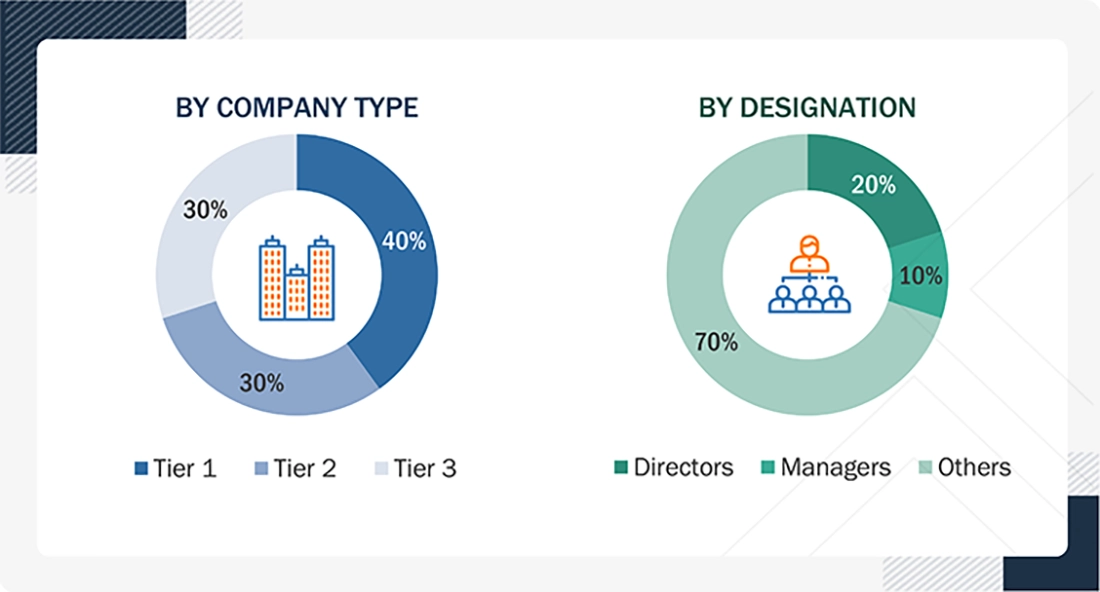
To know about the assumptions considered for the study, download the pdf brochure
Europe IoT Market Size Estimation
Multiple approaches were adopted to estimate and forecast the size of the Europe IoT Market. The first approach involves estimating market size by summing up the revenue generated by companies through the sale of IoT solutions.
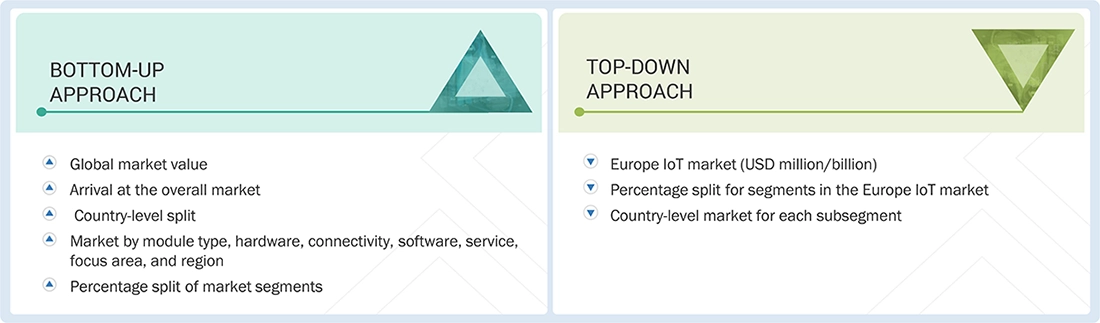
Top-down and bottom-up approaches were used to estimate and validate the total size of the Europe IoT Market. These methods were also extensively used to estimate the size of various market segments. The research methodology used to evaluate the market size is listed below.
- Key players in the market have been identified through extensive secondary research.
- In terms of value, the industry’s supply chain and market size have been determined through a combination of primary and secondary research processes.
- All percentage shares, splits, and breakups have been determined using secondary sources and verified through primary sources.
Europe IoT Market : Top-Down and Bottom-Up Approach
Data Triangulation
After determining the overall market size, the Europe IoT Market was segmented into several categories and subcategories. A data triangulation procedure was employed to complete the overall market engineering process and derive the exact statistics for all segments and subsegments, as applicable. The data was triangulated by studying various factors and trends from the demand and supply sides. In addition to data triangulation and market breakdown, the market size was validated using both top-down and bottom-up approaches.
Market Definition
Internet of Things (IoT), is a network of physical devices embedded with sensors and software that can collect and exchange data over the internet, enabling them to communicate and interact with each other without human intervention; essentially, it encompasses hardware, software, connectivity, and services used to build and operate IoT systems across various focus areas such as smart transportation, smart energy & utilities, smart manufacturing, smart retail, among others.
Stakeholders
- Government agencies
- IoT service providers
- Telecom companies
- System integrators
- Smart device manufacturers
- Healthcare providers and institutions
- Automotive and mobility solution providers
- Energy and utility companies
- Retailers and E-commerce platforms
- Industrial enterprises
- Construction and real estate developers
- Agricultural enterprises
- Financial institutions and banks
- Research and development institutions
- Educational and training organizations
Report Objectives
- To determine and forecast the Europe IoT Market by module type, hardware, connectivity, software, service, focus area, and region
- To forecast the size of the market segments for North America, Europe, Asia Pacific, Latin America, and the Middle East & Africa
- To provide detailed information about the major factors (drivers, restraints, opportunities, and challenges) influencing the growth of the Europe IoT Market
- To analyze each submarket concerning individual growth trends, prospects, and contributions to the overall Europe IoT Market
- To analyze the opportunities in the market for stakeholders by identifying the high-growth segments of the Europe IoT Market
- To profile the key market players, provide a comparative analysis based on business overviews, regional presence, product offerings, business strategies, and key financials, and illustrate the market’s competitive landscape
- Track and analyze competitive developments in the market, such as mergers and acquisitions, product development, partnerships and collaborations, and research and development (R&D) activities
Available Customizations
With the given market data, MarketsandMarkets offers customizations to meet the company’s specific needs. The following customization options are available for the report:
Geographic Analysis as per Feasibility
- Analysis for additional countries (up to five)
Company Information
- Detailed analysis and profiling of additional market players (up to 5)
Key Questions Addressed by the Report
What is the projected size of the Europe IoT Market by 2030?
The Europe IoT market is projected to grow from USD 118.18 billion in 2025 to USD 164.03 billion by 2030, at a CAGR of 6.8% during the forecast period.
Which hardware segment is expected to hold the largest share of the Europe IoT Market?
The modules/sensors segment is projected to account for the largest market share in 2025.
Which connectivity technology is expected to grow the fastest in the Europe IoT Market?
The satellite connectivity segment is expected to register the highest CAGR of 12.2% during the forecast period.
Which service segment is projected to witness the fastest growth in the Europe IoT Market?
The managed services segment is expected to be the fastest-growing service segment, with a CAGR of 8.3% during the forecast period.
Which focus area is expected to dominate the Europe IoT Market?
The smart manufacturing segment is projected to account for the largest market share in 2025.
What is accelerating IoT adoption across Europe?
The increasing focus on Industry 4.0, energy efficiency, smart manufacturing, edge computing, and 5G-enabled connectivity is accelerating IoT adoption across Europe.


Personalize This Research
- Triangulate with your Own Data
- Get Data as per your Format and Definition
- Gain a Deeper Dive on a Specific Application, Geography, Customer or Competitor
- Any level of Personalization
Let Us Help You
- What are the Known and Unknown Adjacencies Impacting the Europe IoT Market
- What will your New Revenue Sources be?
- Who will be your Top Customer; what will make them switch?
- Defend your Market Share or Win Competitors
- Get a Scorecard for Target Partners

Custom Market Research Services
We Will Customise The Research For You, In Case The Report Listed Above Does Not Meet With Your Requirements
Get 10% Free CustomisationTESTIMONIALS






Growth opportunities and latent adjacency in Europe IoT Market