Europe Learning Management System Market

Europe Learning Management System Market by Delivery Mode (Distance Learning, Instructor-led Learning, Blended Learning), Application (Corporate Training & Development, Professional Certification & Compliance, Course Management) - Forecast to 2032




OVERVIEW
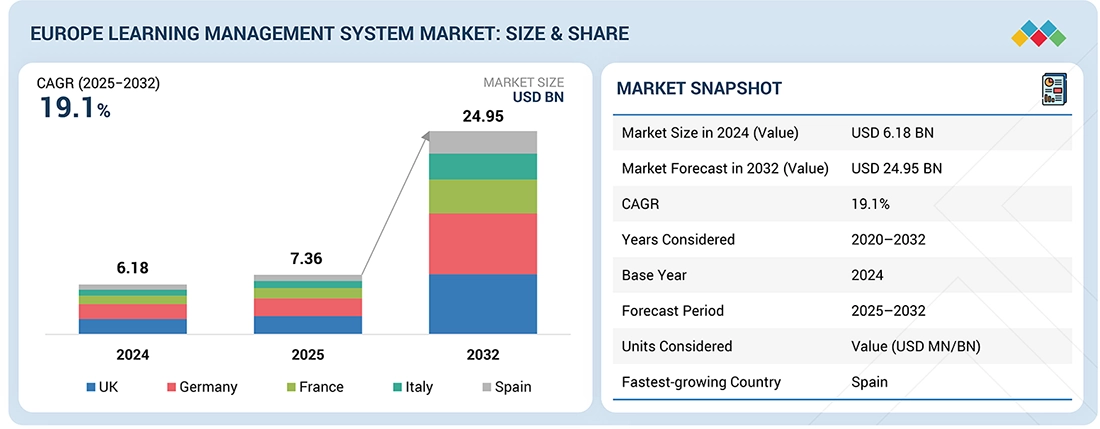
Source: Secondary Research, Interviews with Experts, MarketsandMarkets Analysis
The Europe learning management system market is expected to grow from USD 7.36 billion in 2025 to USD 24.95 billion by 2032. This growth is driven by the adoption of digital learning in schools, universities, and workplaces. Government initiatives like the EU Digital Education Action Plan are helping institutions transition to online platforms. Moreover, organizations are implementing learning management system solutions to train employees, ensure compliance, and support remote and hybrid work environments. Technologies such as AI, analytics, cloud platforms, and mobile learning are making education more accessible, personalized, and efficient.
KEY TAKEAWAYS
-
BY COUNTRYThe UK held the largest market value of USD 2,286.2 million in 2025
-
BY OFFERINGThe solutions segment captured the largest market value of USD 5,534.2 million in 2025.
-
BY APPLICATIONThe corporate training & development segment is expected to record a CAGR of 20.9% during the forecast period.
-
BY DELIVERY MODEThe instructor-led training segment dominated the market in 2025.
-
BY ORGANIZATION SIZEThe small & medium-sized segment is expected to grow at the highest CAGR during the forecast period.
-
BY USER TYPEThe academic users segment is expected to lead the market during the forecast period.
-
COMPETITIVE LANDSCAPECornerstone OnDemand, Anthology, Moodle, D2L, and IBM are strengthening their presence through platform enhancements, partnerships, acquisitions, and technology upgrades. These companies are focusing on AI-based learning features, personalization, analytics, mobile access, accessibility compliance, and GDPR-aligned security to meet Europe’s growing demand for advanced digital learning. Their strong capabilities help organizations manage large-scale learning programs, support continuous training, and improve workforce and student performance across sectors such as education, government, and corporate enterprises.
-
COMPETITIVE LANDSCAPEDocebo, Learning Technologies Group (LTG), Learning Pool, and CrossKnowledge are gaining attention with flexible, user-friendly, and cost-effective learning management system solutions. These companies focus on simple deployment, customization, integration with HR and enterprise systems, and scalable learning environments tailored to European needs. Their platforms help SMEs, training providers, and institutions modernize learning, improve engagement, support multilingual education, and meet specific training and compliance needs.
Europe’s learning management system market is becoming more strategic, shifting from basic content delivery to platforms centered on skills intelligence, performance measurement, and measurable learning impact. Vendors are increasingly focusing on interoperability, accessibility compliance, and alignment with regional education and workforce policies.
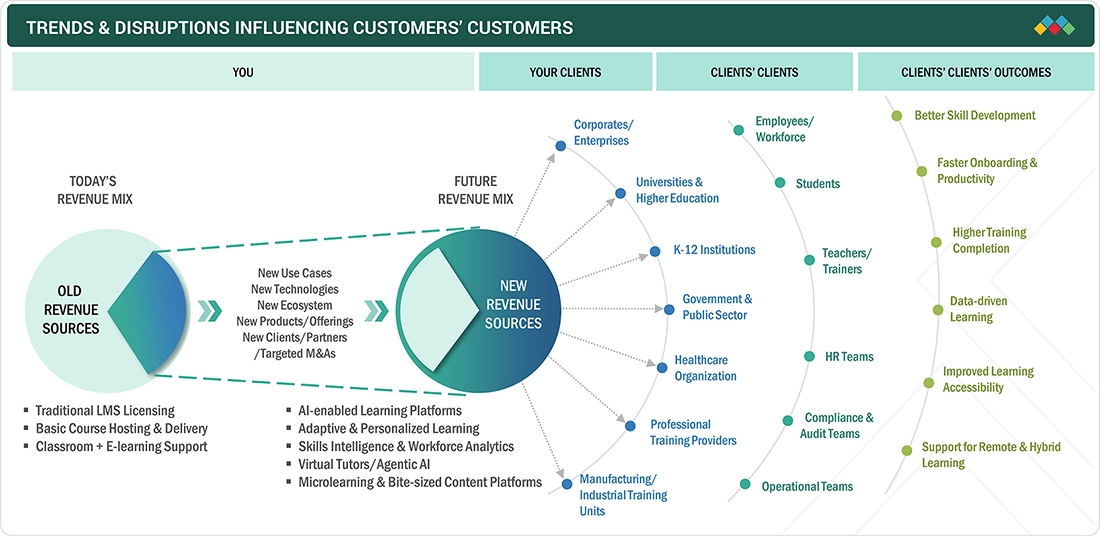
TRENDS & DISRUPTIONS IMPACTING CUSTOMERS' CUSTOMERS
The learning management system market in Europe is evolving as more organizations adopt AI-powered tools to personalize learning, track skills, and measure outcomes. Blended and hybrid learning are becoming more widespread, supported by cloud platforms and mobile access. Government policies and funding programs across different European countries are helping to upgrade education and training systems. At the same time, regulations around accessibility, data protection, and system compatibility are shaping how learning management system platforms are developed. Increasing demand for employee training, reskilling, and short professional certifications is creating new business opportunities and boosting competition among learning management system providers.
Source: Secondary Research, Interviews with Experts, MarketsandMarkets Analysis
MARKET DYNAMICS

Level
-
GDPR-driven compliance requirements

-
Favorable government initiatives and funding


Level
-
High implementation and maintenance costs

-
Digital divide and infrastructure gaps


Level
-
Heightened demand due to BYOD policies

-
AI and personalization integration


Level
-
Data security and privacy concerns

-
Measuring ROI and performance tracking

Source: Secondary Research, Interviews with Experts, MarketsandMarkets Analysis
Driver: GDPR-driven compliance requirements
GDPR-driven compliance requirements boost the adoption of learning management systems in Europe, as organizations must continuously train employees on data protection, privacy practices, and regulatory responsibilities. Sectors such as banking, healthcare, government, and telecom face strict regulations and need to demonstrate training compliance. Learning management system platforms facilitate delivering standardized GDPR courses, track completion status, and store records for audits. Since GDPR rules are periodically updated, ongoing training remains essential. This has turned compliance learning into a continuous process and has led to increased use of learning management system platforms across Europe.
Restraint: High implementation and maintenance costs
High setup and maintenance costs remain a significant barrier in Europe, especially for small companies and public institutions. While learning management systems can enhance education, initial expenses for licenses, implementation, and infrastructure are often high. Even open-source platforms incur additional costs for customization, hosting, integration, security, and technical support. Ongoing updates, accessibility requirements, GDPR compliance, and staff training also increase expenses. As a result, some smaller organizations delay adoption, which slows the growth of digital learning in parts of Europe.
Opportunity: Heightened demand due to BYOD policies
Europe’s increased use of smartphones, widespread internet coverage, and remote work trends are creating strong opportunities for mobile-friendly learning management system platforms. Many European organizations are adopting Bring Your Own Device (BYOD) policies, which boosts the need for learning platforms that work seamlessly across smartphones, tablets, and laptops. Mobile learning management tools support anytime learning, valuable for field workers, frontline staff, and distributed teams. Students also prefer mobile access for studying and communication. As convenience and flexibility become more important, the demand for mobile-based learning management system platforms is expected to grow.
Challenge: Data security and privacy concerns
Data security and privacy pose significant challenges for the Europe learning management system market. Users and institutions demand strong protection for personal and educational data. Under GDPR, learning management systems must handle data responsibly and adhere to strict rules regarding storage, consent, and security. Any data breach can lead to penalties and damage trust. With the rise of cyber threats and heightened public awareness of privacy concerns, expectations are very high. Vendors of learning management systems need continuous investment and expertise to meet these standards, making compliance an ongoing challenge.
EUROPE LEARNING MANAGEMENT SYSTEM MARKET: COMMERCIAL USE CASES ACROSS INDUSTRIES
| COMPANY | USE CASE DESCRIPTION | BENEFITS |
|---|---|---|
 |
Upgraded its human rights e-learning platform using Docebo to improve accessibility and engagement. | Doubled users in six months, improved learning reach, and strengthened human rights awareness. |
 |
Developed an online certification and learning platform for healthcare professionals using D2L Brightspace. | Delivered 60,000+ learning hours, certified 1,000+ professionals, and improved patient care impact. |
 |
Replaced its legacy LMS with Learning Pool to support workforce training across public services. | Increased course completions by 240%, improved digital skills, and supported rapid staff redeployment. |
Logos and trademarks shown above are the property of their respective owners. Their use here is for informational and illustrative purposes only.
MARKET ECOSYSTEM
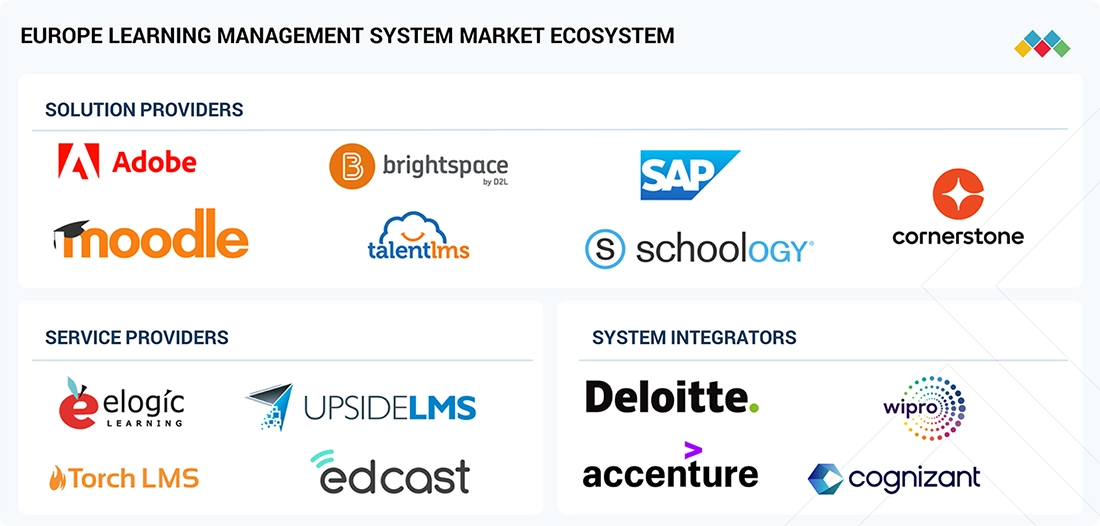
Europe’s learning management system ecosystem includes solution providers, service providers, service integrators, content creators, technology partners, and end users such as businesses, public organizations, schools, and universities. Solution providers deliver the core learning management system platforms, while service providers support implementation, training, customization, and ongoing maintenance. Content partners produce multilingual learning materials aligned with European standards. Technology partners enable AI, analytics, security, mobile access, and cloud hosting. Service integrators connect learning management platforms with HR, ERP, and national education systems. Learners, teachers, employees, and administrators use these systems and provide feedback, helping build scalable, secure, and efficient digital learning environments across Europe.
Logos and trademarks shown above are the property of their respective owners. Their use here is for informational and illustrative purposes only.
MARKET SEGMENTS
Source: Secondary Research, Interviews with Experts, MarketsandMarkets Analysis
Europe Learning Management System Market, By Offering
In Europe, the solutions segment is expected to capture the largest share of the learning management system market. Most organizations and educational institutions prefer investing in full-featured learning management platforms rather than only services. These solutions support core needs such as course creation, delivery, multilingual learning, compliance tracking, assessments, reporting, and analytics. As digital learning expands across schools and workplaces, institutions seek reliable, secure, and scalable platforms. Factors such as AI adoption, accessibility regulations, GDPR compliance, and the increased use of blended learning further boost demand for robust learning management system solutions across the region.
Europe Learning Management System Market, By Delivery Mode
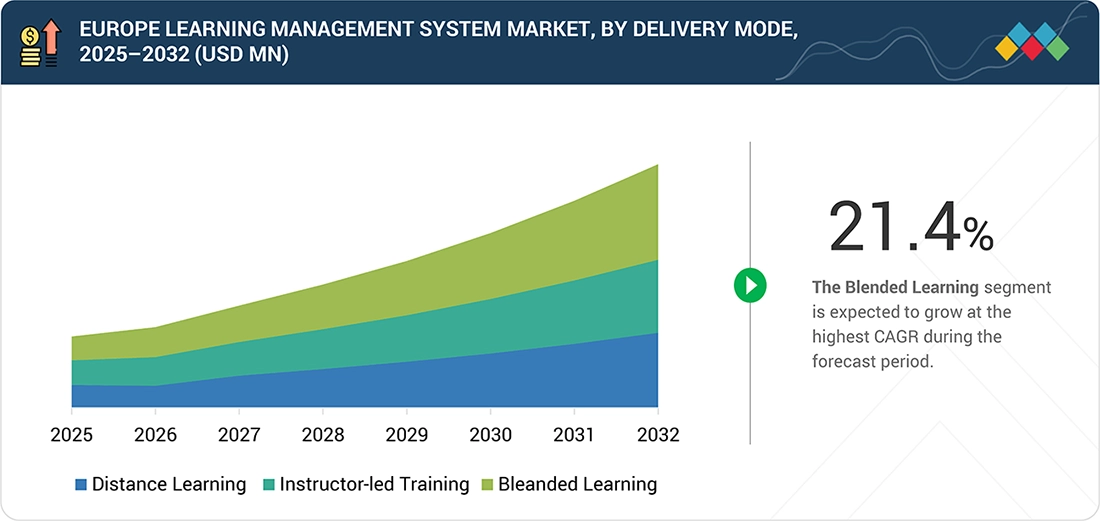
Blended learning is expected to record the fastest growth in Europe. Many schools, universities, and training institutions are merging classroom teaching with online learning instead of fully transitioning to digital platforms. This method helps keep teachers engaged while offering flexibility to learners. It boosts participation, supports personalization, and lowers training costs compared to fully instructor-led approaches. Blended learning also aligns well with European education policies that promote digital learning inclusion, accessibility, and modernization. As hybrid learning becomes common in education and corporate training, platforms supporting blended learning are seeing increased adoption.
Europe Learning Management System Market, By Deployment
The cloud segment is expected to hold the largest share of the Europe learning management system market because organizations prefer platforms that are easy to deploy, cost-effective, and require minimal in-house IT management. Cloud learning management systems support remote and hybrid learning, allowing users to access content anytime and anywhere, which is important for both corporate and academic environments. They also offer better scalability, enabling institutions to handle increasing numbers of learners without heavy infrastructure investments. Regular security updates, GDPR-compliant data protection, and strong backup capabilities make cloud platforms more reliable and trusted.
Europe Learning Management System Market, By Organization Size
Small and medium-sized enterprises in Europe are expected to adopt learning management system platforms more quickly than large companies. With growing digital adoption and the increasing need for workforce training, many SMEs are using learning management systems for onboarding, skill development, and compliance training. Subscription-based and cloud-based models help lower costs, making it easier for smaller organizations to implement digital learning without extensive IT infrastructure. SMEs also prefer platforms that are easy to use, flexible, multilingual, and scalable to grow with their business.
Europe Learning Management System Market, By Application
Course management is expected to be the largest segment in the Europe learning management system market. Organizations and institutions use learning management systems to create, organize, and deliver structured learning programs. These platforms help manage enrollments, scheduling, certifications, assignments, assessments, and tracking learner performance. A strong emphasis on structured education systems, compliance requirements, standardized training, and professional development supports the dominance of course management applications in Europe. This makes course management the most widely used and essential feature of learning management system platforms in both education and corporate settings.
Europe Learning Management System Market, By User Type
Corporate users in Europe are expected to grow at the fastest rate. Companies are increasingly investing in learning platforms to train employees, meet compliance requirements, build skills, and boost productivity. The rise of remote and hybrid work has made digital learning essential rather than optional. Cloud-based learning management systems enable businesses of all sizes to easily deliver training across various locations and employee groups. Continuous learning, reskilling needs, industry regulations, and the focus on workforce development are key reasons why the adoption of learning management systems is accelerating among European enterprises.
REGION
Mexico to be the fastest-growing country in the Latin America cloud computing market during the forecast period
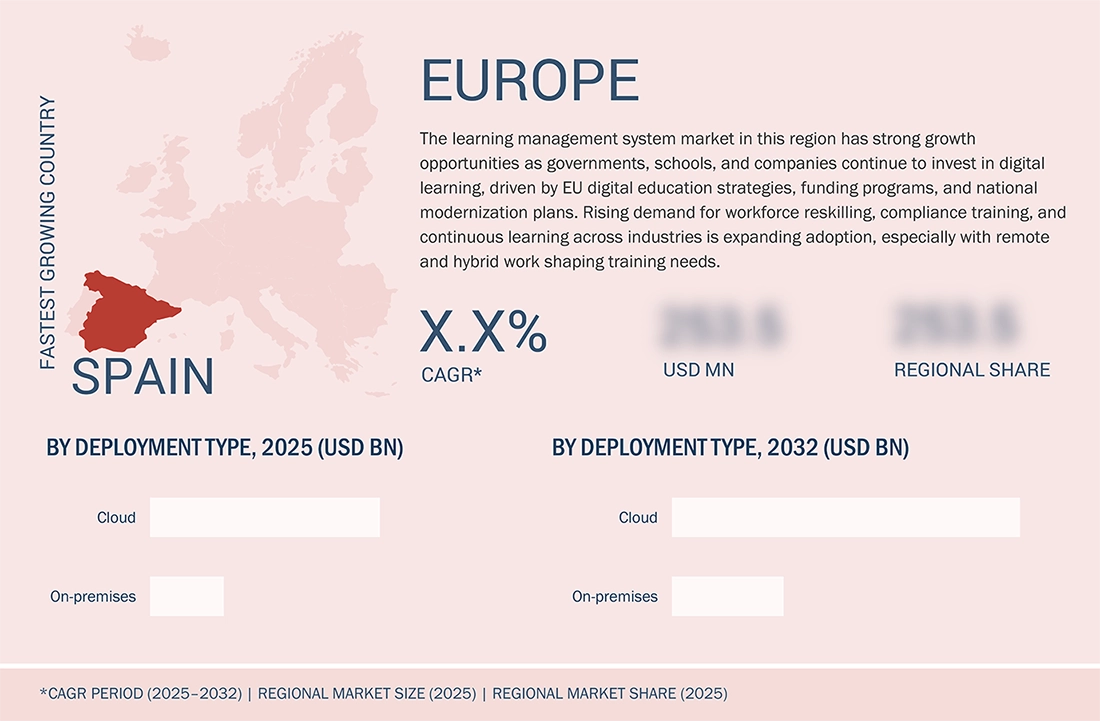
Spain is expected to record the fastest growth in the Europe learning management system market due to strong government support and significant investment in digital education. Programs like Agenda España Digital 2026, DigEdu Plan, and Kit Digital are driving the adoption of learning management systems in schools, universities, and small businesses. The country is also working to close the digital gap between urban and rural areas and promote multilingual learning. Learning management platforms that support offline and mobile learning are in high demand for sectors like tourism, agriculture, and construction. AI-based and immersive learning tools are expanding as part of national digital initiatives.
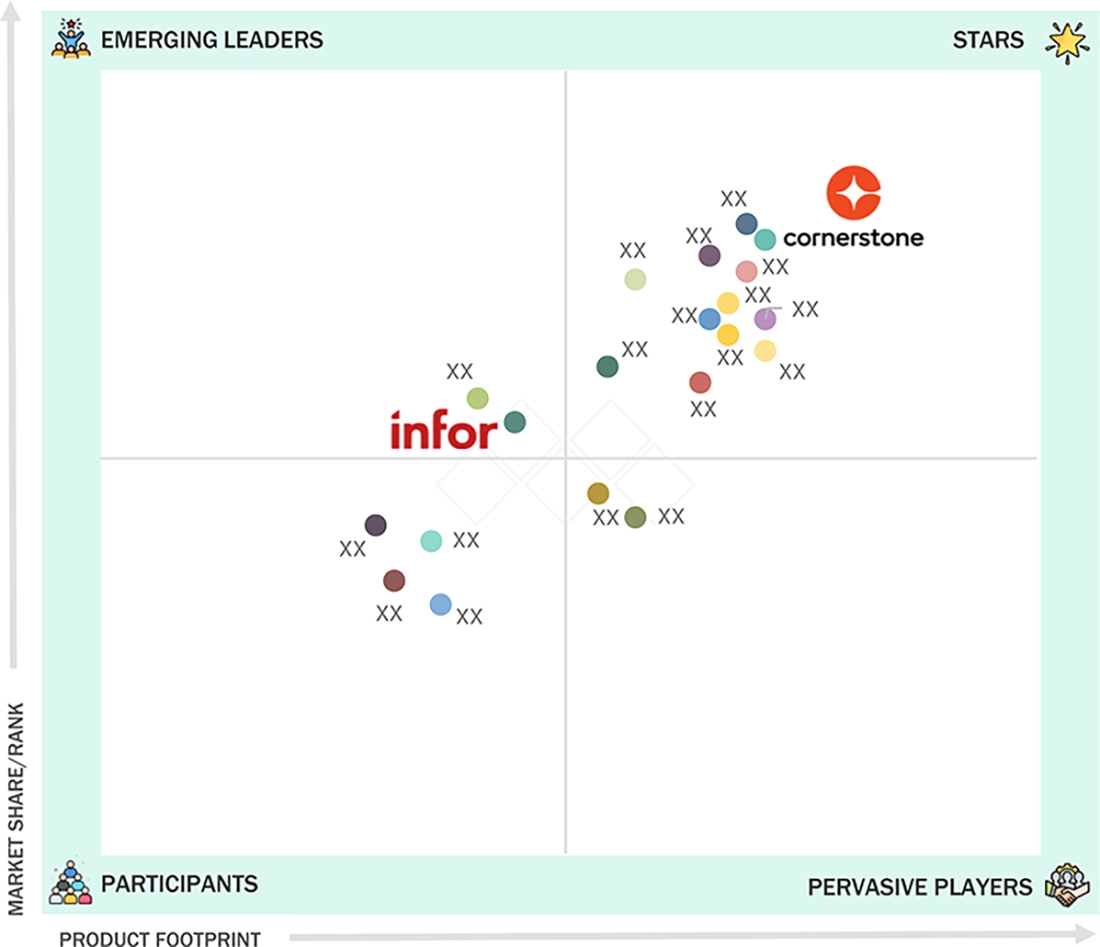
EUROPE LEARNING MANAGEMENT SYSTEM MARKET: COMPANY EVALUATION MATRIX
Cornerstone OnDemand (Star) holds a strong position in Europe with its enterprise-level learning management system platform. It supports AI-based learning, analytics, compliance needs, multilingual use, and large workforces, making it popular across government, corporate, education, and healthcare sectors. Docebo (Emerging Leader) is also gaining momentum as an emerging leader because of its cloud platform, AI personalization, easy integration, and strong support for corporate learning. With rising demand for modern and user-friendly platforms, the company is becoming one of the key growth players in Europe.
Source: Secondary Research, Interviews with Experts, MarketsandMarkets Analysis
KEY MARKET PLAYERS
- Cornerstone Ondemand (US)
- Anthology (US)
- Moodle (Australia)
- D2L Corporation (Canada)
- IBM (US)
- PowerSchool (US)
- Instructure (US)
- IMC Learning (Germany)
- Docebo (US)
- LTG (London)
- SAP (Germany)
- Learning Pool (UK)
- CrossKnowledge (France)
- Kallidus (UK)
- Thrive (UK)
MARKET SCOPE
| REPORT METRIC | DETAILS |
|---|---|
| Market Size in 2024 (Value) | USD 6.18 BN |
| Market Forecast in 2032 (value) | USD 24.95 BN |
| Growth Rate | CAGR of 14.8% from 2025–2030 |
| Years Considered | 2020–2032 |
| Base Year | 2024 |
| Forecast Period | 2025–2032 |
| Units Considered | Value (USD MN/BN) |
| Report Coverage | Revenue forecast, company ranking, competitive landscape, growth factors, and trends. |
| Segments Covered |
|
| Region Covered | UK, Germany, France, Italy, Spain, Rest of Europe |
WHAT IS IN IT FOR YOU: EUROPE LEARNING MANAGEMENT SYSTEM MARKET REPORT CONTENT GUIDE
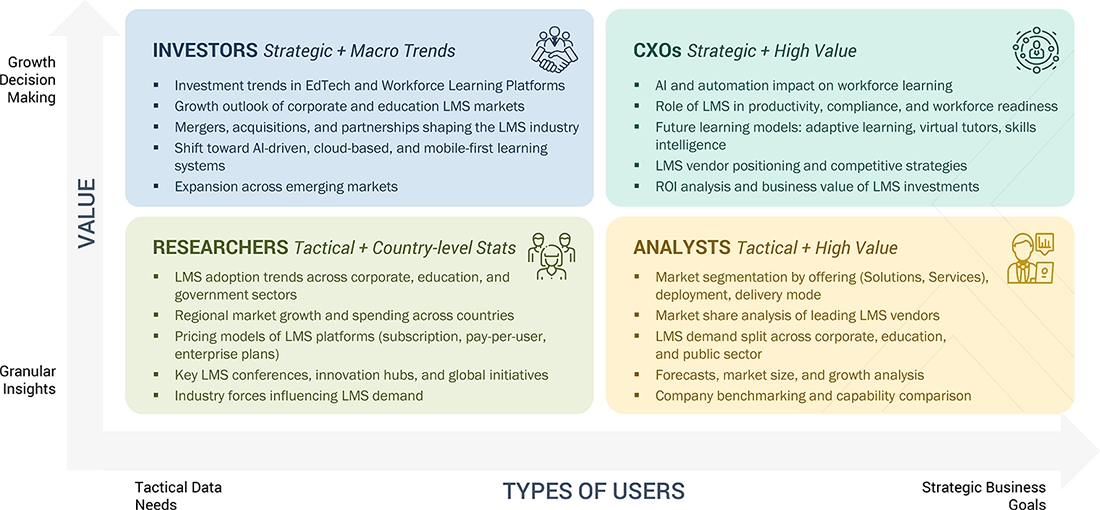
DELIVERED CUSTOMIZATIONS
We have successfully delivered the following deep-dive customizations:
| CLIENT REQUEST | CUSTOMIZATION DELIVERED | VALUE ADDS |
|---|---|---|
| LMS Solution Provider | European LMS demand mapping across key countries, analysis of enterprise, education, and government LMS usage, assessment of AI-enabled learning, mobile learning, and cloud-based LMS adoption trends, along with competitive benchmarking of leading European LMS vendors | Helps identify high-growth European markets, supports stronger product strategy, improves go-to-market planning, and guides platform enhancement aligned with regional needs |
| Education Institution / University | Regional digital learning readiness assessment, roadmap for hybrid and online learning adoption in European education systems, guidance for LMS deployment and integration, evaluation of student engagement tools and learning outcomes | Better digital learning planning, improved student engagement, stronger LMS implementation strategies, and better platform selection decisions for European institutions |
| Corporate / Enterprise | Corporate LMS use case assessment, mapping of workforce training, upskilling, and compliance needs across Europe, cost-benefit evaluation of LMS adoption, and comparison of suitable LMS platforms for corporate learning | Better workforce training planning, stronger compliance management, reduced risk in LMS investments, and improved employee skill development across European organizations |
RECENT DEVELOPMENTS
- October 2025 : IMC Learning introduced Innovation Pack 14.26, bringing major enhancements to the IMC Learning Suite. A key highlight is the new channels' mobile app, available from January 26, 2026, enabling truly mobile, on-the-go personalized learning with easy access to content and channels. The update also adds advanced reporting subscriptions, allowing administrators to automate email report delivery with flexible scheduling options, reducing workload and supporting compliance needs.
- August 2025 : Thrive announced the acquisition of Huler, creating the world’s first fully integrated platform combining learning, mentoring, and employee experience. This move followed the company’s earlier acquisition of Guider, bringing together AI-powered learning, smart intranet capabilities, and mentoring tools in one unified ecosystem. With Huler’s personalized, AI-driven employee hub and Thrive’s strong L&D technology, the partnership aimed to deliver a seamless, people-first digital workplace experience. Huler continues to operate as a standalone brand with planned investments in analytics, AI personalization, and deeper integrations.
- October 2024 : Docebo partnered with TEDAI Vienna, becoming the official Business Learning Partner for Europe’s first TED conference dedicated to AI, held from October 17–19, 2024, in Vienna, Austria. Through this partnership, Docebo supported enterprises in exploring how AI reshaped learning and workforce development. The company led workshops, joined panel discussions, and shared expertise on AI-driven learning innovation, aligning with TEDAI’s mission to examine AI’s impact on industry, society, and the future of work.
Table of Contents
 Exclusive indicates content/data unique to MarketsandMarkets and not available with any competitors.
Methodology
The study involved four major activities in estimating the Europe Learning Management System Market. We performed extensive secondary research to collect information on the market, the competitive market, and the parent market. The next step was to validate these findings, assumptions, and sizing with industry experts across the value chain through primary research. Both top-down and bottom-up approaches were employed to estimate the complete market size. After that, we used the market breakup and data triangulation procedures to estimate the market size of the various segments in the Europe Learning Management System market.
Secondary Research
This research study used extensive secondary sources, directories, and databases, such as D&B Hoovers, DiscoverOrg, Factiva, vendor data sheets, product demos, Cloud Computing Association (CCA), Vendor Surveys, Asia Cloud Computing Association, and The Software Alliance. We used these sources to identify and collect valuable information for this technical, market-oriented, and commercial Europe Learning Management System market.
Primary Research
Primary sources were several industry experts from the core and related industries, preferred software providers, hardware manufacturers, distributors, service providers, technology developers, alliances, and organizations related to all segments of the industry's value chain. In-depth interviews were conducted with primary respondents, including key industry participants, subject-matter experts, C-level executives of key market players, and industry consultants, to obtain and verify critical qualitative and quantitative information and assess the market's prospects.
We conducted primary interviews to gather insights, such as market statistics, the latest trends disrupting the market, new use cases implemented, data on revenue collected from products and services, market breakups, market size estimations, market forecasts, and data triangulation. Primary research also helped understand various technology trends, segmentation types, industry trends, and regions. Demand-side stakeholders, such as Chief Information Officers (CIOs), Chief Technology Officers (CTOs), and Chief Security Officers (CSOs); the installation teams of governments/end users using Europe Learning Management System solutions & services; and digital initiatives project teams, were interviewed to understand the buyer's perspective on suppliers, products, service providers, and their current use of services, which would affect the overall Europe Learning Management System market.
Market Size Estimation
We used top-down and bottom-up approaches to estimate and forecast the Europe Learning Management System and other dependent submarkets. We deployed a bottom-up procedure to arrive at the overall market size using the revenues and offerings of key companies in the market. With data triangulation methods and validation through primary interviews, this study determined and confirmed the exact value of the overall parent market size. We used the overall market size in the top-down procedure to estimate the size of other individual markets via percentage splits of the market segments.
The research methodology used to estimate the market size included the following details:
- We identified key players in the market through secondary research. We then determined their revenue contributions in the respective countries through primary and secondary research.
- This procedure included studying top market players' annual and financial reports and extensive interviews for key insights from industry leaders, such as Chief Executive Officers (CEOs), VPs, directors, and marketing executives.
- All percentage splits and breakups were determined using secondary sources and verified through primary sources.
All the possible parameters that affect the market covered in this research study have been accounted for, viewed in extensive detail, verified through primary research, and analyzed to get the final quantitative and qualitative data. This data is consolidated and added with detailed inputs and analysis from MarketsandMarkets.
Data Triangulation
After arriving at the overall market size, the market was split into several segments and subsegments—using the market size estimation processes as explained above. Where applicable, data triangulation and market breakup procedures were employed to complete the overall market engineering process and determine each market segment's and subsegment's exact statistics. The data was triangulated by studying several factors and trends from the Europe Learning Management System market's demand and supply sides.
Market Definition
Learning Management System is a software application or web-based platform designed to facilitate the administration, documentation, tracking, and delivery of educational courses or training programs. It is commonly used in educational institutions, corporations, and organizations to manage and organize learning materials and activities. With the help of these solutions, companies and institutions can provide specialized training to their employees and students in the most interactive manner.
Key Stakeholders
- IT Service Providers
- Europe Learning Management System Vendors
- Learning Service Providers
- Software Providers
- E-learning Course Providers
- System Integrators
- System Administrators
- Internet Service Providers (ISPs)
- Corporate Trainers
- Compliance Regulatory Authorities
- Cloud Service Providers (CSPs)
- Government Authorities
Report Objectives
- To define, describe, and forecast the Europe Learning Management System market based on offerings, delivery modes, organization sizes, deployment types, application areas, user types, and regions
- To strategically analyze the Europe Learning Management System market subsegments concerning individual growth trends, prospects, and contributions to the market
- To provide detailed information related to the significant factors influencing the growth of the Europe Learning Management System market (drivers, restraints, opportunities, and challenges)
- To strategically analyze the macro and micromarkets concerning growth trends, prospects, and their contributions to the overall Europe Learning Management System market
- To analyze the industry trends, patents and innovations, and pricing data related to the Europe Learning Management System market
- To analyze the opportunities in the Europe Learning Management System market for stakeholders and provide details of the competitive landscape for major players
- To profile the key players in the market and comprehensively analyze their market share/ranking and core competencies across segments and subsegments in the Europe Learning Management System market
- To track and analyze the competitive developments, such as mergers and acquisitions, product developments, and partnerships and collaborations in the Europe Learning Management System market
Available Customizations
With the given market data, MarketsandMarkets offers customizations per the company's specific needs. The following customization options are available for the report:
Product Analysis
- The product matrix provides a detailed comparison of the product portfolio of each company.
Geographic Analysis
- Further breakup of the Asia Pacific Learning Management System market into countries contributing 75% to the regional market size
- Further breakup of the North American Learning Management System market into countries contributing 75% to the regional market size
- Further breakup of the Latin American Learning Management System market into countries contributing 75% to the regional market size
- Further breakup of the Middle Eastern & African Learning Management System market into countries contributing 75% to the regional market size
- Further breakup of the European Learning Management System market into countries contributing 75% to the regional market size
Company Information
- Detailed analysis and profiling of additional market players (up to 5)
Key Questions Addressed by the Report
What is the projected size of the Europe Learning Management System Market by 2032?
The Europe learning management system market is projected to reach USD 24.95 billion by 2032, growing at a CAGR of 19.1% during 2025–2032.
Which delivery mode is driving growth in the Europe Learning Management System Market?
Distance learning is a key delivery mode driving market growth due to increasing demand for flexible and remote learning experiences.
Which application areas are fueling demand for learning management systems in Europe?
Corporate training & development, professional certification & compliance, and course management are the primary application areas driving demand.
What is accelerating adoption of learning management systems across Europe?
Digital transformation in education and enterprises, hybrid learning models, and increasing workforce upskilling initiatives are accelerating adoption.
Which organizations are investing the most in learning management systems?
Enterprises and educational institutions are investing heavily in learning management systems to improve training efficiency, learner engagement, and compliance management.
What is a major trend shaping the Europe Learning Management System Market?
The growing adoption of AI-enabled, cloud-based, and personalized learning platforms is a major trend shaping the market.


Personalize This Research
- Triangulate with your Own Data
- Get Data as per your Format and Definition
- Gain a Deeper Dive on a Specific Application, Geography, Customer or Competitor
- Any level of Personalization
Let Us Help You
- What are the Known and Unknown Adjacencies Impacting the Europe Learning Management System Market
- What will your New Revenue Sources be?
- Who will be your Top Customer; what will make them switch?
- Defend your Market Share or Win Competitors
- Get a Scorecard for Target Partners

Custom Market Research Services
We Will Customise The Research For You, In Case The Report Listed Above Does Not Meet With Your Requirements
Get 10% Free CustomisationTESTIMONIALS






Growth opportunities and latent adjacency in Europe Learning Management System Market