Europe Mass Notification System Market

Europe Mass Notification System Market by Offering (Software, Hardware (Fire Alarm System, Public Address Systems, Duress Buttons, Sirens, Electronic Messaging Systems), Application (Critical Event Management, Reporting & Analytics) – Forecast to 2030




OVERVIEW
Source: Secondary Research, Interviews with Experts, MarketsandMarkets Analysis
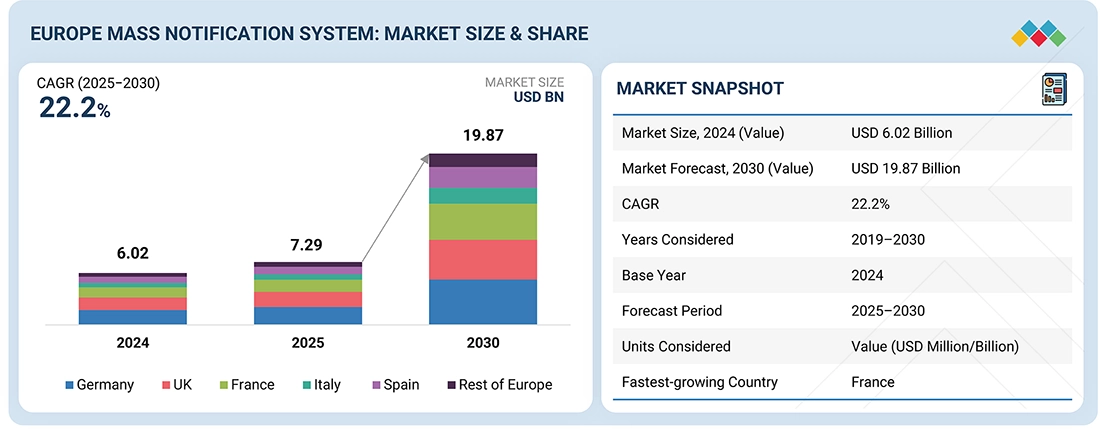
The Europe mass notification system market is projected to grow from USD 7.29 billion in 2025 to USD 19.87 billion by 2030, at a CAGR of 22.2% during the forecast period. The Europe mass notification system market is steadily expanding as organizations focus on faster and more reliable emergency communication. Growth is mainly driven by strict safety and regulatory requirements across public infrastructure, transportation, and workplaces. Rising climate-related risks and security threats are also increasing demand for real-time alerts. Enterprises and public authorities are investing in these platforms to ensure timely communication and maintain business continuity during critical events.
KEY TAKEAWAYS
-
By Communication ChannelBy communication channel, the voice communication segment is estimated to dominate the market, with a share of 40.2% in 2025.
-
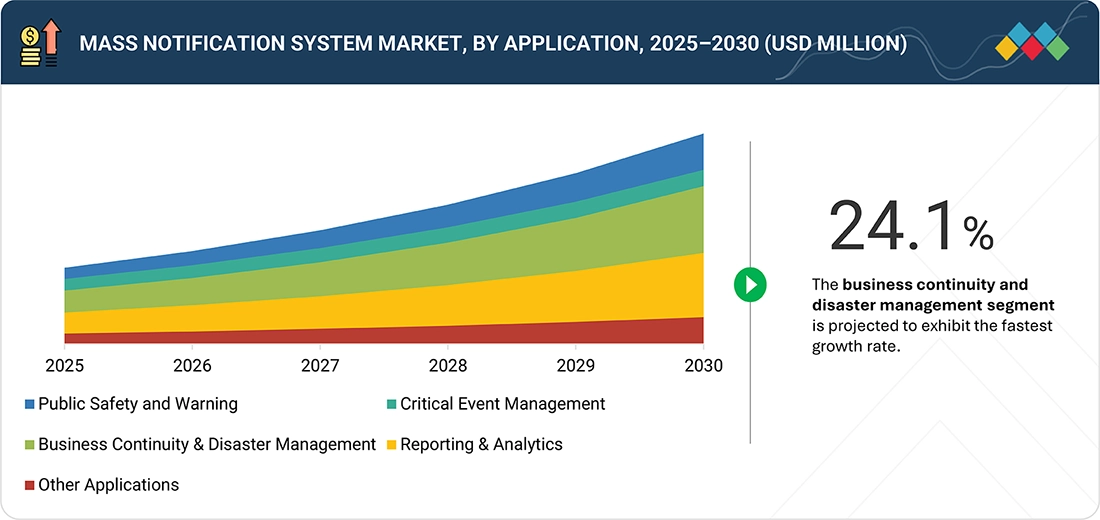
By ApplicationBy application, the business continuity and disaster management segment is anticipated to be the fastest-growing segment, with a CAGR of 24.1% during the forecast period.
-
By VerticalBy vertical, the BFSI segment is set to dominate the market in 2025.
-
Competitive Landscape - Key PlayersEaton, Johnson Controls, and Siemens AG were identified as leading players in the Europe mass notification system market due to their strong product innovation, broad industry coverage, and solid operational and financial performance.
-
Competitive Landscape - StartupsRegroup Mass Notification, Crises Control, and CrisisGo have distinguished themselves among startups and SMEs through robust product portfolios and effective business strategies.
Content
TRENDS & DISRUPTIONS IMPACTING CUSTOMERS' CUSTOMERS
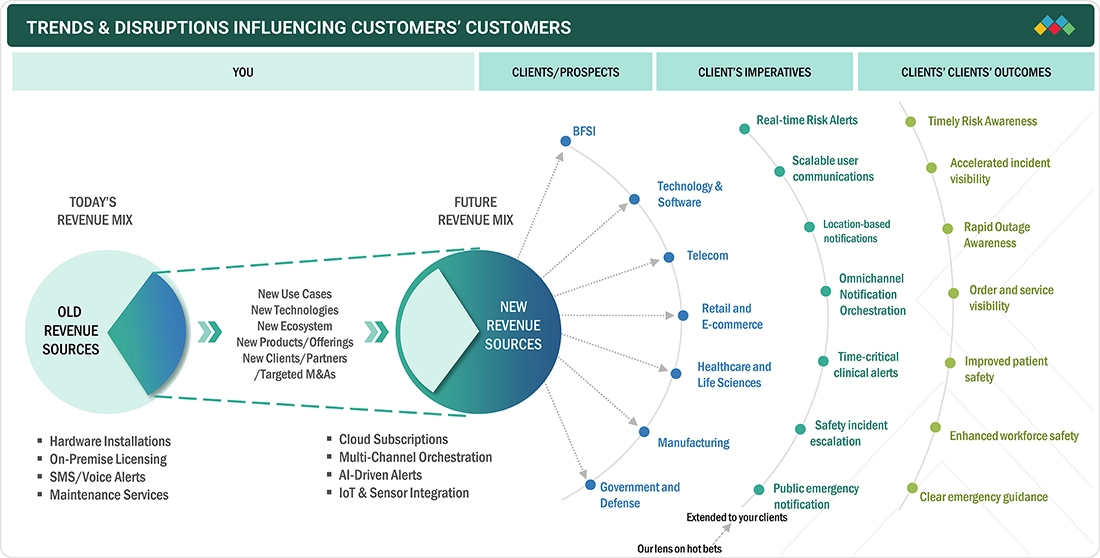
The Europe mass notification system market is estimated to grow at a CAGR of 22.2% by value during the forecast period. The market is expanding due to increasing safety concerns, technological advancements, and the need for real-time communication. Organizations seek efficient ways to disseminate critical information during emergencies, driving the demand for versatile notification solutions. Additionally, the integration of mobile devices and social media platforms has further fueled the growth by enhancing accessibility and reach. This convergence is expected to change the business revenue mix for Europe mass notification system vendors in the next 3–5 years.
Source: Secondary Research, Interviews with Experts, MarketsandMarkets Analysis
MARKET DYNAMICS

Level
-
Enforcement of EU Emergency Alert and Cell Broadcast Regulations

-
Enterprise Shift Toward Cloud-based, Multi-Channel Notification Platforms


Level
-
High Integration Costs with Legacy Communication Infrastructure

-
Reliance on Telecom Operators Slowing Cell Broadcast Implementation


Level
-
Demand for Cross-Border and Multi-Agency Alert Interoperability

-
Adoption of AI-Enabled Predictive and Context-Aware Alerting


Level
-
Managing Cybersecurity Risks in Critical Alerting Platforms

-
Ensuring Message Delivery During Network Congestion and Failures

Source: Secondary Research, Interviews with Experts, MarketsandMarkets Analysis
Driver: Enforcement of EU Emergency Alert and Cell Broadcast Regulations
Regulatory mandates across Europe are a major driver for mass notification system adoption. Governments are implementing national public warning frameworks aligned with EU emergency communication requirements. These rules require authorities to deploy reliable alerting systems that can reach large populations quickly during emergencies. Cell broadcast adoption has increased the need for centralized platforms that manage alerts across multiple channels. Public agencies, municipalities, and transport authorities must comply with defined standards for message delivery, testing, and reporting. As compliance deadlines approach, organizations are investing in modern mass notification systems to meet legal obligations and ensure consistent emergency communication.
Restraint: High Integration Costs with Legacy Communication Infrastructure
Many European organizations rely on legacy systems such as older public address networks, dispatch systems, and building controls. Integrating modern mass notification platforms with these systems requires customization and technical expertise. Integration projects increase the total cost of ownership and extend deployment timelines. Public agencies and utilities often operate mixed technology environments, which complicates upgrades. Budget constraints make it difficult to replace legacy systems entirely. As a result, organizations may postpone adoption or limit deployments to basic features. High integration effort remains a key restraint, especially for large and complex infrastructure environments.
Opportunity: Demand for Cross-Border and Multi-Agency Alert Interoperability
Europe’s interconnected transport networks and open borders create a need for coordinated emergency communication. Travelers, logistics operators, and cross-border workers require consistent alerts across regions. Interoperability solutions that align message formats, standards, and languages address this need. Platforms that support coordination between agencies and countries are valuable for large-scale incidents and major events. As regional cooperation increases, demand grows for systems that enable seamless information sharing. This presents an opportunity for vendors to support regional resilience and large public-sector programs.
Challenge: Managing Cybersecurity Risks in Critical Alerting Platforms
Mass notification systems are critical assets and attractive targets for cyberattacks. Unauthorized access or false alerts could cause panic and loss of trust. Vendors must protect platforms against ransomware, service disruption, and misuse. Strong security controls, monitoring, and access management are essential. Public agencies demand high assurance, which increases development and compliance effort. Cybersecurity incidents would have a profound reputational impact. Maintaining secure operations while supporting cloud connectivity and system integration remains a major and ongoing challenge for providers.
EUROPE MASS NOTIFICATION SYSTEM MARKET: COMMERCIAL USE CASES ACROSS INDUSTRIES
| COMPANY | USE CASE DESCRIPTION | BENEFITS |
|---|---|---|
 |
Austal collaborated with Eaton to implement the SmartWire-DT wiring system, solving accelerated ship electrical panel design and build challenges. | The solution reduced design and construction time for control panels, streamlined wiring processes, and enhanced diagnostic capabilities during operation. |
 |
Kugler Precision deployed Netpresenter’s Digital Signage and Corporate Screensavers to inform all employees, addressing communication gaps for staff without regular PC access. | Internal communication became faster, more targeted, visually engaging, and reliably reached employees without PC access, improving information visibility. |
 |
A leading international aviation operator implemented Crises Control incident management software to replace slow communication, enabling instant alerts and streamlined emergency response. | The solution improved response times, ensured prompt notification of key personnel, simplified incident handling, and enhanced operational continuity. |
Logos and trademarks shown above are the property of their respective owners. Their use here is for informational and illustrative purposes only.
MARKET ECOSYSTEM
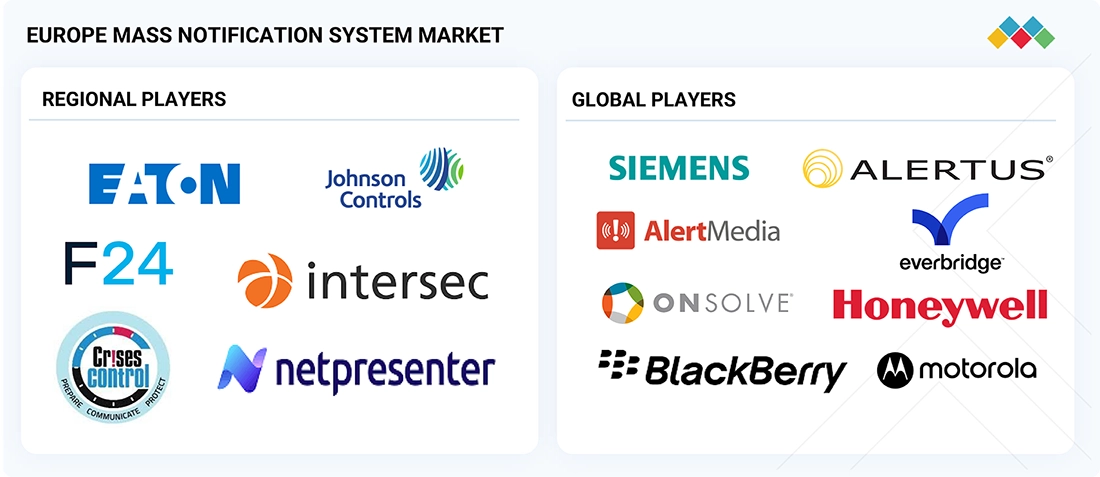
The Europe mass notification system market ecosystem includes a mix of regional and global players addressing diverse safety and communication needs. Regional players such as Crises Control, Eaton, and Johnson Controls focus on localized compliance, critical infrastructure coverage, and integrated safety systems. Global players, including Siemens, AlertMedia, and OnSolve, bring scalable platforms, advanced analytics, and multi-region deployment capabilities, supporting large enterprises and cross-border emergency communication requirements.
Logos and trademarks shown above are the property of their respective owners. Their use here is for informational and illustrative purposes only.
MARKET SEGMENTS
Source: Secondary Research, Interviews with Experts, MarketsandMarkets Analysis
Europe Mass Notification System Market, By Offering
Public warning & emergency alerting platforms are deployed across governments, telecommunications, and public sectors to deliver alerts specifically to people in affected areas using location data. Across European countries, governments are legally required to operate population-wide emergency alert systems to create non-discretionary, recurring demand for public warning platforms.
Europe Mass Notification System Market, By Communication Channel
Voice communication remains a key channel because of its clarity, immediacy, and effectiveness across diverse user groups. Organizations rely on voice alerts for urgent, high-impact messaging where tone, urgency, and direct comprehension matter. This channel supports landlines, mobile devices, and integrated PA systems, ensuring reliable delivery during critical moments.
Europe Mass Notification System Market, By Application
Public safety and warning applications form the backbone of the mass notification ecosystem. These systems help authorities distribute timely alerts during emergencies such as severe weather events, security breaches, and infrastructure failures. Their role in safeguarding communities and coordinating response activities drives widespread adoption across government and enterprise settings.
Europe Mass Notification System Market, By Facility Type
Outdoor facilities are increasingly deploying mass notification systems to ensure rapid communication across wide, open environments. Solutions such as outdoor speakers, sirens, and integrated digital signage help convey instructions during emergencies in locations like industrial parks, transportation hubs, and stadiums. Their coverage range and durability make them suitable for high-traffic, distributed spaces.
Europe Mass Notification System Market, By Vertical
BFSI organizations rely on mass notification systems to maintain business continuity, protect employees and customers, and respond swiftly to operational or security-related disruptions. These systems support crisis communication, fraud alerts, evacuation coordination, and IT outage notifications. Strong compliance requirements and the need for resilient communication drive adoption across banks, insurance companies, and financial institutions.
REGION
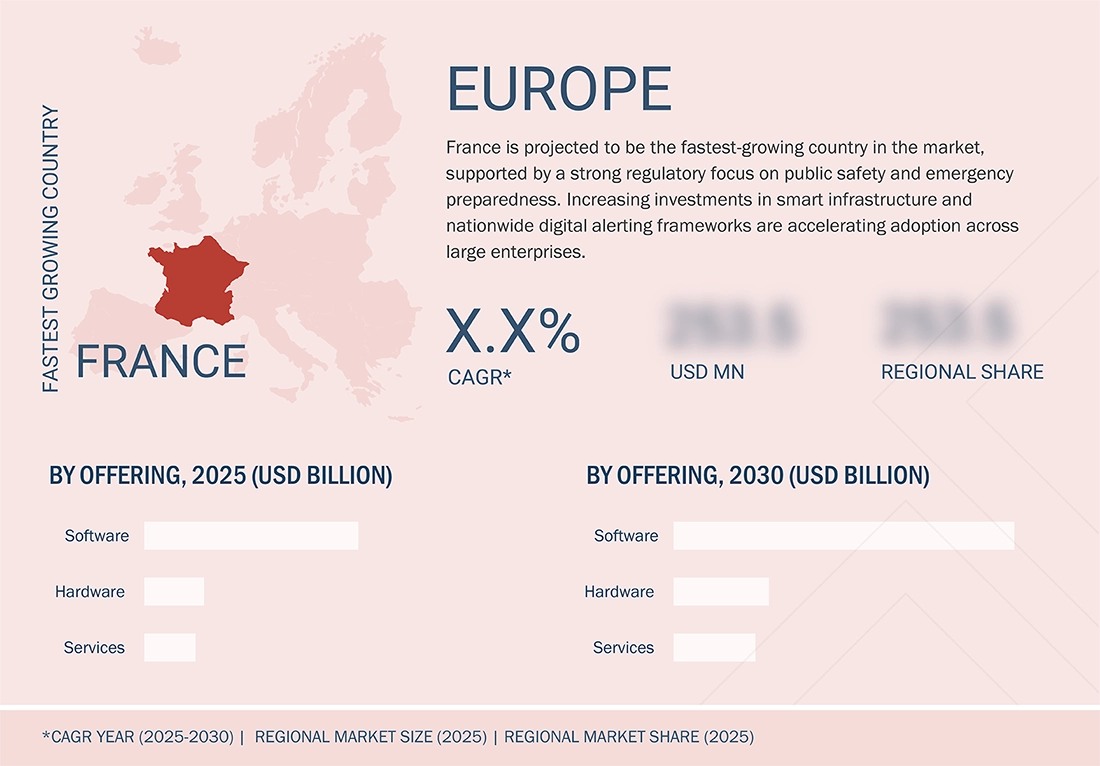
France to be fastest-growing country in Europe mass notification system during forecast period
France is projected to be the fastest-growing country in the Europe mass notification system market due to rising demand for advanced alerting solutions across public safety, critical infrastructure, and large enterprises. Government initiatives to improve emergency communications, increased focus on cyber-physical threat response, and investment in digital public warning systems are driving growth. Strong adoption of cloud-enabled and AI-assisted notification platforms is expanding market uptake and supporting continued growth in the French market.
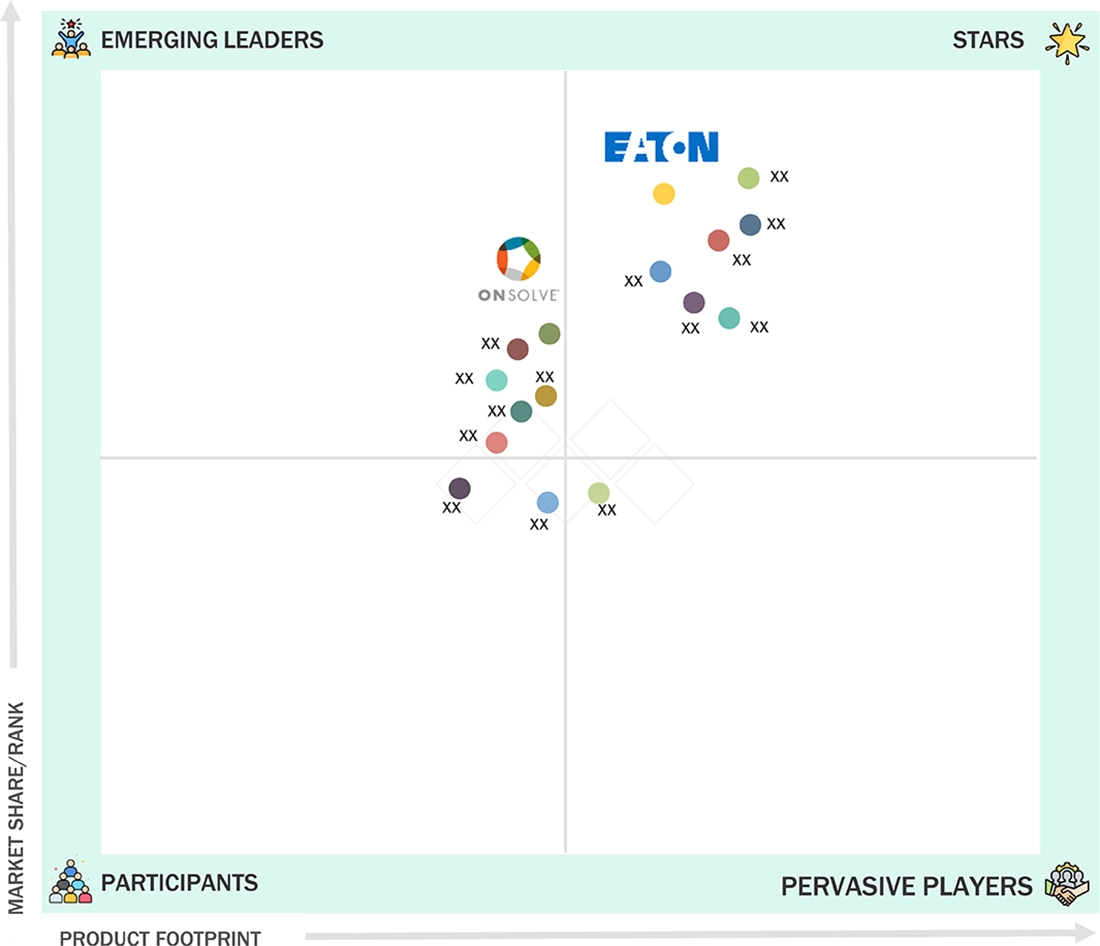
EUROPE MASS NOTIFICATION SYSTEM MARKET: COMPANY EVALUATION MATRIX
In the mass notification system market matrix, Eaton (Star) leads through its reliable emergency communication platforms and strong presence in critical infrastructure, industrial facilities, and public safety environments. Its scalable systems, integrated voice and alerting solutions, and focus on system reliability reinforce its position as a trusted market leader. OnSolve (Emerging Leader) is gaining traction with AI-enabled critical event management capabilities that support faster threat detection, risk analysis, and multi-channel alert delivery. Its emphasis on intelligent automation and data-driven decision support positions it as a growing challenger in the MNS landscape.
Source: Secondary Research, Interviews with Experts, MarketsandMarkets Analysis
KEY MARKET PLAYERS
- Siemens AG (Germany)
- Everbridge (US)
- Honeywell (US)
- Eaton (Ireland)
- Motorola Solutions (US)
- Blackberry (Canada)
- Johnson Controls (Ireland)
- OnSolve (US)
- AlertMedia (US)
- Alertus Technologies (US)
- F24 AG (Germany)
- Intersec (France)
- Crises Control (UK)
- Netpresenter (Netherlands)
MARKET SCOPE
| REPORT METRIC | DETAILS |
|---|---|
| Market Size, 2024 (Value) | USD 6.02 Billion |
| Market Forecast, 2030 (Value) | USD 19.87 Billion |
| Growth Rate | 22.2% |
| Years Considered | 2019–2030 |
| Base Year | 2024 |
| Forecast Period | 2025–2030 |
| Units Considered | Value (USD Million/Billion) |
| Report Coverage | Revenue forecast, company ranking, competitive landscape, growth factors, and trends |
| Segments Covered |
|
| Countries Covered | UK, Germany, France, Italy, Spain, Rest of Europe |
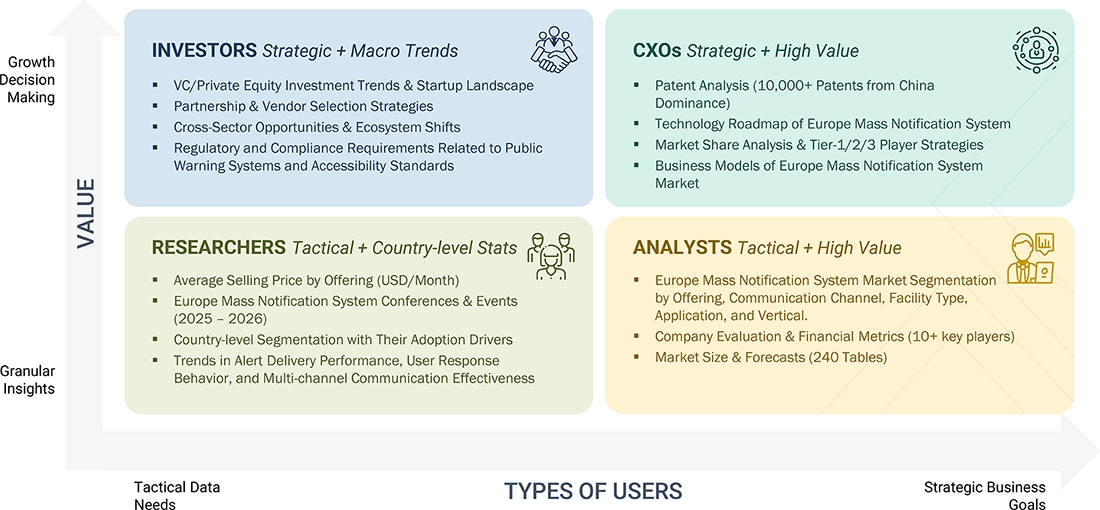
WHAT IS IN IT FOR YOU: EUROPE MASS NOTIFICATION SYSTEM MARKET REPORT CONTENT GUIDE
DELIVERED CUSTOMIZATIONS
We have successfully delivered the following deep-dive customizations:
| CLIENT REQUEST | CUSTOMIZATION DELIVERED | VALUE ADDS |
|---|---|---|
| Leading Mass Notification System Vendor |
|
|
| Leading Mass Notification System Vendor |
|
|
RECENT DEVELOPMENTS
- September 2025 : Everbridge expanded its collaboration with Johnson Controls to launch managed critical event management services. The deal combined Everbridge’s CEM platform with Johnson Controls’ managed security services, enabling organizations to improve emergency response, simplify operations, and strengthen mass notification and risk management capabilities.
- July 2024 : Altor acquired a majority stake in F24 AG and partnered with the company’s management team to support long-term growth. The deal strengthened F24’s position in Europe by enabling increased investment in crisis management and mass notification software development and regional market expansion.
- April 2024 : Johnson Controls renewed its partnership with Everbridge to further integrate critical event management and mass notification solutions with building and security systems. The collaboration helped organizations detect risks faster, coordinate responses, and deliver timely alerts across facilities using connected safety and communication platforms.
Table of Contents
 Exclusive indicates content/data unique to MarketsandMarkets and not available with any competitors.
Methodology
The research methodology for the Europe Mass Notification System market report involved the use of extensive secondary sources and directories, as well as various reputed open-source databases, to identify and collect useful information for this technical and market-oriented study. In-depth interviews were conducted with various primary respondents, including software by type; software by integration; by deployment mode; verticals; high-level executives of multiple companies offering Europe mass notification system software, hardware & services; and industry consultants to obtain and verify critical qualitative and quantitative information and assess the market prospects and industry trends.
Secondary Research
During the secondary research process, various secondary sources were consulted to identify and collect information for the study. The secondary sources included annual reports; press releases and investor presentations of companies; white papers, certified publications.
The secondary research was utilized to gather key information about the industry’s value chain, the market’s monetary chain, the overall pool of key players, market classification and segmentation based on industry trends, and regional markets, as well as key developments from both market- and technology-oriented perspectives.
Primary Research
In the primary research process, a diverse range of stakeholders from both the supply and demand sides of the Europe mass notification system ecosystem were interviewed to gather qualitative and quantitative insights specific to this market. From the supply side, key industry experts, such as chief executive officers (CEOs), vice presidents (VPs), marketing directors, technology & innovation directors, as well as technical leads from vendors offering mass notification system hardware, software & services, were consulted. Additionally, system integrators, service providers, and IT service firms that implement and support the Mass notification system solutions were included in the study. On the demand side, input from IT decision-makers, infrastructure managers, and business heads of prominent industry verticals was collected to understand the user perspectives and adoption challenges within targeted industries.
The primary research ensured that all crucial parameters affecting the Europe mass notification system market, from technological advancements and evolving use cases to regulatory and compliance needs, were considered. Each factor was thoroughly analyzed, verified through primary research, and evaluated to obtain precise quantitative and qualitative data for this market.
Once the initial phase of market engineering was completed, including detailed calculations for market statistics, segment-specific growth forecasts, and data triangulation, a second round of primary research was conducted. This step was crucial for refining and validating critical data points, such as Mass notification system offerings (hardware, software & services), industry adoption trends, the competitive landscape, and key market dynamics like demand drivers (Growing need for real-time, multi-channel emergency communication across organizations, Regulatory and industry-mandated requirements for emergency preparedness), challenges Balancing ease of access with strong security posture across devices and external users, Managing cross-channel consistency, false alarms, and governance across large distributed organizations), and opportunities (Advanced content lifecycle automation, intelligent sync, and metadata-driven governance, Expansion into AI-driven alert automation, multilingual messaging, and behavioral response analytics) and restraints (Balancing ease of access with strong security posture across devices and external users, Managing cross-channel consistency, false alarms, and governance across large distributed organizations).
In the comprehensive market engineering process, the top-down and bottom-up approaches, along with several data triangulation methods, were extensively employed to perform market estimation and forecasting for the overall market segments and subsegments listed in this report. Extensive qualitative and quantitative analysis was performed on the complete market engineering process to record the critical information/insights throughout the report.
Market Size Estimation
The top-down and bottom-up approaches were employed to estimate and forecast the Europe Mass Notification System market, as well as its dependent submarkets. This multi-layered analysis was further reinforced through data triangulation, which incorporated primary and secondary research inputs. The market figures were also validated against the existing MarketsandMarkets repository for accuracy.
Europe Mass Notification System Market : Top-Down and Bottom-Up Approach
Data Triangulation
The market was divided into several segments and subsegments after determining the overall market size using the market size estimation processes described above. To complete the overall market engineering process and determine the exact statistics for each market segment and subsegment, data triangulation and market segmentation procedures were employed, wherever applicable. The overall market size was then used in the top-down approach to estimate the size of other individual markets by applying percentage splits to the market segmentation.
Market Definition
According to Everbridge, a mass notification system is a vital solution that enables the prompt and precise delivery of notifications to individuals or groups, irrespective of their location. It is a comprehensive platform, swiftly disseminating emergency messages through various communication channels like voice calls, SMS, push notifications, desktop alerts, and social media. By utilizing visual intelligence and user-friendly interfaces, a mass notification system ensures that the right message reaches the intended recipients during critical events, regardless of their devices or physical whereabouts. This system plays a pivotal role in protecting people, securing operations, and safeguarding the reputation of organizations by facilitating timely and accurate communication.
Key Stakeholders
- Mass Notification System Vendors
- Mass Notification Software Vendors
- Managed Service Providers
- Support and Maintenance Service Providers
- System Integrators (SIs)/Migration Service Providers
- Distributors and Value-added Resellers (VARs)
- Independent Software Vendors (ISVs)
- Cloud Service Providers
- Technology Providers
Report Objectives
- To define, describe, and predict the Europe mass notification system market by offering (software, hardware, and services), communication channel, facility type, application, vertical, and region
- To provide detailed information related to major factors (drivers, restraints, opportunities, and industry-specific challenges) influencing market growth
- To analyze opportunities in the market and provide details of the competitive landscape for stakeholders and market leaders
- To analyze each submarket with respect to individual growth trends, prospects, and contributions to the overall Europe mass notification system market
- To analyze competitive developments, such as partnerships, new product launches, mergers & acquisitions, in the Europe mass notification system market
- To analyze the impact of macroeconomic factors on the Europe Mass Notification System market across all regions
Available Customizations
With the given market data, MarketsandMarkets offers customizations based on the company’s specific needs. The following customization options are available for the report.
Product Analysis
- Product comparative analysis, which gives a detailed comparison of innovative products being offered by prominent vendors
Geographic analysis
- Further breakup of additional Europe countries by offering, communication channel, facility type, application and vertical
- Further breakup of additional Asia Pacific countries by offering, communication channel, facility type, application and vertical
- Further breakup of additional Middle East & Africa countries by offering, communication channel, facility type, application and vertical
- Further breakup of additional Latin America countries by offering, communication channel, facility type, application and vertical
Company information
- Detailed analysis and profiling of additional market players (up to five)
Key Questions Addressed by the Report
What is the current size of the Europe Mass Notification System market?
The Europe Mass Notification System market is projected to grow from USD 7.29 billion in 2025 to USD 19.87 billion by 2030, driven by rising investments in emergency communication and public safety technologies.
What is the expected growth rate of the Europe Mass Notification System market?
The market is expected to register a Compound Annual Growth Rate (CAGR) of 22.2% from 2025 to 2030, supported by increasing demand for critical event management and business continuity solutions across Europe.
What are the key factors driving the Europe Mass Notification System market?
The market is growing due to stricter workplace safety regulations, increased focus on emergency preparedness, rising adoption of cloud-based communication platforms, growing cybersecurity concerns, and the need for real-time multi-channel notification systems.
Which application is expected to lead the Europe Mass Notification System market?
The Critical Event Management segment is expected to account for the largest market share during the forecast period, as organizations increasingly prioritize rapid incident response, operational resilience, and employee safety.
Which offering segment holds the largest share in the Europe Mass Notification System market?
The software segment is expected to hold the largest market share, driven by growing adoption of cloud-native notification platforms, AI-enabled alerting, and centralized emergency communication systems.
Who are the leading companies in the Europe Mass Notification System market?
Key players operating in the Europe Mass Notification System market include Eaton, Johnson Controls, and Siemens AG, which are strengthening their market positions through product innovation, strategic partnerships, and expansion across the European region.


Personalize This Research
- Triangulate with your Own Data
- Get Data as per your Format and Definition
- Gain a Deeper Dive on a Specific Application, Geography, Customer or Competitor
- Any level of Personalization
Let Us Help You
- What are the Known and Unknown Adjacencies Impacting the Europe Mass Notification System Market
- What will your New Revenue Sources be?
- Who will be your Top Customer; what will make them switch?
- Defend your Market Share or Win Competitors
- Get a Scorecard for Target Partners

Custom Market Research Services
We Will Customise The Research For You, In Case The Report Listed Above Does Not Meet With Your Requirements
Get 10% Free CustomisationTESTIMONIALS






Growth opportunities and latent adjacency in Europe Mass Notification System Market