Europe Real-time Location Systems (RTLS) Market

Europe Real-time Location Systems (RTLS) Market by Offering (Tags/Badges, Readers/Trackers/Access Points), Technology (RFID, Wi-Fi, UWB, BLE, Infrared, Ultrasound, GPS, Zigbee), Application (Inventory Tracking, Personnel Tracking) - Forecast to 2030




OVERVIEW
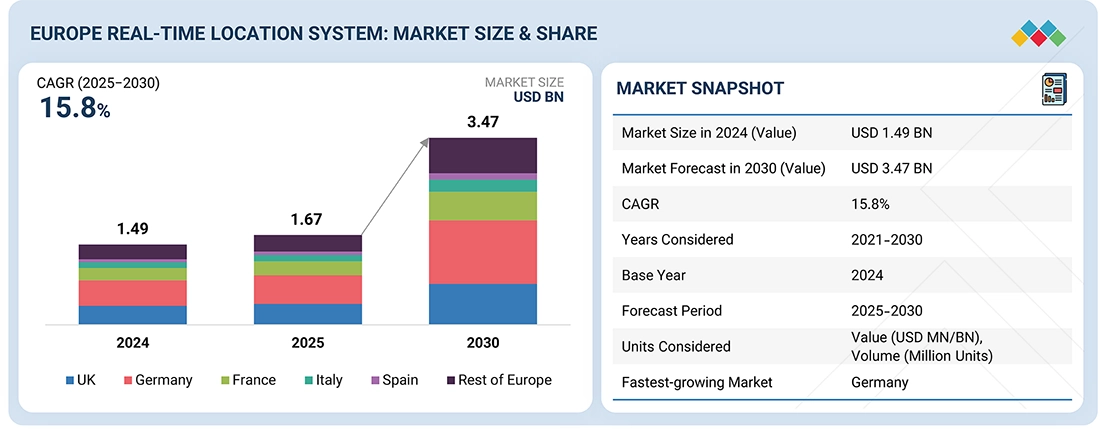
Source: Secondary Research, Interviews with Experts, MarketsandMarkets Analysis
The Europe real-time location system (RTLS) market is anticipated to expand from USD 1.64 billion in 2025 to USD 4.71 billion by 2030, at a CAGR of 15.8% during the period from 2025 to 2030. This growth is facilitated by the development of cost-effective, industry-specific RTLS solutions from agile European start-ups and established vendors, as well as the increasing adoption of RTLS tags for asset and personnel tracking, thereby offering substantial return on investment across manufacturing, healthcare, and logistics sectors.
KEY TAKEAWAYS
-
BY COUNTRYGermany is projected to register the fastest growth with a CAGR of 17.2%.
-
BY TECHNOLOGYThe Wi-Fi technology segment held the largest market share of 32.1% in 2024.
-
BY VERTICALThe transportation & logistics segment is expected to grow at the highest CAGR of 18.8%.
-
COMPETITIVE LANDSCAPE - KEY PLAYERSSecuritas Technology, Zebra Technologies Corp., and Impinj, Inc. were identified as some of the star players in the Europe RTLS market, given their strong market share and product footprint.
-
COMPETITIVE LANDSCAPE - STARTUPS/SMESQuuppa and Pozxy have distinguished themselves among startups and SMEs due to their strong product portfolio and business strategy.
The Europe real-time location system (RTLS) market is expanding steadily, driven by stringent workplace safety regulations and the drive for operational efficiency across manufacturing, healthcare, logistics, and mining. Adoption is accelerating in German automotive plants, Dutch and Belgian ports (container & equipment monitoring), and Scandinavian hospitals (patient/staff flow and asset management). Cost-effective UWB, BLE, and hybrid solutions, paired with cloud-based platforms and AI analytics, deliver sub-meter accuracy and seamless integration with existing ERP and IoT systems.
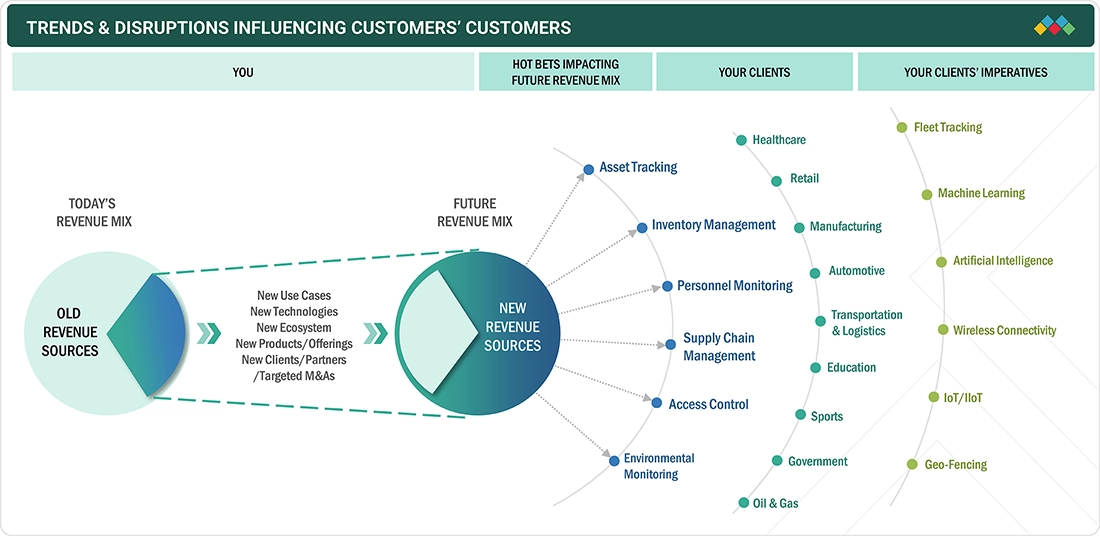
TRENDS & DISRUPTIONS IMPACTING CUSTOMERS' CUSTOMERS
Emerging technologies are poised to disrupt traditional revenue streams by shifting the future revenue mix toward innovation-driven solutions. Key growth areas, such as asset tracking, inventory management, supply chain optimization, and environmental monitoring, are driving demand across industries, including healthcare, retail, manufacturing, and logistics. Disruptive enablers, including IoT/IIoT, AI, machine learning, and wireless connectivity, are accelerating this shift, creating opportunities in fleet tracking, geofencing, and smart monitoring. This transition underscores the need for businesses to adopt new technologies to stay competitive and capture high-growth revenue streams.
Source: Secondary Research, Interviews with Experts, MarketsandMarkets Analysis
MARKET DYNAMICS

Level
-
High emphasis on safety, compliance, and operational efficiency across enterprises in Europe

-
Rising need for real-time visibility of assets in European industries


Level
-
Data security and privacy issues

-
High installation and maintenance costs


Level
-
Increasing demand for hybrid RTLS solutions

-
Emerging applications of RTLS technology


Level
-
Persistent trade-offs in RTLS design

-
Interoperability issues due to lack of standardized protocols

Source: Secondary Research, Interviews with Experts, MarketsandMarkets Analysis
Driver: High emphasis on safety, compliance, and operational efficiency across enterprises in Europe
Europe’s rigorous focus on workplace safety, regulatory compliance, and efficiency is driving RTLS adoption across manufacturing, healthcare, logistics, and mining. EU-OSHA directives and safety standards require real-time tracking of personnel, equipment, and hazardous zones to prevent incidents and maintain audit-ready records. RTLS provides immediate visibility for emergency response, geofencing, and process optimization, helping organizations meet strict obligations while improving productivity in highly regulated environments.
Restraint: High installation and maintenance costs
High installation and maintenance costs remain a significant restraint for RTLS adoption in Europe, particularly for large-scale deployments in manufacturing plants, hospitals, and logistics facilities. Upfront expenses include hardware (tags, anchors, readers), network infrastructure upgrades, and professional integration services, while ongoing costs cover battery replacements, software updates, and periodic calibration to maintain accuracy. These financial barriers are especially challenging for mid-sized enterprises and public-sector organizations with limited budgets, often delaying or limiting RTLS rollout despite the technology’s proven long-term benefits in efficiency and safety.
Opportunity: Emerging applications of RTLS technology
The Europe RTLS market is unlocking significant new opportunities as the technology extends beyond traditional asset tracking into innovative applications such as worker safety in hazardous environments, automated guided vehicle (AGV) navigation in smart factories, and real-time patient flow management in hospitals. Emerging use cases include geofencing for restricted zones in mining and chemical plants, collision avoidance in busy ports, and indoor positioning for augmented reality maintenance in manufacturing. These advanced applications, combined with the integration of RTLS with IoT, 5G, and AI analytics, are creating high-value solutions that improve safety, productivity, and decision-making across industries.
Challenge: Interoperability issues due to lack of standardized protocols
Interoperability remains a major challenge in Europe's RTLS market due to the absence of universally accepted protocols across UWB, BLE, Wi-Fi, and RFID technologies. This fragmentation forces enterprises to contend with compatibility issues when integrating systems from different vendors, resulting in complex custom integrations, higher engineering costs, and limited scalability. In multi-vendor environments common in European manufacturing plants, hospitals, and logistics hubs, the lack of standardized protocols often creates data silos, reduces accuracy, and slows deployment, hindering broader adoption despite strong safety and efficiency drivers.
EUROPE REAL-TIME LOCATION SYSTEMS (RTLS) MARKET: COMMERCIAL USE CASES ACROSS INDUSTRIES
| COMPANY | USE CASE DESCRIPTION | BENEFITS |
|---|---|---|
 |
RTLS solutions for healthcare asset tracking and staff workflow optimization in Hull University Teaching Hospital (UK), where systems track medical equipment like IV pumps and wheelchairs in real-time to improve availability | Improved operational efficiency, reduced equipment loss, enhanced patient care by ensuring quick access to critical assets |
 |
RTLS systems for hospitals to track medical devices, monitor patients, and ensure staff safety, as implemented in Turku University Hospital (Finland) for staff protection and emergency response in high-risk areas | Increased patient and staff safety, optimized asset utilization, and compliance with EU healthcare standards like GDPR for data handling |
 |
RTLS for smart manufacturing and logistics to enable automated workflows, such as in Volkswagen Autoeuropa (Portugal), for worker positioning and collision avoidance in automotive assembly lines | Higher productivity, real-time insights, minimized downtime with automated safety alerts, and process optimization |
Logos and trademarks shown above are the property of their respective owners. Their use here is for informational and illustrative purposes only.
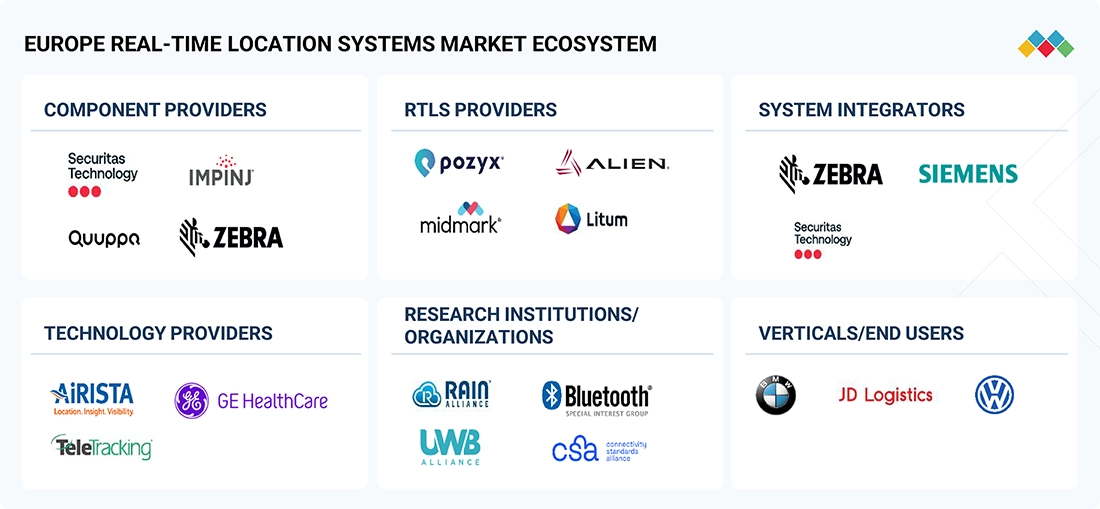
MARKET ECOSYSTEM
The Europe RTLS ecosystem encompasses key components, such as hardware and software, which include tags, readers, antennas, and positioning software, utilizing RFID, UWB, BLE, Wi-Fi, and GPS technologies. These systems are employed in asset and personnel tracking, workflow optimization, and inventory management across the healthcare, manufacturing, logistics, and retail sectors. It involves a variety of services, including installation, integration, maintenance, and data analytics. The hardware types include tags, sensors, gateways, and handheld readers, all functioning to deliver real-time location data, thereby enhancing visibility and operational efficiency.
Logos and trademarks shown above are the property of their respective owners. Their use here is for informational and illustrative purposes only.
MARKET SEGMENTS
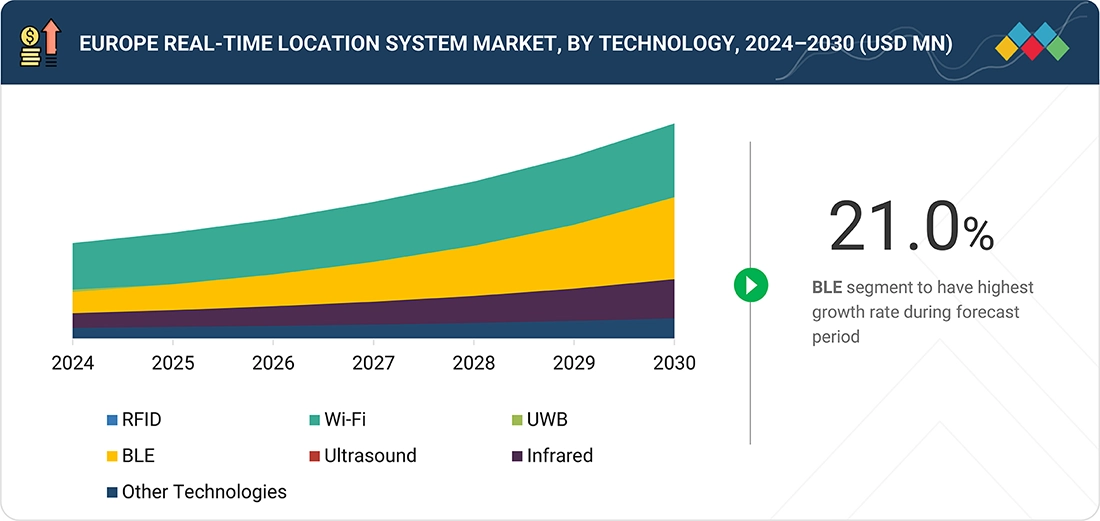
Source: Secondary Research, Interviews with Experts, MarketsandMarkets Analysis
Real-time Location System Market, By Technology
In Europe, the Bluetooth Low Energy (BLE) segment is poised for strong growth in the RTLS market, driven by low power consumption, cost-effectiveness, and seamless deployment. BLE’s extended battery life and minimal maintenance make it ideal for Europe’s large hospital networks, smart factories, and logistics facilities that require continuous tracking with low operational overhead. Its strong signal performance in dense, multi-structure environments aligns well with the region’s older building architecture and complex industrial sites. As European organizations accelerate digitalization under Industry 4.0 and sustainability goals, BLE is emerging as a preferred RTLS technology for scalable, energy-efficient, and budget-friendly deployments.
Real-time Location System Market, By Vertical
The Europe RTLS market in transportation and logistics is growing as operators adopt real-time tracking to improve fleet visibility, streamline warehouse workflows, and ensure timely deliveries amid increasingly complex supply chains. Rising cross-border e-commerce activity and stricter EU regulations on worker safety and cargo security are accelerating RTLS adoption for asset monitoring, yard management, and trailer tracking. With well-developed logistics corridors, modernized ports, and widespread digital infrastructure across Western and Central Europe, RTLS deployments are scaling rapidly across warehouses, distribution hubs, and transportation networks.
REGION
Germany is expected to be the fastest-growing country across Europe RTLS market during the forecast period.
Germany’s RTLS market is growing as the country accelerates Industry 4.0 adoption across advanced manufacturing, automotive, and logistics sectors, driving demand for real-time asset and workforce visibility. Strong investments in smart factories, automation, and digital supply chains are prompting enterprises to deploy RTLS to improve efficiency, traceability, and safety. Additionally, Germany’s highly regulated industrial environment and emphasis on precision and operational reliability further support widespread RTLS integration.

EUROPE REAL-TIME LOCATION SYSTEMS (RTLS) MARKET: COMPANY EVALUATION MATRIX
In the Europe RTLS market matrix, Securitas Technology (Star) leads with a strong global presence and a comprehensive portfolio of RTLS technologies. It also serves a number of verticals, including healthcare, manufacturing, and automotive. GE Healthcare (Emerging Leader) is gaining momentum with innovative RTLS solutions in the healthcare vertical.

Source: Secondary Research, Interviews with Experts, MarketsandMarkets Analysis
KEY MARKET PLAYERS
- Securitas AB (Sweden)
- Zebra Technologies Corp. ( US)
- Impinj, Inc. (US)
- Siemens (Germany)
- GE Healthcare (US)
- Qorvo Inc. (US)
- Alien Technology, LLC (US)
- TeleTracking Technologies, Inc. (US)
- Midmark Corporation (US)
- Litum (Turkey)
MARKET SCOPE
| REPORT METRIC | DETAILS |
|---|---|
| Market Size in 2024 (Value) | USD 1.49 BN |
| Market Forecast in 2030 (Value) | USD 3.47 BN |
| Growth Rate | 15.8% |
| Years Considered | 2021–2030 |
| Base Year | 2024 |
| Forecast Period | 2025–2030 |
| Units Considered | Value (USD Million/Billion), Volume (Million Units) |
| Report Coverage | Revenue forecast, company ranking, competitive landscape, growth factors, and trends |
| Segments Covered |
|
| Regional Scope | Europe (UK, Germany, France, Italy, Spain, Rest of Europe) |
WHAT IS IN IT FOR YOU: EUROPE REAL-TIME LOCATION SYSTEMS (RTLS) MARKET REPORT CONTENT GUIDE
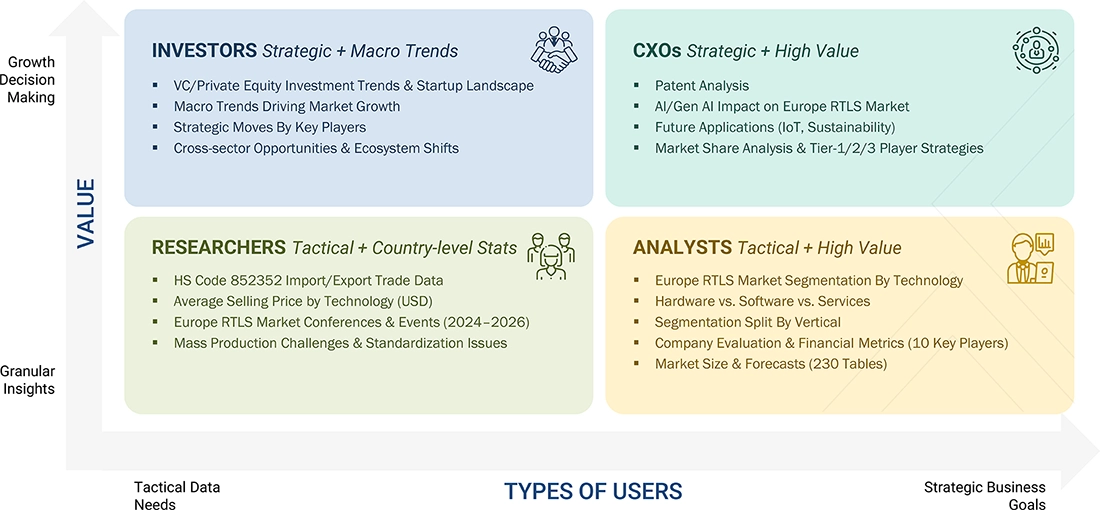
DELIVERED CUSTOMIZATIONS
We have successfully delivered the following deep-dive customizations:
| CLIENT REQUEST | CUSTOMIZATION DELIVERED | VALUE ADDS |
|---|---|---|
| Logistics & Distribution Operator |
|
|
| Pharmaceutical Product Manufacturer |
|
|
| Automotive OEM |
|
|
RECENT DEVELOPMENTS
- January 2025: Palantir Technologies Inc. entered into a five-year, multimillion-dollar strategic partnership with Europe’s applied AI leader, Faculty, to incorporate AI-driven simulation and predictive capabilities into its Operations IQ platform. This collaboration aims to enhance hospital operations through more intelligent, data-informed decision-making.
- July 2024: TeleTracking Technologies, Inc. launched Capacity?IQ, its SaaS offering of the Capacity Management Suite. It provides hospitals with cloud-based tools to optimize bed capacity, accelerate discharges, reduce emergency department boarding, and eliminate hardware investments.
- July 2023: Impinj, Inc. released the Impinj M800 series of RAIN RFID tag chips, which help meet enterprise needs for item connectivity across global IoT deployments.
Table of Contents
 Exclusive indicates content/data unique to MarketsandMarkets and not available with any competitors.
Methodology
The study involved four major activities in estimating the current size of the Europe Real-time Location Systems (RTLS) Market. Exhaustive secondary research has been conducted to gather information on the market, adjacent markets, and the overall RTLS landscape. These findings, along with assumptions and projections, were validated through primary research involving interviews with industry experts and key stakeholders across the value chain. Both top-down and bottom-up approaches were utilized to estimate the overall market size. Subsequently, market breakdown and data triangulation techniques were applied to determine the sizes of various segments and subsegments. Two key sources, secondary and primary, were leveraged to conduct a comprehensive technical and commercial assessment of the RTLS market.
Secondary Research
Various secondary sources have been referred to in the secondary research process to identify and collect important information for this study. The secondary sources include annual reports, press releases, and investor presentations of companies; white papers; journals and certified publications; and articles from recognized authors, websites, directories, and databases. Secondary research has been conducted to obtain key information about the industry’s supply chain, the market’s value chain, the total pool of key players, market segmentation according to the industry trends (to the bottom-most level), regional markets, and key developments from market- and technology-oriented perspectives. The secondary data has been collected and analyzed to determine the overall market size, further validated by primary research.
Primary Research
Extensive primary research was conducted after gaining knowledge about the current scenario of the RTLS market through secondary research. Several primary interviews were conducted with experts from the demand and supply sides across four major regions: North America, Europe, Asia Pacific, and RoW. This primary data was collected through questionnaires, emails, and telephone interviews.
Market Size Estimation
Both top-down and bottom-up approaches have been used to estimate and validate the total size of the RTLS market. These methods have also been used extensively to estimate the size of various subsegments in the market. The following research methodology has been used to estimate the market size:
- Major players in the industry and markets have been identified through extensive secondary research.
- The industry’s value chain and market size (in terms of value) have been determined through primary and secondary research processes.
- All percentage shares, splits, and breakdowns have been determined using secondary sources and verified through primary sources.
Data Triangulation
After arriving at the overall size of the RTLS market from the market size estimation process explained above, the total market has been split into several segments and subsegments. Data triangulation and market breakdown procedures have been employed, wherever applicable, to complete the overall market engineering process and arrive at the exact statistics for all segments and subsegments of the market. The data has been triangulated by studying various factors and trends from both the demand and supply sides. Along with this, the market size has been validated using both top-down and bottom-up approaches.
Market Definition
A real-time location system (RTLS) is designed to automatically detect, identify, and track the position of objects, individuals, or targets within a defined area with high precision. These systems typically comprise location tags or badges affixed to assets or worn by personnel, a network of readers, sensors, or access points strategically deployed across the facility, and a centralized software platform that processes and visualizes location data in real time. RTLS components communicate wirelessly, leveraging a range of enabling technologies such as radio-frequency identification (RFID), Wi-Fi, ultrasound, infrared (IR), Bluetooth Low Energy (BLE), or global positioning systems (GPS) to accurately determine movement and positioning. The core objective of RTLS is to deliver continuous visibility and situational awareness across sectors, including healthcare, manufacturing, logistics, warehousing, and transportation. By providing real-time tracking of high-value assets and personnel, RTLS helps organizations improve operational efficiency, ensure safety compliance, prevent loss or theft, streamline workflow, and optimize resource utilization, making it a critical tool for data-driven decision-making in dynamic operational environments.
Key Stakeholders
- RTLS Hardware Providers
- RTLS Software Providers
- RTLS-related Service Providers
- Government Bodies and Policymakers
- Industry-standard Organizations, Forums, Alliances, and Associations
- Market Research and Consulting Firms
- Raw Material Suppliers and Distributors
- Research Institutes and Organizations
- Testing, Inspection, and Certification Providers
- Distributors and Resellers
- End Users
Report Objectives
- To define, describe, and forecast the RTLS market in terms of offering, technology, application, and vertical
- To describe and forecast the market, in terms of value, with regard to four main regions: North America, Europe, Asia Pacific, and Rest of the World (RoW), along with their respective countries
- To provide detailed information regarding major factors influencing the market growth (drivers, restraints, opportunities, and challenges)
- To provide a detailed overview of the value chain of the RTLS market
- To strategically analyze micromarkets with respect to individual growth trends, prospects, and contributions to the RTLS market
- To analyze opportunities for stakeholders by identifying high-growth segments of the RTLS market
- To strategically profile key players and comprehensively analyze their market position in terms of ranking and core competencies, along with detailing the competitive landscape for market leaders
- To analyze competitive strategies, such as product launches, expansions, mergers, and acquisitions, adopted by key market players in the RTLS market
Customization Options
With the given market data, MarketsandMarkets offers customizations according to the company’s specific needs. The following customization options are available for the report:
Company Information
- Detailed analysis and profiling of additional market players (up to 5)


Personalize This Research
- Triangulate with your Own Data
- Get Data as per your Format and Definition
- Gain a Deeper Dive on a Specific Application, Geography, Customer or Competitor
- Any level of Personalization
Let Us Help You
- What are the Known and Unknown Adjacencies Impacting the Europe Real-time Location Systems (RTLS) Market
- What will your New Revenue Sources be?
- Who will be your Top Customer; what will make them switch?
- Defend your Market Share or Win Competitors
- Get a Scorecard for Target Partners

Custom Market Research Services
We Will Customise The Research For You, In Case The Report Listed Above Does Not Meet With Your Requirements
Get 10% Free CustomisationTESTIMONIALS

Tetsuya Ohhira
Business Development Manager-Technology Business
Nikon Corporation,
Leading Japanese MNC specializing in optics and imaging productswww.nikon.com
MarketsandMarkets™ response
is quick. Their attitude is flexible and positive. Analyst Insights are globally considered and
significant. Client Services quickly respond to our inquiry and demand. Their wide range of global
surveys help us make our strategic plan.
We hope Knowledge Store will be easier to search
for a report.
VP - Marketing & Business Development
Leading Provider of Process Control Solutions
We engaged with MarketsandMarkets on a study to perform an analysis and recommend a Go-To-Market strategy for metrology and process control in the semiconductor market. The study was tailored to our targets and needs with well-defined milestones. Our overall experience with the MarketsandMarkets team was very good throughout the project in all aspects including the analysis methodologies used, the quality and depth of primary and secondary data sets, the professionalism and flexibility of the team and the ability to meet the target schedule and milestones. We want to thank MarketsandMarkets team for a job well done.






Growth opportunities and latent adjacency in Europe Real-time Location Systems (RTLS) Market