Europe Smart Cities Market

Europe Smart Cities Market by Focus Area (Transportation (Smart Ticketing, Traffic Management, Passenger Information), Building (BIM, Energy Management, Network Management, IWMS), Utility (AMI, MDM, DMS), Citizen Services) - Forecast to 2030




OVERVIEW
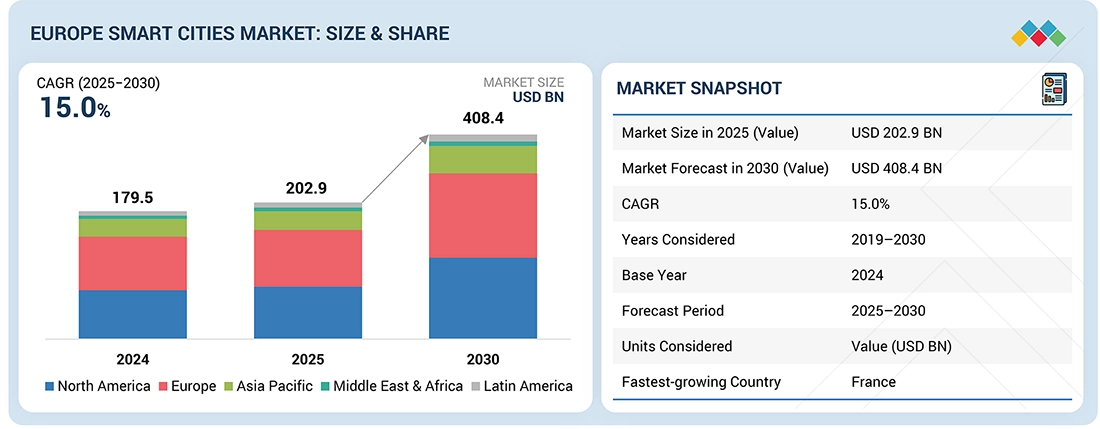
Source: Secondary Research, Interviews with Experts, MarketsandMarkets Analysis
The European smart cities market size is projected to grow from USD 202.9 billion in 2025 to USD 408.4 billion by 2030 at a CAGR of 15.0% during the forecast period. European smart cities place strong emphasis on climate neutrality and efficient use of resources. Digital technologies, such as Artificial Intelligence (AI), the Internet of Things (IoT), and data analytics, are being applied to lower emissions and improve energy management. City-level initiatives such as Paris’s Smart City Plan and Copenhagen’s urban sustainability programs focus on renewable energy, low-emission districts, and smarter infrastructure to support long-term environmental goals.
KEY TAKEAWAYS
-
By Focus AreaThe smart citizen services segment accounted for a 47.0% share in 2025.
-
By Smart TransportationThe smart ticketing segment is expected to register the highest CAGR of 17.4%.
-
By Smart BuildingThe residential segment is projected to grow the fastest from 2025 to 2030.
-
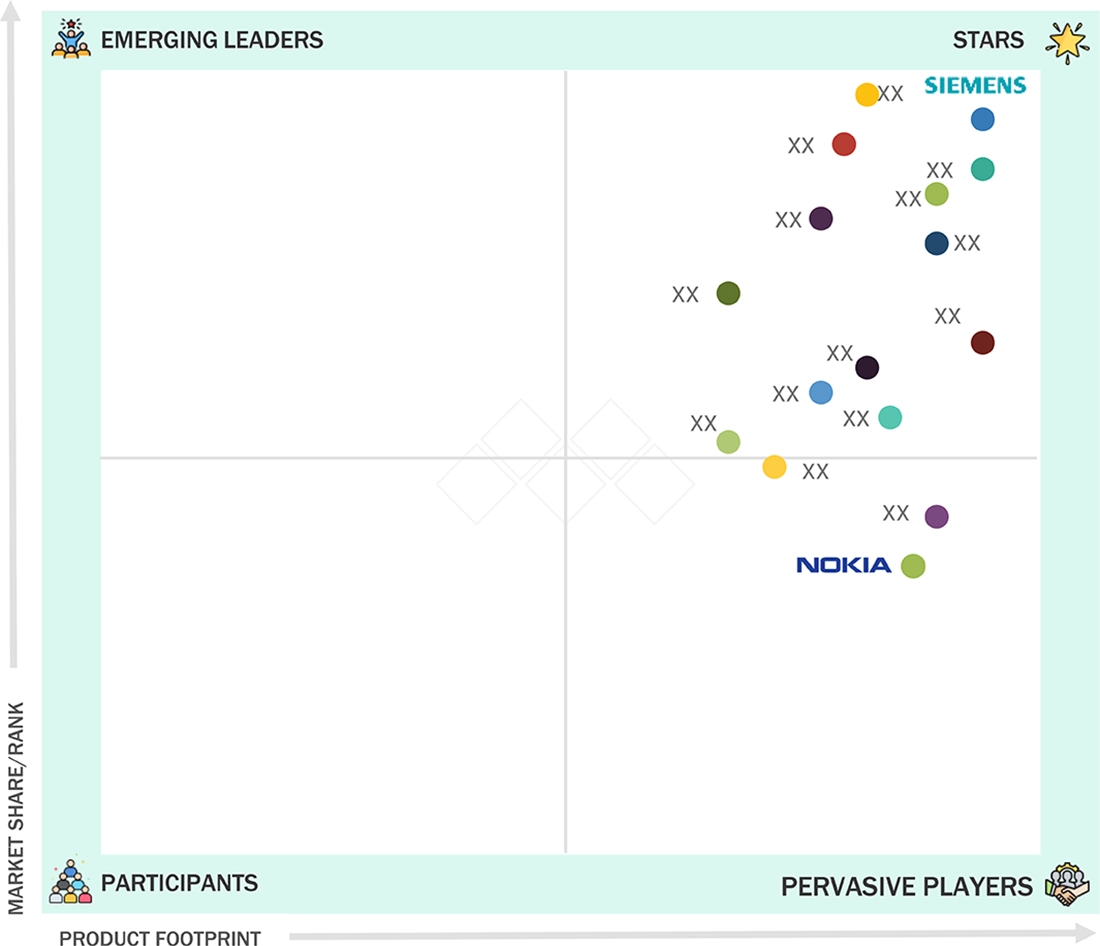
Competitive Landscape - Key PlayersCompanies such as Siemens, Schneider Electric, Ericsson, and ABB were identified as some of the star players in the Europe smart cities market, given their strong market share and product footprint.
The Europe smart cities market is shaped by established urban areas, older infrastructure, and strict environmental goals. Many cities in Western and Northern Europe need to reduce emissions, improve energy efficiency, and keep public services running without expanding outward. To address this, city authorities are relying more on digital tools to manage transport, buildings, utilities, and public spaces. This has increased the use of traffic management systems, energy monitoring tools, and city data platforms that support daily operations and long-term sustainability plans.
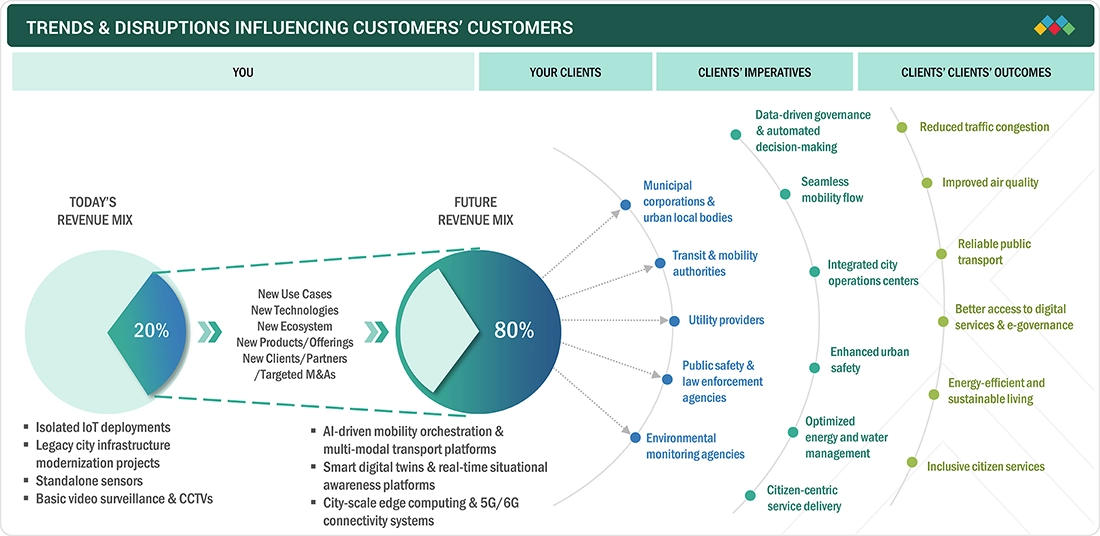
TRENDS & DISRUPTIONS IMPACTING CUSTOMERS' CUSTOMERS
The impact on customers' businesses in the Europe smart cities market is driven by increasing digitalization, smart city initiatives, and growth in smart cities. The adoption of digital technology in traffic management, utilities, and overall municipal services is increasing at a rapid pace in smart cities. The utilities sector is upgrading its energy infrastructure in smart cities to support renewable energy and manage demand in real-time. At the same time, cities are selectively exploring advanced connectivity and data-led services in areas such as transport coordination and urban healthcare. These efforts support climate targets, ease congestion, strengthen public confidence, and improve the overall quality of urban living.
Source: Secondary Research, Interviews with Experts, MarketsandMarkets Analysis
MARKET DYNAMICS

Level
-
Strong EU-level Funding for Sustainable Urban Transformation

-
Mobility as a Service (MaaS) and Integrated Multimodal Transport


Level
-
Highly Complex Regulatory Ecosystem Slowing Deployment Speed

-
High Cost of Upgrading Aging Infrastructure


Level
-
Rapid Growth of Digital Twin Deployments Across European Cities

-
Expansion of EV Charging, Smart Grid & Renewable Integration


Level
-
Limited Budget Flexibility Within Municipal Bodies

-
Interoperability & Vendor Lock-in Across EU Member States

Source: Secondary Research, Interviews with Experts, MarketsandMarkets Analysis
Driver: Strong EU-level Funding for Sustainable Urban Transformation
Europe receives strong support from European Union funding programs, including Horizon Europe, the Green Deal, and the EU Mission for Climate-Neutral and Smart Cities. More than 100 cities, such as Stockholm, Amsterdam, Copenhagen, and Barcelona, have been selected to test climate-neutral projects with a 2030 target. These programs focus on practical use cases, including digital twins, clean mobility, energy-efficient districts, and data-based city management. As sustainability targets become mandatory, cities are investing in renewable microgrids, better waste systems, electric mobility hubs, and connected digital platforms. Support from European Union funding programs is helping projects move forward more quickly and is making it easier for cities to adopt smart city technologies across the region.
Restraint: Highly Complex Regulatory Ecosystem Slowing Deployment Speed
Europe’s strict regulatory environment on data protection, including the GDPR, provisions under the AI Act, and ePrivacy directives, stands in the way of large-scale surveillance, data sharing, and behavioral analytics. Deploying sensors, camera networks, or biometric systems requires extensive compliance reviews by cities. Public resistance against facial-recognition technologies has led to projects being either suspended or modified in France, Germany, and the United Kingdom. While these regulations make data protection stronger, they also extend timelines for deployment and limit experimentation with certain advanced technologies.
Opportunity: Rapid Growth of Digital Twin Deployments Across European Cities
Several European cities are using digital twin models at the city level. Cities such as Helsinki, Rotterdam, Zurich, Vienna, and Valencia use three-dimensional city models to study traffic patterns, energy consumption, flood risk, and climate-related impacts. These models support predictive planning, emergency preparedness, and efficient urban development. European Union sustainability rules are also encouraging more regular use of digital twins, simulation tools, and GIS-based systems in city planning. As a result, these tools are moving beyond pilot use and are increasingly applied in day-to-day urban analysis. Demand is therefore rising for mapping software, simulation tools, forecasting applications, and systems that link real-time sensor data with planning platforms.
Challenge: Limited Budget Flexibility Within Municipal Bodies
A large number of smart city projects in Europe depend on European Union funding programs, innovation schemes, or national grants that come with co-financing conditions and fixed funding timelines. This funding structure can limit budget flexibility, as cities often need to design projects around eligibility rules rather than local priorities. When grant support ends, some municipalities struggle to cover ongoing operating and maintenance costs through regular budgets. This situation can restrict the long-term expansion and continuity of smart city initiatives.
EUROPE SMART CITIES MARKET: COMMERCIAL USE CASES ACROSS INDUSTRIES
| COMPANY | USE CASE DESCRIPTION | BENEFITS |
|---|---|---|
 |
Vienna Smart Infrastructure Program: Siemens supports the City of Vienna with intelligent traffic management, smart grid technologies, and digital building systems aligned with the city’s climate-neutral targets. | Lower emissions, improved energy efficiency, and optimized urban mobility across dense city zones. |
 |
Barcelona Smart City Energy Platform: Schneider Electric deployed energy management and monitoring systems across municipal buildings and public infrastructure for the Barcelona City Council. | Reduced municipal energy consumption, centralized asset visibility, and stronger compliance with European Union climate targets. |
 |
Bologna 5G Smart City Pilot (Italy): Ericsson partnered with local authorities to deploy 5G-enabled smart mobility, public safety, and environmental monitoring solutions. | Ultra-low-latency connectivity, support for autonomous transport trials, and enhanced urban data collection. |
Logos and trademarks shown above are the property of their respective owners. Their use here is for informational and illustrative purposes only.
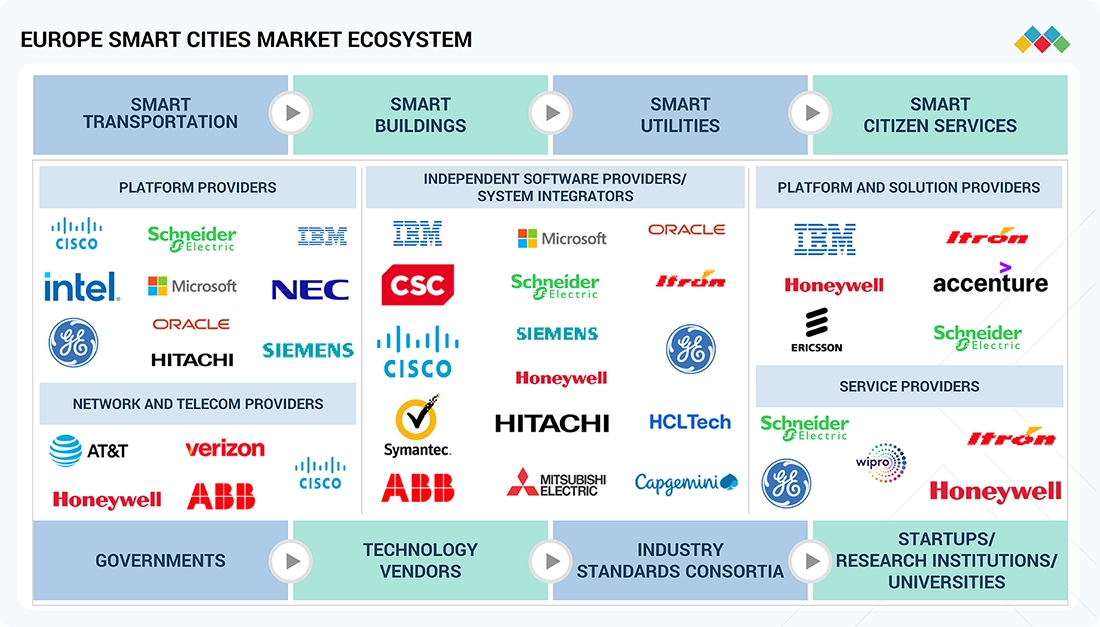
MARKET ECOSYSTEM
European smart cities have a robust ecosystem, including platform providers, telecom operators, system integrators, and public-sector innovation bodies. Technology firms such as Siemens, Schneider Electric, IBM, Ericsson, and Nokia provide the necessary platforms for smart transport, smart buildings, the operation of utilities, and citizen services. Telecom operators such as Vodafone provide the necessary connectivity through the use of 5G, FTTH, and LPWAN. System integrators provide end-to-end implementations by incorporating Artificial Intelligence, sensors, and cloud infrastructure.
Logos and trademarks shown above are the property of their respective owners. Their use here is for informational and illustrative purposes only.
MARKET SEGMENTS
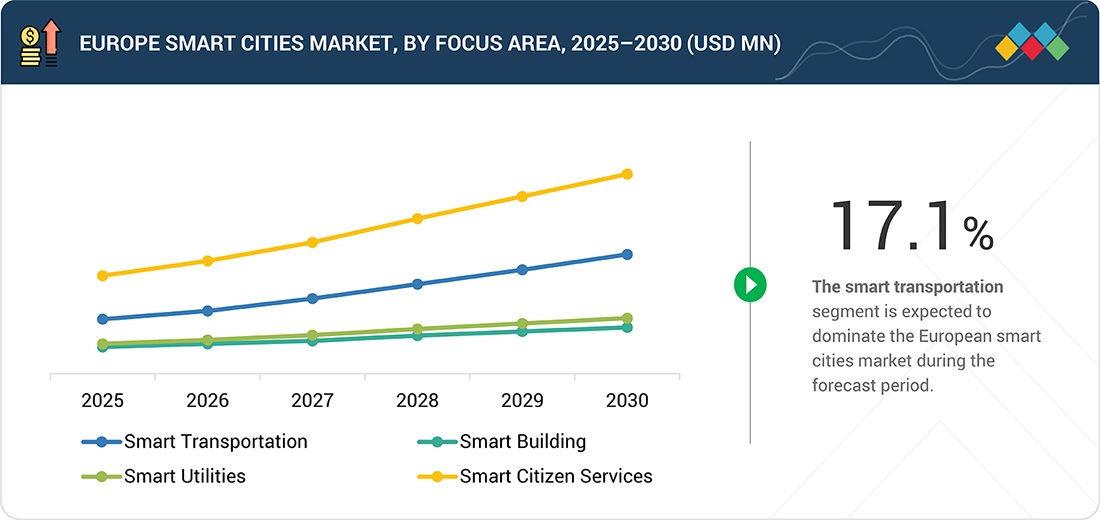
Source: Secondary Research, Interviews with Experts, MarketsandMarkets Analysis
Europe Smart Cities Market, By Smart Transportation Type
In the Europe smart cities market, by smart transportation type, roadway solutions are projected to hold the largest market share in 2025. This dominance is driven by substantial investments in intelligent traffic management, smart parking, and connected vehicle technologies, which are critical for reducing congestion and improving urban mobility. Roadway-focused solutions rely on sensor networks, real-time traffic data, and analytics to optimize signal control, enhance road safety, and support electric vehicle traffic. As European cities continue to upgrade road infrastructure and promote sustainable mobility, roadway solutions remain the primary area of smart transportation spending.
Europe Smart Cities Market, By Smart Building Solution
Energy management is growing faster than other smart building solutions in Europe over the forecast period. This growth is closely linked to European Union policies such as the revised Energy Performance of Buildings Directive (EPBD) and the Fit-for-55 framework, which place tighter limits on building energy use. New construction and renovation projects increasingly require energy monitoring and control systems to meet these requirements. Demand is also supported by Europe’s large base of older buildings that need efficiency upgrades. Wider use of Internet of Things (IoT) sensors and Artificial Intelligence (AI) tools is helping simplify system deployment and routine operation. Financial incentives for renewable energy and continued pressure from energy costs further support adoption.
REGION
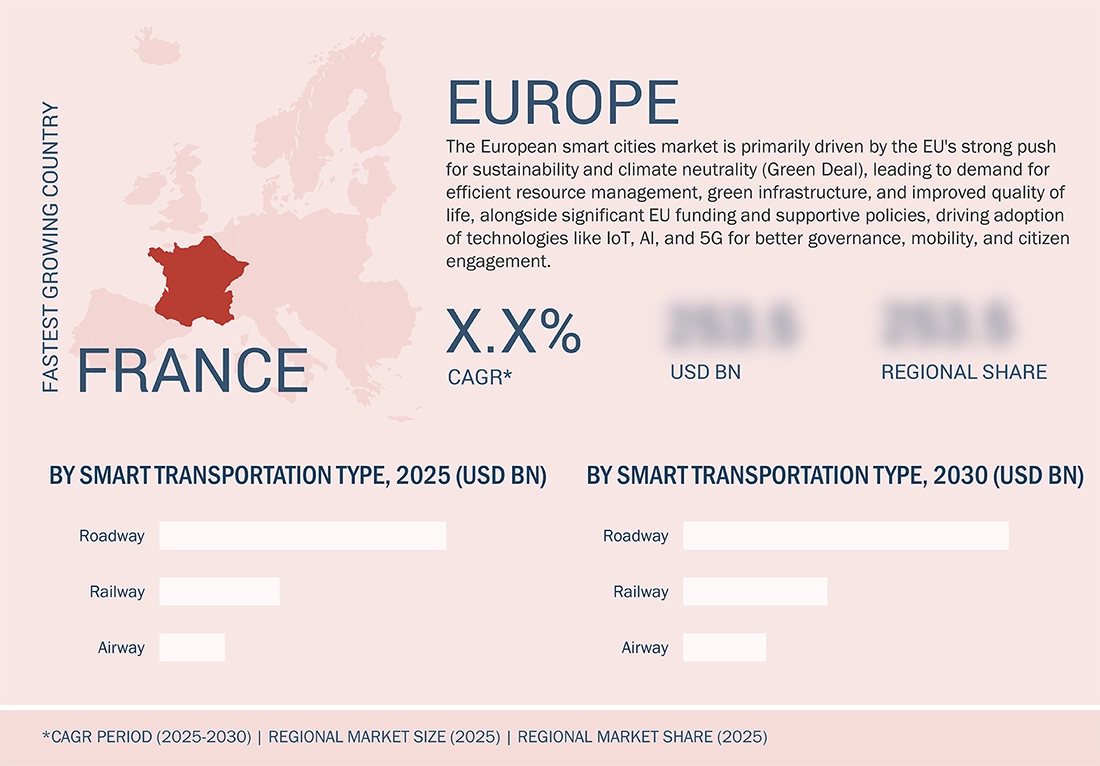
France is expected to be the fastest-growing country in the Europe smart cities market during the forecast period.
France continues to see steady expansion in smart city activity, supported by public investment and technology-focused urban programs. In 2025, the Côte d’Azur region directed over USD 50.2 million toward smart grid research and pilot programs. At the city scale, the Métropole Nice Côte d’Azur is progressing digital and sustainability efforts through the Plaine du Var Eco-Vallée initiative, which is centered on long-term urban development and clean technology adoption. Citizen engagement is also being strengthened through open data platforms such as the Smart Observatoire. France’s active participation in international smart city forums reflects its growing role in Europe’s urban innovation landscape.
EUROPE SMART CITIES MARKET: COMPANY EVALUATION MATRIX
In the Europe smart cities market matrix, Siemens, positioned as a “Star,” maintains a strong regional presence based on its digital infrastructure, automation capabilities, and large-scale urban transformation projects. Nokia, categorized as a “Pervasive Player,” is positioned mainly around its network and connectivity solutions used in mobility systems, public safety, and city infrastructure. Siemens operates across smart city deployments that cover multiple domains. Nokia’s role is mainly used for providing reliable network integration within city projects across Europe.
Source: Secondary Research, Interviews with Experts, MarketsandMarkets Analysis
KEY MARKET PLAYERS
- Siemens (Germany)
- Schneider Electric (France)
- Ericsson (Sweden)
- ABB (Switzerland)
- Accenture (Ireland)
- Thales (France)
- Vodafone (UK)
- Signify Holding (Netherlands)
- Nokia (Finland)
- SAP (Germany)
- TomTom (Netherlands)
- AppyWay (UK)
- Landis+Gyr (Switzerland)
- Kapsch TrafficCom (Austria)
- AVEVA Group plc (UK)
- Telensa (UK)
MARKET SCOPE
| REPORT METRIC | DETAILS |
|---|---|
| Market Size in 2024 (Value) | USD 179.5 Billion |
| Market Forecast in 2030 (Value) | USD 408.4 Billion |
| Growth Rate | CAGR of 15.0% during 2025-2030 |
| Years Considered | 2019-2030 |
| Base Year | 2024 |
| Forecast Period | 2025-2030 |
| Units Considered | Value (USD Billion) |
| Report Coverage | Revenue forecast, company ranking, competitive landscape, growth factors, and trends |
| Segments Covered |
|
| Regions Covered | Europe |
WHAT IS IN IT FOR YOU: EUROPE SMART CITIES MARKET REPORT CONTENT GUIDE
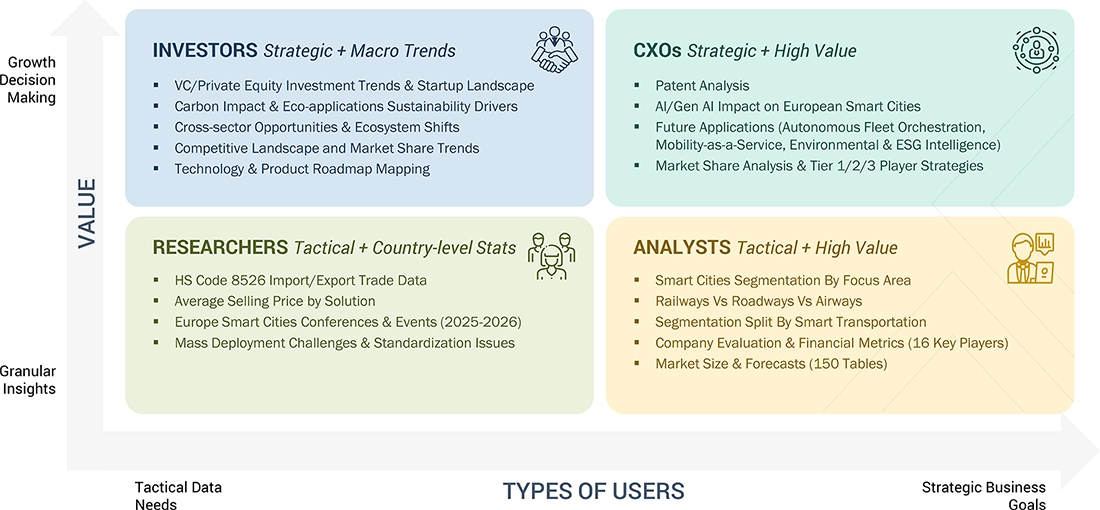
DELIVERED CUSTOMIZATIONS
We have successfully delivered the following deep-dive customizations:
| CLIENT REQUEST | CUSTOMIZATION DELIVERED | VALUE ADDS |
|---|---|---|
| Company Information | Detailed analysis and profiling of additional market players (up to 5) |
|
RECENT DEVELOPMENTS
- March 2025 : Siemens and Reactive Technologies collaborated to enhance grid stability monitoring. Siemens' software provides improved precision and real-time insights, enabling grid operators to better manage the integration of renewable energy sources and ensure a reliable, resilient energy supply.
- March 2024 : The Municipality of Utrecht implemented Microsoft 365 E5 to enhance security, compliance, and productivity for government employees. The collaboration supports secure digital transformation in public administration, improving citizen services and operational efficiency in the Netherlands.
- September 2023 : Siemens collaborated with Northumbrian Water to deploy a data platform that helps tackle household leaks. The solution uses advanced analytics to monitor water networks in real time, enabling early leak detection, reduced water loss, and improved operational efficiency for the utility
Table of Contents
 Exclusive indicates content/data unique to MarketsandMarkets and not available with any competitors.
Methodology
This research study utilized a wide range of secondary sources, including directories and databases such as Dun & Bradstreet (D&B) Hoovers, and Bloomberg BusinessWeek, to gather valuable insights for a technical, market-oriented, and commercial analysis of the Europe Smart Cities Market. Industry experts from core and related sectors, as well as preferred suppliers, manufacturers, distributors, service providers, technology developers, and organizations connected to all segments of the value chain in this market were interviewed as part of the study. To obtain and verify critical qualitative and quantitative information, in-depth interviews were conducted with key industry participants, subject matter experts, C-level executives from leading market players, and industry consultants.
Secondary Research
In the secondary research process, various sources were consulted to gather information for the study. These sources included annual reports, press releases, investor presentations from companies, white papers, certified publications, and articles from recognized associations and governmental publications. Several journals and conferences, such as the 27th IEEE International Conference on Intelligent Transportation Systems (IEEE ITSC 2024) and the Smart Building Conference at Integrated Systems Europe (ISE) 2024, were also referenced. This secondary research aimed to obtain crucial information about industry insights, the monetary flow within the market, the landscape of key players, market classification and segmentation based on current industry trends, regional markets, and significant developments from both, market and technology-oriented perspectives.
Primary Research
In the primary research process, various sources from both the supply and demand sides were interviewed to gather qualitative and quantitative information for the report. On the supply side, the primary sources included industry experts such as Chief Executive Officers (CEOs), Chief Technology Officers (CTOs), Chief Operating Officers (COOs), Vice Presidents (VPs), marketing directors, technology and innovation directors, and other key executives from significant companies and organizations involved in the Europe Smart Cities Market. On the demand side, the primary sources consisted of smart cities end users, consultants, specialists, Chief Information Officers (CIOs), and subject-matter experts from enterprises and government associations.
Market Size Estimation
Several methods were used to estimate and forecast the Europe Smart Cities Market size. The first method involves calculating the market size by adding the revenue generated by companies from the sale of smart city solutions.
Both, the top-down and bottom-up approaches were used to estimate and validate the total size of the Europe Smart Cities Market. These methods were extensively used to estimate the size of various segments in the market. The research methodology used to estimate the market size includes the following.
- Key players in the market were identified through extensive secondary research.
- In terms of value, the industry’s supply chain and market size were determined through primary and secondary research processes.
- All percentage shares, splits, and breakups were determined using secondary sources and verified through primary sources.
Data Triangulation
Upon determining the overall market size, the Europe Smart Cities Market was segmented into various segments and subsegments. A data triangulation process was employed to finalize the overall market engineering and achieve precise statistics for each segment and subsegment, as applicable. This triangulation involved analyzing various factors and trends from both, the demand and supply perspectives. Additionally, the market size was validated using both, the top-down and bottom-up approaches, alongside the data triangulation and market breakdown procedures.
Market Definition
The European Union defines a smart city as a place where traditional networks and services are made more efficient with the use of digital solutions for the benefit of its inhabitants and businesses.
A smart city encompasses more than just the application of digital technologies to enhance resource efficiency and reduce emissions. It includes improved urban transport networks, upgraded water supply and waste disposal systems, and more efficient methods for lighting and heating buildings. Additionally, a smart city features a more interactive and responsive administration, safer public spaces, and addresses the needs of an aging population.
Stakeholders
- National/State Governments
- Municipal Authorities
- Real Estate Developers
- Information Technology (IT) Solution Providers
- Platform Providers
- System Integrators
- Telecom Service Providers
- Networking Solution Providers
- Utility Companies
- Transportation Service Providers
- Independent Software Vendors (ISVs)
- Network Equipment Providers
- Communication Service Providers (CSPs)
Report Objectives
- To determine and forecast the Europe Smart Cities Market size based on focus areas: smart transportation, smart buildings, smart utilities, smart citizen services, and regions from 2025 to 2030, and analyze the various macroeconomic and microeconomic factors that affect market growth
- To provide detailed information about the major factors (drivers, restraints, opportunities, and challenges) influencing the growth of the Europe Smart Cities Market.
- To analyze each submarket concerning individual growth trends, prospects, and contributions to the overall Europe Smart Cities Market
- To analyze opportunities in the market for stakeholders by identifying the high-growth segments of the Europe Smart Cities Market
- To profile key market players, provide a comparative analysis based on business overviews, regional presence, product offerings, business strategies, and key financials, and illustrate the market’s competitive landscape.
- To analyze competitive developments in the market, such as mergers & acquisitions, product developments, partnerships, collaborations, and research & development (R&D) activities
Available Customizations
With the given market data, MarketsandMarkets offers customizations as per the company’s specific needs. The following customization options are available for the report.
Geographic Analysis as per Feasibility
- Analysis for additional countries (up to five)
Company Information
- Detailed analysis and profiling of additional market players (up to 5)
Key Questions Addressed by the Report
What is the projected size of the Europe Smart Cities Market by 2030?
The Europe smart cities market is projected to grow from USD 202.9 billion in 2025 to USD 408.4 billion by 2030, at a CAGR of 15.0% during the forecast period.
Which smart city focus areas are driving growth in the Europe Smart Cities Market?
Smart transportation, smart buildings, smart utilities, and smart citizen services are the primary focus areas driving market growth.
What is the primary factor driving the Europe Smart Cities Market?
Government initiatives promoting sustainable urban development, digital transformation, and carbon reduction are the primary drivers of market growth.
Which technologies are enabling smart city transformation across Europe?
IoT, AI, cloud computing, digital twins, and advanced analytics are enabling smart city transformation across Europe.
Why are European cities investing in smart city solutions?
European cities are investing in smart city solutions to improve urban mobility, energy efficiency, public safety, environmental sustainability, and citizen services.
Which smart citizen service is expected to grow the fastest in the Europe Smart Cities Market?
Smart healthcare is expected to register the highest CAGR among smart citizen services during the forecast period.


Personalize This Research
- Triangulate with your Own Data
- Get Data as per your Format and Definition
- Gain a Deeper Dive on a Specific Application, Geography, Customer or Competitor
- Any level of Personalization
Let Us Help You
- What are the Known and Unknown Adjacencies Impacting the Europe Smart Cities Market
- What will your New Revenue Sources be?
- Who will be your Top Customer; what will make them switch?
- Defend your Market Share or Win Competitors
- Get a Scorecard for Target Partners

Custom Market Research Services
We Will Customise The Research For You, In Case The Report Listed Above Does Not Meet With Your Requirements
Get 10% Free CustomisationTESTIMONIALS






Growth opportunities and latent adjacency in Europe Smart Cities Market