Europe Temperature Sensor Market

Europe Temperature Sensor Market by Connectivity (Wired, Wireless), Contact Type (Thermocouple, Thermistors, Resistive Temperature Detectors), Non-Contact Type (Infrared Temperature, Fiber Optic), Output (Digital, Analog) - Forecast to 2030




OVERVIEW
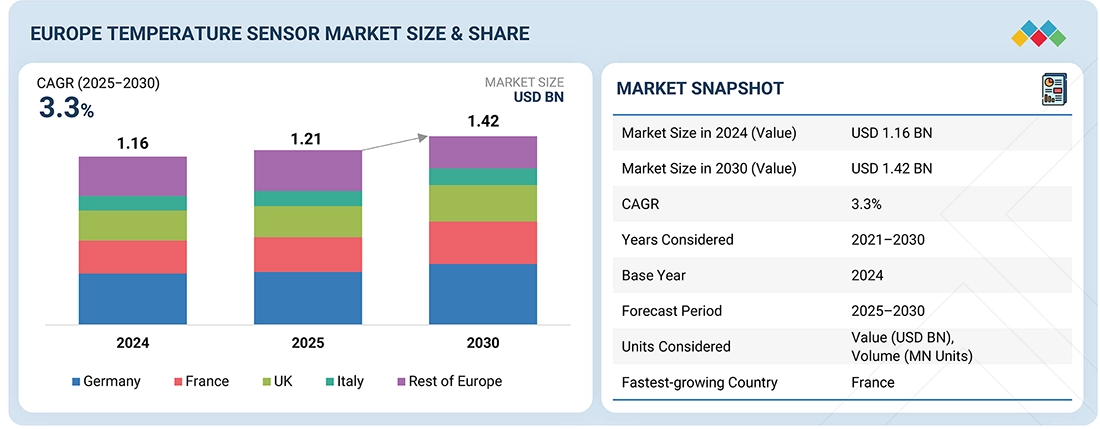
Source: Secondary Research, Interviews with Experts, MarketsandMarkets Analysis
The Europe temperature sensor market is projected to grow from USD 1.16 billion in 2024 to USD 1.42 billion by 2030, registering a CAGR of 3.3%. Strong demand from the automotive, aerospace, energy, and semiconductor industries, where precise thermal control is critical, supports this growth. Growth in healthcare and medical device manufacturing, driven by rising diagnostic and continuous monitoring needs, further boosts deployment of advanced contact and non-contact temperature sensing technologies. The region’s increasing focus on building automation, HVAC efficiency, and regulatory compliance around workplace and equipment safety strengthens demand for integrated temperature sensing solutions.
Market Size & Forecast
KEY TAKEAWAYS
-
BY COUNTRYGermany is estimated to dominate the Europe temperature sensor market with a share of 30.4% in 2025.
-
BY PRODUCT TYPEBy product type, the contact temperature sensor segment accounted for the largest market share of 86.2% in 2024.
-
BY CONNECTIVITYBy connectivity, the wireless segment is projected to grow at the highest CAGR during the forecast period.
-
By OUTPUTBy output, the digital segment is projected to grow at the highest CAGR during the forecast period.
-
BY END-USE INDUSTRYBy end-use industry, the consumer electronics segment is expected to hold 14.6% of the temperature sensors market in 2025.
-
Competitive Landscape - Key PlayersTexas Instruments, Inc., Honeywell International, Inc., and TE Connectivity, among others, were identified as some of the star players in Europe temperature sensor market, given their strong market share and product footprint.
-
Competitive Landscape - Startups/SMEsFLIR Systems, Inc. and Pyromation, among others, have distinguished themselves among startups and SMEs by securing strong footholds in specialized niche areas, underscoring their potential as emerging market leaders.
Europe’s strong adoption of IoT devices, smart home solutions, EVs, and advanced industrial automation is accelerating demand for sensors that offer high accuracy, fast response, built-in calibration, and seamless integration with digital electronics. Regulatory push for energy efficiency and safety compliance across consumer electronics, HVAC systems, and industrial equipment further strengthens the move toward digital sensing technologies.
TRENDS & DISRUPTIONS IMPACTING CUSTOMERS' CUSTOMERS
The Europe temperature sensor market is experiencing a significant transformation motivated by increasing demand for sophisticated, multi-functional systems. Major areas of innovation, including industrial automation, healthcare automation, and smart wearables, are redefining future revenue streams. These technological advancements directly impact sectors such as consumer electronics and healthcare, ultimately resulting in notable shifts in client revenue.
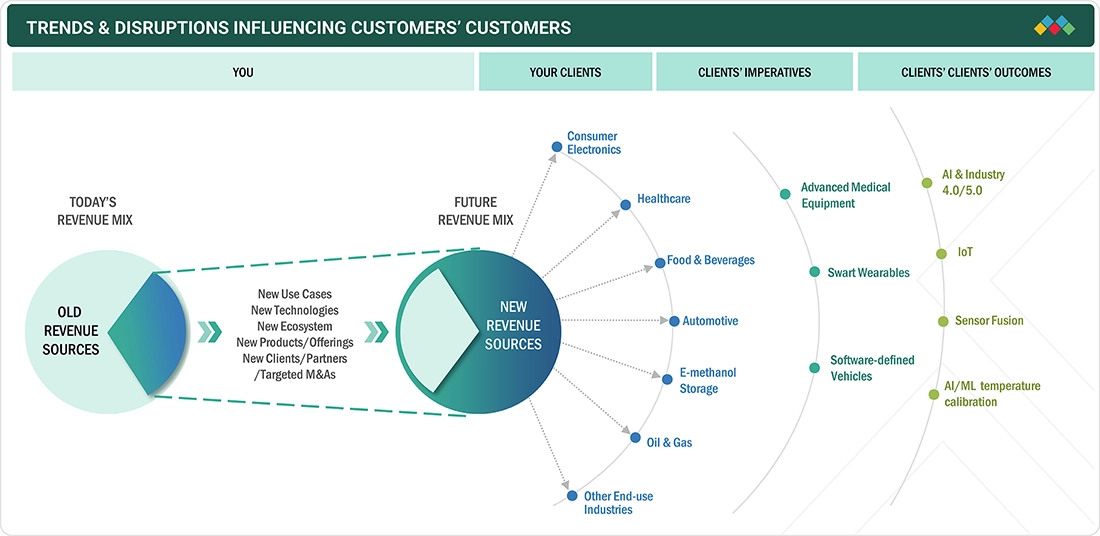
Source: Secondary Research, Interviews with Experts, MarketsandMarkets Analysis
MARKET DYNAMICS

Level
-
Escalating adoption of Industry 4.0 and IoT technologies

-
Increasing need for sensors to control spacecraft remotely


Level
-
Fluctuations in raw material costs


Level
-
Increasing investments in IoT research projects

-
Rising preference for wearable devices


Level
-
Stringent performance requirements for advanced applications

-
Intense price competition among manufacturers

Source: Secondary Research, Interviews with Experts, MarketsandMarkets Analysis
Driver: Increasing need for sensors to control spacecraft remotely
Sensors designated for spacecraft applications must differentiate between payload sensors and those sensors responsible for managing the satellite platform's functions as well as the payload itself. Remote sensing payloads utilize electromagnetic techniques for data collection. Various sensor types function within distinct ranges of the electromagnetic spectrum.
Restraint: Fluctuations in raw material costs
Fluctuations in the prices of these raw materials are attributed to ongoing global economic growth in emerging economies, trade tariffs, rising global demand, natural disasters, conflicts, and other political events, as well as volatility in foreign currency exchange rates.
Opportunity: Increasing investment in IoT research projects
Governments worldwide are supporting and funding IoT-related innovations, as the government sector is likely to be one of the largest potential customers of IoT. Governments are also funding new IoT research projects to develop smart cities. This support is expected to play a crucial role in the growth of the IoT in the next few years.
Challenge: Stringent performance requirements for advanced applications
Given that temperature measurement is essential across nearly all processes, sensors have attained widespread market penetration. Nonetheless, volume discounting presents a challenge concerning low-priced sensors. To maintain market demand, high precision, ease of integration, and reliability are imperative.
EUROPE TEMPERATURE SENSOR MARKET: COMMERCIAL USE CASES ACROSS INDUSTRIES
| COMPANY | USE CASE DESCRIPTION | BENEFITS |
|---|---|---|
 |
Honeywell’s temperature sensors are utilized within the aerospace, automotive, and industrial automation sectors for accurate thermal monitoring, HVAC regulation, and energy management. | Enhances operational reliability, reduces maintenance downtime, and optimizes energy efficiency through advanced thermal control and diagnostics |
 |
Texas Instruments Incorporated's analog and digital temperature sensing ICs are used in data centers, EV battery management, and consumer electronics for compact, energy-efficient thermal monitoring. | Enables high-accuracy thermal control, improved device safety, and faster product design cycles through scalable sensor integration |
 |
TE Connectivity Ltd.'s temperature sensors support automotive, industrial, and medical applications, including EV charging systems, HVAC, and patient monitoring devices. | Improves system performance and product safety, ensuring temperature stability and compliance with automotive and medical-grade standards |
 |
Endress+Hauser’s industrial-grade temperature sensors and transmitters are used in the process automation for oil & gas, chemical, and food & beverage sectors. | Enhances process efficiency, ensures product quality, and minimizes operational risks through precise and real-time temperature monitoring |
 |
Siemens integrates temperature sensors into its automation and building management systems for predictive maintenance and energy optimization. | Enables smart infrastructure and efficient energy utilization through IoT-enabled monitoring and predictive analytics |
Logos and trademarks shown above are the property of their respective owners. Their use here is for informational and illustrative purposes only.
MARKET ECOSYSTEM
The Europe temperature sensor ecosystem delineates the various categories, products, and emerging technologies likely to enhance demand for temperature sensors. Within the components and solution provider domain, prominent entities such as Honeywell International Inc. (US), TE Connectivity (Switzerland), among others, serve to enhance the upstream landscape. Regarding distribution channels, Digi-Key Electronics, Inc. (US) and Mouser Electronics (US) are recognized as pivotal entities facilitating component availability and broader product dissemination. Ultimately, the end user segment can be expanded to include major adopters of temperature sensors, such as Johnson & Johnson Services, Inc. (US) and Reynolds Group Ltd. (New Zealand), thereby providing a more comprehensive, industry-representative perspective of the ecosystem.
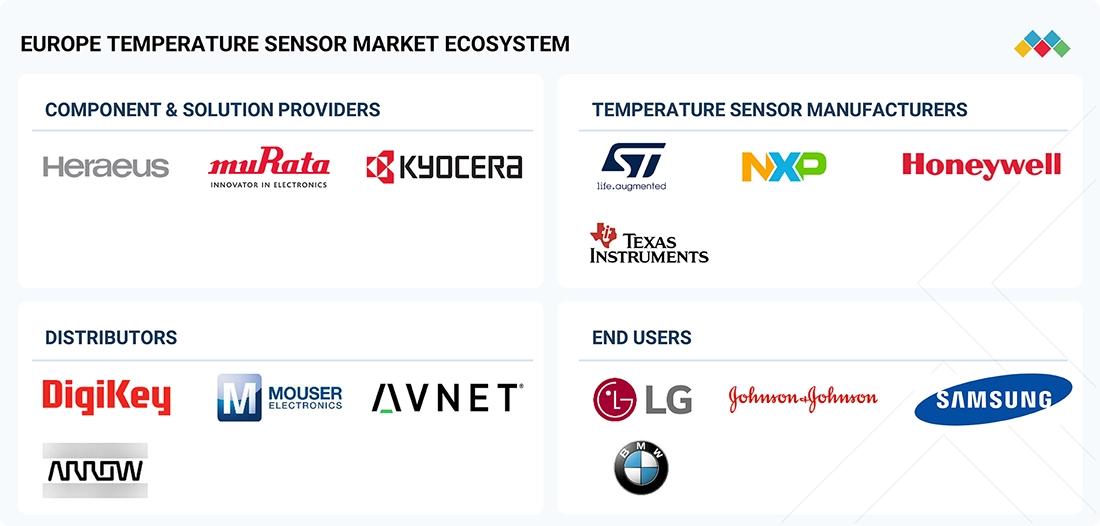
Logos and trademarks shown above are the property of their respective owners. Their use here is for informational and illustrative purposes only.
MARKET SEGMENTS
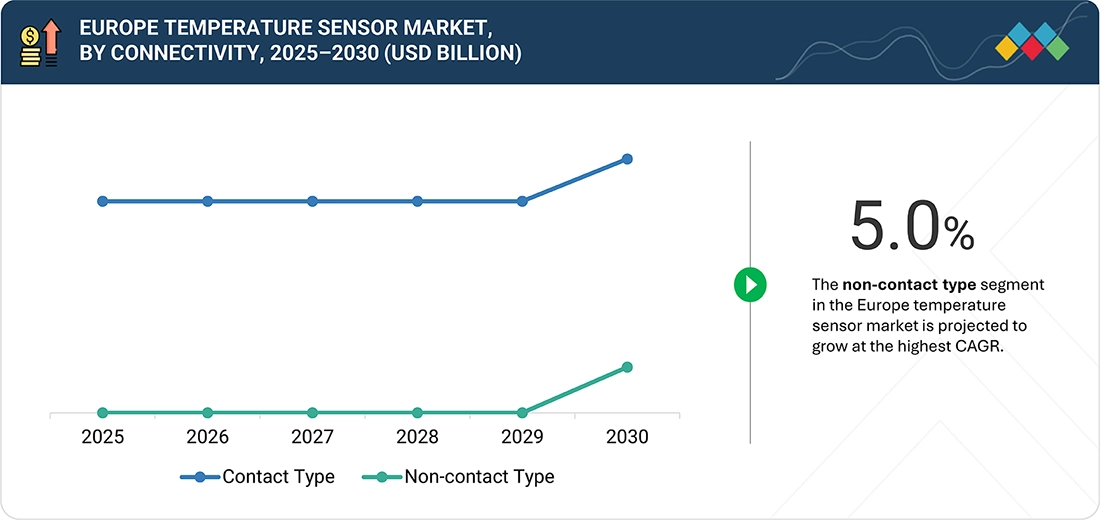
Source: Secondary Research, Interviews with Experts, MarketsandMarkets Analysis
Europe Temperature Sensor Market, By Product Type
By product type, the contact type segment accounted for the largest share of the Europe temperature sensors market in 2024 and is expected to continue to dominate the market during the forecast period. Due to their low cost, wide temperature ranges, and high accuracy, contact temperature sensors are widely used in industries such as chemicals, consumer electronics, oil & gas, energy & power, and automotive. Prominent companies offering contact temperature sensors include Honeywell International Inc. (US), TE Connectivity (Switzerland), Dwyer Instruments, LLC (US), and Texas Instruments Incorporated (US).
Europe Temperature Sensor Market, By Connectivity
By connectivity, the wireless segment accounted for the largest share in 2024 due to rising demand for industrial automation and for miniaturized consumer devices across regions, such as wearables and IoT-connected devices. Additionally, the growing development of temperature sensors by various manufacturers is creating an opportunity for the market.
Europe Temperature Sensor Market, By End-use Industry
By end-use industry, the consumer electronics segment is expected to grow at the highest CAGR during the forecast period. The increasing use of temperature sensors in smartphones, PCs, laptops, tablets, and other smart home appliances, including smart refrigerators, is expected to drive market growth. This growth in the consumer electronics industry presents a significant opportunity for innovative, power-efficient temperature sensors. The market for temperature sensors in electrical and electronic applications is expected to expand with the introduction of new technologies.
REGION
Asia Pacific to be fastest-growing region in global collaborative robot market during forecast period
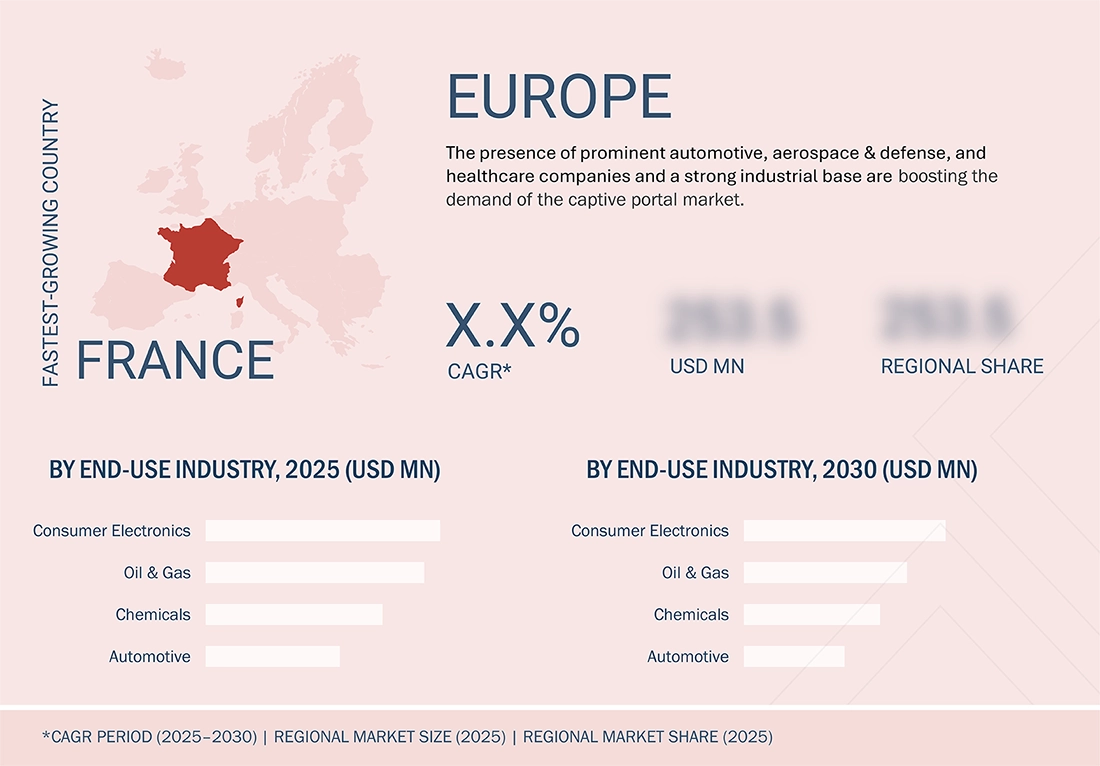
Europe is one of the most technologically advanced markets for temperature sensors, owing to the presence of prominent system suppliers and extensive industries including chemicals, oil & gas, healthcare, and food & beverages. It constitutes a significant source of revenue for the market, propelled by the region’s size, consumer affluence, and the competitiveness of military & aerospace manufacturers, industrial producers, and medical OEMs. Furthermore, increasing government funding in the military & defense sector actively fosters market expansion.
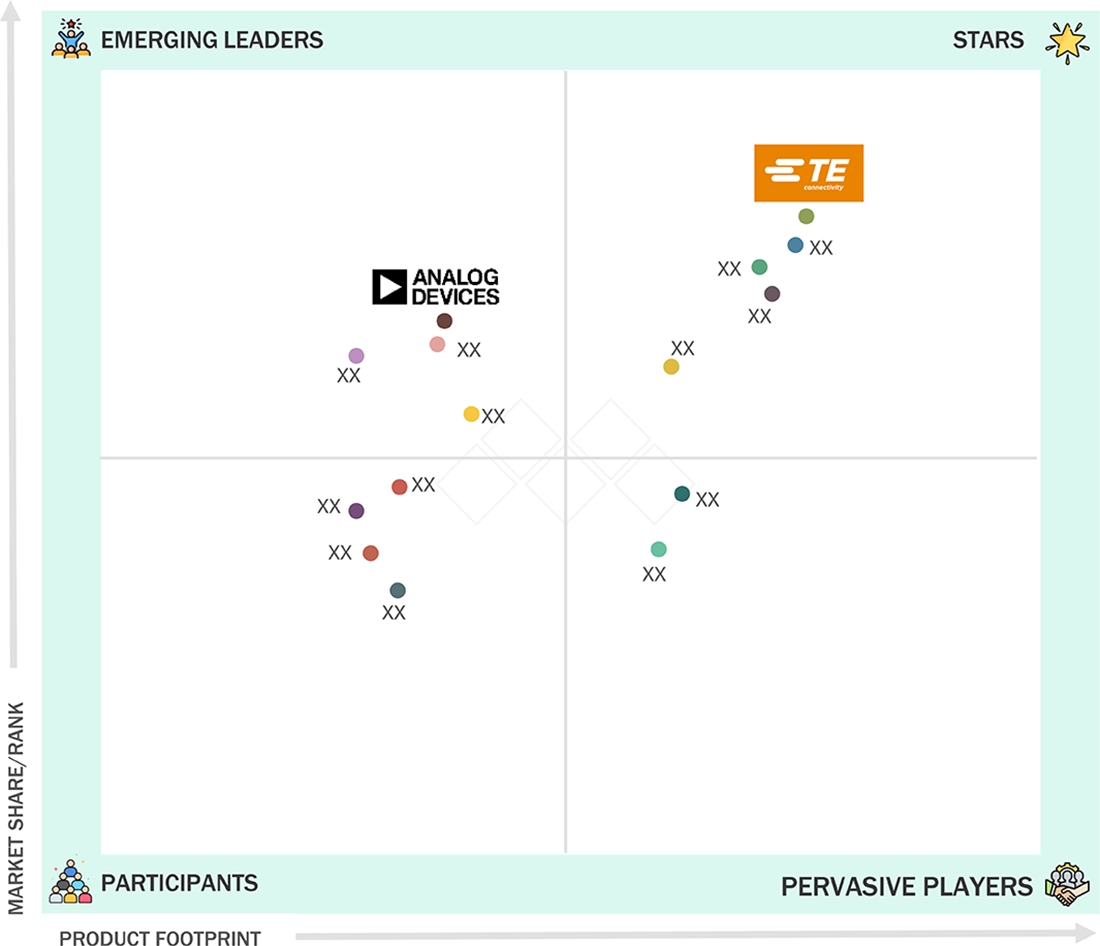
EUROPE TEMPERATURE SENSOR MARKET: COMPANY EVALUATION MATRIX
In the Europe temperature sensor market matrix, TE Connectivity (Star) leads with a strong global presence and a comprehensive temperature sensor portfolio. Analog Devices, Inc. (Emerging Leader) is rapidly expanding its footprint through strong adoption in various sectors.
Source: Secondary Research, Interviews with Experts, MarketsandMarkets Analysis
KEY MARKET PLAYERS
- Honeywell International Inc. (US)
- TE Connectivity (Switzerland)
- Texas Instruments Incorporatedv (US)
- Endress+Hauser Group Services AG (Switzerland)
- Siemens (Germany)
- Emerson Electric Co. (US)
- Analog Devices, Inc. (US)
- Amphenol Corporation (US)
- WIKA Alexander Wiegand SE & Co. KG (Germany)
- Microchip Technology Inc. (US)
- STMicroelectronics (Switzerland)
- NXP Semiconductors (Netherlands)
- Omega Engineering, Inc. (US)
- Yokogawa Electric Corporation (Japan)
- Murata Manufacturing Co., Ltd. (Japan)
MARKET SCOPE
| REPORT METRIC | DETAILS |
|---|---|
| Market Size in 2024 (Value) | USD 1.16 Billion |
| Market Forecast in 2030 (Value) | USD 1.42 Billion |
| Growth Rate | CAGR of 3.3% from 2025–2030 |
| Years Considered | 2021–2030 |
| Base Year | 2024 |
| Forecast Period | 2025–2030 |
| Units Considered | Value (USD Million/Billion), Volume (Million Units) |
| Report Coverage | Revenue forecast, company ranking, competitive landscape, growth factors, and trends |
| Segments Covered |
|
| Countries Covered | Germany, UK, France, Italy, Rest of Europe |
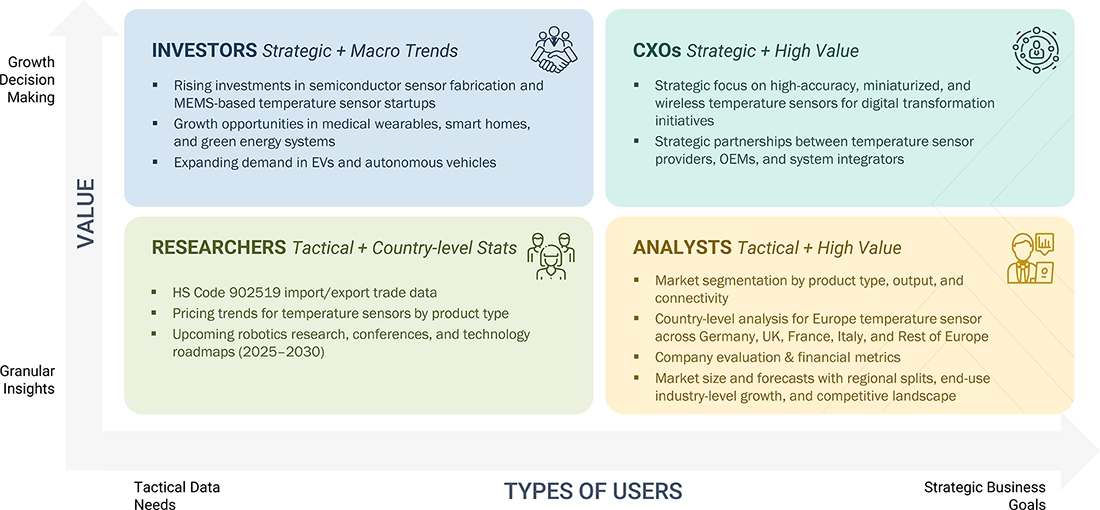
WHAT IS IN IT FOR YOU: EUROPE TEMPERATURE SENSOR MARKET REPORT CONTENT GUIDE
DELIVERED CUSTOMIZATIONS
We have successfully delivered the following deep-dive customizations:
| CLIENT REQUEST | CUSTOMIZATION DELIVERED | VALUE ADDS |
|---|---|---|
| Automotive OEM |
|
|
| Healthcare Device Manufacturer |
|
|
RECENT DEVELOPMENTS
- June 2024 : Honeywell completed its acquisition of Carrier Global Corporation's Global Access Solutions business for USD 4.95 billion. By acquiring Carrier's Global Access Solutions business, Honeywell is positioning itself as a security solutions provider for the digital age while allowing for opportunities for advanced innovation in the fast-growing, cloud-based services and solutions space.
- May 2024 : Amphenol Corporation completed the acquisition of the Carlisle Interconnect Technologies (CIT) business from Carlisle Companies Incorporated. This acquisition enhances Amphenol’s product portfolio for highly engineered harsh environment interconnect solutions and will enable the company to deliver expanded offerings to customers in the commercial air, defense, and industrial markets.
- July 2023 : Analog Devices invested over USD 1 billion in the expansion of its semiconductor facilities in Oregon. The investment increases the cleanroom area to approximately 118,000 sq-ft, nearly doubling the internal manufacturing capacity for products utilizing the 180-nanometer technology node and higher.
- April 2021 : Amphenol Corporation completed its acquisition of MTS Systems Corporation. This acquisition strengthened the sensor product portfolios and allowed customers an expanded array of innovative technologies across multiple end markets.
Table of Contents
 Exclusive indicates content/data unique to MarketsandMarkets and not available with any competitors.
Methodology
The study involved major activities in estimating the current size of the Europe Temperature Sensor Market. Exhaustive secondary research was done to collect information on temperature sensors. The next step was to validate these findings, assumptions, and sizing with industry experts across the value chain using primary research. Different approaches, such as top-down and bottom-up, were employed to estimate the total market size. After that, the market breakup and data triangulation procedures were used to estimate the market size of the segments and subsegments of the temperature sensor.
Secondary Research
In the secondary research process, various secondary sources were referred to identify and collect information relevant to this study. Secondary sources included annual reports, press releases, and investor presentations of companies; white papers, certified publications, and articles from recognized authors; directories; and databases. Secondary research was mainly carried out to obtain critical information about the industry’s supply chain, value chain, the total pool of key players, and market classification and segmentation according to industry trends, geographic markets, and key developments from both market- and technology-oriented perspectives. Secondary sources included corporate filings (such as annual reports, investor presentations, and financial statements); trade, business, and professional associations; white papers; IoT technologies journals and certified publications; articles by recognized authors; gold- and silver-standard websites; directories; and databases. Data was also collected from secondary sources, such as the Semiconductor Industry Association, Global Semiconductor Alliance, and Taiwan Semiconductor Industry Association.
Secondary research was mainly used to obtain critical information about the industry's supply chain and value chain, the total pool of key players, market classification and segmentation according to industry trends to the bottom-most level, geographic markets, and key developments from both the market and technology-oriented perspectives. Secondary data has been gathered and analyzed to determine the overall market size, which has also been validated by primary research.
Primary Research
Extensive primary research was conducted after understanding and analyzing the current scenario of the Europe Temperature Sensor Market through secondary research. A number of primary interviews were held with demand and supply side key opinion leaders in four key regions: North America, Europe, Asia Pacific, and Rest of the World. Nearly 25% of the primary interviews were held with the demand side and 75% with the supply side. The primary data was gathered primarily through telephonic interviews, which were 80% of the total primary interviews. Surveys and e-mails were also utilized to gather data.
Market Size Estimation
This report implements both the top-down and bottom-up approaches to estimate and validate the size of the Europe Temperature Sensor Market and various other dependent submarkets. Key players in this market are identified through secondary research, and their market shares in the respective regions are determined through primary and secondary research.
This entire research methodology included the study of annual and financial reports of top companies, as well as interviews with experts (such as CEOs, VPs, directors, and marketing executives) for key insights (both quantitative and qualitative). All percentage shares, splits, and breakdowns were determined using secondary sources and verified through primary sources. All the possible parameters that affect the market covered in this research study were accounted for, viewed in detail, verified through primary research, and analyzed to obtain the final quantitative and qualitative data. This data was consolidated and supplemented with detailed inputs and analysis from MarketsandMarkets and presented in this report.
Data Triangulation
After arriving at the overall size of the Europe Temperature Sensor Market from the estimation process explained above, the market was split into several segments and subsegments. The data triangulation and market breakdown procedures were employed (wherever applicable) to complete the overall market engineering process and arrive at the exact statistics for all segments and subsegments. The data was triangulated by studying various factors and trends from both the demand and supply sides. The size of the Europe Temperature Sensor Market was validated using both top-down and bottom-up approaches.
Market Definition
A temperature sensor is a device that is used to measure the degree or level of heat in a substance or its surroundings. Temperature sensors can typically be classified into two types: contact and non-contact sensors.
Contact sensors: These temperature sensors need to make physical contact with the object being sensed. In contact sensors, temperature sensing occurs through conduction. Contact sensors are capable of measuring the temperature of solids, liquids, or gases over a wide range. A few examples of common contact sensors include thermocouples, temperature sensor ICs, thermistors, and RTDs. Non-contact sensors operate on the principles of convection and radiation to detect temperature changes. Non-contact sensors detect the thermal radiation that is emitted from an object and are equipped with infrared radiation sensors. The major types of non-contact sensors are optical and infrared sensors.
Key Stakeholders
- Semiconductor Industry Association
- Global Semiconductor Alliance
- European Semiconductor Industry Association
- Taiwan Semiconductor Industry Association
- SemiconPortal
- AMA Association for Sensor Technology
- OMICS International
- IEEE
- MEMS & Sensors Industry Group
- Educational Institutions Research/White Papers (Published by Communication Organizations)
- Investor Presentations and Annual Reports of Key Market Players
Report Objectives
- To define, describe, and forecast the Europe Temperature Sensor Market, by product type, output, connectivity, end-user industry, and region, in terms of value
- To define, describe, and forecast the Europe Temperature Sensor Market, in terms of volume
-
To forecast the sizes of various segments with respect to the four major regions—
North America, Europe, Asia Pacific, and Rest of the World (RoW) - To provide a detailed analysis of the temperature sensors supply chain
- To analyze the impact of the recession on the Europe Temperature Sensor Market
- To strategically analyze the micromarkets with respect to individual growth trends and prospects, and their contributions to the total market
- To analyze competitive developments, such as expansions, agreements, partnerships, acquisitions, product developments, and research & development (R&D), in the Europe Temperature Sensor Market
- To analyze the opportunities for market players and provide details of the competitive landscape of the market.
- To benchmark the market players using the proprietary company evaluation matrix framework, which analyzes the market players on various parameters within the broad categories of business strategy excellence and strength of product portfolios
- To strategically profile the key players and comprehensively analyze their market positions in terms of ranking and core competencies, along with a detailed competitive landscape of the market
- To analyze the supply chain, market/ecosystem map, trend/disruptions impacting customer business, technology analysis, Porter’s five force analysis, trade analysis, patent analysis, key conferences & events, and regulations related to the Europe Temperature Sensor Market
Available customizations:
With the market data given, MarketsandMarkets offers customizations according to the company’s specific needs. The following customization options are available for the report:
Company Information
- Detailed analysis and profiling of additional market players (up to 7)
Key Questions Addressed by the Report
What is the projected market value of the Europe temperature sensor market by 2030?
The Europe temperature sensor market is projected to reach approximately USD 4.28 billion by 2030, growing from about USD 3.47 billion in 2025 at a CAGR of 4.4% during the forecast period.
Which countries are key contributors in the Europe temperature sensor market?
Germany, the UK, France, Italy, and Spain are key contributors in the Europe temperature sensor market due to strong industrial, automotive, and consumer electronics demand across these countries.
What are the key segments of the Europe temperature sensor market?
The key segments of the Europe temperature sensor market include product type (contact and non-contact sensors), connectivity (wired and wireless), output (analog and digital), and end-use industries such as automotive, consumer electronics, healthcare, energy, and industrial.
Which segment holds a significant share or is expected to grow fastest in the Europe temperature sensor market?
The contact sensor segment holds a significant share due to widespread industrial adoption, while the wireless connectivity and digital output segments are expected to grow faster driven by IoT and smart monitoring applications.
Who are the key players operating in the Europe temperature sensor market?
Key players operating in the Europe temperature sensor market include Honeywell International Inc., Texas Instruments Incorporated, TE Connectivity, Siemens AG, Analog Devices, ams-OSRAM AG, STMicroelectronics, NXP Semiconductors, Bosch Sensortec GmbH, and Sensata Technologies, Inc., reflecting a competitive and technology-driven ecosystem.


Personalize This Research
- Triangulate with your Own Data
- Get Data as per your Format and Definition
- Gain a Deeper Dive on a Specific Application, Geography, Customer or Competitor
- Any level of Personalization
Let Us Help You
- What are the Known and Unknown Adjacencies Impacting the Europe Temperature Sensor Market
- What will your New Revenue Sources be?
- Who will be your Top Customer; what will make them switch?
- Defend your Market Share or Win Competitors
- Get a Scorecard for Target Partners

Custom Market Research Services
We Will Customise The Research For You, In Case The Report Listed Above Does Not Meet With Your Requirements
Get 10% Free CustomisationTESTIMONIALS

Tetsuya Ohhira
Business Development Manager-Technology Business
Nikon Corporation,
Leading Japanese MNC specializing in optics and imaging productswww.nikon.com
MarketsandMarkets™ response
is quick. Their attitude is flexible and positive. Analyst Insights are globally considered and
significant. Client Services quickly respond to our inquiry and demand. Their wide range of global
surveys help us make our strategic plan.
We hope Knowledge Store will be easier to search
for a report.
VP - Marketing & Business Development
Leading Provider of Process Control Solutions
We engaged with MarketsandMarkets on a study to perform an analysis and recommend a Go-To-Market strategy for metrology and process control in the semiconductor market. The study was tailored to our targets and needs with well-defined milestones. Our overall experience with the MarketsandMarkets team was very good throughout the project in all aspects including the analysis methodologies used, the quality and depth of primary and secondary data sets, the professionalism and flexibility of the team and the ability to meet the target schedule and milestones. We want to thank MarketsandMarkets team for a job well done.






Growth opportunities and latent adjacency in Europe Temperature Sensor Market