
Vietnam 3D Printing Robot Market (2025-2030)

The Vietnam 3D Printing Robot Market was valued at $1.62 Million in 2025 and projected to reach to $2.55 Million by 2030, representing a compound annual growth rate of 9.6%. Vietnam's 3D printing robot market is positioned for steady growth as the country strengthens its role in global electronics manufacturing.


| Market Size in | USD 26.32 MN |
| Market Forecast in | |
| CAGR | |
| Forecast Period | |
| Units Considered | Value (USD MN) |
Vietnam 3D Printing Robot Market Trends and Insights
- Valued at $1.62 million in 2025, Vietnam's market is forecast to grow to $2.55 million by 2030, driven by increasing adoption of automation in manufacturing and electronics production.
- Vietnam's strategic position as a regional electronics hub and rising labor costs are accelerating investment in robotic 3D printing technologies across the country. The 9.6% compound annual growth rate reflects Vietnam's commitment to Industry 4.0 initiatives and digital transformation in manufacturing.
- Vietnam's growing semiconductor assembly and consumer electronics sectors are primary demand drivers for advanced 3D printing robotic solutions.
- By 2030, Vietnam is expected to capture a larger share of regional automation spending as companies seek to enhance precision, reduce production costs, and improve supply chain resilience within the country..
Key Market Statistics
- CAGR (2025-2030) 9.6% CAGR
- Market Size, 2025 ~USD 1.62 Million
- Forecast, 2030 ~USD 2.55 Million
- Country Vietnam
Vietnam 3D Printing Robot Market Overview
Market Valuation :
Vietnam's 3D printing robot market is valued at $1.62 million in 2025, with a projected compound annual growth rate of 9.6% through 2030, outpacing the global average of 9.5%.
Regional Electronics Hub Status :
Vietnam's position as a critical regional electronics manufacturing center in Asia Pacific is driving demand for advanced automation technologies, including 3D printing robotics solutions.
Labor Cost Pressures :
Rising labor costs in Vietnam are compelling manufacturers to invest in robotic automation and 3D printing technologies to maintain competitive margins and production efficiency.
Forecast Growth Trajectory :
The market is expected to reach $2.55 million by 2030, representing a 57% increase over the five-year forecast period, driven by semiconductor and electronics sector expansion.
Vietnam 3D Printing Robot Market Dynamics
- The convergence of rising labor costs and increasing automation adoption is creating favorable conditions for 3D printing robotics deployment across semiconductor fabrication and electronics assembly operations.
- Government initiatives supporting Industry 4.0 adoption and foreign direct investment in high-tech manufacturing are expected to accelerate market penetration. Manufacturers in Vietnam are increasingly recognizing the efficiency gains and cost savings potential of 3D printing robots for prototyping, tooling, and precision component production.
- As supply chains continue to diversify away from traditional manufacturing hubs, Vietnam's competitive advantages in labor costs combined with technological modernization will drive sustained demand for advanced robotic solutions through 2030..
Market Ecosystem
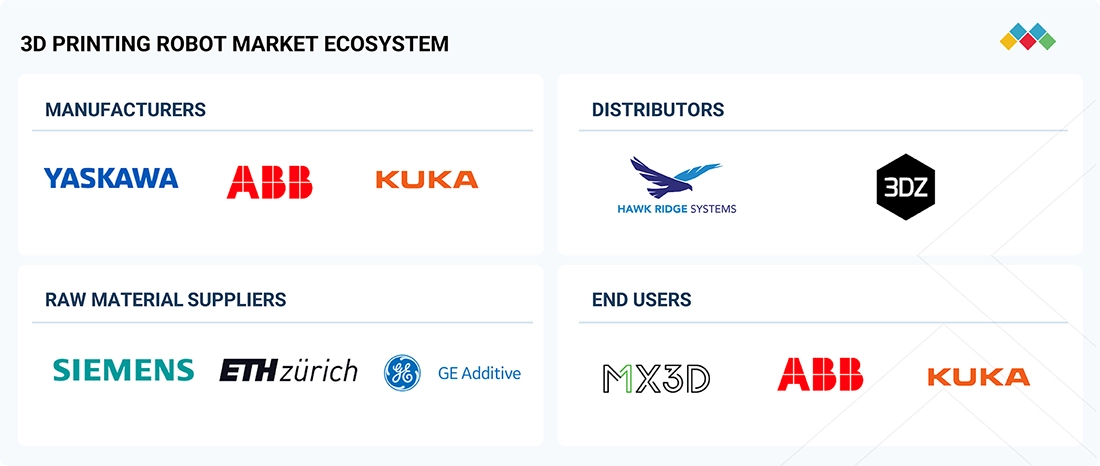
3D Printing Robot Market Trends: COMMERCIAL USE CASES ACROSS INDUSTRIES
| COMPANY | USE CASE DESCRIPTION | BENEFITS |
|---|---|---|
 |
ABB collaborated with the German Red Cross (DRK) to construct Germany’s first non-residential 3D-printed building. The project used the ABB IRB 6700 six-axis industrial robot integrated into a large-format polymer 3D printer to create complex walls and facades efficiently. | The solution enabled faster, flexible, and environmentally friendly construction, more than doubled DRK’s space, improved material efficiency, and set a benchmark for automated, digitalized building processes. |
 |
Eplus3D partnered with a medical team to create customized titanium prosthetic limbs for a cat using advanced metal 3D printing. The prosthetics were designed to match the cat’s anatomy, ensuring strength, biocompatibility, and long-term stability. | The solution restored the cat’s full mobility, enabled walking, running, and climbing, and demonstrated the potential of 3D-printed, bio-compatible prosthetics in veterinary and medical applications. |
 |
Protolabs partnered with Small Robot Company to produce lightweight, durable, and highly detailed components for the Tom V4 autonomous farming robot using Multi Jet Fusion 3D printing. This enabled rapid prototyping, design optimization, and customization of critical parts like the steering actuator cap and SSD mount. | The solution reduced the robot’s weight, improved durability and performance, allowed modular and scalable design, and accelerated time-to-market for precision farming robots while lowering production costs. |
 |
Yaskawa Europe implemented robotic automation for Resin Transfer Molding (RTM) at Hilger u. Kern GmbH, streamlining resin injection, mixing, and curing processes. Robots precisely managed coupling and uncoupling of molds, reducing manual intervention and improving process consistency. | The solution significantly shortened production cycle times, enhanced system availability, enabled scalable large-batch manufacturing, and improved efficiency and throughput in composite component production. |
Logos and trademarks shown above are the property of their respective owners. Their use here is for informational and illustrative purposes only.
Related Ecosystem
Automotive Electronics And Electrical Equipment
- Battery Electric Vehicle (BEV)
- Light Commercial Vehicles (LCVs)
- Fuel Cell Electric Vehicle (FCEV)
- Sensors
- Hybrid Electric Vehicle (HEV)
- BOSCH LIMITED
- DENSO Corporation
- Continental ag
- Panasonic Holdings Corporation
- Texas Instruments Incorporated
Digitalization And Iot
- Sensors
- Remote Monitoring
- Supply Chain Management
- Passenger Information System (PIS)
- Platform as A Service (PaaS)
- International Business Machines Corporation
- Cisco Systems, Inc.
- MICROSOFT CORPORATION
- Oracle Corporation
- HUAWEI TECHNOLOGIES CO LTD
Drones And Robotics
- Sensors
- Articulated Robots
- Cartesian Robots
- Scara Robots
- Actuators
- ABB India Limited
- KUKA AG
- MOMENTIVE PERFORMANCE MATERIALS INC.
- Fanuc Corporation
- STAUBLI INTERNATIONAL AG
Key Takeaways
- Vietnam's 3D printing robot market is valued at $1.62 million in 2025 and is projected to reach $2.55 million by 2030.
- Vietnam is experiencing a 9.6% CAGR, reflecting strong demand for automation in electronics manufacturing.
- Vietnam's electronics and semiconductor sectors are primary growth catalysts for 3D printing robot adoption.
- Vietnam's labor cost pressures and Industry 4.0 initiatives are driving investment in advanced robotic manufacturing solutions.
3D Printing Robot Market Report Scope
| Report Metric | Details |
|---|---|
| Base Year | 2025 |
| Fastest Growing Segment | SERVICES (Component & Service) |
| Forecast Period | 2025–2030 |
| Growth Rate | CAGR of 9.5% from 2025 to 2030 |
| Largest Segment | ROBOT ARMS (Component & Service) |
| Market Size Base Year (Billions) | ~USD 1.99 (2025) |
| Revenue Forecast (Billions) | ~USD 3.14 (2030) |
| Segments Covered | Component & Service, Hardware Component, End-Use Industry, Robot Type, Application, Component |
Vietnam 3D Printing Robot Market Report Segmentation
6 segment dimensions are covered across the global market.
By Component & Service
- 3D Printing Heads
- Robot Arms
- Services
- Software
By Hardware Component
- 3D Printing Heads
- Robot Arms
By End-Use Industry
- Aerospace & Defense
- Automotive
- Construction
- Culinary
- Fmcg
- Other End-Use Industries
By Robot Type
- Articulated
- Cartesian
- Delta
- Other Robot Types
- Polar
- Scara
By Application
- Functional Part Manufacturing
- Prototyping
- Tooling
By Component
- 3D Printing Heads
- Robot Arms
- Software
Target Audience
- Robotics & Automation Manufacturers : Companies developing 3D printing robots need Vietnam-specific market data to identify growth opportunities, assess market potential, and develop localized go-to-market strategies.
- Electronics & Semiconductor Producers : Vietnamese and international manufacturers in electronics need insights on automation adoption trends to optimize production efficiency and maintain competitive advantage in rising labor cost environment.
- Investment & Private Equity Firms : Investors evaluating opportunities in Vietnam's manufacturing technology sector require detailed market analysis to assess growth potential and identify promising portfolio companies.
- Supply Chain & Operations Strategists : Supply chain professionals planning manufacturing expansion or optimization in Vietnam need market intelligence on automation adoption to inform technology investment decisions.
- Market Research & Consulting Professionals : Analysts and consultants serving clients in Vietnam's manufacturing sector require granular market data to support strategic recommendations and competitive analysis.
Key Companies in the Vietnam 3D Printing Robot Market
| Company | HQ | Ownership | Strongest segments |
|---|---|---|---|
| KUKA AG | Germany | Private Company | Industrial robots and controllers,Collaborative and mobile robots,Turnkey systems and production cells, |
| YASKAWA ELECTRIC CORPORATION | Japan | Public Company | Motion control (servo motors, drives, controllers, encoders),Industrial robots (arc/spot welding, handling, palletizing, collaborative, biomedical),AC drives for appliances, social infrastructure, and factories, |
| CEAD B.V. | United States | Public Company | Environmental control & process cooling systems,MEP engineering & facility design services,LED lighting, benching, racking, and automation, |
| MELTIO3D | Spain | Private Company | Standalone metal 3D printers (wire-laser DED),Printheads for CNC/robotic integration,Wire feedstock and consumables, |
| TWENTE ADDITIVE MANUFACTURING | Canada | Private Company | Turnkey printed buildings (design–build),Construction 3D printers and equipment,Printing-as-a-service / contract printing, |
| DOBOT | China | Public Company | CR Series six-axis industrial cobots,Magician Series (education-focused cobots),M Series (MG400, M1 Pro) light manufacturing cobots, |
KUKA AG
KUKA AG is a German industrial robotics and automation company founded in 1898 with 14,985 employees. Operating as a private company, KUKA specializes in manufacturing robots and automation solutions for various industrial sectors.
YASKAWA ELECTRIC CORPORATION
Yaskawa Electric Corporation is a Japanese public company founded in 1915 with 12,483 employees. The company is a leading manufacturer of industrial robots, motion control products, and automation systems.
CEAD B.V.
CEAD B.V. is a United States-based public company founded in 2006 with 10 employees. The company operates in a specialized manufacturing or technology sector.
MELTIO3D
Meltio3D is a Spanish private company founded in 2019 focused on additive manufacturing technology.
TWENTE ADDITIVE MANUFACTURING
Twente Additive Manufacturing is a Canadian private company founded in 2018 focused on additive manufacturing solutions.
DOBOT
DOBOT is a Chinese public company founded in 2015 with 768 employees, specializing in collaborative robots and automation technology.
Reasons to Buy this Report
- Vietnam-Specific Market Sizing : Access precise market valuation data for Vietnam's 3D printing robot sector with detailed 2025-2030 forecasts, enabling accurate investment planning and resource allocation decisions.
- Competitive Positioning Intelligence : Understand Vietnam's market dynamics relative to global and regional trends, identifying growth opportunities unique to Vietnam's electronics manufacturing ecosystem.
- Sector-Specific Insights : Gain detailed analysis of how semiconductor and electronics manufacturers in Vietnam are adopting 3D printing robotics, with actionable intelligence on adoption drivers and barriers.
- Investment Decision Support : Leverage comprehensive Vietnam market data to evaluate expansion strategies, partnership opportunities, and market entry timing for robotics and automation solutions.
- Trend Analysis & Forecasting : Benefit from expert analysis of Vietnam-specific factors including labor cost trends, manufacturing growth, and technology adoption patterns shaping market trajectory through 2030.
Frequently asked questions
What is the current size of Vietnam's 3D printing robot market?
Vietnam's 3D printing robot market was valued at $1.62 million in 2025 and is expected to grow to $2.55 million by 2030.
What is the growth rate for 3D printing robots in Vietnam?
Vietnam's 3D printing robot market is growing at a compound annual growth rate (CAGR) of 9.6% from 2025 to 2030.
Which industries are driving 3D printing robot adoption in Vietnam?
Vietnam's semiconductor assembly, consumer electronics, and precision manufacturing sectors are the primary drivers of 3D printing robot demand.
Why is Vietnam's market growing faster than the global average?
Vietnam's market growth is accelerated by rising labor costs, increasing foreign direct investment in electronics manufacturing, and government support for Industry 4.0 digital transformation initiatives.
What factors will influence Vietnam's 3D printing robot market through 2030?
Key factors include automation adoption rates in electronics production, supply chain localization efforts, technological advancements in robotic systems, and Vietnam's competitive positioning in regional manufacturing.
RESEARCH METHODOLOGY
The study involved four major activities in estimating the current size of the 3D printing robot market. Exhaustive secondary research collected information on the market, peer, and parent markets. The next step was to validate these findings, assumptions, and sizing with industry experts across the value chain through primary research. Both top-down and bottom-up approaches were employed to estimate the complete market size. After that, market breakdown and data triangulation techniques were used to estimate the market size of segments and subsegments.
Secondary Research
The secondary research process has referred to various secondary sources to identify and collect necessary information for this study. The secondary sources include annual reports, press releases, and investor presentations of companies; white papers; journals and certified publications; and articles from recognized authors, websites, directories, and databases. Secondary research was conducted to obtain critical information about the industry’s supply chain, the market’s value chain, the total pool of key players, market segmentation according to the industry trends (to the bottom-most level), regional markets, and key developments from market- and technology-oriented perspectives. The secondary data was collected and analyzed to determine the overall market size, further validated by primary research.
Primary Research
Extensive primary research was conducted after gaining knowledge about the current scenario of the 3D printing robot market through secondary research. Several primary interviews were conducted with experts from the demand and supply sides across four major regions—North America, Europe, Asia Pacific, and RoW. This primary data was collected through questionnaires, emails, and telephonic interviews.
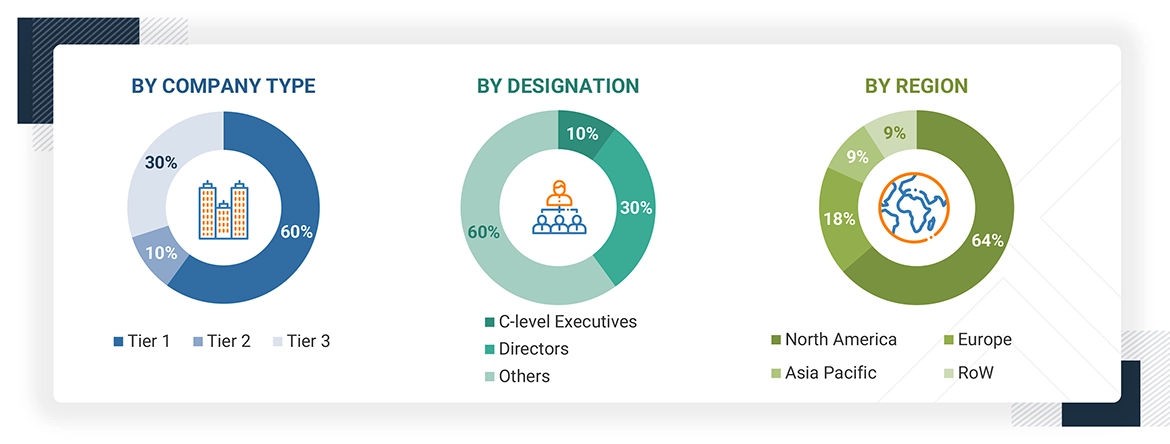
Note: Other designations include technology heads, media analysts, sales managers, marketing managers, and product managers. The three tiers of the companies are based on their total revenues as of 2024 - Tier 1: >USD 1 billion, Tier 2: USD 500 million–1 billion, and Tier 3: USD 500 million.
To know about the assumptions considered for the study, download the pdf brochure
Market Size Estimation
In the complete market engineering process, top-down and bottom-up approaches and several data triangulation methods were used to estimate and forecast the overall market segments and subsegments listed in this report. Key players in the market were identified through secondary research, and their market shares in the respective regions were determined through primary and secondary research. This entire procedure includes the study of annual and financial reports of the top market players and extensive interviews for key insights (quantitative and qualitative) with industry experts (CEOs, VPs, directors, and marketing executives).
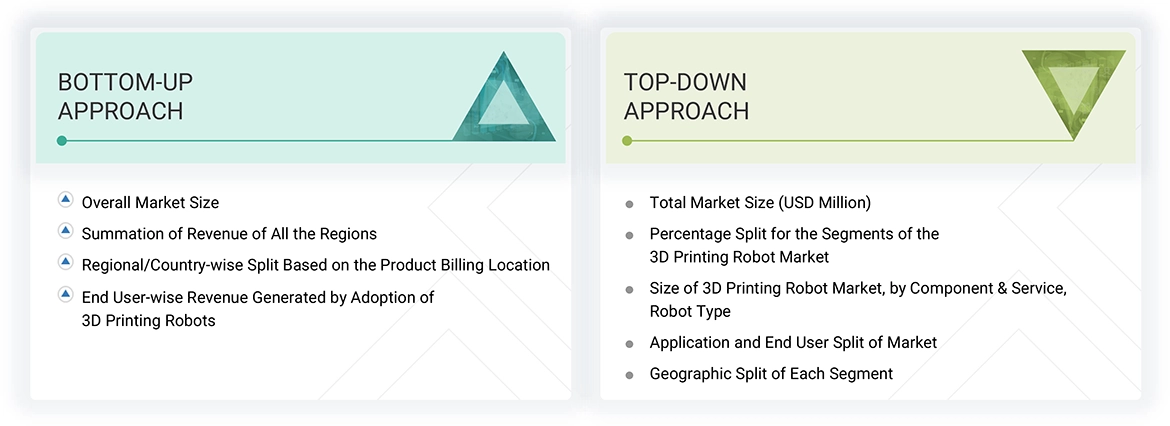
All percentage shares, splits, and breakdowns were determined using secondary sources and verified through primary sources. All the parameters affecting the markets covered in this research study were accounted for, viewed in detail, verified through primary research, and analyzed to obtain the final quantitative and qualitative data. This data was consolidated and supplemented with detailed inputs and analysis from MarketsandMarkets and presented in this report. The following figure represents this study’s overall market size estimation process.
Bottom-Up Approach
- Identifying key participants in the 3D printing robot market that influence the entire market, along with the related component players
- Analyzing major manufacturers of 3D printing robots, studying their portfolios, and understanding different types
- Analyzing trends about the use of 3D printing robots in different kinds of industries
- Tracking the ongoing and upcoming developments in the market, such as investments, R&D activities, product/service launches, collaborations, and partnerships, and forecasting the market based on these developments and other critical parameters
- Carrying out multiple discussions with key opinion leaders to understand different types of 3D printing robot trends in the market, thereby analyzing the breakup of the scope of work carried out by major companies
- Arriving at the market estimates by analyzing the revenues of companies generated through the sales of 3D printing robots, and then combining them to estimate the overall market size
- Segmenting the overall market into various other market segments
- Verifying and cross-checking the estimate at every level, from discussions with key opinion leaders such as CXOs, directors, and operations managers, and finally with the domain experts at MarketsandMarkets
- Studying various paid and unpaid sources of information, such as annual reports, press releases, white papers, and databases
Top-Down Approach
- Focusing initially on the top-line investments and expenditures being made in the ecosystem of the 3D printing robot market, further splitting the key market based on component & service, robot type, end user, application, and region, and listing the key developments
- Identifying all leading players in the 3D printing robot market based on component & service, robot type, end user, and application through secondary research and fully verifying them through a brief discussion with Industry experts
- Analyzing revenues, product mix, geographic presence, and key applications served by all identified players to estimate and arrive at percentage splits for all key segments
- Discussing splits with industry experts to validate the information and identify key growth pockets across all key segments
- Breaking down the total market based on verified splits and key growth pockets across all segments
3D Printing Robot Market : Top-Down and Bottom-Up Approach
Data Triangulation
After arriving at the overall market size, the market was split into several segments and subsegments using the market size estimation processes explained above. Data triangulation and market breakdown procedures were employed to complete the entire market engineering process and determine the exact statistics of each market segment and subsegment. The data was triangulated by studying various factors and trends from the demand and supply sides in the 3D printing robot market.
Market Definition
A 3D printing robot employs layer-by-layer additive manufacturing via a multi-axis robotic arm, print head, and build platform. It constructs objects using 3D printing technology, making it pivotal for precision and customization in various fields. These robots are used in multiple industries, such as aerospace & defense, automotive, construction, fast-moving consumer goods (FMCG), and culinary.
Key Stakeholders
- Original equipment manufacturers (OEMs)
- Technology solution providers
- Research institutes
- Market research and consulting firms
- Industrial robot forums, alliances, and associations
- Technology investors
- Governments and financial institutions
- Analysts and strategic business planners
- Existing and prospective end users
- Business providers
- Professional service/solution providers
Report Objectives
-
To describe and forecast the 3D printing robot market,
by component & service, robot type, application, end user, and region - To forecast the 3D printing robot market, by function, in terms of volume
- To estimate the market size in North America, Europe, Asia Pacific, and Rest of the World (RoW), along with their respective country-level market sizes, in terms of value
- To provide detailed information regarding drivers, restraints, opportunities, and challenges influencing the market growth
- To provide a value chain analysis, ecosystem analysis, case study analysis, patent analysis, trade analysis, technology analysis, pricing analysis, key conferences and events, key stakeholders and buying criteria, Porter's five forces analysis, investment and funding scenario, regulations, and 2025 US trump tariff and AI/Gen AI impact analysis pertaining to the market.
- To strategically analyze micromarkets about individual growth trends, prospects, and contributions to the total market
- To analyze opportunities for stakeholders by identifying high-growth segments of the market
- To strategically profile the key players, comprehensively analyze their market positions in terms of ranking and core competencies, and provide a competitive market landscape
- To analyze strategic approaches such as product launches, expansions, and partnerships in the 3D printing robot market
- To analyze the impact of the macroeconomic outlook for each region
Available Customizations:
With the given market data, MarketsandMarkets offers customizations according to the specific requirements of companies. The following customization options are available for the report:
- Detailed analysis and profiling of additional market players based on various blocks of the supply chain
Get the Full 3D Printing Robot Market Report
Full forecast, segment splits, and company analysis for all 3D Printing Robot Market.
- US 3D Printing Robot Market
- Canada 3D Printing Robot Market
- Mexico 3D Printing Robot Market
- UK 3D Printing Robot Market
- Germany 3D Printing Robot Market
- France 3D Printing Robot Market
- Italy 3D Printing Robot Market
- Spain 3D Printing Robot Market
- Poland 3D Printing Robot Market
- China 3D Printing Robot Market
- Japan 3D Printing Robot Market
- South Korea 3D Printing Robot Market
- India 3D Printing Robot Market
- Australia 3D Printing Robot Market
- Indonesia 3D Printing Robot Market
- Malaysia 3D Printing Robot Market
- Thailand 3D Printing Robot Market
- Nordics 3D Printing Robot Market
- Rest Of Europe 3D Printing Robot Market
- Rest Of Asia Pacific 3D Printing Robot Market
Need a Tailored Report?
Customize this report to your needs
Get 10% FREE Customization
Customize This Report
