
Brazil AI Security Operations Center (SOC) Market (2026-2031)

The Brazil AI Security Operations Center (SOC) Market was valued at $587.7 Million in 2026 and projected to reach to $1428.9 Million by 2031, representing a compound annual growth rate of 19.4%. Brazil's AI Security Operations Center market is poised for substantial growth through 2031, driven by escalating cyber threats, regulatory pressures, and digital transformation initiatives across public and private sectors.


| Market Size in | USD 26.32 MN |
| Market Forecast in | |
| CAGR | |
| Forecast Period | |
| Units Considered | Value (USD MN) |
Brazil AI Security Operations Center (SOC) Market Trends and Insights
- This 19.4% compound annual growth rate reflects Brazil's increasing investment in advanced cybersecurity infrastructure and AI-driven threat detection capabilities.
- Brazil is positioning itself as a regional leader in adopting intelligent SOC solutions to combat evolving cyber threats across financial services, government, and enterprise sectors. The Brazilian market is driven by regulatory compliance requirements, rising digital transformation initiatives, and heightened awareness of sophisticated cyberattacks.
- Brazil's growing fintech ecosystem and expanding cloud adoption are accelerating demand for AI-powered security monitoring and automated incident response.
- Organizations across Brazil recognize that traditional SOC approaches are insufficient, spurring migration toward AI-enhanced platforms that deliver real-time threat intelligence and predictive analytics. By 2031, Brazil's AI SOC market will nearly triple in value, reflecting the country's commitment to strengthening its cybersecurity posture and protecting critical infrastructure.
- Brazil's strategic importance in Latin America positions it as a key market for global and regional security vendors seeking to expand their AI SOC footprint..
Key Market Statistics
- CAGR (2026-2031) 19.4% CAGR
- Market Size, 2026 ~USD 587.7 Million
- Forecast, 2031 ~USD 1428.9 Million
- Country Brazil
Brazil AI Security Operations Center (SOC) Market Overview
Rapid Market Expansion :
Brazil's AI SOC market is growing at 19.4% CAGR, expanding from USD 587.7 million in 2026 to USD 1,428.9 million by 2031, driven by increasing cybersecurity threats and regulatory compliance demands.
Regional Leadership Position :
Brazil is establishing itself as a regional leader in Latin America for AI-driven security operations, with enterprises increasingly adopting advanced threat detection and automated response capabilities.
Investment in Cyber Infrastructure :
Brazilian organizations are significantly increasing capital allocation toward AI-powered security solutions, reflecting heightened awareness of sophisticated cyber threats and the need for intelligent threat management.
Regulatory Compliance Drivers :
Strengthening data protection regulations and LGPD compliance requirements are compelling Brazilian enterprises to invest in advanced AI SOC solutions for enhanced monitoring and incident response capabilities.
Brazil AI Security Operations Center (SOC) Market Dynamics
- The 19.4% CAGR reflects strong enterprise demand for intelligent threat detection and automated response systems that can address Brazil's unique cybersecurity landscape. The market will be shaped by increasing adoption among financial institutions, government agencies, and large enterprises seeking to modernize their security infrastructure.
- Investment in local AI SOC capabilities, partnerships with global security vendors, and development of regional expertise will further accelerate market penetration and establish Brazil as a critical hub for advanced cybersecurity innovation in Latin America..
Market Ecosystem
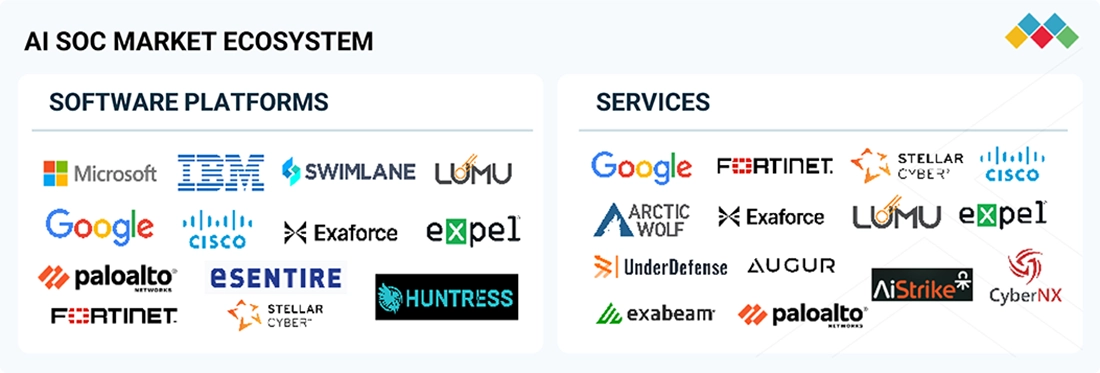
AI SECURITY OPERATIONS CENTER (SOC) MARKET: COMMERCIAL USE CASES ACROSS INDUSTRIES
| COMPANY | USE CASE DESCRIPTION | BENEFITS |
|---|---|---|
 |
Thetabyte deployed Swimlane Turbine as the central AI automation platform for NNPC’s Security Operations Center, automating SIEM alert triage, threat-intelligence enrichment, and incident-response workflows across its complex infrastructure. | Automated more than 60% of Tier 1 triage, reduced incident response time by 70%, and enabled threats to be contained in under 5 minutes, while reducing analyst workload and improving SOC efficiency. |
 |
Accton Technology deployed Exaforce’s AI SOC platform to unify security visibility across its global infrastructure, automate alert triage and investigation, and accelerate threat detection and response across cloud, endpoint, network, and security environments. | Reduced security noise by 91% and cut mean time to investigate from approximately 3 hours to 10 minutes, while automating alert triage and investigation and improving SOC efficiency. |
 |
Lumu deployed its Autopilot AI-driven security operations capability to autonomously investigate confirmed compromises across network, endpoint, identity, cloud, and email environments, determine whether incidents should be closed, escalated, or remediated, and orchestrate response workflows without human intervention. | Executed 7.2 million AI-driven workflows, autonomously resolved 45.3% of confirmed compromise incidents, eliminated more than 17,000 hours of manual triage, and reduced manual triage workload by up to 69.9%. |
 |
A US financial services organization deployed Stellar Cyber's Open XDR and AI-native SecOps platform to centralize security telemetry, automate threat detection, and simplify investigations across hybrid IT and cloud environments. | Improved SOC visibility, accelerated threat investigations, reduced alert fatigue through AI-driven correlation, strengthened compliance, and increased operational efficiency with a unified security operations platform. |
 |
CarbonHelix integrated Intezer's AI-powered Autonomous SOC platform into its managed security services to automate malware analysis, alert triage, and incident investigations, enabling scalable and efficient security operations for customers. | Reduced investigation time, automated repetitive SOC tasks, improved detection accuracy, accelerated incident response, and enabled analysts to focus on complex threats while supporting MSSP service scalability. |
Logos and trademarks shown above are the property of their respective owners. Their use here is for informational and illustrative purposes only.
Related Ecosystem
Cyber Security
- Cloud Security
- Biometric Systems
- Data Loss Prevention (DLP)
- Multi-Factor Authentication
- Security Analytics
- REDINGTON
- International Business Machines Corporation
- Cisco Systems, Inc.
- MITSUI BUSSAN SECURE DIRECTIONS INC
- MICROSOFT CORPORATION
Key Takeaways
- Brazil's AI SOC market will grow from USD 587.7M (2026) to USD 1,428.9M (2031) at a 19.4% CAGR, nearly tripling in value.
- Brazil's financial services and fintech sectors are primary drivers of AI SOC adoption due to regulatory mandates and cyber threat exposure.
- Brazil's digital transformation and cloud migration initiatives are accelerating demand for AI-powered threat detection and automated incident response.
- Brazil's strategic regional position makes it a priority market for global and regional security vendors expanding their AI SOC solutions.
AI Security Operations Center (SOC) Market Report Scope
| Report Metric | Details |
|---|---|
| Base Year | 2026 |
| Fastest Growing Segment | AI SOC-AS-A-SERVICE (SOCAAS) (Service) |
| Forecast Period | 2026-2031 |
| Growth Rate | CAGR of 21.1% from 2026 to 2031 |
| Largest Segment | LARGE ENTERPRISES (Organization Size) |
| Market Size Base Year (Billions) | ~USD 18.07 (2026) |
| Revenue Forecast (Billions) | ~USD 47.07 (2031) |
| Segments Covered | Offering, Software Platform, Software Platforms, Service, Organization Size, Application, Vertical |
Brazil AI Security Operations Center (SOC) Market Report Segmentation
7 segment dimensions are covered across the global market.
By Offering
- Services
- Software Platforms
By Software Platform
- AI Governance, Risk, And Compliance Solutions
- AI Soc Agent Solutions
- AI-Enabled Detection And Analytics Platforms
- AI-Native Soc Platforms
- AI-Orchestrated Response And Automation Platforms
- Security Data Platforms
- Threat Intelligence Platforms
By Software Platforms
- AI Governance, Risk, And Compliance Solutions
- AI Soc Agent Solutions
- AI-Enabled Detection And Analytics Platforms
- AI-Native Soc Platforms
- AI-Orchestrated Response And Automation Platforms
- Security Data Platforms
- Threat Intelligence Platforms
By Service
- AI Soc-As-A-Service (Socaas)
- AI-Augmented Managed Detection And Response (Mdr)
- Incident Response And Forensics Services
- Threat Intelligence And Advisory Services
By Organization Size
- Large Enterprises
- Smes
By Application
- Alert Triage And Prioritization
- Cloud Security Monitoring
- Compliance Monitoring And Reporting
- Identity And Access Monitoring
- Incident Investigation And Analysis
- Incident Response And Remediation
- Insider Threat Detection
- Security Analytics And Visualization
- Threat Detection And Monitoring
- Threat Hunting
By Vertical
- Bfsi
- Education
- Energy & Utilities
- Government & Defense
- Healthcare & Life Sciences
- Healthcare & Lifesciences
- It & Telecommunications
- Manufacturing
- Media & Entertainment
- Other Verticals
- Retail & Ecommerce
Target Audience
- Cybersecurity Solution Vendors : Vendors need Brazil-specific market data to develop localized AI SOC products, establish regional partnerships, and allocate sales resources effectively in this high-growth market.
- Enterprise Security Leaders : CISOs and security directors in Brazil require market intelligence to benchmark their AI SOC investments, evaluate vendor options, and justify budget allocation to executive leadership.
- Investment & Private Equity Firms : Investors evaluating cybersecurity opportunities in Latin America need Brazil market sizing and growth projections to assess portfolio companies and identify acquisition targets.
- Government & Regulatory Bodies : Brazilian government agencies and regulators need market data to understand cybersecurity infrastructure gaps, inform policy decisions, and guide national digital security initiatives.
- Systems Integrators & Consultants : SI firms and consultancies require Brazil market insights to advise clients on AI SOC implementation strategies, vendor selection, and technology roadmap planning.
Reasons to Buy this Report
- Market Size & Growth Validation : Quantified market data for Brazil's AI SOC sector with precise valuations (2026-2031) enables accurate investment planning, competitive positioning, and revenue forecasting for market participants.
- Regional Competitive Intelligence : Understand Brazil's market dynamics relative to global trends (21.1% global CAGR vs. 19.4% Brazil CAGR) to identify competitive advantages, market gaps, and localization opportunities.
- Regulatory & Compliance Insights : Gain clarity on how LGPD and emerging Brazilian cybersecurity regulations are driving AI SOC adoption, enabling compliant product development and targeted go-to-market strategies.
- Enterprise Buyer Segmentation : Access detailed analysis of Brazilian financial institutions, government agencies, and enterprises investing in AI SOC solutions to prioritize sales efforts and customize offerings.
- Strategic Expansion Planning : Leverage Brazil-specific market forecasts to evaluate market entry timing, partnership opportunities, and resource allocation for vendors seeking to capture Latin American growth.
Frequently asked questions
What is the current size of Brazil's AI SOC market?
Brazil's AI Security Operations Center market is valued at USD 587.7 million in 2026 and is expected to grow to USD 1,428.9 million by 2031.
What is the growth rate of Brazil's AI SOC market?
Brazil's AI SOC market is growing at a compound annual growth rate (CAGR) of 19.4% from 2026 to 2031.
Which industries are driving AI SOC adoption in Brazil?
Brazil's financial services, fintech, government, and enterprise sectors are the primary drivers of AI SOC adoption due to regulatory requirements and increasing cyber threats.
What factors are accelerating AI SOC market growth in Brazil?
Brazil's market growth is accelerated by digital transformation initiatives, cloud migration, regulatory compliance mandates, and rising awareness of sophisticated cyberattacks.
How does Brazil's AI SOC market compare to the global market?
Brazil's 19.4% CAGR is slightly lower than the global 21.1% CAGR, but Brazil represents a high-growth regional opportunity within Latin America.
RESEARCH METHODOLOGY
Secondary research was conducted to collect information useful for this technical, market-oriented, and commercial study of the AI SOC market. The next step involved validating these findings, assumptions, and sizing with industry experts across the value chain using primary research. Different approaches, including top-down and bottom-up methods, were employed to estimate the total market size. After that, the market breakup and data triangulation procedures were used to estimate the market size of the segments and subsegments of the AI SOC market.
Secondary Research
During the secondary research process, various secondary sources were consulted to identify and collect information relevant to the study. The secondary sources included annual reports, press releases, investor presentations of AI SOC vendors, forums, certified publications, and whitepapers. The secondary research was mainly used to obtain key information about the industry’s supply chain, the total pool of key players, market classification and segmentation according to industry trends to the bottom-most level, regional markets, and key developments from both market- and technology-oriented perspectives, all of which were further validated by primary sources.
Primary Research
In the primary research process, various primary sources from both the supply and demand sides were interviewed to obtain qualitative and quantitative information for this report. The primary sources from the supply side included industry experts, such as chief executive officers (CEOs), vice presidents (VPs), marketing directors, technology and innovation directors, and other key executives from companies and organizations operating in the AI SOC market.
In the market engineering process, top-down and bottom-up approaches were extensively used, along with several data triangulation methods, to perform market estimation and forecasting for the overall market segments and subsegments listed in this report. Extensive qualitative and quantitative analysis was performed on the complete market engineering process to list key information/insights throughout the report.
After the complete market engineering process (including calculations for market statistics, market breakups, market size estimations, market forecasts, and data triangulation), extensive primary research was conducted to gather information and verify & validate the critical numbers arrived at. Primary research was also conducted to identify segmentation types, industry trends, the competitive landscape of AI SOC market players, and key market dynamics, such as drivers, restraints, opportunities, challenges, and key strategies.
The following is the breakup of the primary study:
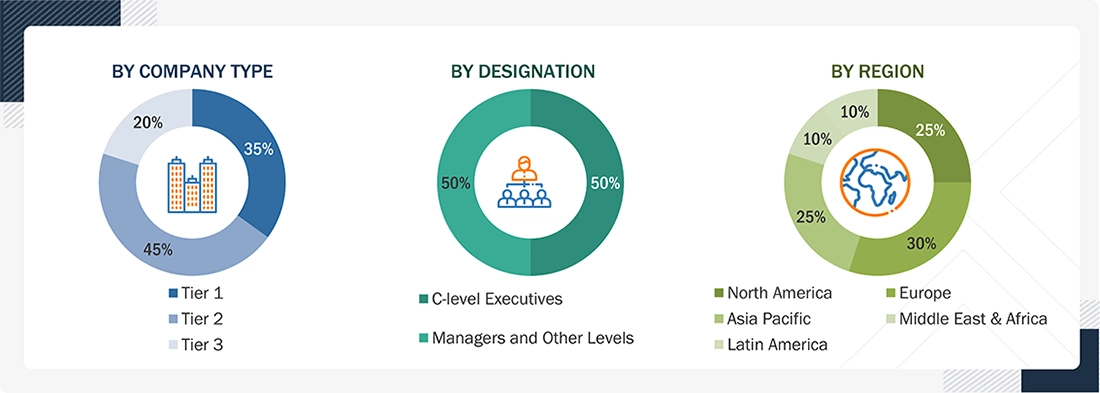
Note: Tier 1 companies receive revenues higher than USD 10 billion; Tier 2 companies' revenues range between USD 1 and 10 billion; and Tier 3 companies' revenues range between USD 500 million and USD 1 billion. Other designations include sales, marketing, and product managers.
Source: Industry Experts
To know about the assumptions considered for the study, download the pdf brochure
Market Size Estimation
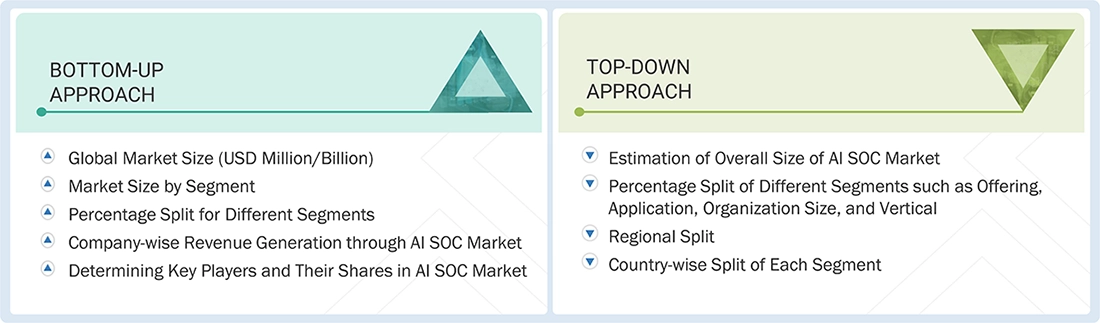
Top-down and bottom-up approaches were employed to estimate and validate the size of the AI SOC market, as well as the size of various dependent sub-segments within the overall AI SOC market. The research methodology used to estimate the market size includes the following details: critical players in the market were identified through secondary research, and their market shares in the respective regions were determined through primary and secondary research. This entire procedure involved studying the annual and financial reports of the top market players, and extensive interviews were conducted with key industry leaders, including CEOs, VPs, directors, and marketing executives, to gather valuable insights.
All percentage splits and breakdowns were determined using secondary sources and verified through primary sources. All parameters that affect the market covered in this research study were accounted for, examined in extensive detail, verified through primary research, and analyzed to obtain the final quantitative and qualitative data. This data was consolidated and added to detailed inputs and analysis from MarketsandMarkets.
AI SOC Market : Top-Down and Bottom-Up Approach
Data Triangulation
The market was split into several segments and subsegments after arriving at the overall market size using the market size estimation processes explained above. The data triangulation and market breakup procedures were employed, wherever applicable, to complete the overall market engineering process and arrive at the exact statistics of each market segment and subsegment. The data was triangulated by studying various factors and trends from both the demand and supply sides.
Market Definition
The AI Security Operations Center (SOC) Market comprises software platforms and security services that leverage Artificial Intelligence (AI), Machine Learning (ML), Generative AI (GenAI), Large Language Models (LLMs), and Agentic AI to augment, automate, or autonomously perform SOC functions throughout the cyber threat lifecycle.
Key Stakeholders
- Chief Information Security Officers (CISOs) & Security Leaders
- Security Operations Center (SOC) Teams & Security Analysts
- Information Technology (IT) & Cybersecurity Professionals
- Government Agencies & Critical Infrastructure Operators
- Small and Medium-sized Enterprises (SMEs) and Large Enterprises
- Managed Security Service Providers (MSSPs)
- Managed Detection and Response (MDR) Providers
- AI SOC Platform Vendors
- SIEM, SOAR, XDR & EDR Solution Providers
- Threat Intelligence Platform Providers
- Cloud Service Providers (AWS, Microsoft Azure, Google Cloud)
- AI Infrastructure & GPU Providers
- System Integrators & Cybersecurity Consulting Firms
- Technology Channel Partners & Value-Added Resellers (VARs)
- Compliance, Risk & Governance Professionals
- Investors & Venture Capital Firms
- Industry Analysts & Research Organizations
- Telecommunications & Digital Infrastructure Providers
- Third-party Security Service Providers
- Enterprise Software & Identity Security Vendors (IAM/PAM)
Report Objectives
- To define, describe, and forecast the AI SOC market based on offering, application, organization size, vertical, and region
- To provide detailed information about the major factors, such as drivers, opportunities, restraints, and challenges, influencing the growth of the market
- To forecast the size of the market segments with respect to five main regions: North America, Europe, Asia Pacific, Middle East & Africa, and Latin America
- To analyze subsegments of the market with respect to individual growth trends, prospects, and contributions to the overall market
- To profile the key players of the market and comprehensively analyze their market shares and core competencies
- To map the competitive intelligence based on company profiles, key player strategies, and game-changing developments, such as product enhancements/launches, collaborations, and acquisitions
- To track and analyze the competitive developments, such as product enhancements/launches, acquisitions, partnerships, and collaborations, in the AI SOC market globally
Available customizations:
With the given market data, MarketsandMarkets offers customizations based on company-specific needs. The following customization options are available for the report:
Geographic Analysis
- Further breakdown of the Asia Pacific market into countries contributing to the regional market size.
- Further breakdown of the North American market into countries contributing to the rest of the regional market size.
- Further breakdown of the Latin American market into countries contributing to the rest of the regional market size.
- Further breakdown of the Middle East & African market into countries contributing to the rest of the regional market size.
- Further breakdown of the European market into countries contributing to the rest of the regional market size.
Company Information
- Detailed analysis and profiling of additional market players (up to 5)
Get the Full AI Security Operations Center (SOC) Market Report
Full forecast, segment splits, and company analysis for all AI Security Operations Center (SOC) Market.
- Canada AI Security Operations Center (SOC) Market
- US AI Security Operations Center (SOC) Market
- UK AI Security Operations Center (SOC) Market
- Germany AI Security Operations Center (SOC) Market
- France AI Security Operations Center (SOC) Market
- Italy AI Security Operations Center (SOC) Market
- China AI Security Operations Center (SOC) Market
- Japan AI Security Operations Center (SOC) Market
- India AI Security Operations Center (SOC) Market
- UAE AI Security Operations Center (SOC) Market
- Mexico AI Security Operations Center (SOC) Market
- Rest Of Europe AI Security Operations Center (SOC) Market
- Rest Of Asia Pacific AI Security Operations Center (SOC) Market
- Rest Of Latin America AI Security Operations Center (SOC) Market
- Africa AI Security Operations Center (SOC) Market
- GCC AI Security Operations Center (SOC) Market
- Rest Of Middle East AI Security Operations Center (SOC) Market
- Ksa AI Security Operations Center (SOC) Market
- Rest Of GCC AI Security Operations Center (SOC) Market
Need a Tailored Report?
Customize this report to your needs
Get 10% FREE Customization
Customize This Report
