
Brazil Air-Cooled Heat Exchanger Market (2024-2029)

The Brazil Air-Cooled Heat Exchanger Market was valued at $129.03 Million in 2024 and projected to reach to $187.66 Million by 2029, representing a compound annual growth rate of 7.8%. Brazil's air-cooled heat exchanger market is poised for sustained growth as the country's chemical and material processing industries prioritize operational efficiency and energy optimization.


| Market Size in | USD 26.32 MN |
| Market Forecast in | |
| CAGR | |
| Forecast Period | |
| Units Considered | Value (USD MN) |
Brazil Air-Cooled Heat Exchanger Market Trends and Insights
- Brazil's chemical and material processing industries are driving demand for efficient thermal management solutions, with the country's industrial base increasingly adopting air-cooled heat exchangers to optimize operational efficiency and reduce energy costs.
- The 7.8% compound annual growth rate reflects Brazil's commitment to industrial modernization and sustainability initiatives across petrochemical, refining, and manufacturing sectors. Brazil's market growth is underpinned by rising investments in industrial infrastructure and the country's strategic position as a regional manufacturing hub in South America.
- Brazil's expanding chemical production capacity and growing focus on process optimization are accelerating adoption of advanced heat exchanger technologies.
- Between 2024 and 2029, Brazil is expected to see increased capital expenditure in industrial cooling systems, driven by both replacement cycles and new facility construction across the energy and chemical sectors..
Key Market Statistics
- CAGR (2024-2029) 7.8% CAGR
- Market Size, 2024 ~USD 129.03 Million
- Forecast, 2029 ~USD 187.66 Million
- Country Brazil
Brazil Air-Cooled Heat Exchanger Market Overview
Market Valuation :
Brazil's air-cooled heat exchanger market is valued at USD 129.03 million in 2024, with strong growth trajectory positioning it as a key market in Latin America's industrial sector.
Robust CAGR Growth :
The Brazilian market is expanding at 7.8% CAGR from 2024-2029, outpacing the global average of 7.5%, reflecting accelerating industrial modernization and thermal management investments.
Industrial Demand Drivers :
Brazil's chemical and material processing industries are increasingly adopting air-cooled heat exchangers to enhance operational efficiency, reduce energy consumption, and meet environmental compliance standards.
Forecast Growth Potential :
The market is projected to reach USD 187.66 million by 2029, representing a 45.4% increase over five years, driven by industrial expansion and infrastructure development across Brazil's manufacturing sector.
Brazil Air-Cooled Heat Exchanger Market Dynamics
- Industrial modernization initiatives, coupled with increasing environmental regulations, are driving adoption of advanced thermal management solutions across manufacturing facilities.
- The market's 7.8% CAGR reflects strong demand from both established industrial players and emerging manufacturing hubs throughout Brazil. Looking ahead, Brazil's economic recovery and infrastructure investments will further accelerate market expansion.
- Rising energy costs and sustainability pressures are compelling manufacturers to upgrade cooling systems, while growing foreign direct investment in the chemical sector creates additional opportunities.
- The forecast growth to USD 187.66 million by 2029 underscores Brazil's strategic importance as a regional industrial hub and the increasing necessity for efficient heat exchange solutions in competitive manufacturing environments..
Market Ecosystem
Related Ecosystem
Equipment Machine And Tooling
- Wastewater Treatment
- Air Cooled Heat Exchangers
- Diaphragm Pumps
- Fiberglass
- HVAC System
- Alfa Laval Corporate AB
- Johnson Controls International plc
- Veolia
- Daikin Industries,Ltd.
- Carrier Global Corporation
Industrial Gases
- Dry Cooling Tower
- HVAC System
- Heat Exchanger
- Hybrid Cooling Tower
- Industrial Refrigeration
- Linde plc
- MESSER GROUP GMBH
- Air Products and Chemicals, Inc.
- AIR LIQUIDE
- Iwatani Corporation
Digital Oilfield
- Remote Monitoring
- Dairy Products
- Digital Addressable Lighting Interface (DALI)
- Enocean
- Meter Data Management (MDM)
- International Business Machines Corporation
- HONEYWELL INTERNATIONAL INC.
- Oracle Corporation
- ABB India Limited
- SCHNEIDER ELECTRIC SE
Key Takeaways
- Brazil's air-cooled heat exchanger market is valued at USD 129.03 million in 2024 and will grow to USD 187.66 million by 2029, representing a 7.8% CAGR.
- Brazil's chemical and petrochemical sectors are primary demand drivers, leveraging air-cooled heat exchangers for enhanced energy efficiency and operational performance.
- Brazil's industrial modernization initiatives and sustainability focus are accelerating technology adoption across manufacturing and refining industries.
- Brazil's strategic regional position in South America positions the country as a key market for heat exchanger manufacturers and industrial equipment suppliers.
Air-Cooled Heat Exchanger Market Report Scope
| Report Metric | Details |
|---|---|
| Base Year | 2024 |
| Fastest Growing Segment | -EDGE DATA CENTERS (End-Use Industry) |
| Forecast Period | 2024-2029 |
| Growth Rate | CAGR of 7.5% from 2024 to 2029 |
| Largest Segment | FORCED DRAFT (Type) |
| Market Size Base Year (Billions) | ~USD 3.96 (2024) |
| Revenue Forecast (Billions) | ~USD 5.69 (2029) |
| Segments Covered | Type, Structure, Material, Fin Design, Capacity, End-Use Industry |
Brazil Air-Cooled Heat Exchanger Market Report Segmentation
6 segment dimensions are covered across the global market.
By Type
- Forced
- Forced Draft
- Induced
- Induced Draft
- Other Types
By Structure
- Ducted
- Non-Ducted
- Other Structures
By Material
- Carbon Steel
- Other Materials
- Stainless Steel
By Fin Design
- Extruded Fin
- G Fin
- L Fin
- Other Fin Designs
By Capacity
- 11-50 Kw
- 201-500 Kw
- 51-200 Kw
- <10 Kw
- >500 Kw
By End-Use Industry
- Data Centers
- Oil & Gas
- Other End-Use Industries
- Power Generation
- -Colocation Data Centers
- -Edge Data Centers
- -Enterprise Data Centers
- -Micro Data Centers
- -Other Data Centers
BRAZIL: AIR-COOLED HEAT EXCHANGER MARKET, BY END-USE INDUSTRY, 2024–2029
| Segment | 2024 | 2025 | 2026 | 2027 | 2028 | 2029 | CAGR (%) |
|---|---|---|---|---|---|---|---|
| DATA CENTERS | 14.3 | 15.6 | 17 | 18.5 | 20.1 | 21.8 | 8.7 |
| OIL & GAS | 64.5 | 69.2 | 74.4 | 79.9 | 85.4 | 91.2 | 7.2 |
| OTHER END-USE INDUSTRIES | 11.4 | 12.3 | 13.3 | 14.4 | 15.5 | 16.7 | 8 |
| POWER GENERATION | 38.8 | 42.1 | 45.8 | 49.7 | 53.7 | 58 | 8.3 |
| TOTAL | 129 | 139.1 | 150.5 | 162.4 | 174.8 | 187.7 | 7.8 |
Target Audience
- Chemical & Material Manufacturers : Brazilian chemical and material processing companies need detailed market insights to optimize cooling system investments, improve operational efficiency, and maintain competitive advantage in their production processes.
- Heat Exchanger Equipment Suppliers : Manufacturers and distributors of air-cooled heat exchangers require Brazil-specific market data to identify growth opportunities, understand customer needs, and develop localized sales and marketing strategies.
- Industrial Equipment Distributors : Regional distributors and resellers need comprehensive market analysis to forecast demand, optimize inventory management, and identify high-potential customer segments within Brazil's industrial sector.
- Investment & Private Equity Firms : Investors evaluating opportunities in Brazil's industrial sector require detailed market valuations, growth projections, and competitive dynamics to assess investment viability and portfolio positioning.
- Industrial Facility Operators & Engineers : Plant managers and engineering teams in Brazil need market intelligence to evaluate cooling solutions, benchmark against industry standards, and justify capital expenditures for thermal management upgrades.
Reasons to Buy this Report
- Market-Specific Growth Intelligence : Gain detailed insights into Brazil's 7.8% CAGR trajectory and understand the unique drivers propelling the market from USD 129.03M to USD 187.66M, enabling informed investment and expansion decisions.
- Competitive Landscape Analysis : Access Brazil-focused competitive intelligence to identify market leaders, emerging players, and strategic opportunities within the country's air-cooled heat exchanger sector.
- Industry-Specific Demand Patterns : Understand how Brazil's chemical and material processing industries are driving adoption of air-cooled heat exchangers, including sector-specific requirements and purchasing behaviors.
- Regional Market Positioning : Leverage Brazil-specific data to benchmark performance against regional competitors and identify market gaps, customer segments, and geographic expansion opportunities within the country.
- Strategic Planning & Forecasting : Utilize comprehensive 2024-2029 projections and market dynamics to develop targeted go-to-market strategies, product development roadmaps, and investment plans specific to Brazil's industrial landscape.
Frequently asked questions
What is the current market size of air-cooled heat exchangers in Brazil?
Brazil's air-cooled heat exchanger market was valued at USD 129.03 million in 2024 and is projected to reach USD 187.66 million by 2029.
What is the expected growth rate for Brazil's air-cooled heat exchanger market?
Brazil's air-cooled heat exchanger market is expected to grow at a compound annual growth rate (CAGR) of 7.8% from 2024 to 2029.
Which industries drive demand for air-cooled heat exchangers in Brazil?
Brazil's chemical processing, petrochemical refining, and manufacturing sectors are the primary drivers of air-cooled heat exchanger demand, seeking improved thermal efficiency and cost optimization.
What factors are contributing to market growth in Brazil?
Brazil's market growth is driven by industrial modernization, increased capital investments in infrastructure, sustainability initiatives, and rising demand for energy-efficient cooling solutions across manufacturing sectors.
How does Brazil's market compare to the global air-cooled heat exchanger market?
Brazil's market CAGR of 7.8% slightly exceeds the global CAGR of 7.5%, indicating stronger regional growth momentum driven by Brazil's expanding industrial base and regional manufacturing prominence.
RESEARCH METHODOLOGY
The study involved four major activities in estimating the market size of the air-cooled heat exchanger market. Exhaustive secondary research was done to collect information on the market, the peer market, and the grandparent market. The next step was to validate these findings, assumptions, and sizing with industry experts across the value chain through primary research. Both top-down and bottom-up approaches were employed to estimate the complete market size. Thereafter, the market breakdown and data triangulation procedures were used to estimate the market size of the segments and subsegments.
Secondary Research
In the secondary research process, various secondary sources have been referred to for identifying and collecting information for this study. These secondary sources include annual reports, press releases, investor presentations of companies, white papers, certified publications, trade directories, certified publications, articles from recognized authors, gold standard and silver standard websites, and databases.
Secondary research has been used to obtain key information about the value chain of the industry, monetary chain of the market, the total pool of key players, market classification and segmentation according to industry trends to the bottom-most level, and regional markets. It was also used to obtain information about the key developments from a market-oriented perspective.
Primary Research
The air-cooled heat exchanger market comprises several stakeholders in the value chain, which include raw material suppliers, manufacturers, and end users. Various primary sources from the supply and demand sides of the air-cooled heat exchanger market have been interviewed to obtain qualitative and quantitative information. The primary interviewees from the demand side include key opinion leaders in end-use sectors. The primary sources from the supply side include manufacturers, associations, and institutions involved in the air-cooled heat exchanger industry.
Primary interviews were conducted to gather insights such as market statistics, data of revenue collected from the products and services, market breakdowns, market size estimations, market forecasting, and data triangulation. Primary research also helped in understanding the various trends related to structure, material, type, capacity, fin design, end-use industry, and region. Stakeholders from the demand side, such as CIOs, CTOs, and CSOs were interviewed to understand the buyer’s perspective on the suppliers, products, component providers, and their current usage of air-cooled heat exchanger and the future outlook of their business which will affect the overall market.
The breakdown of profiles of the primary interviewees is illustrated in the figure below:
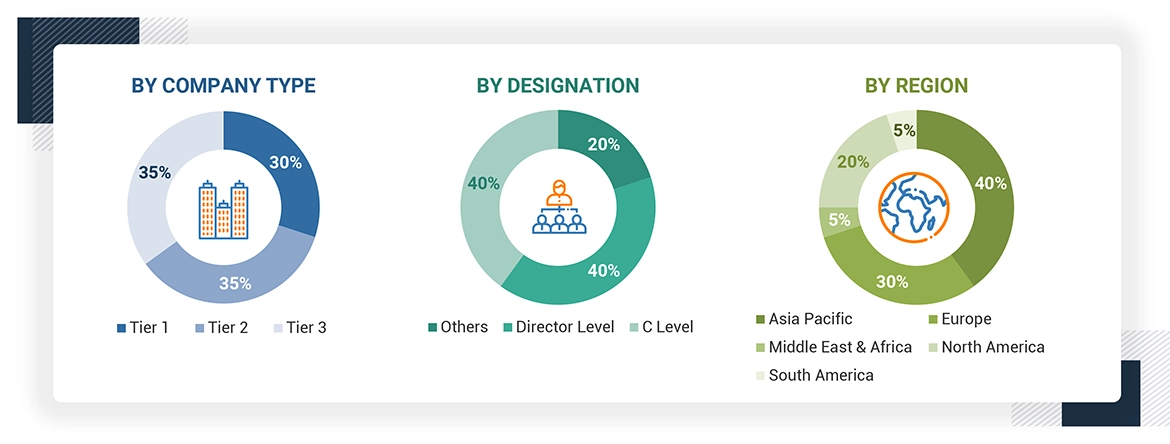
Note: Tier 1, Tier 2, and Tier 3 companies are classified based on their market revenue in 2023 available in the public domain, product portfolios, and geographical presence.
Other designations include consultants and sales, marketing, and procurement managers.
To know about the assumptions considered for the study, download the pdf brochure
Market Size Estimation
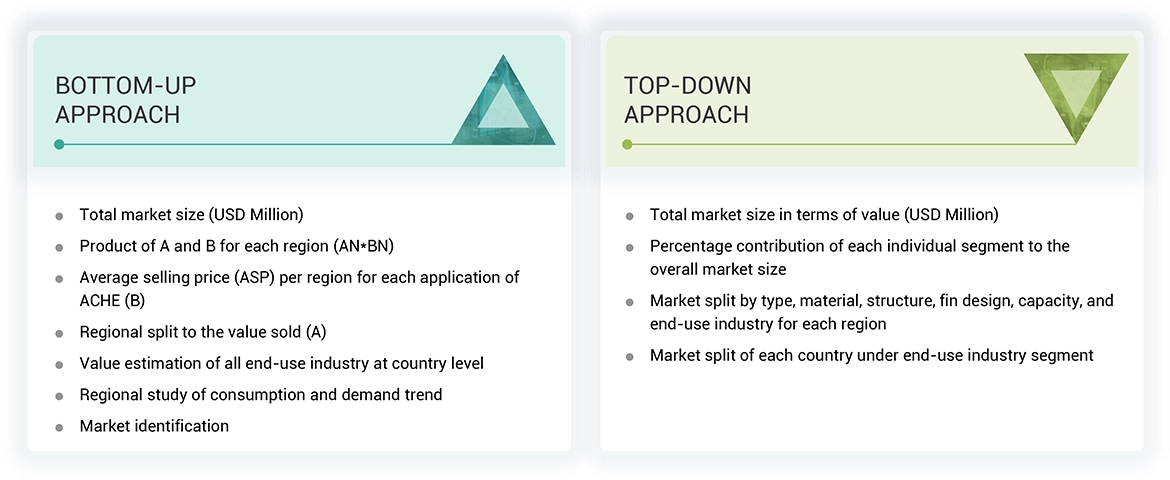
The top-down and bottom-up approaches have been used to estimate and validate the size of the air-cooled heat exchanger market.
- The key players in the industry have been identified through extensive secondary research.
- The supply chain of the industry has been determined through primary and secondary research.
- The global market was then segmented into five major regions and validated by industry experts.
- All percentage shares, splits, and breakdowns based on structure, material, type, capacity, fin design, end-use industry, and region were determined using secondary sources and verified through primary sources.
- All possible parameters that affect the markets covered in this research study were accounted for, viewed in extensive detail, verified through primary research, and analyzed to get the final quantitative and qualitative data. This data was consolidated and added with detailed inputs and analysis and presented in this report.
Data Triangulation
After arriving at the total market size from the estimation process air-cooled heat exchanger above, the overall market has been split into several segments and sub-segments. To complete the overall market engineering process and arrive at the exact statistics for all the segments and sub-segments, the data triangulation and market breakdown procedures have been employed, wherever applicable. The data has been triangulated by studying various factors and trends from both the demand and supply sides. Along with this, the market size has been validated by using both the top-down and bottom-up approaches and primary interviews. Hence, for every data segment, there have been three sources—top-down approach, bottom-up approach, and expert interviews. The data was assumed correct when the values arrived from the three sources matched.
Market Definition
An air-cooled heat exchanger is a type of heat transfer equipment that utilizes air as the cooling medium to dissipate heat from a fluid, typically in industrial applications. It comprises a series of tubes or fins through which the hot fluid flows, while ambient air is drawn across the external surfaces to absorb and carry away heat. These heat exchangers are widely used in various sectors, including oil and gas, power generation, petrochemicals, and HVAC systems, due to their efficiency, lower water consumption, and ease of maintenance. Their design varies to meet specific operational requirements, making them essential for maintaining optimal temperatures in processing and cooling applications.
Stakeholders
- Air-cooled heat exchanger Manufacturers
- Air-cooled heat exchanger Traders, Distributors, and Suppliers
- Raw Material Suppliers
- Government and Private Research Organizations
- Associations and Industrial Bodies
- R&D Institutions
- Environmental Support Agencies
Report Objectives
- To define, describe, and forecast the air-cooled heat exchanger market size in terms of value and volume
- To provide detailed information regarding the drivers, restraints, opportunities, and challenges influencing the growth of the air-cooled heat exchanger market
- To analyze and forecast the market by structure, material, type, capacity, fin design, end-use industry and region
- To describe and forecast the market with respect to five main regions: North America, Europe, Asia Pacific, South America, and the Middle East & Africa, along with their key countries
- To analyze opportunities for stakeholders by identifying high-growth segments of the air-cooled heat exchanger market
- To strategically analyze the ecosystem, Porter’s Five Forces, technology analysis, tariffs and regulations, patent landscape, trade landscape, key conferences and events, and case studies/use cases pertaining to the market under study
- To strategically analyze micromarkets with respect to individual growth trends, prospects, and contributions to the overall market
- To strategically profile the key players and comprehensively analyze their market positions in terms of their ranking and core competencies, along with detailing the competitive landscape for market leaders
- To analyze competitive developments such as investments & expansions and mergers & acquisitions
Get the Full Air-Cooled Heat Exchanger Market Report
Full forecast, segment splits, and company analysis for all Air-Cooled Heat Exchanger Market.
- South Korea Air-Cooled Heat Exchanger Market
- South Africa Air-Cooled Heat Exchanger Market
- Argentina Air-Cooled Heat Exchanger Market
- Rest Of Europe Air-Cooled Heat Exchanger Market
- Rest Of Asia Pacific Air-Cooled Heat Exchanger Market
- GCC Countries Air-Cooled Heat Exchanger Market
- -Rest Of The GCC Countries Air-Cooled Heat Exchanger Market
- Rest Of South America Air-Cooled Heat Exchanger Market
- US Air-Cooled Heat Exchanger Market
- Canada Air-Cooled Heat Exchanger Market
- Mexico Air-Cooled Heat Exchanger Market
- Germany Air-Cooled Heat Exchanger Market
- France Air-Cooled Heat Exchanger Market
- UK Air-Cooled Heat Exchanger Market
- Italy Air-Cooled Heat Exchanger Market
- Switzerland Air-Cooled Heat Exchanger Market
- Spain Air-Cooled Heat Exchanger Market
- China Air-Cooled Heat Exchanger Market
- Japan Air-Cooled Heat Exchanger Market
- India Air-Cooled Heat Exchanger Market
Need a Tailored Report?
Customize this report to your needs
Get 10% FREE Customization
Customize This Report
