
Brazil Air Quality Monitoring System Market (2023-2028)

The Brazil Air Quality Monitoring System Market was valued at $166.1 Million in 2023 and projected to reach to $255.3 Million by 2028, representing a compound annual growth rate of 9.0%. Brazil's air quality monitoring system market is poised for sustained expansion as urbanization accelerates and environmental consciousness grows among both government and private sectors.


| Market Size in | USD 26.32 MN |
| Market Forecast in | |
| CAGR | |
| Forecast Period | |
| Units Considered | Value (USD MN) |
Brazil Air Quality Monitoring System Market Trends and Insights
- This 9.0% compound annual growth rate reflects Brazil's increasing focus on environmental health and regulatory compliance across urban and industrial sectors.
- Brazil's rapid urbanization and industrial expansion have intensified air pollution concerns, driving demand for advanced monitoring technologies in major metropolitan areas. The Brazilian market is supported by growing government initiatives and corporate sustainability commitments aimed at improving air quality standards.
- Brazil's healthcare and environmental sectors are increasingly investing in real-time air quality monitoring systems to protect public health and meet international environmental standards.
- By 2028, Brazil is expected to consolidate its position as a key market for air quality monitoring solutions in Latin America, driven by technological innovation and heightened awareness of air pollution's health impacts..
Key Market Statistics
- CAGR (2023-2028) 9.0% CAGR
- Market Size, 2023 ~USD 166.1 Million
- Forecast, 2028 ~USD 255.3 Million
- Country Brazil
Brazil Air Quality Monitoring System Market Overview
Market Valuation Growth :
Brazil's air quality monitoring system market reached USD 166.1 million in 2023 and is projected to grow to USD 255.3 million by 2028, representing a strong 9% CAGR driven by urbanization and industrial expansion.
Regulatory Compliance Drivers :
Stricter environmental regulations from CONAMA and state-level agencies are compelling industrial facilities and municipalities across Brazil to invest in advanced air quality monitoring solutions for compliance and reporting.
Urban Air Pollution Crisis :
Major Brazilian cities including São Paulo, Rio de Janeiro, and Brasília face persistent air quality challenges, creating urgent demand for real-time monitoring systems in both public health and industrial sectors.
Industrial Sector Expansion :
Brazil's growing manufacturing, petrochemical, and mining industries are increasingly adopting air quality monitoring systems to meet environmental standards and reduce operational risks.
Brazil Air Quality Monitoring System Market Dynamics
- The 9% CAGR reflects increasing investments in smart city infrastructure and industrial compliance technologies across major metropolitan areas.
- Regulatory pressures from federal and state environmental agencies are compelling municipalities and large industrial operators to deploy comprehensive monitoring networks. The forecast period through 2028 will be characterized by rising adoption of IoT-enabled monitoring solutions and cloud-based data analytics platforms.
- Growing public health awareness regarding air pollution impacts, combined with Brazil's commitment to environmental sustainability goals, will drive market penetration in both urban centers and industrial zones, creating significant opportunities for technology providers and system integrators..
Market Ecosystem
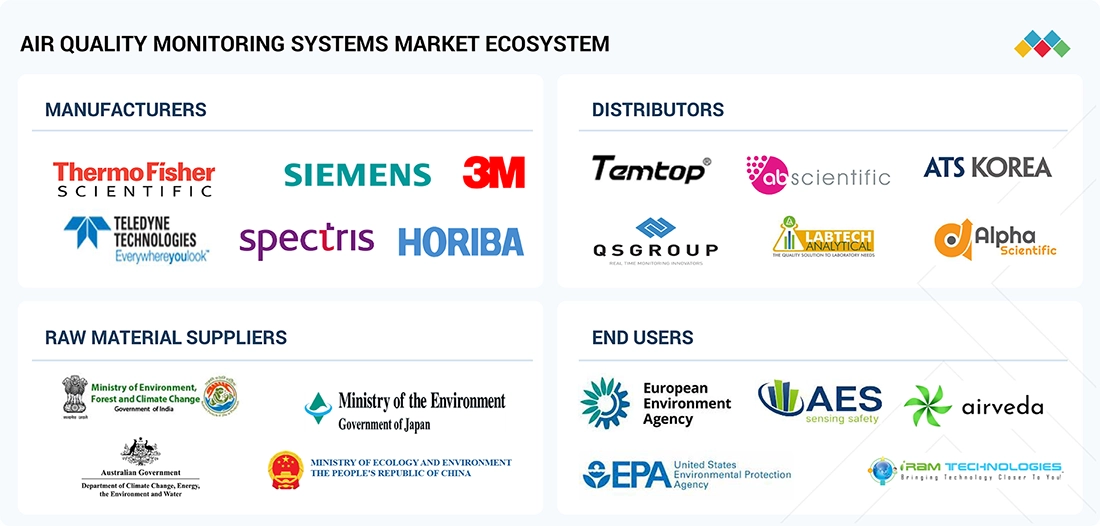
AIR QUALITY MONITORING SYSTEM MARKET: COMMERCIAL USE CASES ACROSS INDUSTRIES
| COMPANY | USE CASE DESCRIPTION | BENEFITS |
|---|---|---|
 |
Provides ambient air monitoring systems, gas analyzers, and particulate monitoring solutions for industrial facilities, environmental agencies, research institutions, and urban air quality monitoring networks | Supports continuous and accurate monitoring of air pollutants | Helps industries comply with environmental and emission regulations |
 |
Delivers indoor and outdoor air quality monitoring solutions, including air quality sensors, continuous emission monitoring systems, and smart building environmental monitoring platforms | Enhances energy-efficient building management and indoor air quality control | Supports industrial emission monitoring and compliance requirements |
 |
Offers environmental monitoring instruments and continuous emissions monitoring systems for industrial stack emissions, ambient air quality assessment, and environmental research applications | Enables precise detection and monitoring of trace gases and pollutants |Improves industrial pollution monitoring and reporting accuracy |
 |
Provides environmental sensing and monitoring technologies integrated with smart infrastructure and industrial monitoring applications to support air quality management and operational safety | Supports safer indoor and industrial environments | Enhances connected monitoring and operational efficiency |
Logos and trademarks shown above are the property of their respective owners. Their use here is for informational and illustrative purposes only.
Related Ecosystem
Analytical And Scientific Instrumentation
Key Takeaways
- Brazil's air quality monitoring system market is valued at USD 166.1 million in 2023 and will reach USD 255.3 million by 2028, representing a 9.0% CAGR.
- Brazil's rapid urbanization and industrial growth are primary drivers of demand for advanced air quality monitoring technologies.
- Government regulations and corporate sustainability initiatives in Brazil are accelerating adoption of real-time monitoring solutions.
- Brazil is positioned as a leading market for air quality monitoring systems within Latin America through 2028.
Air Quality Monitoring System Market Report Scope
| Report Metric | Details |
|---|---|
| Base Year | 2023 |
| Fastest Growing Segment | OUTDOOR MONITORS (Product) |
| Forecast Period | 2023–2028 |
| Growth Rate | CAGR of 7% from 2023 to 2028 |
| Largest Segment | CHEMICAL POLLUTANTS (Pollutant) |
| Market Size Base Year (Billions) | ~USD 4.92 (2023) |
| Revenue Forecast (Billions) | ~USD 6.9 (2028) |
| Segments Covered | Sampling Method, Pollutant, Type, Product, End User |
Brazil Air Quality Monitoring System Market Report Segmentation
5 segment dimensions are covered across the global market.
By Sampling Method
- Active/Continuous Monitoring
- Intermittent Monitoring
- Manual Monitoring
- Passive Monitoring
- Stack Monitoring
By Pollutant
- Biological
- Biological Pollutants
- Carbon Oxides
- Chemical Pollutants
- Nitrogen Oxides
- Other Chemical Pollutants
- Physical
- Physical Pollutants
- Sulfur Oxides
- Volatile Organic Compounds
By Type
- Aqm Stations
- Carbon Oxides
- Dust & Particulate Matter Monitors
- Fixed Indoor
- Fixed Indoor Monitors
- Fixed Outdoor Monitors
- Nitrogen Oxides
- Portable Indoor
- Portable Indoor Monitors
- Portable Outdoor Monitors
- Sulfur Oxides
- Volatile Organic Compounds
- Wearable Air Quality Monitors
By Product
- Indoor Air Quality Monitors
- Indoor Monitors
- Outdoor Air Quality Monitors
- Outdoor Monitors
- Wearable Air Quality Monitors
- Wearable Monitors
By End User
- Commercial And Residential Users
- Government Agencies & Academic Institutes
- Government Agencies And Academic Institutes
- Other End Users
- Petrochemical Industry
- Pharmaceutical Industry
- Power Generation Plants
- Smart City Authorities
Target Audience
- Environmental Compliance Officers : Need Brazil-specific regulatory requirements and monitoring standards to ensure industrial facilities and municipalities meet CONAMA mandates and avoid penalties while optimizing compliance investments.
- Municipal Government Planners : Require market data on air quality monitoring solutions to develop smart city initiatives in São Paulo, Rio de Janeiro, and other major cities, addressing public health concerns and environmental goals.
- Industrial Facility Managers : Seek market insights on monitoring technologies and compliance solutions to reduce operational risks, meet environmental standards, and demonstrate corporate sustainability commitments across manufacturing and petrochemical sectors.
- Technology & System Integrators : Need Brazil market analysis to identify growth opportunities, understand customer requirements, and develop localized air quality monitoring solutions for urban and industrial applications.
- Investment & Business Development Teams : Require market sizing, growth forecasts, and competitive landscape data to evaluate Brazil as an expansion market, identify acquisition targets, and allocate resources for air quality monitoring ventures.
Key Companies in the Brazil Air Quality Monitoring System Market
| Company | HQ | Ownership | Strongest segments |
|---|---|---|---|
| BIOMERIEUX S.A. | France | Public Company | Clinical microbiology (culture media, VITEK, API, ETEST, BACT/ALERT),Syndromic and molecular diagnostics (BIOFIRE, SPOTFIRE, ARGENE, NUCLISENS),Immunoassays and biomarkers (VIDAS, Hybiome CLIA), |
| VALMET CORPORATION | Finland | Public Company | Biomaterial Solutions and Services – production lines and process islands,Process Performance Solutions – automation systems and industrial internet,Flow control – valves, pumps, and valve automation, |
| THERMO FISHER SCIENTIFIC, INC. | United States | Public Company | Life Sciences Solutions,Analytical Instruments,Specialty Diagnostics, |
| SIEMENS AG | Germany | Public Company | Digital Industries (automation, PLM, simulation),Smart Infrastructure (electrification, buildings, grid),Mobility (rail systems, automation, services), |
| TELEDYNE TECHNOLOGIES INCORPORATED | United States | Public Company | Digital Imaging (visible, IR, UV, X-ray, MEMS, semiconductors),Instrumentation (monitoring, control, test, connectivity),Aerospace and Defense Electronics, |
| EMERSON ELECTRIC CO. | United States | Public Company | Final Control,Measurement & Analytical,Discrete Automation, |
| 3M | United States | Public Company | Safety and Industrial,Transportation and Electronics,Consumer, |
| HORIBA, LTD. | Japan | Public Company | Mobility, Energy and Environment solutions,Bio and Healthcare (life science and IVD),Advanced Materials and Semiconductor, |
| MERCK KGAA | United States | Public Company | Life Science (tools, consumables, bioprocessing, CDMO/testing),Healthcare (oncology, neurology, fertility, rare diseases, others),Electronics (semiconductor and display materials, gases, equipment), |
| SPECTRIS | United Kingdom | Private Company | Spectris Scientific,Spectris Dynamics, |
| TSI | China | Public Company | Tsingtao Beer (core and premium),Laoshan Beer,Hans Beer and other regional brands, |
| HONEYWELL INTERNATIONAL INC. | United States | Public Company | Industrial Automation,Building Automation,Energy and Sustainability Solutions (UOP and related), |
| AGILENT TECHNOLOGIES, INC. | United States | Public Company | Life Sciences and Diagnostics Markets,Agilent CrossLab,Applied Markets, |
| PERKINELMER INC. | United States | Public Company | Diagnostics instruments and automation (GSP, AutoDELFIA, EUROIMMUN, IDS-iSYS, Vanadis, workstations),Reagents, assays, and consumables (newborn, prenatal, infectious disease, immunodiagnostics),Genomic and NGS workflow solutions (chemagic, NEXTFLEX, Dharmacon, CHOSOURCE), |
BIOMERIEUX S.A.
bioMérieux S.A. is a French public company founded in 1963 that employs 14,894 people. The company operates in the diagnostics and life sciences sector.
VALMET CORPORATION
Valmet Corporation is a Finnish public company founded in 1750 with 18,370 employees. The company provides technologies and services for the pulp, paper, energy, and other process industries.
THERMO FISHER SCIENTIFIC, INC.
Thermo Fisher Scientific, Inc. is a United States public company founded in 1956 with 125,000 employees. The company provides laboratory equipment, reagents, and analytical instruments for research and diagnostics.
SIEMENS AG
Siemens AG is a German public company founded in 1847 with 310,312 employees. The company operates across electrification, automation, and digitalization sectors globally.
TELEDYNE TECHNOLOGIES INCORPORATED
Teledyne Technologies Incorporated is a United States public company founded in 1960 with 15,800 employees. The company provides instrumentation, digital imaging, and aerospace and defense electronics.
EMERSON ELECTRIC CO.
Emerson Electric Co. is a United States public company founded in 1890 with 71,000 employees. The company provides process management and climate technologies for industrial and commercial customers.
3M
3M is a United States public company founded in 1902 with 60,500 employees. The company manufactures diversified products across industrial, healthcare, safety, and consumer segments.
HORIBA, LTD.
Horiba, Ltd. is a Japanese public company founded in 1945 with 9,101 employees. The company provides automotive testing systems, environmental monitoring equipment, and analytical instruments.
MERCK KGAA
Merck KGaA is a United States public company founded in 1668 with 59,077 employees. The company operates in pharmaceuticals, life sciences, and performance materials.
SPECTRIS
Spectris is a United Kingdom private company founded in 1986 with 7,400 employees. The company provides precision instrumentation and controls for industrial applications.
TSI
TSI is a Chinese public company founded in 1903 with 29,257 employees. The company operates in industrial manufacturing and related sectors.
HONEYWELL INTERNATIONAL INC.
Honeywell International Inc. is a United States public company founded in 1885 with 101,000 employees. The company provides automation, control systems, and software solutions across aerospace, building, and industrial sectors.
AGILENT TECHNOLOGIES, INC.
Agilent Technologies, Inc. is a United States public company founded in 1999 with 18,000 employees. The company provides analytical instruments, software, and services for life sciences and diagnostics.
PERKINELMER INC.
PerkinElmer Inc. is a United States public company founded in 1937 with 11,000 employees. The company provides instruments, reagents, and software for diagnostics, life sciences, and environmental testing.
Reasons to Buy this Report
- Market Size & Growth Validation : Confirm Brazil's air quality monitoring market is worth USD 166.1M with 9% CAGR through 2028, providing accurate baseline data for investment decisions and market entry strategies.
- Regulatory Landscape Intelligence : Understand CONAMA regulations and state-level compliance requirements driving adoption across Brazilian municipalities and industrial sectors, enabling compliant product development and market positioning.
- Competitive Opportunity Assessment : Identify market gaps and growth segments within Brazil's urbanization and industrial expansion trends, allowing strategic positioning against local and international competitors.
- Investment & Expansion Planning : Leverage Brazil-specific market projections and sector insights to justify capital allocation, partnership development, and go-to-market strategies for air quality monitoring solutions.
- Stakeholder Alignment : Present credible market data to investors, board members, and government agencies to support business cases for air quality monitoring initiatives and environmental compliance programs in Brazil.
Frequently asked questions
What is the current size of Brazil's air quality monitoring system market?
Brazil's air quality monitoring system market was valued at USD 166.1 million in 2023.
What is the projected market size for Brazil by 2028?
Brazil's air quality monitoring system market is projected to reach USD 255.3 million by 2028.
What is the CAGR for Brazil's air quality monitoring system market?
Brazil's air quality monitoring system market is expected to grow at a compound annual growth rate of 9.0% from 2023 to 2028.
What factors are driving growth in Brazil's air quality monitoring market?
Growth in Brazil is driven by rapid urbanization, industrial expansion, government environmental regulations, and increased corporate sustainability commitments.
How does Brazil's market growth compare to global trends?
Brazil's 9.0% CAGR outpaces the global market CAGR of 7.0%, indicating stronger regional demand for air quality monitoring solutions.
RESEARCH METHODOLOGY
This study involved the extensive use of both primary and secondary sources. The research process involved the study of various factors affecting the industry to identify the segmentation types, industry trends, key players, competitive landscape, key market dynamics, and key player strategies.
Secondary Research
The secondary research process involved the widespread use of secondary sources, directories, databases (such as Bloomberg Businessweek, Factiva, and D&B Hoovers), white papers, annual reports, company house documents, investor presentations, and SEC filings of companies. Secondary research was used to identify and collect information useful for the extensive, technical, market-oriented, and commercial study of the air quality monitoring systems market. It was also used to obtain important information about the key players and market classification & segmentation according to industry trends to the bottom-most level, and key developments related to market and technology perspectives. A database of the key industry leaders was also prepared using secondary research.
Primary Research
In the primary research process, various sources from both the supply and demand sides were interviewed to obtain qualitative and quantitative information for this report. The primary sources from the supply side include industry experts such as CEOs, vice presidents, marketing and sales directors, technology & innovation directors, and related key executives from various key companies and organizations in the air quality monitoring systems market. The primary sources from the demand side include medical OEMs, analytical instrument OEMs, CDMOs, and service providers, among others. Primary research was conducted to validate the market segmentation, identify key players in the market, and gather insights on key industry trends & key market dynamics.
A breakdown of the primary respondents is provided below:
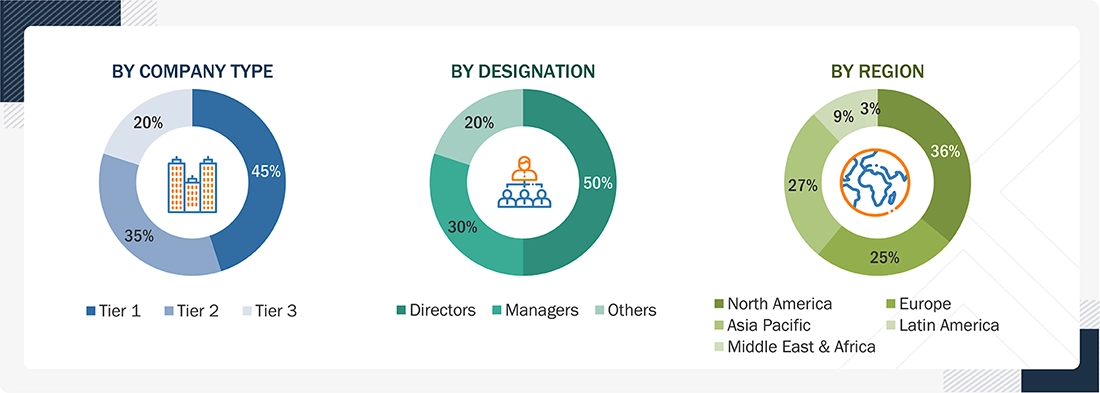
*Others include sales managers, marketing managers, business development managers, product managers, distributors, and suppliers.
Note: Companies are classified into tiers based on their total revenue. As of 2022, Tier 1 = >USD 10.00 billion, Tier 2 = USD 1.00 billion to USD 10.00 billion, and Tier 3 = <USD 1.00 billion.
To know about the assumptions considered for the study, download the pdf brochure
Market Size Estimation
In this report, the global air quality monitoring systems market size was arrived at by using the revenue share analysis of leading players. For this purpose, key players in the market were identified, and their revenues from the air quality monitoring systems business were determined through various insights gathered during the primary and secondary research phases. Secondary research included the study of the annual and financial reports of the top market players. In contrast, primary research included extensive interviews with key opinion leaders, such as CEOs, directors, and key marketing executives.
To calculate the global market value, segmental revenues were calculated based on the revenue mapping of major solution/service providers. This process involved the following steps:
- Generating a list of major global players operating in the air quality monitoring systems market
- Mapping annual revenues generated by major global players from the air quality monitoring systems segment (or nearest reported business unit/product category)
- Revenue mapping of key players to cover a major share of the global market, as of 2025
- Extrapolating the global value of the air quality monitoring systems industry
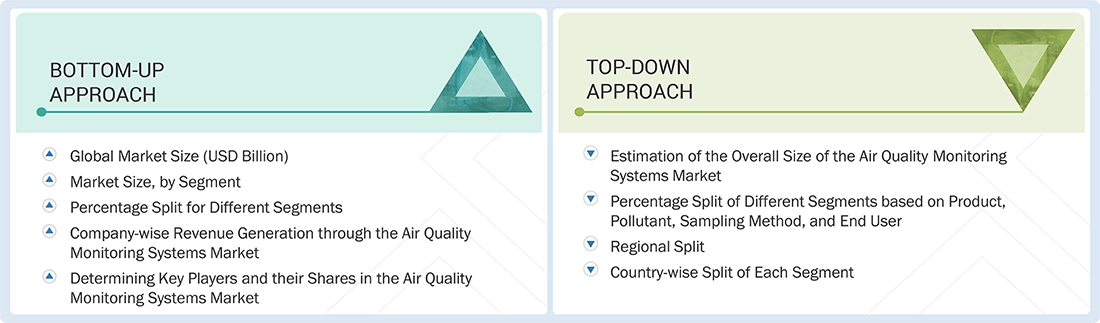
Air Quality Monitoring Systems Market : Top-Down and Bottom-Up Approach
Data Triangulation
After arriving at the overall market size from the market size estimation process explained above, the global air quality monitoring systems market was split into segments and subsegments. Data triangulation and market breakdown procedures were employed to complete the overall market engineering process and arrive at the exact statistics for all segments and subsegments. The data was triangulated by studying various factors and trends from both the demand and supply sides. Additionally, the air quality monitoring systems market was validated using both top-down and bottom-up approaches.
Market Definition
Air quality monitoring is the process of measuring and analyzing the concentration of pollutants and contaminants present in the air, including particulate matter, harmful gases, and airborne microorganisms. Air quality monitoring systems are used to continuously assess ambient and indoor air conditions, track changes in pollution levels, and evaluate the impact of air pollution on human health, industrial safety, and the environment.
Key Stakeholders
- Manufacturers and distributors of air quality monitoring products
- Air quality monitoring software developers
- Research laboratories and academic institutes
- Air pollution monitoring committees
- Pharmaceutical and biotechnology companies
- Government and non-government agencies
- National and regional air pollution control boards and organizations
- Oil & gas production and distribution companies
- Gas operators, distributors, and regulators
- Power generation and power distribution units
- Municipalities and municipal corporations
- Food & beverage manufacturing companies
- Market research and consulting firms
Report Objectives
- To define, describe, and forecast the air quality monitoring systems market on the basis of product, sampling method, pollutant, end user, and region
- To provide detailed information regarding the major factors influencing the growth potential of the global air quality monitoring systems market (drivers, restraints, opportunities, challenges, and trends)
- To analyze the micro markets with respect to individual growth trends, prospects, and contributions to the global air quality monitoring systems market
- To analyze key growth opportunities in the global air quality monitoring systems market for key stakeholders and provide details of the competitive landscape for market leaders
- To forecast the size of market segments and/or subsegments with respect to major regions, namely, North America (US and Canada), Europe (Germany, France, the UK, Italy, Spain, and the RoE), Asia Pacific (Japan, China, India, Australia, South Korea, ASEAN region, and the RoAPAC), Latin America, and Middle East & Africa
- To profile the key players in the global air quality monitoring systems market and comprehensively analyze their market shares and core competencies
- To track and analyze the competitive developments undertaken in the global air quality monitoring systems market, such as product launches, agreements, expansions, and acquisitions.
Available customizations:
With the given market data, MarketsandMarkets offers customizations as per the company’s specific needs. The following customization options are available for the present global air quality monitoring systems market report:
Product Analysis
- Product matrix, which gives a detailed comparison of the product portfolios of the top fifteen companies
Regional Analysis
- Further breakdown of the Rest of Europe air quality monitoring systems market into Russia, Belgium, the Netherlands, Switzerland, Austria, Finland, Sweden, Poland, and Portugal, among other countries
- Further breakdown of the Rest of Asia Pacific air quality monitoring systems market into Singapore, Taiwan, New Zealand, the Philippines, Malaysia, and other APAC countries
- Further breakdown of the Rest of the Latin America air quality monitoring systems market into Argentina, Chile, Peru, and Colombia, among other countries
Company Information
- Detailed analysis and profiling of additional market players (up to 15)
Get the Full Air Quality Monitoring System Market Report
Full forecast, segment splits, and company analysis for all Air Quality Monitoring System Market.
- France Air Quality Monitoring System Market
- Italy Air Quality Monitoring System Market
- Spain Air Quality Monitoring System Market
- Japan Air Quality Monitoring System Market
- China Air Quality Monitoring System Market
- India Air Quality Monitoring System Market
- Australia Air Quality Monitoring System Market
- South Korea Air Quality Monitoring System Market
- Mexico Air Quality Monitoring System Market
- US Air Quality Monitoring System Market
- Canada Air Quality Monitoring System Market
- Germany Air Quality Monitoring System Market
- UK Air Quality Monitoring System Market
Need a Tailored Report?
Customize this report to your needs
Get 10% FREE Customization
Customize This Report
