
South Korea Aircraft Platforms Market (2024-2029)

The South Korea Aircraft Platforms Market was valued at $2490 Million in 2024 and projected to reach to $2737 Million by 2029, representing a compound annual growth rate of 1.6%. South Korea's aircraft platforms market is positioned for steady growth driven by ongoing military modernization initiatives and the expansion of domestic aerospace manufacturing.


| Market Size in | USD 26.32 MN |
| Market Forecast in | |
| CAGR | |
| Forecast Period | |
| Units Considered | Value (USD MN) |
South Korea Aircraft Platforms Market Trends and Insights
- South Korea's aerospace and defence sector continues to modernize its military fleet and expand domestic aircraft manufacturing capabilities, driving steady demand for advanced aircraft platforms.
- The market in South Korea reflects the nation's strategic focus on indigenous defence technology development and regional security requirements. Growth in South Korea's aircraft platforms market is supported by government investment in next-generation fighter jets, transport aircraft, and unmanned aerial systems.
- South Korea's defence budget allocations and participation in international aerospace partnerships are expected to sustain moderate expansion through 2029.
- The market dynamics in South Korea are shaped by both domestic procurement needs and the country's emerging role as an aerospace exporter in the Asia Pacific region..
Key Market Statistics
- CAGR (2024-2029) 1.6% CAGR
- Market Size, 2024 ~USD 2490 Million
- Forecast, 2029 ~USD 2737 Million
- Country South Korea
South Korea Aircraft Platforms Market Overview
Steady Market Growth :
South Korea's aircraft platforms market is valued at USD 2,490 million in 2024, with a projected CAGR of 1.6% through 2029, reaching USD 2,737 million. This moderate growth reflects consistent investment in military modernization and domestic aerospace capabilities.
Military Fleet Modernization :
South Korea continues to upgrade its military aircraft fleet with advanced platforms, including fighter jets, transport aircraft, and surveillance systems. Government defense spending prioritizes next-generation aircraft to enhance regional security and operational capabilities.
Domestic Manufacturing Expansion :
The country is expanding indigenous aircraft manufacturing capabilities through programs like the KF-21 fighter jet development and licensed production of commercial platforms. This drives demand for advanced aircraft platforms and components within the domestic supply chain.
Regional Security Dynamics :
Geopolitical tensions in Northeast Asia sustain demand for advanced aircraft platforms. South Korea's strategic focus on air superiority and defense modernization ensures continued investment in cutting-edge aerospace technologies and platform upgrades.
South Korea Aircraft Platforms Market Dynamics
- The country's commitment to developing indigenous defense capabilities, exemplified by programs like the KF-21 fighter jet, creates sustained demand for advanced aircraft platforms and related technologies.
- Government defense budgets remain robust, supporting procurement and upgrade cycles for military aircraft across multiple segments. Looking ahead to 2029, the market will benefit from increased collaboration between South Korean defense contractors and international partners, technology transfer agreements, and investments in next-generation platform development.
- Regional security considerations and the need to maintain technological parity with neighboring nations will continue to underpin market expansion, though growth rates remain moderate compared to global averages due to market maturity and budget constraints..
Market Ecosystem
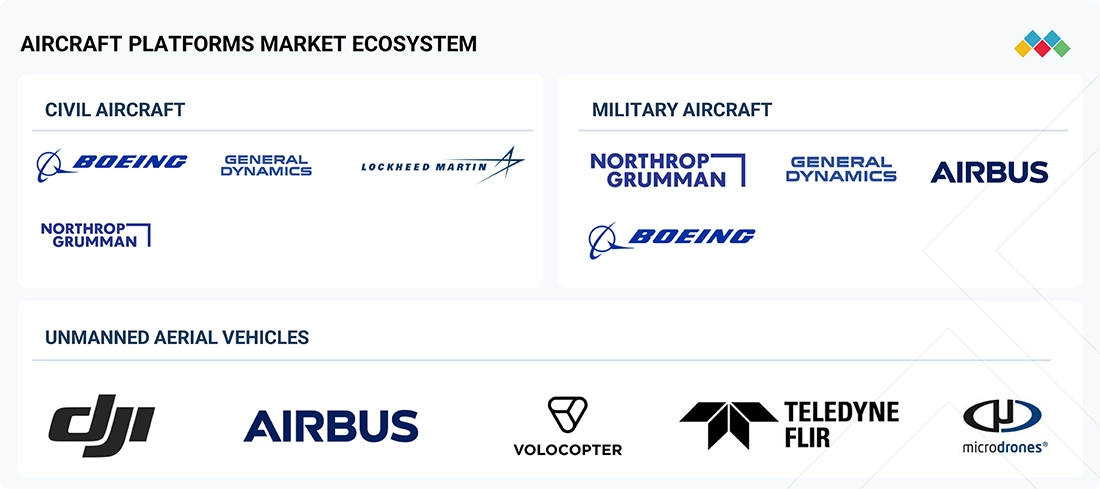
AIRCRAFT PLATFORMS MARKET SIZE, SHARE AND TRENDS: COMMERCIAL USE CASES ACROSS INDUSTRIES
| COMPANY | USE CASE DESCRIPTION | BENEFITS |
|---|---|---|
 |
Uses aerospace-grade delivery drones for food, prescriptions, and healthcare supplies; shifting from student food delivery to essential services during the pandemic; planning commercial drone delivery expansion. | Faster last-mile delivery, reduced human contact, scalable drone operations, and proven reliability with 5,000 real-world deliveries. |
 |
Developing electric air taxis and cargo drones (VoloCity) for urban air mobility; conducting global test flights and building vertiports for commercial launch by 2024. | Sustainable, low-emission urban transport, reduced congestion, efficient take-off/landing infrastructure, and a cleaner alternative to traditional mobility. |
 |
Joint development of a first-generation electric demonstrator propulsion module (InCEPTion) for drones, eVTOLs, general aviation, and sub-regional aircraft under 5 tons. | Lightweight, high power-to-weight propulsion, supports battery or hybrid, modular configuration, fast charging, and suitable for diverse aircraft types. |
 |
Use Case Description | Benefits |
Logos and trademarks shown above are the property of their respective owners. Their use here is for informational and illustrative purposes only.
Related Ecosystem
Aviation
- Narrow Body Aircraft
- Wide Body Aircraft
- Military Helicopters
- Special Mission Aircraft
- Fighter Aircraft
- HONEYWELL INTERNATIONAL INC.
- COLLINS AEROSPACE
- Thales group
- Safran group
- HEICO Corporation
Defence Platforms And Systems
- Sensors
- Unmanned Ground Vehicles (UGV)
- Fighter Aircraft
- Special Mission Aircraft
- Antennas
- BAE Systems plc
- Thales group
- LOCKHEED MARTIN CORPORATION
- Northrop Grumman Corporation
- L3Harris Technologies, Inc.
Unmanned Systems
- Rotary Wing Aircraft
- Fixed-Wing Drones
- Sensors
- Fuel Cell
- Fixed Wing Aircraft
- LOCKHEED MARTIN CORPORATION
- Northrop Grumman Corporation
- ISRAEL AEROSPACE INDUSTRIES LTD
- Thales group
- BAE Systems plc
Key Takeaways
- South Korea's aircraft platforms market is valued at USD 2,490 million in 2024 and will reach USD 2,737 million by 2029.
- South Korea is experiencing a 1.6% CAGR, reflecting steady but moderate growth driven by defence modernization initiatives.
- South Korea's indigenous aircraft development programs and military fleet upgrades are primary growth catalysts through 2029.
- South Korea's aerospace sector is increasingly positioned as a regional exporter, supporting long-term market expansion.
Aircraft Platforms Market Report Scope
| Report Metric | Details |
|---|---|
| Base Year | 2024 |
| Fastest Growing Segment | SAF-BASED (Power Source) |
| Forecast Period | 2024-2029 |
| Growth Rate | CAGR of 4.2% from 2024 to 2029 |
| Largest Segment | CIVIL AIRCRAFT (Type) |
| Market Size Base Year (Billions) | ~USD 235.31 (2024) |
| Revenue Forecast (Billions) | ~USD 289.05 (2029) |
| Segments Covered | Type, Military Aircraft, Civil Aircraft, Unmanned Aerial Vehicle, Propulsion Technology, Power Source |
South Korea Aircraft Platforms Market Report Segmentation
6 segment dimensions are covered across the global market.
By Type
- Civil Aircraft
- Military Aircraft
- Unmanned Aerial Vehicles
By Military Aircraft
- Combat
- Helicopters
- Military Helicopters
- Special Missions
- Transport
By Civil Aircraft
- Business Jets
- Commercial Helicopters
- Light Aircraft
- Narrow Body
- Narrow Body Aircraft
- Narrow-Body
- Regional Transport
- Wide Body
- Wide Body Aircraft
- Wide-Body
By Unmanned Aerial Vehicle
- Civil & Commercial
- Defense & Government
By Propulsion Technology
- Electric
- Hybrid-Electric
- Piston Engine
- Turbofan
- Turbojet
- Turboprop
- Turboshaft
By Power Source
- Battery-Powered
- Conventional Fuel
- Fuel Cell
- Saf-Based
- Solar-Powered
Target Audience
- South Korean Defense Contractors : Leverage market intelligence to support domestic aircraft platform development programs, identify partnership opportunities with international OEMs, and understand government procurement priorities and budget allocations for military modernization.
- International Aerospace OEMs : Assess market entry strategies and partnership opportunities in South Korea's growing aircraft platforms sector. Understand local manufacturing requirements, technology transfer expectations, and collaboration models with domestic defense contractors.
- Government & Military Procurement Officials : Utilize market data to inform defense budget allocation, platform procurement decisions, and modernization program planning. Benchmark South Korea's aircraft platform investments against regional peers and global defense spending trends.
- Investment & Private Equity Firms : Identify investment opportunities in South Korean aerospace and defense companies involved in aircraft platform development and manufacturing. Understand market growth drivers, competitive dynamics, and long-term sector expansion potential.
- Supply Chain & Component Suppliers : Understand demand drivers for aircraft platform components and systems within South Korea's aerospace sector. Identify procurement opportunities with defense contractors and OEMs engaged in military aircraft modernization and domestic manufacturing programs.
Reasons to Buy this Report
- Market-Specific Sizing & Forecasts : Access precise valuation data for South Korea's aircraft platforms market with detailed 2024-2029 projections. Understand market size dynamics specific to South Korean defense spending and procurement cycles, enabling accurate business planning and investment decisions.
- Military Modernization Insights : Gain detailed intelligence on South Korea's military fleet modernization programs, including fighter jet upgrades, transport aircraft procurement, and surveillance platform development. Identify key government initiatives driving demand for advanced aircraft platforms.
- Domestic Manufacturing Opportunities : Understand the expanding landscape of indigenous aircraft manufacturing in South Korea, including licensed production agreements and domestic development programs. Identify partnership and supply chain opportunities within the growing domestic aerospace sector.
- Competitive Landscape Analysis : Evaluate key South Korean defense contractors, international competitors, and technology partnerships shaping the market. Benchmark your position against major players in military aircraft platforms and identify strategic positioning opportunities.
- Regional Security Context : Understand how geopolitical dynamics in Northeast Asia influence South Korea's aircraft platform investments and procurement priorities. Align your strategy with regional security trends and long-term defense modernization trajectories.
Frequently asked questions
What is the current size of South Korea's aircraft platforms market?
South Korea's aircraft platforms market is valued at USD 2,490 million in 2024.
What is the projected market size for South Korea by 2029?
South Korea's aircraft platforms market is forecast to reach USD 2,737 million by 2029.
What is the CAGR for South Korea's aircraft platforms market?
South Korea's aircraft platforms market is growing at a CAGR of 1.6% from 2024 to 2029.
What are the main drivers of growth in South Korea's aircraft platforms market?
South Korea's market growth is driven by defence modernization, indigenous aircraft development programs, military fleet upgrades, and expanding aerospace export capabilities.
How does South Korea's market growth compare to global trends?
South Korea's 1.6% CAGR is more moderate than the global aircraft platforms market CAGR of 4.2%, reflecting regional-specific defence priorities and procurement cycles.
RESEARCH METHODOLOGY
The research study used secondary sources, directories, and databases, such as D&B Hoovers, Bloomberg Businessweek, and Factiva, to identify and collect information relevant to the aircraft platforms market. Secondary sources referred to for this research study included the General Aviation Manufacturers Association (GAMA) Industry Outlook, Bombardier Business Aircraft Outlook, Embraer Market Outlook, Airbus Global Helicopter Forecast, Federal Aviation Agency (FAA), SIPRI and product brochures of leading companies manufacturing among others for different aircraft platforms. Primary sources included industry experts from the core and related industries, preferred suppliers, manufacturers, solution providers, technology developers, alliances, and organizations related to all the segments of this industry’s value chain. All primary sources were interviewed to obtain and verify critical qualitative and quantitative information and assess prospects for market growth during the forecast period.
Secondary Research
Secondary research was conducted in order to gather relevant details for this market study on aircraft platforms. Various sources were consulted to accumulate vital information and insights into this market. Annual reports, whitepapers, press releases, investor presentations by major companies, certified publications, and reputable articles were all sourced. Other information was extracted from articles, manufacturer associations, industry directories, and specialized databases. Mostly primary research was done for the crucial discovery of about the supply chain in the aircraft platforms industry, the financial structure of the market, key players, and also the segmentation of the market based upon the industry trends. Further, the secondary research was undertaken in order to provide knowledge on regional markets, technological issues as well as important developments; hence gave an overall understanding of market-driven as well as technology-driven aspects.
Primary Research
Extensive primary research was conducted after obtaining information about the current scenario of the aircraft platforms market through secondary research. Several primary interviews were conducted with market experts from the demand and supply sides across North America, Europe, Asia Pacific, the Middle East, and RoW. This primary data was collected through questionnaires, emails, and telephonic interviews. In the primary research process, various primary sources from the supply and demand sides were interviewed to obtain qualitative and quantitative information on the market. Primary sources from the supply side included various industry experts, such as vice presidents, directors, regional managers, technology providers, product development teams, distributors, and end users.
Primary interviews were conducted to gather insights, such as market statistics, data on revenue collected from the products, market breakdowns, market size estimations, market forecasting, and data triangulation. Primary research also helped understand the trends related to aircraft type, propulsion technology, power source, and region. Demand-side stakeholders, such as CXOs, production managers, engineers, and installation teams of end users of aircraft platforms, were interviewed to understand the buyer’s perspective on the suppliers, products, service providers, and their current usage and future outlook of their business, which could affect the aircraft platforms market.
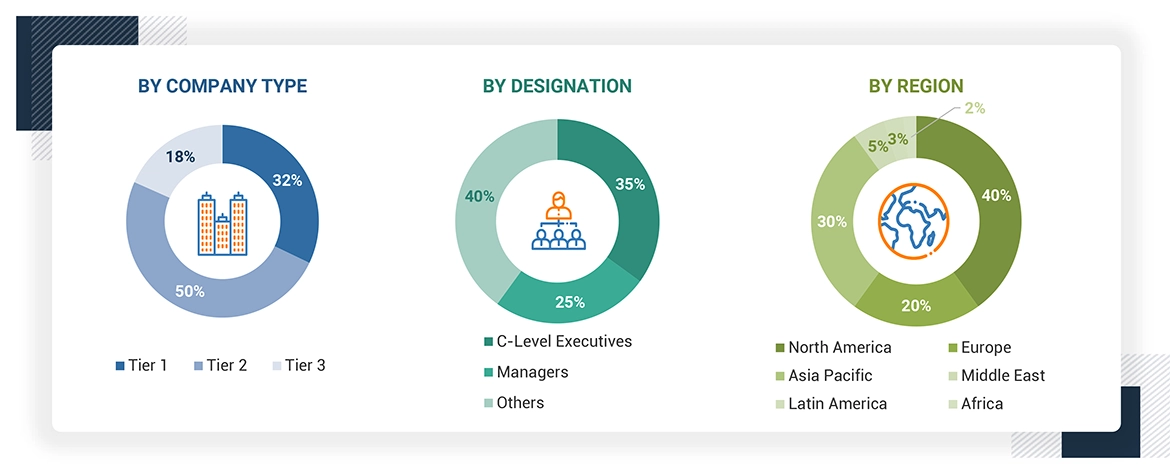
Note: Note: C-level executives include the CEO, COO, and CTO, among others. *Others include Sales Managers, Marketing Managers, and Product Managers.
The tiers of the companies have been defined based on their total revenue as of 2022. Tier 1 = > USD 1 billion, Tier 2 = USD 100 million to USD 1 billion, and Tier 3 = < USD 100 million.
To know about the assumptions considered for the study, download the pdf brochure
Market Size Estimation
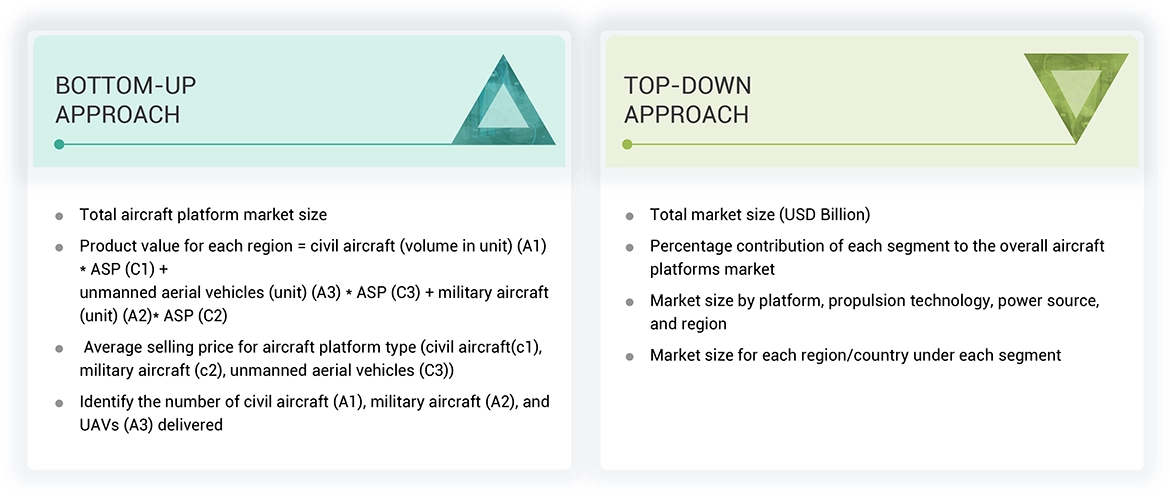
The top-down and bottom-up approaches were used to estimate and validate the size of the aircraft platforms market. The research methodology used to estimate the market size includes the following details:
- Key players were identified through secondary research, and their market ranking was determined through primary and secondary research. This included a study of annual and financial reports of the top market players and extensive interviews of leaders, including CEOs, directors, and marketing executives.
- All percentage share, splits, and breakdowns were determined using secondary sources and verified through primary sources. All possible parameters that affect the markets covered in this research study were accounted for, viewed in extensive detail, verified through primary research, and analyzed to obtain the final quantitative and qualitative data. This data was consolidated, enhanced with detailed inputs, analyzed by MarketsandMarkets, and presented in this report.
The top-down approach has been used to estimate and validate the total size of the 3D metrology market
Aircraft Platforms Market : Top-Down and Bottom-Up Approach
Data Triangulation
After arriving at the overall size of the aircraft platforms market from the market size estimation process explained above, the total market was split into several segments and subsegments. To complete the overall market engineering process and arrive at the exact statistics for various market segments and subsegments, the data triangulation and market breakdown procedures explained below were implemented, wherever applicable. The data was triangulated by studying various factors and trends from the demand and supply sides. The market size was also validated using both the top-down and bottom-up approaches.
Market Definition
The aircraft platforms market encompasses various aircraft designed for specific operational roles across civil, military, and unmanned sectors. This includes civil platforms such as narrow-body and wide-body airliners, regional transport aircraft, business jets, and commercial helicopters. Military platforms include fighter jets, transport aircraft, special mission aircraft, and military helicopters tailored for defense operations. Additionally, unmanned aerial vehicles (UAVs) serve critical functions in surveillance and logistics. Aircraft platforms play a pivotal role in modern aviation, addressing varied needs and leveraging technological advancements to enhance operational efficiency and effectiveness.
Key Stakeholders
- Aircraft Manufacturers
- Aircraft System & Component Manufacturers
- Prime Contractors (e.g., Lockheed Martin, Boeing)
- Defense Organisations
- Charter Operators
- Maintenance, Repair, and Overhaul (MRO) companies
- Defense and Security Consultants
- Government Bodies and Agencies
Report Objectives
- To define, segment, and forecast the size of the aircraft platforms market in terms of value based on by type, propulsion technology, power source, and region from 2024 to 2030
- To forecast the size of market segments with respect to major regions, namely North America, Europe, Asia Pacific, the Middle East, and Africa.
- To identify and analyze key drivers, restraints, opportunities, and challenges influencing market growth
- To strategically analyze micromarkets with respect to individual growth trends, prospects, and their contribution to the Aircraft platforms market
- To analyze opportunities for stakeholders in the market by identifying key market trends
- To analyze competitive developments such as contracts, expansions, acquisitions, agreements, joint ventures, partnerships, product launches, and research and development (R&D) activities in the Aircraft platforms market
- To provide a detailed competitive landscape of the market, in addition to an analysis of business and corporate strategies adopted by leading market players
- To strategically profile key market players and comprehensively analyze their core competencies
Available Customizations
Along with the market data, MarketsandMarkets offers customizations as per the specific needs of companies. The following customization options are available for the report:
Product Analysis
- Product matrix, which gives a detailed comparison of the product portfolio of each company
Regional Analysis
- Further breakdown of the market segments at country-level
Company Information
- Detailed analysis and profiling of additional market players (up to 5)
Get the Full Aircraft Platforms Market Report
Full forecast, segment splits, and company analysis for all Aircraft Platforms Market.
- Canada Aircraft Platforms Market
- US Aircraft Platforms Market
- UK Aircraft Platforms Market
- Germany Aircraft Platforms Market
- France Aircraft Platforms Market
- Italy Aircraft Platforms Market
- Ireland Aircraft Platforms Market
- China Aircraft Platforms Market
- Japan Aircraft Platforms Market
- India Aircraft Platforms Market
- Australia Aircraft Platforms Market
- Singapore Aircraft Platforms Market
- Brazil Aircraft Platforms Market
- Mexico Aircraft Platforms Market
- South Africa Aircraft Platforms Market
- Nigeria Aircraft Platforms Market
- UAE Aircraft Platforms Market
- Saudi Arabia Aircraft Platforms Market
- Qatar Aircraft Platforms Market
- Turkey Aircraft Platforms Market
Need a Tailored Report?
Customize this report to your needs
Get 10% FREE Customization
Customize This Report
