
US Aluminum Plate Market (2026-2031)

The US Aluminum Plate Market was valued at $6909.9 Million in 2026 and projected to reach to $7890 Million by 2031, representing a compound annual growth rate of 4.5%. The US aluminum plate market is positioned for steady growth through 2031, driven by sustained demand from aerospace manufacturers, automotive OEMs transitioning to electric vehicles, and robust construction activity.


| Market Size in | USD 26.32 MN |
| Market Forecast in | |
| CAGR | |
| Forecast Period | |
| Units Considered | Value (USD MN) |
US Aluminum Plate Market Trends and Insights
- The US market benefits from strong demand across aerospace, automotive, and construction sectors, where aluminum plates serve critical structural and thermal applications.
- In 2026, the US aluminum plate market reflects mature industrial adoption and steady capital investment in manufacturing infrastructure. Growth in the US aluminum plate market through 2031 is driven by increased vehicle production, aerospace modernization, and infrastructure renewal initiatives.
- The US maintains a competitive advantage in high-specification aluminum plate production, supporting both domestic consumption and export markets.
- By 2031, the US aluminum plate market is expected to capture sustained demand from lightweight vehicle platforms and advanced aerospace programs, positioning the country as a key regional hub for premium aluminum plate supply..
Key Market Statistics
- CAGR (2026-2031) 4.5% CAGR
- Market Size, 2026 ~USD 6909.9 Million
- Forecast, 2031 ~USD 7890 Million
- Country US
US Aluminum Plate Market Overview
Market Size & Growth :
The US aluminum plate market is valued at $6,909.9 million in 2026 and is projected to reach $7,890.0 million by 2031, growing at a CAGR of 4.5%, outpacing broader economic growth trends.
Aerospace Sector Dominance :
US aerospace industry drives significant demand for high-performance aluminum plates used in aircraft fuselage, wings, and structural components, supported by ongoing commercial and defense aviation programs.
Automotive & EV Transition :
The US automotive sector increasingly adopts aluminum plates for lightweighting in electric vehicles and traditional models, improving fuel efficiency and meeting stringent emissions regulations.
Construction & Infrastructure :
Strong US construction activity and infrastructure investment initiatives boost demand for aluminum plates in roofing, cladding, and structural applications across commercial and residential projects.
US Aluminum Plate Market Dynamics
- The 4.5% CAGR reflects moderate but consistent expansion as industries prioritize lightweight, durable materials for performance and sustainability goals.
- Supply chain stabilization and increased domestic production capacity will support market resilience.
- However, raw material price volatility and competition from alternative materials may moderate growth rates.
- Strategic investments in recycling infrastructure and advanced alloy development will create opportunities for market participants to capture emerging applications in renewable energy and advanced manufacturing sectors..
Market Ecosystem
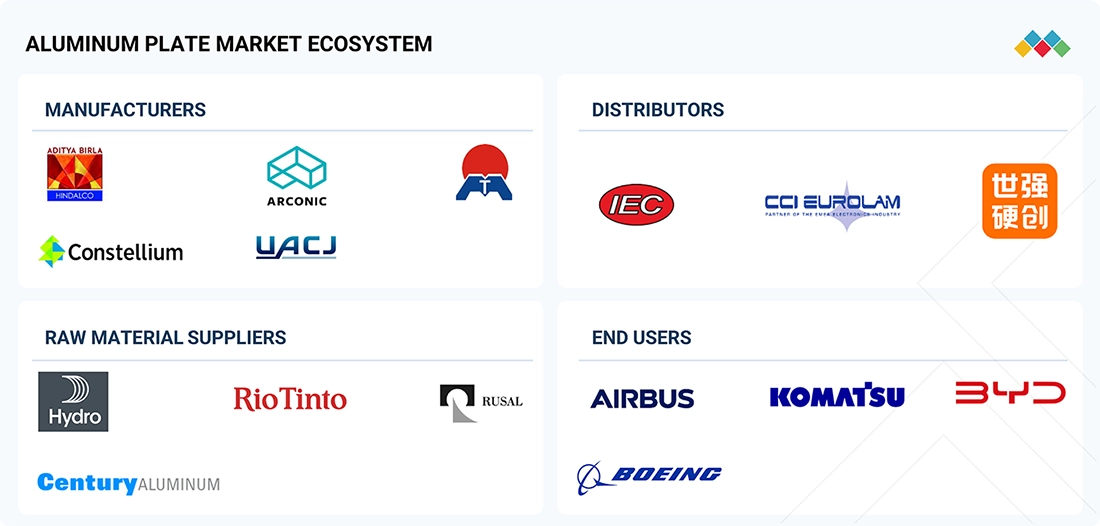
ALUMINUM PLATE MARKET: COMMERCIAL USE CASES ACROSS INDUSTRIES
| COMPANY | USE CASE DESCRIPTION | BENEFITS |
|---|---|---|
 |
Constellium worked with the U.S. Department of Defense (DoD), Army Research Laboratory (ARL) and Ground Vehicle Systems Center (GVSC) to create new aluminum armor plates, such as thick 5083-H131 plates and next-generation 2139 and 7056 alloys, for military combat vehicles that need more ballistic and blast protection but less weight. | Higher mobility, survivability, and blast resistance with lower vehicle weight. Permitted single-piece armor structures, reduced manufacturing costs and reduced the weight of the U.S. SOCOM M-ATV by approx. 1,200 lbs without compromising underbody blast protection. |
 |
The all-new F-150 pickup truck was redesigned with the application of high-strength, military-grade aluminum sheet and plate technologies to replace traditional steel-intensive body structures to support vehicle lightweighting while maintaining durability, performance and structural integrity. | ~700 lb. reduction in vehicle weight improves fuel economy, payload capacity, towing performance and handling. The lightweight design also contributed to earning a 5-star NHTSA safety rating and aligned with Ford’s long-term vehicle electrification strategy. |
|
|
Constellium has partnered with the Army Research Laboratory (ARL) and BAE Systems to develop large, single-piece formed aluminum armor plate hulls for tracked combat vehicles with improved underbody blast protection under the U.S. Army’s Affordable Protection from Objective Threats (APOT) ManTech Program. | Met blast protection design objectives, while improving vehicle design flexibility and survivability. The technology helped develop future combat vehicles, and earned Constellium the 2017 Defense Manufacturing Technology (ManTech) Achievement Award for improving military capability. |
Logos and trademarks shown above are the property of their respective owners. Their use here is for informational and illustrative purposes only.
Related Ecosystem
Equipment Machine And Tooling
- Wastewater Treatment
- Air Cooled Heat Exchangers
- Diaphragm Pumps
- Fiberglass
- HVAC System
- Alfa Laval Corporate AB
- Johnson Controls International plc
- Daikin Industries,Ltd.
- Veolia
- Carrier Global Corporation
Infrastructure Material
- Alumina Ceramics
- Ceramic Coatings
- Monolithic Ceramics
- Polyphenylene Sulfide (PPS)
- Titanate Ceramics
- Saint-gobain
- Simpson Manufacturing Co., Inc.
- Sika ag
- DOW CHEMICAL COMPANY
- Basf se
Key Takeaways
- The US aluminum plate market is valued at $6,909.9 million in 2026 and will reach $7,890.0 million by 2031 at a 4.5% CAGR.
- The US aerospace and automotive sectors are primary growth drivers, leveraging aluminum plates for weight reduction and performance enhancement.
- The US maintains technological leadership in high-specification aluminum plate manufacturing, supporting both domestic and export demand.
- The US aluminum plate market is expected to benefit from infrastructure modernization and electric vehicle adoption through 2031.
Aluminum Plate Market Report Scope
| Report Metric | Details |
|---|---|
| Base Year | 2026 |
| Fastest Growing Segment | -7050 (Grade) |
| Forecast Period | 2026-2031 |
| Growth Rate | CAGR of 5.1% from 2026 to 2031 |
| Largest Segment | MEDIUM ALUMINUM PLATE (6 MM - 15 MM) (Product Form) |
| Market Size Base Year (Billions) | ~USD 33.84 (2026) |
| Revenue Forecast (Billions) | ~USD 43.4 (2031) |
| Segments Covered | Product Form, Grade, End-Use Industry |
US Aluminum Plate Market Report Segmentation
3 segment dimensions are covered across the global market.
By Product Form
- Heavy Gauge Aluminum Plate (51 Mm - 100 Mm)
- Medium Aluminum Plate (6 Mm - 15 Mm)
- Thick Aluminum Plate (16 Mm - 50 Mm)
- Ultra-Thick Aluminum Plate (Above 100 Mm)
By Grade
- 2Xxx
- 2Xxx Series
- 5Xxx
- 5Xxx Series
- 6Xxx
- 6Xxx Series
- 7Xxx
- 7Xxx Series
- Other Grades
- -2014
- -2024
- -5052
- -5083
- -5086
- -6061
- -6082
- -7050
- -7075
- -Others
By End-Use Industry
- Aerospace & Defense
- Automotive & Transportation
- Construction & Infrastructure
- Heavy Machinery & Industrial Equipment
- Marine & Shipbuilding
- Other End-Use Industries
Target Audience
- Aluminum Manufacturers & Producers : Need US market data to optimize production capacity, plan facility investments, and develop targeted sales strategies for aerospace, automotive, and construction segments with 4.5% growth visibility.
- Aerospace & Defense OEMs : Require detailed US aluminum plate supply forecasts and market trends to secure long-term supplier contracts, manage material costs, and support aircraft production and defense program requirements.
- Automotive Suppliers & OEMs : Need insights into US aluminum plate demand driven by EV lightweighting trends and traditional vehicle production to plan supply agreements, R&D investments, and manufacturing strategies.
- Construction & Building Material Distributors : Seek US market intelligence on aluminum plate demand for roofing, cladding, and structural applications to optimize inventory management, supplier relationships, and sales forecasting through 2031.
- Investment & Private Equity Firms : Require comprehensive US market analysis and growth projections to evaluate acquisition targets, assess portfolio company performance, and identify investment opportunities in aluminum manufacturing and distribution.
Reasons to Buy this Report
- Accurate US Market Sizing : Obtain precise valuation data for the US aluminum plate market with verified 2026 baseline ($6,909.9M) and 2031 projections ($7,890.0M), enabling accurate budget allocation and revenue forecasting.
- Sector-Specific Demand Insights : Understand growth drivers across US aerospace, automotive, and construction sectors with detailed analysis of application trends, helping identify high-potential customer segments and market opportunities.
- Competitive Positioning Strategy : Benchmark your US operations against market growth rates and identify competitive gaps in aerospace, EV manufacturing, and infrastructure projects to optimize market share and pricing strategies.
- Investment & Expansion Planning : Make informed decisions on capacity expansion, facility location, and product development investments in the US market with reliable growth forecasts and sector-specific demand trajectories through 2031.
- Supply Chain & Sourcing Optimization : Align procurement strategies and supplier relationships with projected US market demand patterns, ensuring adequate material availability and cost efficiency across aerospace, automotive, and construction channels.
Frequently asked questions
What is the current size of the US aluminum plate market?
The US aluminum plate market is estimated at $6,909.9 million in 2026 and is projected to grow to $7,890.0 million by 2031.
What is the growth rate of the US aluminum plate market?
The US aluminum plate market is expected to grow at a compound annual growth rate (CAGR) of 4.5% from 2026 to 2031.
Which industries drive demand in the US aluminum plate market?
The US aluminum plate market is primarily driven by aerospace, automotive, construction, and marine industries, which rely on aluminum plates for structural and thermal applications.
What factors support growth in the US aluminum plate market through 2031?
Growth in the US aluminum plate market is supported by increased vehicle production, aerospace modernization, infrastructure renewal, and the adoption of lightweight materials in electric vehicles.
How does the US aluminum plate market compare regionally?
The US aluminum plate market maintains a competitive advantage in high-specification production and serves as a key regional hub for premium aluminum plate supply within North America.
RESEARCH METHODOLOGY
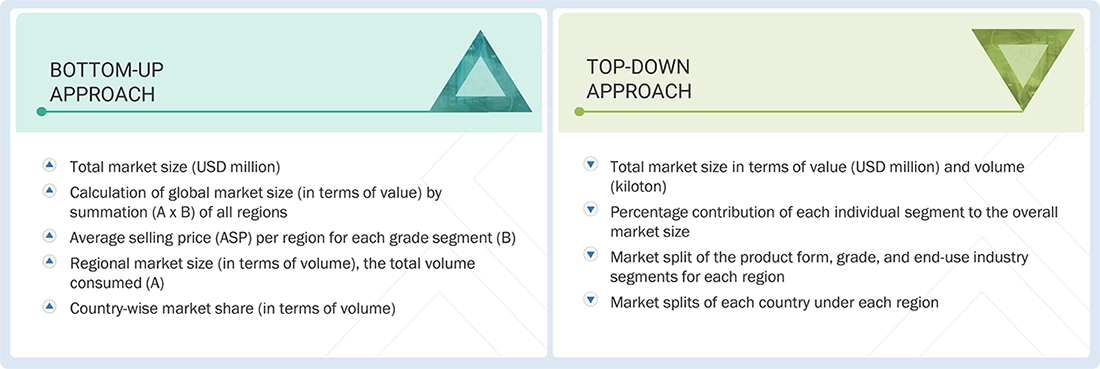
The study involved four major activities to estimate the current size of the global aluminum plate market. Exhaustive secondary research was conducted to gather information on the market, the peer product market, and the parent product group market. The next step was to validate these findings, assumptions, and sizes with industry experts across the aluminum plate value chain through primary research. The top-down and bottom-up approaches were employed to estimate the overall size of the aluminum plate market. After that, market breakdown and data triangulation procedures were used to determine the size of different segments and sub-segments of the market.
Secondary Research
The market for companies offering aluminum plates is arrived at by secondary data available through paid and unpaid sources, analyzing the product portfolios of the major companies in the ecosystem, and rating the companies by their performance and quality. Various secondary sources, such as Business Standard, Bloomberg, World Bank, and Factiva, were referred to identify and collect information for this study on the aluminum plate market. In the secondary research process, various secondary sources were referred to identify and collect information related to the study. Secondary sources included annual reports, press releases, and investor presentations of door vendors, forums, certified publications, and whitepapers. The secondary research was used to obtain critical information on the industry’s value chain, the total pool of key players, market classification, and segmentation from the market and technology-oriented perspectives.
Primary Research
In the primary research process, various primary sources from both the supply and demand sides were interviewed to obtain qualitative and quantitative information for this report. Primary sources from the supply side included industry experts, such as Chief Executive Officers (CEOs), Vice Presidents (VPs), marketing directors, technology and innovation directors, and related key executives from several key companies and organizations operating in the aluminum plate market. After the complete market engineering (calculations for market statistics, market breakdown, market size estimations, market forecasting, and data triangulation), extensive primary research was conducted to gather information and verify and validate the critical numbers arrived at. Primary research was also conducted to identify segmentation types, the competitive landscape of aluminum plates offered by various market players, and key market dynamics, including drivers, restraints, opportunities, challenges, and key player strategies. In the complete market engineering process, the top-down and bottom-up approaches and several data triangulation methods were extensively used to perform the market estimation and market forecasting for the overall market segments and subsegments listed in this report. Extensive qualitative and quantitative analysis was performed across the complete market engineering process to present key information/insights throughout the report.
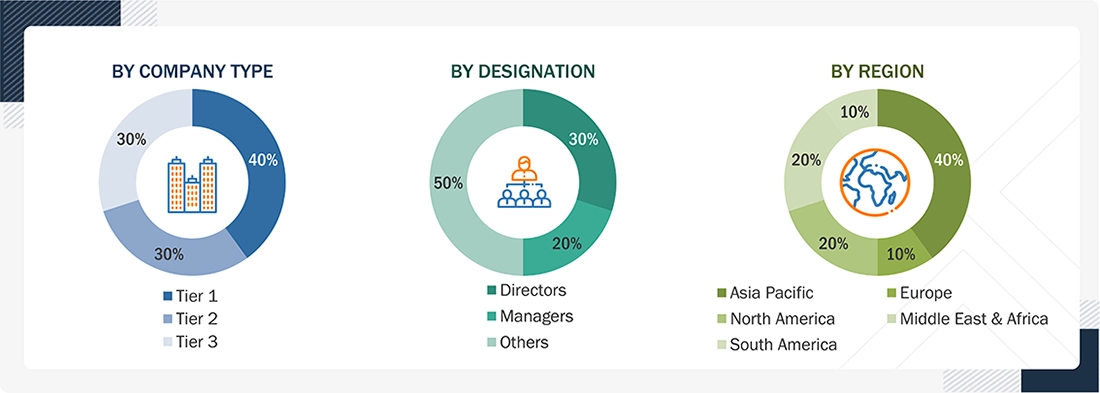
Notes: Other designations include sales, marketing, and product managers.
To know about the assumptions considered for the study, download the pdf brochure
Market Size Estimation
The top-down and bottom-up approaches were used to estimate and validate the size of the global aluminum plate market. These approaches were also widely used to estimate the sizes of various dependent market segments. The research methodology used to estimate the market size included the following:
Data Triangulation
After arriving at the overall market size using the market size estimation processes, the market was split into several segments and subsegments. The data triangulation and market breakup procedures were employed, wherever applicable, to complete the overall market engineering process and arrive at the exact statistics of each market segment and subsegment. The data was triangulated by studying various factors and trends from both the demand and supply sides.
Market Definition
Aluminum plates are considered to be among the flat-rolled aluminum materials; however, they have greater thickness than regular aluminum sheets. As defined by the Aluminum Association, an aluminum plate can be described as a flat-rolled aluminum material with a thickness of 6.3 mm (0. 250 inch) or more. The production process of such materials consists of rolling, heat treating, and finishing the materials. There are different alloys in which aluminum plates can be found, such as 2xxx, 5xxx, 6xxx, and 7xxx alloys. Different alloys provide different strengths of aluminum plates. Standard organizations like ASTM and EN ensure the quality of aluminum plates by providing standards concerning alloy content, temper, dimensions, and mechanical properties of aluminum plates.
Key Stakeholders
- Aluminum plate manufacturers
- Raw material suppliers
- Converters & processors
- Distributors and traders
- Industry associations and regulatory bodies
- End users
Report Objectives
- To define, describe, and forecast the size of the global aluminum plate market, based on product form, grade, end-use industry, and region in terms of value.
- To provide detailed information on the significant drivers, restraints, opportunities, and challenges influencing the market
- To strategically analyze micromarkets concerning individual growth trends, prospects, and their contribution to the market
- To assess the growth opportunities in the market for stakeholders and provide details on the competitive landscape for market leaders
- To forecast the market size of segments and subsegments for North America, Europe, Asia Pacific, South America, and the Middle East & Africa.
- To strategically profile key players and comprehensively analyze their market shares and core competencies
- To analyze competitive developments such as product launches, acquisitions, expansions, partnerships, and agreements in the aluminum plate market
- To provide the impact of AI/Gen AI on the market
Available customizations:
With the given market data, MarketsandMarkets offers customizations according to client-specific needs.
The following customization options are vailable for the aluminum plate market report:
Product Analysis
- A product matrix that gives a detailed comparison of the product portfolio of each company
Regional Analysis
- A further breakdown of the aluminum plate market for additional countries
Company Information
- Detailed analysis and profiling of additional market players (up to five)
Get the Full Aluminum Plate Market Report
Full forecast, segment splits, and company analysis for all Aluminum Plate Market.
- China Aluminum Plate Market
- India Aluminum Plate Market
- Japan Aluminum Plate Market
- South Korea Aluminum Plate Market
- Canada Aluminum Plate Market
- Mexico Aluminum Plate Market
- Germany Aluminum Plate Market
- France Aluminum Plate Market
- UK Aluminum Plate Market
- Italy Aluminum Plate Market
- South Africa Aluminum Plate Market
- Brazil Aluminum Plate Market
- Argentina Aluminum Plate Market
- Rest Of Europe Aluminum Plate Market
- Rest Of Asia Pacific Aluminum Plate Market
- GCC Countries Aluminum Plate Market
- -Rest Of GCC Countries Aluminum Plate Market
- Rest Of South America Aluminum Plate Market
Need a Tailored Report?
Customize this report to your needs
Get 10% FREE Customization
Customize This Report
