
China Fleet Management Software Market (2025-2030)

The China Fleet Management Software Market was valued at $29.1 Million in 2025 and projected to reach to $116.1 Million by 2030, representing a compound annual growth rate of 21.9%. China's fleet management software market is positioned for exceptional growth through 2030, driven by the nation's digital transformation initiatives and the rapid expansion of logistics infrastructure.


| Market Size in | USD 26.32 MN |
| Market Forecast in | |
| CAGR | |
| Forecast Period | |
| Units Considered | Value (USD MN) |
China Fleet Management Software Market Trends and Insights
- This robust growth trajectory reflects China's accelerating digital transformation across logistics, transportation, and automotive sectors.
- China's market is driven by increasing adoption of IoT technologies, government mandates for vehicle tracking, and the rise of e-commerce logistics demands that require sophisticated fleet optimization solutions. The 21.9% compound annual growth rate significantly outpaces global benchmarks, positioning China as a critical growth engine within the Asia Pacific region.
- China's expanding middle class, urbanization, and investment in smart city infrastructure are catalyzing demand for real-time fleet visibility and operational efficiency tools.
- By 2030, China is expected to capture substantial market share as enterprises prioritize cost reduction, regulatory compliance, and data-driven decision-making in fleet operations..
Key Market Statistics
- CAGR (2025-2030) 21.9% CAGR
- Market Size, 2025 ~USD 29.1 Million
- Forecast, 2030 ~USD 116.1 Million
- Country China
China Fleet Management Software Market Overview
Rapid Market Expansion :
China's fleet management software market is projected to grow from $29.1 million in 2025 to $116.1 million by 2030, representing a 21.9% CAGR, significantly outpacing the global average of 18.7%.
IoT and Digital Transformation :
Accelerating adoption of IoT technologies across China's logistics, transportation, and automotive sectors is driving demand for advanced fleet management solutions and real-time vehicle tracking capabilities.
Government Regulatory Support :
Chinese government mandates for vehicle tracking and emissions monitoring are creating compliance requirements that fuel enterprise adoption of fleet management software across commercial transportation sectors.
E-commerce and Logistics Boom :
China's booming e-commerce and last-mile delivery sectors are generating unprecedented demand for efficient fleet optimization, route planning, and vehicle management solutions.
China Fleet Management Software Market Dynamics
- The market benefits from strong government support for vehicle tracking regulations and the proliferation of IoT-enabled devices across transportation networks.
- Major growth catalysts include the rise of autonomous delivery services, increasing fuel costs driving efficiency demands, and the integration of AI-powered analytics for predictive maintenance and route optimization. The competitive landscape in China is intensifying as both domestic and international vendors establish operations to capture market share.
- Investment in cloud-based solutions, mobile-first platforms, and integration with existing ERP systems will be critical for success.
- The market's trajectory suggests sustained double-digit growth as enterprises prioritize operational efficiency, cost reduction, and sustainability compliance in their fleet operations..
Market Ecosystem
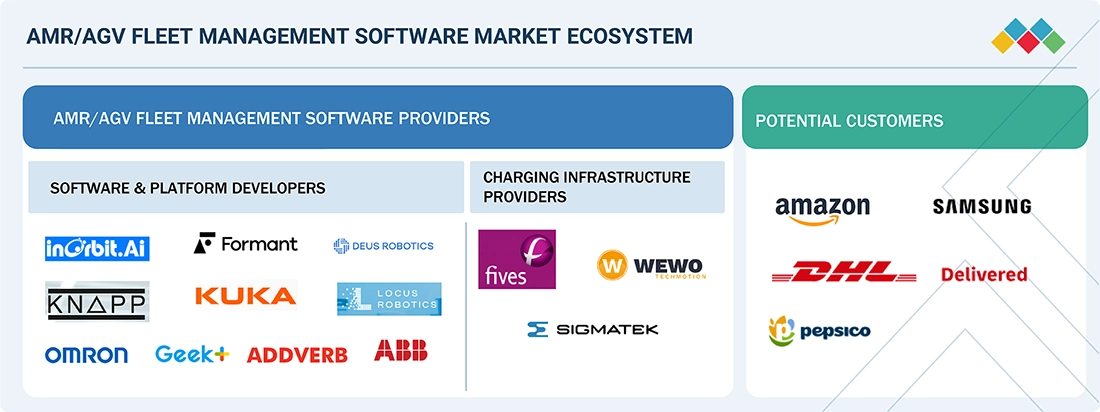
amr-agv-fleet-management-software-market: COMMERCIAL USE CASES ACROSS INDUSTRIES
| COMPANY | USE CASE DESCRIPTION | BENEFITS |
|---|---|---|
 |
KUKA’s fleet management software enables coordinated control of AMRs and AGVs across manufacturing, assembly, and intralogistics environments. The platform provides real-time routing, traffic control, task assignment, battery monitoring, and seamless integration with MES, ERP, and warehouse automation systems. | Enhances operational efficiency with optimized multi robot routing and traffic control. Improves safety and workflow continuity. Maximizes asset utilization and uptime through predictive charging and centralized orchestration. |
 |
ABB delivers enterprise-level fleet management systems for automated material movement, production line support, and facility-wide logistics automation. Its software enables task scheduling, dynamic path planning, collision avoidance, and integration with robotics, conveyors, and control systems. | Improves productivity through synchronized AGV and AMR operations. Reduces manual handling and downtime with automated job assignment. Enables scalable automation adoption through modular and interoperable fleet control. |
 |
Omron’s fleet management platform provides autonomous navigation, multi-robot coordination, load handoff automation, and real-time workflow optimization. The system integrates with Omron controllers, vision systems, and safety solutions to support end-to-end industrial automation. | Strengthens throughput with efficient robot to robot communication. Increases safety with dynamic zoning and intelligent traffic rules. Ensures reliable operations through predictive maintenance and full fleet visibility. |
 |
Geekplus offers cloud-based fleet management software built for high volume e-commerce, retail fulfillment, and warehouse automation. It coordinates large fleets of AMRs with intelligent task prioritization, zone routing, high speed picking workflows, and performance analytics. | Boosts order fulfillment speed and accuracy in large warehouses. Supports rapid scalability using cloud fleet control. Reduces operating costs through optimized paths, energy management, and real time data analytics. |
 |
Addverb’s fleet management solution supports AMRs, AGVs, and sorting systems with real-time orchestration, dynamic task allocation, traffic balancing, and IoT-enabled workflow optimization. It integrates with WMS, WES, and enterprise automation platforms. | Improves logistics efficiency with synchronized fleet behavior. Reduces delays and errors using data driven routing. Enables flexible, scalable operations for dynamic warehouse and manufacturing needs. |
Logos and trademarks shown above are the property of their respective owners. Their use here is for informational and illustrative purposes only.
Related Ecosystem
Industrial Automation
- Sensors
- Image Sensors
- Manufacturing Execution System (MES)
- Actuators
- Flow Sensors
- Siemens ag
- ABB India Limited
- Emerson Electric Co.
- HONEYWELL INTERNATIONAL INC.
- SCHNEIDER ELECTRIC SE
Key Takeaways
- China's fleet management software market will grow from $29.1M (2025) to $116.1M (2030), representing a 21.9% CAGR.
- China's market growth is driven by e-commerce expansion, IoT adoption, and government vehicle tracking regulations.
- China's digital transformation initiatives and smart city investments are accelerating fleet management software adoption.
- China's market is expected to become a dominant regional player, outpacing global growth rates by 2030.
Fleet Management Software Market Report Scope
| Report Metric | Details |
|---|---|
| Base Year | 2025 |
| Fastest Growing Segment | LOGISTICS/3PL (Industry) |
| Forecast Period | 2025–2030 |
| Growth Rate | CAGR of 18.7% from 2025 to 2030 |
| Largest Segment | LARGE ENTERPRISES (Organization Size) |
| Market Size Base Year (Billions) | ~USD 1.58 (2025) |
| Revenue Forecast (Billions) | ~USD 3.71 (2030) |
| Segments Covered | Offering, Type, Platform Type, Fleet Type, Industry, Application, Organization Size |
China Fleet Management Software Market Report Segmentation
7 segment dimensions are covered across the global market.
By Offering
- Services
- Software
By Type
- Assembly Line Agvs
- Cloud-Based Orchestration Platforms
- Collaborative Amrs
- Consulting & System Design
- Hybrid Platforms
- Implementation & Integration
- Maintenance & Updates
- Managed Services
- On-Premises Orchestration Platforms
- Pallet Truck Agvs
- Picking & Sorting Amrs
- Tow/Tugger Agvs
- Training & Support
- Transportation Amrs
- Unit Load Agvs
By Platform Type
- Multi-Vendor Fleet Platforms
- Single-Vendor Fleet Platforms
By Fleet Type
- Agvs
- Amrs
- Hybrid (Multi-Robot Fleets)
By Industry
- Automotive
- Aviation
- Chemicals
- E-Commerce & Retail
- Food & Beverages
- Healthcare
- Logistics/3Pl
- Other Industries
- Semiconductor & Electronics
By Application
- Cross-Docking & Dock-To-Dock Transfers
- Fleet Coordination & Zone Management
- Intralogistics & Material Transport Management
- Order Fulfillment & Picking Operations
- Packaging, Palletizing, And Line Feeding
- Sorting & Allocation Management
By Organization Size
- Large Enterprises
- Small & Medium Enterprises (Smes)
Target Audience
- Fleet Management Software Vendors : Vendors need China-specific market data to assess market opportunity, plan product localization, identify customer segments, and develop competitive strategies for capturing share in this high-growth market.
- Logistics & Transportation Companies : Chinese logistics enterprises require market intelligence to evaluate software solutions, benchmark against competitors, understand pricing trends, and make informed technology investment decisions for fleet optimization.
- Private Equity & Investment Firms : Investors evaluating opportunities in China's transportation tech sector need detailed market sizing, growth projections, and competitive landscape analysis to assess investment returns and portfolio company potential.
- Automotive & E-commerce Enterprises : Large Chinese automotive manufacturers and e-commerce platforms need market insights to understand fleet management technology trends, vendor capabilities, and ROI potential for internal fleet operations.
- Technology Consultants & System Integrators : Consultants advising Chinese enterprises on digital transformation require market data to recommend appropriate solutions, justify technology investments, and align fleet management strategies with market best practices.
Key Companies in the China Fleet Management Software Market
| Company | HQ | Ownership | Strongest segments |
|---|---|---|---|
| KUKA SE & CO. KGAA | Germany | Private Company | Industrial robots and controllers,Systems integration and turnkey production cells,Mobile robots, AGVs, and logistics automation, |
| SIEMENS | Germany | Public Company | Digital Industries (automation, industrial software, PLM),Smart Infrastructure (electrification, buildings, grid),Mobility (rail, automation, services), |
| FIVES | France | Private Company | Cement, minerals, glass, and heavy-process lines (incl. EPC),Smart automation, intralogistics, and robotics,High-precision machine tools and composite processing, |
| OCADO GROUP PLC. | United Kingdom | Public Company | Technology Solutions & Intelligent Automation,Logistics & Fulfilment Services,UK Online Grocery Retail, |
| MITSUBISHI LOGISNEXT CO., LTD | Japan | Private Company | Electric forklifts,Engine-powered forklifts,Automated warehouses and logistics systems, |
KUKA SE & CO. KGAA
KUKA SE & CO. KGAA is a German private company founded in 1898 with 14,985 employees. The company specializes in industrial automation and robotics solutions.
SIEMENS
SIEMENS is a German public company founded in 1847 with 310,312 employees, providing industrial automation, digitalization, and infrastructure solutions globally.
FIVES
FIVES is a French private company founded in 1812 with 8,132 employees, specializing in industrial engineering and equipment manufacturing.
OCADO GROUP PLC.
OCADO GROUP PLC. is a United Kingdom public company founded in 2000 with 21,367 employees, operating as an online grocery retailer and technology platform.
MITSUBISHI LOGISNEXT CO., LTD
MITSUBISHI LOGISNEXT CO., LTD is a Japanese private company founded in 1937 with 11,161 employees, providing material handling and logistics equipment.
Reasons to Buy this Report
- Market Size & Growth Validation : Quantified market data for China with precise valuations ($29.1M in 2025, $116.1M in 2030) and 21.9% CAGR enables accurate business planning, investment decisions, and revenue forecasting specific to the Chinese market.
- Competitive Intelligence : Understand China's unique competitive dynamics, vendor positioning, and market consolidation trends to identify partnership opportunities, acquisition targets, and differentiation strategies for market entry or expansion.
- Regulatory & Policy Insights : Gain clarity on Chinese government mandates for vehicle tracking and emissions compliance that are driving market adoption, helping you align product development and go-to-market strategies with regulatory requirements.
- Sector-Specific Opportunities : Identify high-growth segments within China's logistics, e-commerce delivery, and automotive sectors to prioritize sales efforts, customize solutions, and maximize ROI in the fastest-expanding verticals.
- Strategic Market Positioning : Leverage China-specific market insights to benchmark against competitors, identify white space opportunities, and develop localized strategies that resonate with Chinese enterprises' unique operational and cultural requirements.
Frequently asked questions
What is the current size of China's fleet management software market?
China's fleet management software market is valued at $29.1 million in 2025 and is projected to grow to $116.1 million by 2030.
What is the growth rate of China's fleet management software market?
China's fleet management software market is growing at a compound annual growth rate (CAGR) of 21.9% from 2025 to 2030.
What factors are driving growth in China's fleet management software market?
Key drivers include rapid e-commerce expansion, increasing IoT technology adoption, government vehicle tracking mandates, and China's smart city infrastructure investments.
How does China's market growth compare to global trends?
China's 21.9% CAGR significantly exceeds the global average of 18.7%, making China a critical growth engine for the Asia Pacific region.
What industries in China are adopting fleet management software?
Primary adopters in China include logistics and transportation companies, e-commerce platforms, automotive manufacturers, and ride-sharing services seeking operational efficiency and regulatory compliance.
RESEARCH METHODOLOGY
The study involved four major activities in estimating the current size of the AMR/AGV fleet management software market. Exhaustive secondary research has been conducted to gather information on the market, adjacent markets, and the overall AMR/AGV fleet management software landscape. These findings, along with assumptions and projections, were validated through primary research involving interviews with industry experts and key stakeholders across the value chain. Both top-down and bottom-up approaches were utilized to estimate the overall market size. Subsequently, market breakdown and data triangulation techniques were applied to determine the sizes of various segments and subsegments. Two key sources, secondary and primary, were leveraged to conduct a comprehensive technical and commercial assessment of the AMR/AGV fleet management software market.
Secondary Research
Various secondary sources have been referred to in the secondary research process to identify and collect important information for this study. The secondary sources include annual reports, press releases, and investor presentations of companies; white papers; journals and certified publications; and articles from recognized authors, websites, directories, and databases. Secondary research has been conducted to obtain key information about the industry’s supply chain, the market’s value chain, the total pool of key players, market segmentation according to the industry trends (to the bottom-most level), regional markets, and key developments from market- and technology-oriented perspectives. The secondary data has been collected and analyzed to determine the overall market size, further validated by primary research.
Primary Research
Extensive primary research was conducted after gaining knowledge about the current scenario of the AMR/AGV fleet management software market through secondary research. Several primary interviews were conducted with experts from the demand and supply sides across four major regions—North America, Europe, Asia Pacific, and RoW. This primary data was collected through questionnaires, emails, and telephonic interviews.
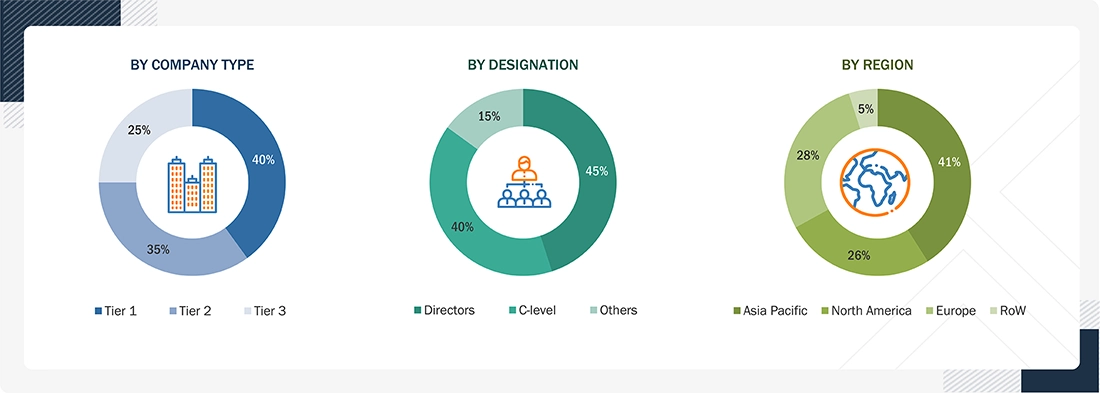
Note: The RoW region includes the Middle East, Africa, and South America. Other designations include product, sales, and marketing managers. Three tiers of companies have been defined based on their total revenue as of 2024: Tier 3, with revenue less than USD 300 million; Tier 2, with revenue between USD 300 million and USD 1 billion; and Tier 1, with revenue more than USD 1 billion.
To know about the assumptions considered for the study, download the pdf brochure
Market Size Estimation
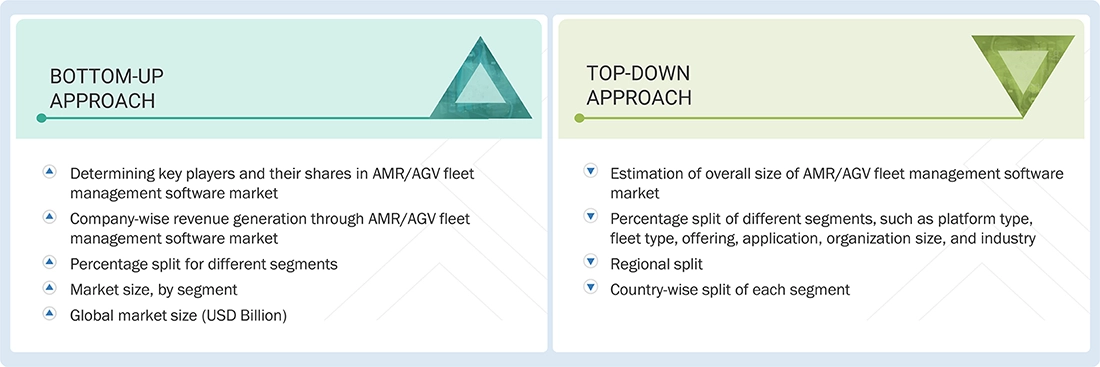
Both top-down and bottom-up approaches have been used to estimate and validate the total size of the AMR/AGV fleet management software market. These methods have also been used extensively to estimate the size of various subsegments in the market. The following research methodology has been used to estimate the market size:
- Major players in the industry and markets have been identified through extensive secondary research.
- The industry’s value chain and market size (in terms of value) have been determined through primary and secondary research processes.
- All percentage shares, splits, and breakdowns have been determined using secondary sources and verified through primary sources.
Fleet Management Software Market : Top-Down and Bottom-Up Approach
Data Triangulation
After arriving at the overall size of the AMR/AGV fleet management software market from the market size estimation process explained above, the total market has been split into several segments and subsegments. Data triangulation and market breakdown procedures have been employed, wherever applicable, to complete the overall market engineering process and arrive at the exact statistics for all segments and subsegments of the market. The data has been triangulated by studying various factors and trends from both the demand and supply sides. Along with this, the market size has been validated using both top-down and bottom-up approaches.
Market Definition
AMR/AGV fleet management software market refers to the market for software platforms that enable centralized monitoring, control, and optimization of fleets of Autonomous Mobile Robots (AMRs) and Automated Guided Vehicles (AGVs) operating in warehouses, factories, logistics hubs, hospitals, and other facilities. This includes solutions that manage traffic and routing, task allocation and scheduling, battery and charging, collision avoidance, and real-time tracking, while integrating with WMS, MES, ERP, and other automation systems. The market encompasses revenues generated from software licenses, subscriptions, and associated services (such as configuration, customization, analytics, and support) offered by technology vendors to end-users and system integrators deploying AMR/AGV fleets. The scope encompasses both proprietary software provided by robot manufacturers for their own fleets and third-party solutions that can manage heterogeneous fleets from multiple manufacturers.
Key Stakeholders
- AMR and AGV Manufacturers
- Fleet Management Software Providers
- Warehouse Management System (WMS), MES, and ERP Solution Providers
- System Integrators Specializing in Warehouse & Factory Automation
- Technology Providers (AI, IoT, Edge Computing, Sensors, Cloud Platforms)
- Semiconductor & High-Tech Manufacturing Facilities
- Consulting Firms Specializing in Automation & Digital Transformation
- Government Bodies, Regulatory Agencies, and Warehouse Safety Authorities
- Venture Capitalists, Private Equity Firms, and Automation-Focused Investors
- Research Organizations, Robotics Labs, and Industrial Consortia
- Cloud Service Providers and Industrial Networking Providers
Report Objectives
- To define, describe, and forecast the AMR/AGV fleet management software market, in terms of platform type, fleet type, offering, application, organization size, industry, and region.
- To describe and forecast the market, in terms of value, with regard to four main regions: North America, Europe, Asia Pacific, and Rest of the World (RoW), along with their respective countries.
- To provide detailed information regarding major factors influencing market growth (drivers, restraints, opportunities, and challenges)
- To offer a detailed overview of the value chain of the AMR/AGV fleet management software market.
- To strategically analyze micromarkets with respect to individual growth trends, prospects, and contributions to the AMR/AGV fleet management software market
- To analyze opportunities in the market for stakeholders by identifying high-growth segments of the AMR/AGV fleet management software market.
- To strategically profile key players and comprehensively analyze their market position in terms of ranking and core competencies, along with detailing the competitive landscape for market leaders
- To analyze competitive strategies, such as product launches, expansions, mergers, and acquisitions, adopted by key market players in the AMR/AGV fleet management software market.
Available Customizations
With the given market data, MarketsandMarkets offers customizations according to the company’s specific needs. The following customization options are available for the report:
Company Information:
- Detailed analysis and profiling of additional market players (up to 5)
Get the Full Fleet Management Software Market Report
Full forecast, segment splits, and company analysis for all Fleet Management Software Market.
- US Fleet Management Software Market
- Canada Fleet Management Software Market
- Mexico Fleet Management Software Market
- Germany Fleet Management Software Market
- UK Fleet Management Software Market
- France Fleet Management Software Market
- Italy Fleet Management Software Market
- Rest Of Europe Fleet Management Software Market
- Japan Fleet Management Software Market
- India Fleet Management Software Market
- South Korea Fleet Management Software Market
- Australia Fleet Management Software Market
- Rest Of Asia Pacific Fleet Management Software Market
Need a Tailored Report?
Customize this report to your needs
Get 10% FREE Customization
Customize This Report
