
UK Artificial Intelligence (AI) Market (2026-2031)

The UK Artificial Intelligence (AI) Market was valued at $34630 Million in 2026 and projected to reach to $176550 Million by 2031, representing a compound annual growth rate of CAGR 26.2%. The UK artificial intelligence market is positioned for sustained expansion through 2031, driven by increasing enterprise adoption across financial services, healthcare, and manufacturing sectors.


| Market Size in | USD 26.32 MN |
| Market Forecast in | |
| CAGR | |
| Forecast Period | |
| Units Considered | Value (USD MN) |
UK Artificial Intelligence (AI) Market Trends and Insights
- This represents a compound annual growth rate of 26.2%, reflecting the UK's strategic position as a leading AI hub in Europe.
- The UK's strong technology infrastructure, regulatory frameworks, and investment in AI research and development are driving accelerated adoption across enterprise and public sectors. During the 2026–2031 forecast period, the UK AI market will be shaped by increasing demand for machine learning solutions, natural language processing, and autonomous systems across financial services, healthcare, and manufacturing.
- The UK government's commitment to AI innovation and the presence of world-class research institutions position the country as a critical growth engine for AI technologies in the region.
- Enterprise investment in AI-driven digital transformation continues to fuel market expansion throughout this period..
Key Market Statistics
- CAGR (2026-2031) CAGR 26.2%
- Market Size, 2026 ~USD 34630 Million
- Forecast, 2031 ~USD 176550 Million
- Country UK
UK Artificial Intelligence (AI) Market Overview
Market Valuation Growth :
The UK AI market is valued at $34,630 million in 2026 and is projected to reach $176,550 million by 2031, representing a 26.2% CAGR and demonstrating exceptional growth momentum in the region.
European AI Leadership :
The UK maintains a strategic position as a leading AI hub in Europe, supported by world-class research institutions, government backing, and a thriving startup ecosystem that attracts global investment.
Regulatory Framework Advantage :
The UK's progressive regulatory environment and AI governance frameworks provide clarity for businesses, fostering innovation while maintaining ethical standards and competitive advantage over other European markets.
R&D Investment Surge :
Significant government and private sector investment in AI research and development across UK universities and tech companies is accelerating technological breakthroughs and commercialization opportunities.
UK Artificial Intelligence (AI) Market Dynamics
- Government initiatives supporting AI innovation, combined with the UK's talent pool of AI researchers and engineers, create a favorable ecosystem for market growth.
- The 26.2% CAGR reflects strong demand for AI solutions in automation, data analytics, and intelligent systems. Looking ahead, the UK market will benefit from post-Brexit regulatory independence, enabling tailored AI policies that attract international investment.
- Strategic partnerships between UK tech companies and global enterprises, alongside growing venture capital funding, will accelerate market penetration.
- However, competition from other European nations and the need for skilled AI talent will remain key considerations for sustained growth through the forecast period..
Market Ecosystem

ARTIFICIAL INTELLIGENCE (AI) MARKET: COMMERCIAL USE CASES ACROSS INDUSTRIES
| COMPANY | USE CASE DESCRIPTION | BENEFITS |
|---|---|---|
 |
Klarna deployed an OpenAI-powered AI assistant across its customer service operations, covering 23 markets and over 35 languages | The platform replaced a large share of first-line support interactions, routing complex cases to human agents | Handled 2.3 million conversations in the first month | Automated 67% of all customer service chats, equivalent to the output of 700 full-time agents | Average resolution time dropped from 11 minutes to under 2 minutes | Repeat inquiries fell 25% |
 |
TreviPay implemented Tricentis Testim, an AI-powered UI test automation tool, to support cloud migration of 25+ applications and to scale regression coverage across multiple Agile teams | AI models assessed more than 5,000 daily shipments from plants to warehouses, generating over USD 20 million in savings since fiscal 2024 | Real-time manufacturing performance data is projected to deliver more than USD 50 million in waste reduction |
 |
Meta built one of the world's largest AI compute infrastructures, deploying tens of thousands of NVIDIA H100 GPUs across purpose-built data center clusters to train and serve its large language models, including the Llama series | Hardware foundation enabled Meta to release Llama models as open-source, accelerating AI research and product development across industries |
 |
Insilico Medicine used its end-to-end generative AI platform to identify a novel drug target for idiopathic pulmonary fibrosis (IPF) and develop a candidate molecule entirely through AI-driven design, from target discovery through to clinical development | Advanced from novel target identification to Phase I clinical trial in under 30 months — approximately half the traditional timeline |
 |
Dell Technologies deployed its AI Factory with NVIDIA, an end-to-end AI infrastructure and services platform, to help enterprises move AI initiatives from pilot to production | The offering integrates AI-ready data platforms, scalable hardware, and implementation services | Over 4,000 enterprise customers deployed the Dell AI Factory within two years of launch | Early adopters reported up to 2.6x ROI within the first year of deployment |
Logos and trademarks shown above are the property of their respective owners. Their use here is for informational and illustrative purposes only.
Related Ecosystem
Key Takeaways
- The UK AI market will grow from $34.6B (2026) to $176.6B (2031) at a 26.2% CAGR, significantly outpacing many global peers.
- The UK's regulatory environment and government support create a favorable ecosystem for AI innovation and enterprise adoption.
- Financial services, healthcare, and manufacturing sectors in the UK are primary drivers of AI market growth through 2031.
- The UK's concentration of AI talent and research institutions positions it as Europe's leading AI market by forecast year 2031.
Artificial Intelligence (AI) Market Report Scope
| Report Metric | Details |
|---|---|
| Base Year | 2026 |
| Fastest Growing Segment | MULTI-AGENT ORCHESTRATION PLATFORMS (Ai Agent Orchestration & Rag Platform) |
| Forecast Period | 2026–2031 |
| Growth Rate | CAGR of 29.3% from 2026 to 2031 |
| Largest Segment | ENTERPRISES (End User) |
| Market Size Base Year (Billions) | ~USD 602.12 (2026) |
| Revenue Forecast (Billions) | ~USD 2176.08 (2031) |
| Segments Covered | Offering, Hardware, Business Function, Marketing & Sales, Human Resources, Finance & Accounting, Operations & Supply Chain, Cybersecurity, Bfsi Use Case, Retail & Ecommerce Use Case, Manufacturing Use Case, Government & Defense Use Case, Healthcare & Life Sciences Use Case, Healthcare & Life Science Use Case, Telecommunications Use Case, Energy & Utilities Use Case, Transportation & Logistics Use Case, Agriculture Use Case, Software & Technology Providers Use Case, Media & Entertainment Use Case, End User, Enterprise Ai, Bfsi End User, Manufacturing End User, Government & Defense End User, Healthcare & Life Sciences End User, Energy & Utilities End User, Ai Accelerator Chip, Edge Ai Processor, Ai Memory, Ai Storage, Ai Networking, Software, Ai/Ml Development & Training Platform, Mlops & Llmops Platform, Foundation Models & Llm, Ai Agent Orchestration & Rag Platform, Ai Data Platform, Ai Sgrc Platform, Ai Productivity Tool, Service, Ai Strategy & Consulting Service, Ai Implementation & System Integration Service, Managed Ai Service, Technology, Classical Machine Learning, Deep Learning, Generative Ai, Natural Language Processing, Vision Ai, Speech & Audio Ai, Symbolic Ai & Knowledge Representation, Deployment Model |
UK Artificial Intelligence (AI) Market Report Segmentation
53 segment dimensions are covered across the global market.
By Offering
- Hardware
- Service
- Services
- Software
By Hardware
- AI Accelerator Chips
- AI Memory
- AI Networking
- AI Storage
By Business Function
- Cybersecurity
- Finance & Accounting
- Human Resources
- Marketing & Sales
- Operations & Supply Chain
- Other Business Functions
By Marketing & Sales
- Audience Segmentation & Personalization
- Content Generation & Marketing
- Customer Experience Management
- Other Marketing & Sales Functions
- Predictive Forecasting
- Sentiment Analysis
By Human Resources
- Candidate Screening & Recruitment
- Employee Feedback Analysis
- Onboarding Automation
- Other Human Resource Functions
- Performance Management
- Workforce Management
By Finance & Accounting
- Automated Bookkeeping & Reconciliation
- Financial Compliance & Regulatory Reporting
- Financial Planning & Forecasting
- Other Finance & Accounting Functions
- Procurement & Supply Chain Finance
- Revenue Cycle Management
By Operations & Supply Chain
- Aiops
- Demand Planning & Forecasting
- It Service Management
- Other Operations & Supply Chain Functions
- Procurement & Sourcing
- Production Planning & Scheduling
- Warehouse & Inventory Management
By Cybersecurity
- Data Security
- Fraud Detection & Prevention
- Identity & Access Management
- Other Cybersecurity Functions
- Risk & Compliance Management
- Security Operations Automation
- Threat Detection & Response
- Vulnerability & Exposure Management
By Bfsi Use Case
- Algorithmic Trading
- Credit Scoring & Underwriting
- Customer Service Automation
- Fraud Detection & Prevention
- Investment Portfolio Management
- Other Bfsi Use Cases
- Personalized Financial Recommendations
- Regulatory Compliance Monitoring
- Risk Assessment & Management
By Retail & Ecommerce Use Case
- Customer Relationship Management
- Other Retail & E-Commerce Use Cases
- Personalized Product Recommendation
- Price Optimization
- Supply Chain Management & Demand Planning
- Virtual Customer Assistant
- Virtual Stores
- Visual Search
By Manufacturing Use Case
- Intelligent Inventory Management
- Material Movement Management
- Other Manufacturing Use Cases
- Predictive Maintenance And Machinery Inspection
- Production Line Optimization
- Production Planning
- Quality Control
- Recyclable Material Reclamation
By Government & Defense Use Case
- Command & Control
- Disaster Response & Recovery Assistance
- E-Governance & Digital City Services
- Intelligence Analysis & Data Processing
- Law Enforcement
- Other Government & Defense Use Cases
- Simulation & Training
- Surveillance & Situational Awareness
By Healthcare & Life Sciences Use Case
- AI-Assisted Medical Services
- Drug Discovery
- Inpatient Care & Hospital Management
- Lifestyle Management & Monitoring
- Medical Imaging & Diagnostics
- Medical Research
- Other Healthcare & Life Sciences Use Cases
- Patient Data & Risk Analysis
- Patient Data And Risk Analysis
- Precision Medicine
By Healthcare & Life Science Use Case
- AI-Assisted Medical Services
- Drug Discovery
- Inpatient Care & Hospital Management
- Lifestyle Management & Monitoring
- Medical Imaging & Diagnostics
- Medical Research
- Other Healthcare & Life Sciences Use Cases
- Patient Data And Risk Analysis
- Precision Medicine
By Telecommunications Use Case
- Customer Service & Support
- Intelligent Call Routing
- Network Analytics
- Network Fault Prediction
- Network Optimization
- Network Security
- Other Telecom Use Cases
- Virtual Network Assistants
- Voice & Speech Recognition
By Energy & Utilities Use Case
- Energy Consumption Analytics
- Energy Demand Forecasting
- Energy Storage Optimization
- Energy Trading & Market Forecasting
- Grid Optimization & Management
- Intelligent Energy Management Systems
- Other Energy & Utilities Use Cases
- Power Quality Monitoring & Management
- Real-Time Energy Monitoring & Control
- Smart Metering & Energy Data Management
By Transportation & Logistics Use Case
- Driver Assistance Systems
- Fleet Management
- Intelligent Traffic Management
- Other Transportation & Logistics Use Cases
- Route Optimization
- Semi-Autonomous And Autonomous Vehicles
- Smart Logistics And Warehousing
- Supply Chain Visibility And Tracking
- Vehicle Diagnostics And Telematics
By Agriculture Use Case
- Automated Harvesting & Sorting
- Crop Monitoring & Yield Prediction
- Irrigation Optimization & Water Management
- Livestock Monitoring & Health Management
- Others Agricultural Use Cases
- Pest & Disease Detection
- Precision Farming
- Soil Analysis & Nutrient Management
- Weather & Climate Monitoring
- Weed Detection & Management
By Software & Technology Providers Use Case
- AI-Powered Cybersecurity & Threat Detection
- Automated Devops & Ci/Cd Optimization
- Automated Software Testing & Qa
- Bug Detection & Fixing
- Code Generation & Auto-Completion
- Other Software & Technology Use Cases
By Media & Entertainment Use Case
- Audience Analytics & Segmentation
- Content Copyright Protection
- Content Creation & Generation
- Content Recommendation Systems
- Others Media & Entertainment Use Cases
- Personalized Advertising
By End User
- Consumers
- Enterprises
By Enterprise Ai
- Agriculture
- Bfsi
- Energy & Utilities
- Government & Defense
- Healthcare & Life Sciences
- Manufacturing
- Media & Entertainment
- Other Enterprises
- Retail & Ecommerce
- Software & Technology Providers
- Telecommunications
- Transportation And Logistics
By Bfsi End User
- Banking
- Financial Services
- Insurance
By Manufacturing End User
- Discrete Manufacturing
- Process Manufacturing
By Government & Defense End User
- Federal Government
- Military & Defense
- Public Service Agencies
- State & Local Government
By Healthcare & Life Sciences End User
- Healthcare Providers
- Medtech
- Pharmaceuticals & Biotech Sector
By Energy & Utilities End User
- Electrical Utilities & Power Generation
- Oil & Gas
- Other Energy & Utilities End Users
- Renewable Energy
- Waste Management Utilities
- Water Utilities
By Ai Accelerator Chip
- AI Asics & Tpus
- Cpus
- Edge AI Processors
- Fpgas
- Gpus
By Edge Ai Processor
- Npu
- Soc
By Ai Memory
- Gddr
- Hbm
- Lpddr
- Pim
By Ai Storage
- AI Data Lake Object Storage
- All-Flash Storage Arrays
- Nvme Ssds
- Parallel/Distributed File System Storage
By Ai Networking
- High Speed Ethernet Nics
- Infiniband Hca & Switches
By Software
- AI Agent Orchestration & Rag Platforms
- AI Data Platforms
- AI Productivity Tools
- AI Sgrc Platforms
- AI/ML Development & Training Platforms
- Foundation Models & Llms
- Mlops & Llmops Platforms
By Ai/Ml Development & Training Platform
- Automl Platforms
- End-To-End ML Platforms
- Fine-Tuning Platforms
- Foundation Model Training Platforms
By Mlops & Llmops Platform
- Feature Stores
- Inference Optimization Platforms
- Llm Quality & Output Monitoring
- Model Monitoring & Drift Detection
- Model Registry & Versioning
- Model Serving & Inference Serving Platforms
- Prompt Lifecycle Management
By Foundation Models & Llm
- Document Intelligence & Ocr Models
- Domain-Specific Foundation Models
- Embedding Models & Vector Representation Apis
- General-Purpose Llms
- Generative Image & Video Models
- Multimodal Foundation Models
- Open-Weight Foundation Models
- Small Language Models
- Speech Recognition Models
- Text-To-Speech & Voice Synthesis Models
- Vision AI Models
By Ai Agent Orchestration & Rag Platform
- AI Copilot Development Platforms
- Enterprise Knowledge Grounding & Search Orchestration
- Llm Orchestration & Chaining
- Multi-Agent Orchestration Platforms
- Rag Pipeline Platforms
- Single-Agent Development Platforms
- Tool-Calling & Api Integration Platforms
- Vector Databases & Semantic Search Engines
By Ai Data Platform
- AI Data Fabric & Udm Platforms
- Data Labeling & Annotation Platforms
- Data Lakehouse Platforms
- Knowledge Graph Platforms
- Streaming & Data Ingestion Platforms
By Ai Sgrc Platform
- AI Data Security Platforms
- AI For Cybersecurity Platforms
- AI Governance & Policy Platforms
- AI Model Security Platforms
- Responsible AI Platforms
By Ai Productivity Tool
- AI Coding Assistants & Developer Tools
- AI Enterprise Search & Knowledge Assistants
- AI Meeting Transcription & Summary Tools
- AI Presentation & Document Generation Tools
- AI Software Testing & Code Review Tools
- AI Writing & Content Assistants
By Service
- AI Implementation & System Integration Services
- AI Strategy & Consulting Services
- AI Training & Enablement Services
- Data Labelling & Annotation Services
- Managed AI Services
By Ai Strategy & Consulting Service
- AI Operating Model Services
- AI Regulatory Compliance Advisory
- AI Strategy & Roadmap Advisory
- AI Use-Case Identification
- Responsible AI & Ethics Advisory
By Ai Implementation & System Integration Service
- AI Api Integration & Workflow Integration Services
- AI Data Engineering & Readiness Services
- AI Infrastructure Deployment Services
- AI Solution Architecture & System Design Services
- Autonomous Agent Workflow Implementation Services
- Custom AI/ML Model Development Services
- Llm Fine-Tuning & Rag Implementation Services
By Managed Ai Service
- AI Api Integration & Workflow Integration Services
- AI Help Desk & Support Services
- Managed AI Application Services
- Managed AI Infrastructure & Gpuaas
- Managed Knowledge-Base & Rag Services
- Managed Mlops/Aiops
By Technology
- Classical Machine Learning
- Deep Learning
- Generative AI
- Natural Language Processing
- Speech & Audio AI Technology
- Symbolic AI & Knowledge Representation
- Vision AI
By Classical Machine Learning
- Federated Learning
- Reinforcement Learning
- Supervised Learning
- Unsupervised Learning
By Deep Learning
- Convolutional Neural Networks
- Diffusion Models
- Generative Adversarial Networks
- Graph Neural Networks
- Recurrent Neural Networks
- Transformer-Based Models
By Generative Ai
- Code Generation
- Image & Video Generation
- Multimodal Generation
- Synthetic Data Generation
- Text Generation
By Natural Language Processing
- Multilingual & Cross-Lingual Nlp
- Statistical Nlp
- Transformer-Based Nlp
By Vision Ai
- 3D Vision & Point Cloud Processing
- Image Classification & Object Detection
- Ocr & Idp
- Video Analytics & Action Recognition
By Speech & Audio Ai
- Audio Analytics & Sound Event Detection
- Automatic Speech Recognition
- Speaker Identification & Voice Biometrics
- Text-To-Speech & Voice Synthesis
By Symbolic Ai & Knowledge Representation
- Knowledge Graphs & Ontology-Based Reasoning
- Neurosymbolic AI
- Rule-Based AI & Expert Systems
By Deployment Model
- Cloud
- Edge AI
- Hybrid
- On-Premises
Target Audience
- Technology Investors : UK-focused venture capitalists and private equity firms need detailed market sizing and growth projections to identify promising AI startups and allocate capital effectively in the region.
- Enterprise Decision Makers : UK-based corporate executives and CIOs require market intelligence to justify AI investments, benchmark spending against peers, and align digital transformation strategies with market trends.
- AI Solution Providers : Software vendors and AI service companies targeting the UK market need segmentation data, competitive analysis, and growth forecasts to refine go-to-market strategies and revenue projections.
- Government & Policy Bodies : UK government agencies and regulatory bodies use market data to inform AI policy development, funding decisions, and initiatives that support the nation's position as a leading AI hub.
- Management Consultants : Strategy and management consulting firms advising UK clients on digital transformation and AI adoption require authoritative market data to support recommendations and client presentations.
Key Companies in the UK Artificial Intelligence (AI) Market
| Company | HQ | Ownership | Strongest segments |
|---|---|---|---|
| GETRONICS | Netherlands | Private Company | AI Services (Managed, Consulting, Integration),AI Software (Applications, Platforms, Tools),AI Hardware (Chips, Memory, Storage), |
| KUDELSKI GROUP | Switzerland | Public Company | AI-Enabled Cybersecurity Services,Core Digital Security & Middleware with AI Analytics,IoT Security Platforms & Services, |
| ENGHOUSE INTERACTIVE | United States | Private Company | AI Software (EnghouseAI, contact center AI, analytics),AI-Related Services (integration, customization, support),AI-Linked Hardware / Infrastructure Pass-through, |
| UNITED MICROELECTRONICS CORP | Taiwan | Public Company | Hardware – AI chips (logic, specialty processes),Hardware – Memory and Storage-related wafers,AI-related Services (design support, mask, backend), |
| DATAMATICS GLOBAL SERVICES LIMITED | India | Public Company | AI Software Platforms (TruBot, TruCap+, TruBI, TrueAI, TruDiscovery, FINATO),AI-enabled Services (Digital Operations, BPM, Analytics),AI-related Hardware & Infrastructure, |
| GFT TECHNOLOGIES SE | Germany | Public Company | AI Services & Consulting,AI Software & Platforms (Wynxx, Smaragd, Engenion, AI solutions),AI-Adjacent Infrastructure & Management, |
| MICROSOFT | United States | Public Company | AI Software (Azure AI, Copilot, Dynamics, GitHub, Nuance),AI Services (Enterprise support, consulting, industry solutions),AI Hardware & Infrastructure (cloud compute, storage, networking), |
| United States | Public Company | AI Hardware (Chips, Memory, Storage),AI Software (ML, NLP, Generative, Neurosymbolic),AI Services (Consulting, Integration, Managed), | |
| IBM | United States | Public Company | AI Software (ML, NLP, Generative, Neurosymbolic),AI Services (Consulting, Managed, Integration),AI Hardware (Chips, Memory, Storage), |
| AMD | United States | Public Company | AI Data Center Hardware (Instinct, EPYC, Radeon PRO V-series, Alveo/Pensando),Client & Edge AI Hardware (Ryzen AI, Radeon, Embedded Radeon, Versal AI Edge/Core, Zynq),Software, Tools & Services (Vitis, Vivado, ROCm, development services), |
| ORACLE | United States | Public Company | AI Software (Fusion, NetSuite, Database, Middleware),AI Services (Consulting, Advanced Customer Services),AI Infrastructure Hardware (Engineered Systems, Servers, Storage), |
| INTEL | United States | Public Company | AI Hardware (AI Chips, Memory, Storage),AI Software,AI Services, |
| BAIDU | China | Public Company | AI Software (ML, NLP, Generative AI platforms and tools),AI Services (Cloud, Managed AI, Autonomous Mobility-as-a-Service),AI Hardware (AI Chips, Memory, Storage), |
| HPE | United States | Public Company | AI Hardware (Servers, AI Chips, Memory, Storage),AI Software,AI Services, |
GETRONICS
Getronics is a Netherlands-based private company established in 1887 with 23,915 employees, operating as a major technology services provider.
KUDELSKI GROUP
Kudelski Group is a Swiss public company founded in 1951 with 110 employees, operating in digital security and content protection technologies.
ENGHOUSE INTERACTIVE
Enghouse Interactive is a United States-based private company founded in 1984 with 243 employees, offering customer engagement and communications software.
UNITED MICROELECTRONICS CORP
United Microelectronics Corp is a Taiwan-based public company founded in 1980 with 20,000 employees, operating as a major semiconductor manufacturer.
DATAMATICS GLOBAL SERVICES LIMITED
Datamatics Global Services Limited is an India-based public company founded in 1975 with 15,660 employees, providing IT services and business process management solutions.
GFT TECHNOLOGIES SE
GFT Technologies SE is a Germany-based public company founded in 1987 with 11,645 employees, providing digital transformation and IT consulting services.
MICROSOFT
Microsoft is a United States-based public company founded in 1975 with 228,000 employees, a global leader in software, cloud computing, and technology services.
Google is a United States-based public company founded in 1998 with 194,668 employees, a global technology leader in search, advertising, and cloud services.
IBM
IBM is a United States-based public company founded in 1911 with 264,300 employees, a major provider of enterprise IT solutions, cloud services, and consulting.
AMD
AMD is a United States-based public company founded in 1969 with 31,000 employees, a leading semiconductor manufacturer specializing in processors and graphics.
ORACLE
Oracle is a United States-based public company founded in 1977 with 141,000 employees, a global leader in database software, cloud computing, and enterprise solutions.
INTEL
Intel is a United States-based public company founded in 1968 with 85,100 employees, a major semiconductor manufacturer and technology innovator.
BAIDU
Baidu is a China-based public company founded in 2000 with 33,500 employees, a leading provider of internet search, AI, and online services.
HPE
HPE is a United States-based public company founded in 1939 with 67,000 employees, providing enterprise IT infrastructure, software, and services.
Reasons to Buy this Report
- Market Entry Strategy : Gain comprehensive insights into the UK AI market structure, competitive landscape, and growth drivers to develop informed market entry strategies and identify high-potential segments for expansion.
- Investment Decision Support : Access detailed forecasts and valuation data to support investment decisions, funding allocation, and portfolio management in the UK's rapidly growing AI sector through 2031.
- Competitive Intelligence : Understand UK-specific market dynamics, regulatory environment, and emerging opportunities to benchmark against competitors and identify differentiation strategies in this strategic European market.
- Sector-Specific Insights : Obtain granular analysis of AI adoption across UK industries including fintech, healthcare, and manufacturing to target high-growth verticals and tailor solutions to regional demand patterns.
- Risk Mitigation : Evaluate UK market risks, regulatory changes, and talent availability challenges to develop contingency plans and ensure sustainable business operations in this dynamic market environment.
Frequently asked questions
What is the projected size of the UK AI market in 2031?
The UK AI market is forecast to reach $176,550 million by 2031, growing from $34,630 million in 2026.
What is the CAGR for the UK AI market between 2026 and 2031?
The UK AI market is expected to grow at a compound annual growth rate of 26.2% from 2026 to 2031.
Which sectors are driving AI adoption in the UK?
Financial services, healthcare, manufacturing, and retail sectors are the primary drivers of AI market growth in the UK.
How does the UK AI market compare to the global market?
The UK's 26.2% CAGR is slightly below the global average of 29.3%, but the UK remains a critical regional hub for AI innovation and investment.
What factors support AI market growth in the UK?
Government support, strong regulatory frameworks, world-class research institutions, abundant AI talent, and enterprise digital transformation initiatives drive UK AI market expansion.
RESEARCH METHODOLOGY
The research methodology for the global Artificial Intelligence (AI) market report involved the use of extensive secondary sources and directories, as well as various reputed open-source databases, to identify and collect information useful for this technical and market-oriented study. In-depth interviews were conducted with various primary respondents, including AI software providers, AI service providers, AI hardware providers, individual end users, and enterprise end users; high-level executives of multiple companies offering artificial intelligence software, hardware & services; and industry consultants to obtain and verify critical qualitative and quantitative information and assess the market prospects and industry trends.
Secondary Research
In the secondary research process, various secondary sources were referred to for identifying and collecting information for the study. The secondary sources included annual reports; press releases and investor presentations of companies; white papers, certified publications such as Journal of Artificial Intelligence Research (JAIR), Transactions of the Association for Computational Linguistics (TACL), Journal of Machine Learning Research (JMLR), IEEE Transactions on Neural Networks and Learning Systems, Nature Machine Intelligence, Artificial Intelligence Journal (AIJ), ACM Transactions on Information Systems (TOIS), Pattern Recognition Journal, and Neural Computation (MIT Press); and articles from recognized associations and government publishing sources including but not limited to IEEE International Conference on Software Testing, Verification and Validation (ICST), IEEE/ACM International Conference on Automated Software Engineering (ASE), ACM SIGSOFT Symposium on the Foundations of Software Engineering (FSE), International Journal of Software Engineering & Applications (IJSEA), Springer’s Lecture Notes in Computer Science (LNCS) series, IEEE Transactions on Software Engineering, Association for Computational Linguistics (ACL), International Association for Machine Learning (IAMLE), Artificial Intelligence Industry Association (AIIA), International Speech Communication Association (ISCA), Natural Language Processing Association (NLPA), Machine Learning and AI Industry Research Association (MLAIRA), and AI Hardware Alliance (AIIA).
The secondary research was used to obtain key information about the industry’s value chain, the market’s monetary chain, the overall pool of key players, market classification and segmentation according to industry trends to the bottom-most level, regional markets, and key developments from the market and technology-oriented perspectives.
Primary Research
In the primary research process, a diverse range of stakeholders from the supply and demand sides of the artificial intelligence ecosystem were interviewed to gather qualitative and quantitative insights specific to this market. From the supply side, key industry experts, such as chief executive officers (CEOs), vice presidents (VPs), marketing directors, technology & innovation directors, as well as technical leads from vendors offering artificial intelligence hardware, software & services were consulted. Additionally, system integrators, service providers, and IT service firms that implement and support artificial intelligence were included in the study. On the demand side, input from IT decision-makers, hardware managers, and business heads of prominent enterprise end users was collected to understand the user perspectives and adoption challenges within targeted industries.
The primary research ensured that all crucial parameters affecting the artificial intelligence market—from technological advancements and evolving use cases (predictive maintenance, fraud detection, customer service automation, content generation, personalized recommendations, etc.) to regulatory and compliance needs (GDPR, CCPA, Europe AI Act, AIDA, etc.) were considered. Each factor was thoroughly analyzed, verified through primary research, and evaluated to obtain precise quantitative and qualitative data for this market.
Once the initial phase of market engineering was completed, including detailed calculations for market statistics, segment-specific growth forecasts, and data triangulation, an additional round of primary research was undertaken. This step was crucial for refining and validating critical data points, such as AI offerings (artificial intelligence hardware, software & services), industry adoption trends, the competitive landscape, and key market dynamics like demand drivers (Agentic AI is transitioning enterprise deployment from isolated tools to autonomous workflow execution, Sovereign AI hardware investment is creating structural long-term demand across all geographies, Open-source model proliferation is democratizing access and compressing AI deployment costs, Proprietary enterprise data is emerging as the defining competitive moat in the AI economy), challenges (Pilot-to-production gap is constraining enterprise AI value realization at scale, AI talent concentration is creating structural inequality in capability development), and opportunities (AI-enabled healthcare transformation is unlocking one of the largest and most durable vertical market opportunities, AI governance and safety hardware is emerging as a distinct and fast-growing commercial segment, Small language models and edge AI are enabling deployment in cost, latency, and privacy-constrained environments).
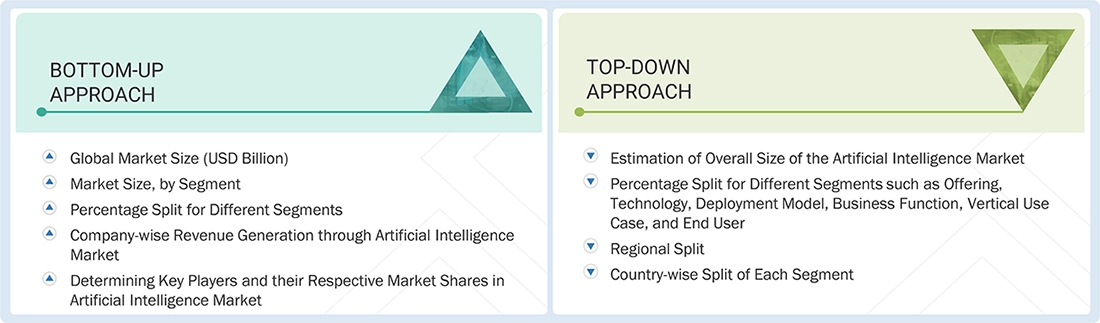
In the comprehensive market engineering process, the top-down and bottom-up approaches, along with several data triangulation methods, were extensively employed to perform market estimation and forecasting for the overall market segments and subsegments listed in this report. Extensive qualitative and quantitative analysis was performed on the complete market engineering process to record the critical information/insights throughout the report.
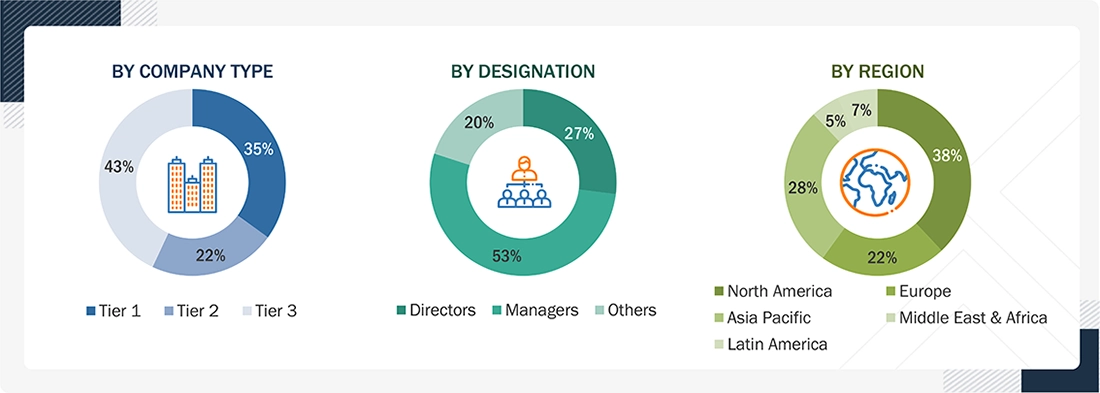
Note: Three tiers of companies are defined based on their total revenue for the year ended 31st December 2025; Tier 1 companies’ revenue is more than USD 1 billion; Tier 2 companies ‘revenue ranges between USD 1 billion and 500 million; and Tier 3 companies’ revenue ranges less than USD 500 million
Source: MarketsandMarkets Analysis
To know about the assumptions considered for the study, download the pdf brochure
Market Size Estimation
The top-down and bottom-up approaches were employed to estimate and forecast the artificial intelligence market, as well as its dependent submarkets. This multi-layered analysis was further reinforced through data triangulation, which incorporated primary and secondary research inputs. The market figures were also validated against the existing MarketsandMarkets repository for accuracy.
Artificial Intelligence (AI) Market : Top-Down and Bottom-Up Approach
Data Triangulation
The market was divided into several segments and subsegments after determining the overall market size using the market size estimation processes described above. To complete the overall market engineering process and determine the exact statistics for each market segment and subsegment, data triangulation and market segmentation procedures were employed, wherever applicable. The overall market size was then used in the top-down approach to estimate the size of other individual markets by applying percentage splits to the market segmentation.
Market Definition
Artificial Intelligence (AI) refers to the ecosystem of hardware, software, and services that enables machines, applications, and digital systems to sense, learn, reason, generate, predict, recommend, automate, and act on data with varying levels of human oversight. In market terms, AI includes the compute infrastructure required to train and run AI models, such as AI chips, memory, storage, and networking; software layers such as machine learning platforms, generative AI models, natural language processing systems, computer vision, speech and audio AI, AI orchestration, AI governance, and productivity tools; and services such as consulting, implementation, system integration, managed AI services, data labeling, annotation, and AI training.
Key Stakeholders
- AI software developers
- AI hardware providers
- AI-integrated service providers
- AI training dataset providers
- Core data service providers
- Business analysts
- Cloud service providers
- Consulting service providers
- Enterprise end users
- Distributors and Value-added Resellers (VARs)
- Government agencies
- Independent Software Vendors (ISV)
- Managed service providers
- Market research and consulting firms
- Support and maintenance service providers
- System Integrators (SIs)/migration service providers
- Language service providers
- Technology providers
- Academia and research institutions
- Investors and venture capital firms
- QA teams, DevOps teams, and engineering leaders
- System integrators (SIs) and digital engineering service providers
- Independent software vendors (ISVs)
- Test data management and synthetic data providers
- Test analytics and observability platform providers
- Channel partners, distributors, and value-added resellers (VARs)
- Consulting and advisory firms
- Government and regulatory bodies (quality, compliance, cybersecurity)
- Academia and research institutions (AI and software engineering)
- Investors and venture capital firms
Report Objectives
- To define, describe, and forecast the artificial intelligence market, by offering (hardware, software, and services), business function, technology, deployment model, vertical use cases, and end user
- To provide detailed information related to major factors (drivers, restraints, opportunities, and industry-specific challenges) influencing market growth
- To analyze the micro markets with respect to individual growth trends, prospects, and their contribution to the total market
- To analyze the opportunities in the market for stakeholders by identifying the high-growth segments of the artificial intelligence market
- To analyze opportunities in the market and provide details of the competitive landscape for stakeholders and market leaders
- To forecast the market size of segments for five main regions: North America, Europe, Asia Pacific, the Middle East & Africa, and Latin America
- To profile the key players and comprehensively analyze their market ranking and core competencies
- To analyze competitive developments, such as partnerships, product launches, mergers and acquisitions, in the artificial intelligence market
- To analyze the impact of various macroeconomic factors on the artificial intelligence market across all regions
Available customizations:
With the given market data, MarketsandMarkets offers customizations based on the company’s specific needs. The following customization options are available for the report.
Product Comparative Analysis
- Brand/product comparative analysis of additional vendors
Geographic analysis
- Further breakup of Canada by offering, technology, deployment model, business function, vertical use case, and end user
- Further breakup of Europe countries by offering, technology, deployment model, business function, vertical use case, and end user
- Further breakup of Asia Pacific countries by offering, technology, deployment model, business function, vertical use case, and end user
- Further breakup of Middle East & African countries by offering, technology, deployment model, business function, vertical use case, and end user
- Further breakup of Latin American countries by offering, technology, deployment model, business function, vertical use case, and end user
Company Information
- Detailed analysis and profiling of additional market players (up to five)
Get the Full Artificial Intelligence (AI) Market Report
Full forecast, segment splits, and company analysis for all Artificial Intelligence (AI) Market.
- Egypt Artificial Intelligence (AI) Market
- Brazil Artificial Intelligence (AI) Market
- Mexico Artificial Intelligence (AI) Market
- Argentina Artificial Intelligence (AI) Market
- Chile Artificial Intelligence (AI) Market
- US Artificial Intelligence (AI) Market
- Canada Artificial Intelligence (AI) Market
- Germany Artificial Intelligence (AI) Market
- FRANCE Artificial Intelligence (AI) Market
- ITALY Artificial Intelligence (AI) Market
- SPAIN Artificial Intelligence (AI) Market
- RUSSIA Artificial Intelligence (AI) Market
- CHINA Artificial Intelligence (AI) Market
- INDIA Artificial Intelligence (AI) Market
- JAPAN Artificial Intelligence (AI) Market
- SOUTH KOREA Artificial Intelligence (AI) Market
- Saudi Arabia Artificial Intelligence (AI) Market
- UAE Artificial Intelligence (AI) Market
- Qatar Artificial Intelligence (AI) Market
- South Africa Artificial Intelligence (AI) Market
- Turkey Artificial Intelligence (AI) Market
Need a Tailored Report?
Customize this report to your needs
Get 10% FREE Customization
Customize This Report
