
Europe Asphalt Additive Market (2025-2030)

The Europe Asphalt Additive Market was valued at $908 Million in 2025 and projected to reach to $1205 Million by 2030, representing a compound annual growth rate of 5.8%. Europe's asphalt additive market is positioned for steady growth driven by ongoing infrastructure modernization initiatives and stringent environmental regulations.


| Market Size in | USD 26.32 MN |
| Market Forecast in | |
| CAGR | |
| Forecast Period | |
| Units Considered | Value (USD MN) |
Europe Asphalt Additive Market Trends and Insights
- This steady expansion reflects Europe's ongoing investment in road infrastructure modernization and the continent's commitment to sustainable construction practices.
- Europe's market growth is driven by stringent environmental regulations, aging road networks requiring rehabilitation, and increased adoption of high-performance additives that enhance durability and reduce maintenance costs. The European asphalt additive sector benefits from advanced manufacturing capabilities and a mature construction industry across member states.
- Europe's focus on circular economy principles and recycled asphalt pavement (RAP) integration is reshaping additive demand, with polymeric and chemical additives gaining prominence.
- Between 2025 and 2030, Europe is expected to see accelerated adoption of warm-mix asphalt technologies and bio-based additives, positioning the region as a leader in sustainable road construction innovation..
Key Market Statistics
- CAGR (2025-2030) 5.8% CAGR
- Market Size, 2025 ~USD 908 Million
- Forecast, 2030 ~USD 1205 Million
- Geography Europe
Europe Asphalt Additive Market Overview
Infrastructure Investment Surge :
Europe's asphalt additive market benefits from substantial EU funding for road infrastructure modernization, with member states prioritizing highway maintenance and urban mobility projects through 2030.
Sustainability Regulations Drive Adoption :
Stringent European environmental standards and circular economy directives are accelerating demand for eco-friendly asphalt additives, including recycled asphalt pavement (RAP) and warm-mix technologies.
Germany Leads Market Dominance :
Germany commands the largest European market share at USD 325 million, driven by its robust construction sector, advanced infrastructure networks, and commitment to sustainable road solutions.
Steady Growth Trajectory :
Europe's market is projected to grow from USD 908 million in 2025 to USD 1,205 million by 2030 at a 5.8% CAGR, reflecting consistent infrastructure investment and regulatory compliance requirements.
Europe Asphalt Additive Market Dynamics
- The continent's commitment to sustainable construction practices and circular economy principles is reshaping product demand, with manufacturers increasingly focusing on eco-friendly formulations and recycled materials.
- Government investments in road maintenance and urban mobility projects across EU member states provide sustained market opportunities. The market's 5.8% CAGR reflects Europe's balanced approach between infrastructure development and environmental stewardship.
- Key growth drivers include adoption of warm-mix asphalt technologies, increased use of recycled asphalt pavement, and compliance with EU sustainability directives.
- Regional variations exist, with Western European markets showing stronger growth than Eastern European counterparts, though overall market expansion remains consistent through 2030..
Market Ecosystem
Related Ecosystem
Infrastructure Material
- Alumina Ceramics
- Ceramic Coatings
- Monolithic Ceramics
- Polyphenylene Sulfide (PPS)
- Titanate Ceramics
- Saint-gobain
- Simpson Manufacturing Co., Inc.
- DOW CHEMICAL COMPANY
- Basf se
- Sika ag
Speciality Chemicals
- Corrosion Inhibitors
- Polyetheretherketone (PEEK)
- Acrylonitrile Butadiene Styrene (ABS)
- Epoxy Resin
- Polycarbonate
- Basf se
- DOW CHEMICAL COMPANY
- Evonik industries ag
- Clariant ag.
- Solvay sa
Key Takeaways
- Europe's asphalt additive market will grow from USD 908.0M (2025) to USD 1,205.0M (2030) at a 5.8% CAGR.
- Stringent EU environmental regulations and circular economy mandates are driving demand for sustainable additive solutions across Europe.
- Europe is leading adoption of warm-mix asphalt and bio-based additives, differentiating the region from global markets.
- Aging road infrastructure across European member states creates sustained demand for high-performance additives through 2030.
Asphalt Additive Market Report Scope
| Report Metric | Details |
|---|---|
| Base Year | 2025 |
| Fastest Growing Segment | REJUVENATORS (Type) |
| Forecast Period | 2025–2030 |
| Growth Rate | CAGR of 7.4% from 2025 to 2030 |
| Largest Segment | ROAD CONSTRUCTION & PAVING (Application) |
| Market Size Base Year (Billions) | ~USD 4.62 (2025) |
| Revenue Forecast (Billions) | ~USD 6.6 (2030) |
| Segments Covered | Application, Type, Technology |
Europe Asphalt Additive Market Report Segmentation
3 segment dimensions are covered across the global market.
By Application
- Adhesives
- Airport Construction
- Metals
- Paints & Coatings
- Plastics & Composites
- Road Construction & Paving
- Road Construction And Paving
- Roofing
- Rubber
By Type
- Anti-Strip & Adhesion Promoters
- Anti-Strip And Adhesion Promoters
- Chemical Modifiers
- Chlorinated Polyolefins
- Colored Asphalt
- Emulsifiers
- Fibers
- Flux Oil
- Maleic Anhydride
- Polymeric Modifiers
- Rejuvenators
- Silane
- Titanate & Zirconate
By Technology
- Cold Mix
- Hot Mix
- Warm Mix
Target Audience
- Construction & Infrastructure Companies : European contractors and infrastructure developers need market intelligence to forecast asphalt additive demand, optimize procurement strategies, and align with sustainability requirements.
- Chemical Manufacturers & Suppliers : Asphalt additive producers require regional market data to assess competitive positioning, identify growth opportunities in high-performing markets like Germany, and develop compliant product portfolios.
- Government & Policy Makers : EU and national authorities use market insights to evaluate infrastructure investment effectiveness, understand industry trends, and develop regulations supporting sustainable construction practices.
- Investment & Private Equity Firms : Investors evaluating European construction chemical companies need market sizing, growth projections, and regional performance data to support M&A and portfolio decisions.
- Consulting & Engineering Firms : Professional services firms advising on infrastructure projects require detailed market analysis to support client recommendations on material selection, cost forecasting, and sustainability compliance.
Key Companies in the Europe Asphalt Additive Market
| Company | HQ | Ownership | Strongest segments |
|---|---|---|---|
| IMERYS SA | France | Public Company | Performance minerals (plastics, paints and coatings, ceramics, building products, filtration, life sciences),Refractory, foundry, abrasives, and building chemistry minerals,Graphite, carbon, and lithium-related minerals for energy transition and mobile energy, |
| GCP APPLIED TECHNOLOGIES INC | United States | Private Company | Waterproofing membranes and building envelope systems,Concrete admixtures and cement additives (including CO2ST Reducers),Specialty and industrial fireproofing solutions, |
| CRH PLC | Ireland | Public Company | Aggregates, asphalt, and paving services,Cementitious materials and ready mixed concrete,Precast and pre-stressed utility and infrastructure products, |
| KRATON CORPORATION | United States | Private Company | SBS and SIS performance polymers (paving, roofing, personal care),Hydrogenated SBCs, isoprene rubber, and isoprene latex (medical, hygiene, high-spec adhesives),Pine-based tackifiers and AMS/terpene resins (packaging, PSA, hygiene, bookbinding), |
| INGEVITY CORPORATION | United States | Public Company | Performance Materials (Activated Carbon for Emission Control and Purification),Performance Chemicals (Road Technologies and Industrial Specialties),Advanced Polymer Technologies (Caprolactone and Specialty Polymers), |
| THE DOW CHEMICAL COMPANY | United States | Private Company | Packaging & Specialty Plastics (ethylene, propylene, aromatics, polyethylene, elastomers, EVA, EPDM),Industrial Intermediates & Infrastructure (ethylene derivatives, cellulose ethers, acrylic emulsions),Performance Materials & Coatings (acrylics, additives, ingredients for paints, textiles, adhesives, HPC), |
| BASF SE | Germany | Public Company | Chemicals (Petrochemicals & Intermediates),Materials (Isocyanates, Polyamides, Inorganics, Plastics Specialties),Industrial Solutions (Dispersions, Resins, Additives, Catalysts, Electronic Materials), |
| HONEYWELL INTERNATIONAL INC | United States | Public Company | Industrial Automation,Building Automation,Energy and Sustainability Solutions (UOP and related), |
| HUNTSMAN CORPORATION | United States | Public Company | Polyurethanes,Performance Products,Advanced Materials, |
| EVONIK INDUSTRIES AG | Germany | Public Company | Advanced Technologies,Custom Solutions,Infrastructure, |
| KAO CORPORATION | Japan | Public Company | Hygiene & Living Care (fabric, kitchen, home, sanitary),Health & Beauty Care (facial, body, hair, oral, warming),Cosmetics & Counselling, |
| SINOPEC | China | Public Company | Refined petroleum products (gasoline, diesel, jet, other fuels),Petrochemicals and other chemical products,Crude oil and natural gas (exploration, production, trading), |
| TOTALENERGIES | France | Public Company | Exploration & Production (oil and natural gas),Integrated LNG, biogas, and gas trading,Integrated Power (generation, storage, B2B-B2C supply), |
IMERYS SA
IMERYS SA is a French public company founded in 1880 that employs 14,878 people. The company operates as a global leader in mineral-based specialty solutions.
GCP APPLIED TECHNOLOGIES INC
GCP APPLIED TECHNOLOGIES INC is a United States-based private company founded in 2015 with 1,800 employees. The company specializes in construction chemicals and building materials technology.
CRH PLC
CRH PLC is an Irish public company established in 1936 with 83,032 employees. The company is a leading global building materials and construction products manufacturer.
KRATON CORPORATION
KRATON CORPORATION is a United States-based private company founded in 2000 with 1,875 employees. The company specializes in polymer and chemical products for various industrial applications.
INGEVITY CORPORATION
INGEVITY CORPORATION is a United States public company founded in 1964 with 1,500 employees. The company produces specialty chemicals and high-performance materials for industrial markets.
THE DOW CHEMICAL COMPANY
THE DOW CHEMICAL COMPANY is a United States-based private company founded in 1897 with 34,600 employees. The company is a major global manufacturer of chemicals, plastics, and agricultural products.
BASF SE
BASF SE is a German public company founded in 1865 with 94,910 employees. The company is the world's largest chemical producer offering a diverse portfolio of products and solutions.
HONEYWELL INTERNATIONAL INC
HONEYWELL INTERNATIONAL INC is a United States public company founded in 1885 with 101,000 employees. The company is a diversified technology and manufacturing conglomerate serving multiple industries.
HUNTSMAN CORPORATION
HUNTSMAN CORPORATION is a United States public company founded in 1970 with 6,000 employees. The company manufactures specialty chemicals and materials for various industrial applications.
EVONIK INDUSTRIES AG
EVONIK INDUSTRIES AG is a German public company founded in 1847 with 30,643 employees. The company is a global specialty chemicals manufacturer serving diverse industrial sectors.
KAO CORPORATION
KAO CORPORATION is a Japanese public company founded in 1887 with 31,514 employees. The company manufactures consumer and specialty chemical products globally.
SINOPEC
SINOPEC is a Chinese public company founded in 2000 with 351,104 employees. The company is a major integrated energy and chemical corporation.
TOTALENERGIES
TOTALENERGIES is a French public company founded in 1924 with 94,847 employees. The company is a global integrated energy company engaged in oil, gas, and renewable energy.
Countries within Europe - compare and drill down
| Country | 2025 size (native) |
|---|---|
| Germany | USD 325 Million |
| UK | USD 215 Million |
| France | USD 183 Million |
| Italy | USD 150 Million |
| Russia | USD 72 Million |
| Spain | USD 52 Million |
| Rest Of Europe | USD 208 Million |
Country market size visualization
Reasons to Buy this Report
- Market Size & Growth Validation : Access precise market valuation data for Europe (USD 908M in 2025) with detailed 5-year forecasts to validate business strategies and investment decisions in the region.
- Country-Level Competitive Intelligence : Analyze market performance across major European economies including Germany (USD 325M), UK (USD 215M), and France (USD 183M) to identify high-opportunity markets and competitive positioning.
- Regulatory & Sustainability Insights : Understand how European environmental regulations and circular economy directives shape product demand, enabling compliant product development and market entry strategies.
- Infrastructure Investment Tracking : Monitor EU-funded infrastructure projects and government spending patterns driving asphalt additive consumption across member states through 2030.
- Strategic Market Segmentation : Leverage detailed European market breakdown to identify emerging segments, technology trends, and regional growth disparities for targeted expansion planning.
Frequently asked questions
What is the current size of Europe's asphalt additive market?
Europe's asphalt additive market is valued at USD 908.0 million in 2025 and is expected to reach USD 1,205.0 million by 2030.
What is the projected growth rate for Europe's asphalt additive market?
Europe's asphalt additive market is projected to grow at a compound annual growth rate (CAGR) of 5.8% from 2025 to 2030.
What are the main drivers of growth in Europe's asphalt additive market?
Key growth drivers in Europe include stringent environmental regulations, aging road infrastructure requiring rehabilitation, increased adoption of sustainable additives, and the circular economy focus on recycled asphalt pavement integration.
Which additive types are gaining prominence in Europe?
Polymeric additives, chemical additives, warm-mix asphalt technologies, and bio-based additives are gaining significant prominence across Europe's market.
How does Europe's market compare to global asphalt additive trends?
Europe's 5.8% CAGR is slightly lower than the global 7.4% CAGR, but Europe leads in sustainable and bio-based additive adoption, reflecting stricter environmental standards and circular economy commitments.
RESEARCH METHODOLOGY
The research involved four main steps to assess the current market size of asphalt additives. Extensive secondary research was conducted to collect information on the market, peer markets, and parent markets. The next step was to validate these findings, assumptions, and figures with industry experts across the asphalt additive value chain through primary research. The overall market size was determined using both top-down and bottom-up approaches. Finally, market segmentation analysis and data triangulation were used to define the sizes of market segments and subsegments.
Secondary Research
The research approach used to assess and project the market starts with collecting revenue data from leading suppliers through secondary research. During this process, many secondary sources, such as Hoovers, Bloomberg BusinessWeek, Factiva, the World Bank, and industry magazines, were used to gather information for this study. These sources included annual reports, press releases, and investor presentations from companies, white papers, reputable periodicals, writings by respected authors, announcements from regulatory agencies, trade directories, and databases. Vendor offerings have been examined to determine the market segmentation.
Primary Research
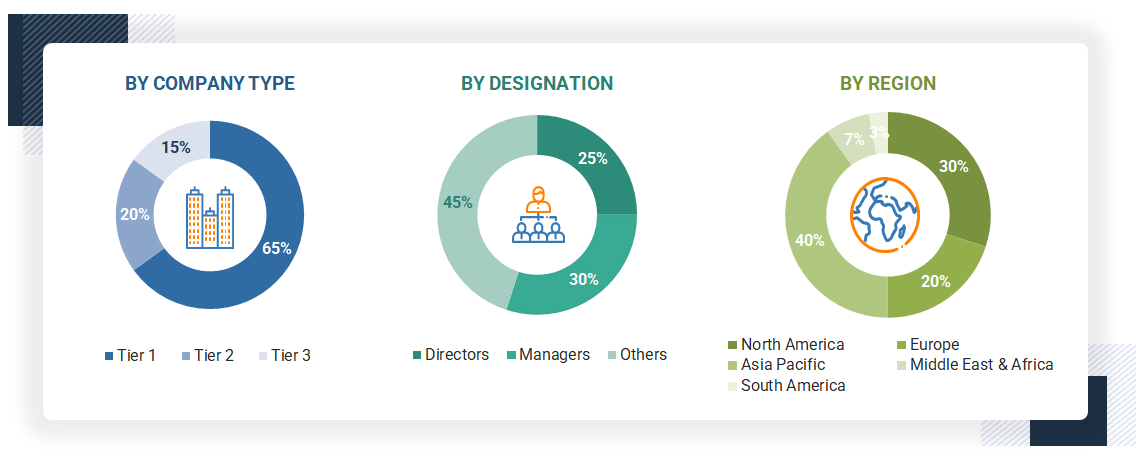
The asphalt additive market includes several stakeholders such as manufacturers, suppliers, traders, associations, and regulatory organizations within the supply chain. The demand side is driven by the growth of various industries, including road construction and paving, roofing, airport construction, and others. On the supply side, technological advancements are prominent. Interviews with various primary sources from both the supply and demand sides provided qualitative and quantitative information.
The following details the breakdown of the primary respondents.
To know about the assumptions considered for the study, download the pdf brochure
Market Size Estimation
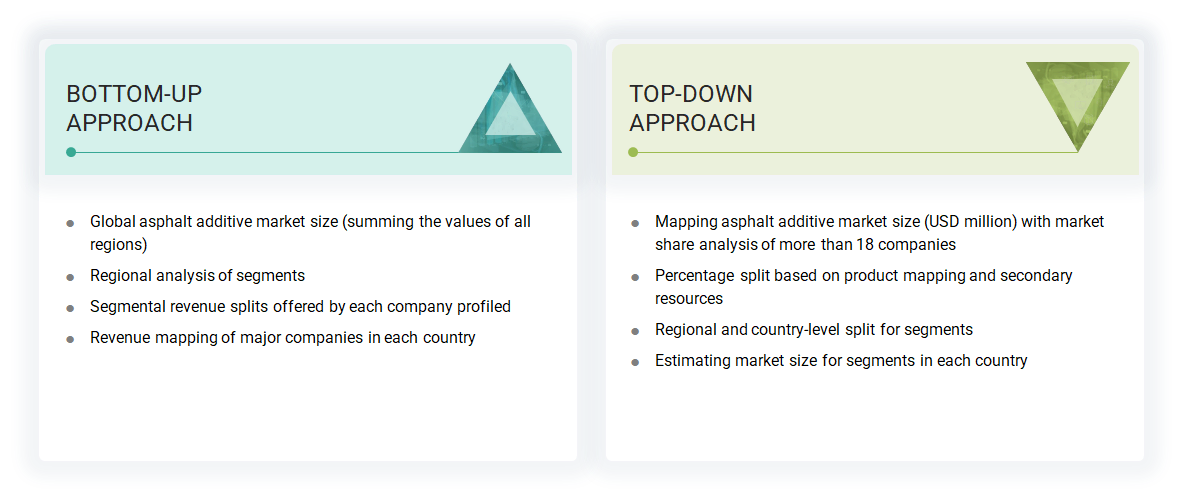
Both the top-down and bottom-up approaches were used to estimate and validate the total size of the asphalt additive market. These methods were also used extensively to determine the size of various subsegments in the market. The research methodology used to estimate the market size included the following:
- The key players were identified through extensive primary and secondary research.
- The value chain and market size of the asphalt additive market, in terms of value and volume, were determined through primary and secondary research.
- All percentage shares, splits, and breakdowns were determined using secondary sources and verified through primary sources.
- All possible parameters that affect the market covered in this research study were accounted for, viewed in extensive detail, verified through primary research, and analyzed to obtain the final quantitative and qualitative data.
- The research included the study of reports, reviews, and newsletters of top market players, along with extensive interviews for opinions from key leaders, such as CEOs, directors, and marketing executives.
Global Asphalt Additive Market Size: Bottom-up and Top-down Approach
Data Triangulation
After arriving at the overall market size using the market size estimation processes as explained above, the market was split into several segments and subsegments. To complete the overall market engineering process and arrive at the exact statistics of each market segment and subsegment, data triangulation and market breakdown procedures were employed, wherever applicable. The market size was calculated globally by summing up the country-level and regional-level data.
Market Definition
Asphalt additives are substances added to the asphalt binder to enhance its properties, such as resistance to rutting, thermal cracking, and stripping caused by moisture. Asphalt pavements tend to become stiff and brittle in regions with high temperatures, while cracks tend to form in areas with low ambient temperatures. These additives also help improve the binding properties of asphalt, strengthening the bond between the aggregate and other components asphalt.
Stakeholders
- Asphalt Additive Manufacturers
- Asphalt Additive Suppliers
- Asphalt Additive Traders, Distributors, and Suppliers
- Investment Banks and Private Equity Firms
- Raw Material Suppliers
- Government and Research Organizations
- Consulting Companies/Consultants in the Chemicals and Materials Sectors
- Industry Associations
- Contract Manufacturing Organizations (CMOs)
- NGOs, Governments, Investment Banks, Venture Capitalists, and Private Equity Firms
Report Objectives
- To define, describe, and forecast the size of the global asphalt additive market in terms of volume and value
- To provide detailed information regarding the key drivers, restraints, opportunities, and challenges influencing the growth of the global asphalt additive market
- To analyze and forecast the size of various segments of the asphalt additive market based on five major regions—North America, Asia Pacific, Europe, South America, and Middle East & Africa, along with their key countries
- To analyze recent developments and competitive strategies, such as acquisitions, agreements, partnerships, collaborations, product launches, and others, to draw the competitive landscape of the market
- To strategically profile the key players in the market and comprehensively analyze their core competencies
Get the Full Asphalt Additive Market Report
Full forecast, segment splits, and company analysis for all Asphalt Additive Market.
- Canada Asphalt Additive Market
- Mexico Asphalt Additive Market
- US Asphalt Additive Market
- France Asphalt Additive Market
- Germany Asphalt Additive Market
- Italy Asphalt Additive Market
- Russia Asphalt Additive Market
- Spain Asphalt Additive Market
- UK Asphalt Additive Market
- Australia Asphalt Additive Market
- China Asphalt Additive Market
- India Asphalt Additive Market
- Indonesia Asphalt Additive Market
- Japan Asphalt Additive Market
- Malaysia Asphalt Additive Market
- South Korea Asphalt Additive Market
- Egypt Asphalt Additive Market
- Saudi Arabia Asphalt Additive Market
- UAE Asphalt Additive Market
- Argentina Asphalt Additive Market
- Brazil Asphalt Additive Market
- Colombia Asphalt Additive Market
- Rest Of Europe Asphalt Additive Market
- Rest Of Asia Pacific Asphalt Additive Market
- Rest Of South America Asphalt Additive Market
Need a Tailored Report?
Customize this report to your needs
Get 10% FREE Customization
Customize This Report
