
Asia Pacific Battery Passport Market (2025-2030)

The Asia Pacific Battery Passport Market was valued at $151.9 Million in 2025 and projected to reach to $277.2 Million by 2030, representing a compound annual growth rate of 32.7%. Asia Pacific is positioned as the fastest-growing battery passport market globally, with a 32.7% CAGR significantly outpacing the global average of 32.1%.


| Market Size in | USD 26.32 MN |
| Market Forecast in | |
| CAGR | |
| Forecast Period | |
| Units Considered | Value (USD MN) |
Asia Pacific Battery Passport Market Trends and Insights
- In 2025, Asia Pacific's battery passport market is estimated at $151.9 million, reflecting strong regional momentum driven by regulatory mandates and EV proliferation across major economies.
- By 2030, Asia Pacific is forecast to reach $277.2 million, representing accelerated market maturation as supply chain transparency and circular economy initiatives gain traction throughout the region. The Asia Pacific battery passport market is experiencing robust growth fueled by stringent environmental regulations, particularly in the European Union's supply chain due diligence requirements affecting regional exporters.
- Asia Pacific stakeholders—including battery manufacturers, OEMs, and logistics providers—are increasingly investing in digital traceability solutions to comply with emerging standards and enhance sustainability credentials.
- This regional expansion reflects Asia Pacific's pivotal role in global EV battery production and the region's commitment to responsible sourcing and end-of-life battery management through 2030..
Key Market Statistics
- CAGR (2025-2030) 32.7% CAGR
- Market Size, 2025 ~USD 151.9 Million
- Forecast, 2030 ~USD 277.2 Million
- Geography Asia Pacific
Asia Pacific Battery Passport Market Overview
Rapid Market Expansion :
Asia Pacific battery passport market is projected to grow from $151.9 million in 2025 to $277.2 million by 2030, driven by aggressive EV adoption and stringent regulatory frameworks across China, India, and Southeast Asia.
Regulatory Momentum :
China's battery traceability requirements and India's emerging EV regulations are accelerating battery passport implementation, positioning Asia Pacific as a regulatory leader in automotive sustainability standards.
EV Market Proliferation :
Asia Pacific accounts for over 60% of global EV sales, creating unprecedented demand for battery authentication, lifecycle tracking, and circular economy solutions through digital passport technologies.
Supply Chain Integration :
Major battery manufacturers and OEMs in South Korea, Japan, and China are investing heavily in passport infrastructure to ensure supply chain transparency and compliance with international sustainability mandates.
Asia Pacific Battery Passport Market Dynamics
- The region's dominance is fueled by China's leadership in EV manufacturing, India's rapid electrification initiatives, and regulatory pressures from the EU and domestic governments demanding battery traceability and circular economy compliance. By 2030, Asia Pacific's market will nearly double to $277.2 million as battery passport adoption becomes mandatory across major economies.
- Investment in digital infrastructure, blockchain integration, and standardized authentication protocols will drive market maturation.
- Strategic partnerships between automotive OEMs, battery manufacturers, and technology providers will accelerate implementation, making Asia Pacific the global benchmark for battery lifecycle management and sustainability..
Market Ecosystem
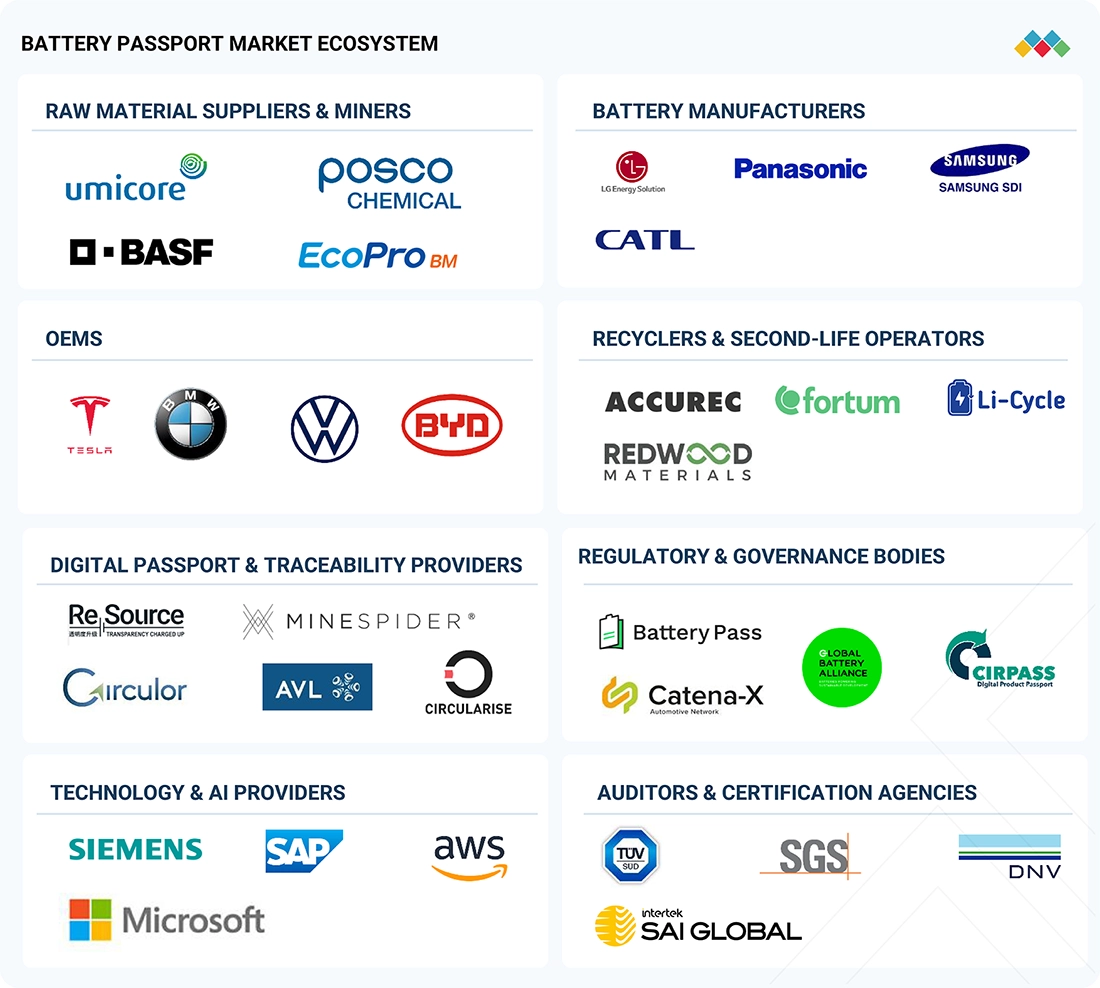
BATTERY PASSPORT MARKET SIZE, SHARE & ANALYSIS: COMMERCIAL USE CASES ACROSS INDUSTRIES
| COMPANY | USE CASE DESCRIPTION | BENEFITS |
|---|---|---|
 |
Implements battery passports for EV models with QR-linked lifecycle data covering chemistry, carbon footprint, sourcing, and in-use parameters | Lower compliance exposure, stronger asset valuation and clearer sustainability reporting |
 |
Applies digital passports with blockchain-backed material tracing for lithium, nickel, and cobalt across supplier tiers | Higher sourcing assurance, faster audit cycles and improved ESG validation |
 |
Runs integrated traceability systems capturing material origin, production steps, carbon intensity, and recycling inputs for passport fields | Reliable upstream data, improved lifecycle oversight and stronger circular supply-chain control |
 |
Supplies recycled-content and recovery-rate data aligned to passport reporting formats for OEMs | Verified recycled input, easier OEM compliance preparation and stronger circularity metrics |
 |
Configures data export and lifecycle telemetry pathways to support passport obligations for battery modules delivered into EU market | Streamlined conformity readiness, better lifecycle analytics and improved recycling coordination |
Logos and trademarks shown above are the property of their respective owners. Their use here is for informational and illustrative purposes only.
Related Ecosystem
Automotive Advance Technologies
- Battery Electric Vehicle (BEV)
- Light Commercial Vehicles (LCVs)
- Fuel Cell Electric Vehicle (FCEV)
- Hybrid Electric Vehicle (HEV)
- Internal Combustion Engine (ICE)
- BOSCH LIMITED
- Continental ag
- Visteon Corporation
- DENSO Corporation
- ZF FRIEDRICHSHAFEN AG
Key Takeaways
- Asia Pacific battery passport market valued at $151.9M in 2025, growing to $277.2M by 2030 at 32.7% CAGR
- Asia Pacific regulatory frameworks and EU compliance requirements are primary drivers of battery passport adoption across the region
- Asia Pacific's dominance in global battery manufacturing positions the region as essential to worldwide supply chain transparency initiatives
- Asia Pacific stakeholders are investing in digital traceability and circular economy solutions to meet sustainability and compliance standards
Battery Passport Market Report Scope
| Report Metric | Details |
|---|---|
| Base Year | 2025 |
| Fastest Growing Segment | SODIUM-ION (Battery Type) |
| Forecast Period | 2025–2030 |
| Growth Rate | CAGR of 32.1% from 2025 to 2030 |
| Largest Segment | LITHIUM-ION (Battery Type) |
| Market Size Base Year (Billions) | ~USD 0.15 (2025) |
| Revenue Forecast (Billions) | ~USD 0.58 (2030) |
| Segments Covered | Battery Type, Technology, Industry |
Asia Pacific Battery Passport Market Report Segmentation
3 segment dimensions are covered across the global market.
By Battery Type
- Lead-Acid
- Lithium-Ion
- Other Batteries
- Sodium-Ion
By Technology
- Blockchain-Based
- Cloud-Based
- IoT & AI–Integrated
- Other Technologies
By Industry
- Automotive
- Energy & Utility
- Off-Highway /Industrial
- Off-Highway/ Industrial
- Off-Highway/Industrial
- Other Industries
Target Audience
- Automotive OEMs & Tier-1 Suppliers : Need Asia Pacific-specific battery passport compliance roadmaps, regulatory requirements, and implementation timelines to ensure supply chain readiness and meet regional sustainability mandates by 2025-2027.
- Battery Manufacturers & Recyclers : Require detailed market forecasts and competitive intelligence for Asia Pacific to optimize battery traceability systems, circular economy investments, and compliance with emerging regional regulations.
- Technology & Software Providers : Seek Asia Pacific market sizing, adoption rates, and technology preferences to develop localized battery passport solutions, blockchain platforms, and digital infrastructure aligned with regional standards.
- Investment & Private Equity Firms : Need comprehensive Asia Pacific market analysis, growth projections, and competitive landscape data to identify acquisition targets, portfolio companies, and high-ROI investment opportunities in the battery passport sector.
- Government & Regulatory Bodies : Require market intelligence on battery passport adoption rates, implementation challenges, and best practices across Asia Pacific to inform policy development and standardization initiatives.
Key Companies in the Asia Pacific Battery Passport Market
| Company | HQ | Ownership | Strongest segments |
|---|---|---|---|
| SIEMENS | Germany | Public Company | Automotive – EV and battery manufacturing (Lithium-ion focused),Energy & Utility – stationary storage and grid integration,Off-Highway/Industrial equipment, |
| DENSO CORPORATION | Japan | Public Company | Automotive – Lithium-ion battery passport enablement,Automotive – Lead-acid and 12V traceability,Energy & Utility – stationary storage, |
| PERFICIENT INC | United States | Private Company | Consulting and Strategy (Regulatory, Data, ESG for Battery Passports),Systems Integration and Custom Application Development,Cloud and Data Platforms (Analytics, AI/ML, Data Lakes), |
| TATA ELXSI | India | Public Company | Automotive – Lithium-ion focused passport and lifecycle platforms,Energy & Utility – Stationary storage traceability and compliance,Off-Highway/Industrial – Fleet and equipment battery intelligence, |
| VOLVO CARS | Sweden | Public Company | Automotive – Lithium-ion BEV and PHEV passports,Automotive – ICE and mild hybrid compliance data backbone,Cloud-based battery data platforms and APIs, |
SIEMENS
Siemens is a German multinational public company founded in 1847 with 310,312 employees, operating as a global leader in industrial technology, infrastructure, and digitalization.
DENSO CORPORATION
Denso Corporation is a Japanese public company founded in 1949 with 154,716 employees, operating as a leading global supplier of automotive components and systems.
PERFICIENT INC
Perficient Inc is a United States-based private company founded in 1998 with 6,547 employees providing digital transformation and management consulting services.
TATA ELXSI
Tata Elxsi is an Indian public company founded in 1989 with 11,046 employees providing design, engineering, and technology services across multiple industries.
VOLVO CARS
Volvo Cars is a Swedish public company founded in 1927 with 39,800 employees, operating as a premium automotive manufacturer known for safety and innovation.
Countries within Asia Pacific - compare and drill down
| Country | 2025 size (native) |
|---|
Country market size visualization
Reasons to Buy this Report
- Regional Market Sizing & Forecasts : Obtain precise market valuations for Asia Pacific ($151.9M in 2025, $277.2M in 2030) with granular breakdowns by country, enabling accurate investment planning and competitive positioning in the region's fastest-growing automotive segment.
- Regulatory Landscape Intelligence : Understand country-specific battery passport mandates across China, India, Japan, and Southeast Asia, including compliance timelines and implementation requirements critical for market entry and product development strategies.
- Competitive Dynamics & Market Share : Identify leading battery passport solution providers, OEM partnerships, and emerging players in Asia Pacific, with detailed competitive analysis to inform M&A decisions and strategic alliances in the region.
- Technology & Implementation Trends : Access insights on blockchain adoption, digital infrastructure investments, and standardization efforts specific to Asia Pacific, guiding technology selection and go-to-market strategies for solution providers.
- Investment & Growth Opportunities : Discover high-potential market segments, emerging economies, and value chain opportunities across Asia Pacific's battery passport ecosystem, supporting venture capital and corporate investment decisions.
Frequently asked questions
What is the current size of the Asia Pacific battery passport market?
In 2025, Asia Pacific's battery passport market is estimated at $151.9 million, reflecting significant regional adoption of digital battery tracking and traceability solutions.
What is the projected market size for Asia Pacific by 2030?
Asia Pacific's battery passport market is forecast to reach $277.2 million by 2030, representing an 83% increase from 2025 levels.
What is driving growth in the Asia Pacific battery passport market?
Asia Pacific market growth is driven by regulatory compliance requirements, EV proliferation, supply chain transparency mandates, and circular economy initiatives across the region.
Which countries in Asia Pacific are leading battery passport adoption?
Asia Pacific's leading markets include China, South Korea, Japan, and India, where battery manufacturing capacity and EV adoption rates are highest in the region.
How does Asia Pacific's growth rate compare to global trends?
Asia Pacific's 32.7% CAGR slightly exceeds the global 32.1% CAGR, reflecting the region's accelerated regulatory adoption and manufacturing leadership.
RESEARCH METHODOLOGY
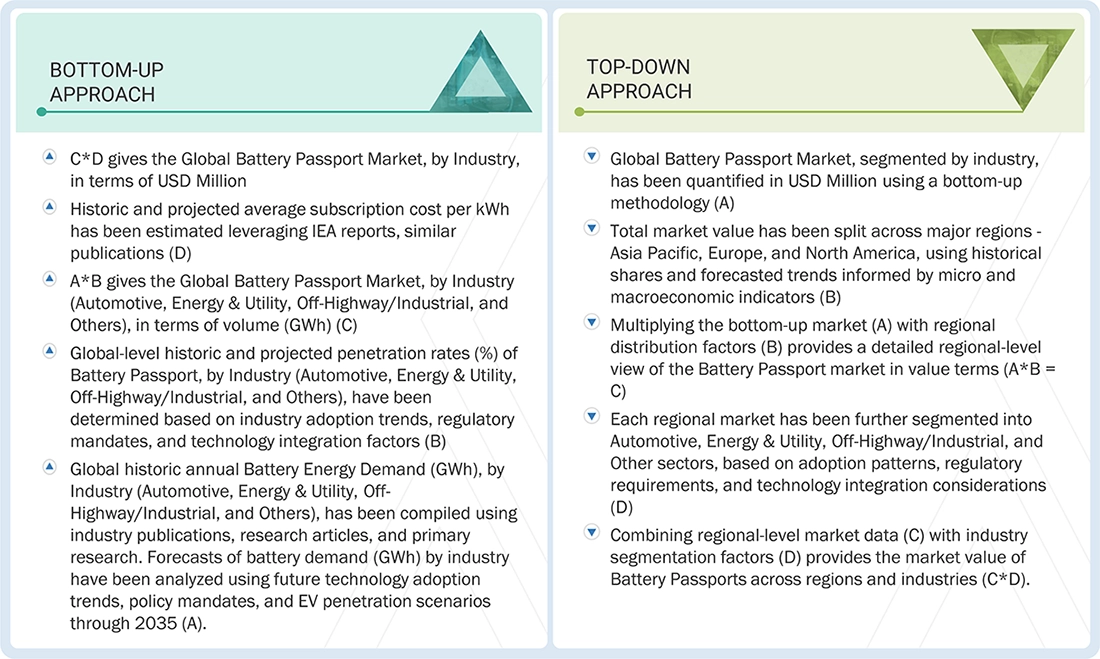
The study involved four major activities in estimating the current size of the battery passport market. Exhaustive secondary research was conducted to gather information on the market, its peer market, and the parent market. The next step was to validate these findings, assumptions, and sizing with the industry experts across value chains through primary research. The bottom-up and top-down approaches were employed to estimate the complete market size. Thereafter, market breakdown and data triangulation processes were used to estimate the market size of segments and subsegments.
Secondary Research
The battery passport market is directly dependent on vehicle production. Battery passport sales/registration volume was derived through secondary sources, including corporate filings (such as annual reports, investor presentations, and financial statements), paid repositories, relevant associations (like IEA, Avicenne Energy), and industry production statistics. The EU’s plans regarding the adoption of battery passport data were compiled and analyzed, and industry trends were considered to inform the forecast, which was subsequently validated through primary research.
Primary Research
In the primary research process, various primary sources from both the supply and demand sides were interviewed to obtain qualitative and quantitative information on the market. Primary sources from the supply side included industry experts, such as CXOs, vice presidents, directors from business development, marketing, and product development/innovation teams, and related key executives from key companies. Various system integrators, industry associations, independent consultants/industry veterans, as well as key opinion leaders, were also interviewed.
Primary interviews were conducted to gather insights in the battery passport market, including battery passport sales and registrations, market forecasts, future technology trends, and upcoming technologies in the industry. Data triangulation was carried out using the information gathered from secondary research and model mapping to triangulate all these points. Stakeholders from the demand and supply sides were interviewed to understand their views on the aforementioned points.
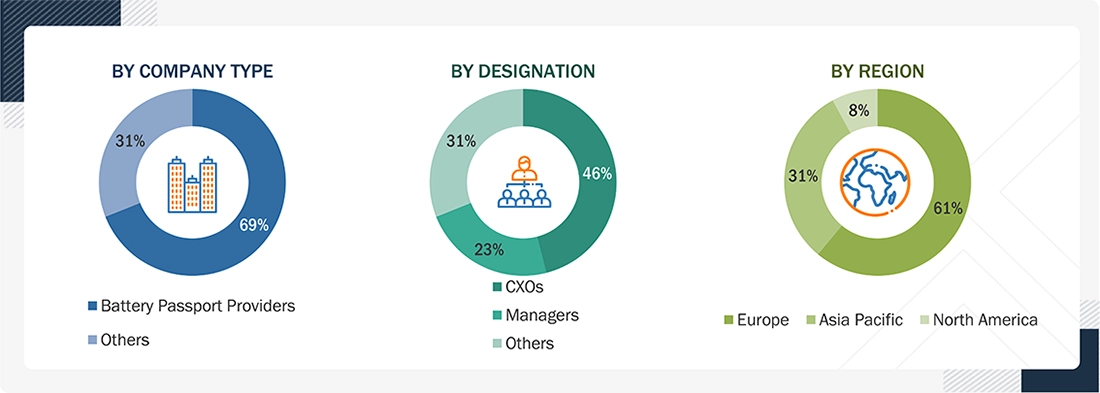
Primary interviews were conducted with market experts from both the demand (battery passport manufacturers) and supply (OEMs, battery swapping service providers, etc.) sides across three major regions: North America, Europe, and Asia Pacific. Approximately 69% and 31% of primary interviews were conducted with battery passport service providers and others, respectively. Primary data was collected through questionnaires, emails, and telephonic interviews. During the canvassing of primaries, various departments within organizations, including sales, marketing, operations, R&D, and aftermarket, were covered to provide a holistic perspective in the report.
After interacting with industry experts, brief sessions were conducted with highly experienced independent consultants to reinforce the findings from primaries. This, along with the in-house subject matter expert opinions, led to the findings as described in the remainder of this report.
To know about the assumptions considered for the study, download the pdf brochure
Market Size Estimation
A detailed market estimation approach was followed to estimate and validate the value of the battery passport market and other dependent submarkets, as mentioned below:
- Key players in the market were identified through secondary research, and their global market shares were determined through a combination of primary and secondary research.
- The research methodology included a study of annual and quarterly financial reports and regulatory filings of major market players (public), as well as interviews with industry experts for detailed market insights.
- All industry-level penetration rates, percentage shares, splits, and breakdowns for the market were determined using secondary sources and verified through primary sources.
- All key macro indicators affecting the revenue growth of the market segments and subsegments were accounted for, viewed in extensive detail, verified through primary research, and analyzed to obtain validated and verified quantitative and qualitative data.
- The gathered market data was consolidated and added with detailed inputs, analyzed, and presented in this report.
- Qualitative aspects, including market drivers, restraints, opportunities, and challenges, were taken into consideration when calculating and forecasting the market size.
Battery Passport Market : Top-Down and Bottom-Up Approach
Data Triangulation
After determining the overall market size using the market size estimation processes explained above, the market was divided into several segments and subsegments. To complete the overall market engineering process and arrive at the exact statistics of each market segment and subsegment, data triangulation and market breakdown procedures were employed, wherever applicable. The data was triangulated by studying various factors and trends from both the demand and supply sides.
Market Definition
The backscatter X-ray devices market involves the development of non-intrusive inspection systems that use low-energy X-rays to detect concealed threats in vehicles, cargo, baggage, and on-person scenarios. These systems provide real-time imaging, which is crucial for border security and law enforcement, enabling the identification of substances such as explosives and narcotics. Backscatter technologies utilize advanced detector arrays, X-ray modules, and automated algorithms for efficient screening, which are deployed at customs, airports, and military bases. The market growth is driven by rising cross-border trade, increasing smuggling, and stricter security regulations. Innovations such as AI-assisted image analysis and portable units enhance detection and operational efficiency, making backscatter X-ray devices essential for reliable security inspections worldwide.
Key Stakeholders
- Global battery passport companies
- Battery manufacturers
- EV manufacturers
- Battery recyclers
- Energy storage system integrators
- Utility operators
- Fleet operators
- Battery technology providers
Report Objectives
-
To define, describe, segment, and forecast the size of the battery passport market in terms of value (USD million) based on
- Industry (automotive, energy & utility, off-highway/industrial, other industries)
- Battery type (lithium-ion, lead-acid, sodium-ion, other batteries)
- Technology (blockchain-based battery passport, cloud-based battery passport, IoT & AI-integrated battery passport, other technologies)
- Region (Asia Pacific, Europe, North America)
- To analyze the market qualitatively based on compliance (EU Battery Regulation-compliant batteries, batteries under pilot schemes, non-compliant/legacy batteries), end user (compliance end users, operational end users), and business model (software-as-a-service platform, white-label solution, on-demand deployment, subscription, licensing, pay-per-use)
- To identify and analyze key drivers, restraints, opportunities, and challenges influencing market growth
- To strategically analyze the market, including macroeconomic outlook, trends/disruptions impacting buyers, case studies, patent analysis, supply chain analysis, market ecosystem, regulatory analysis, impact of AI/Gen AI, brand comparison, and technology trends
- To understand the competition in the market and position players as stars, emerging leaders, pervasive players, and participants based on their product portfolios and business strategies
- To analyze the ranking of leading market players and evaluate the competitive leadership mapping
- To strategically analyze key player strategies/right to win and company revenues
- To analyze the opportunities in the market for stakeholders and provide details of the competitive landscape for market leaders
- To provide an analysis of recent developments, such as joint ventures, mergers & acquisitions, product launches/developments, and other activities carried out by key market players
Customization Options:
With the given market data, MarketsandMarkets offers customizations tailored to the company’s specific needs.
- Battery Passport Market, By Battery Type, at Country Level (For Countries Covered in Report)
- Battery Passport Market, By Industry, at Country Level (For Countries Covered in Report)
Company Information
- Profiling of Up to Five Additional Market Players
Get the Full Battery Passport Market Report
Full forecast, segment splits, and company analysis for all Battery Passport Market.
Need a Tailored Report?
Customize this report to your needs
Get 10% FREE Customization
Customize This Report
