
US Battery Energy Storage System (BESS) TIC Market (2026-2031)

The US Battery Energy Storage System (BESS) TIC Market was valued at $161.7 Million in 2026 and projected to reach to $265.3 Million by 2031, representing a compound annual growth rate of 8.6%. The US BESS TIC market is poised for steady expansion through 2031, driven by the nation's aggressive renewable energy adoption and grid modernization initiatives.


| Market Size in | USD 26.32 MN |
| Market Forecast in | |
| CAGR | |
| Forecast Period | |
| Units Considered | Value (USD MN) |
US Battery Energy Storage System (BESS) TIC Market Trends and Insights
- The US market is driven by increasing regulatory requirements for energy storage safety and performance validation, coupled with the nation's accelerating transition toward renewable energy infrastructure.
- As the US grid modernization accelerates, demand for third-party BESS certification services continues to rise across utility-scale, commercial, and residential segments. The US BESS TIC market benefits from stringent compliance frameworks and the growing adoption of distributed energy resources.
- Throughout the 2026-2031 forecast period, the US is expected to see heightened investment in battery testing facilities and certification protocols to meet evolving federal and state standards.
- The US market's 8.6% compound annual growth rate reflects both technological maturation and the critical role of independent verification in building stakeholder confidence in energy storage deployments..
Key Market Statistics
- CAGR (2026-2031) 8.6% CAGR
- Market Size, 2026 ~USD 161.7 Million
- Forecast, 2031 ~USD 265.3 Million
- Country US
US Battery Energy Storage System (BESS) TIC Market Overview
Market Valuation Growth :
The US BESS TIC market is valued at $161.7 million in 2026 and is projected to reach $265.3 million by 2031, representing a robust 8.6% CAGR over the forecast period.
Regulatory Compliance Drivers :
Stringent US regulatory requirements for energy storage safety and performance validation are accelerating demand for third-party testing, inspection, and certification services across utility-scale and distributed storage systems.
Renewable Energy Transition :
The US government's commitment to clean energy targets and state-level renewable portfolio standards are driving massive investments in battery storage infrastructure, creating sustained demand for TIC services.
Market Maturation :
As the US BESS market matures, standardization of testing protocols and certification frameworks is becoming critical, positioning TIC providers as essential partners for manufacturers and project developers.
US Battery Energy Storage System (BESS) TIC Market Dynamics
- Federal incentives, including the Inflation Reduction Act, are catalyzing significant investments in energy storage capacity, necessitating comprehensive testing and certification to ensure safety, reliability, and grid compatibility.
- Regulatory bodies continue to strengthen performance standards, creating sustained demand for independent TIC services. Key growth opportunities exist in utility-scale battery systems, behind-the-meter storage solutions, and emerging technologies like long-duration energy storage.
- The market will benefit from increasing manufacturer compliance requirements, insurance mandates, and interconnection standards.
- As competition intensifies among TIC providers, differentiation through specialized expertise in battery chemistry, thermal management, and grid integration will become increasingly valuable for capturing market share in this expanding sector..
Market Ecosystem
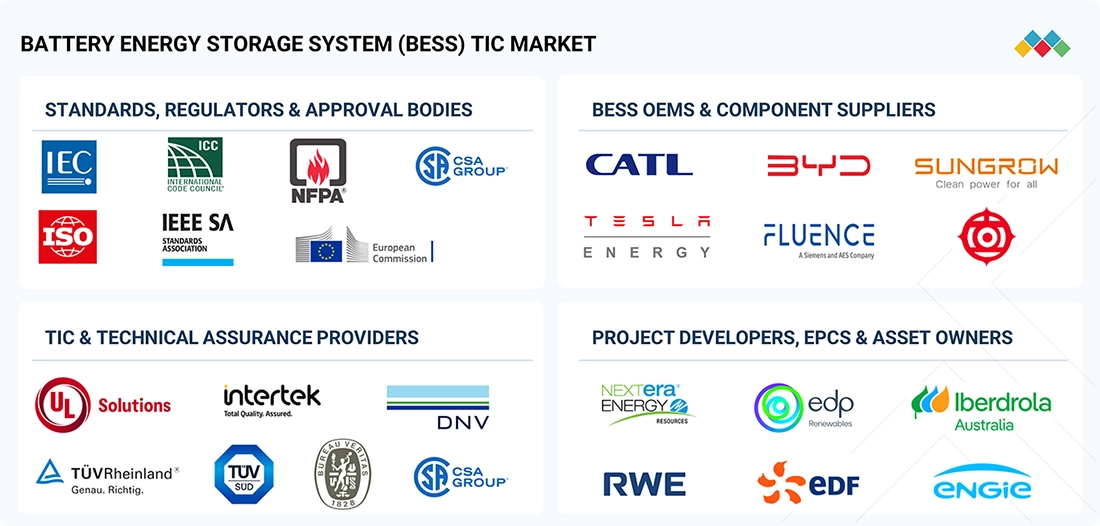
BESS TIC MARKET: COMMERCIAL USE CASES ACROSS INDUSTRIES
| COMPANY | USE CASE DESCRIPTION | BENEFITS |
|---|---|---|
 |
Supports BESS OEMs, integrators, and project developers with ESS safety certification, UL 9540A thermal-runaway testing, and large-scale fire-testing support. The work evaluates fire-propagation behavior, system safety, and the suitability of the installed BESS configuration for approval discussions. | Provides stronger evidence for fire authorities, insurers, and project owners; supports safer site design, lower approval risk, and smoother project commissioning. |
 |
Provides UL 9540 product certification and UL 9540A testing across cell, module, and unit levels for BESS manufacturers and system integrators. Services support design validation, thermal-runaway risk assessment, and safety documentation for stationary storage products. | Improves product-market readiness, identifies safety issues earlier in development, and helps manufacturers build compliant evidence packages for North American deployment. |
 |
Delivers stationary ESS testing and certification covering document review, standards-based testing, factory inspection, test reporting, and certification. Its BESS work can also support grid integration assessment, product qualification, and supplier quality verification across global markets. | Supports international market access, improves supplier and manufacturing quality visibility, and provides structured compliance documentation for project approvals and grid connection. |
 |
Provides ESS safety, performance, and certification services for battery systems and stationary storage projects. Its offerings can include battery and system testing, UL 9540A evaluation, IEC-based assessment, design document review, pre-commissioning inspection, and periodic operational inspection. | Helps BESS stakeholders validate safety and reliability across project stages, accelerate market entry, and strengthen compliance during installation and long-term operation. |
 |
Provides standards-based evaluation, testing, and certification for battery and energy storage products, including large-scale fire testing procedures and North American compliance support. Services are relevant for BESS components, integrated storage systems, and safety-critical project configurations. | Strengthens product acceptance in North American markets, supports fire-safety evidence requirements, and improves confidence among OEMs, integrators, authorities, and project owners. |
Logos and trademarks shown above are the property of their respective owners. Their use here is for informational and illustrative purposes only.
Related Ecosystem
Testing Inspection And Certification
- Eddy Current Testing (ECT)
- Safety Testing
- Signal Generators
- Acoustic Emission Testing (AET)
- Automated Test Equipment
- Sgs s.a.
- Intertek Group plc
- Bureau veritas s.a.
- TUV RHEINLAND AG
- EUROFINS SCIENTIFIC SE
Key Takeaways
- The US BESS TIC market is valued at $161.7 million in 2026 and will reach $265.3 million by 2031, representing an 8.6% CAGR.
- Regulatory compliance and safety standards are primary drivers of US BESS TIC service demand across all deployment scales.
- The US market benefits from accelerating grid modernization and renewable energy adoption, increasing certification requirements.
- Independent third-party verification is becoming essential in the US for utility, commercial, and residential energy storage projects.
Battery Energy Storage System (BESS) TIC Market Report Scope
| Report Metric | Details |
|---|---|
| Base Year | 2026 |
| Fastest Growing Segment | SODIUM-ION BATTERIES (Battery Type) |
| Forecast Period | 2026-2031 |
| Growth Rate | CAGR of 11.8% from 2026 to 2031 |
| Largest Segment | LITHIUM-ION BATTERIES (Battery Type) |
| Market Size Base Year (Billions) | ~USD 0.67 (2026) |
| Revenue Forecast (Billions) | ~USD 1.16 (2031) |
| Segments Covered | Service Type, Testing Service Type, Type, Battery Type, Delivery Mode, Sourcing Type, End User |
US Battery Energy Storage System (BESS) TIC Market Report Segmentation
7 segment dimensions are covered across the global market.
By Service Type
- Certification Services
- Inspection Services
- Other Service Type
- Other Service Types
- Testing Services
By Testing Service Type
- Acceptance & Commissioning Testing
- Electrical Testing
- Emc Testing
- Environmental Testing
- Other Testing Services
- Performance Testing
- Safety Testing
By Type
- Acceptance & Commissioning Testing
- Advisory & Technical Due Diligence
- Electrical Testing
- Emc Testing
- Environmental Certification
- Environmental Testing
- Factory & Manufacturing Inspection
- Grid-Compliance Certification
- Installation & Commissioning Inspection
- Operational & Periodic Safety Inspection
- Other Certification Services
- Other Inspection Services
- Other Testing Services
- Performance Testing
- Product Certification
- Safety Certification
- Safety Testing
- System Certification
- Training & Business Assurance
By Battery Type
- Flow Batteries
- Lead-Acid Batteries
- Lithium-Ion Batteries
- Other Battery Types
- Sodium-Ion Batteries
By Delivery Mode
- Hybrid
- Laboratory
- On-Site
- Remote
By Sourcing Type
- In-House
- Outsourced
By End User
- Bess Manufacturers
- Epc Contractors
- Governments
- Other End Users
- Project Developers
- Utilities
Target Audience
- TIC Service Providers : Testing, inspection, and certification companies need US market data to understand demand drivers, regulatory requirements, and competitive dynamics to expand service portfolios and capture growing opportunities in battery storage validation.
- Battery Manufacturers : BESS manufacturers require insights into US certification standards, compliance pathways, and TIC market trends to streamline product development, ensure regulatory alignment, and reduce time-to-market for energy storage solutions.
- Energy Storage Project Developers : Utility-scale and distributed storage developers need market intelligence on TIC requirements, certification costs, and service availability to optimize project timelines, budgets, and interconnection processes across US markets.
- Investment & Private Equity Firms : Investors evaluating opportunities in the US energy storage ecosystem require market sizing, growth projections, and regulatory context to assess TIC provider valuations and identify high-potential acquisition or funding targets.
- Utilities & Grid Operators : Electric utilities and ISO/RTO operators need BESS TIC market data to understand certification standards, vendor capabilities, and compliance requirements for integrating battery storage into grid operations and modernization initiatives.
Reasons to Buy this Report
- Quantified Market Sizing : Access precise US market valuations ($161.7M in 2026, $265.3M in 2031) with validated CAGR data to support investment decisions, business planning, and competitive benchmarking in the BESS TIC sector.
- Regulatory Landscape Intelligence : Understand US-specific regulatory drivers and compliance requirements shaping the BESS TIC market, enabling service providers to align offerings with evolving safety standards and certification mandates.
- Growth Opportunity Identification : Identify high-potential segments within the US market, including utility-scale systems, distributed storage, and emerging battery technologies, to prioritize resource allocation and market entry strategies.
- Competitive Positioning : Benchmark your organization against market trends and growth trajectories specific to the US, enabling data-driven strategies to capture market share in this 8.6% CAGR growth environment.
- Strategic Planning Foundation : Leverage comprehensive US market insights to inform long-term business strategies, partnership development, and investment decisions aligned with the nation's clean energy transition priorities.
Frequently asked questions
What is the current size of the US BESS TIC market?
The US BESS TIC market is estimated at $161.7 million in 2026 and is projected to grow to $265.3 million by 2031.
What is the growth rate of the US BESS TIC market?
The US BESS TIC market is expected to grow at a compound annual growth rate (CAGR) of 8.6% from 2026 to 2031.
What drives demand for BESS TIC services in the US?
Demand is driven by stringent regulatory compliance requirements, grid modernization initiatives, renewable energy adoption, and the need for independent safety and performance verification across utility, commercial, and residential storage systems.
Which segments contribute most to the US BESS TIC market?
Utility-scale, commercial, and residential energy storage segments all contribute significantly, with utility-scale projects typically requiring the most comprehensive testing and certification services.
How does the US BESS TIC market compare to global trends?
The US market grows at 8.6% CAGR, slightly below the global average of 11.8%, reflecting a more mature regulatory environment and established certification infrastructure.
RESEARCH METHODOLOGY
The study involved four major activities in estimating the current size of the Battery Energy Storage System (BESS) Testing, Inspection, and Certification (TIC) market. Extensive secondary research was conducted to compile information from public sources, including energy regulators, standards and certification bodies, fire-safety authorities, grid operators, government publications, industry associations, company filings, and BESS project announcements. These findings and key assumptions were validated through primary interviews with stakeholders across the BESS value chain, including TIC providers, battery manufacturers, BESS OEMs, system integrators, EPC contractors, utilities, project developers, and independent engineering specialists. Both top-down and bottom-up approaches were used to estimate the overall market size and ensure consistency across regions, service types, sourcing models, battery types, delivery modes, and end users. Finally, market breakdown and data-triangulation methods were applied to derive segment and subsegment estimates and validate alignment across multiple independent inputs.
Secondary Research
Various secondary sources were referred to during the research process to identify and collect information relevant to the Battery Energy Storage System (BESS) Testing, Inspection, and Certification (TIC) market. These sources include annual reports, investor presentations, press releases, company websites, energy-storage project announcements, and regulatory and standards publications from bodies such as IEC, UL Standards, NFPA, ISO, IEEE, and regional energy regulators. Government energy plans, grid operator publications, fire safety guidance, trade association releases, technical papers, and recognized industry publications were also reviewed. Secondary research was conducted to understand the BESS value chain, map key TIC providers and end users, define service, sourcing, battery, delivery, and end-user segments, and track regional deployment, safety, certification, and grid-compliance developments. The findings were consolidated to develop the initial market sizing, segmentation, and competitive assessment, which were subsequently validated and refined through primary research.
Primary Research
Extensive primary research was conducted following an assessment of the BESS TIC market through secondary research. Primary interviews were undertaken with stakeholders across the BESS ecosystem, including TIC providers, battery-cell and module manufacturers, BESS OEMs, system integrators, EPC contractors, utilities, project developers, independent engineers, grid consultants, and fire-safety specialists. Discussions covered testing, inspection, certification, fire risk assessment, grid code validation, FAT/SAT, commissioning, outsourcing practices, service pricing, and future demand trends. Primary inputs were collected across North America, Europe, Asia Pacific, South America, and the Middle East & Africa through questionnaires, email interactions, and telephonic interviews.
Breakdown of Primary Interviews
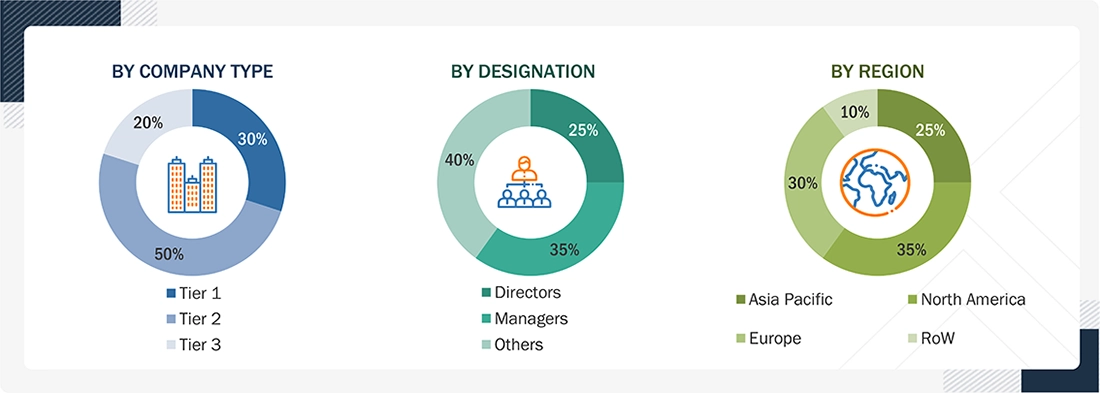
Note: RoW mainly comprises the Middle East & Africa, Central America, and South America.
Other designations include product managers, sales managers, and marketing managers.
Three tiers of companies have been defined based on their total revenue as of 2024. Tier 3: revenue less than USD 500 million; tier 2: revenue between USD 500 million and USD 1 billion; and tier 1: revenue more than USD 1 billion.
To know about the assumptions considered for the study, download the pdf brochure
Market Size Estimation
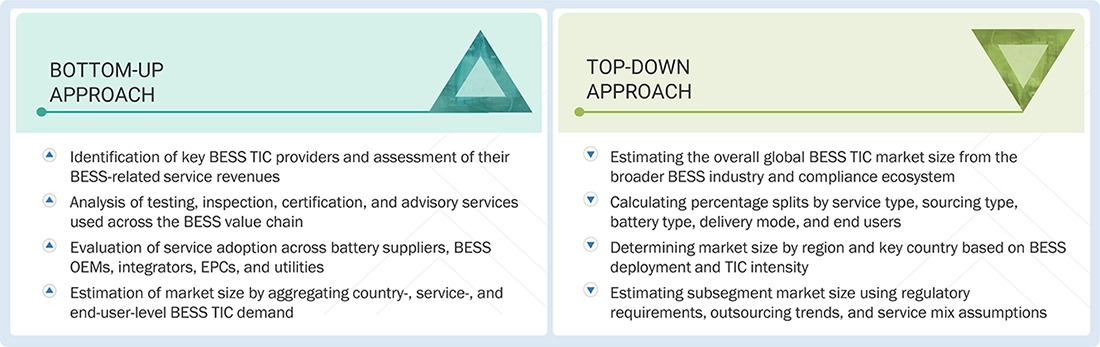
The bottom-up approach has been used to estimate the overall size of the Battery Energy Storage System (BESS) Testing, Inspection, and Certification (TIC) market.
- Key global, regional, and specialist BESS TIC providers were identified, including testing laboratories, certification bodies, fire-testing specialists, grid consultants, independent engineers, and inspection agencies.
- Providers were mapped by BESS service capabilities, including safety and thermal-runaway testing, electrical and performance validation, factory and supplier inspections, product and system certification, grid compliance assessment, FAT/SAT, commissioning, and technical due diligence.
- Country-level BESS TIC demand was assessed across battery manufacturers, BESS OEMs, system integrators, EPC contractors, utilities, project developers, governments, and other asset owners.
- Revenue potential was estimated throughout the BESS lifecycle, including product qualification, factory acceptance, installation inspection, site acceptance, commissioning, operational safety checks, and lifecycle performance verification.
- Outsourced TIC revenue was estimated using provider presence, laboratory capability, regulatory requirements, project complexity, and third-party assurance needs. In-house activity was assessed separately for OEM quality teams, EPC engineering functions, and utility-led technical reviews.
- Country estimates were aggregated to regional and global levels and subsequently allocated by service type, sourcing type, battery type, delivery mode, and end user.
- Bottom-up estimates were triangulated against BESS project pipelines, deployment trends, company service portfolios, laboratory and testing capacity, regulatory developments, and primary inputs from market participants.
The top-down approach has been used to estimate and validate the overall size of the Battery Energy Storage System (BESS) TIC market.
- A global stationary BESS project-value and deployment baseline was established using utility-scale, commercial, industrial, and residential storage activity, while excluding non-TIC elements such as land, financing, electricity trading, and unrelated grid infrastructure.
- TIC intensity was applied to the BESS baseline based on the relative requirement for safety testing, thermal-runaway assessment, fire-risk evaluation, product and system certification, grid-code validation, FAT/SAT, commissioning, and lifecycle assurance.
- The global market was segmented by region based on BESS deployment scale, battery manufacturing concentration, project pipeline, regulatory maturity, third-party assurance intensity, and availability of accredited TIC infrastructure.
- Regional estimates were further allocated to countries based on project activity, safety and fire code requirements, grid interconnection complexity, local certification pathways, outsourcing practices, and market access needs.
- Service-type shares were derived based on the relative demand for Testing, Inspection, Certification, and Other Services across the BESS product and project lifecycle.
- Sourcing-type splits were applied based on the prevalence of in-house engineering and quality-control capabilities versus outsourced laboratory testing, independent inspection, certification, and specialist project assurance.
- Segment and subsegment values were calculated by applying the derived shares to the total market baseline and triangulated against bottom-up findings, primary interviews, BESS project announcements, provider capabilities, and regulatory requirements.
BESS TIC Market : Top-Down and Bottom-Up Approach
Data Triangulation
After arriving at the overall Battery Energy Storage System (BESS) Testing, Inspection, and Certification (TIC) market size using the bottom-up and top-down estimation approaches, the market was segmented across service type, sourcing type, battery type, delivery mode, end user, region, and country. Market breakdown and data triangulation procedures were applied to derive and validate segment and subsegment estimates. The data was triangulated by assessing BESS deployment trends, battery manufacturing activity, project pipelines, regulatory and fire-safety requirements, grid-interconnection needs, third-party outsourcing practices, TIC provider capabilities, and primary stakeholder inputs across the BESS value chain. The final estimates were validated to ensure consistency between global, regional, country, and segment-level market values.
Market Definition
The Battery Energy Storage System (BESS) Testing, Inspection, and Certification (TIC) market comprises services for evaluating the safety, quality, performance, compliance, and operational readiness of battery energy storage systems and related components. These services are delivered by testing laboratories, inspection agencies, certification bodies, independent engineering firms, fire-safety specialists, and technical-assurance providers. The market includes testing, inspection, certification, and other services, such as technical due diligence, advisory services, consulting, training, documentation, traceability, and lifecycle assurance. Testing covers battery and system safety, thermal runaway, electrical, performance, environmental, EMC, FAT/SAT, and commissioning validation. Inspection includes supplier and factory audits, manufacturing surveillance, installation checks, and periodic operational safety reviews. Certification includes product, system, safety, environmental, and grid-compliance certification. The scope covers BESS activities from product qualification and factory acceptance through project commissioning, grid connection, operation, and lifecycle verification.
Key Stakeholders
- Battery and BESS OEMs
- TIC and engineering providers
- Regulators, standards bodies, and grid operators
- Utilities, IPPs, EPCs, and project developers
- Investors, lenders, and insurers
- Technology partners, consultants, and analysts
Report Objectives
- To define, describe, and forecast the Battery Energy Storage System (BESS) Testing, Inspection, and Certification (TIC) market by service type, sourcing type, battery type, delivery mode, end user, and region in terms of value.
- To forecast the market size across North America, Europe, Asia Pacific, South America, and the Middle East & Africa, along with key country-level markets.
- To provide detailed information on the major drivers, restraints, opportunities, and challenges influencing market growth.
- To analyze the impact of evolving BESS technologies, including battery chemistries, thermal-management systems, PCS, BMS, EMS, fire-suppression systems, and grid-interface technologies on TIC demand.
- To assess the impact of safety regulations, fire codes, grid codes, certification pathways, battery traceability requirements, and approval processes on the BESS TIC ecosystem.
- To provide a detailed overview of BESS TIC market trends, including thermal-runaway testing, large-scale fire assessment, grid-performance validation, FAT/SAT, remote inspection, digital documentation, cybersecurity, and lifecycle assurance.
- To strategically analyze micromarkets with respect to individual growth trends, prospects, and contributions to the overall BESS TIC market.
- To provide ecosystem analysis, value chain analysis, service pricing assessment, sourcing analysis, key stakeholder mapping, buying criteria, and trends/disruptions affecting BESS TIC customers.
- To analyze opportunities for TIC providers by identifying high-growth service lines, regional markets, customer groups, and emerging assurance requirements.
- To strategically profile key BESS TIC providers and analyze their core competencies, service portfolios, strategies, partnerships, acquisitions, and competitive positioning.
- To analyze competitive developments, including BESS testing-capacity expansion, laboratory investments, product launches, partnerships, collaborations, certifications, and acquisitions undertaken by market participants.
- To benchmark key players using a competitive leadership mapping framework based on BESS TIC service capability, geographic footprint, technical specialization, and project-lifecycle coverage.
Available customizations:
With the given market data, MarketsandMarkets offers customizations according to the company‘s specific needs. The following customization options are available for the report.
Company Information
- Detailed analysis and profiling of additional market players (up to five)
Get the Full Battery Energy Storage System (BESS) TIC Market Report
Full forecast, segment splits, and company analysis for all Battery Energy Storage System (BESS) TIC Market.
- Canada Battery Energy Storage System (BESS) TIC Market
- Germany Battery Energy Storage System (BESS) TIC Market
- UK Battery Energy Storage System (BESS) TIC Market
- France Battery Energy Storage System (BESS) TIC Market
- China Battery Energy Storage System (BESS) TIC Market
- India Battery Energy Storage System (BESS) TIC Market
- Mexico Battery Energy Storage System (BESS) TIC Market
- Czech Republic Battery Energy Storage System (BESS) TIC Market
- Finland Battery Energy Storage System (BESS) TIC Market
- Italy Battery Energy Storage System (BESS) TIC Market
- Netherlands Battery Energy Storage System (BESS) TIC Market
- Poland Battery Energy Storage System (BESS) TIC Market
- Rest Of Europe Battery Energy Storage System (BESS) TIC Market
- Spain Battery Energy Storage System (BESS) TIC Market
- Sweden Battery Energy Storage System (BESS) TIC Market
- Australia Battery Energy Storage System (BESS) TIC Market
- Japan Battery Energy Storage System (BESS) TIC Market
- Rest Of Asia Pacific Battery Energy Storage System (BESS) TIC Market
- South Korea Battery Energy Storage System (BESS) TIC Market
- GCC Countries Battery Energy Storage System (BESS) TIC Market
- South Africa Battery Energy Storage System (BESS) TIC Market
- Argentina Battery Energy Storage System (BESS) TIC Market
- Brazil Battery Energy Storage System (BESS) TIC Market
- Chile Battery Energy Storage System (BESS) TIC Market
- Colombia Battery Energy Storage System (BESS) TIC Market
- Rest Of South America Battery Energy Storage System (BESS) TIC Market
Need a Tailored Report?
Customize this report to your needs
Get 10% FREE Customization
Customize This Report
