
GCC Countries Bio-Butadiene Market (2024-2029)

The GCC Countries Bio-Butadiene Market was valued at $0.58 Million in 2024 and projected to reach to $0.89 Million by 2029, representing a compound annual growth rate of 9.0%. The bio-butadiene market in GCC Countries is poised for steady expansion driven by regional sustainability initiatives and the petrochemical sector's strategic shift toward bio-based alternatives.


| Market Size in | USD 26.32 MN |
| Market Forecast in | |
| CAGR | |
| Forecast Period | |
| Units Considered | Value (USD MN) |
GCC Countries Bio-Butadiene Market Trends and Insights
- GCC Countries are increasingly adopting sustainable chemical alternatives driven by regional environmental regulations and petrochemical industry diversification.
- The market in GCC Countries is expanding at a compound annual growth rate of 9.0%, reflecting growing demand for bio-based elastomers in automotive and industrial applications. GCC Countries' strategic position as a global petrochemical hub positions the region favorably for bio-butadiene adoption, particularly as manufacturers seek to enhance sustainability credentials.
- Between 2024 and 2029, GCC Countries will witness accelerated investment in green chemistry infrastructure and renewable feedstock sourcing.
- The expansion trajectory in GCC Countries is supported by regional government initiatives promoting circular economy principles and reduced carbon footprints across the chemicals sector..
Key Market Statistics
- CAGR (2024-2029) 9.0% CAGR
- Market Size, 2024 ~USD 0.58 Million
- Forecast, 2029 ~USD 0.89 Million
- Country GCC Countries
GCC Countries Bio-Butadiene Market Overview
Market Size & Growth :
GCC Countries bio-butadiene market valued at $0.58 million in 2024, projected to reach $0.89 million by 2029, representing a 9% CAGR over the forecast period.
Regional Regulatory Drivers :
GCC Countries are implementing stringent environmental regulations promoting sustainable chemical alternatives, creating favorable conditions for bio-butadiene adoption across petrochemical sectors.
Petrochemical Diversification :
GCC Countries' petrochemical industry is actively diversifying away from traditional hydrocarbons, with bio-butadiene emerging as a key sustainable alternative for elastomer and polymer production.
Competitive Positioning :
While growing at 9% CAGR, GCC Countries market remains smaller than global average of 10.1%, indicating significant untapped potential for market expansion and investment opportunities.
GCC Countries Bio-Butadiene Market Dynamics
- Government policies emphasizing environmental compliance and circular economy principles are accelerating adoption among major chemical manufacturers and elastomer producers in the region. GCC Countries' position as a global petrochemical hub positions it favorably for bio-butadiene integration into existing production infrastructure.
- Increasing investments in green chemistry technologies and partnerships with international bio-based chemical suppliers are expected to strengthen market penetration through 2029, supporting the region's long-term sustainability goals..
Market Ecosystem
Related Ecosystem
Green Bio Chemicals
- Animal-Based Sealants
- Bacterial Fermentation
- Corrosion Inhibitors
- Hydrogen Peroxide
- Nitrile Butadiene Rubber (NBR)
- Basf se
- Evonik industries ag
- Solvay sa
- AZELIS HOLDINGS SA
- CARGILL, INCORPORATED
Key Takeaways
- GCC Countries' bio-butadiene market is valued at $0.58 million in 2024 and expected to grow to $0.89 million by 2029.
- GCC Countries demonstrate a 9.0% CAGR, outpacing global average growth and reflecting strong regional demand for sustainable elastomers.
- GCC Countries leverage their petrochemical infrastructure advantage to position bio-butadiene as a competitive alternative to conventional butadiene.
- GCC Countries' regulatory environment and government sustainability initiatives are primary catalysts driving market expansion through 2029.
Bio-Butadiene Market Report Scope
| Report Metric | Details |
|---|---|
| Base Year | 2024 |
| Fastest Growing Segment | STYRENE-BUTADIENE RUBBER (SBR) (Type) |
| Forecast Period | 2024-2029 |
| Growth Rate | CAGR of 10.1% from 2024 to 2029 |
| Largest Segment | INDUSTRIAL GRADE (Grade) |
| Market Size Base Year (Billions) | ~USD 0.06 (2024) |
| Revenue Forecast (Billions) | ~USD 0.09 (2029) |
| Segments Covered | Grade, Type, Application, End-Use Industry |
GCC Countries Bio-Butadiene Market Report Segmentation
4 segment dimensions are covered across the global market.
By Grade
- Industrial Grade
- Laboratory Grade
By Type
- Acrylonitrile-Butadiene-Styrene (Abs) Resins
- Nitrile Butadiene Rubber (Nbr)
- Nitrile-Butadiene Rubber (Nbr)
- Other Types
- Polybutadiene (Pb)
- Styrene-Butadiene Block Copolymers (Sbs And Sebs)
- Styrene-Butadiene Latex (Sbl)
- Styrene-Butadiene Rubber (Sbr)
By Application
- Fine Chemicals
- Other Applications
- Plastics
- Synthetic Rubber
- Thermoplastic Elastomers
By End-Use Industry
- Automotive And Transportation
- Building And Construction
- Chemical Processing
- Consumer Goods (Footwear)
- Medical
- Other End-Use Industries
- Textile
Target Audience
- Chemical Manufacturers : GCC-based chemical producers need market data to assess bio-butadiene integration opportunities, competitive threats, and capacity planning for sustainable product lines.
- Petrochemical Companies : Regional petrochemical operators require insights on bio-butadiene market trends to support diversification strategies and investment decisions in green chemistry alternatives.
- Investment & Private Equity Firms : Investors targeting GCC Countries' chemical sector need detailed market forecasts and growth drivers to evaluate bio-butadiene ventures and portfolio opportunities.
- Government & Policy Makers : GCC regulatory bodies and economic development agencies use market intelligence to shape sustainability policies and support strategic initiatives in bio-based chemical sectors.
- Supply Chain & Distribution Partners : Distributors and logistics providers in GCC Countries need market outlook data to plan inventory, partnerships, and distribution networks for bio-butadiene products.
Reasons to Buy this Report
- Regional Market Intelligence : Gain exclusive insights into GCC Countries' bio-butadiene market dynamics, including localized growth drivers, regulatory landscape, and competitive positioning specific to the region.
- Investment Decision Support : Access detailed market sizing and forecasts for GCC Countries to identify investment opportunities in the $0.58M-$0.89M market segment with 9% growth potential.
- Regulatory Compliance Guidance : Understand GCC Countries' environmental regulations and sustainability requirements driving bio-butadiene adoption, enabling compliant market entry and product development strategies.
- Competitive Landscape Analysis : Benchmark your position against regional competitors and identify market gaps in GCC Countries' bio-butadiene sector for strategic differentiation and growth planning.
- Petrochemical Sector Alignment : Leverage insights on GCC Countries' petrochemical diversification trends to align product portfolios with regional industry transformation and capture emerging demand segments.
Frequently asked questions
What is the current market size of bio-butadiene in GCC Countries?
The bio-butadiene market in GCC Countries was valued at $0.58 million in 2024 and is projected to reach $0.89 million by 2029.
What is the expected growth rate for bio-butadiene in GCC Countries?
GCC Countries' bio-butadiene market is expected to grow at a compound annual growth rate of 9.0% from 2024 to 2029.
Which industries drive bio-butadiene demand in GCC Countries?
Automotive, industrial elastomers, and tire manufacturing sectors are primary demand drivers for bio-butadiene in GCC Countries.
Why is GCC Countries a strategic market for bio-butadiene?
GCC Countries' established petrochemical infrastructure, government sustainability mandates, and regional manufacturing capabilities make it an attractive hub for bio-butadiene production and adoption.
What factors support bio-butadiene market growth in GCC Countries?
Environmental regulations, circular economy initiatives, renewable feedstock availability, and corporate sustainability commitments are key growth factors in GCC Countries.
RESEARCH METHODOLOGY
The study involved four major activities in estimating the market size of the Bio-butadiene market. Exhaustive secondary research was done to collect information on the market, the peer market, and the parent market. The next step was to validate these findings, assumptions, and sizing with industry experts across the value chain through primary research. Both top-down and bottom-up approaches were employed to estimate the complete market size. Thereafter, the market breakdown and data triangulation procedures were used to estimate the market size of the segments and subsegments.
Secondary Research
In the secondary research process, various secondary sources have been referred to for identifying and collecting information for this study. These secondary sources include annual reports, press releases, investor presentations of companies, white papers, certified publications, trade directories, articles from recognized authors, the gold standard and silver standard websites, and databases.
Secondary research has been used to obtain key information about the value chain of the industry, the monetary chain of the market, the total pool of key players, market classification, and segmentation according to industry trends to the bottom-most level and regional markets. It was also used to obtain information about the key developments from a market-oriented perspective.
Primary Research
The bio-butadienemarket comprises several stakeholders in the value chain, which include feedstock providers, bio-butadiene manufacturers, distribution and end users. Various primary sources from the supply and demand sides of the Bio-butadiene market have been interviewed to obtain qualitative and quantitative information. The primary interviewees from the demand side include key opinion leaders in end-use sectors. The primary sources from the supply side include manufacturers, associations, and institutions involved in the bio-butadiene industry.
Primary interviews were conducted to gather insights such as market statistics, data on revenue collected from the products and services, market breakdowns, market size estimations, market forecasting, and data triangulation. Primary research also helped in understanding the various trends related to type, application, end-use, grade and region. Stakeholders from the demand side, such as CIOs, CTOs, and CSOs, were interviewed to understand the buyer’s perspective on the suppliers, products, fabricators, and their current usage of bio-butadiene material and the outlook of their business, which will affect the overall market.
The breakdown of profiles of the primary interviewees is illustrated in the figure below:
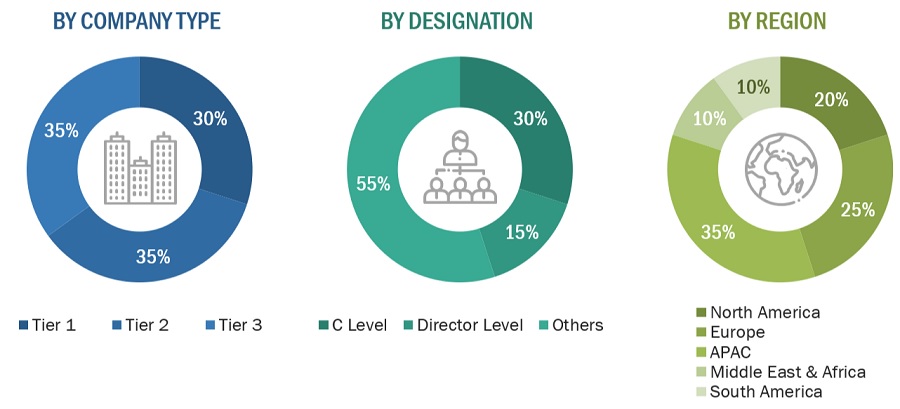
Note: Tier 1, Tier 2, and Tier 3 companies are classified based on their market revenue in 2023, available in the public domain, product portfolios, and geographical presence.
Other designations include consultants and sales, marketing, and procurement managers.
To know about the assumptions considered for the study, download the pdf brochure
|
Company name |
Designation |
|
Lummus Technology (US) |
Piping & Layout Engineer |
|
Genomatica Inc, |
Polymer Expert |
|
Michelin (France) |
R&D Manager |
|
Biokemik (Spain) |
Sales Manager |
|
ETB Catalytic Technologies (Netherlands) |
Technology Expert |
Market Size Estimation
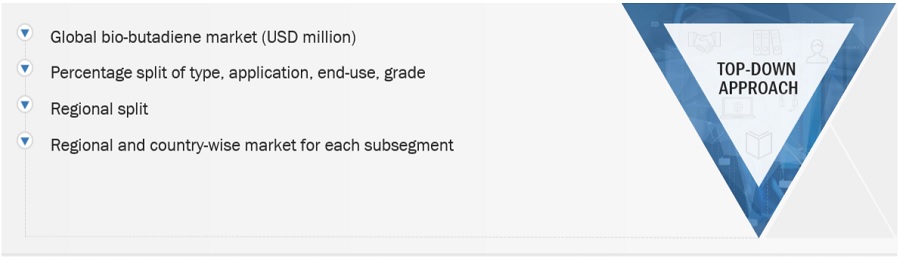
The top-down and bottom-up approaches have been used to estimate and validate the size of the bio-butadiene market.
- The key players in the industry have been identified through extensive secondary research.
- The industry's supply chain has been determined through primary and secondary research.
- All percentage shares, splits, and breakdowns have been determined using secondary sources and verified through primary sources.
- All possible parameters that affect the markets covered in this research study have been accounted for, viewed in extensive detail, verified through primary research, and analyzed to obtain the final quantitative and qualitative data.
- The research includes the study of reports, reviews, and newsletters of the key market players, along with extensive interviews for opinions with leaders such as directors and marketing executives.
Bio-Butadienemarket: Bottum-Up Approach
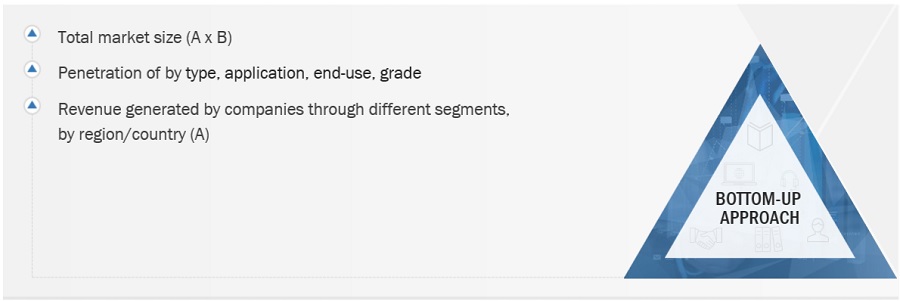
Note: All the shares are based on the global market size.
Source: Secondary Research, Interviews with Experts, and MarketsandMarkets Analysis
To know about the assumptions considered for the study, Request for Free Sample Report
Bio-Butadienemarket: Top-Down Approach
Data Triangulation
After arriving at the total market size from the estimation process explained above, the overall market has been split into several segments and sub-segments. To complete the overall market engineering process and arrive at the exact statistics for all the segments and sub-segments, the data triangulation and market breakdown procedures have been employed, wherever applicable. The data has been triangulated by studying various factors and trends from both the demand and supply sides. Along with this, the market size has been validated by using both the top-down and bottom-up approaches and primary interviews. Hence, for every data segment, there have been three sources—top-down approach, bottom-up approach, and expert interviews. The data was assumed correct when the values arrived from the three sources matched.
Market Definition
The bio-butadiene market refers to the commercial landscape encompassing the production, distribution, and application of bio-butadiene, a sustainable alternative to conventional butadiene derived from fossil fuels. Bio-butadiene is produced from renewable resources such as biomass, including agricultural residues, sugarcane, and corn. This market represents an essential segment of the broader bio-based chemicals industry, which aims to reduce the environmental footprint associated with traditional petrochemicals by leveraging renewable feedstocks.
The bio-butadiene market is driven by several factors, including the growing global emphasis on sustainability and environmental stewardship. Governments worldwide are implementing stringent regulations to curb carbon emissions and promote the use of eco-friendly materials, thereby creating a favorable regulatory environment for bio-based products. In response, numerous industries such as automotive, construction, and consumer goods are increasingly adopting bio-butadiene to meet their sustainability goals and reduce dependency on fossil-based raw materials.
Overall, the bio-butadiene market is poised for significant growth, driven by environmental regulations, technological innovations, and the increasing demand for sustainable alternatives across various industries. As the market matures, it is expected to play a pivotal role in the transition towards a more sustainable and circular economy.
Key Stakeholders
- Bio-butadiene suppliers
- Manufacturing Facilities
- Environment friendly product manufacturers
- Research organizations
- Governments and research organizations
- Regulatory bodies
- Environment support agencies
- End-users
Report Objectives
- To define, describe, and forecast the size of the bio-butadiene market, in terms of value and volume.
- To provide detailed information regarding the major factors (drivers, opportunities, restraints, and challenges) influencing the growth of the market
- To estimate and forecast the market size based on product type, end-use, application, grade and region.
- To forecast the size of the market with respect to major regions, namely, Europe, North America, Asia Pacific, Middle East & Africa, and South America, along with their key countries.
- To strategically analyze micromarkets1 with respect to individual growth trends, prospects, and their contribution to the overall market.
- To analyze opportunities in the market for stakeholders and provide a competitive landscape of market leaders.
- To track and analyze recent developments such as expansions, new product launches, partnerships & agreements, and acquisitions in the market.
- To strategically profile key market players and comprehensively analyze their core competencies.
Available Customizations
Along with the given market data, MarketsandMarkets offers customizations according to the company’s specific needs. The following customization options are available for the report:
Regional Analysis
- Further breakdown of a region with respect to a particular country or additional application
Company Information
- Detailed analysis and profiles of additional market players
Get the Full Bio-Butadiene Market Report
Full forecast, segment splits, and company analysis for all Bio-Butadiene Market.
- China Bio-Butadiene Market
- Japan Bio-Butadiene Market
- South Korea Bio-Butadiene Market
- India Bio-Butadiene Market
- US Bio-Butadiene Market
- Canada Bio-Butadiene Market
- Mexico Bio-Butadiene Market
- Germany Bio-Butadiene Market
- UK Bio-Butadiene Market
- France Bio-Butadiene Market
- Italy Bio-Butadiene Market
- Spain Bio-Butadiene Market
- Russia Bio-Butadiene Market
- Brazil Bio-Butadiene Market
- Argentina Bio-Butadiene Market
- South Africa Bio-Butadiene Market
- Rest Of Europe Bio-Butadiene Market
- Rest Of Asia Pacific Bio-Butadiene Market
- -Rest Of GCC Bio-Butadiene Market
- Rest Of South America Bio-Butadiene Market
Need a Tailored Report?
Customize this report to your needs
Get 10% FREE Customization
Customize This Report
