
Rest Of Asia Pacific Bioconjugation Market (2024-2029)

The Rest Of Asia Pacific Bioconjugation Market was valued at $55.7 Million in 2024 and projected to reach to $107.6 Million by 2029, representing a compound annual growth rate of 14.1%. Rest Of Asia Pacific represents a high-growth frontier for bioconjugation technologies, driven by escalating pharmaceutical R&D investments and the region's emerging biopharmaceutical ecosystem.


| Market Size in | USD 26.32 MN |
| Market Forecast in | |
| CAGR | |
| Forecast Period | |
| Units Considered | Value (USD MN) |
Rest Of Asia Pacific Bioconjugation Market Trends and Insights
- Rest Of Asia Pacific represents a critical growth region driven by increasing pharmaceutical R&D investments, rising demand for targeted therapeutics, and expanding biopharmaceutical manufacturing capabilities.
- The region's bioconjugation market benefits from growing adoption of antibody-drug conjugates (ADCs), immunotoxins, and diagnostic conjugates across emerging economies. Rest Of Asia Pacific's 14.1% compound annual growth rate reflects accelerating healthcare modernization and biotechnology sector development.
- Key markets within Rest Of Asia Pacific are witnessing heightened investment in contract research organizations (CROs) and contract manufacturing organizations (CMOs) specializing in bioconjugation technologies.
- Rest Of Asia Pacific's competitive landscape is characterized by both multinational players and regional innovators capitalizing on cost advantages and expanding clinical trial infrastructure, positioning the region as a strategic hub for bioconjugation applications through 2029..
Key Market Statistics
- CAGR (2024-2029) 14.1% CAGR
- Market Size, 2024 ~USD 55.7 Million
- Forecast, 2029 ~USD 107.6 Million
- Country Rest Of Asia Pacific
Rest Of Asia Pacific Bioconjugation Market Overview
Rapid Market Expansion :
Rest Of Asia Pacific bioconjugation market is growing at 14.1% CAGR, expanding from USD 55.7 million in 2024 to USD 107.6 million by 2029, outpacing many mature markets in the region.
Pharmaceutical R&D Acceleration :
Increasing investments in pharmaceutical research and development across emerging Asia Pacific economies are driving demand for advanced bioconjugation technologies and targeted therapeutic solutions.
Biopharmaceutical Manufacturing Growth :
Expanding biopharmaceutical manufacturing capabilities in Rest Of Asia Pacific countries are creating substantial opportunities for bioconjugation reagents, services, and contract manufacturing partnerships.
Targeted Therapeutics Demand :
Rising prevalence of chronic diseases and cancer in the region is fueling demand for targeted therapeutics and personalized medicine, directly increasing bioconjugation technology adoption.
Rest Of Asia Pacific Bioconjugation Market Dynamics
- Countries within this segment are increasingly establishing manufacturing hubs and research centers, attracting multinational biotech companies seeking cost-effective production and innovation capabilities.
- The market's 14.1% CAGR reflects strong momentum in targeted drug development and immunotherapy applications. Looking ahead, Rest Of Asia Pacific's bioconjugation market will benefit from government initiatives supporting life sciences infrastructure, rising healthcare expenditures, and growing collaborations between local and international pharmaceutical companies.
- Expanding contract research and manufacturing organizations (CROs/CMOs) will accelerate technology adoption, while increasing focus on biosimilars and novel therapeutics will sustain robust demand through 2029..
Market Ecosystem
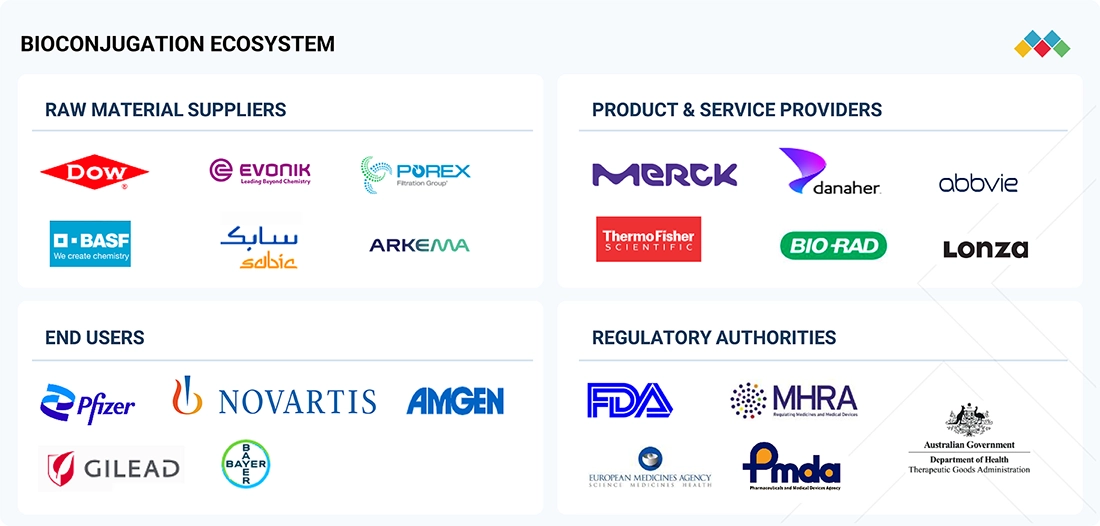
Bioconjugation Market: COMMERCIAL USE CASES ACROSS INDUSTRIES
| COMPANY | USE CASE DESCRIPTION | BENEFITS |
|---|---|---|
 |
Developed high-throughput single-cell protein detection arrays using DNA–antibody conjugation via SoluLINK chemistry; antibodies conjugated to complementary DNA strands captured proteins on DNA microbeads | Enabled multiplexed protein detection at the single-cell level, improved accuracy for pathology and cell biology studies, potential to enhance clinical diagnostics |
 |
In partnership with AstraZeneca, applied site-specific bioconjugation to develop Enhertu (trastuzumab deruxtecan), an ADC targeting HER2+ cancers | Improved progression-free survival in breast, gastric, and lung cancer; broadened treatment options for HER2-positive patients |
 |
At the Bioconjugation Process Development (BCPD) department of WuXi XCD, experienced experts specializing in consistent and scalable conjugation and purification have delivered more than a hundred processes within aggressive timelines to support IND filings or conduct process characterization (PC) activities for programs working towards a BLA submission | Faster and efficient process characterization (PC), improved scalability |
Logos and trademarks shown above are the property of their respective owners. Their use here is for informational and illustrative purposes only.
Related Ecosystem
Key Takeaways
- Rest Of Asia Pacific bioconjugation market valued at USD 55.7 million in 2024, expanding to USD 107.6 million by 2029 at 14.1% CAGR
- Rest Of Asia Pacific driven by rising ADC adoption, increased biopharmaceutical manufacturing, and expanding CRO/CMO capabilities
- Rest Of Asia Pacific benefits from cost-competitive manufacturing and growing clinical trial infrastructure attracting multinational investment
- Rest Of Asia Pacific emerging as strategic bioconjugation hub with accelerating healthcare modernization and biotechnology sector development
Bioconjugation Market Report Scope
| Report Metric | Details |
|---|---|
| Base Year | 2024 |
| Fastest Growing Segment | ANTIBODY CONJUGATION (Conjugation Type) |
| Forecast Period | 2024-2029 |
| Growth Rate | CAGR of 15.6% from 2024 to 2029 |
| Largest Segment | CONSUMABLES (Type) |
| Market Size Base Year (Billions) | ~USD 5.26 (2024) |
| Revenue Forecast (Billions) | ~USD 10.86 (2029) |
| Segments Covered | Type, Technique, Biomolecule Type, Application, End User, Conjugation Type |
Rest Of Asia Pacific Bioconjugation Market Report Segmentation
6 segment dimensions are covered across the global market.
By Type
- Analytical & Characterization Services
- Antibody-Drug Conjugates
- Antibody-Drug Conjugates (Adcs)
- Bead Coupling
- Chromatography Systems
- Consumables
- Custom Synthesis & Conjugation Services
- Electrophoresis Equipment
- Enzymes
- Filtration Systems
- Flow Cytometers
- Fluorescent Tags
- Haptens
- Incubators
- Instruments
- Labeling Reagents & Kits
- Labels
- Linker And Crosslinking Reagents & Kits
- Mass Spectrometers
- Mixers & Shakers
- Modification Reagents & Kits
- Other Consumables
- Other Instruments
- Other Labels
- Other Reagents & Kits
- Other Services
- Other Therapeutic Applications
- Peptide-Drug Conjugates
- Polymers
- Protein-Drug Conjugates
- Reagents & Kits
- Scale-Up & Manufacturing Services
- Spectroscopy Instruments
By Technique
- Chemical Conjugation
- Click Chemistry
- Enzyme-Mediated Conjugation
- Other Techniques
- Photoreactive Crosslinking
By Biomolecule Type
- Antibodies
- Oligonucleotides
- Other Biomolecules
- Peptides
- Proteins
By Application
- Diagnostics
- Research & Development
- Therapeutics
By End User
- Academic & Research Institutes
- Cros & Cmos
- Hospitals And Clinical/Diagnostic Laboratories
- Pharmaceutical & Biotechnology Companies
By Conjugation Type
- Antibody Conjugation
- Oligonucleotide Conjugation
- Other Conjugation Services
- Peptide Conjugation
- Protein Conjugation
Target Audience
- Pharmaceutical & Biotech Companies : Manufacturers and developers of bioconjugated therapeutics need Rest Of Asia Pacific market intelligence to identify expansion opportunities, assess manufacturing partnerships, and understand regional demand for targeted drugs.
- Contract Research & Manufacturing Organizations : CROs and CMOs operating in Rest Of Asia Pacific require market data to evaluate service demand, competitive positioning, pricing strategies, and growth potential in bioconjugation services.
- Bioconjugation Reagent & Equipment Suppliers : Vendors of bioconjugation technologies, reagents, and instruments need regional market insights to identify customer segments, forecast demand, and develop targeted sales and marketing strategies.
- Investment & Private Equity Firms : Investors evaluating biotech and pharmaceutical opportunities in Rest Of Asia Pacific require comprehensive market analysis to assess growth potential, competitive dynamics, and valuation benchmarks.
- Healthcare & Regulatory Consultants : Consultants advising clients on market entry, regulatory compliance, and business strategy in Rest Of Asia Pacific need detailed market data to provide informed recommendations and competitive analysis.
Reasons to Buy this Report
- Regional Market Sizing & Forecasts : Obtain precise market valuations for Rest Of Asia Pacific (USD 55.7M in 2024, USD 107.6M in 2029) with detailed CAGR analysis to support strategic planning and investment decisions specific to this high-growth region.
- Competitive Landscape Intelligence : Identify key players, market share distribution, and competitive strategies tailored to Rest Of Asia Pacific's unique regulatory environment, manufacturing capabilities, and customer preferences.
- Growth Driver Analysis : Understand region-specific catalysts including pharmaceutical R&D investments, biopharmaceutical manufacturing expansion, and targeted therapeutics demand to capitalize on emerging opportunities.
- Investment & Expansion Strategy : Make informed decisions on market entry, partnerships, and resource allocation in Rest Of Asia Pacific with data-driven insights on market dynamics, customer segments, and growth trajectories.
- Technology & Application Trends : Stay ahead of bioconjugation technology adoption patterns, application developments, and emerging therapeutic areas specific to Rest Of Asia Pacific's pharmaceutical and biotech sectors.
Frequently asked questions
What is the current market size of bioconjugation in Rest Of Asia Pacific?
Rest Of Asia Pacific bioconjugation market was valued at USD 55.7 million in 2024 and is projected to grow to USD 107.6 million by 2029.
What is the expected growth rate for Rest Of Asia Pacific bioconjugation market?
Rest Of Asia Pacific bioconjugation market is expected to grow at a compound annual growth rate (CAGR) of 14.1% from 2024 to 2029.
What are the primary drivers of bioconjugation market growth in Rest Of Asia Pacific?
Rest Of Asia Pacific growth is driven by increasing pharmaceutical R&D investments, rising ADC adoption, expanding biopharmaceutical manufacturing, and growing CRO/CMO capabilities in the region.
Which bioconjugation applications are most prevalent in Rest Of Asia Pacific?
Rest Of Asia Pacific market is dominated by antibody-drug conjugates (ADCs), immunotoxins, and diagnostic conjugates, reflecting demand for targeted therapeutics and diagnostic solutions.
How does Rest Of Asia Pacific bioconjugation market compare to other regions?
Rest Of Asia Pacific's 14.1% CAGR reflects strong regional growth driven by cost advantages, manufacturing capabilities, and clinical trial infrastructure that attract multinational pharmaceutical and biotech companies.
RESEARCH METHODOLOGY
This research study includes significant use of secondary sources, directories, and databases to discover and collect valuable information for analyzing the global bioconjugation market. In-depth interviews were conducted with a variety of primary respondents, including key industry participants, subject-matter experts (SMEs), C-level executives of key market players, and industry consultants, to gather and verify critical qualitative and quantitative data and assess the market's growth prospects. The global market size determined from secondary research was then triangulated with primary research inputs to calculate the final market size.
Secondary Research
Secondary research was used mainly to identify and collect information for the extensive, technical, market-oriented, and commercial study of the bioconjugation market. The secondary sources used for this study include World Health Organization (WHO), the National Institutes of Health (NIH), the United States Food and Drug Administration (US FDA), American Chemical Society (ACS), Royal Society of Chemistry, American Society of Clinical Oncology (ASCO), American Association for Cancer Research (AACR), Antibody Society, Biotechnology Innovation Organization (BIO), ADC Review, Journal of Antibody-drug Conjugates, Center of Disease Control & Prevention (CDC), National Center for Biotechnology Information (NCBI), EvalutePharma, ScienceDirect, Eurostat, and Factiva; corporate filings such as annual reports, SEC filings, investor presentations, and financial statements; press releases; trade, business, professional associations and among others. These sources were also used to obtain key information about major players, market classification, and segmentation according to industry trends, regional/country-level markets, market developments, and technology perspectives.
Primary Research
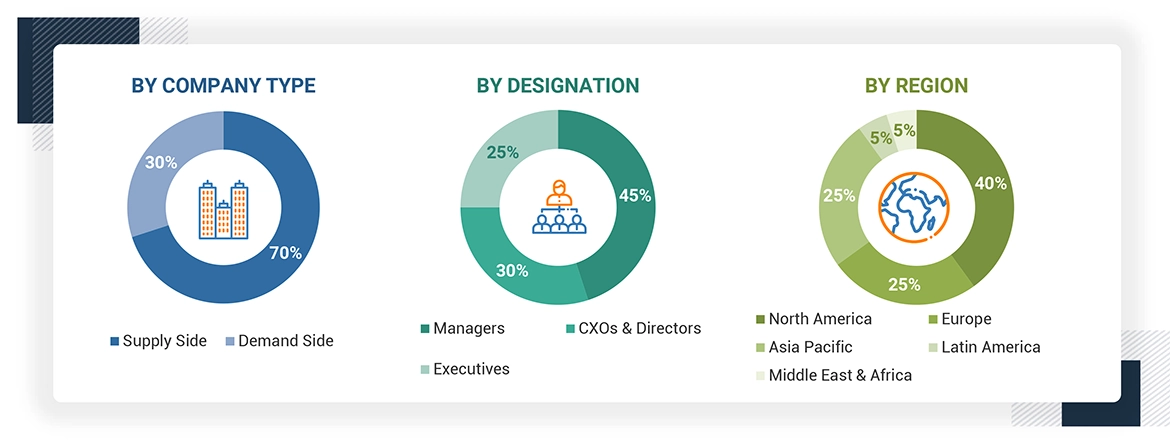
Extensive primary research was conducted after acquiring basic knowledge about the global bioconjugation market scenario through secondary research. Several primary interviews were conducted with market experts from the demand side, such as pharmaceutical & biotechnology companies, academic & research institutes, hospitals & clinical/diagnostic laboratories, CROs, and CMOs, and experts from the supply side, such as C-level and D-level executives, product managers, marketing & sales managers of key manufacturers, distributors, and channel partners. These interviews were done in five key regions: Asia Pacific, North America, Europe, Latin America, and Middle East & Africa. About 70% and 30% of the primary interviews were conducted with supply-side and demand-side participants, respectively. This data was gathered using questionnaires, e-mails, online surveys, in-person interviews, and telephone interviews.
The following is a breakdown of the primary respondents:
To know about the assumptions considered for the study, download the pdf brochure
Market Size Estimation
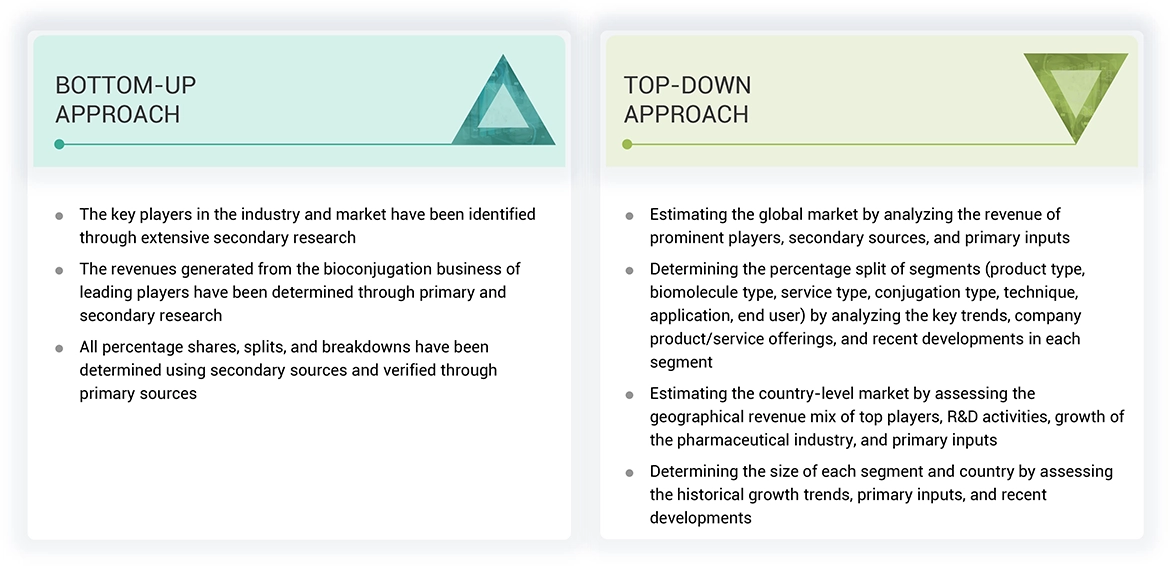
Both top-down and bottom-up approaches were used to estimate and validate the total size of the bioconjugation market. These methods were also used extensively to estimate the size of various subsegments in the market. The research methodology used to estimate the market size includes the following:
Data Triangulation
After arriving at the market size from the market size estimation process explained above, the total market was divided into several segments and subsegments. To complete the overall market engineering process and arrive at the exact statistics for all segments and subsegments, data triangulation and market breakdown procedures were employed, wherever applicable. The data was triangulated by studying various factors and trends from both the demand and supply sides.
Market Definition
Bioconjugation refers to the chemical or biological process of forming a stable covalent bond between two molecules, typically involving a biomolecule (such as a protein, antibody, nucleic acid, or peptide) and another molecule, which could be a drug, imaging agent, polymer, or another biomolecule_ The purpose of bioconjugation is to combine the properties of the two molecules, creating a single functional entity with enhanced or novel capabilities.
The report presents the market size for bioconjugation services and products that can be utilized throughout the bioconjugation process, from preparation to analysis. The key segments of the market include products such as consumables, & instruments, along with services for bioconjugation.
Stakeholders
- Bioconjugation Product Manufacturers
- Distributors of Bioconjugation Products
- Bioconjugation Service Providers
- Biotechnology, Biopharmaceutical, and Pharmaceutical Companies
- Research Institutes and Clinical Research Organizations (CROs)
- Contract Manufacturing Organizations (CMOs)
- Academic Institutes
- Investors
- Medical Institutes & Universities
- Venture Capitalists
- Insurance Providers
- Government Bodies
Report Objectives
- To define, describe, and forecast the global bioconjugation products market based on type, technique, biomolecule type application, end user, and region
- To define, describe, and forecast the global bioconjugation services market based on type, technique, conjugation type application, end user, and region
- To provide detailed information regarding the major factors influencing the market growth (drivers, restraints, opportunities, and challenges)
- To strategically analyze micromarkets1 with respect to their individual growth trends, future prospects, and contributions to the total market
- To analyze opportunities in the market for stakeholders and provide details of the competitive landscape for market leaders
- To forecast the revenue of the market segments with respect to six major regions:
- North America, Europe, Asia Pacific, Latin America, the Middle East, and Africa
- To profile the key players and comprehensively analyze their market shares and core competencies
- To track and analyze competitive developments such as product/service launches, agreements, partnerships, collaborations, acquisitions, and expansions in the bioconjugation market
- To benchmark players within the bioconjugation market using the Company Evaluation Matrix framework, which analyzes market players based on various parameters within the broad categories of business and product/service strategy
Get the Full Bioconjugation Market Report
Full forecast, segment splits, and company analysis for all Bioconjugation Market.
- US Bioconjugation Market
- Canada Bioconjugation Market
- Germany Bioconjugation Market
- UK Bioconjugation Market
- France Bioconjugation Market
- Italy Bioconjugation Market
- Spain Bioconjugation Market
- China Bioconjugation Market
- Japan Bioconjugation Market
- India Bioconjugation Market
- South Korea Bioconjugation Market
- Australia Bioconjugation Market
- Brazil Bioconjugation Market
- Mexico Bioconjugation Market
- Rest Of Europe Bioconjugation Market
- Rest Of Latin America Bioconjugation Market
- Other GCC Countries Bioconjugation Market
- Saudi Arabia (Ksa) Bioconjugation Market
- United Arab Emirates (UAE) Bioconjugation Market
- GCC Countries Bioconjugation Market
- Rest Of The Middle East Bioconjugation Market
Need a Tailored Report?
Customize this report to your needs
Get 10% FREE Customization
Customize This Report
