
Europe Building Integrated Photovoltaic Market (2024-2029)

The Europe Building Integrated Photovoltaic Market was valued at $4772.1 Million in 2024 and projected to reach to $8322.8 Million by 2029, representing a compound annual growth rate of 11.8%. Europe's BIPV market is positioned for sustained expansion through 2029, supported by ambitious climate neutrality targets and mandatory renewable energy requirements in building codes.


| Market Size in | USD 26.32 MN |
| Market Forecast in | |
| CAGR | |
| Forecast Period | |
| Units Considered | Value (USD MN) |
Europe Building Integrated Photovoltaic Market Trends and Insights
- This 11.8% compound annual growth rate reflects Europe's strong commitment to renewable energy integration and sustainable building practices.
- Europe leads global adoption of BIPV technologies, driven by stringent EU energy efficiency directives and net-zero carbon targets across member states. The European market benefits from advanced regulatory frameworks, substantial government incentives, and growing consumer demand for energy-efficient buildings.
- Europe's construction sector increasingly incorporates photovoltaic elements into facades, roofs, and windows, transforming buildings into active energy producers.
- Between 2024 and 2029, Europe is expected to capture significant market share through technological innovation, declining installation costs, and accelerated retrofitting of existing structures. Europe's BIPV expansion is supported by established manufacturing capabilities, skilled workforce, and collaborative innovation ecosystems across the continent.
- The region's focus on circular economy principles and building-integrated renewable energy solutions positions Europe as a critical growth engine for the global BIPV market..
Key Market Statistics
- CAGR (2024-2029) 11.8% CAGR
- Market Size, 2024 ~USD 4772.1 Million
- Forecast, 2029 ~USD 8322.8 Million
- Geography Europe
Europe Building Integrated Photovoltaic Market Overview
Market Leadership Position :
Europe commands the global BIPV market with a 2024 valuation of $4,772.1 million, representing the strongest regional adoption of building-integrated photovoltaic technologies worldwide, driven by regulatory mandates and sustainability commitments.
Robust Growth Trajectory :
The European BIPV market is projected to grow from $4,772.1 million in 2024 to $8,322.8 million by 2029, achieving an 11.8% CAGR, demonstrating sustained investor confidence and accelerating market maturation across the continent.
Regulatory Catalyst :
Stringent EU energy efficiency directives and the European Green Deal mandate renewable energy integration in buildings, creating a favorable regulatory environment that accelerates BIPV adoption across residential, commercial, and industrial sectors.
Technology Integration Leadership :
European markets lead in advanced BIPV applications including solar facades, transparent photovoltaic windows, and roof-integrated systems, with Germany, France, and Italy accounting for the majority of regional market value and innovation.
Europe Building Integrated Photovoltaic Market Dynamics
- The continent's mature construction sector, combined with increasing energy costs and government incentives, creates strong demand for integrated solar solutions.
- Germany, France, and Italy represent the primary growth engines, with emerging opportunities in Eastern European markets as sustainability standards harmonize across EU member states. The market outlook remains positive despite economic headwinds, as BIPV technologies increasingly offer cost-competitive alternatives to traditional building materials while delivering energy independence.
- Technological advancements in efficiency and aesthetics, coupled with declining installation costs, are expected to drive mainstream adoption beyond early adopters.
- European manufacturers and installers are well-positioned to capture growth through 2029, with potential for export opportunities to other developed markets seeking to replicate Europe's renewable energy integration success..
Market Ecosystem
Related Ecosystem
Decarbonization
- Battery Electric Vehicle (BEV)
- Energy Management Systems
- Fuel Cell
- Fuel Cell Electric Vehicle (FCEV)
- Geographical Information System (GIS)
- TotalEnergies SE
- Siemens ag
- Mitsui & Co., Ltd.
- General Electric Company
- Thyssenkrupp ag
Smart Lighting
- Fiber Laser
- Fluorescent Lighting
- Gas Lasers
- Sensors
- 3D Sensors
- Zumtobel group ag
- Nedap n.v.
- Acuity Brands, Inc.
- OSRAM Licht AG
- Philips
Key Takeaways
- Europe's BIPV market will grow from $4.77B (2024) to $8.32B (2029) at an 11.8% CAGR, outpacing many global regions.
- EU regulatory mandates and net-zero targets are primary drivers accelerating BIPV adoption across Europe's building sector.
- Europe's advanced manufacturing infrastructure and skilled workforce provide competitive advantages in BIPV technology development and deployment.
- Retrofitting existing buildings and integrating BIPV into new construction represent Europe's largest growth opportunities through 2029.
Building Integrated Photovoltaic Market Report Scope
| Report Metric | Details |
|---|---|
| Base Year | 2024 |
| Fastest Growing Segment | RESIDENTIAL (End User) |
| Forecast Period | 2024-2029 |
| Growth Rate | CAGR of 17% from 2024 to 2029 |
| Largest Segment | CRYSTALLINE SILICON (Technology) |
| Market Size Base Year (Billions) | ~USD 12.5 (2024) |
| Revenue Forecast (Billions) | ~USD 27.41 (2029) |
| Segments Covered | Technology, Type, Application, End User |
Europe Building Integrated Photovoltaic Market Report Segmentation
4 segment dimensions are covered across the global market.
By Technology
- Crystalline Silicon
- Thin Film
By Type
- Monocrystalline
- Polycrystalline
By Application
- Externally Integrated Systems
- Facades
- Roofing
By End User
- Commercial
- Industrial
- Residential
EUROPE: BUILDING INTEGRATED PHOTOVOLTAIC MARKET, BY END USER, 2024–2029
| Segment | 2024 | 2025 | 2026 | 2027 | 2028 | 2029 | CAGR (%) |
|---|---|---|---|---|---|---|---|
| COMMERCIAL | 1452.3 | 1632.5 | 1877.2 | 2146.6 | 2453.4 | 2802.7 | 14.1 |
| INDUSTRIAL | 2100.1 | 2345.9 | 2694.4 | 3032.9 | 3410.1 | 3830.4 | 12.8 |
| RESIDENTIAL | 1219.7 | 1355.2 | 1389.6 | 1483.2 | 1583.1 | 1689.8 | 6.7 |
| TOTAL | 4772.1 | 5333.6 | 5961.2 | 6662.6 | 7446.6 | 8322.8 | 11.8 |
Target Audience
- Solar Equipment Manufacturers : Manufacturers need European market data to optimize product portfolios for regional preferences, identify high-growth country markets, and develop localized strategies for Germany, France, and Italy where BIPV adoption is strongest.
- Construction & Real Estate Developers : Developers require market insights to understand BIPV integration costs, regulatory requirements, and consumer demand across European markets, enabling informed decisions on sustainable building projects and competitive differentiation.
- Energy & Utility Companies : Utilities need comprehensive European BIPV data to assess distributed generation trends, grid integration challenges, and market opportunities in renewable energy transition, supporting strategic planning and investment allocation.
- Investment & Private Equity Firms : Investors require detailed market sizing, growth forecasts, and country-level performance data to evaluate BIPV sector opportunities, identify acquisition targets, and assess portfolio companies' competitive positioning in Europe.
- Policy Makers & Government Agencies : Government officials need market intelligence to evaluate BIPV policy effectiveness, benchmark European adoption rates, and design incentive programs that accelerate renewable energy integration in buildings across member states.
Countries within Europe - compare and drill down
| Country | 2025 size (native) |
|---|---|
| Germany | USD 2525.7 Million |
| France | USD 2325.8 Million |
| Italy | USD 2150.2 Million |
| Spain | USD 291.4 Million |
| Netherlands | USD 178.5 Million |
| Switzerland | USD 794.2 Million |
| Rest Of Europe | USD 56.9 Million |
Country market size visualization
Reasons to Buy this Report
- Regional Market Dominance Data : Gain comprehensive insights into Europe's $4.8 billion BIPV market with country-level breakdowns for Germany ($2,525.7M), France ($2,325.8M), and Italy ($2,150.2M), enabling precise market positioning and competitive analysis.
- Growth Forecasting & Investment Planning : Access detailed 5-year projections showing 11.8% CAGR growth to $8.3 billion by 2029, providing critical data for investment decisions, capacity planning, and market entry strategies across European territories.
- Regulatory & Policy Intelligence : Understand how EU energy directives and national sustainability mandates drive BIPV adoption, with analysis of regulatory catalysts specific to each major European market to inform compliance and go-to-market strategies.
- Competitive Landscape Mapping : Identify market concentration patterns across leading European countries and emerging opportunities in secondary markets, enabling strategic positioning against regional competitors and potential partnership identification.
- Technology & Application Trends : Discover which BIPV applications (solar facades, transparent windows, roof systems) are driving growth in specific European markets, supporting product development and marketing strategies tailored to regional preferences.
Frequently asked questions
What is the current size of Europe's BIPV market in 2024?
Europe's Building Integrated Photovoltaic market was valued at $4,772.1 million in 2024, representing a significant portion of global BIPV demand.
What is the projected market size for Europe's BIPV sector by 2029?
Europe's BIPV market is forecasted to reach $8,322.8 million by 2029, reflecting sustained growth and market expansion across the region.
What is driving growth in Europe's BIPV market?
Europe's BIPV growth is driven by EU energy efficiency directives, net-zero carbon commitments, government incentives, declining technology costs, and increasing demand for sustainable buildings.
Which European countries are leading BIPV adoption?
Leading European markets include Germany, Italy, France, and the Netherlands, where strong regulatory frameworks and renewable energy targets accelerate BIPV integration.
What is Europe's BIPV market CAGR from 2024 to 2029?
Europe's BIPV market is expected to grow at a compound annual growth rate of 11.8% between 2024 and 2029.
RESEARCH METHODOLOGY
The study involved major activities in estimating the current size of the building integrated photovoltaic market. Exhaustive secondary research was done to collect information on the peer and parent markets. The next step was to validate these findings, assumptions, and sizing with industry experts across the value chain through primary research. Both top-down and bottom-up approaches were employed to estimate the total market size. Thereafter, market breakdown and data triangulation were used to estimate the market size of the segments and subsegments.
Secondary Research
Secondary sources referred to for this research study include annual reports, press releases, and investor presentations of companies; white papers; certified publications; articles by recognized authors; and databases of various companies and associations. Secondary research was mainly used to obtain key information about the industry’s supply chain, the total pool of key players, market classification, and segmentation according to industry trends to the bottom-most level, regional markets, and key developments from both, market- and technology-oriented perspectives.
Primary Research
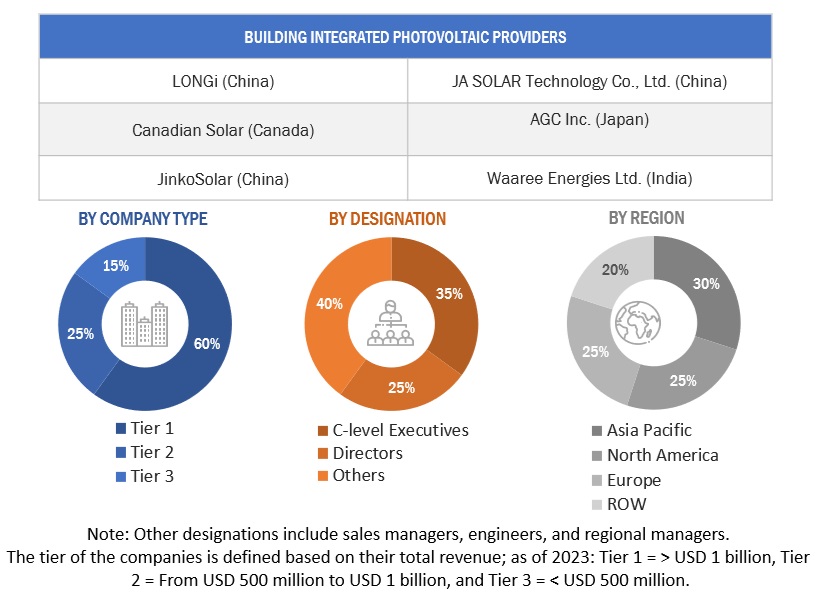
In the primary research process, various primary sources from the supply and demand sides were interviewed to obtain qualitative and quantitative information for this report. Primary sources from the supply side include industry experts such as chief executive officers (CEOs), vice presidents (VPs), marketing directors, and related key executives from various companies and organizations operating in the building-integrated photovoltaics market.
In the complete market engineering process, the top-down and bottom-up approaches, along with several data triangulation methods, were extensively used to perform the market size estimations and forecasts for all segments and subsegments listed in this report. Extensive qualitative and quantitative analyses were conducted to complete the market engineering process and list key information/insights throughout the report. Following is the breakdown of primary respondents:
To know about the assumptions considered for the study, download the pdf brochure
BIPV Market Size Estimation
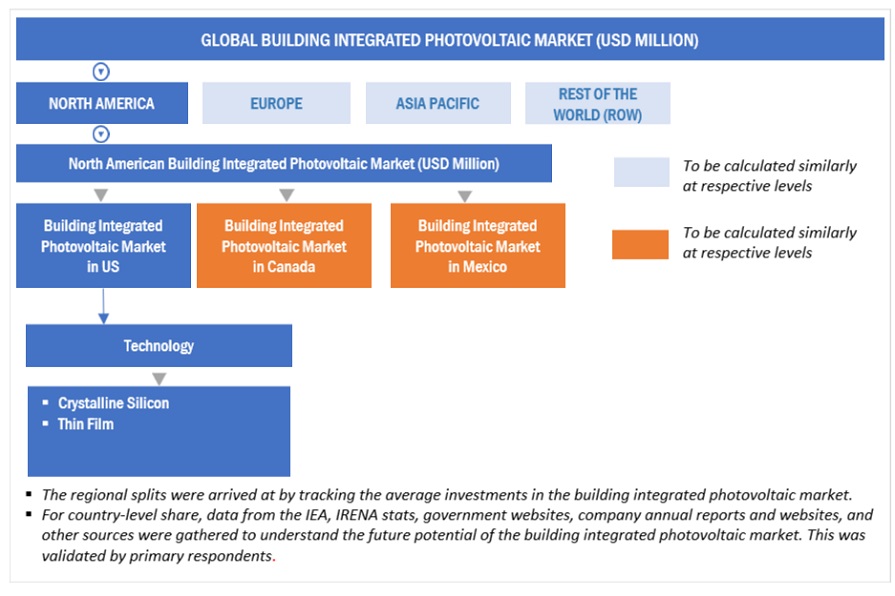
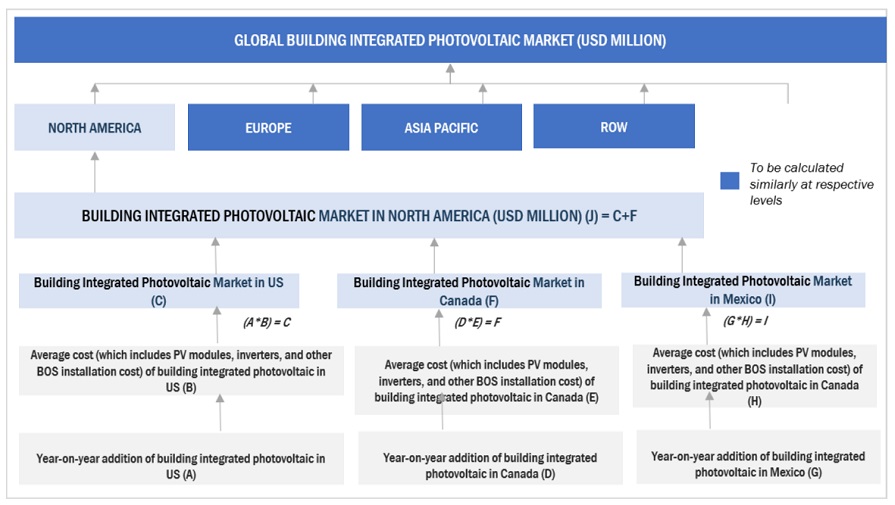
The top-down and bottom-up approaches were used to estimate and validate the size of the building-integrated photovoltaic market. The key players in the market were identified through secondary research, and their market share in the respective regions was obtained through primary and secondary research. The research methodology includes the study of the annual and financial reports of the top market players and interviews with industry experts, such as chief executive officers, vice presidents, directors, sales managers, and marketing executives, for key quantitative and qualitative insights related to the BIPV market. The research methodology used to estimate the market size includes the following:
- Extensive secondary research was used to identify the major players in the industry and market, and their market share was established using both primary and secondary research.
- Both primary and secondary research methods were used to assess the industry's value chain and market size.
- All percentage shares, splits, and breakdowns were obtained using secondary sources and validated by primary sources.
Building integrated photovoltaic Market Size: Top-Down Approach
To know about the assumptions considered for the study, Request for Free Sample Report
Building-integrated photovoltaics Market Size: Bottom-Up Approach
Data Triangulation
After arriving at the overall market size from the estimation process explained below, the total market was split into several segments and subsegments. The data triangulation and market breakdown procedures were employed, wherever applicable, to complete the overall market engineering process and arrive at the exact statistics for all segments and subsegments. The data was triangulated by studying various factors and trends from both the demand and supply sides. The market size was validated using the top-down and bottom-up approaches.
Market Definition
Building integrated photovoltaics (BIPV) refers to photovoltaic materials that are incorporated directly into the building envelope, replacing conventional building components like roofs, walls, windows, facades, skylights, and even walkways.
They also function as building materials, offering weather protection, and insulation, and potentially contributing to daylighting and aesthetics. BIPY seamlessly blends with the building design, becoming an integral part of the structure. It offers the combined benefits of power generation and building material properties.
BIPV is growing technology that contributes to sustainable building practices by generating clean energy and improving building energy efficiency.
Key Stakeholders
- PV cell manufacturers
- PV module manufacturers
- BIPV product manufacturers
- BIPV product distributors
- BIPV market technical consultants
- End users of BIPV-based solutions
- Raw materials and manufacturing equipment suppliers
- PV market technical consultants
- Technology standards organizations, forums, alliances, and associations
- Governments, financial institutions, and investment communities
- Research organizations
- Analysts and strategic business planners
- Venture capitalists, private equity firms, and start-up companies
- Distributors
Objectives of the Stud
- To define, describe, segment, and forecast the building integrated photovoltaic market size, by technology, application, and end-user in terms of value
- To forecast the market size across four key regions, namely, North America, Europe, Asia Pacific, and the Rest of the World, along with the country-level market sizes in terms of value
- To forecast the market size across four key regions, namely, North America, Europe, Asia Pacific, and the Rest of the World, in terms of volume.
- To provide detailed information about the key drivers, restraints, opportunities, and industry-specific challenges influencing the growth of the BIPV market
- To strategically analyze the BIPV market for individual growth trends, prospects, and contributions of each segment to the market
- To provide information pertaining to the supply chain, trends/disruptions impacting customer business, ecosystem/market map, pricing of building integrated photovoltaic, and regulatory landscape of the BIPV market
- To strategically analyze the micromarkets1 with respect to individual growth trends, upcoming expansions, and their contributions to the overall market
- To analyze opportunities for stakeholders in the BIPV market and draw a competitive landscape for market players
- To benchmark players within the market using the company evaluation matrix, which analyzes market players on various parameters within the broad categories of business and product strategies
- To compare key market players with respect to the market share, product specifications, and applications
- To strategically profile key players and comprehensively analyze their market ranking and core competencies2.
- To track and analyze competitive developments in the BIPV market, such as contracts, agreements, investments, expansions, product launches, alliances, mergers, partnerships, joint ventures, collaborations, and acquisitions
Available Customizations:
With the given market data, MarketsandMarkets offers customizations according to the specific requirements of companies. The following customization options are available for the report:
PRODUCT ANALYSIS
- Product Matrix, which provides a detailed comparison of the product portfolio of each company
COMPANY INFORMATION
- Detailed analyses and profiling of additional market players
Get the Full Building Integrated Photovoltaic Market Report
Full forecast, segment splits, and company analysis for all Building Integrated Photovoltaic Market.
- US Building Integrated Photovoltaic Market
- Canada Building Integrated Photovoltaic Market
- Mexico Building Integrated Photovoltaic Market
- Germany Building Integrated Photovoltaic Market
- France Building Integrated Photovoltaic Market
- Italy Building Integrated Photovoltaic Market
- Spain Building Integrated Photovoltaic Market
- Netherlands Building Integrated Photovoltaic Market
- Switzerland Building Integrated Photovoltaic Market
- China Building Integrated Photovoltaic Market
- Japan Building Integrated Photovoltaic Market
- South Korea Building Integrated Photovoltaic Market
- Australia Building Integrated Photovoltaic Market
- Rest Of Europe Building Integrated Photovoltaic Market
- Rest Of Asia Pacific Building Integrated Photovoltaic Market
Need a Tailored Report?
Customize this report to your needs
Get 10% FREE Customization
Customize This Report
