
Canada Butyraldehyde Market (2025-2030)

The Canada Butyraldehyde Market was valued at $143 Million in 2025 and projected to reach to $172.4 Million by 2030, representing a compound annual growth rate of CAGR 3.8%. Canada's butyraldehyde market is positioned for steady growth through 2030, supported by sustained demand from the plastics and coatings industries.


| Market Size in | USD 26.32 MN |
| Market Forecast in | |
| CAGR | |
| Forecast Period | |
| Units Considered | Value (USD MN) |
Canada Butyraldehyde Market Trends and Insights
- Canada's butyraldehyde sector is driven by steady demand from the plastics, coatings, and chemical synthesis industries, which rely on butyraldehyde as a key intermediate feedstock.
- The Canadian market benefits from established petrochemical infrastructure and proximity to North American supply chains, supporting consistent production and distribution networks. Growth in Canada's butyraldehyde market is underpinned by expanding applications in specialty chemicals and industrial coatings, alongside regulatory support for sustainable chemical manufacturing.
- Canada's position within North America positions it as a critical hub for butyraldehyde production and consumption, with domestic manufacturers serving both regional and export markets.
- Over the forecast period through 2030, Canada is expected to maintain moderate growth momentum, supported by recovery in downstream industries and continued investment in chemical processing capacity..
Key Market Statistics
- CAGR (2025-2030) CAGR 3.8%
- Market Size, 2025 ~USD 143 Million
- Forecast, 2030 ~USD 172.4 Million
- Country Canada
Canada Butyraldehyde Market Overview
Market Size & Growth :
Canada's butyraldehyde market is valued at USD 143.0 million in 2025, with projected growth to USD 172.4 million by 2030, reflecting a steady CAGR of 3.8%.
Key End-Use Industries :
The Canadian market is primarily driven by demand from plastics manufacturing, coatings production, and chemical synthesis sectors that utilize butyraldehyde as a critical intermediate feedstock.
Regional Competitive Position :
Canada's butyraldehyde market grows at 3.8% CAGR, slightly below the global average of 4.8%, indicating moderate growth relative to international markets.
Industrial Infrastructure :
Canada's robust chemical manufacturing base and proximity to North American supply chains support consistent demand for butyraldehyde across multiple industrial applications.
Canada Butyraldehyde Market Dynamics
- The country's established chemical manufacturing infrastructure and integration within North American supply chains provide a stable foundation for market expansion.
- Regulatory compliance and environmental standards in Canada continue to shape production practices, encouraging innovation in synthesis methods and sustainable applications. The forecast period will likely see increased adoption of butyraldehyde in specialty chemical applications and advanced coatings formulations.
- Growth will be moderated by global economic conditions and competition from alternative chemical intermediates, but the 3.8% CAGR reflects resilient underlying demand from core industrial sectors across Canada..
Market Ecosystem
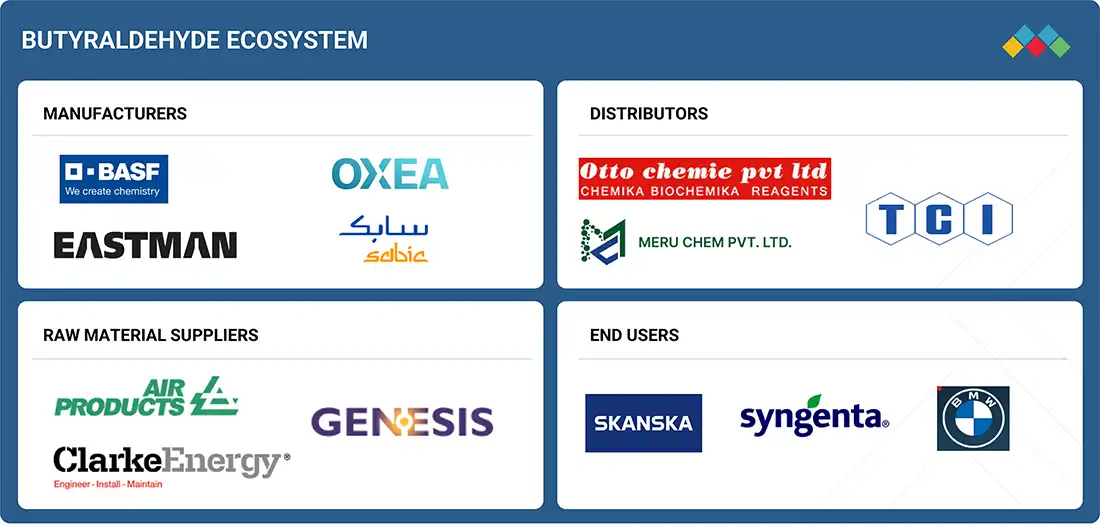
Butyraldehyde Market: COMMERCIAL USE CASES ACROSS INDUSTRIES
| COMPANY | USE CASE DESCRIPTION | BENEFITS |
|---|---|---|
 |
Integration of butyraldehyde-derived coatings and adhesives in body panels, interiors, and exterior finishes | Superior surface durability, scratch and chemical resistance, premium finish quality, and longer component life |
 |
Use of butyraldehyde-based plasticizers in flexible PVC for wiring harnesses, seals, and interior components | Enhanced flexibility and safety in wiring, extended durability of seals, and reduced material degradation under heat and stress |
 |
Application of butyraldehyde-based coatings, adhesives, and protective resins in large-scale infrastructure projects | Increased weather resistance, lower lifecycle costs, improved environmental compliance, and extended structure lifespan |
 |
Use of butyraldehyde-derived plasticizers and resins in high-performance concrete admixtures and sealants | Enhanced workability of concrete, longer durability of structures, reduced maintenance costs, and improved sustainability in building materials |
Logos and trademarks shown above are the property of their respective owners. Their use here is for informational and illustrative purposes only.
Related Ecosystem
Speciality Chemicals
- Corrosion Inhibitors
- Polyetheretherketone (PEEK)
- Acrylonitrile Butadiene Styrene (ABS)
- Epoxy Resin
- Polycarbonate
- Basf se
- DOW CHEMICAL COMPANY
- Evonik industries ag
- Clariant ag.
- Solvay sa
Key Takeaways
- Canada's butyraldehyde market is valued at USD 143.0 million in 2025 and will reach USD 172.4 million by 2030, growing at a 3.8% CAGR.
- Canada's market is supported by strong demand from plastics, coatings, and specialty chemical manufacturing sectors.
- Canada's established petrochemical infrastructure and North American supply chain integration drive competitive advantage and market stability.
- Canada's butyraldehyde sector is expected to benefit from regulatory initiatives promoting sustainable chemical production through 2030.
Butyraldehyde Market Report Scope
| Report Metric | Details |
|---|---|
| Base Year | 2025 |
| Fastest Growing Segment | MEDICAL (End-Use Industry) |
| Forecast Period | 2025–2030 |
| Growth Rate | CAGR of 4.8% from 2025 to 2030 |
| Largest Segment | N-BUTYRALDEHYDE (Product Type) |
| Market Size Base Year (Billions) | ~USD 5.51 (2025) |
| Revenue Forecast (Billions) | ~USD 6.96 (2030) |
| Segments Covered | Product Type, End-Use Industry, Application |
Canada Butyraldehyde Market Report Segmentation
3 segment dimensions are covered across the global market.
By Product Type
- Isobutyraldehyde
- N-Butyraldehyde
By End-Use Industry
- Agriculture
- Automotive
- Construction
- Cosmetics
- Food & Beverage
- Medical
- Other End-Use Industries
By Application
- Chemical Intermediates
- Other Applications
- Plasticizers
- Rubber Accelerators
- Synthetic Resins
CANADA: BUTYRALDEHYDE MARKET, BY APPLICATION, 2025–2030
| Segment | 2025 | 2026 | 2027 | 2028 | 2029 | 2030 | CAGR (%) |
|---|---|---|---|---|---|---|---|
| CHEMICAL INTERMEDIATES | 45.7 | 47.9 | 50.1 | 52.1 | 54.2 | 56.1 | 4.2 |
| OTHER APPLICATIONS | 15.9 | 16.5 | 17.1 | 17.7 | 18.2 | 18.7 | 3.3 |
| PLASTICIZERS | 33.5 | 35 | 36.4 | 37.6 | 39 | 40.1 | 3.7 |
| RUBBER ACCELERATORS | 8 | 8.4 | 8.7 | 9 | 9.2 | 9.5 | 3.4 |
| SYNTHETIC RESINS | 39.8 | 41.6 | 43.3 | 44.8 | 46.4 | 47.9 | 3.7 |
| TOTAL | 143 | 149.4 | 155.5 | 161.2 | 167.1 | 172.4 | 3.8 |
Target Audience
- Chemical Manufacturers : Canadian and international chemical producers need market data to assess butyraldehyde demand, optimize production capacity, and identify growth opportunities in domestic and regional markets.
- Plastics & Coatings Producers : Manufacturers in Canada's plastics and coatings sectors require detailed market intelligence to forecast raw material costs, secure supply contracts, and plan product development strategies.
- Investment & Private Equity Firms : Investors evaluating opportunities in Canada's chemical sector need accurate market sizing, growth forecasts, and competitive analysis to support M&A and capital allocation decisions.
- Supply Chain & Procurement Teams : Procurement professionals require Canada-specific market data to negotiate supplier contracts, manage inventory, and optimize sourcing strategies for butyraldehyde and derivatives.
- Strategic Business Consultants : Consulting firms advising chemical and industrial clients need comprehensive Canadian market insights to develop competitive strategies, market entry plans, and growth roadmaps.
Key Companies in the Canada Butyraldehyde Market
| Company | HQ | Ownership | Strongest segments |
|---|---|---|---|
| BASF | Germany | ||
| MITSUBISHI CHEMICAL GROUP CORPORATION | Japan | Public Company | N-Butyraldehyde,Isobutyraldehyde, |
| SABIC | Saudi Arabia | Public Company | N-Butyraldehyde,Isobutyraldehyde, |
| EASTMAN CHEMICAL COMPANY | United States | Public Company | N-Butyraldehyde,Isobutyraldehyde, |
| KH NEOCHEM CO., LTD. | Japan | Public Company | N-Butyraldehyde,Isobutyraldehyde,Chemical Intermediates, |
| PERSTORP | Sweden | Private Company | N-Butyraldehyde,Isobutyraldehyde,Other Butyraldehyde-Linked Derivatives and Captive Use, |
| GRUPA AZOTY | Poland | Public Company | N-Butyraldehyde,Isobutyraldehyde, |
| LG CHEM | South Korea | Public Company | N-Butyraldehyde,Isobutyraldehyde, |
| FORMOSA PLASTICS GROUP | Taiwan | Public Company | N-Butyraldehyde,Isobutyraldehyde, |
| THE ANDHRA PETROCHEMICALS LIMITED | India | Public Company | N-Butyraldehyde,Isobutyraldehyde,Chemical Intermediates (downstream from butyraldehyde), |
| SUMITOMO SEIKA CHEMICALS CO., LTD. | Japan | Public Company | N-Butyraldehyde,Isobutyraldehyde, |
BASF
BASF is a German chemical company.
MITSUBISHI CHEMICAL GROUP CORPORATION
Mitsubishi Chemical Group Corporation is a Japanese public company founded in 1933 with 56,678 employees, operating in the chemical industry.
SABIC
SABIC is a Saudi Arabian public company founded in 1976 with 35,000 employees, engaged in chemical manufacturing and production.
EASTMAN CHEMICAL COMPANY
Eastman Chemical Company is a United States-based public company founded in 1920 with 13,000 employees, specializing in chemical manufacturing.
KH NEOCHEM CO., LTD.
KH Neochem Co., Ltd. is a Japanese public company founded in 1966 with 863 employees, operating in the chemical sector.
PERSTORP
Perstorp is a Swedish private company founded in 1881 with 1,506 employees, engaged in chemical manufacturing and specialty chemicals.
GRUPA AZOTY
Grupa Azoty is a Polish public company founded in 2001 with 12,747 employees, engaged in chemical production and manufacturing.
LG CHEM
LG Chem is a South Korean public company founded in 1947 with 14,019 employees, operating in the chemical and materials sector.
FORMOSA PLASTICS GROUP
Formosa Plastics Group is a Taiwanese public company founded in 1954, engaged in plastics and chemical manufacturing.
THE ANDHRA PETROCHEMICALS LIMITED
The Andhra Petrochemicals Limited is an Indian public company founded in 1984 with 317 employees, engaged in petrochemical production.
SUMITOMO SEIKA CHEMICALS CO., LTD.
Sumitomo Seika Chemicals Co., Ltd. is a Japanese public company founded in 1944 with 1,438 employees, specializing in chemical manufacturing.
Reasons to Buy this Report
- Accurate Market Sizing : Obtain precise valuation data for Canada's butyraldehyde market (USD 143.0M in 2025) with detailed forecasts through 2030 to support investment and expansion decisions.
- Competitive Intelligence : Understand Canada-specific market dynamics, growth rates (3.8% CAGR), and competitive positioning relative to global trends (4.8% global CAGR) for strategic planning.
- End-Use Sector Insights : Identify demand drivers across Canadian plastics, coatings, and chemical synthesis industries to target high-growth applications and customer segments effectively.
- Regulatory & Supply Chain Context : Access Canada-specific insights on regulatory compliance, environmental standards, and North American supply chain integration affecting market opportunities.
- Forecast-Driven Strategy : Leverage 5-year projections (USD 172.4M by 2030) to develop informed go-to-market strategies, capacity planning, and resource allocation for Canadian operations.
Frequently asked questions
What is the current size of Canada's butyraldehyde market?
Canada's butyraldehyde market is estimated at USD 143.0 million in 2025.
What is the projected market size for Canada's butyraldehyde industry by 2030?
Canada's butyraldehyde market is forecast to reach USD 172.4 million by 2030.
What is the growth rate of Canada's butyraldehyde market?
Canada's butyraldehyde market is expected to grow at a CAGR of 3.8% from 2025 to 2030.
Which industries drive demand for butyraldehyde in Canada?
Canada's butyraldehyde demand is primarily driven by plastics, coatings, specialty chemicals, and chemical synthesis industries.
What factors support Canada's butyraldehyde market growth?
Canada's market growth is supported by established petrochemical infrastructure, North American supply chain integration, and regulatory support for sustainable chemical manufacturing.
RESEARCH METHODOLOGY
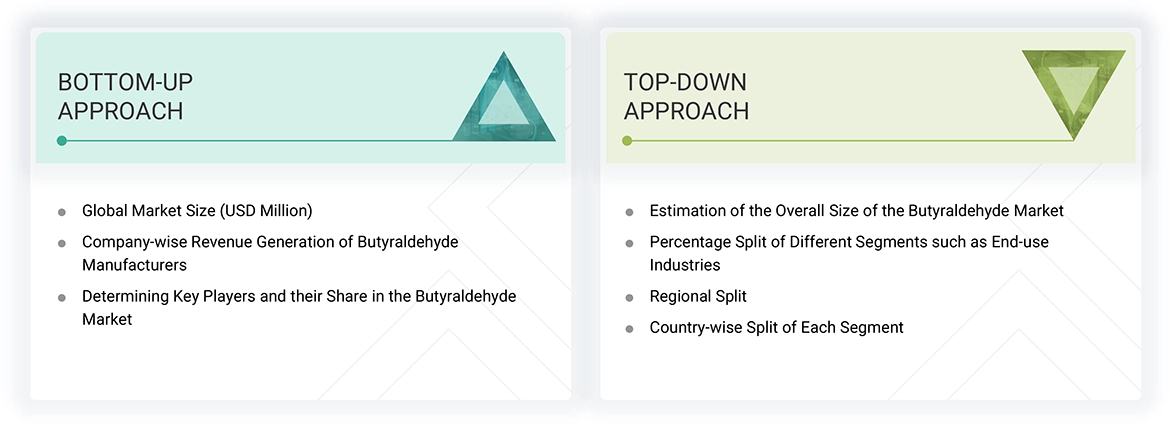
The study involves two main activities to estimate the current market size for butyraldehyde. Extensive secondary research was conducted to gather information on the overall, related, and parent markets. The next step was to validate these findings, assumptions, and estimates with industry experts across the value chain through primary research. Both top-down and bottom-up approaches were used to determine the total market size. Then, market segmentation and data triangulation were applied to estimate the sizes of segments and subsegments.
Secondary Research
Secondary sources used for this research include financial statements of companies offering butyraldehyde and information from various trade, business, and professional associations. Secondary research has been utilized to gather critical information about the value chain, the total pool of key players, market classification, and segmentation based on industry trends at the most detailed level, including regional markets. The secondary data was collected and analyzed to determine the overall size of the butyraldehyde market, which primary respondents validated.
Primary Research
Extensive primary research was performed after gathering information on the butyraldehyde market through secondary research. Several interviews were conducted with market experts from both the demand and supply sides across key countries in North America, Europe, Asia Pacific, the Middle East & Africa, and South America. Data was collected via questionnaires, emails, and phone calls. From the supply side, sources included industry professionals such as Chief X Officers (CXOs), Vice Presidents (VPs), Directors of business development, marketing, product development/innovation teams, and other key executives from vendors, material providers, distributors, and opinion leaders in the butyraldehyde industry. These interviews provided insights into market statistics, revenue data from products and services, market segmentation, market size estimates, forecasts, and data triangulation. They also helped identify trends related to product types, applications, end-use industries, and regions. Stakeholders from the demand side, including CIOs, CTOs, CSOs, and installation teams from end-user companies seeking butyraldehyde, were interviewed to gain their perspectives on suppliers, product offerings, component providers, current usage, and future outlooks, which influence the overall market.
Breakup of Primary Research
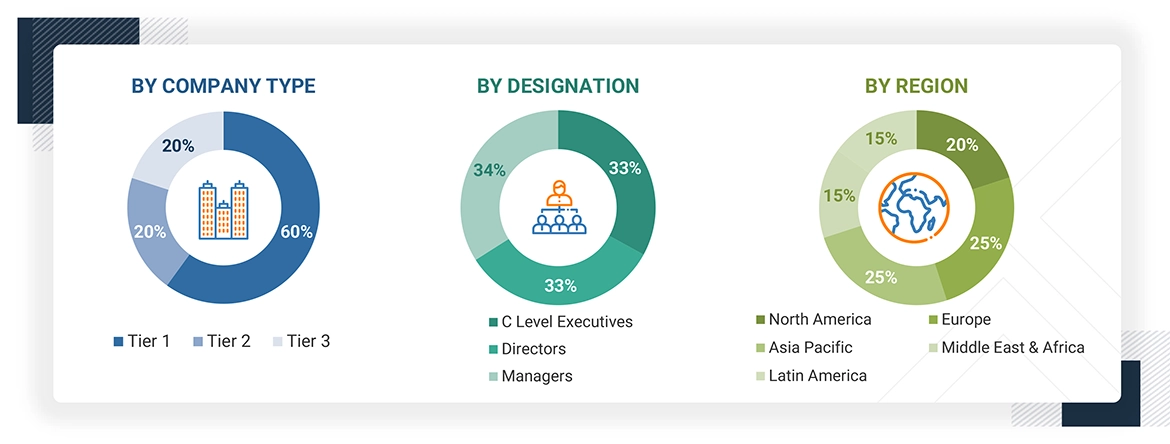
To know about the assumptions considered for the study, download the pdf brochure
Market Size Estimation
The research methodology used to estimate the size of the butyraldehyde market includes the following details. The market sizing was conducted from the demand side. The market expanded based on the demand for butyraldehyde in different end-use industries at a regional level. Such procurements provide information on the demand aspects of the butyraldehyde industry for each application. For each end-use, all possible segments of the butyraldehyde market were integrated and mapped.
Data Triangulation
After determining the overall size from the market size estimation process described above, the total market was divided into various segments and subsegments. The data triangulation and market breakdown methods outlined below were applied, where applicable, to complete the overall market analysis and determine precise statistics for different market segments and subsegments. The data was triangulated by examining various factors and trends from both the demand and supply sides. Additionally, the market size was validated using both the top-down and bottom-up approaches.
Market Definition
Butyraldehyde, also called butanal, is a colorless, flammable liquid aldehyde with the chemical formula C4H8O. It is an important intermediate in organic synthesis and serves as a core building block in many industrial processes. Made mainly through propylene hydroformylation (oxo process), butyraldehyde has a strong odor and is highly reactive due to its aldehyde group. Its versatility is important as a precursor for producing chemicals like 2-ethylhexanol, n-butanol, trimethylolpropane, and various plasticizers and resins. These derivatives are key components in products such as coatings, adhesives, lubricants, and solvents. Butyraldehyde plays a crucial role in supply chain integration in the global chemical industry, especially in petrochemical and specialty chemical markets. Its demand is closely linked to economic trends and sectors like automotive, construction, and consumer goods.
Stakeholders
- Butyraldehyde manufacturers
- Butyraldehyde distributors and suppliers
- End-use industries
- Universities, governments, and research organizations
- Associations and industrial bodies
- R&D institutes
- Environmental support agencies
- Investment banks and private equity firms
- Research and consulting firms
Report Objectives
- To define, describe, and forecast the butyraldehyde market size in terms of volume and value
- To provide detailed information regarding the key factors, such as drivers, restraints, opportunities, and challenges influencing market growth
- To analyze and project the global butyraldehyde market based on product type, application, end-use industry, and region
- To forecast the market size concerning five main regions (along with country-level data), namely, North America, Europe, Asia Pacific, Middle East & Africa, and South America, and analyze the significant region-specific trends
- To strategically analyze micromarkets with respect to individual growth trends, prospects, and contributions of the submarkets to the overall market
- To analyze the market opportunities and the competitive landscape for stakeholders and market leaders
- To assess recent market developments and competitive strategies, such as agreements, contracts, acquisitions, and new product developments/new product launches, to draw the competitive landscape
- To strategically profile the key market players and comprehensively analyze their core competencies
Get the Full Butyraldehyde Market Report
Full forecast, segment splits, and company analysis for all Butyraldehyde Market.
- US Butyraldehyde Market
- Mexico Butyraldehyde Market
- Germany Butyraldehyde Market
- UK Butyraldehyde Market
- France Butyraldehyde Market
- Italy Butyraldehyde Market
- Spain Butyraldehyde Market
- China Butyraldehyde Market
- Japan Butyraldehyde Market
- India Butyraldehyde Market
- South Korea Butyraldehyde Market
- South Africa Butyraldehyde Market
- Brazil Butyraldehyde Market
- Argentina Butyraldehyde Market
- Rest Of Europe Butyraldehyde Market
- Rest Of Asia Pacific Butyraldehyde Market
- GCC Countries Butyraldehyde Market
- –Rest Of The GCC Countries Butyraldehyde Market
- Rest Of South America Butyraldehyde Market
Need a Tailored Report?
Customize this report to your needs
Get 10% FREE Customization
Customize This Report
