
Asia Pacific Cabin Management System Market (2024-2029)

The Asia Pacific Cabin Management System Market was valued at $179 Million in 2024 and projected to reach to $244.5 Million by 2029, representing a compound annual growth rate of 6.4%. The Asia Pacific cabin management system market is poised for sustained expansion through 2029, driven by increasing aircraft deliveries and retrofit programs across the region's rapidly growing airline sector.


| Market Size in | USD 26.32 MN |
| Market Forecast in | |
| CAGR | |
| Forecast Period | |
| Units Considered | Value (USD MN) |
Asia Pacific Cabin Management System Market Trends and Insights
- Asia Pacific's cabin management systems are increasingly critical as regional airlines modernize fleets and enhance passenger experience through advanced in-flight entertainment, lighting, and climate control integration.
- The region's growth trajectory reflects rising air travel demand, expanding middle-class populations, and significant investments in aerospace infrastructure across emerging economies. Asia Pacific's 6.4% CAGR outpaces the global average, driven by fleet expansion among carriers in China, India, and Southeast Asia.
- The market benefits from regulatory mandates for enhanced cabin safety systems and growing adoption of connected aircraft technologies.
- Asia Pacific's competitive landscape features both established aerospace suppliers and emerging regional players capitalizing on cost-effective manufacturing and localized support services. By 2029, Asia Pacific is expected to solidify its position as a high-growth region within the global cabin management ecosystem, supported by continued urbanization, rising disposable incomes, and modernization of aging aircraft across the region..
Key Market Statistics
- CAGR (2024-2029) 6.4% CAGR
- Market Size, 2024 ~USD 179 Million
- Forecast, 2029 ~USD 244.5 Million
- Geography Asia Pacific
Asia Pacific Cabin Management System Market Overview
Market Valuation & Growth :
Asia Pacific cabin management system market valued at $179.0 million in 2024, expanding at 6.4% CAGR to reach $244.5 million by 2029, outpacing the global growth rate of 6.2%.
Fleet Modernization Drivers :
Regional airlines across Asia Pacific are accelerating fleet upgrades to enhance passenger experience through integrated in-flight entertainment, advanced lighting systems, and smart climate control technologies.
Key Market Contributors :
China leads the region with $106.6 million market share, followed by Japan ($45.9 million) and South Korea ($28.5 million), reflecting strong aerospace manufacturing and airline expansion in these economies.
Passenger Experience Focus :
Growing emphasis on premium cabin amenities and digital connectivity is driving adoption of sophisticated cabin management systems among Asia Pacific carriers competing for international routes.
Asia Pacific Cabin Management System Market Dynamics
- Rising passenger expectations for enhanced in-flight comfort and connectivity are compelling carriers to invest in modern cabin technologies.
- China's dominance in aerospace manufacturing and Japan's technological innovation create a competitive ecosystem fostering system advancement. Regional economic growth, expanding middle-class travel demand, and government support for aviation infrastructure development will continue accelerating market penetration.
- Airlines are prioritizing integrated cabin solutions that optimize fuel efficiency and operational costs while delivering superior passenger experiences, positioning Asia Pacific as a critical growth engine for the global cabin management system market..
Market Ecosystem
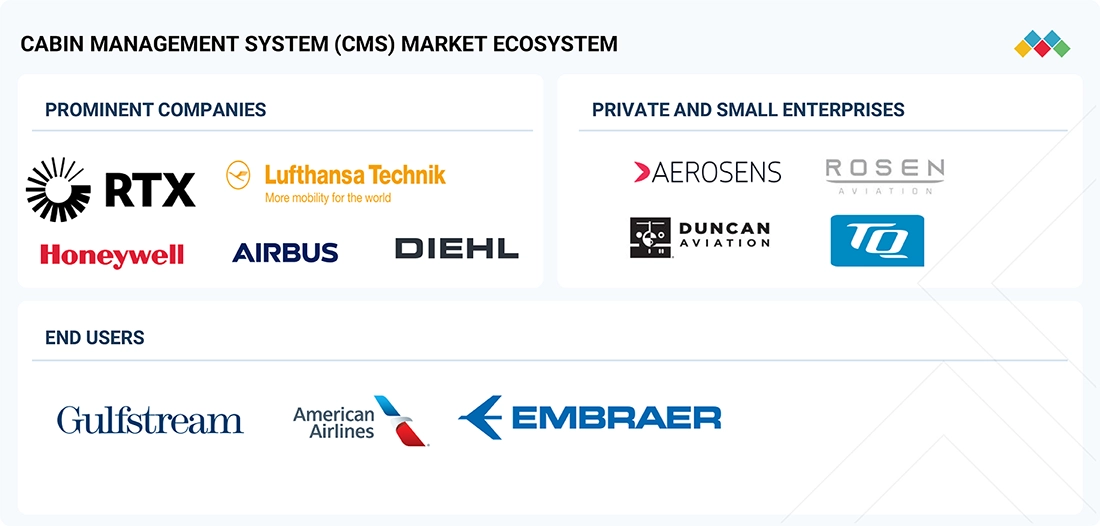
Cabin Management System Market: COMMERCIAL USE CASES ACROSS INDUSTRIES
| COMPANY | USE CASE DESCRIPTION | BENEFITS |
|---|---|---|
 |
Advanced cabin control and environmental monitoring systems for commercial fleets. | Enhances passenger comfort and operational reliability with integrated sensing. |
 |
Connected cabin platforms with automated lighting, entertainment, and air quality control. | Improves passenger experience while reducing maintenance and power consumption. |
 |
Cabin upgrades, IFE/CMS retrofit solutions for airlines and VIP aircraft. | Extends fleet lifecycle and supports customized premium cabin layouts. |
 |
Integrated CMS in new-build aircraft aligned with digital cabin ecosystems. | Drives seamless connectivity and data analytics for efficiency and service innovation. |
 |
Modular cabin control units and lighting solutions for OEM and retrofit markets. | Enables lightweight, scalable configurations that reduce cost and support future upgrades. |
Logos and trademarks shown above are the property of their respective owners. Their use here is for informational and illustrative purposes only.
Related Ecosystem
Aviation
- Narrow Body Aircraft
- Wide Body Aircraft
- Military Helicopters
- Special Mission Aircraft
- Fighter Aircraft
- HONEYWELL INTERNATIONAL INC.
- COLLINS AEROSPACE
- Thales group
- Safran group
- HEICO Corporation
Key Takeaways
- Asia Pacific's cabin management system market will grow from $179.0M (2024) to $244.5M (2029) at a 6.4% CAGR, outpacing global growth rates.
- Rising air travel demand and fleet modernization across China, India, and Southeast Asia are primary growth catalysts for Asia Pacific.
- Asia Pacific airlines are increasingly adopting integrated cabin management solutions for enhanced passenger experience and operational efficiency.
- Regulatory compliance and connected aircraft technologies are driving investment in advanced cabin management systems throughout Asia Pacific.
Cabin Management System Market Report Scope
| Report Metric | Details |
|---|---|
| Base Year | 2024 |
| Fastest Growing Segment | NARROW-BODY AIRCRAFT (Aircraft Type) |
| Forecast Period | 2024–2029 |
| Growth Rate | CAGR of 6.2% from 2024 to 2029 |
| Largest Segment | LINEFIT (End User) |
| Market Size Base Year (Billions) | ~USD 1.39 (2024) |
| Revenue Forecast (Billions) | ~USD 1.88 (2029) |
| Segments Covered | Aircraft Type, Solution, Type, End User |
Asia Pacific Cabin Management System Market Report Segmentation
4 segment dimensions are covered across the global market.
By Aircraft Type
- Business Jets
- Narrow-Body Aircraft
- Regional Transport Aircraft
- Wide-Body Aircraft
By Solution
- Audio/Video System Units
- Cabin Management Software
- Cabin Management Units And Servers
- Control Panels And Interfaces
- Network And Connectivity
By Type
- Crew Control Panels
- Passenger Control Units (Pcus)
- – Centralized Control Panels
- – Galley Control Panels
- – Overhead Control Panels
- – Passenger Service Units (Psus)
- – Switch Panels
By End User
- Linefit
- Retrofit
Target Audience
- Aerospace OEMs & Suppliers : Cabin system manufacturers and aerospace suppliers need Asia Pacific market data to identify regional demand patterns, customize product offerings, and prioritize manufacturing investments in high-growth markets like China and India.
- Airlines & Fleet Operators : Regional and international carriers operating in Asia Pacific require market insights to benchmark cabin system investments, evaluate technology trends, and plan fleet modernization strategies aligned with passenger expectations.
- Investment & Private Equity Firms : Investors evaluating aerospace and aviation technology opportunities need Asia Pacific market analysis to assess growth potential, identify acquisition targets, and understand regional market dynamics and competitive positioning.
- Technology & Systems Integrators : Cabin management system developers and integrators need regional market intelligence to understand Asia Pacific adoption rates, competitive landscape, and emerging technology requirements for IFE and climate control systems.
- Government & Aviation Authorities : Regional aviation regulators and government agencies require market data to inform infrastructure planning, support domestic aerospace industry development, and understand modernization trends across Asia Pacific airlines.
Key Companies in the Asia Pacific Cabin Management System Market
| Company | HQ | Ownership | Strongest segments |
|---|---|---|---|
| RTX | United States | Public Company | Collins Aerospace (avionics, interiors, mission systems, aftermarket),Pratt & Whitney (commercial and military engines, APU, MRO),Raytheon (sensors, effectors, command-and-control, space), |
| HONEYWELL INTERNATIONAL INC. | United States | Public Company | Industrial Automation,Building Automation,Energy and Sustainability Solutions (UOP and related), |
| AIRBUS | United States | Public Company | Commercial aircraft (Airbus segment),Helicopters,Defence and military air systems, |
| ASTRONICS CORPORATION | United States | Public Company | Aerospace – Lighting and Safety Systems,Aerospace – Electrical Power Generation and Distribution,Aerospace – Structures, Avionics, Seat Motion, Certification and Other, |
| BAE SYSTEMS | United Kingdom | Public Company | Electronic Systems,Air,Maritime, |
| PANASONIC CORPORATION | Japan | Public Company | Energy (cylindrical in-vehicle batteries, storage systems, dry and secondary batteries),HVAC & CC (air-conditioners, heat-pump water heaters, ventilation, showcases, commercial refrigeration),Electric Works and housing (lighting, wiring devices, solar PV, fuel cells, kitchen/bath, interior/exterior materials), |
RTX
RTX is a United States-based public company founded in 1934 that employs 180,000 people. The company operates as a major aerospace and defense contractor.
HONEYWELL INTERNATIONAL INC.
Honeywell International Inc. is a United States-based public company founded in 1885 with 101,000 employees. The company is a diversified technology and manufacturing conglomerate.
AIRBUS
Airbus is a United States-based public company founded in 1998 with 166,876 employees. The company operates as a major aerospace and aircraft manufacturing enterprise.
ASTRONICS CORPORATION
Astronics Corporation is a United States-based public company founded in 1968 with 2,700 employees. The company supplies aerospace and defense systems and components.
BAE SYSTEMS
BAE Systems is a United Kingdom-based public company founded in 1979 with 111,400 employees. The company is a major aerospace, defense, and security contractor.
PANASONIC CORPORATION
Panasonic Corporation is a Japan-based public company founded in 1918 with 183,685 employees. The company is a diversified electronics and technology manufacturer.
Countries within Asia Pacific - compare and drill down
| Country | 2025 size (native) |
|---|---|
| China | USD 106.6 Million |
| India | USD 17.2 Million |
| Japan | USD 45.9 Million |
| South Korea | USD 28.5 Million |
| Australia | USD 23.9 Million |
| Rest Of Asia Pacific | USD 22.5 Million |
Country market size visualization
Reasons to Buy this Report
- Regional Market Intelligence : Gain detailed insights into Asia Pacific's $179 million cabin management market with country-level breakdowns for China, Japan, India, South Korea, and Australia to identify high-growth opportunities.
- Competitive Landscape Analysis : Understand competitive positioning across Asia Pacific's rapidly modernizing airline sector and identify key players driving cabin system adoption in the region's expanding fleet.
- Growth Trajectory Forecasting : Access 5-year projections showing 6.4% CAGR growth to $244.5 million by 2029, enabling strategic planning for market entry and expansion in Asia Pacific's high-growth aviation sector.
- Technology Adoption Trends : Discover emerging cabin technology preferences specific to Asia Pacific airlines, including integrated IFE systems, smart lighting, and climate control solutions driving regional market demand.
- Investment Decision Support : Make informed investment and partnership decisions with comprehensive market sizing, growth drivers, and regional dynamics specific to Asia Pacific's cabin management system ecosystem.
Frequently asked questions
What is the current market size of cabin management systems in Asia Pacific?
The Asia Pacific cabin management system market was valued at $179.0 million in 2024 and is expected to reach $244.5 million by 2029.
What is the projected growth rate for Asia Pacific's cabin management system market?
Asia Pacific's cabin management system market is projected to grow at a compound annual growth rate (CAGR) of 6.4% from 2024 to 2029.
Which countries are driving growth in Asia Pacific's cabin management system market?
China, India, and Southeast Asian nations are primary growth drivers in Asia Pacific, supported by fleet expansion and modernization initiatives among regional carriers.
What factors are accelerating cabin management system adoption in Asia Pacific?
Key drivers include rising air travel demand, regulatory mandates for enhanced safety systems, connected aircraft technology adoption, and passenger experience enhancement initiatives across Asia Pacific airlines.
How does Asia Pacific's growth compare to the global cabin management system market?
Asia Pacific's 6.4% CAGR exceeds the global average of 6.2%, positioning the region as a high-growth market within the aerospace and defence industry.
RESEARCH METHODOLOGY
The research study conducted on the Cabin Management System market involved the extensive use of secondary sources, directories, and databases, such as D&B Hoovers, Bloomberg, and Factiva, to identify and collect relevant information. Primary sources included industry experts from the market as well as suppliers, manufacturers, solution providers, technology developers, alliances, and organizations related to all segments of the value chain of this industry. In-depth interviews of various primary respondents, including key industry participants, subject matter experts (SMEs), industry consultants, and C-level executives, were conducted to obtain and verify critical qualitative and quantitative information pertaining to the market as well as assess the growth prospects of the market. A deductive approach, also known as the bottom-up approach combined with the top-down approach, was used to forecast the market size of different market segments.
Secondary Research
The share of companies in the Cabin Management System market was determined based on secondary data made available through paid and unpaid sources and an analysis of the product portfolios of major companies. These companies were rated based on their performance and quality. These data points were further validated by primary sources. Secondary sources for this research study included corporate filings, such as annual reports, investor presentations, and financial statements from trade, business, and professional associations. The secondary data was collected and analyzed to arrive at the overall market size, which was further validated by primary respondents.
Primary Research
Extensive primary research was conducted after obtaining information about the current scenario of the Cabin Management System market through secondary research. Several primary interviews were conducted with market experts from both, the demand and supply sides across different regions. This primary data was collected through questionnaires, emails, and telephonic interviews.
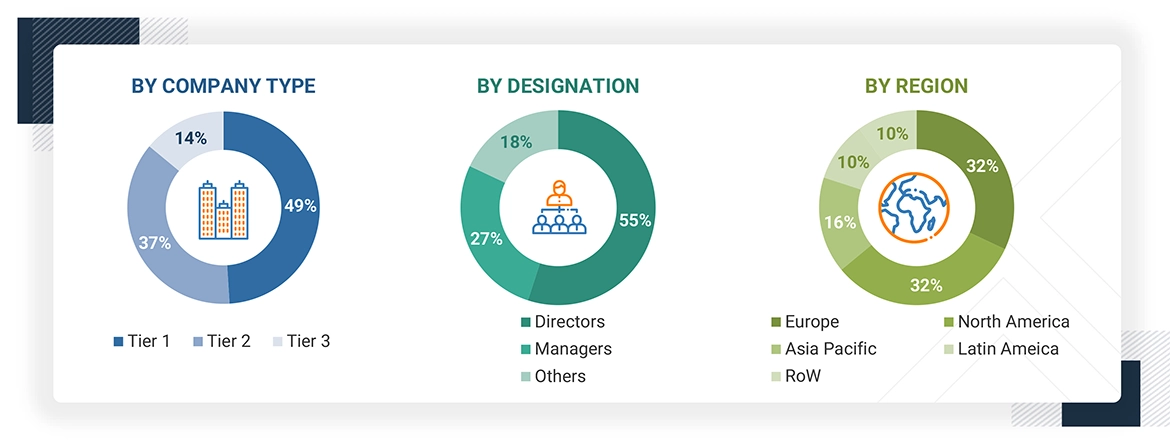
Note: Tiers of companies are based on their revenue in 2023. Tier 1: company revenue greater than USD 1 billion; tier 2: company revenue between USD 100 million and USD 1 billion; and tier 3: company revenue less than USD 100 million.
To know about the assumptions considered for the study, download the pdf brochure
Market Size Estimation
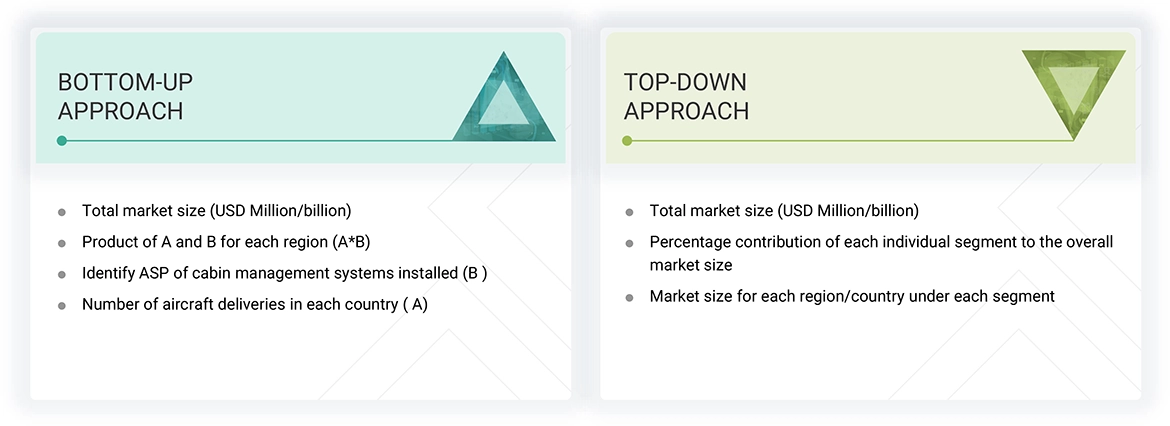
The top-down and bottom-up approaches were used to estimate and validate the size of the Cabin Management System market. The research methodology used to estimate the market size includes the following details.
Key players in the market were identified through secondary research, and their market share was determined through primary and secondary research. This included a study of the annual and financial reports of top market players and extensive interviews with industry stakeholders such as CEOs, technical advisors, military experts, and SMEs of leading companies operating in the Cabin Management System market.
All percentage shares, splits, and breakdowns were determined using secondary sources and verified through primary sources. All possible parameters that affect the markets covered in this research study were accounted for, viewed in extensive detail, verified through primary research, and analyzed to obtain the final quantitative and qualitative data on the Cabin Management System market. This data was consolidated, enhanced with detailed inputs, analyzed by MarketsandMarkets, and presented in this report.
Cabin Management System Market : Top-Down and Bottom-Up Approach
Data Triangulation
After arriving at the overall size of the Cabin Management System market from the estimation process explained above, the total market was split into several segments and subsegments. The data triangulation and market breakdown procedures explained below were implemented, wherever applicable, to complete the overall market engineering process and arrive at the exact statistics for various market segments and subsegments. The data was triangulated by studying various factors and trends from the demand and supply sides. Along with this, the Cabin Management System market size was validated using the top-down and bottom-up approaches.
Market Definition
Cabin management systems (CMS) is an integrated solution that co-ordinates and controls of various cabin environmental functions such as temperature, lighting, galley services, wastewater, and window shades. Additionally, they include in-flight entertainment (IFE), which provides audio, video, interfaces to personal electronic devices, access to media content storage (audio & video files), satellite TV, moving map equipment, and access to long-range satellite communications and internet connectivity.
Key Stakeholders
- Cabin Management System Manufacturers
- Aircraft Manufacturers
- MRO Providers
- Technology Support Providers
- Related Research Bodies
- Cabin Management System Integrators
- Airline Operator
Report Objectives
- To define, describe, segment, and forecast the size of the Cabin Management System market based on aircraft type, solution, end user, and region.
- To forecast sizes of various segments of the market with respect to six major regions, namely, North America, Europe, Asia Pacific, Middle East, Latin America and Africa, along with major countries in each of these regions.
- To identify and analyze key drivers, restraints, opportunities, and challenges influencing the growth of the market across the globe.
- To identify industry trends, market trends, and technology trends that are currently prevailing in the market.
- To provide an overview of the regulatory landscape with respect to Cabin Management System regulations across regions.
- To analyze micro markets with respect to individual growth trends, prospects, and their contribution to the overall market.
- To analyze opportunities in the market for stakeholders by identifying key market trends.
- To profile key market players and comprehensively analyze their market shares and core competencies.
- To analyze the degree of competition in the market by identifying key growth strategies, such as acquisitions, product launches, contracts, and partnerships, adopted by leading market players.
- To identify detailed financial positions, key products, and unique selling points of leading companies in the market.
- To provide a detailed competitive landscape of the market, along with market ranking analysis, market share analysis, and revenue analysis of key players.
Available Customizations
Along with the market data, MarketsandMarkets offers customizations as per the specific needs of companies. The following customization options are available for the report:
Product Analysis
- Product matrix, which gives a detailed comparison of the product portfolio of each company
Regional Analysis
- Further breakdown of the market segments at country-level
Regional Analysis
- Detailed analysis and profiling of additional market players (up to 5)
Get the Full Cabin Management System Market Report
Full forecast, segment splits, and company analysis for all Cabin Management System Market.
- Italy Cabin Management System Market
- Spain Cabin Management System Market
- China Cabin Management System Market
- India Cabin Management System Market
- Japan Cabin Management System Market
- South Korea Cabin Management System Market
- Australia Cabin Management System Market
- Brazil Cabin Management System Market
- Mexico Cabin Management System Market
- UAE Cabin Management System Market
- Saudi Arabia Cabin Management System Market
- Qatar Cabin Management System Market
- South Africa Cabin Management System Market
- Egypt Cabin Management System Market
- Rest Of Europe Cabin Management System Market
- Rest Of Asia Pacific Cabin Management System Market
- Rest Of Latin America Cabin Management System Market
- Rest Of Middle East Cabin Management System Market
- Rest Of Africa Cabin Management System Market
- Canada Cabin Management System Market
- US Cabin Management System Market
- UK Cabin Management System Market
- France Cabin Management System Market
- Germany Cabin Management System Market
Need a Tailored Report?
Customize this report to your needs
Get 10% FREE Customization
Customize This Report
