
US Cell-free Protein Synthesis Market (2025-2030)

The US Cell-free Protein Synthesis Market was valued at $0.97 Million in 2025 and projected to reach to $1.45 Million by 2030, representing a compound annual growth rate of 7.1%. The US cell-free protein synthesis market is positioned for sustained growth driven by increasing adoption in pharmaceutical development and synthetic biology research.


| Market Size in | USD 26.32 MN |
| Market Forecast in | |
| CAGR | |
| Forecast Period | |
| Units Considered | Value (USD MN) |
US Cell-free Protein Synthesis Market Trends and Insights
- The US market benefits from strong biotechnology infrastructure, significant R&D investment, and growing adoption of cell-free systems in pharmaceutical development and synthetic biology applications.
- In 2025, the US represents a mature yet expanding segment within the broader North American market, driven by increasing demand for rapid prototyping and cost-effective protein production methods. By 2030, the US cell-free protein synthesis market is expected to capture greater market share as regulatory frameworks evolve and commercial applications scale.
- The US pharmaceutical and biotech sectors are increasingly leveraging cell-free platforms for vaccine development, therapeutic protein engineering, and personalized medicine initiatives.
- This growth trajectory reflects the US market's position as a leader in innovation-driven healthcare solutions and its commitment to advancing next-generation protein synthesis technologies..
Key Market Statistics
- CAGR (2025-2030) 7.1% CAGR
- Market Size, 2025 ~USD 0.97 Million
- Forecast, 2030 ~USD 1.45 Million
- Country US
US Cell-free Protein Synthesis Market Overview
Market Valuation :
The US cell-free protein synthesis market is valued at $0.97 million in 2025, with projections to reach $1.45 million by 2030, representing steady growth in the biotechnology sector.
Strong R&D Infrastructure :
The US benefits from world-leading biotechnology research institutions, substantial federal funding through NIH and NSF, and a robust ecosystem of biotech companies driving innovation in cell-free systems.
Pharmaceutical Development Applications :
US pharmaceutical companies are increasingly adopting cell-free protein synthesis for rapid drug development, vaccine production, and therapeutic protein manufacturing, reducing time-to-market.
Synthetic Biology Growth :
Expanding synthetic biology initiatives across US academic institutions and biotech startups are accelerating demand for cell-free protein synthesis platforms in research and commercial applications.
US Cell-free Protein Synthesis Market Dynamics
- Strong biotechnology infrastructure, coupled with significant private and public R&D investments, supports market expansion.
- The 7.1% CAGR reflects growing recognition of cell-free systems' advantages in speed, cost-efficiency, and flexibility compared to traditional cell-based protein production methods. Looking ahead, the US market will benefit from emerging applications in personalized medicine, rapid vaccine development, and industrial biotechnology.
- Continued technological advancements, declining production costs, and strategic partnerships between academic institutions and biotech companies will further accelerate adoption.
- The market is expected to attract increased venture capital investment and corporate interest through 2030..
Market Ecosystem
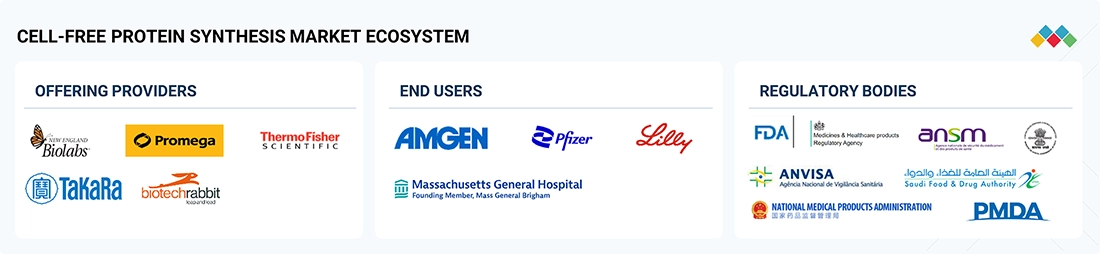
Cell-free Protein Synthesis Market: COMMERCIAL USE CASES ACROSS INDUSTRIES
| COMPANY | USE CASE DESCRIPTION | BENEFITS |
|---|---|---|
 |
Boehringer scaled CFPS from small-scale to a 4,500?L GMP batch in Vienna using Sutro’s modular platform, enabling site-specific protein conjugation with non-natural amino acids | First demonstration of CFPS at commercial scale | Efficient, flexible production of complex biologics | High-quality batches meeting GMP standards for clinical trials |
 |
Development of high-fidelity conjugate vaccines (e.g., VAX-31 and VAX-24 pneumococcal conjugate vaccines) using XpressCF, a cell-free protein synthesis platform licensed exclusively from Sutro Biopharma | Enhanced flexibility in vaccine design without compromising safety or efficacy | Reduced dependence on limitations of traditional cell-based expression, enabling faster, scalable vaccine production |
Logos and trademarks shown above are the property of their respective owners. Their use here is for informational and illustrative purposes only.
Related Ecosystem
Biotechnology
- Reagents
- Polymerase Chain Reaction (PCR)
- Stem Cells
- Assay Kits
- Flow Cytometers
- Thermo Fisher Scientific Inc.
- Merck KGaA
- Danaher Corporation
- Agilent Technologies, Inc.
- Bio-Rad Laboratories, Inc.
Key Takeaways
- The US cell-free protein synthesis market is valued at $0.97 million in 2025 and will reach $1.45 million by 2030 at a 7.1% CAGR.
- The US market is driven by robust biotech R&D spending, regulatory support, and adoption in vaccine and therapeutic protein development.
- The US pharmaceutical sector is increasingly integrating cell-free systems for rapid prototyping and cost optimization.
- By 2030, the US market is expected to lead North American growth as commercial applications and regulatory pathways mature.
Cell-free Protein Synthesis Market Report Scope
| Report Metric | Details |
|---|---|
| Base Year | 2025 |
| Fastest Growing Segment | SERVICES (Offerings) |
| Forecast Period | 2025–2030 |
| Growth Rate | CAGR of 7.3% from 2025 to 2030 |
| Largest Segment | PRODUCT (Offerings) |
| Market Size Base Year (Billions) | ~USD 0.22 (2025) |
| Revenue Forecast (Billions) | ~USD 0.31 (2030) |
| Segments Covered | Offerings, Type, Workflow, Method, Application, End User |
US Cell-free Protein Synthesis Market Report Segmentation
6 segment dimensions are covered across the global market.
By Offerings
- Product
- Services
By Type
- Cell Extracts & Expression Systems
- Instruments
- Kits & Reagents
By Workflow
- Protein Folding/Post-Translational Modifications
- Reaction Setup
- Recovery & Purification
- Template Preparation
- Transcription & Translation
- Validation & Analysis
By Method
- Coupled Transcription–Translation (Tx/Tl) System
- Transcription & Translation
By Application
- Enzyme Engineering
- High Throughput Production
- Protein Labeling
- Protein Purification
- Protein-Protein Interaction
By End User
- Academic Research Institutes
- Cros & Cdmos
- Diagnostic Companies
- Pharmaceutical & Biotechnology Companies
US: CELL-FREE PROTEIN SYNTHESIS MARKET, BY APPLICATION, 2023–2030
| Segment | 2023 | 2024 | 2025 | 2026 | 2027 | 2028 | 2029 | 2030 | CAGR (%) |
|---|---|---|---|---|---|---|---|---|---|
| ENZYME ENGINEERING | 20.5 | 21 | 22.7 | 24.5 | 26.4 | 28.6 | 31.1 | 33.9 | 8.4 |
| HIGH THROUGHPUT PRODUCTION | 17.7 | 18.1 | 19.3 | 20.6 | 22 | 23.5 | 25.2 | 27.2 | 7.1 |
| PROTEIN LABELING | 11.2 | 11.5 | 12.2 | 13 | 13.8 | 14.7 | 15.8 | 16.9 | 6.7 |
| PROTEIN PURIFICATION | 8.5 | 8.7 | 9.1 | 9.7 | 10.2 | 10.9 | 11.6 | 12.4 | 6.2 |
| PROTEIN–PROTEIN INTERACTION | 14.1 | 14.4 | 15.4 | 16.5 | 17.7 | 19.1 | 20.6 | 22.3 | 7.7 |
| TOTAL | 72 | 73.8 | 78.7 | 84.2 | 90.2 | 96.8 | 104.3 | 112.7 | 7.4 |
Target Audience
- US Pharmaceutical Companies : Need market data to evaluate cell-free protein synthesis adoption for drug development pipelines, assess competitive positioning, and identify partnership opportunities with technology providers.
- Biotech Startups and Entrepreneurs : Require market sizing and growth projections to support funding pitches, validate business models, and understand market timing for launching cell-free protein synthesis solutions in the US.
- Academic Research Institutions : Seek market intelligence to justify R&D investments, identify commercialization pathways for innovations, and understand industry adoption trends in synthetic biology and protein engineering.
- Investment and Venture Capital Firms : Need comprehensive US market analysis to identify investment opportunities, assess portfolio company positioning, and evaluate growth potential in the cell-free protein synthesis sector.
- Technology and Equipment Suppliers : Require US market data to develop targeted sales strategies, understand customer needs, forecast demand for equipment and reagents, and plan product development roadmaps for the American market.
Key Companies in the US Cell-free Protein Synthesis Market
| Company | HQ | Ownership | Strongest segments |
|---|---|---|---|
| THERMO FISHER SCIENTIFIC INC. | United States | Public Company | Life Sciences Solutions,Analytical Instruments,Specialty Diagnostics, |
| GENSCRIPT | Hong Kong | Public Company | Life Science Services and Products,Biologics Development Services,Industrial Synthetic Biology Products, |
| TAKARA BIO INC. | Japan | Private Company | Genetic and cellular research reagents,Instruments and cellular analysis devices,In vitro diagnostics (COVID-19 and related), |
| BIONEER CORPORATION | South Korea | Public Company | PCR and RT-PCR reagents and consumables,Real-time PCR instruments and conventional PCR instruments,Molecular diagnosis kits and MDx extraction kits, |
| SINO BIOLOGICAL, INC. | China | Public Company | Recombinant proteins,Antibodies (incl. multispecific and CAR-T/ADC related),cDNA clones, qPCR primers, and cell lysates, |
| KANEKA CORPORATION | Japan | Public Company | PVC and related vinyl polymers/additives,Engineering resins, films, foams, and thermal solutions,Healthcare, medical devices, and biopharma inputs, |
THERMO FISHER SCIENTIFIC INC.
Thermo Fisher Scientific Inc. is a publicly traded biotechnology company founded in 1956 in the United States with 125,000 employees.
GENSCRIPT
GenScript is a publicly traded biotechnology company founded in 2002 in Hong Kong with 6,165 employees.
TAKARA BIO INC.
Takara Bio Inc. is a private biotechnology company founded in 2002 in Japan with 1,779 employees.
BIONEER CORPORATION
Bioneer Corporation is a publicly traded biotechnology company founded in 1992 in South Korea with 392 employees.
SINO BIOLOGICAL, INC.
Sino Biological, Inc. is a publicly traded biotechnology company founded in 2016 in China with 1,069 employees.
KANEKA CORPORATION
Kaneka Corporation is a publicly traded company founded in 1949 in Japan with 11,762 employees.
Reasons to Buy this Report
- US-Specific Market Sizing : Obtain precise valuation data for the US market segment ($0.97M in 2025) with detailed forecasts through 2030, enabling accurate budget allocation and investment planning for US operations.
- Competitive Landscape Intelligence : Understand the competitive dynamics specific to the US market, including key players, market share distribution, and strategic positioning of domestic and international competitors in the American biotech sector.
- Regulatory and Infrastructure Insights : Gain comprehensive understanding of US regulatory environment, FDA approval pathways, and biotechnology infrastructure advantages that impact cell-free protein synthesis adoption and commercialization strategies.
- Growth Driver Analysis : Identify US-specific growth catalysts including pharmaceutical R&D trends, synthetic biology initiatives, academic partnerships, and venture capital investment patterns driving market expansion.
- Strategic Market Entry Planning : Develop informed go-to-market strategies for the US with actionable insights on customer segments, adoption barriers, technology preferences, and partnership opportunities specific to the American market.
Frequently asked questions
What is the current size of the US cell-free protein synthesis market?
The US cell-free protein synthesis market is valued at $0.97 million in 2025 and is expected to grow to $1.45 million by 2030.
What is the growth rate of the US cell-free protein synthesis market?
The US cell-free protein synthesis market is growing at a compound annual growth rate (CAGR) of 7.1% from 2025 to 2030.
What are the primary drivers of growth in the US market?
Key drivers include strong biotech R&D infrastructure, increasing adoption in vaccine and therapeutic protein development, regulatory support, and demand for rapid prototyping and cost-effective production methods.
Which applications are leading the US cell-free protein synthesis market?
Leading applications in the US include vaccine development, therapeutic protein engineering, synthetic biology research, and personalized medicine initiatives.
How does the US market compare to the global market?
The US market is a significant contributor to the global cell-free protein synthesis market, with a 7.1% CAGR compared to the global 7.3% CAGR, reflecting its mature and innovation-driven position.
RESEARCH METHODOLOGY
This study primarily relied on secondary sources, directories, and databases to gather essential information for analyzing the global cell-free protein synthesis market. In-depth interviews were carried out with a range of primary respondents, including industry key players, subject-matter experts (SMEs), C-level executives, and industry consultants, to collect and validate both qualitative and quantitative data and evaluate market growth potential. The estimated global market size, based on secondary research, was cross-checked with primary research inputs to determine the final market size.
Secondary Research
Secondary research primarily involved gathering information for an extensive, technical market analysis of the cell-free protein synthesis industry. The sources included databases and organizations such as the National Center for Biotechnology Information (NCBI), National Institutes of Health (NIH), World Health Organization (WHO), Food and Drug Administration (FDA), European Medicines Agency (EMA), Pharmaceutical Research and Manufacturers of America (PhRMA), Centers for Disease Control and Prevention (CDC), European Federation of Biotechnology, PubMed, Protein Data Bank (PDB), The Protein Society (PS), along with Annual Reports, SEC Filings, Corporate Presentations, Press Releases, Company Websites, Journals, Research Publications, Expert Interviews, and MarketsandMarkets Analysis. These sources provided vital data on major companies, market classifications, segmentation by industry trends, regional and country markets, technological developments, and market dynamics.
Primary Research
Extensive primary research was conducted subsequent to acquiring foundational knowledge regarding the global cell-free protein synthesis market through secondary research. Multiple key interviews were performed with market experts from both the demand side—comprising personnel from pharmaceutical and biotechnology companies, hospitals, diagnostic laboratories, academic and research institutions, and medical device firms—and the supply side—including C-level and D-level executives, product managers, marketing, and sales managers from leading manufacturers, distributors, and channel partners across six principal regions: North America, Europe, Asia Pacific, Latin America, the Middle East, and Africa. Approximately 70% of these interviews involved representatives from the supply side, with the remaining conducted with demand-side participants. This initial data collection was accomplished through questionnaires, emails, online surveys, personal interviews, and phone communications.
The following is a breakdown of the primary respondents:
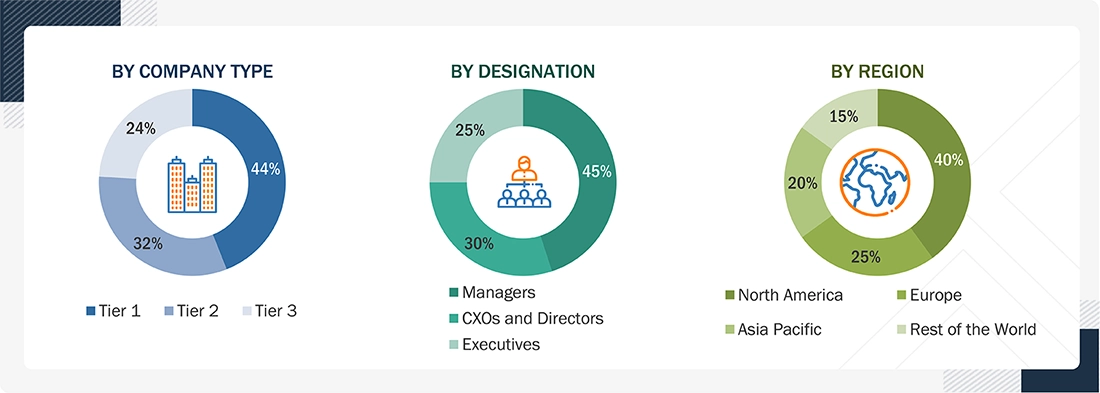
To know about the assumptions considered for the study, download the pdf brochure
Market Size Estimation
Both top-down and bottom-up approaches were employed to estimate and validate the total size of the cell-free protein synthesis market. These methods were also used extensively to assess the size of various subsegments within the market. The research methodology for estimating the market size includes the following:
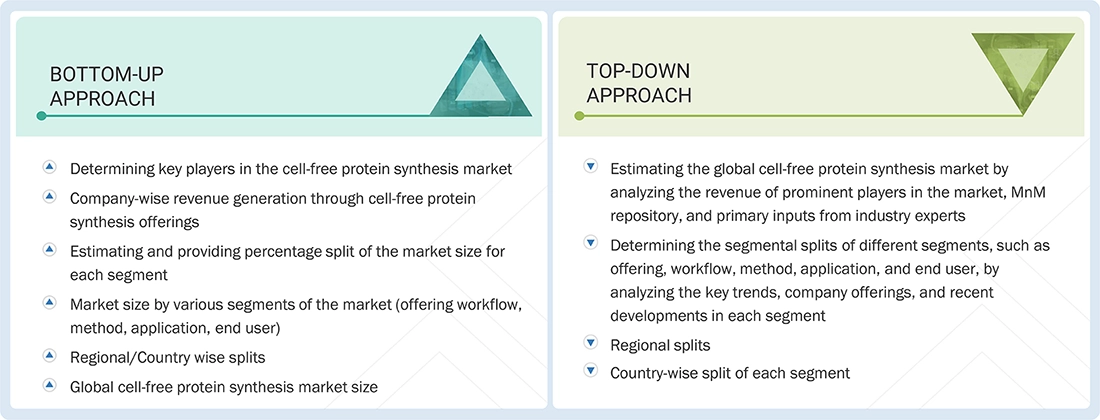
Data Triangulation
After determining the overall market size from the estimation process described above, the total market was segmented into various sections and sub-sections. To finalize the market analysis and obtain precise statistics for all segments and sub-segments, data triangulation and market breakdown methods were used whenever applicable.
Market Definition
Cell-free protein synthesis (CFPS) is a technique for producing proteins outside of living cells by using extracted biological machinery. It involves combining components necessary for transcription and translation—such as ribosomes, enzymes, tRNAs, amino acids, and energy sources—with a DNA or mRNA template in a cell-free environment. This setup allows for the direct and quick synthesis of the target protein. The cell-free protein synthesis market covered in this report includes products and services used in the protein synthesis process across various applications, including enzyme engineering, high-throughput production, protein labeling, purification, and protein-protein interaction studies.
Stakeholders
- Pharmaceutical and biotechnology companies
- Academic & research institutes
- Contract research organizations (CROs)
- Contract development and manufacturing organizations (CDMOs)
- Diagnostics companies
- Regulatory agencies
- Venture capitalists
- Government organizations
- Hospitals and diagnostic laboratories
Report Objectives
- To define, describe, and forecast the global cell-free protein synthesis market based on offerings, workflow, method, application, and end user, and region
- To provide detailed information regarding the major factors influencing the market growth (such as drivers, restraints, opportunities, and challenges)
- To strategically analyze micromarkets with respect to individual growth trends, prospects, and contributions to the overall market
- To analyze the opportunities in the market for stakeholders and provide details of the competitive landscape for market leaders
- To forecast the size of the market segments with respect to six main regions, namely, North America, Europe, Asia Pacific, Latin America, the Middle East, and Africa
- To profile key players in the global cell-free protein synthesis market and comprehensively analyze their core competencies and market share
- To track and analyze competitive developments such as product launches, expansions, agreements, partnerships, and collaborations in the cell-free protein synthesis market
- To benchmark players in the cell-free protein synthesis market using the “Company Evaluation Matrix” framework, which analyzes market players based on various parameters, including offerings portfolio, geographic reach, and market share
Get the Full Cell-free Protein Synthesis Market Report
Full forecast, segment splits, and company analysis for all Cell-free Protein Synthesis Market.
- Canada Cell-free Protein Synthesis Market
- Germany Cell-free Protein Synthesis Market
- UK Cell-free Protein Synthesis Market
- France Cell-free Protein Synthesis Market
- Italy Cell-free Protein Synthesis Market
- Spain Cell-free Protein Synthesis Market
- China Cell-free Protein Synthesis Market
- Japan Cell-free Protein Synthesis Market
- India Cell-free Protein Synthesis Market
- Australia Cell-free Protein Synthesis Market
- Brazil Cell-free Protein Synthesis Market
- Mexico Cell-free Protein Synthesis Market
- Roe Cell-free Protein Synthesis Market
- Roapac Cell-free Protein Synthesis Market
- S.Korea Cell-free Protein Synthesis Market
- Rest Of Latin America Cell-free Protein Synthesis Market
Need a Tailored Report?
Customize this report to your needs
Get 10% FREE Customization
Customize This Report
