
UAE Cellulose Ether & Derivatives Market (2026-2031)

The UAE Cellulose Ether & Derivatives Market was valued at $3156.1 Million in 2026 and projected to reach to $4223.5 Million by 2031, representing a compound annual growth rate of 6.0%. The UAE Cellulose Ether & Derivatives Market is poised for steady expansion, supported by the nation's diversified industrial base and strategic position as a regional manufacturing hub.


| Market Size in | USD 26.32 MN |
| Market Forecast in | |
| CAGR | |
| Forecast Period | |
| Units Considered | Value (USD MN) |
UAE Cellulose Ether & Derivatives Market Trends and Insights
- This water-soluble polymer derivative is widely utilized across food, pharmaceutical, cosmetic, and industrial applications due to its thickening, stabilizing, and emulsifying properties.
- Carboxymethyl Cellulose is projected to expand to USD 4,223.5 million by 2031, reflecting steady demand growth driven by increasing adoption in processed foods, personal care formulations, and specialty chemical applications. The growth trajectory of Carboxymethyl Cellulose is underpinned by rising consumer preference for natural and plant-based additives, coupled with stringent regulatory support for cellulose-derived ingredients.
- Carboxymethyl Cellulose maintains cost-effectiveness compared to synthetic alternatives, positioning it favorably in price-sensitive markets.
- Between 2026 and 2031, Carboxymethyl Cellulose is expected to benefit from expanding pharmaceutical and nutraceutical sectors, particularly in emerging economies where industrial modernization and consumer spending are accelerating..
Key Market Statistics
- CAGR (2026-2031) 6.0% CAGR
- Market Size, 2026 ~USD 3156.1 Million
- Forecast, 2031 ~USD 4223.5 Million
- Country UAE
UAE Cellulose Ether & Derivatives Market Overview
UAE Market Size & Growth :
The UAE Cellulose Ether & Derivatives Market is valued at USD 3,156.1 million in 2026, with a projected CAGR of 6.0% through 2031, reaching USD 4,223.5 million. This growth outpaces many regional markets, driven by robust industrial expansion and increasing demand across multiple sectors.
CMC Dominance in UAE Applications :
Carboxymethyl Cellulose (CMC) represents the primary product segment in the UAE market, leveraging the nation's strong food processing, pharmaceutical manufacturing, and cosmetics industries. CMC's versatile thickening and stabilizing properties make it essential for local producers serving both domestic and export markets.
Strategic Industrial Hub Position :
UAE's position as a regional manufacturing and distribution hub accelerates cellulose ether adoption. The country's advanced logistics infrastructure, free zones, and proximity to Middle Eastern markets create favorable conditions for cellulose ether producers and end-users to establish operations and expand market reach.
Diversified End-Use Sectors :
The UAE market benefits from diversified demand across food & beverage, pharmaceuticals, personal care, construction, and oil & gas industries. This sectoral diversity reduces market dependency on single industries and provides multiple growth pathways for cellulose ether derivatives through 2031.
UAE Cellulose Ether & Derivatives Market Dynamics
- Growing investments in food processing, pharmaceutical production, and cosmetics manufacturing are driving consistent demand for CMC and other cellulose derivatives.
- The 6.0% CAGR reflects moderate but sustainable growth, underpinned by increasing regulatory standards for product quality and performance in food and pharmaceutical applications. Looking ahead to 2031, the market will benefit from UAE's continued economic diversification initiatives and infrastructure development.
- Rising consumer demand for premium food products, coupled with expanding pharmaceutical manufacturing capacity, will sustain cellulose ether consumption.
- Additionally, growing adoption in construction and industrial applications, combined with increasing exports to neighboring GCC countries, positions the UAE market for resilient long-term growth through the forecast period..
Market Ecosystem
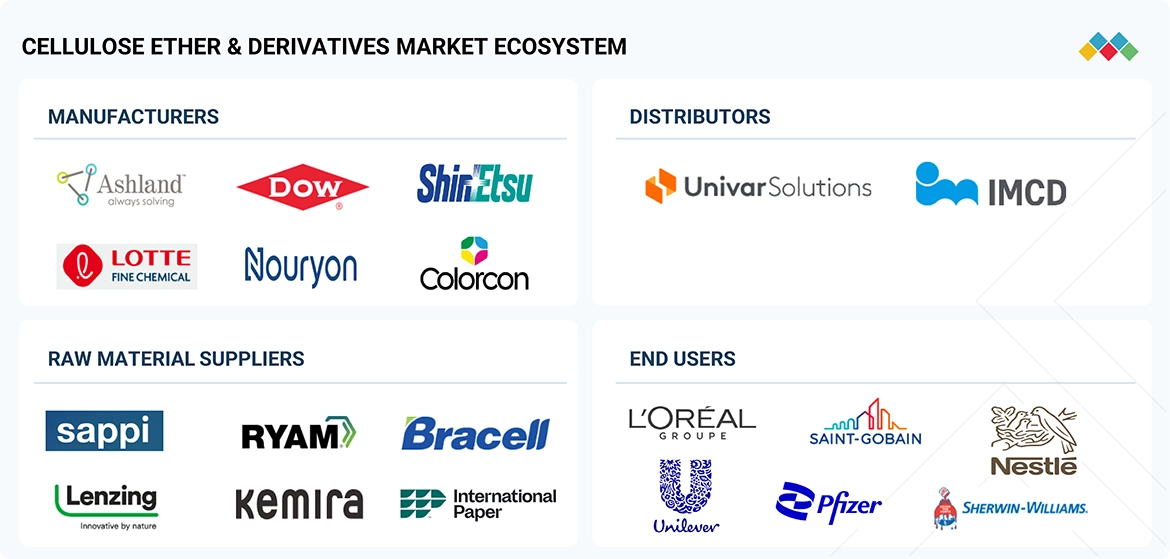
CELLULOSE ETHER & DERIVATIVES MARKET: COMMERCIAL USE CASES ACROSS INDUSTRIES
| COMPANY | USE CASE DESCRIPTION | BENEFITS |
|---|---|---|
 |
Uses cellulose ethers (HPMC, MHEC) in drymix mortars, tile adhesives, gypsum products, and cement-based formulations | Improved water retention, workability, adhesion strength, and crack resistance |
 |
Incorporates cellulose derivatives in detergents and personal care formulations | Stabilization, texture improvement, and product consistency |
 |
Uses pharmaceutical-grade HPMC and HPC in tablet coatings and controlled drug-release systems | Controlled release, binding efficiency, and formulation stability |
Logos and trademarks shown above are the property of their respective owners. Their use here is for informational and illustrative purposes only.
Related Ecosystem
Bulk Chemicals And Inorganics
- Corrosion Inhibitors
- Glycol Ethers
- Acetic Acid
- Acetone
- Ammonium Nitrate
- Basf se
- DOW CHEMICAL COMPANY
- Exxon Mobil Corporation
- AZELIS HOLDINGS SA
- Sinopec limited
Speciality Chemicals
- Corrosion Inhibitors
- Polyetheretherketone (PEEK)
- Acrylonitrile Butadiene Styrene (ABS)
- Epoxy Resin
- Polycarbonate
- Basf se
- DOW CHEMICAL COMPANY
- Evonik industries ag
- Clariant ag.
- Solvay sa
Fandb Additives
- Dairy Products
- Bakery Products
- Polyglycerol Esters
- Microorganism
- Carbohydrates
- AZELIS HOLDINGS SA
- Archer-Daniels-Midland Company
- Amway
- UNILEVER PLC
- DuPont de Nemours, Inc.
Key Takeaways
- Carboxymethyl Cellulose market is valued at USD 3,156.1 million in 2026 and is forecast to reach USD 4,223.5 million by 2031, representing a 6.0% CAGR.
- Carboxymethyl Cellulose demand is driven by its multifunctional properties as a thickener, stabilizer, and emulsifier across food, pharmaceutical, and cosmetic industries.
- Carboxymethyl Cellulose benefits from regulatory tailwinds favoring plant-based and natural additives, enhancing its competitive positioning against synthetic alternatives.
- Carboxymethyl Cellulose growth is accelerated by expansion in emerging markets where pharmaceutical, nutraceutical, and processed food sectors are experiencing rapid industrialization.
Cellulose Ether & Derivatives Market Report Scope
| Report Metric | Details |
|---|---|
| Base Year | 2026 |
| Fastest Growing Segment | HYDROXYETHYL, HYDROXYPROPYL, AND ETHYL CELLULOSE (Product Type) |
| Forecast Period | 2026–2031 |
| Growth Rate | CAGR of 6.8% from 2026 to 2031 |
| Largest Segment | METHYL CELLULOSE & DERIVATIVES (Product Type) |
| Market Size Base Year (Billions) | ~USD 11.85 (2026) |
| Revenue Forecast (Billions) | ~USD 16.47 (2031) |
| Segments Covered | Product Type, Product Derivatives, Application |
UAE Cellulose Ether & Derivatives Market Report Segmentation
3 segment dimensions are covered across the global market.
By Product Type
- Carboxymethyl Cellulose
- Hydroxyethyl Cellulose, Hydroxypropyl Cellulose, And Ethyl Cellulose
- Hydroxyethyl, Hydroxypropyl And Ethyl Cellulose
- Hydroxyethyl, Hydroxypropyl, And Ethyl Cellulose
- Methyl Cellulose & Derivatives
By Product Derivatives
- Ethyl Cellulose
- Hydroxyethyl Cellulose
- Hydroxyethyl Methyl Cellulose
- Hydroxypropyl Cellulose
- Hydroxypropyl Methyl Cellulose
- Methyl Cellulose
By Application
- Construction
- Electrical
- Food & Beverage
- Industrial
- Mining
- Oil Fields
- Other Applications
- Paints & Coatings
- Personal Care
- Pharmaceutical
- Printing
Target Audience
- Chemical Manufacturers & Suppliers : UAE-based and regional cellulose ether producers need localized market data to optimize production capacity, identify distribution partnerships, and develop competitive strategies within the UAE's 6.0% CAGR growth environment.
- Food & Beverage Processors : Local F&B manufacturers require insights into CMC availability, pricing trends, and regulatory compliance in the UAE to secure reliable supply chains and maintain product quality standards for domestic and export markets.
- Pharmaceutical & Cosmetics Companies : UAE-based pharmaceutical and cosmetics producers need market intelligence on cellulose ether derivatives to optimize formulations, ensure regulatory compliance, and benchmark against competitors in the rapidly growing local market.
- Investment & Private Equity Firms : Investors evaluating opportunities in UAE's chemical and materials sector require detailed market forecasts, growth drivers, and competitive dynamics to make informed investment decisions in cellulose ether manufacturing or distribution ventures.
- Construction & Industrial Operators : UAE construction and industrial companies utilizing cellulose ethers in applications need market trend analysis and supplier landscape data to optimize procurement strategies and ensure cost-effective sourcing through 2031.
Key Companies in the UAE Cellulose Ether & Derivatives Market
| Company | HQ | Ownership | Strongest segments |
|---|---|---|---|
| THE DOW CHEMICAL COMPANY | United States | Private Company | Packaging & Specialty Plastics (ethylene, propylene, aromatics, polyethylene, polyolefin elastomers, EVA),Ethylene Derivatives & Elastomers for Mobility and Consumer Durables,Industrial Intermediates & Infrastructure (cellulose ethers, acrylic emulsions, construction additives), |
| SHIN-ETSU CHEMICAL CO., LTD. | Japan | Public Company | Semiconductor silicon and electronic materials,PVC, chlor-alkali, and basic vinyls,Silicones and functional materials, |
| LOTTE FINE CHEMICAL | South Korea | Public Company | Chlorine relatives (epichlorohydrin, caustic soda, chloromethanes, chloroform, sodium hypochlorite, HCl),Ammonia relatives (urea solution, ammonia, methylamines, trimethylamine-HCl),Green materials (cellulose products: MECELLOSE, HECELLOSE, AnyCoat, AnyAddy), |
| ASHLAND GLOBAL HOLDINGS, INC. | United States | Public Company | Life Sciences,Personal Care,Specialty Additives, |
| RAYONIER ADVANCED MATERIALS | United States | Public Company | Cellulose Specialties,Cellulose Commodities (viscose and absorbent materials),Paperboard, |
| DKS CO. LTD. | United States | Public Company | Hardlines (sporting, fitness, golf, fishing equipment),Apparel,Footwear and Cleats, |
| SHANDONG HEAD CO., LTD. | China | Public Company | Non-ionic cellulose ethers (HPMC, HEMC, EC, HEC),HPMC vegetable capsules (immediate, delayed, enteric),Graphite and silicon carbide chemical equipment, |
THE DOW CHEMICAL COMPANY
The Dow Chemical Company is a United States-based private company founded in 1897 with 34,600 employees. It is a major player in the global chemical industry.
SHIN-ETSU CHEMICAL CO., LTD.
Shin-Etsu Chemical Co., Ltd. is a Japanese public company founded in 1926 with 27,342 employees. The company is a leading chemical manufacturer with significant international operations.
LOTTE FINE CHEMICAL
Lotte Fine Chemical is a South Korean public company established in 1964 with 959 employees. The company operates in the fine chemicals sector.
ASHLAND GLOBAL HOLDINGS, INC.
Ashland Global Holdings, Inc. is a United States-based public company founded in 1924 with 2,900 employees. The company provides specialty chemicals and related services.
RAYONIER ADVANCED MATERIALS
Rayonier Advanced Materials is a United States-based public company founded in 1926 with 2,325 employees. The company specializes in advanced materials and specialty chemicals.
DKS CO. LTD.
DKS Co. Ltd. is a United States-based public company founded in 1948 with 68,400 employees. The company operates as a major chemical manufacturer and distributor.
SHANDONG HEAD CO., LTD.
Shandong Head Co., Ltd. is a Chinese public company founded in 1992 with 1,738 employees. The company operates in the chemical manufacturing sector.
Reasons to Buy this Report
- UAE-Specific Market Sizing : Obtain precise market valuation data exclusive to the UAE, including 2026 baseline (USD 3,156.1M) and 2031 forecast (USD 4,223.5M), enabling accurate budgeting and investment planning tailored to the local market opportunity.
- Competitive Landscape Intelligence : Gain insights into UAE-based and regional competitors operating in the cellulose ether market, including their market positioning, product portfolios, and strategic initiatives specific to the Emirates' regulatory and business environment.
- Sector-Specific Demand Analysis : Understand which UAE industries—food processing, pharmaceuticals, cosmetics, construction, and oil & gas—drive cellulose ether consumption, allowing targeted market entry and product development strategies aligned with local demand patterns.
- Regulatory & Trade Insights : Access UAE-specific regulatory requirements, import/export dynamics, free zone opportunities, and compliance standards for cellulose ether products, reducing market entry barriers and accelerating commercialization timelines.
- Growth Opportunity Identification : Identify high-potential segments and emerging applications within the UAE market, including expansion opportunities in neighboring GCC markets, enabling strategic resource allocation and revenue maximization through 2031.
Frequently asked questions
What is the market size of Carboxymethyl Cellulose in 2026?
Carboxymethyl Cellulose market is valued at USD 3,156.1 million in 2026.
What is the projected market size of Carboxymethyl Cellulose by 2031?
Carboxymethyl Cellulose is forecast to reach USD 4,223.5 million by 2031.
What is the CAGR for Carboxymethyl Cellulose from 2026 to 2031?
Carboxymethyl Cellulose is expected to grow at a compound annual growth rate of 6.0% during the forecast period.
What are the primary applications of Carboxymethyl Cellulose?
Carboxymethyl Cellulose is utilized as a thickening, stabilizing, and emulsifying agent in food, pharmaceutical, cosmetic, and industrial applications.
Why is Carboxymethyl Cellulose preferred over synthetic alternatives?
Carboxymethyl Cellulose is preferred due to its plant-based origin, regulatory approval, cost-effectiveness, and multifunctional properties that meet clean-label consumer demands.
RESEARCH METHODOLOGY
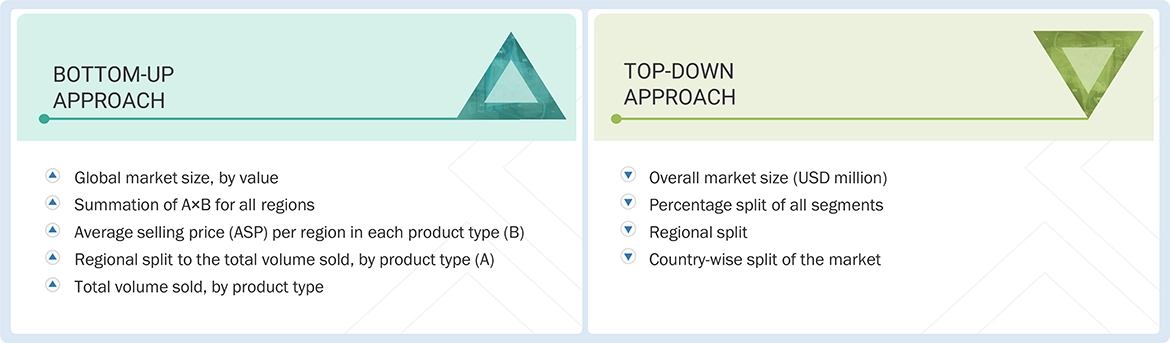
The study involves two major activities in estimating the current market size for the cellulose ether & derivatives market. Exhaustive secondary research was done to collect information on the market, peer market, and parent market. The next step was to validate these findings, assumptions, and sizing with industry experts across the value chain through primary research. Both top-down and bottom-up approaches were employed to estimate the complete market size. Afterward, data triangulation was used to estimate the market size for segments and subsegments.
Secondary Research
Secondary sources referred to for this research study include financial statements of companies offering cellulose ether & derivatives and information from various trade, business, and professional associations. Secondary research has been used to obtain critical information on the industry’s value chain, the total pool of key players, market classification, and segmentation by industry trends, down to the bottom-most level and regional markets. Secondary data were collected and analyzed to determine the overall size of the cellulose ether & derivatives market, which was validated by primary respondents.
Primary Research
Extensive primary research was conducted after obtaining information regarding the cellulose ether & derivatives market scenario through secondary research. Several primary interviews were conducted with market experts from both the demand and supply sides across major countries of North America, Europe, Asia Pacific, the Middle East & Africa, and Latin America. Primary data was collected through questionnaires, emails, and telephonic interviews. The primary sources from the supply side included various industry experts, such as Chief X Officers (CXOs), Vice Presidents (VPs), Directors from business development, marketing, product development/innovation teams, and related key executives from cellulose ether & derivatives industry vendors; system integrators; component providers; distributors; and key opinion leaders.
Primary interviews were conducted to gather insights, including market statistics, revenue data from products and services, market breakdowns, market size estimates, market forecasting, and data triangulation. Primary research also helped in understanding the various trends related to product type, application, and region.
Stakeholders from the demand side, such as CIOs, CTOs, CSOs, and installation teams of the customers/end users who are using cellulose ether & derivatives, were interviewed to understand the buyer’s perspective on the suppliers, products, component providers, and their current usage of cellulose ether & derivatives and future outlook of their business, which will affect the overall market.
Breakup of Primary Research
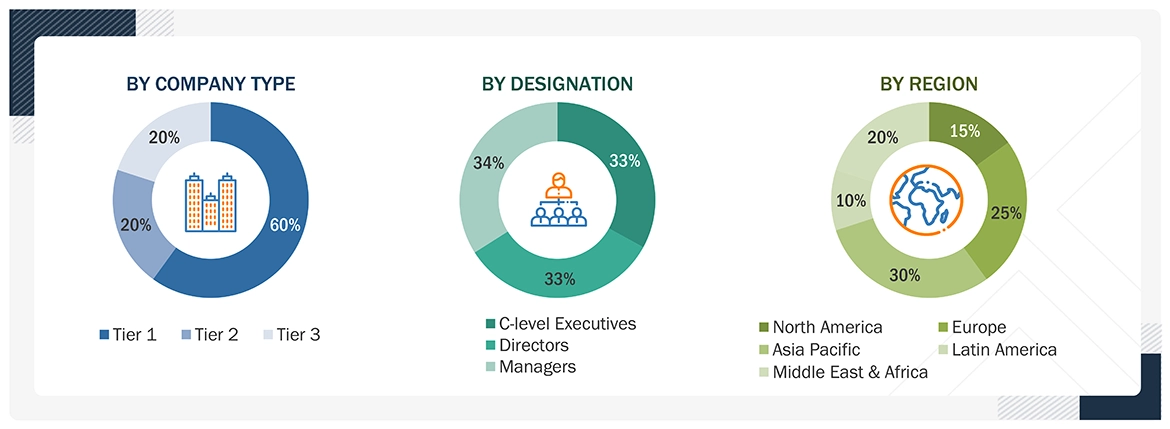
Note: Tiers of companies are based on their revenue in 2024. Tier 1: company revenue greater than USD 1 billion; Tier 2: company revenue between USD 100 million and USD 1 billion; and Tier 3: company revenue less than USD 100 million.
To know about the assumptions considered for the study, download the pdf brochure
Market Size Estimation
The research methodology used to estimate the size of the cellulose ether & derivatives market includes the following details. Market sizing was conducted from the demand side. The market was upsized to accommodate procurements and modernizations of cellulose ether & derivatives across different product types at the regional level. Such procurements provide information on the demand aspects of the cellulose ether & derivatives industry for each product type. For each product type, all possible segments of the cellulose ether & derivatives market were integrated and mapped.
Cellulose Ether & Derivatives Market : Top-Down and Bottom-Up Approach
Data Triangulation
After arriving at the overall size from the market size estimation process explained above, the total market was split into several segments and subsegments. The data triangulation and market breakdown procedures explained below were implemented, where applicable, to complete the overall market engineering process and derive the exact statistics for various market segments and subsegments. The data was triangulated by examining various factors and trends on both the demand and supply sides. In addition, the market size was validated using both top-down and bottom-up approaches.
Market Definition
Cellulose ether & derivatives are defined as polymers, which are produced by the chemical modification of cellulose. It consists of methylcellulose & derivatives, carboxymethyl cellulose, hydroxyethyl cellulose, hydroxypropyl cellulose, and ethyl cellulose. They perform a variety of functions, such as thickening, binding, water retention, emulsifying, and acting as a protective colloid in industries, including pharmaceutical, construction, food & beverage, oil & gas, and paints & coatings.
Key Stakeholders
- Cellulose ether & derivative manufacturers
- Raw material manufacturers
- Government and research organizations
- R&D institutions
- National and local government organizations
- Institutional investors
- Cellulose ether & derivatives suppliers
- End users
Report Objectives
- To define, describe, and forecast the cellulose ether & derivatives market size in terms of volume and value
- To provide detailed information regarding the key factors, such as drivers, restraints, opportunities, and challenges influencing market growth
- To analyze and project the global cellulose ether & derivatives market by product type, application, and region
- To forecast the market size concerning five main regions (along with country-level data), namely, North America, Europe, Asia Pacific, the Middle East & Africa, and Latin America, and analyze the significant region-specific trends
- To strategically analyze micromarkets with respect to individual growth trends, prospects, and contributions of the submarkets to the overall market
- To analyze the market opportunities and the competitive landscape for stakeholders and market leaders
- To assess recent market developments and competitive strategies, such as agreements, contracts, acquisitions, and product developments/product launches, to draw the competitive landscape
- To strategically profile the key market players and comprehensively analyze their core competencies
Available customizations:
MarketsandMarkets offers the following customizations for this market report:
- Additional country-level analysis of the cellulose ether & derivatives market
Product Analysis
- Product matrix, which provides a detailed comparison of the product portfolio of each company’s market
Get the Full Cellulose Ether & Derivatives Market Report
Full forecast, segment splits, and company analysis for all Cellulose Ether & Derivatives Market.
- US Cellulose Ether & Derivatives Market
- Canada Cellulose Ether & Derivatives Market
- Germany Cellulose Ether & Derivatives Market
- France Cellulose Ether & Derivatives Market
- UK Cellulose Ether & Derivatives Market
- Turkey Cellulose Ether & Derivatives Market
- Russia Cellulose Ether & Derivatives Market
- China Cellulose Ether & Derivatives Market
- Japan Cellulose Ether & Derivatives Market
- India Cellulose Ether & Derivatives Market
- Indonesia Cellulose Ether & Derivatives Market
- Saudi Arabia Cellulose Ether & Derivatives Market
- South Africa Cellulose Ether & Derivatives Market
- Brazil Cellulose Ether & Derivatives Market
- Mexico Cellulose Ether & Derivatives Market
Need a Tailored Report?
Customize this report to your needs
Get 10% FREE Customization
Customize This Report
