
North America Character-based AI Agents Market (2026-2031)

The North America Character-based AI Agents Market was valued at $207.8 Million in 2026 and projected to reach to $1873.1 Million by 2031, representing a compound annual growth rate of 44.3%. North America's character-based AI agents market is positioned for transformative growth through 2031, driven by accelerating enterprise digital transformation initiatives and substantial R&D investments in semiconductor technologies.


| Market Size in | USD 26.32 MN |
| Market Forecast in | |
| CAGR | |
| Forecast Period | |
| Units Considered | Value (USD MN) |
North America Character-based AI Agents Market Trends and Insights
- This robust growth trajectory reflects North America's leadership in semiconductor and electronics innovation, driven by substantial investments in AI infrastructure and enterprise adoption across the region.
- North America's dominance stems from its concentration of technology leaders, advanced R&D capabilities, and early-stage deployment of character-based AI solutions in customer engagement, gaming, and enterprise automation sectors. The forecast period from 2026 to 2031 will witness North America consolidating its market position through accelerated commercialization of character-based AI agents.
- North America's regulatory environment and venture capital ecosystem are catalyzing rapid product development cycles and market penetration.
- Key drivers include North America's demand for personalized user experiences, integration with existing semiconductor platforms, and the region's competitive advantage in AI model development and deployment infrastructure..
Key Market Statistics
- CAGR (2026-2031) 44.3% CAGR
- Market Size, 2026 ~USD 207.8 Million
- Forecast, 2031 ~USD 1873.1 Million
- Geography North America
North America Character-based AI Agents Market Overview
Explosive Growth Trajectory :
North America's character-based AI agents market is projected to grow from $207.8 million in 2026 to $1,873.1 million by 2031, representing a 44.3% CAGR and establishing the region as a critical growth engine for AI-driven enterprise solutions.
Leadership in AI Infrastructure :
North America leads global semiconductor and electronics innovation with substantial investments in AI infrastructure, positioning the region as the epicenter for character-based AI agent development and deployment across enterprise verticals.
Enterprise Adoption Acceleration :
Rapid enterprise adoption across North America is driving demand for character-based AI agents in customer service, content creation, and interactive applications, with major tech hubs accelerating implementation across Fortune 500 companies.
Regional Market Dominance :
North America's combined market strength across the US, Canada, and Mexico demonstrates the region's unparalleled capacity for AI innovation, with the US alone representing a significant portion of the continental market value.
North America Character-based AI Agents Market Dynamics
- The region's advanced infrastructure, coupled with early adoption of conversational AI solutions, creates a competitive advantage for market participants seeking to capture high-value enterprise segments. The forecast period will witness intensified competition among technology leaders, increased venture capital funding, and strategic partnerships between semiconductor manufacturers and AI software developers.
- North America's regulatory environment and talent pool will continue to support innovation, while expanding use cases in healthcare, finance, and customer experience management will unlock new revenue streams and market opportunities..
Market Ecosystem

CHARACTER-BASED AI AGENTS MARKET: COMMERCIAL USE CASES ACROSS INDUSTRIES
| COMPANY | USE CASE DESCRIPTION | BENEFITS |
|---|---|---|
 |
Deployment of AI-powered virtual characters for brand marketing, customer engagement, and interactive digital experiences across social media, websites, virtual events, and product demonstrations; AI characters enable brands to deliver scalable, always-on engagement while maintaining brand identity, consistency, and personalized consumer interaction across digital channels | Improved audience engagement and brand interaction through personalized AI-driven experiences | Reduced dependence on costly human influencers while enabling scalable and consistent brand representation | Enhanced marketing ROI visibility through measurable user interaction and engagement analytics |
 |
Deployment of AI-powered digital human assistants to provide 24/7 customer support, product recommendations, and personalized guidance for telecommunications services; AI characters interact naturally in native language while representing Deutsche Telekom’s brand identity across customer-facing digital channels | Achieved 5.6× increase in conversion rate and 9% reduction in cart abandonment | Improved customer confidence and engagement through emotionally responsive interactions and always-available AI support | Enhanced scalability and consistency of customer service operations while strengthening brand experience |
|
|
Deployment of AI-powered non-player characters (NPCs) for gaming and immersive environments, enabling real-time conversational interaction, adaptive behavior, contextual intelligence, and emotionally responsive gameplay experiences; AI characters dynamically react to player choices and support personalized narrative development | Enhanced player immersion and engagement through realistic, adaptive, and personalized interactions | Enabled dynamic storytelling and non-linear gameplay experiences while reducing limitations of scripted NPC behavior | Improved player retention through emotionally engaging and continuously evolving game environments |
Logos and trademarks shown above are the property of their respective owners. Their use here is for informational and illustrative purposes only.
Related Ecosystem
Information System And Analytics
- Machine Learning
- Natural Language Processing (NLP)
- Sensors
- Software as A Service (SaaS)
- Data Loss Prevention (DLP)
- International Business Machines Corporation
- MICROSOFT CORPORATION
- Amazon.com, Inc.
- Oracle Corporation
Key Takeaways
- North America's character-based AI agents market will grow from $207.8M (2026) to $1,873.1M (2031), representing a 44.3% CAGR.
- North America leads global adoption due to its concentration of AI technology companies, semiconductor manufacturers, and enterprise early adopters.
- North America's market growth is driven by demand for conversational AI in customer service, gaming, and enterprise automation applications.
- North America's venture capital ecosystem and favorable regulatory environment accelerate innovation and commercialization of character-based AI solutions.
Character-based AI Agents Market Report Scope
| Report Metric | Details |
|---|---|
| Base Year | 2026 |
| Fastest Growing Segment | CORPORATE & BRAND MASCOTS (Interaction Mode) |
| Forecast Period | 2026–2031 |
| Growth Rate | CAGR of 46.7% from 2026 to 2031 |
| Largest Segment | FICTIONAL CHARACTER AGENTS (Interaction Mode) |
| Market Size Base Year (Billions) | ~USD 0.55 (2026) |
| Revenue Forecast (Billions) | ~USD 3.72 (2031) |
| Segments Covered | Type, Interaction Mode, Application |
North America Character-based AI Agents Market Report Segmentation
3 segment dimensions are covered across the global market.
By Type
- Corporate & Brand Mascots
- Fictional Character Agents
- Personalized AI Companions
- Real-World Personas
By Interaction Mode
- Corporate & Brand Mascots
- Fictional Character Agents
- Multi-Modal
- Real-World Personas
- Text-Based
- Voice-Based
By Application
- Fan Engagement & Merchandising
- Gaming & Immersive Media
- Interactive Storytelling, Roleplay & Narrative Experiences
- Other Applications
- Social Media & Virtual Influencers
Target Audience
- Technology & Software Companies : Develop market entry strategies and product roadmaps for North America by understanding regional demand patterns, competitive positioning, and enterprise customer requirements for character-based AI solutions.
- Semiconductor & Hardware Manufacturers : Align chip design and manufacturing strategies with North America's accelerating AI infrastructure investments and enterprise adoption trends to capture growing demand for AI-optimized processors.
- Enterprise & Fortune 500 Organizations : Evaluate character-based AI agent solutions and vendors within the North American market to optimize customer experience, operational efficiency, and competitive advantage through informed procurement decisions.
- Venture Capital & Private Equity Firms : Identify high-growth investment opportunities in North America's character-based AI agents ecosystem by analyzing market dynamics, funding trends, and emerging companies with significant scaling potential.
- Consulting & Systems Integration Partners : Develop North America-specific service offerings and implementation strategies by understanding regional market maturity, customer pain points, and technology adoption patterns across industries.
Key Companies in the North America Character-based AI Agents Market
| Company | HQ | Ownership | Strongest segments |
|---|---|---|---|
| LUKA, INC. | Slovenia | Public Company | Container terminal services,Car and RO-RO terminal services,Dry bulk, alumina, iron ore, coal, and silo services, |
| SOUL MACHINES | New Zealand | Private Company | Enterprise digital humans for CX & service,Marketing, brand ambassadors & virtual influencers,Developer platform, tools & OEM/partner integrations, |
| LATITUDE | Australia | Public Company | Personal and motor loans,Credit cards and retail finance,Factoring/BNPL and merchant solutions, |
| DEEPBRAIN AI | South Korea | Private Company | AI Studios (video creation with AI Humans),AI Human (interactive digital humans),AI Conversation (industrial customer service), |
LUKA, INC.
Luka, Inc. is a public company headquartered in Slovenia, founded in 1957 and employing 2,475 people.
SOUL MACHINES
Soul Machines is a private company based in New Zealand, founded in 2016.
LATITUDE
Latitude is a public company headquartered in Australia, founded in 1925 and employing 742 people.
DEEPBRAIN AI
DeepBrain AI is a South Korea-based private company founded in 2016.
Countries within North America - compare and drill down
| Country | 2025 size (native) |
|---|---|
| US | USD 210.3 Million |
| Canada | USD 189.92 Million |
| Mexico | USD 223.34 Million |
Country market size visualization
Reasons to Buy this Report
- Regional Market Sizing & Forecasts : Access precise market valuations for North America's character-based AI agents sector with country-level breakdowns for the US, Canada, and Mexico, enabling accurate budget allocation and market entry strategies.
- Competitive Landscape Intelligence : Understand North America's competitive dynamics, key players, and market consolidation trends to identify partnership opportunities and competitive positioning within the region's rapidly evolving AI ecosystem.
- Enterprise Adoption Insights : Gain actionable intelligence on enterprise adoption patterns across North American industries, including vertical-specific growth drivers and implementation barriers to inform go-to-market strategies.
- Investment & Funding Analysis : Track venture capital flows, M&A activity, and strategic investments specific to North America's character-based AI agents market to identify emerging opportunities and market momentum indicators.
- Regulatory & Technology Roadmap : Navigate North America's regulatory landscape and semiconductor technology evolution with insights on compliance requirements, standards development, and infrastructure investments shaping market growth.
Frequently asked questions
What is the projected market size for character-based AI agents in North America by 2031?
North America's character-based AI agents market is projected to reach $1,873.1 million by 2031, growing from $207.8 million in 2026 at a 44.3% CAGR.
Why is North America leading the character-based AI agents market?
North America leads due to its concentration of technology companies, advanced semiconductor infrastructure, substantial R&D investments, and early enterprise adoption of AI solutions.
What are the primary applications driving North America's character-based AI agents market?
North America's market is driven by applications in customer engagement, interactive gaming, enterprise automation, virtual assistants, and personalized user experience platforms.
How does North America's market growth compare to the global character-based AI agents market?
North America's 44.3% CAGR slightly exceeds the global 46.7% CAGR, reflecting the region's mature market dynamics and established enterprise adoption patterns.
What factors will sustain North America's character-based AI agents market growth through 2031?
North America's growth will be sustained by increasing enterprise demand for AI automation, semiconductor integration advances, venture capital funding, and regulatory clarity supporting AI deployment.
RESEARCH METHODOLOGY
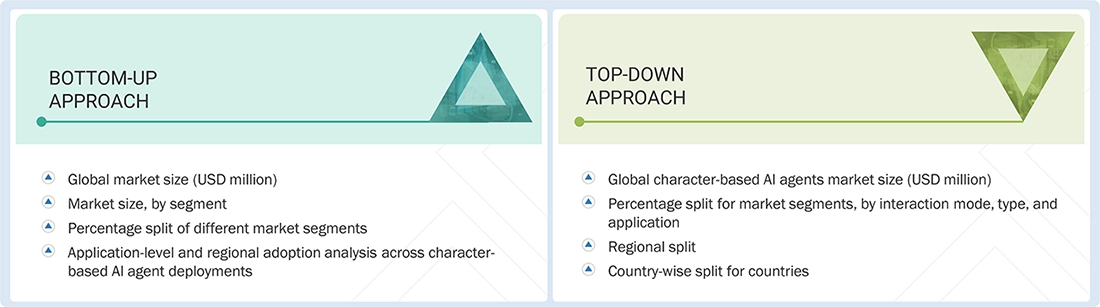
The study involved four major activities in estimating the current size of the character-based AI agents market. Exhaustive secondary research collected information on the market, peer, and parent markets. The next step was to validate these findings, assumptions, and sizing with industry experts across the value chain through primary research. Both top-down and bottom-up approaches were employed to estimate the complete market size. After that, market breakdown and data triangulation techniques were used to estimate the market size of segments and subsegments.
Secondary Research
The secondary research process has referred to various secondary sources to identify and collect necessary information for this study. The secondary sources include annual reports, press releases, and investor presentations of companies; white papers; journals and certified publications; and articles from recognized authors, websites, directories, and databases. Secondary research was mainly used to obtain key information about the supply chain of the industry, the total pool of market players, classification of the market according to industry trends to the bottom-most level, regional markets, and key developments from the market and technology-oriented perspectives. Secondary data was collected and analyzed to determine the overall market size, which was further validated through primary research.
Primary Research
Extensive primary research was conducted after gaining knowledge about the current scenario of the character-based AI agents market through secondary research. Several primary interviews were conducted with experts from the demand and supply sides across four major regions: North America, Europe, Asia Pacific, and RoW. This primary data was collected through questionnaires, emails, and telephone interviews.
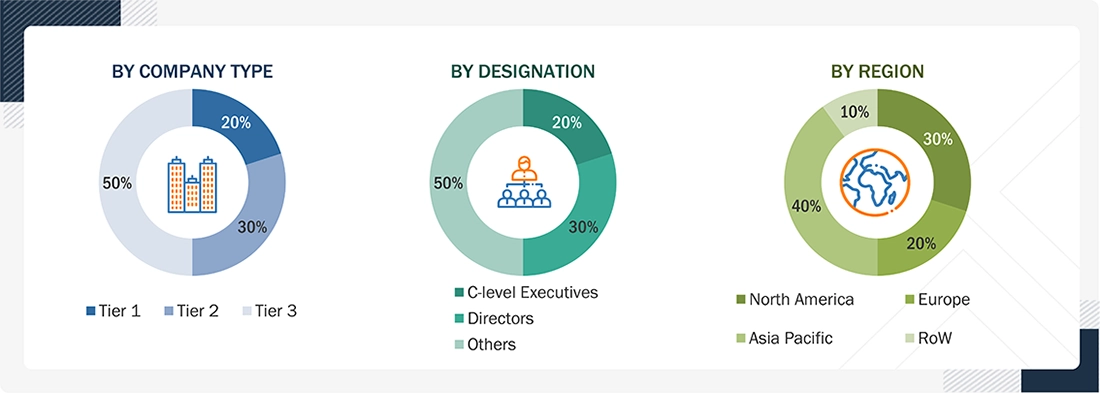
Note: Other designations include technology heads, media analysts, sales managers, marketing managers, and product managers.
The three tiers of the companies are based on their total revenues as of 2024; Tier 1: >USD 1 billion, Tier 2: USD 500 million–1 billion, and Tier 3: <USD 500 million.
To know about the assumptions considered for the study, download the pdf brochure
Market Size Estimation
In the complete market engineering process, the top-down and bottom-up approaches and several data triangulation methods were used to estimate and forecast the overall market segments and subsegments listed in this report. Key players in the character-based AI agents market were identified through secondary research, and their market shares in the respective regions were determined through primary and secondary research. This entire procedure includes the study of annual and financial reports of the top market players and extensive interviews for key insights (quantitative and qualitative) with industry experts (CEOs, VPs, directors, and marketing executives).
All percentage shares, splits, and breakdowns were determined using secondary sources and verified through primary sources. All the parameters affecting the markets covered in this research study were accounted for, viewed in detail, verified through primary research, and analyzed to obtain the final quantitative and qualitative data. This data was consolidated and supplemented with detailed inputs and analysis from MarketsandMarkets and presented in this report.
Character-based AI Agents Market : Top-Down and Bottom-Up Approach
Data Triangulation
After arriving at the overall market size, the market was split into several segments and subsegments using the market size estimation processes explained above. Data triangulation and market breakdown procedures were employed to complete the entire market engineering process and determine the exact statistics of each market segment and subsegment. The data was triangulated by studying various factors and trends from the demand and supply sides in the character-based AI agents market.
Market Definition
Character-based AI agents are artificial intelligence-driven digital entities designed with distinct personalities, identities, and interaction styles to engage users through conversational and immersive experiences. These agents can exist as fictional characters, virtual influencers, AI companions, branded mascots, or representations of real-world personas. Powered by technologies such as large language models, voice synthesis, emotional AI, and avatar systems, character-based AI agents interact through text, voice, or multi-modal interfaces. They are widely used across gaming, social media, storytelling, fan engagement, education, and enterprise applications to deliver personalized, adaptive, and human-like digital interactions.
Key Stakeholders
- Government bodies and AI regulatory authorities
- Generative AI and foundation model providers
- Character AI platform providers
- Digital human and avatar technology providers
- Voice AI and synthetic media companies
- Gaming and immersive media companies
- Social media and creator economy platforms
- Virtual influencer agencies and talent networks
- Entertainment studios and IP owners
- Fan engagement and digital merchandising platforms
- Cloud computing and AI infrastructure providers
- Enterprise AI solution providers
- Research institutes and universities
- Venture capital and technology investors
Report Objectives
- To describe and forecast the size of the character-based AI agents market, by type, interaction mode, and application, in terms of value
- To forecast the size of market segments with respect to four regions, namely North America, Europe, Asia Pacific, and RoW, in terms of value
- To identify and analyze key drivers, restraints, opportunities, and challenges influencing the market growth
- To offer an ecosystem analysis, value chain analysis, case study analysis, patent analysis, technology analysis, pricing analysis, Porter’s five forces analysis, and regulations pertaining to the market
- To strategically analyze micromarkets with respect to individual growth trends, prospects, and contributions to the total market
- To strategically profile key players and comprehensively analyze their market shares and core competencies
- To analyze the opportunities in the market for stakeholders and describe the competitive landscape of the market
- To study competitive developments, such as collaborations, partnerships, product launches/developments, and acquisitions, in the market
Available customizations:
With the given market data, MarketsandMarkets offers customizations according to the specific requirements of companies. The following customization options are available for the report:
Country-wise Information:
- Additional country-wise breakdown for North America, Europe, the Asia Pacific, and the Rest of the World
Company Information
- Detailed analysis and profiling of additional market players (up to five)
Get the Full Character-based AI Agents Market Report
Full forecast, segment splits, and company analysis for all Character-based AI Agents Market.
- US Character-based AI Agents Market
- Canada Character-based AI Agents Market
- Mexico Character-based AI Agents Market
- UK Character-based AI Agents Market
- Germany Character-based AI Agents Market
- France Character-based AI Agents Market
- Italy Character-based AI Agents Market
- China Character-based AI Agents Market
- Japan Character-based AI Agents Market
- India Character-based AI Agents Market
- South Korea Character-based AI Agents Market
- Rest Of Europe Character-based AI Agents Market
- Rest Of Asia Pacific Character-based AI Agents Market
Need a Tailored Report?
Customize this report to your needs
Get 10% FREE Customization
Customize This Report
