
Brazil Cloud Computing Market (2025-2030)

The Brazil Cloud Computing Market was valued at $28700 Million in 2025 and projected to reach to $53900 Million by 2030, representing a compound annual growth rate of 13.5%. Brazil's cloud computing market is positioned for sustained growth through 2030, driven by accelerating digital transformation across enterprises, government agencies, and small-to-medium enterprises.


| Market Size in | USD 26.32 MN |
| Market Forecast in | |
| CAGR | |
| Forecast Period | |
| Units Considered | Value (USD MN) |
Brazil Cloud Computing Market Trends and Insights
- This 13.5% compound annual growth rate reflects Brazil's increasing digital transformation across enterprises, government sectors, and SMEs.
- Brazil is leveraging cloud infrastructure to modernize legacy systems, enhance operational efficiency, and support remote work adoption across diverse industries including finance, retail, and manufacturing. The Brazilian cloud market benefits from rising internet penetration, growing data center investments, and regulatory frameworks supporting digital innovation.
- Brazil's strategic position in Latin America positions it as a regional hub for cloud services, attracting both multinational providers and local startups.
- Between 2025 and 2030, Brazil is expected to see accelerated adoption of hybrid and multi-cloud solutions, driven by cost optimization needs and compliance requirements specific to Brazilian data protection laws. Key drivers propelling Brazil's cloud market include increasing cybersecurity concerns, demand for scalable IT infrastructure, and government initiatives promoting digital economy growth.
- Brazil's competitive landscape features both established global players and emerging regional providers tailoring solutions to local market needs..
Key Market Statistics
- CAGR (2025-2030) 13.5% CAGR
- Market Size, 2025 ~USD 28700 Million
- Forecast, 2030 ~USD 53900 Million
- Country Brazil
Brazil Cloud Computing Market Overview
Market Valuation Growth :
Brazil's cloud computing market is valued at USD 28,700 million in 2025 and is projected to reach USD 53,900 million by 2030, representing an 88% increase over five years.
Outpacing Global Growth :
Brazil's 13.5% CAGR significantly exceeds the global cloud computing CAGR of 12%, positioning the country as a high-growth market within Latin America and attracting increased investment.
Digital Transformation Drivers :
Enterprise modernization, government digitalization initiatives, and SME cloud adoption are primary catalysts fueling Brazil's cloud market expansion and infrastructure investments.
Legacy System Modernization :
Brazilian organizations are increasingly migrating from legacy systems to cloud platforms to enhance operational efficiency, reduce IT costs, and improve scalability across sectors.
Brazil Cloud Computing Market Dynamics
- The country's 13.5% CAGR reflects strong demand for cloud infrastructure, platform services, and software solutions as organizations prioritize modernization and operational efficiency.
- Government initiatives supporting digital economy development and increasing cybersecurity investments further strengthen market fundamentals. The competitive landscape is intensifying as global cloud providers expand Brazilian operations while local providers enhance service offerings.
- Investment in data centers, regional compliance frameworks, and localized solutions will be critical for capturing market share.
- SME adoption remains a significant growth opportunity, with increasing accessibility to cloud services and favorable pricing models driving broader market penetration through 2030..
Market Ecosystem
Related Ecosystem
Cloud Computing
Key Takeaways
- Brazil's cloud computing market will nearly double from USD 28.7B (2025) to USD 53.9B (2030), representing a 13.5% CAGR.
- Brazil is emerging as Latin America's leading cloud services hub, attracting significant investment from global and regional providers.
- Digital transformation initiatives and compliance with Brazilian data protection regulations are primary growth catalysts for Brazil's cloud adoption.
- Brazil's hybrid and multi-cloud strategies are expected to dominate between 2025 and 2030, driven by cost optimization and regulatory requirements.
Cloud Computing Market Report Scope
| Report Metric | Details |
|---|---|
| Base Year | 2025 |
| Fastest Growing Segment | SERVICES (Offering) |
| Forecast Period | 2025–2030 |
| Growth Rate | CAGR of 12% from 2025 to 2030 |
| Largest Segment | PUBLIC CLOUD (Deployment Model) |
| Market Size Base Year (Billions) | ~USD 1294.36 (2025) |
| Revenue Forecast (Billions) | ~USD 2281.1 (2030) |
| Segments Covered | Service Model, Iaas, Paas, Saas, Deployment Model, Organization Size, Vertical, Component, Offering |
Brazil Cloud Computing Market Report Segmentation
9 segment dimensions are covered across the global market.
By Service Model
- IaaS
- PaaS
- SaaS
By Iaas
- Compute
- Networking
- Storage
By Paas
- Analytics & Reporting
- Application Development & Integration Platforms
- Application Testing & Quality
- Databases & Data Management
- Other PaaS
By Saas
- Collaboration & Productivity Suites
- Content Management
- Crm
- Erm
- Hcm
- Other SaaS
- Scm
- System Infrastructure Software
By Deployment Model
- Hybrid Cloud
- Private Cloud
- Public Cloud
By Organization Size
- Large Enterprises
- Smes
By Vertical
- Bfsi
- Energy & Utilities
- Government & Public Sector
- Healthcare & Life Sciences
- Manufacturing
- Media & Entertainment
- Other Verticals
- Retail & Ecommerce
- Software & It Services
- Telecommunications
- Transportation & Logistics
By Component
- Hardware
- Services
- Software
By Offering
- Services
- Solutions
Target Audience
- Cloud Service Providers : Global and regional cloud providers need Brazil-specific market data to develop localized strategies, assess competitive positioning, and identify growth opportunities in this high-CAGR market.
- Enterprise IT Decision-Makers : Brazilian CIOs and IT directors require market insights to benchmark cloud adoption trends, evaluate vendor options, and justify digital transformation investments aligned with industry benchmarks.
- Investment & Private Equity Firms : Investors targeting Latin American tech opportunities need validated market sizing and growth forecasts for Brazil to evaluate portfolio companies, identify acquisition targets, and assess market potential.
- Government & Policy Makers : Brazilian government agencies and policymakers need market intelligence to develop digital economy strategies, infrastructure investments, and regulatory frameworks supporting cloud sector growth.
- Technology Consultants & Analysts : Consulting firms and market analysts require Brazil-specific cloud data to support client advisory services, competitive analysis, and strategic recommendations for market participants.
Key Companies in the Brazil Cloud Computing Market
| Company | HQ | Ownership | Strongest segments |
|---|---|---|---|
| TELENET GROUP | United States | Private Company | IaaS (Compute, Storage, Networking),PaaS (App Dev & Integration, Database & Data, Analytics & Reporting),SaaS (CRM, SCM, Collaboration & Productivity), |
| FOXCONN INDUSTRIAL INTERNET CO LTD | United States | Public Company | IaaS – Compute (Servers, AI-optimized platforms),IaaS – Storage,IaaS – Networking, |
| ALMAVIVA S.P.A. | Italy | Private Company | IaaS (Compute, Storage, Networking),PaaS (Application Development & Integration),PaaS (Database & Data), |
| PLDT ENTERPRISE | Philippines | InvalidIdentifier | IaaS (Compute, Storage, Networking, including co-location),PaaS (Application Development & Integration, Database & Data, Analytics & Reporting),SaaS (CRM, SCM, Collaboration & Productivity), |
| SONATA SOFTWARE LIMITED | India | Public Company | IaaS – Managed Cloud & Infrastructure (Compute/Storage/Networking),PaaS – Application Development & Integration,PaaS – Database, Data, Analytics & Reporting, |
| MAGIC SOFTWARE ENTERPRISES | Israel | Private Company | PaaS – Application Development & Integration (Magic xpa, xpi, SmartUX, AppBuilder),PaaS – Data, Database, Analytics & Reporting (Magic Data Management and Analytics Platform, FactoryEye),SaaS – Vertical Solutions (Clicks, Hermes Cargo, HR Pulse, MBS, Nativ, Mobisale), |
| RED HAT INC | United States | Private Company | IaaS-aligned (Compute, Storage, Networking enablement via Linux and virtualization),PaaS (Application Development & Integration, Database & Data, Analytics & Reporting),SaaS (CRM, SCM, Collaboration & Productivity – enablement and management), |
| TERADATA CORPORATION | United States | Public Company | IaaS-aligned (Compute, Storage, Networking enablement),PaaS – Database & Data Platform,PaaS – Analytics & Reporting, |
| HYLAND SOFTWARE, INC | United States | Private Company | SaaS – ECM, BPM, Case Management (OnBase, Perceptive, Saperion, NolijWeb),SaaS – Healthcare Imaging & VNA (Hyland Healthcare, Acuo, NilRead, PACSgear),Cloud-based Collaboration & Sharing (ShareBase, Media Manager), |
| AVANADE | United States | Private Company | IaaS (Compute, Storage, Networking),PaaS (Application Development & Integration),PaaS (Database & Data, Analytics & Reporting), |
| PRESIDIO | United States | Private Company | IaaS-related (Compute, Storage, Networking),PaaS-related (App Dev & Integration, Data, Analytics & Reporting),SaaS-related (CRM, SCM, Collaboration & Productivity), |
| MICROSOFT | United States | Public Company | IaaS (Compute, Storage, Networking),PaaS (App Dev & Integration, Database & Data, Analytics & Reporting),SaaS (CRM, SCM, Collaboration & Productivity), |
| United States | Public Company | IaaS – Compute,IaaS – Storage,IaaS – Networking, | |
| ORACLE | United States | Public Company | IaaS (Compute, Storage, Networking),PaaS (Application Development & Integration),PaaS (Database & Data), |
| SALESFORCE | United States | Public Company | SaaS – CRM (Sales, Service, Marketing, Commerce, Field Service, Salesforce Starter),SaaS – Collaboration & Productivity (Slack and related services),PaaS – Application Development & Integration (Agentforce platform, integration tools), |
| DROPBOX | United States | Public Company | SaaS – Collaboration & Productivity,SaaS – Workflow, e-signature, and adjacent services,Other (developer integrations, ancillary services), |
TELENET GROUP
Telenet Group is a private company founded in 1994 and based in the United States, employing 3,467 people.
FOXCONN INDUSTRIAL INTERNET CO LTD
Foxconn Industrial Internet Co Ltd is a publicly traded company established in 2015 in the United States with 217,084 employees.
ALMAVIVA S.P.A.
Almaviva S.P.A. is an Italian private company founded in 2005 that employs 41,065 people.
PLDT ENTERPRISE
PLDT Enterprise information is incomplete and cannot be accurately described with the provided data.
SONATA SOFTWARE LIMITED
Sonata Software Limited is a publicly traded Indian software company founded in 1986 with 5,948 employees.
MAGIC SOFTWARE ENTERPRISES
Magic Software Enterprises is an Israeli private company founded in 1983 that employs 3,787 people.
RED HAT INC
Red Hat Inc is a private software company founded in 1993 in the United States with 13,360 employees.
TERADATA CORPORATION
Teradata Corporation is a publicly traded company founded in 1979 in the United States with 5,100 employees.
HYLAND SOFTWARE, INC
Hyland Software, Inc is a private company established in 1991 in the United States with 336 employees.
AVANADE
Avanade is a private company founded in 2000 in the United States with 3,900 employees.
PRESIDIO
Presidio is a private company established in 2003 in the United States with 2,900 employees.
MICROSOFT
Microsoft is a publicly traded technology company founded in 1975 in the United States with 228,000 employees.
Google is a publicly traded technology company established in 1998 in the United States with 194,668 employees.
ORACLE
Oracle is a publicly traded software company founded in 1977 in the United States with 141,000 employees.
SALESFORCE
Salesforce is a publicly traded cloud software company established in 1999 in the United States with 83,334 employees.
DROPBOX
Dropbox is a publicly traded cloud storage company founded in 2007 in the United States with 2,113 employees.
Reasons to Buy this Report
- Market Size & Growth Validation : Obtain precise market valuation data for Brazil (USD 28.7B in 2025) and verified forecasts through 2030, enabling accurate business planning and investment decisions in Latin America's largest cloud market.
- Competitive Positioning Intelligence : Understand Brazil-specific market dynamics, regional player strategies, and competitive landscape to identify opportunities for market entry, partnerships, or expansion within the high-growth 13.5% CAGR environment.
- Sector-Specific Adoption Insights : Access detailed analysis of cloud adoption patterns across Brazilian enterprises, government agencies, and SMEs to tailor solutions, marketing strategies, and service offerings for maximum market relevance.
- Investment & Funding Decisions : Leverage comprehensive market data to support investment thesis, secure funding, and justify resource allocation for cloud infrastructure projects, partnerships, or subsidiary operations in Brazil.
- Risk Mitigation & Regulatory Compliance : Gain insights into Brazil-specific regulatory frameworks, data localization requirements, and compliance considerations essential for successful cloud service deployment and market operations.
Frequently asked questions
What is the projected size of Brazil's cloud computing market by 2030?
Brazil's cloud computing market is projected to reach USD 53,900 million by 2030, growing from USD 28,700 million in 2025 at a 13.5% CAGR.
What are the primary drivers of cloud adoption in Brazil?
Brazil's cloud adoption is driven by digital transformation initiatives, increasing cybersecurity concerns, demand for scalable IT infrastructure, and government policies promoting digital economy growth.
How does Brazil's cloud market growth compare to global trends?
Brazil's 13.5% CAGR outpaces the global cloud computing market CAGR of 12%, positioning Brazil as a faster-growing market within the global landscape.
What role does data protection regulation play in Brazil's cloud market?
Brazil's data protection laws, including LGPD (Lei Geral de Proteção de Dados), drive demand for compliant cloud solutions and influence multi-cloud and hybrid adoption strategies.
Which industries are leading cloud adoption in Brazil?
Finance, retail, manufacturing, and government sectors are leading cloud adoption in Brazil, driven by modernization needs and operational efficiency requirements.
RESEARCH METHODOLOGY
This research study on the cloud computing market involved extensive secondary sources, directories, IEEE Communication-Efficient: Algorithms and Systems, International Journal of Innovation and Technology Management, and paid databases. Primary sources were mainly industry experts from the core and related industries, preferred cloud service providers, third-party service providers, consulting service providers, end users, and other commercial enterprises. In-depth interviews were conducted with various primary respondents, including key industry participants and subject matter experts, to obtain and verify critical qualitative and quantitative information and assess the market’s prospects.
Secondary Research
In the secondary research process, various sources were referred to identify and collect information for this study. Secondary sources included annual reports, press releases, and investor presentations of companies; white papers, journals, and certified publications; and articles from recognized authors, directories, and databases. The data was also collected from other secondary sources, such as journals, government websites, blogs, and vendors' websites. Additionally, the cloud computing spending of various countries was extracted from the respective sources.
Primary Research
In the primary research process, various primary sources from both the supply and demand sides were interviewed to obtain qualitative and quantitative information on the market. The primary sources from the supply side included various industry experts, such as Chief Experience Officers (CXOs), Vice Presidents (VPs), and directors specializing in business development, marketing, and cloud service providers. It also included key executives from cloud computing solution vendors, system integrators (SIs), professional service providers, industry associations, and other key opinion leaders.
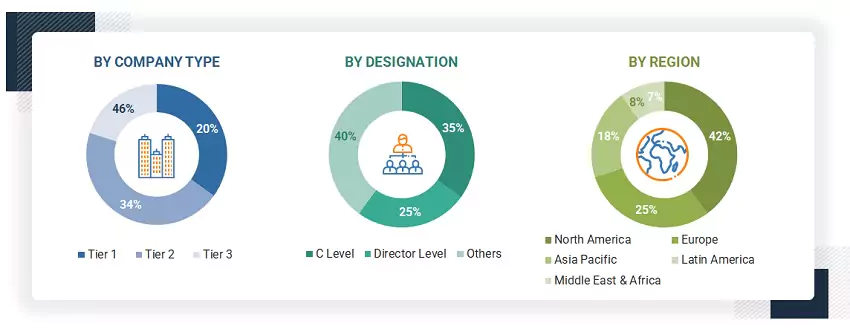
Note: Tier 1 companies’ revenues are more than USD 10 billion; tier 2 companies’ revenues range between
USD 1 and 10 billion; and tier 3 companies’ revenues range between USD 500 million and USD 1 billion.
Other designations include sales managers, marketing managers, and product managers.
Source: Industry Experts
To know about the assumptions considered for the study, download the pdf brochure
Market Size Estimation
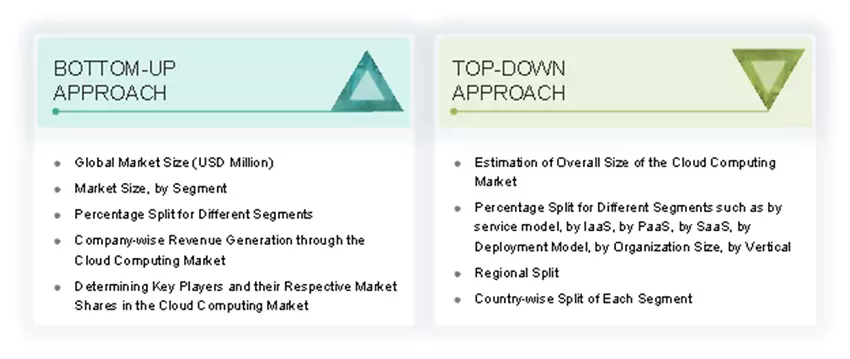
Multiple approaches were adopted to estimate and forecast the cloud computing market. The first approach involved estimating the market size by companies’ revenue generated through the sale of cloud computing services.
Market Size Estimation Methodology- Top-down approach
In the top-down approach, an exhaustive list of all the vendors offering products in the cloud computing market was prepared. The revenue contribution of the market vendors was estimated through annual reports, press releases, funding, investor presentations, paid databases, and primary interviews. Each vendor's offerings were evaluated based on platform, degree of customization, type, application, end user, and region. The markets were triangulated through both primary and secondary research. The primary procedure included extensive interviews for key insights from industry leaders, such as CIOs, CEOs, VPs, directors, and marketing executives. The market numbers were further triangulated with the existing MarketsandMarkets’ repository for validation.
Market Size Estimation Methodology-Bottom-up approach
In the bottom-up approach, the adoption rate of cloud computing services among different verticals in key countries with respect to their regions contributing the most to the market share was identified. For cross-validation, the adoption of cloud computing services among enterprises, along with different use cases with respect to their regions, was identified and extrapolated. Weightage was given to use cases identified in different regions for the market size calculation.
Based on market numbers, the regional split was determined by primary and secondary sources. The procedure included an analysis of the cloud computing market’s regional penetration. Based on secondary research, the regional spending on Information and Communications Technology (ICT), socio-economic analysis of each country, strategic vendor analysis of major cloud computing providers, and organic and inorganic business development activities of regional and global players were estimated.
Cloud Computing Market : Top-Down and Bottom-Up Approach
Data Triangulation
After arriving at the overall market size using the market size estimation processes as explained above, the market was split into several segments and subsegments. To complete the overall market engineering process and arrive at the exact statistics of each market segment and subsegment, data triangulation and market breakup procedures were employed, wherever applicable. The overall market size was then used in the top-down procedure to estimate the size of other individual markets via percentage splits of the market segmentation.
Market Definition
The cloud computing market involves delivering computing services such as servers, storage, databases, networking, software, and analytics over the internet, enabling organizations to access and manage data and applications remotely. It includes public, private, and hybrid cloud deployment models and supports various service models such as Infrastructure as a Service (IaaS), Platform as a Service (PaaS), and Software as a Service (SaaS). Cloud computing helps businesses reduce capital expenditure, improve scalability, enhance collaboration, and accelerate innovation. It plays a vital role in digital transformation, supporting emerging technologies such as AI, IoT, big data, and machine learning across industries.
Stakeholders
- Cloud Service Providers (CSPs)
- Networking companies
- Information Technology (IT) infrastructure providers
- Consultants/Consultancies/Advisory firms
- Component providers
- Telecom service providers
- System Integrators (SIs)
- Support and maintenance service providers
- Support service providers
- Third-party providers
- Government organizations and standardization bodies
- Datacenter providers
- Regional associations
- Independent hardware and software vendors
- Value-added resellers and distributors
Report Objectives
- To define, describe, and forecast the global cloud computing market based on service model, Infrastructure as a Service (IaaS), Platform as a Service (PaaS), Software as a Service (SaaS), deployment model, organization size, vertical, and region
- To provide detailed information about the major factors (drivers, opportunities, restraints, and challenges) influencing the growth of the cloud computing market
- To analyze the opportunities in the market for stakeholders by identifying the high-growth segments of the cloud computing market
- To forecast the market size with respect to five main regions—North America, Europe, Asia Pacific, the Middle East & Africa, and Latin America
- To analyze the subsegments of the market with respect to individual growth trends, prospects, and contributions to the overall market
- To profile the key players of the cloud computing market and comprehensively analyze their market size and core competencies
- To track and analyze the competitive developments, such as product enhancements and product launches, acquisitions, and partnerships & collaborations, in the cloud computing market globally
Available Customizations
With the given market data, MarketsandMarkets offers customizations as per the company’s specific needs. The following customization options are available for the report:
Product Analysis
- The product matrix provides a detailed comparison of the product portfolio of each company.
Geographic Analysis as per Feasibility
- Further breakup of the North American cloud computing market
- Further breakup of the European market
- Further breakup of the Asia Pacific market
- Further breakup of the Middle East & African market
- Further breakup of the Latin American cloud computing market
Company Information
- Detailed analysis and profiling of additional market players (up to five)
Get the Full Cloud Computing Market Report
Full forecast, segment splits, and company analysis for all Cloud Computing Market.
- Singapore Cloud Computing Market
- South Korea Cloud Computing Market
- UAE Cloud Computing Market
- Qatar Cloud Computing Market
- South Africa Cloud Computing Market
- Mexico Cloud Computing Market
- Rest Of Europe Cloud Computing Market
- Rest Of Apac Cloud Computing Market
- Rest Of Latin America Cloud Computing Market
- GCC Countries Cloud Computing Market
- Ksa Cloud Computing Market
- Rest Of GCC Cloud Computing Market
- Canada Cloud Computing Market
- US Cloud Computing Market
- UK Cloud Computing Market
- Germany Cloud Computing Market
- France Cloud Computing Market
- Spain Cloud Computing Market
- Italy Cloud Computing Market
- Netherlands Cloud Computing Market
- China Cloud Computing Market
- India Cloud Computing Market
- Japan Cloud Computing Market
Need a Tailored Report?
Customize this report to your needs
Get 10% FREE Customization
Customize This Report
