
Rest Of Asia Pacific Computational Storage Market (2026-2031)

The Rest Of Asia Pacific Computational Storage Market was valued at $26.5 Million in 2026 and projected to reach to $184.7 Million by 2031, representing a compound annual growth rate of CAGR 38.2%. Rest Of Asia Pacific is positioned as a high-growth hub for computational storage adoption, driven by increasing enterprise digitalization and the proliferation of data-intensive applications across manufacturing, telecommunications, and financial services sectors.


| Market Size in | USD 26.32 MN |
| Market Forecast in | |
| CAGR | |
| Forecast Period | |
| Units Considered | Value (USD MN) |
Rest Of Asia Pacific Computational Storage Market Trends and Insights
- This exceptional growth trajectory reflects Rest Of Asia Pacific's increasing adoption of advanced storage architectures that integrate processing capabilities directly into storage devices, driven by rising data volumes and enterprise digitalization initiatives.
- Rest Of Asia Pacific's computational storage market is outpacing global trends, with a 38.2% compound annual growth rate significantly exceeding the global average of 29%, positioning the region as a critical growth engine for the semiconductor and electronics industry. The expansion of Rest Of Asia Pacific's computational storage sector is fueled by growing demand from enterprise customers seeking to optimize data center efficiency and reduce latency in high-performance computing environments.
- Rest Of Asia Pacific's technology infrastructure investments and the region's role as a manufacturing and data processing hub are accelerating the deployment of computational storage solutions across financial services, cloud computing, and artificial intelligence applications.
- By 2031, Rest Of Asia Pacific is expected to capture substantial market share as organizations throughout the region prioritize storage solutions that enhance computational performance and operational efficiency..
Key Market Statistics
- CAGR (2026-2031) CAGR 38.2%
- Market Size, 2026 ~USD 26.5 Million
- Forecast, 2031 ~USD 184.7 Million
- Country Rest Of Asia Pacific
Rest Of Asia Pacific Computational Storage Market Overview
Explosive Growth Trajectory :
Rest Of Asia Pacific's computational storage market is expanding at 38.2% CAGR, significantly outpacing the global average of 29%, driven by rapid digital transformation and data-intensive applications across emerging economies in the region.
Market Valuation Surge :
The region's market is projected to grow from $26.5 million in 2026 to $184.7 million by 2031, representing a 597% increase over five years, reflecting accelerating adoption of edge computing and AI-driven storage solutions.
Data Volume Acceleration :
Rest Of Asia Pacific countries are experiencing unprecedented data generation from IoT devices, cloud services, and digital infrastructure expansion, necessitating advanced computational storage architectures that process data at the source.
Emerging Market Opportunity :
The region's developing economies are leapfrogging traditional storage infrastructure, directly adopting next-generation computational storage technologies to support smart cities, manufacturing automation, and digital commerce initiatives.
Rest Of Asia Pacific Computational Storage Market Dynamics
- The region's rapid urbanization and government initiatives supporting digital infrastructure create substantial demand for storage solutions that integrate processing capabilities, reducing latency and bandwidth requirements. Key growth catalysts include rising investments in AI and machine learning infrastructure, expansion of 5G networks enabling edge computing, and growing awareness among enterprises of computational storage's cost and performance benefits.
- As regional technology adoption accelerates and local vendors develop competitive solutions, Rest Of Asia Pacific is expected to become a critical market for computational storage innovation and deployment through 2031..
Market Ecosystem
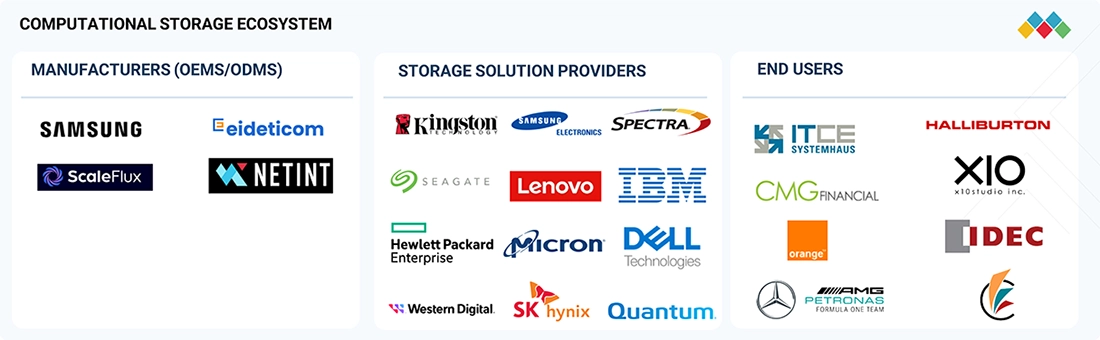
COMPUTATIONAL STORAGE MARKET: COMMERCIAL USE CASES ACROSS INDUSTRIES
| COMPANY | USE CASE DESCRIPTION | BENEFITS |
|---|---|---|
 |
Integration of computational storage SSDs with embedded processors to accelerate data filtering, compression, and encryption at the storage level | Reduces data movement, lowers latency, improves system performance, and decreases CPU workload |
 |
Deployment of SmartSSD with FPGA-based processing for real-time analytics and AI inference within storage devices | Enhances processing speed, minimizes network traffic, and improves energy efficiency |
Logos and trademarks shown above are the property of their respective owners. Their use here is for informational and illustrative purposes only.
Related Ecosystem
Electronics System And Components
- Sensors
- Temperature Sensors
- Pressure Sensors
- Actuators
- Image Sensors
- Lenovo
- Samsung
- Texas Instruments Incorporated
- HONEYWELL INTERNATIONAL INC.
- Teledyne Technologies Incorporated
Key Takeaways
- Rest Of Asia Pacific's computational storage market will grow from $26.5M (2026) to $184.7M (2031), representing a 38.2% CAGR that outpaces global growth.
- Rest Of Asia Pacific's enterprise storage segment is driving adoption of computational storage to reduce data center latency and improve processing efficiency.
- Rest Of Asia Pacific's position as a manufacturing and data processing hub accelerates deployment across AI, cloud computing, and financial services sectors.
- Rest Of Asia Pacific's market growth significantly exceeds the global 29% CAGR, establishing the region as a key driver of computational storage innovation.
Computational Storage Market Report Scope
| Report Metric | Details |
|---|---|
| Base Year | 2026 |
| Fastest Growing Segment | SOFTWARE (Offering) |
| Forecast Period | 2026–2031 |
| Growth Rate | CAGR of 29% from 2026 to 2031 |
| Largest Segment | HARDWARE (Offering) |
| Market Size Base Year (Billions) | ~USD 0.93 (2026) |
| Revenue Forecast (Billions) | ~USD 3.33 (2031) |
| Segments Covered | Offering, Hardware, Device Type, End User |
Rest Of Asia Pacific Computational Storage Market Report Segmentation
4 segment dimensions are covered across the global market.
By Offering
- Hardware
- Software
By Hardware
- Processors
- Solid-State Drives
By Device Type
- Fixed Computational Storage Devices
- Programmable Computational Storage Devices
By End User
- Cloud Service Providers
- Enterprise Storage
- Government Bodies
Target Audience
- Storage Hardware Manufacturers : Need Rest Of Asia Pacific market data to identify expansion opportunities, assess regional demand for computational storage products, and develop localized solutions addressing emerging market requirements and price sensitivities.
- Enterprise IT Decision Makers : Require regional market insights to evaluate computational storage adoption trends, benchmark against regional peers, and make informed technology investment decisions aligned with Rest Of Asia Pacific's digital transformation roadmaps.
- Technology Investors & PE Firms : Need comprehensive regional market analysis to identify high-growth investment opportunities in Rest Of Asia Pacific's computational storage ecosystem, assess portfolio company positioning, and evaluate exit potential.
- System Integrators & Solution Providers : Require region-specific market forecasts and segment analysis to develop computational storage solutions tailored to Rest Of Asia Pacific's unique customer needs, competitive dynamics, and emerging use cases.
- Government & Policy Organizations : Need market intelligence on Rest Of Asia Pacific's computational storage adoption to inform digital infrastructure policies, technology roadmaps, and investment priorities supporting regional economic development and innovation.
Key Companies in the Rest Of Asia Pacific Computational Storage Market
| Company | HQ | Ownership | Strongest segments |
|---|---|---|---|
| ADVANCED MICRO DEVICES, INC. | United States | Public Company | Data Center (EPYC, Instinct, Pensando, Alveo),Client (Ryzen, Ryzen AI, Athlon),Gaming (Radeon, semi-custom SoCs for consoles), |
| SAMSUNG ELECTRONICS CO., LTD. | South Korea | Public Company | Smartphones, tablets, wearables, and accessories,Memory, storage, and system LSI,TVs, monitors, and display panels, |
| INTEL CORPORATION | United States | Public Company | Client Computing Group (client and commercial CPUs, discrete client GPUs, edge and connectivity),Data Center and AI (server CPUs, discrete GPUs, networking),Intel Foundry (wafer fabrication, substrates, related services), |
| MARVELL | United States | Public Company | Ethernet controllers, switches, and PHYs,Storage controllers and host interfaces,Optical and electrical interconnect DSPs, |
| ARM LIMITED | United Kingdom | Public Company | CPU IP,GPU and NPU accelerators,System IP and interconnects, |
| NVIDIA CORPORATION | United States | Public Company | Data Center AI & Accelerated Compute Platforms,Networking (High-speed Interconnects & DPUs),Gaming GPUs (GeForce), |
| KALRAY SA | France | Public Company | Storage acceleration cards,AI and compute acceleration cards,Embedded/automotive and edge MPPA solutions, |
| PHISON ELECTRONICS CORP. | Taiwan | Public Company | Client and external SSD solutions,Flash controllers (SSD, USB, card),Embedded eMMC/UFS and industrial/automotive storage, |
ADVANCED MICRO DEVICES, INC.
Advanced Micro Devices, Inc. is a United States-based semiconductor company founded in 1969 that designs and manufactures processors and graphics processing units. With 31,000 employees, AMD operates as a publicly traded company serving the computing, gaming, and data center markets.
SAMSUNG ELECTRONICS CO., LTD.
Samsung Electronics Co., Ltd. is a South Korean multinational conglomerate founded in 1969 with 128,735 employees. The company is a leading manufacturer of semiconductors, consumer electronics, displays, and home appliances, operating as a public company with global market presence.
INTEL CORPORATION
Intel Corporation is a United States semiconductor company founded in 1968 with 85,100 employees. As a publicly traded company, Intel designs and manufactures microprocessors and computing technologies for personal computers, data centers, and enterprise markets.
MARVELL
Marvell is a United States semiconductor company founded in 1995 with 7,480 employees. Operating as a public company, Marvell designs and manufactures integrated circuits for storage, networking, and mobile applications.
ARM LIMITED
ARM Limited is a United Kingdom-based semiconductor design company founded in 1990 with 9,584 employees. Operating as a public company, ARM designs processor architectures and intellectual property licensed to manufacturers worldwide.
NVIDIA CORPORATION
NVIDIA Corporation is a United States technology company founded in 1993 with 42,000 employees. As a publicly traded company, NVIDIA designs and manufactures graphics processing units and system-on-chip units for gaming, professional visualization, and artificial intelligence applications.
KALRAY SA
Kalray SA is a French semiconductor company founded in 2008 with 92 employees. Operating as a public company, Kalray develops processors and computing solutions for data-intensive and edge computing applications.
PHISON ELECTRONICS CORP.
Phison Electronics Corp. is a Taiwan-based semiconductor company founded in 2000 with 2,052 employees. Operating as a public company, Phison designs and manufactures solid-state drive controllers and memory solutions.
Reasons to Buy this Report
- Regional Market Sizing & Forecasts : Obtain precise valuation data specific to Rest Of Asia Pacific, including 2026 baseline ($26.5M) and 2031 projections ($184.7M), enabling accurate budget allocation and investment planning for regional expansion strategies.
- Competitive Landscape Intelligence : Understand regional vendor positioning, market share distribution, and emerging players in Rest Of Asia Pacific's computational storage sector to identify partnership and acquisition opportunities in high-growth emerging markets.
- Growth Driver Analysis : Identify specific catalysts fueling Rest Of Asia Pacific's 38.2% CAGR, including data volume trends, technology adoption patterns, and regulatory factors unique to the region's developing economies and digital transformation initiatives.
- Segment & Application Insights : Access detailed breakdowns of computational storage adoption across Rest Of Asia Pacific's key verticals—manufacturing, telecommunications, finance, and smart cities—to target high-potential customer segments and use cases.
- Strategic Market Entry Planning : Leverage region-specific insights on infrastructure readiness, technology maturity, and customer requirements to develop tailored go-to-market strategies and localization approaches for Rest Of Asia Pacific's diverse markets.
Frequently asked questions
What is the projected market size for computational storage in Rest Of Asia Pacific by 2031?
Rest Of Asia Pacific's computational storage market is projected to reach $184.7 million by 2031, growing from $26.5 million in 2026.
What is the CAGR for computational storage in Rest Of Asia Pacific?
Rest Of Asia Pacific's computational storage market is expected to grow at a compound annual growth rate of 38.2% between 2026 and 2031.
Why is Rest Of Asia Pacific's computational storage market growing faster than the global average?
Rest Of Asia Pacific's rapid growth is driven by increasing enterprise digitalization, rising data volumes, infrastructure investments, and the region's role as a manufacturing and data processing hub.
Which industries in Rest Of Asia Pacific are driving computational storage adoption?
Rest Of Asia Pacific's computational storage adoption is accelerating in financial services, cloud computing, artificial intelligence, and high-performance computing sectors.
How does Rest Of Asia Pacific's computational storage growth compare to global trends?
Rest Of Asia Pacific's 38.2% CAGR significantly exceeds the global computational storage market CAGR of 29%, positioning the region as a critical growth engine.
RESEARCH METHODOLOGY
The study involved four major activities in estimating the size of the computational storage market. Exhaustive secondary research was done to collect information on the market, peer market, and parent market. The next step was to validate these findings, assumptions, and sizing with industry experts across value chains through primary research. The bottom-up approach was employed to estimate the overall market size. After that, market breakdown and data triangulation were used to estimate segment and subsegment market sizes.
Secondary Research
In the secondary research process, sources such as annual reports, press releases, investor presentations of companies, white papers, and articles by recognized authors were referred to. Secondary research was done to obtain key information about the market’s supply chain, the market’s value chain, the pool of key market players, and market segmentation according to industry trends, region, and developments from both market and technology perspectives.
Primary Research
Extensive primary research has been conducted after understanding and analyzing the computational storage market scenario through secondary research. Several primary interviews have been conducted with key opinion leaders from both demand- and supply-side vendors across four major regions—North America, Europe, Asia Pacific, and the RoW. Approximately 25% of primary interviews have been conducted with the demand side and 75% with the supply side. This primary data has been collected through telephonic interviews, questionnaires, and emails.
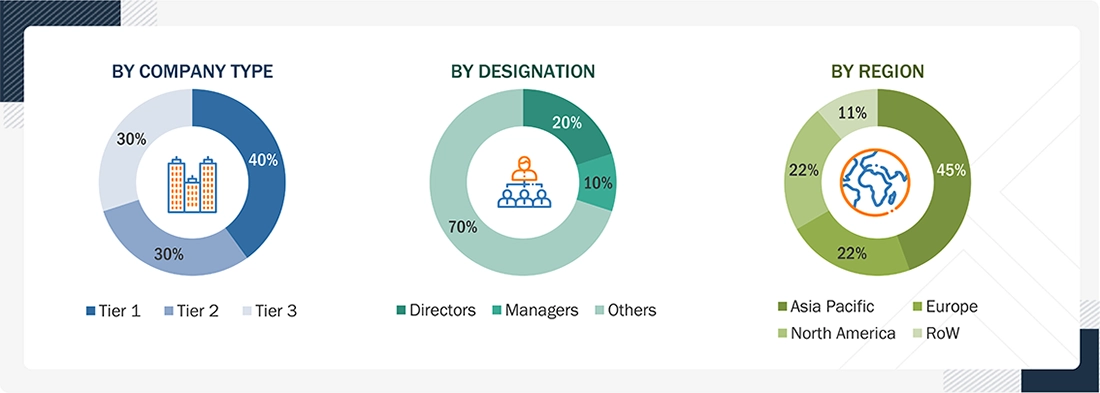
Note: “Others” include sales, marketing specialists, and product managers. The 3 tiers of the companies are defined based on their total revenue as of 2024; tier 1: revenue greater than USD 1 billion, tier 2: revenue between USD 500 million and USD 1 billion, and tier 3: revenue less than USD 500 million.
To know about the assumptions considered for the study, download the pdf brochure
Market Size Estimation
In the complete market engineering process, top-down and bottom-up approaches and several data triangulation methods have been used to estimate and forecast the market size for the overall market segments and subsegments listed in this report. Extensive qualitative and quantitative analyses have been conducted across the complete market engineering process to present key information/insights throughout the report.
The key players in the market have been identified through secondary research, and their market shares in the respective regions have been determined through primary and secondary research. This entire procedure includes studying the annual and financial reports of the top players, as well as extensive interviews with industry experts (such as CEOs, VPs, directors, and marketing executives) to provide key insights (both quantitative and qualitative) on the computational storage market. All percentage shares, splits, and breakdowns have been determined using secondary sources and verified through primary sources. All the possible parameters that affect the markets covered in this research study have been accounted for, viewed in extensive detail, verified through primary research, and analyzed to get the final quantitative and qualitative data. This data has been consolidated and supplemented with detailed inputs and analysis from MarketsandMarkets and presented in this report.
Computational Storage Market : Top-Down and Bottom-Up Approach
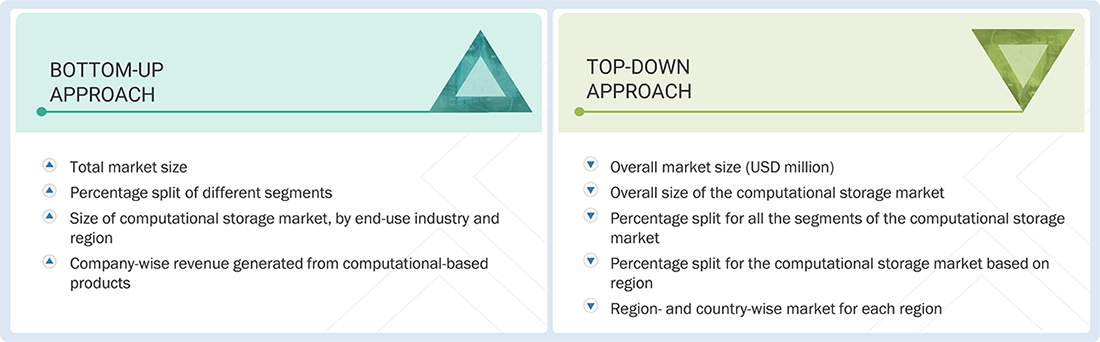
In the top-down approach, the overall market size has been used to estimate the size of the individual markets (mentioned in the market segmentation) through percentage splits from secondary and primary research. For the calculation of specific market segments, the most appropriate immediate parent market size has been used to implement the top-down approach. The bottom-up approach has also been implemented for the data obtained from the secondary research to validate the market size of various segments. Each company’s market share has been estimated to verify the revenue shares used earlier in the bottom-up approach. With the data triangulation procedure and validation of the data through primaries, the overall parent market size and each individual market size have been determined and confirmed in this study.
Data Triangulation
After arriving at the overall market size through the above process, the overall market has been split into several segments. To complete the overall market engineering process and arrive at the exact statistics for all the segments, market breakdown, and data triangulation procedures have been employed, wherever applicable. The data has been triangulated by studying various factors and trends from both the demand and supply sides. The market has also been validated using both top-down and bottom-up approaches.
Market Definition
Computational storage refers to an advanced storage architecture that integrates processing capabilities directly within the storage device, allowing data to be processed where it is stored rather than being transferred to a separate CPU. This approach reduces latency, offloads workloads from the central processor, and improves overall system efficiency, especially in data-intensive applications such as AI, big data analytics, and high-performance computing. By combining storage and computation, computational storage enables faster data handling, real-time analytics, and optimized performance for enterprises and cloud data centers. It represents a shift from traditional storage solutions toward intelligent, workload-aware storage systems.
Key Stakeholders
- Raw material suppliers
- Storage manufacturers
- Semiconductor manufacturers
- Research institutes and government organizations
- Traders, distributors, and suppliers of electronic devices
- Logic device manufacturers
- Semiconductor industry players
Report Objectives
- To define, describe, and forecast the computational storage market based on offering, type, end-use industry, and region
- To forecast the market size across four major regions, namely North America, Europe, Asia Pacific, and the Rest of the World (RoW), along with their respective countries, in terms of value
- To describe and forecast the computational storage market size in terms of volume
- To present detailed information regarding the major factors influencing the market (drivers, restraints, opportunities, and challenges)
- To provide an analysis of the market ecosystem, case studies, patents, technologies, pricing analysis, Porter’s five forces, and regulations pertaining to the market
- To offer a comprehensive overview of the value chain of the computational storage market ecosystem
- To critically analyze micromarkets with respect to individual growth trends, prospects, and contributions to the total market
- To strategically profile the key players and comprehensively analyze their market shares and core competencies
- To assess the opportunities in the market for stakeholders and describe the competitive landscape of the market
- To analyze competitive developments, such as collaborations, acquisitions, partnerships, and product developments, in the market
- To analyze the impact of AI/GenAI, the 2025 US tariff, and the macroeconomic outlook for each region covered under the study
Available customizations:
Based on the given market data, MarketsandMarkets offers customizations tailored to the company’s specific needs. The following customization options are available for the report:
Company Information
- Detailed analysis and profiling of 25 market players
Get the Full Computational Storage Market Report
Full forecast, segment splits, and company analysis for all Computational Storage Market.
- US Computational Storage Market
- Canada Computational Storage Market
- Mexico Computational Storage Market
- UK Computational Storage Market
- Germany Computational Storage Market
- France Computational Storage Market
- Italy Computational Storage Market
- Poland Computational Storage Market
- Spain Computational Storage Market
- China Computational Storage Market
- Japan Computational Storage Market
- South Korea Computational Storage Market
- India Computational Storage Market
- Australia Computational Storage Market
- Nordics Computational Storage Market
- Rest Of Europe Computational Storage Market
Need a Tailored Report?
Customize this report to your needs
Get 10% FREE Customization
Customize This Report
